Archive for ‘Chindia Alert’

04/09/2014

Democracy for Hong Kong: Unyielding | The Economist

PRO-DEMOCRACY activists announced the start of a “new era of civil disobedience” on the night of August 31st, after China’s top legislature laid down restrictive guidelines on the kind of elections that are allowed in Hong Kong, a semi-autonomous territory. Officials in Beijing had promised to allow the election of Hong Kong’s next leader, in 2017, through universal suffrage. With the announcement China has clarified that there is a catch, a big one: the government sees itself as being under no obligation to allow open nominations for the election’s candidates. Before the announcement, Chen Zuoer, one of the officials who helped negotiate Hong Kong’s handover to mainland China back in 1997, had warned that “blood will be shed” if their opponents refuse to back down.

In a show of defiance, an alliance of activists who support fully open elections held a rally on Sunday night to declare that it would launch waves of protests, culminating in the occupation of the city’s main financial district. Their movement has been many months in the making; they call it “Occupy Central with Love and Peace”. It was first proposed nearly two years ago by Benny Tai, an associate law professor at the University of Hong Kong, in anticipation of a disappointing official interpretation of “universal suffrage”—just like the one that the central government has now given them.

Police arrested at least 22 people during protests that began on Sunday night and carried through Monday morning. The student-union president at the Chinese University of Hong Kong has announced a strike; students there will have a rally of their own on September 4th around a replica of the “Goddess of Democracy” statue that became famous for its appearance in Tiananmen Square in 1989. Other universities are expected to see strikes of their own announced in the next few days.

Many of the participants at Sunday’s rally despair at convincing the bureaucrats in Beijing to change their position—but they feel they need to put up a fight anyway. “Normal protests are no longer useful,” in the words of Agnes Chow Ting, a student protester. She led a failed attempt after the rally to “ambush” a delegation of officials from the central government.

Such actions may attract international attention but indeed, they are less than likely to sway decision-makers in Beijing. Li Fei, a deputy secretary-general of the National People’s Congress Standing Committee, told local politicians on September 1st that the committee believes Hong Kong’s police will be capable of handling any disturbance that might be caused by “a small group of people seeking to undermine Hong Kong”, as he characterises the Occupy movement.

Hong Kong’s current chief executive, Leung Chun-ying, was picked for the role in 2012 by a 1,200-member “election committee”. A reliable majority of that committee were Hong Kongers who will ever be glad to demonstrate loyalty to their counterparts in Beijing.

via Democracy for Hong Kong: Unyielding | The Economist.

04/09/2014

Water Shortages Will Limit Global Shale Gas Development – Businessweek

If all the world’s theoretically recoverable shale gas could be developed, our supply of clean-burning natural gas would expand 47 percent—lowering both greenhouse gas emissions and energy prices, according to estimates from the Washington-based World Resources Institute.

Shale drilling in China's Sichuan Province

The hitch is that the process for extracting shale gas, called hydraulic fracking, sucks up as much as 25 million liters (6.6 million gallons) of water for each well. A report from WRI (PDF), “Global Shale Gas Development: Water Availability and Business Risks,” released on Tuesday, shows that roughly 38 percent of the world’s shale gas and oil lies buried beneath water-stressed regions. This means that extraction efforts will be difficult and expensive, as well as economically and environmentally risky.

China has the world’s largest estimated deposits of shale gas (1,115 trillion cubic feet), according to studies by the U.S. Energy Information Administration. Yet China is also one of the world’s most naturally water-stressed nations: It is home to a fifth of the world’s population but only 7 percent of its freshwater resources. WRI’s team compared maps of China’s potential shale plays with available water and found that 61 percent of China’s shale lies in arid regions. (China recently slashed in half its mid-term projections for shale gas development, from a goal of over 60 billion cubic meters annually to 30 billion cm by 2020.)

via Water Shortages Will Limit Global Shale Gas Development – Businessweek.

04/09/2014

China Fights Local Budget Corruption With ‘Economic Constitution’ – Businessweek

Revising a budget law, as China’s National People’s Congress just did, sure doesn’t sound very sexy. But Sunday’s move is a crucial step toward fixing some of China’s biggest economic challenges: controlling runaway local debt; curbing rampant official corruption, and stemming the spread of socially destabilizing land seizures.

The Shanghai skyline

The amended law that now requires local governments to publicize their annual budgets is so important that some are calling it the “Economic Constitution,” the China Daily reported on Sept. 1. The revision “will prove a milestone in China’s fiscal history, as it will make the government’s collection of taxes and fees and distribution of its fiscal money to become more law-based and transparent,” the English-language paper reports.

Until now, the finances of China’s tens of thousands of counties, townships, and villages have been split into budget and extra-budgetary funds. With much of the financing falling in the murkier off-budget category, “government departments have a great leeway in managing government funds, which can possibly lead to corruption and abuse of public funds,” the newspaper explains.

via China Fights Local Budget Corruption With ‘Economic Constitution’ – Businessweek.

04/09/2014

India and Japan Are a Perfect Fit – India Real Time – WSJ

Indian Prime Minister Narendra Modi’s visit to Japan will generate headlines for the big deals that he does (or doesn’t) conclude with his Japanese counterpart Shinzo Abe. These include civil nuclear cooperation, high-speed rail construction and defense ties.

However, the bilateral relationship ultimately depends on thousands of smaller commercial deals. If the two leaders set the tone and clear away obstacles, the India-Japan partnership can become the driver of Asia’s growth. Mr Modi said on this visit that Japan and India bear a ‘huge responsibility’ to define the path of Asian growth in the 21st century.

The two powers are complementary on several levels, but primarily in the economic realm. Japan has the largest growth problem in the world while India has the largest development problem.

There is no clearer example of this than India’s need for new roads, railways and ports. The Reserve Bank of India has defined India’s key economic problem as a supply-side deficit; demand is abundant, at times rampant, but supply responses are reduced by the unavailability and cost of capital, alongside logistics bottlenecks. The result is higher inflation and lower growth.

Japan can provide the solution in the form of capital and technology. Tokyo is a partner in the $90 billion Delhi-Mumbai Industrial Corridor which will create new “smart cities,” seven of which have started construction. Some 100 more are planned nationwide. This initiative has already yielded the Delhi Metro, built under budget and within schedule with Japanese loans and rolling stock.

via India and Japan Are a Perfect Fit – India Real Time – WSJ.

04/09/2014

Japan PM Abe appoints China-friendly lawmakers to key posts | Reuters

Japanese Prime Minister Shinzo Abe picked two veteran lawmakers with friendly ties to China for top party posts on Wednesday in an apparent signal of hope for a thaw in chilly ties with Beijing and a summit with Chinese leader Xi Jinping.

Japan's Prime Minister Shinzo Abe walks into the Prime Minister's official residence in Tokyo September 3, 2014.  REUTERS/Yuya Shino

The change in executives in Abe’s Liberal Democratic Party (LDP) is part of a broad leadership rejig, including a cabinet reshuffle, aimed at strengthening party unity and polishing Abe’s image 20 months after he surged back to office.

In a move welcomed by Tokyo stock market players, Abe drafted Yasuhisa Shiozaki, 63, a proponent of an overhaul of Japan’s Government Pension Investment Fund (GPIF), to head the ministry of labor, health and welfare, which oversees GPIF.

The fund is finalizing plans to boost the weighting of domestic stocks in its portfolio.

Abe also gave women almost a third of the posts in his 18-minister cabinet to show his commitment to promoting women as part of his “Abenomics” growth strategy.

But he retained core cabinet members such as Chief Cabinet Secretary Yoshihide Suga, Finance Minister Taro Aso, 73, Economics Minister Akira Amari, 65, and Foreign Minister Fumio Kishida, 57, signaling policy continuity.

Abe’s new line-up faces a number of challenges, including how to repair ties with China that have been frayed by rows over disputed territory and Japan’s wartime history, and whether to go ahead with a planned sales tax rise next year despite signs the economy is faltering.

via Japan PM Abe appoints China-friendly lawmakers to key posts | Reuters.

03/09/2014

In Modi’s first 100 days, foreign ministry moves fastest on Raisina Hill

With her many visits abroad, External Affairs Minister Sushma Swaraj has been running the busiest ministry in the new government.

India’s new foreign minister, Sushma Swaraj, seems to be running the busiest ministry on Raisina Hill ─ the area of Lutyen’s Delhi that houses key government buildings ─ for the regime led by Prime Minister Narendra Modi.

Modi’s decision to invite all the heads of state in the South Asian Association for Regional Cooperation group to his swearing-in ceremony, widely hailed as a good and forward-thinking move, meant that Swaraj had to be on her toes from the get-go. In no time at all, Swaraj and Modi embarked on trips to neighbouring countries such as Bangladesh and Nepal, which an Indian head of state had not officially visited since 1997.

Swaraj has had her hands full, visiting neighbours such as Bangladesh and Myanmar in quick succession while overseeing the successful evacuation of hundreds of stranded Indian citizens from hotspots such as Iraq and Libya and formulating India’s position on the conflict between Israel and the Palestinian territory of Gaza. She has just returned from Vietnam and was set to go to Beijing for a trilateral meeting with the Chinese and Russian foreign ministers but the government called off her trip, perhaps in deference to the sensitivities of Japan, where Prime Minister Modi arrived on Sunday for a summit.

On Israel, despite the BJP’s highly favourable stance towards the country, India eventually stuck to its historical position by voting in favour of Palestine at the United Nations Human Rights Commission. Many BJP supporters questioned the government’s move, with some saying it was unable to break out of a Congress-era mindset.

The new order at the Ministry of External Affairs has a spring in its heels. From looking to invite all heads of state in the African Union to New Delhi to attracting mixed responses for allowing Modi to cancel talks with Pakistan after its high commissioner met Kashmiri separatist leaders from the Hurriyat Conference, the ministry has been hogging the limelight on Raisina Hill.

via Scroll.in – News. Politics. Culture..

03/09/2014

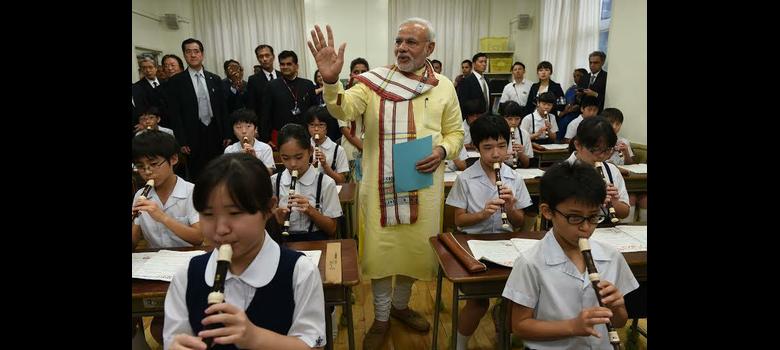
These photos show what Modi did in Japan when he wasn’t attending to business

All prime ministers enjoy spending time abroad, especially if it is while visiting a particularly friendly ally.

Prime Minister Narendra Modi isn’t exactly the jovial type. Sure, he peppers his speeches with a bit of light humour occasionally, but he doesn’t seem like the kind of person who would enjoy a comedy night on television. So what could possibly make him really happy? The same thing that makes heads of states happy all over the world: leaving their own countries to visit friendly allies.

And by any measure, it seems like Modi managed to have a blast in Japan (even if no nuclear deal was signed). Since he also happens to be the Selfie Era Prime Minister, every moment of this fun journey was documented and promptly tweeted by the prime minister’s official twitter account.

more photos from:  http://scroll.in/article/677092/These-photos-show-what-Modi-did-in-Japan-when-he-wasn’t-attending-to-business

03/09/2014

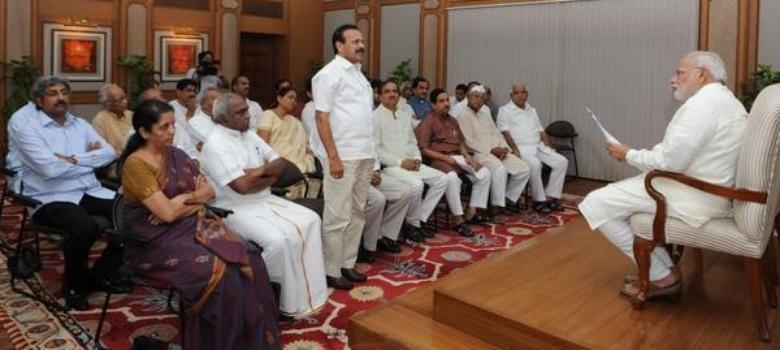
Six ways in which Narendra Modi has changed Delhi

From: http://scroll.in/article/677239/Six-ways-in-which-Narendra-Modi-has-changed-Delhi

He’s undermined the hierarchy of the BJP, but bureaucrats are reporting to work on time.

Narendra Modi’s first hundred days in power may not have brought big bang economic reforms or sweeping social initiatives, but the shift in dynamics across political, bureaucratic and corporate circles has been huge. Except for the period of the Emergency four decades ago, which turned everything upside down, never have the customary power equations of Lutyens Delhi become so redundant.

1. The Bharatiya Janata Party
The biggest impact of Modi’s arrival at the seat of power has been on his own party. The Bharatiya Janata Party today is looking like a punctured balloon. This was one of the few remaining political outfits in the country that still routinely practiced internal debate. After Modi’s victory, the hush among the BJP leadership has been deafening. The party is under Modi’s thumb and is now feeling the pressure of Amit Shah’s palm as well. Apart from the overwhelming presence of these two leaders, no one is quite sure about the hierarchy in the party. Party members don’t know whom to approach for what, since everybody else seems so powerless. There is surprisingly little triumphalism or celebratory swagger among BJP leaders in the aftermath of such an astounding electoral victory.

2. The council of ministers
In the beginning there was some envy about those who got plum ministerial positions. But a few of them, such as power minister Piyush Goel, and environment and information minister Prakash Javdekar, were reported to have been ticked off like schoolboys. As a result, a ministerial post does not look so inviting anymore. Individual ministers have never before been so devoid of the powers to dispense favours. In the past, some politicians were able to wrangle such favours even if they were in opposition. The ministers are instead driven to work relentlessly from early in the morning to late in the night, driving teams of sleepless bureaucrats, some of whom appear to have more direct access to the prime minister’s office than their political superiors. The word out is that Big Brother is watching and any sign of laxity will not go unpunished.

3. Parliament
There also appears to a conscious decision by the new prime minister to bypass conventional parliamentary processes for policymaking. Standing committees are yet to be set up. Such is the apathy to parliament that even seat allotments to different parties in the new Lok Sabha are yet to begin. Clearly, Modi does not have much inclination for parliamentary debate and review to make policies.

4. The bureaucracy
Significant changes in the corridors of power are also evident. The bureaucracy, from top to bottom, is still struggling to cope with the drastic departure from the slow pace of government. Office hours are not only being imposed in terms of punctuality, but can also get extended indefinitely.

5. India Inc
The relationship between corporate groups and the Modi government in the first hundred days has belied fears, particularly of liberal-left opinion makers, that it would be a willing instrument for crony capitalists. So far this has not been the case. It has become increasingly clear that the country’s largest industrial magnate Mukesh Ambani, who was supposed to be one of the main moneybags to bankroll the Modi campaign, is not calling the shots. Even Gautam Adani, known to have been personally close to Modi when he was Gujarat chief minister, has not been patronised. Power minister Piyush Goel was said to have been pulled up for publicly hobnobbing with the industrialist whose power company was also slapped with a clear energy cess in the budget.

This is not to suggest that the new prime minister has turned his back on industrialists. He has had individual meetings with a number of them including Cyrus Mistry of the Tata group, Anil Agarwal of Vedanta and Anil Ambani, although mysteriously not the latter’s elder brother, Mukesh. The message so far has been clear. The new government was ready to consider all proposals as long as they fit into the regime’s scheme of things, but would not be manipulated through fear or inducement on specific projects or policies. Ever since the new government came to power, the vast army of corporate lobbyists in Lutyens Delhi have been sitting idle.

6. Sycophants and cheerleaders
Finally, the most striking difference between the Modi regime and previous ones, is the way the new prime minister has spurned a long queue of sycophants and cheerleaders who had expected to be rewarded for their services to the Modi campaign. Quite a few of them are in the media, or experts who are hoping to be accommodated in think tanks now that they have been overlooked for plum government posts. The impression, however, is that the prime minister is adamant about horses for courses, and will only elevate someone he feels will be able to do the job.

Those close to Modi have assiduously cultivated the image of a prime minister who has his party leaders by the scruff of its neck, the bureaucracy on tenterhooks and business magnates at an arms distance – “a tough guy who does not dance”.

01/09/2014

China imposes harsher punishment to ensure workplace safety – Xinhua | English.news.cn

China’s top legislature on Sunday adopted a revision to the Workplace Safety Law which imposes harsher punishment on offenders.

Members of the Standing Committee of the National People’s Congress adopted the revision through a vote at the bi-monthly legislative session held from Monday to Sunday.

The amendment further increased fines for enterprises involved in serious workplace accidents from the maximum of 5 million yuan (810,000 U.S. dollars) proposed in its original draft to 20 million yuan.

The quadrupled fine cap is stated in an added article which stipulates fines ranging from 200,000 yuan to 20 million yuan, depending on the losses incurred in the accident.

Under the old Workplace Safety Law, fines for enterprises violating the law were no more than 100,000 yuan or below five times the income earned from illegal operation.

Managers in charge of such enterprises who are found to have failed in their duty to ensure safety will also now be fined between 30 and 80 percent of their annual income corresponding to losses in the accidents.

This is a massive raise compared with the former law, under which managers faced fines between 20,000 yuan and 200,000 yuan.

The revised law states that managers responsible for “serious” and “extremely serious” accidents will be banned from serving as principals in enterprises in the same industry.

The regulation on work safety issued by the State Council in 2007 defines “serious accidents” as those causing 10 to 30 deaths, 50 to 100 serious injuries, or direct economic losses of between 50 and 100 million yuan.

via China imposes harsher punishment to ensure workplace safety – Xinhua | English.news.cn.

01/09/2014

State-owned enterprises: Fixing China Inc | The Economist

JIN JIANG is one of the world’s biggest hotel groups, managing five-star properties across China, a budget motel chain and a travel agency. It is also a state-owned enterprise (SOE), controlled by the Shanghai government. It has seen better days. The company’s best hotels played host to hundreds of foreign leaders in the past century, including Richard Nixon in 1972, when America and China began their historic rapprochement. But in recent years visiting dignitaries have opted for newer hotels over Jin Jiang’s musty rooms and tired furnishings.

When people think of Chinese state companies, they often have its giant banks or oil companies in mind. But most of the 155,000 enterprises still owned by the central and local governments are more akin to Jin Jiang: they are businesses that have little to do with the country’s economic or political priorities, and they have had a run of bad years, losing ground to private-sector rivals. That may be about to change. China is in the midst of the biggest attempt in more than a decade to fix the country’s brand of state capitalism, attempting to breathe new life into Jin Jiang and dozens, if not hundreds or even thousands, more like it.

There are two main problems with China’s SOEs today. First, they have failed to comply with the government’s order to focus on what are deemed to be “strategic sectors” such as aviation, power and telecommunications. These are industries that the Communist Party believes it must dominate in order to maintain control of an increasingly complex economy. But fewer than half of state companies occupy these commanding heights. Some 80,000 are instead in the economic lowlands: they run hotels, build property developments, manage restaurants and operate shopping malls. The temptations to branch out have been too great: relative to their private-sector peers, they have benefited from cheaper financing from state-owned banks, favouritism from local governments in land sales and a lighter touch from regulators.

Second, despite these advantages, SOEs have given progressively less bang for their buck. Faced with mounting losses in the 1990s, China undertook a first round of drastic reforms of its state-owned companies. There were mass closures of the weakest firms, tens of millions of lay-offs and stockmarket listings for many of the biggest which made them run a little more like private companies. That initially paid dividends. SOEs’ return on assets, a gauge of their productivity, rose from barely higher than zero in 1998 to nearly 7% a decade later, just shy of the private-sector average. But over the past five years, their fortunes have ebbed. Profitability of state companies has fallen, even as private firms have grown in strength. SOE returns are now about half those of their non-state peers. For an economy that, inevitably, is slowing as it matures, inefficient state companies are a dangerous extra drag. Jian Chang of Barclays says that putting SOEs right is “the most critical reform area for China in the coming decade”.

Until recently, however, few analysts thought that China had the desire or the ability to get back into the muck of SOE reform. Companies under the central government, such as PetroChina, the country’s biggest oil producer, were believed to be strong enough to resist the changes that would erode their privileges. At the provincial and municipal levels, local officials were thought bound to government-owned companies by ties of power, patronage and money. China was not expected to sit entirely still: gradual deregulation of interest rates and energy pricing was placing indirect pressure on state companies to operate more efficiently. But a direct, frontal assault on them of the kind waged by Zhu Rongji, then prime minister, in the 1990s seemed out of the question. Even when the party unveiled a much-ballyhooed reform plan last November and vowed to target SOEs, there were doubts about how far Xi Jinping, China’s president, could go. People close to the State-owned Assets Supervision and Administration Commission (SASAC), the agency that oversees China’s biggest SOEs, say that it was still dragging its feet at the start of this year.

But a flurry of announcements in the past few months shows that reforms are getting on track. There is no one-size-fits-all approach. Sinopec, Asia’s biggest refiner, is close to selling a $16 billion stake in its retail unit, a potentially lucrative opening for private investors. CITIC Group, China’s biggest conglomerate, is poised to become a publicly traded company by injecting its assets into a subsidiary on the Hong Kong stock exchange, for $37 billion. After its initial reluctance, SASAC announced reforms at six companies. They are to experiment with larger private stakes and greater independence for directors.

via State-owned enterprises: Fixing China Inc | The Economist.
Law of Unintended Consequences

continuously updated blog about China & India

ChiaHou's Book Reviews

continuously updated blog about China & India

What's wrong with the world; and its economy

continuously updated blog about China & India