Chindia Alert: You’ll be Living in their World Very Soon
aims to alert you to the threats and opportunities that China and India present. China and India require serious attention; case of ‘hidden dragon and crouching tiger’.
Without this attention, governments, businesses and, indeed, individuals may find themselves at a great disadvantage sooner rather than later.
The POSTs (front webpages) are mainly 'cuttings' from reliable sources, updated continuously.
The PAGEs (see Tabs, above) attempt to make the information more meaningful by putting some structure to the information we have researched and assembled since 2006.
NEW DELHI (Reuters) – India’s federal think-tank has asked scooter and motorbike manufacturers to draw up a plan to switch to electric vehicles, days after they publicly opposed the government’s proposals saying they would disrupt the sector, two sources told Reuters.
Niti Aayog officials met with executives from companies including Bajaj Auto, Hero MotoCorp and TVS late on Friday, giving them two weeks to come up with the plan, according to one of the executives.
The think-tank, which is chaired by Prime Minister Narendra Modi and plays a key role in policymaking, had recommended that only electric models of scooters and motorbikes with engine capacity of more than 150cc must be sold from 2025, sources have told Reuters.
Automakers opposed the proposal and warned that a sudden transition, at a time when auto sales have slumped to a two-decade low, would cause market disruption and job losses.
India is one of the world’s largest two wheeler markets with sales of more than 20 million scooters and motorbikes last year.
During Friday’s meeting government officials argued that switching to EVs is of national importance so India does not miss out on the global drive towards environmentally cleaner vehicles, one of sources said.
But industry executives responded that a premature switch with no established supply chain, charging infrastructure or skilled labour in India, could result in India losing its leadership position in scooters and motorbikes, the second source said.
“There were clearly drawn out positions,” said the source, adding there were “strong opinions” at the meeting.
Bajaj, Hero and Niti Aayog did not respond to a request for comment, while TVS declined to comment.
ELECTRIFICATION
Niti Aayog is working with several other ministries on the recommendations, which are part of an electrification effort to help India reduce its fuel import bill and curb pollution.
The proposal also includes incentives for local production of batteries, an increase ownership cost of gasoline cars and forming a policy to scrap old vehicles, according to records of government meetings seen by Reuters.
The panel has also suggested measures such as directing taxi aggregators like Uber and Ola to convert 40% of their fleets to electric by April 2026, Reuters has reported.
Executives from EV start-up Ather Energy, ride-sharing firm Ola and officials from the Society of Indian Automobile Manufacturers (SIAM), an industry trade body, also attended the meeting, the sources said.
The proposals are India’s second attempt for a switch to EVs. In 2017 it proposed an ambitious plan mainly for electric cars but rowed back after facing resistance from car makers.
The current push could disrupt the market order for two-wheelers and open up avenues for local start-ups, analysts say.
Scooter and bike start-ups like Ather, 22Motors and Okinawa are already making in-roads in India.
“It is extremely critical that we make the transition to electric quickly lest we get wiped out by another global wave,” Tarun Mehta, CEO and co-founder at Ather said.
Inadequate infrastructure and industry standards are holding the country back in the battle to save the environment, new study finds
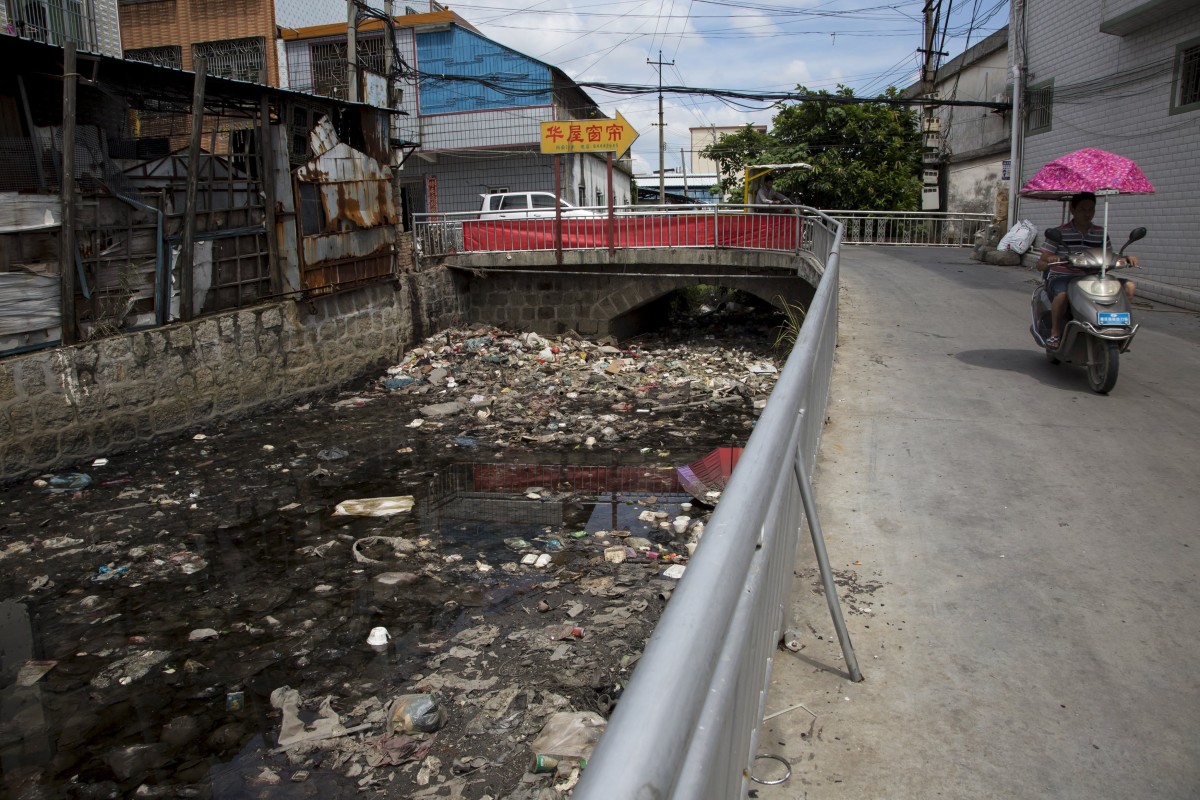
In some extreme cases, incomplete pipework meant factories in industrial parks discharged directly into waterways. Photo: Reuters
A shortage of waste water pipelines, lax local government oversight and a lack of industry standards are holding back efforts to cut industrial water pollution in China, according to a new joint study.
The research by Greenpeace and Nanjing University also found that many of the country’s waste water treatment plants were among its biggest polluters singled out by authorities.
Researchers made the assessment by examining data and reports released by the Ministry of Ecology and Environment last year. According to the reports, 243 – or 56 per cent – of the 436 major polluters fined in 2018 for excessive discharges were waste water treatment plants.
That is despite Beijing claiming to be one of the biggest processors of industrial and household waste water by volume in the world.
Fighting water pollution is part of Beijing’s pledge to fix the country’s depleted environment by 2020, one of the priorities President Xi Jinping identified at the start of his second five-year term in late 2017.
Dong Zhanfeng, deputy director of the Environmental Policy Department at the Chinese Academy for Environmental Planning, said waste water treatment was an important part of the fight against pollution.
“It’s called a ‘critical battle’ because the work is really tough,” Dong said.
China says progress made on water pollution, but battle remains
To try to curb contamination from industry, the central government has urged provincial authorities to concentrate factories in industrial parks, where infrastructure must be built to treat waste water.
The Greenpeace-Nanjing University researchers found that by the end of the third quarter last year, 97 per cent of 2,411 industrial waste water treatment plants needed for industrial parks around the country had been constructed. But not all of the completed plants were in full use because of insufficient pipes connecting factories and the treatment plants.
In extreme examples cited by the report, incomplete pipework meant two treatment plants in Hubei laid dormant for two years, forcing factories in the industrial parks to discharge directly into waterways.
In other cases, factories not linked to industrial waste water treatment plants discharged into the general sewage system, with the effluent ending up at household waste water treatment plants that could only filter part of the industrial waste.
This was the case in the southwest province of Guizhou, where a lack of pipework meant 89 of the 128 industrial parks relied on city sewage systems to treat polluted water.
Deng Tingting, a Beijing-based campaigner with Greenpeace East Asia, said conditions were a mess.
“Brand new waste water treatment plants sit unused while waste pumps into streams and rivers.
The current state of affairs is a mess, and it keeps companies from entering the growing market for waste water treatment. The decision not to shepherd this growing industry is a risky one,” Deng said.
China admits patchy progress tackling soil, water pollution, with some rivers worsening
The Ministry of Ecology and Environment estimated last year that in all China needed 400,000km (248,550 miles) of waste water pipework, costing around 1 trillion yuan (US$145 billion). The ministry did not say how much remained to be built.
Another major problem identified by the study was the lack of treatment standards for industrial waste water plants, with many plants relying on quality standards for household waste water treatment.
In addition, the researchers highlighted the problem of local governments and industrial park administrators shirking their responsibility to enforce standards.
The study called for clear demarcation of regulatory and oversight responsibilities among local environmental watchdogs, industry, industrial parks and water treatment plants.
BEIJING (Reuters) – China recently played host to a Taliban delegation as part of efforts to promote peace and reconciliation in Afghanistan, China’s foreign ministry said on Thursday.
Representatives of the Taliban, who have been fighting for years to expel foreign forces and defeat the U.S.-backed government in Kabul, have been holding talks with U.S. diplomats for months.
The focus has been the Taliban demand for the withdrawal of U.S. and other foreign forces, in exchange for guarantees that Afghanistan will not be used as a base for militant attacks.
Taliban negotiators have also met senior Afghan politicians and civil society representatives, including in Moscow recently, as part of so-called intra-Afghan dialogue to discuss their country’s future.
Chinese foreign ministry spokesman Lu Kang told a daily news briefing that Abdul Ghani Baradar, the Taliban representative in Qatar, and some of his colleagues had recently visited China, though he did not say exactly when.
Chinese officials met them to discuss the Afghan peace process and counter-terror issues, Lu told the briefing, without saying who met the delegation.
“China pays great attention to the evolving situation in Afghanistan in recent years. We have always played a positive role in the Afghan peace and reconciliation process,” Lu said.
China supports Afghans resolving their problems themselves through talks, and this visit was an important part of China promoting such peace talks, he said.
“Both sides believe that this exchange was beneficial and agreed to keep in touch about and cooperate on continuing to seek a political resolution for Afghanistan and fighting terrorism.”
China’s far western Chinese region of Xinjiang shares a short border with Afghanistan.
China has long worried about links between militant groups and what it says are Islamist extremists operating in Xinjiang, home to the mostly Muslim Uighur people, who speak a Turkic language.
China, a close ally of Pakistan, has been deepening its economic and political ties with Kabul and is also using its influence to try to bring the two uneasy neighbours closer.
The Chinese government’s top diplomat, State Councillor Wang Yi, visited Kabul last December.
A Google search for basic information on India’s caste system lists many sites that, with varying degrees of emphasis, outline three popular tropes on the phenomenon.
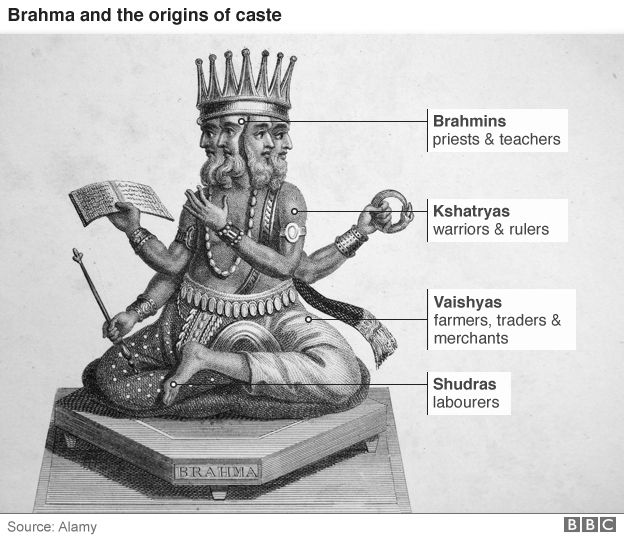
First, the caste system is a four-fold categorical hierarchy of the Hindu religion – with Brahmins (priests/teachers) on top, followed, in order, by Kshatriyas (rulers/warriors), Vaishyas (farmers/traders/merchants), and Shudras (labourers). In addition, there is a fifth group of “Outcastes” (people who do unclean work and are outside the four-fold system).
Second, this system is ordained by Hinduism’s sacred texts (notably the supposed source of Hindu law, the Manusmriti), it is thousands of years old, and it governed all key aspects of life, including marriage, occupation and location.
Third, caste-based discrimination is illegal now and there are policies instead for caste-based affirmative action (or positive discrimination).
These ideas, even seen in a BBC explainer, represent the conventional wisdom. The problem is that the conventional wisdom has not been updated with critical scholarly findings.
The first two statements may as well have been written 200 years ago, at the beginning of the 19th Century, which is when these “facts” about Indian society were being made up by the British colonial authorities.
In a new book, The Truth About Us: The Politics of Information from Manu to Modi, I show how the social categories of religion and caste as they are perceived in modern-day India were developed during the British colonial rule, at a time when information was scarce and the coloniser’s power over information was absolute.
Image caption Conventional wisdom says the caste system is a four-fold categorical hierarchy of the Hindu religion
This was done initially in the early 19th Century by elevating selected and convenient Brahman-Sanskrit texts like the Manusmriti to canonical status; the supposed origin of caste in the Rig Veda (most ancient religious text) was most likely added retroactively, after it was translated to English decades later.
These categories were institutionalised in the mid to late 19th Century through the census. These were acts of convenience and simplification.
The colonisers established the acceptable list of indigenous religions in India – Hinduism, Sikhism, Jainism – and their boundaries and laws through “reading” what they claimed were India’s definitive texts.
What is now widely accepted as Hinduism was, in fact, an ideology (or, more accurately, a theory or fantasy) that is better called “Brahmanism”, that existed largely in textual (but not real) form and enunciated the interests of a small, Sanskrit-educated social group.
There is little doubt that the religion categories in India could have been defined very differently by reinterpreting those same or other texts.
The so-called four-fold hierarchy was also derived from the same Brahman texts. This system of categorisation was also textual or theoretical; it existed only in scrolls and had no relationship with the reality on the ground.
This became embarrassingly obvious from the first censuses in the late 1860s. The plan then was to fit all of the “Hindu” population into these four categories. But the bewildering variety of responses on caste identity from the population became impossible to fit neatly into colonial or Brahman theory.
Image copyright GETTY IMAGESImage caption A leader of those formerly considered untouchable with a government official in British India
WR Cornish, who supervised census operations in the Madras Presidency in 1871, wrote that “… regarding the origin of caste we can place no reliance upon the statements made in the Hindu sacred writings. Whether there was ever a period in which the Hindus were composed of four classes is exceedingly doubtful”.
Similarly, CF Magrath, leader and author of a monograph on the 1871 Bihar census, wrote, “that the now meaningless division into the four castes alleged to have been made by Manu should be put aside”.
Anthropologist Susan Bayly writes that “until well into the colonial period, much of the subcontinent was still populated by people for whom the formal distinctions of caste were of only limited importance, even in parts of the so-called Hindu heartland… The institutions and beliefs which are now often described as the elements of traditional caste were only just taking shape as recently as the early 18th Century”.
In fact, it is doubtful that caste had much significance or virulence in society before the British made it India’s defining social feature.
Astonishing diversity
The pre-colonial written record in royal court documents and traveller accounts studied by professional historians and philologists like Nicholas Dirks, GS Ghurye, Richard Eaton, David Shulman and Cynthia Talbot show little or no mention of caste.
Social identities were constantly malleable. “Slaves” and “menials” and “merchants” became kings; farmers became soldiers, and soldiers became farmers; one’s social identity could be changed as easily as moving from one village to another; there is little evidence of systematic and widespread caste oppression or mass conversion to Islam as a result of it.
All the available evidence calls for a fundamental re-imagination of social identity in pre-colonial India.
The picture that one should see is of astonishing diversity. What the colonisers did through their reading of the “sacred” texts and the institution of the census was to try to frame all of that diversity through alien categorical systems of religion, race, caste and tribe. The census was used to simplify – categorise and define – what was barely understood by the colonisers using a convenient ideology and absurd (and shifting) methodology.
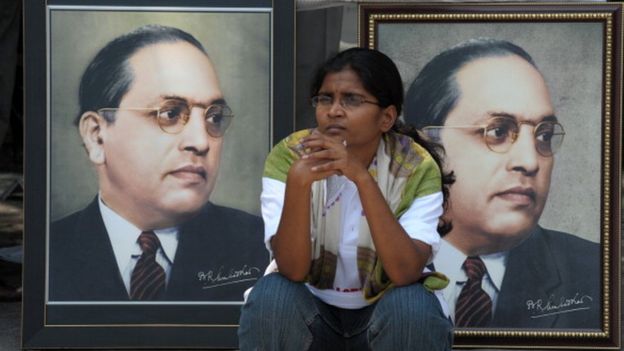
Image copyright AFPImage caption India’s constitution was written by BR Ambedkar, a member of the Dalit community which is at the bottom of the caste system
The colonisers invented or constructed Indian social identities using categories of convenience during a period that covered roughly the 19th Century.
This was done to serve the British Indian government’s own interests – primarily to create a single society with a common law that could be easily governed.
A very large, complex and regionally diverse system of faiths and social identities was simplified to a degree that probably has no parallel in world history, entirely new categories and hierarchies were created, incompatible or mismatched parts were stuffed together, new boundaries were created, and flexible boundaries hardened.
Image copyright GETTY IMAGESImage caption Dalits, or untouchables, were at the bottom of the caste system
The resulting categorical system became rigid during the next century and quarter, as the made-up categories came to be associated with real rights. Religion-based electorates in British India and caste-based reservations in independent India made amorphous categories concrete. There came to be real and material consequences of belonging to one category (like Jain or Scheduled Caste) instead of another. Categorisation, as it turned out in India, was destiny.
The vast scholarship of the last few decades allows us to make a strong case that the British colonisers wrote the first and defining draft of Indian history.
So deeply inscribed is this draft in the public imagination that it is now accepted as the truth. It is imperative that we begin to question these imagined truths.
BEIJING, June 18 (Xinhua) — China on Tuesday said its determination to maintain the Joint Comprehensive Plan of Action (JCPOA) is unwavering and is willing to continue to make efforts for the full and effective implementation of the JCPOA.
Chinese State Councilor and Foreign Minister Wang Yi made the remarks when meeting the press after his meeting with Syrian Deputy Prime Minister and Foreign Minister Walid Mualem.
Calling on all parties to jointly promote the alleviation of Iranian nuclear issue and the situation in the Gulf region, instead of letting it get worse, even slipping into conflicts, Wang urged all parties to firmly maintain the deal.
Wang said ensuring the full and effective implementation of the JCPOA was not only a decision made by the UN Security Council but also the only effective way to resolve the Iranian nuclear issue, which is related to the common interests of the international community.
He urged all parties to maintain rationality and restraint, rather than to “open Pandora’s box”, noting that the United States should change its “maximum pressure” policy.
“There is as no basis for unilateralism in international law,” said Wang, adding that unilateralism will create greater crises instead of solving problems.
Noting the International Atomic Energy Agency has confirmed that Iran has fulfilled its obligations under the JCPOA for 15 consecutive times, Wang said China hoped that Iran could make careful decisions and would not abandon the JCPOA easily.
He also urged other parties to respect the reasonable demands of the Iranian side and take active measures to maintain the balance of rights and obligations under the JCPOA.
Wang noted that China has recently conducted close coordination and cooperation with related parties, resulting in important progress in the reconstruction of the Arak heavy water reactor facility.
“The Chinese side is willing to continue making efforts for the full and effective implementation of the JCPOA. At the same time, we will firmly safeguard our own legitimate rights and interests,” Wang said.
China has become the first nation to fully own and operate a floating launch platform for its space missions
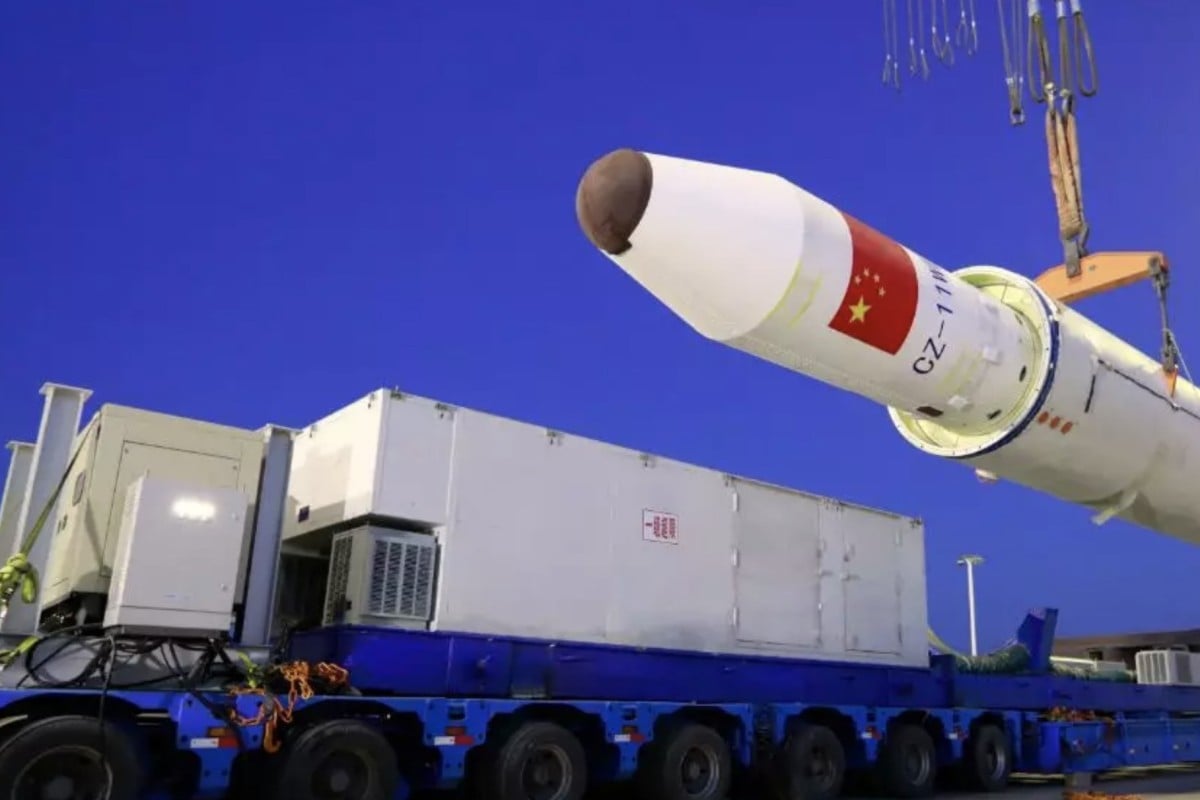
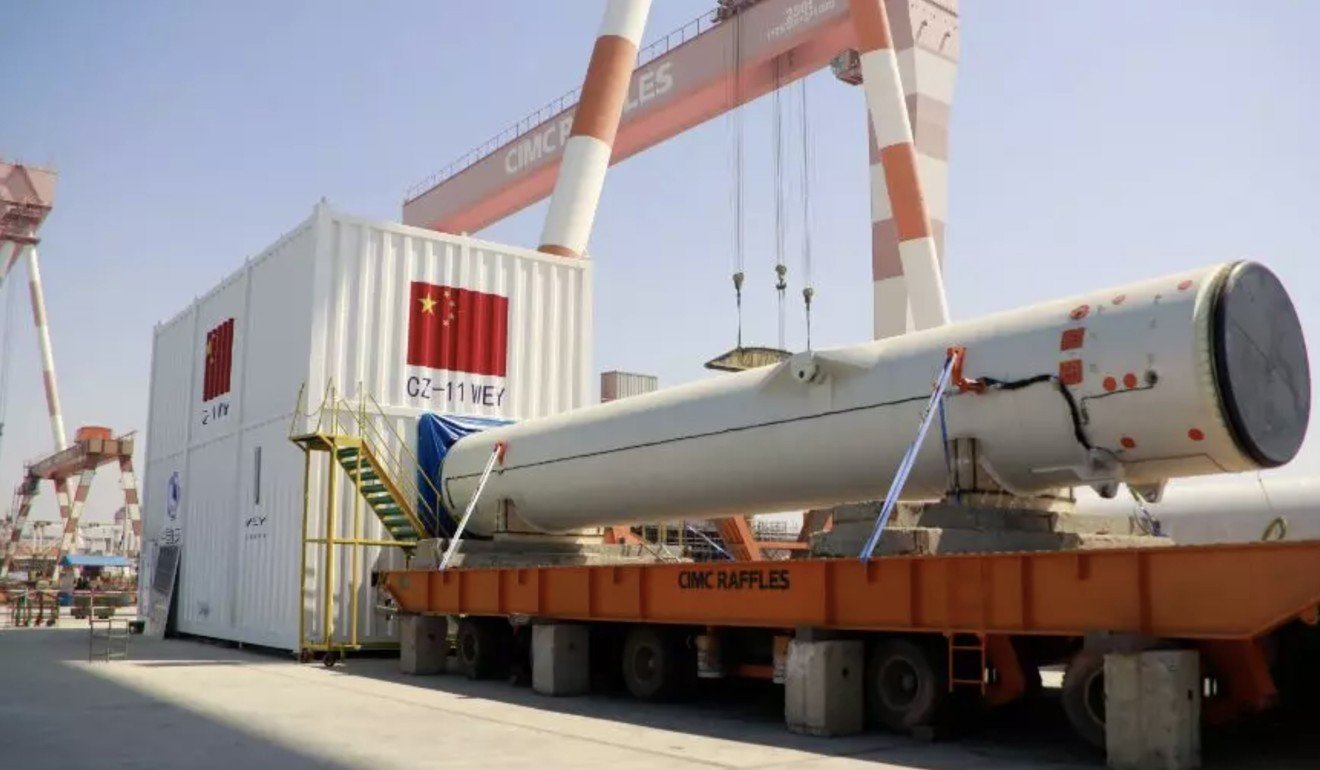
China has successfully launched a rocket into space from the Yellow Sea, making it the first nation to fully own and operate a floating sea launch platform. Photo: China National Space Administration
China successfully launched a rocket into space from a civilian cargo ship at sea on Wednesday, becoming the first nation to fully own and operate a floating sea launch platform, a technology expected to significantly reduce the cost and risk of space missions.
A Long March 11WEY rocket blasted off from the ship in the Yellow Sea at noon Beijing time, according to the China National Space Administration.
About six minutes later, five commercial satellites and a pair of “technical experiment” probes – called Bufeng, or Wind Catchers – reached their designated orbits.
The Wind Catchers will work together to detect winds on the surface of the world’s oceans. They will boost China’s ability to monitor and forecast typhoons and other extreme weather events, according to the administration.
“Launching a rocket from the sea has the advantages of high flexibility, good adaptability for specific tasks, and excellent launch economy,” said a statement on the administration’s website.
“It can flexibly select the launch point and touchdown area to meet the needs of various payloads for different orbits, and provide better aerospace commercial launch services for countries along the belt and road,” it added, referring to the Belt and Road Initiative, China’s plan to grow global trade.
The Long March 11 is a four-stage, solid fuel rocket with a design similar to a ballistic missile. It can carry a payload of about 700kg to the Earth’s lower orbit.
The first two stages of the rocket dropped in open waters in the northern Pacific Ocean, according to the administration. The rocket was equipped with a flight suspension system in case of any abnormal situation, but none occurred.
“The rocket debris will not cause damage to surrounding waters,” the administration said.
The world’s first ocean rocket launch platform, the Sea Launch, was jointly built by companies from Russia, the United States, Norway and Ukraine in the late 1990s. Its operation was halted in 2014 after military conflicts broke out between Russia and Ukraine.
Li Hong, president of the China Academy of Launch Vehicle Technology, told state media in March that the Chinese rocket and launch platform were designed and owned entirely by China, so it would not have similar problems caused by international disputes as the Sea Launch.
The launch was expected to encounter many technical and engineering challenges, including simplified procedures for pre-launch testing, the rocking motion of the ship and heat dissipation in a confined space.
But Chinese space authorities have argued the inconvenience would be offset by numerous advantages. For instance, the technology would allow China to move its launch site to as far away as Hawaii for quicker, cheaper satellite insertion to certain orbits, according to Xinhua.
Preparations get under way for Wednesday’s successful Chinese space launch from the northern Pacific ocean. Photo: China National Space Administration
A maritime launch is also expected to reduce the risk of rocket debris falling into densely populated areas.
Chinese space launch sites are typically located inland for defence purposes.
China has built its sea launch capability mainly to bolster the commercial space sector, according to Chinese space authorities.
In this mission, the rocket was sponsored and named after WEY, a young luxury car brand by Chinese sports utility vehicle manufacturer Great Wall Motor.
Chang’e 4 landing marks start of new China-US space race
Some cutting-edge car technology, such as new paint materials, will go into space for testing in the most extreme environments, according to state media reports.
The payloads include the Jilin 03A, the latest addition to a high-definition Earth observation satellite network, according to Changguang Satellite Technology Corporation, the satellite’s owner.
The company said the constellation, which will eventually comprise more than 20 satellites, would achieve global coverage for commercial applications.
One of the satellites launched on Wednesday belongs to Shanghai-based LinkSure Network, which has ambitious plans to provide free Wi-fi to everyone on the planet. The company has said it plans to eventually launch more than 200 satellites as part of the project.
Chinese President Xi Jinping has made becoming a “space flight superpower” a priority for his government
Chinese space authorities prepare to launch a rocket from a commercial cargo ship at sea. Photo: Handout
China has rolled out its first rules to regulate the manufacture of commercial space rockets and test flights in a move to guide healthy development of the commercial space sector, mirroring similar moves by the US in recent years.
As a rising number of start-ups set out to be China’s version of Elon Musk’s SpaceX, the guidelines are the first since China’s space industry was opened to the private sector in 2014. They require companies to obtain official permission before carrying out rocket research and development as well as production, according to a notice published on the web site of the State Administration of Science, Technology and Industry for National Defense on Monday.
The new rules also require a confidentiality system to be established among commercial rocket companies and asks them to follow state export control regulations when in doubt about whether they can provide overseas services and products.
The detailed regulations come as the number of private companies engaged in the commercialisation of China’s space industry increased to almost 100 in 2018 from 30 a year earlier, and as Beijing puts more emphasis on private sector involvement to boost its space ambitions.
China rockets to forefront of global space race with sea launch success
“The specifics give clear direction for China’s commercial space industry, clarifying the qualifications, operational boundaries and national guarantees, which will be conducive to the sector’s healthy and orderly development,” Shu Chang, CEO of Beijing-based commercial rocket pioneer OneSpace Technology, was quoted as saying to state media Global Times on Tuesday
Since coming to power in 2012, Chinese President Xi Jinping has made becoming a “space flight superpower” a priority for his government. Since 2014, Beijing has encouraged more private investors to participate in its space push to bolster commercial space technology development, including policies directed at investment and providing land for launches.
The guidelines issued on Monday said commercial rocket development had the potential to lower the cost of space sector development, improving China’s space power and competitiveness globally. It also encourages private companies to partner with state-backed organisations to take full advantage of the latter’s resources in research development, production and launch facilities.
Trump criticises Nasa moon mission after previously promoting it
The move by China mirrors similar efforts by the US in recent years to shift the burden of space exploration and technology development away from the state and into the private sector, leading to space rocket development by the likes of Elon Musk, Jeff Bezos and Richard Branson.
Military interests still weigh though. President Donald Trump has championed a return to the moon, calling for a lunar gateway that would allow a continuous stream of spacecraft and people to visit the moon, and serve as a leaping off point for Mars. Trump has also called for the creation of a “Space Force”, a sixth branch of the military that would be focused on defending US interests.
China accounts for roughly 3 per cent of the US$16.1 billion invested in private space companies and partnerships since 2009 in the world. But investments have increased rapidly since 2016, and the country led the world in the third quarter of 2018, according to Space Angels, a US investment firm that specialises in private space ventures.
Beijing is still behind in terms of its space-based military capabilities, but the gap is closing fast, experts say
US law now prohibits Nasa from communicating with China’s space agency
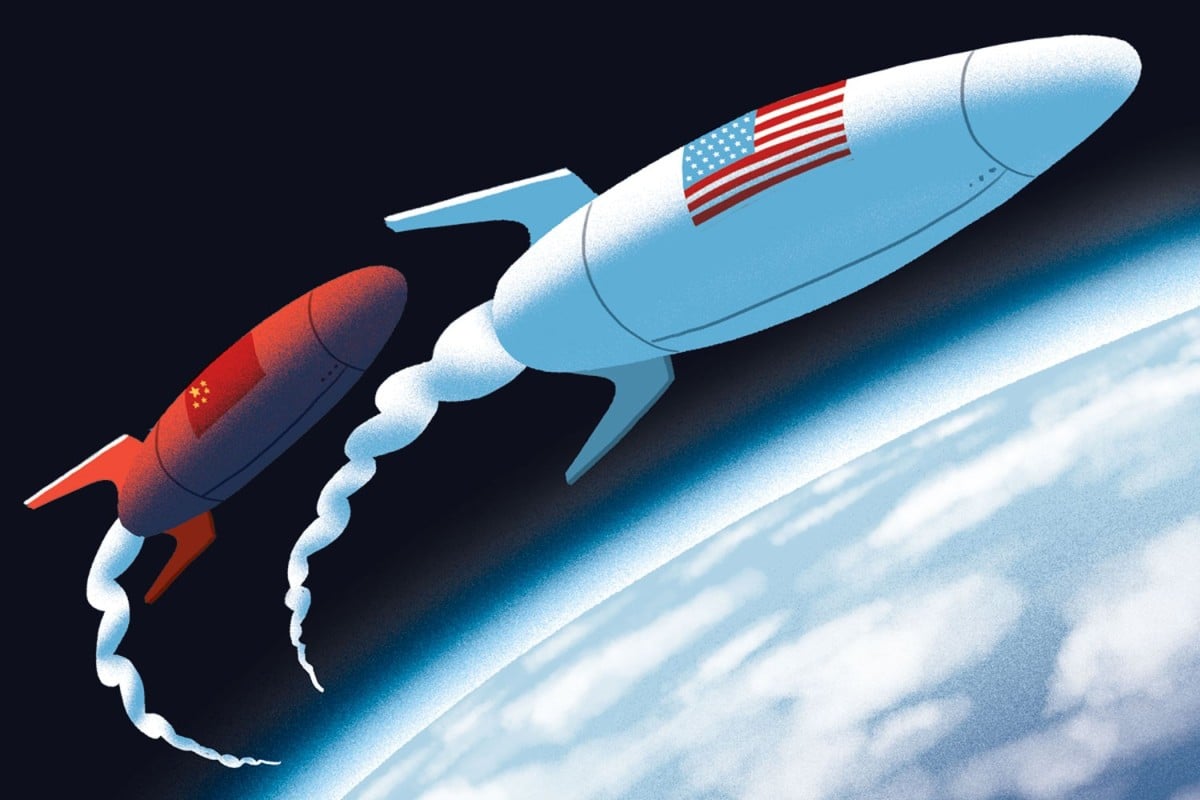
Illustration: Kaliz Lee
This story is part of an ongoing series on US-China relations produced jointly by the South China Morning Post and POLITICO, with reporting from Asia and the United States.
A top Chinese general has a warning for any US leaders planning an arms race in space: be prepared to lose.
Outspending a rival power into economic exhaustion might have helped the US win the cold war, said Qiao Liang, a major general in the Chinese air force who co-wrote the book Unrestricted Warfare: China’s Master Plan to Destroy America. But he said it would not work against a wealthy manufacturing powerhouse like China.
“China is not the Soviet Union,” Qiao said in an interview with the South China Morning Post, a news partner of POLITICO. “If the United States thinks it can also drag China into an arms race and take down China as it did with the Soviets … in the end, probably it would not be China who is down on the ground.”
Qiao’s words come as both Washington and Beijing are pouring money and resources into an increasingly militarised space race that some security specialists and former US officials fear is heightening the risk of war. The aggressive manoeuvres include US President Donald Trump’s proposal for a stand-alone
– which Qiao dismissed as “an unwise move” – and efforts by both countries to develop laser and cyber weapons that could take out each other’s satellites.
The rivalry is plainly on the minds of leaders at the Pentagon, which cites “space” 86 times in a new threat assessment of China’s military. It also warns that the People’s Liberation Army (PLA) is working on “enabling long-range precision strikes” and developing directed-energy weapons for use in orbit.
Sea launch rockets China to forefront of global space race
Trump, Vice-President Mike Pence and a slew of US military leaders have cited China’s military space programmes as a key rationale for proposing the Space Force, which would gather nearly all the defence department’s space-related programmes into a new military branch – similar to the one China created four years ago. Congress is considering the administration’s plan, although some defence hawks are sceptical.
Pence has also expressed alarm at China’s success in
“Last December, China became the first nation to land on the far side of the moon and revealed their ambition to seize the lunar strategic high ground and become the world’s pre-eminent spacefaring nation,” Pence said at a meeting of the National Space Council in March.
China and the US are pouring money into an increasingly militarised space race that some observers fear is heightening the risk of war. Photo: Shutterstock
Even more worrying, neither country seems interested in placing the issue on the diplomatic agenda to lower the tensions, some security advocates say. That is in contrast to the decades of space cooperation that have existed between the US and Russia.
“One of my biggest concerns is that for all the talk about how horrible an armed conflict with China would be for everyone, all the current US policies and actions seem to be preparing for armed conflict instead of avoiding it,” said Brian Weeden, director of programme planning at the Secure World Foundation, which advocates for using space in a peaceful and sustainable way.
“There is not a lot of dialogue between the US and China,” he said.
But other space experts say China is a greater threat to the United States than most people realise – and even an “imminent threat”, according to independent analyst Namrata Goswami.
“If anything, it [the threat from China] is underappreciated and underplayed in the US,” she said. “I suspect that is because the US military might not want to call attention to its own vulnerabilities regarding its space assets.”
Chang’e 4 lunar probe sends first photo of far side of the moon
Qiao said China was not seeking a space war but was preparing to counter any nation, including the US, that sought to pose a threat to its national security.
China’s economic prowess left it well positioned to prevail in an expensive contest with the US, he said.
“When the United States and the Soviet Union engaged in the cold war and the arms race, the United States was the largest manufacturing country, and the Soviet Union was not even the second,” he said. “But today it is China who is the world’s top manufacturer.”
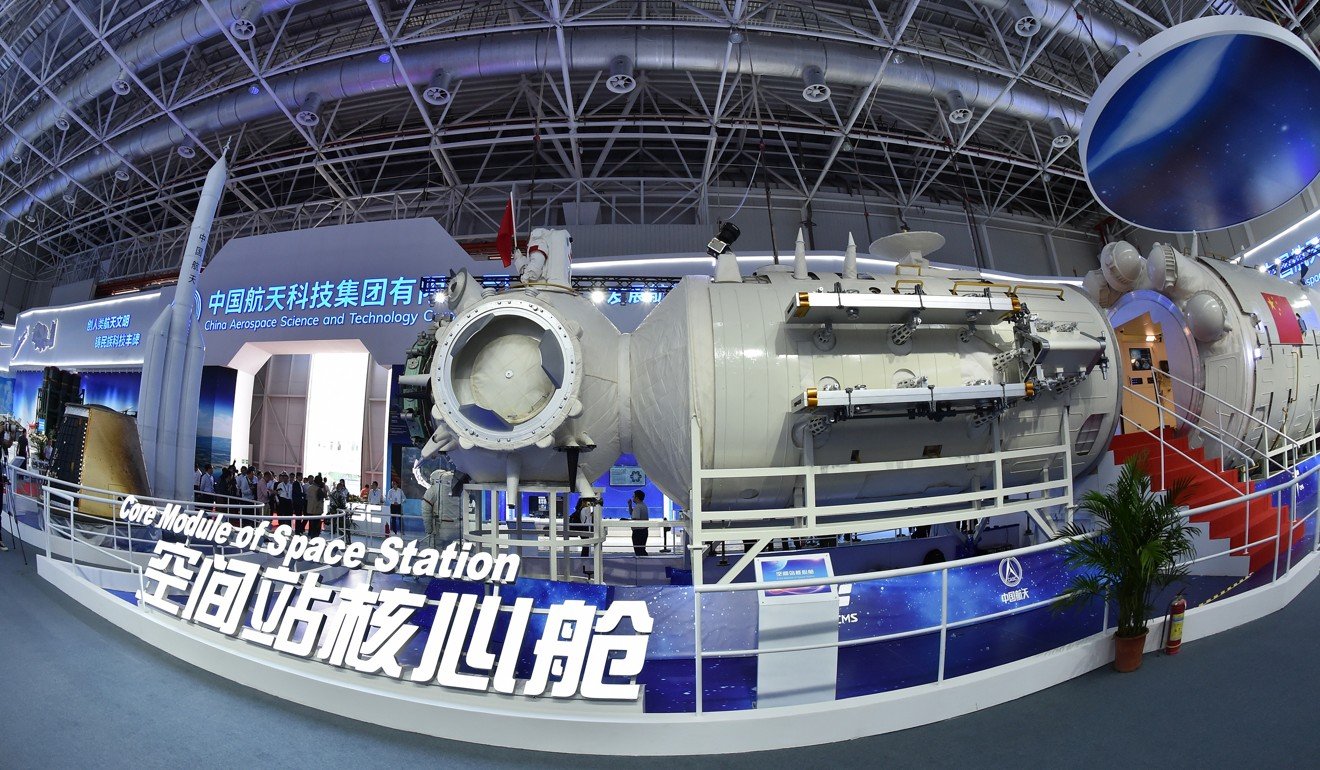
A full-size model of the core module of China’s space station goes on show at Airshow China in November. Photo: Xinhua
Recent reports from US spy agencies and think tanks indicate that China’s efforts are advancing quickly. Those include estimates that China will soon be able to field high-powered lasers designed to attack objects in low-Earth orbit – and evidence that its weapons can already attack targets much further from the Earth than the United States can.
China’s reliance on space assets is also expanding: it has more than 120 intelligence, surveillance and reconnaissance satellites of its own – second only to the United States.
About half of them are owned and operated by the military and could be used to track and target US forces around the world, the report warns.
Will China’s new laser satellite be ‘Death Star’ for submarines?
The threat getting the most attention is the danger China’s orbiting weapons might pose to the satellites the United States relies on for communications, navigation and surveillance – for both military operations and economic well-being.
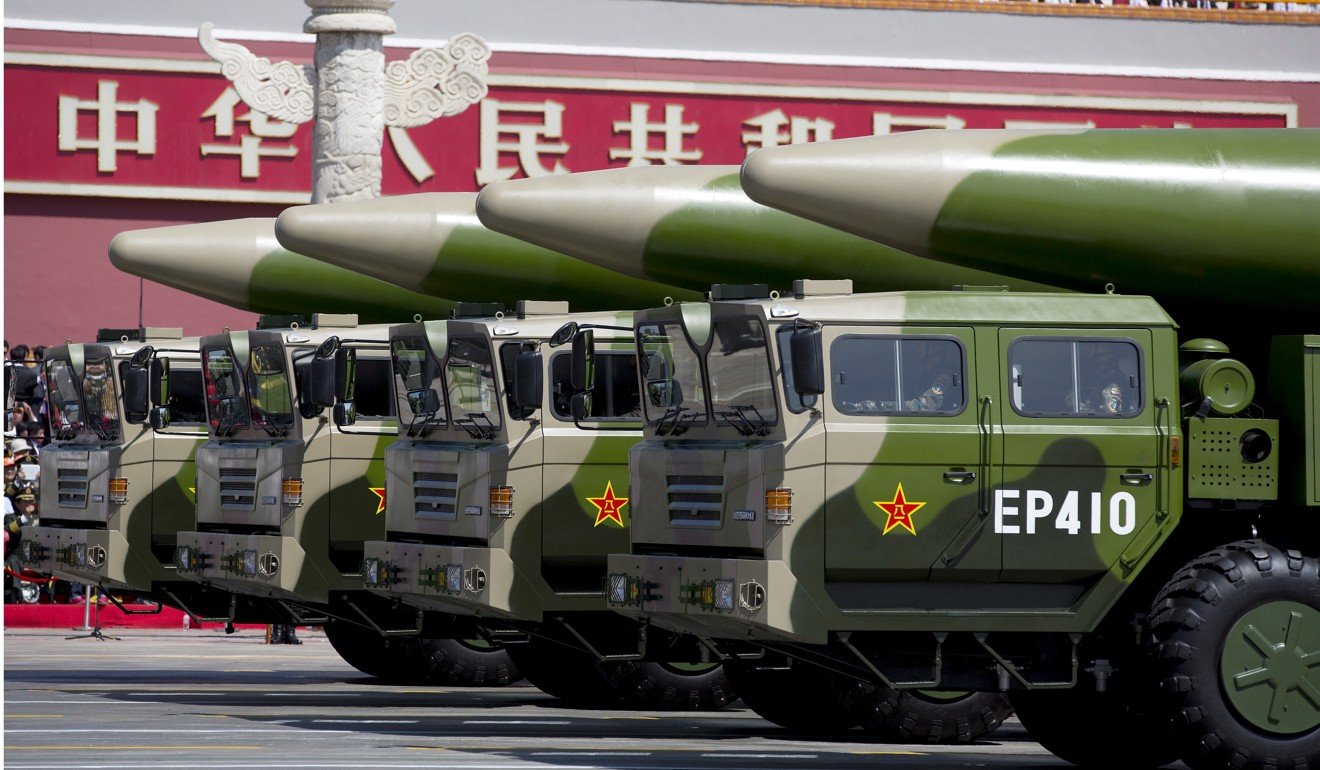
China is heavily investing in so-called counterspace technology, including the development of at least three antisatellite missile systems, according to an April report from the Centre for Strategic and International Studies. It is also developing satellites that can make physical contact with other satellites in orbit, the report said.
While that technology can be used for repairs in orbit, it can also be used to disable a satellite or tear off a solar array to impact a satellite’s power source.
China is developing satellites that can make physical contact with other satellites in orbit. Photo: Xinhua
The Pentagon’s “China Military Power” report found that China is also pursuing new jamming and “directed energy” weapons that can interfere with satellites. In a conflict, that technology would probably be used to “blind and deafen the enemy”, the report said.
China also reorganised the PLA in 2015 to create a Strategic Support Force, a military branch dedicated entirely to space, electronic and cyberwarfare. The new branch was designed to bring space assets from across the military under one organisation, similar to the goal of the US Space Force.
The space-centric branch, which reports directly to the Central Military Commission, is focused primarily on satellite launches and intelligence, navigation and communication operations, but also conducts research and development on new counterspace capabilities, according to the US Defence Intelligence Agency report published in February.
China ‘has overtaken Russia’ as a maritime power
Chinese military units are also training with missiles that could damage or destroy satellites, the agency also reported in February, adding that China will probably have a ground-based laser that can blind optical sensors on satellites in low-Earth orbit by 2020.
Unlike the United States or Russia, China is also believed to have the capacity to use missiles to attack satellites in the more distant geosynchronous orbit, or 35,000km (22,000 miles) above Earth.
If any country were to launch a physical strike in geosynchronous orbit (GEO), the debris field would make the area, which is today used for critical missions like early missile warning and weather observations, unusable.
“We have much more to lose in GEO than any other country,” said Kaitlyn Johnson, an associate fellow who specialises in space security at the Centre for Strategic and International Studies. “We wouldn’t want to have a first strike capability.”
Chinese military units are training with missiles that could destroy satellites. Photo: Reuters
Military experts also worry that China could try to seize areas of the moon that contain strategic resources including ice that could be used for rocket fuel or life support.
But they say it is much more likely China will want to use dominance in space to influence conflicts on Earth. For instance, being able to threaten the military’s GPS or communications satellites might deter the US from getting involved in a conflict in the South China Sea, Weeden said.
The US Space Force is intended to close some of those gaps by grouping space assets together to build expertise and giving the new service autonomy over its budget requests. One of the biggest goals of the new branch is to speed up space acquisitions, allowing new technology to be fielded faster, and to develop a space “doctrine” that would oversee how the US fights conflicts when space platforms are at stake.
China adds new satellite to rival US global positioning system
The Chinese government insists that it is merely responding to aggressive US moves to dominate space militarily. Qiao called it “bullying and hegemonic” for the United States to insist that other countries cannot follow suit.
“The US space troops have long existed,” he said. “They just did not become an independent force … moreover, the US possessed anti-satellite capabilities as early as the 1970s and 1980s. China only developed anti-satellite capabilities at the end of the 1990s and even in the first decade of this century.”
China had little choice but to enhance its capabilities, he said.
“China’s purpose to develop space capabilities, firstly, is we do not want to be blackmailed by others,” Qiao said in the interview. “Second, we hope to use space peacefully. But if others want to oppress us by occupying the heights of space and opening up a ‘fourth battlefield’, China will certainly not accept it.”
Qiao Liang, a major general in the Chinese air force, says it is “bullying and hegemonic” for the United States to insist other countries cannot develop a space force. Photo: Handout
Still, China remained far from surpassing US dominance, he said. “We cannot overtake the US in the next decade or two, but we will narrow the gap in a comprehensive way. And it is possible we may take the lead in some individual areas.”
Weeden agreed.
“China is developing many of the same space capabilities the US did decades ago, while the US is focused on sustaining its capabilities and making them more resilient,” he said.
“On the whole, the US is still far more capable than China is but the relative advantage is narrowing.”
What is space junk and why is it a problem?
The two nations have some diplomatic channels through which they could cooperate in space, including the United Nations’ Committee on the Peaceful Uses of Outer Space, of which both are members. In 2015, the Obama administration established a dialogue with China on space safety, which is quietly continuing under Trump, although Weeden said the meetings were mostly high-level talks.
But the Wolf Amendment, which was first passed in a Congressional appropriations bill in 2011, forbids the US government from working with China and prohibits any bilateral cooperation between the China National Space Administration and the US National Aeronautics and Space Administration on national security grounds. And there is virtually no collaboration between the militaries of the two nations today.
To open the door for conversations that could ease tensions and avoid miscommunication, the US and China must “crawl before we walk”, Audrey Schaffer, the director of space strategy and plans at the defence department, said at a March event on US-China space relations hosted by the Secure World Foundation.
Some potential first steps include the two countries sharing information like their national defence strategies, providing launch notifications of space vehicles or opening routine, secure communications channels between diplomats. Each step would help build trust and transparency, Schaffer said, pointing to the strong relationship between the US and Russia in space as evidence that it could be done.
“Even then when the relationship was just as strained, if not more so, we did manage to work bilaterally and multilaterally with the Soviets to really create mechanisms that would help reduce the risks of conflict and enhance stability,” Schaffer said.
Chinese President Xi Jinping (R) meets with Qatari Emir Sheikh Tamim Bin Hamad Al-Thani in Dushanbe, Tajikistan, June 15, 2019. (Xinhua/Zhang Ling)
DUSHANBE, June 15 (Xinhua) — Chinese President Xi Jinping met with Qatari Emir Sheikh Tamim Bin Hamad Al-Thani here on Saturday, pledging to deepen political mutual trust and boost cooperation between the two nations.
Voicing his appreciation for Tamim’s commitment to promoting the bilateral ties, Xi recalled the emir’s state visit to China in January this year during which the two heads of state had an in-depth exchange of views and reached extensive consensus on developing the China-Qatar strategic partnership under new circumstances.
During Saturday’s meeting on the sidelines of the fifth summit of the Conference on Interaction and Confidence Building Measures in Asia, Xi said China and Qatar should consolidate their political mutual trust and continue understanding and supporting each other on issues involving their core interests.
The two sides should accelerate the all-round cooperation in energy, trade and economy, infrastructure construction, investment, the fifth-generation (5G) telecommunications and other areas, said the Chinese president.
On the cooperation on fighting terrorism, Xi expressed gratitude to the Qatari side for its support for China’s counter-terrorism and de-extremization efforts, stressing that the Chinese side stands ready to step up coordination and cooperation with Qatar in multilateral affairs.
Tamim hailed the strategic significance of the Qatar-China relationship, calling his China visit in January a great success.
The Qatari side is ready to work with China to boost cooperation in key areas including investment and energy, as well as increase cultural and people-to-people exchanges, Tamim said.
Qatar firmly supports China’s push to safeguard sovereignty and fight against terrorism, said the emir. He spoke highly of China’s fair stance on international affairs, where the Chinese side upholds that disputes should be resolved through dialogue between nations, and pledged to increase coordination with the Chinese side in multilateral affairs.
In the last half of the 20th century US worries about a rising Japan led to tariffs and technology mistrust
Differences in the Chinese experience may predict a different outcome
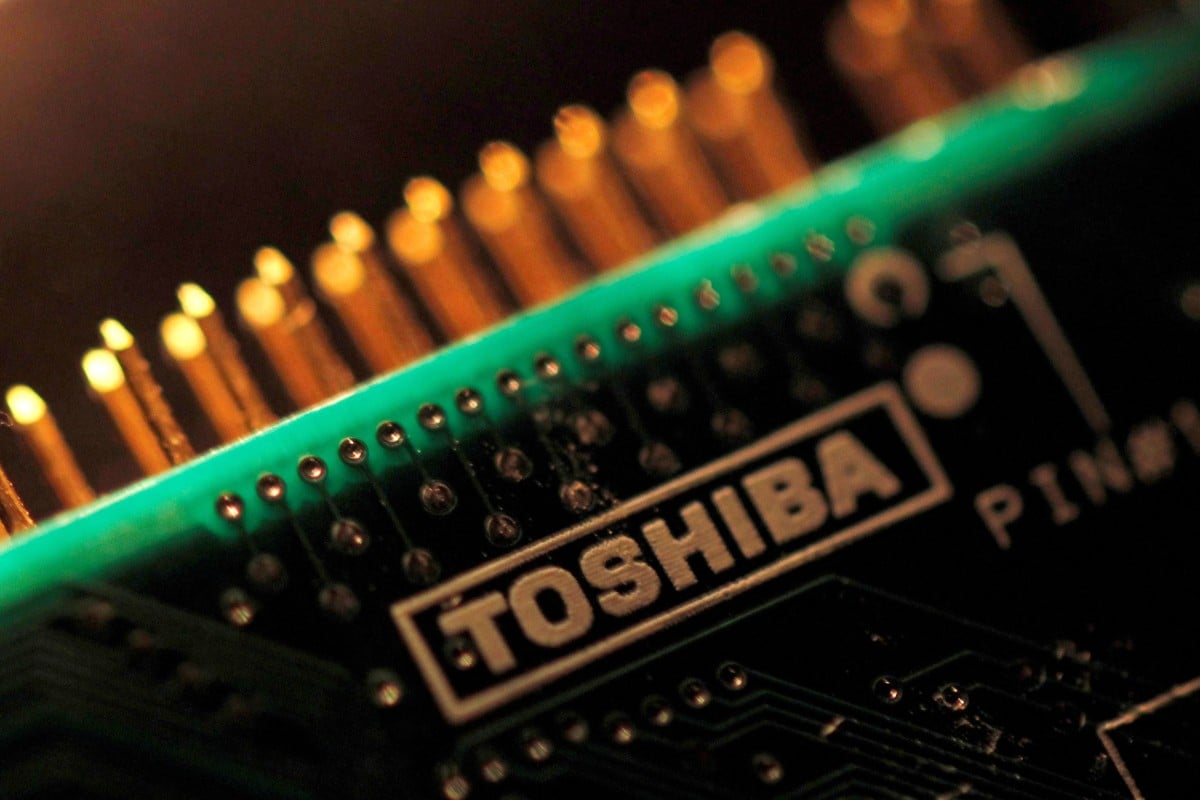
Toshiba was one of the companies affected by US actions to prevent the rise of Japan in a trade war that echoes in today’s tensions between the US and China. Photo: Reuters
If history is a mirror to the future, the similarities between the spiralling technology stand-off between China and the US and the economic wars waged by the US with Japan – which peaked in the 1980s and 1990s – may be instructive. But there are differences between the two which may predict a different outcome.
The US-Japan economic tensions started in the 1950s over textiles, extended to synthetic fibres and steel in the 1960s, and escalated – from the 1970s to 1990s – to colour televisions, cars and semiconductors, as Japan’s adjusted industrial policy and technology development moved it up the industrial chain.
Boosted by government support, Japan’s semiconductor industry surpassed the US as the world’s largest chip supplier in the early 1980s, causing wariness and discontent in the US over national security risks and its loss of competitiveness in core technologies.
The Reagan administration regarded Japan as the biggest economic threat to the US. Washington accused Tokyo of state-sponsored industrial policies, intellectual property theft from US companies, and of dumping products on the American market.
The US punished Japanese companies for allegedly stealing US technology and illegally selling military sensitive products to the Soviet Union. It also forced Japan to sign deals to share its semiconductor technologies and increase its purchases of US semiconductor products.
“The Trump administration is using similar tactics against China that were used against Japan in the 1980s and 1990s,” said an adviser to the Chinese government, on condition of anonymity, adding that the US was continuing its hegemony to curtail China’s tech development and was trying to mobilise its allies to follow suit.
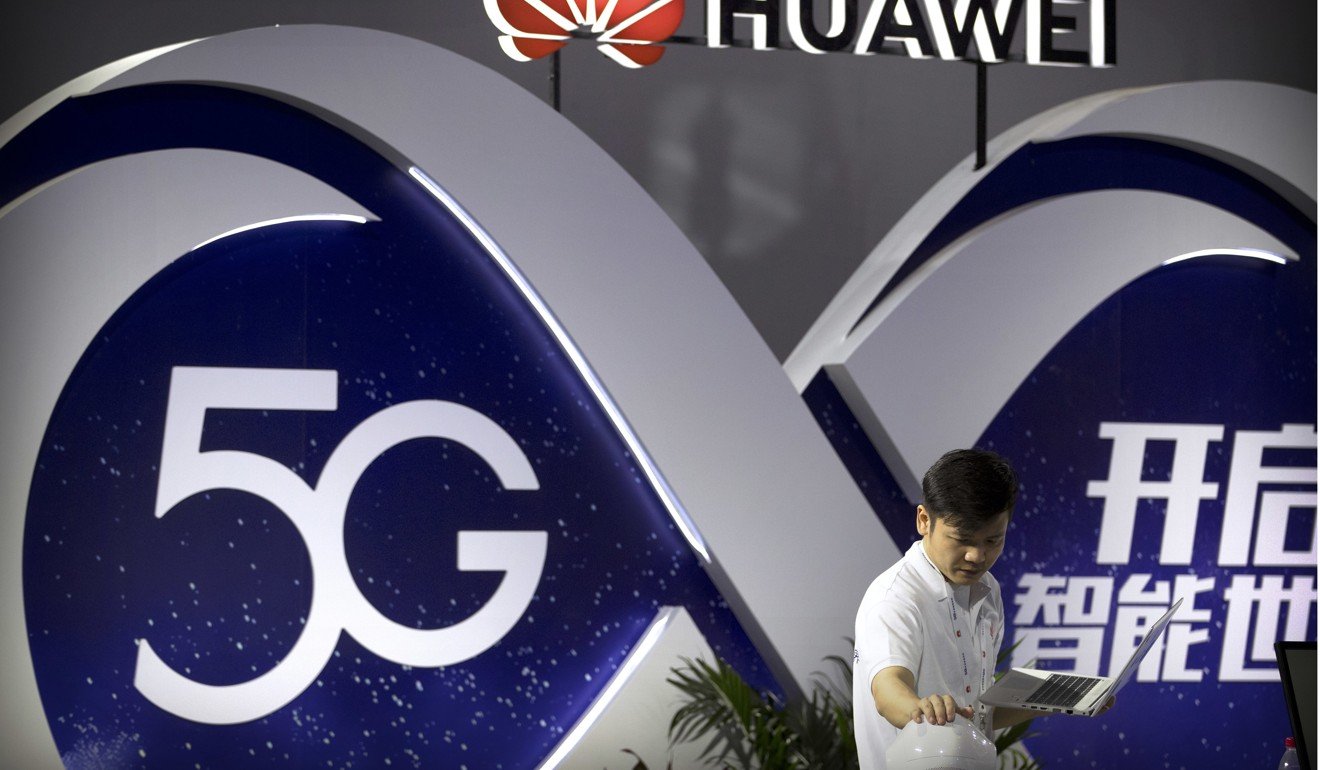
After talks to end the US-China trade faltered last month, Huawei – a global leader in the 5G market – is now standing at centre stage of a protracted technology stand-off between Beijing and Washington, which has grown increasingly wary of the rising competitiveness of Chinese tech companies.
Zhang Monan, a researcher with the Beijing-based China Centre for International Economic Exchanges, does not foresee an easing of the rivalry between the US and China.
“The current US-China conflicts are more complicated than those between the US and Japan,” she said.
“The US will only get more intense in its containment of China and the tech rivalry won’t ease, even if China and the US could reach a deal to de-escalate the trade tensions.”
Huawei is at the centre of a technology stand-off between Beijing and Washington. Photo: AP
Back in 1982, the US justice department charged senior officials at Hitachi with conspiracy to steal confidential computer information from IBM and take it back to Japan. IBM also sued Hitachi. The two companies settled the case out of court and Hitachi paid 10 billion yen (US$92.3 million) to IBM in royalties in 1983, while accepting IBM inspections of its new software products for the next five years.
Toshiba, a major electronics producer in Japan, and Norway’s Kongsberg Vaapenfabrikk secretly sold sophisticated milling machines to the Soviet Union from 1982 to 1984, helping to make its submarines quieter and harder to detect. This transfer of sensitive military technology in the middle of an arms race between the US and the Soviet Union was not revealed until 1986.
The US issued a three-year ban on Toshiba products in 1987 and the company ran full-page advertisements in more than 90 American newspapers apologising for its actions.
In 1985, the US imposed 100 per cent tariffs on Japanese semiconductors. A year later, in its five-year semiconductor deal with the US, Japan agreed to monitor its export prices, increase imports from the US, and submit to inspections by the Office of the United States Trade Representative.
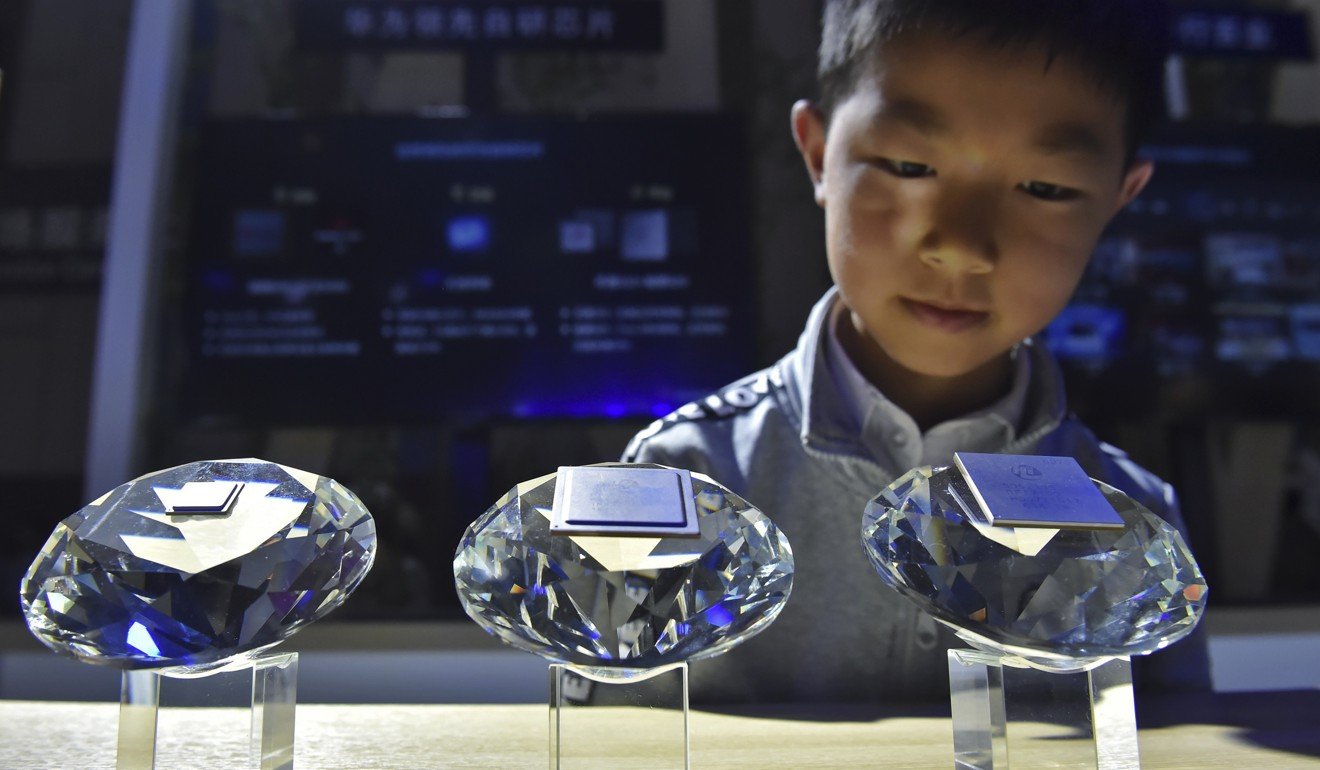
A display of chips designed by Huawei for 5G base stations on show at the China International Big Data Industry Expo. Photo: AP
This was followed by a second five-year semiconductor deal in 1991, in which Japan agreed to double the US market share in Japan to 20 per cent. In yet another bilateral semiconductor deal in 1989 Japan was required to open its semiconductor patents to the US.
Meanwhile, the US government boosted its efforts to help American businesses cement their industrial leverage in the chip sector and unveiled rules to protect its domestic chip industry.
The two countries were irreconcilable in 1996 on how to measure their respective market share. Overall market circumstances had also changed by then, with the US becoming competitive in microprocessing, and South Korea and Taiwan emerging as strong rivals to Japan.
Its dominance in semiconductors lost, Japan reached out to Europe for a range of cooperative technology deals.
Cooperate, don’t confront: academic advises Beijing on trade war tactics
“History can tell that high technology matters greatly to national security strategies. It is not a process of mere market competition. It follows the law of the jungle,” Zhang said.
The US has intensified its investment scrutiny by rolling out the Foreign Investment Risk Review Modernisation Act last year, which extends the regulation to key industrial technology sectors.
Zhang predicted the US would continue to contain China’s technological development in key sectors such as AI, aerospace, robots and nanotechnology – all of which are of great importance to Beijing.
The US has said Chinese tech giants Huawei and ZTE present a national security risk. Last April it cut US supplies to ZTE, citing violations of sanctions against Iran and North Korea. The ban was removed three months later after ZTE paid US$1.4 billion in fines.
It was a wake-up call for China to develop its own core technologies. The subsequent US ban on Huawei added to the urgency to do so, observers said.
Wang Yiwei, a professor in international relations with Renmin University, said China had to develop its own hi-tech know-how while continuing the opening up process.
“China has paid a price to learn whose globalisation it is,” he said.
“We may see some extent of disengagement with the US in technology and dual-use sectors, but China can speed up cooperation with European countries, and other countries such as Israel, to offset the risks from the US.”
In December, the US filed criminal charges against Huawei and its chief financial officer Sabrina Meng Wanzhou, alleging bank fraud, obstruction of justice and technology theft.
The squeeze continued last month with the US blacklisting Huawei, restricting its access to American hi-tech supplies and putting pressure on its allies to freeze the company out of the 5G market. So far, those allies, including Germany and Japan, have remained hesitant about meeting the US request and refrained from siding with either country.
Chinese foreign ministry spokesman Geng Shuang said on Monday that Huawei had obtained 46 commercial contracts in 30 countries as of June 6, “including some US allies and some European countries that the US has been working hard to persuade out of the contracts”.
For Zhang, the differences between Japan’s experience of US concerns of technological advancement and China’s may offer some hope for Chinese ambitions.
“Dependent on US for security protection, Japan was limited in [its ability to] push back and was already a developed country,” she said.
“But China has huge domestic market potential to address the imbalance [between] economic and technology development. This remains a big attraction to multinational companies, which would enable China to integrate into global innovation and technology cooperation, but China has to figure out how to dispel the doubts on its growth model.”











 CHINDIA ALERT: You'll be living in their world, very soon