Archive for ‘Chindia Alert’

28/04/2019

A really simple guide to India’s general election

Indian electionsImage copyright GETTY IMAGES

It is an election like no other. Those eligible to vote in India’s upcoming polls represent more than 10% of the world’s population and they will take part in the largest democratic exercise in history.

Voters will choose representatives for the Indian parliament, and in turn decide if Hindu nationalist Prime Minister Narendra Modi will run the country for another five years.

What is at stake?

Whoever wins these elections and forms a government will control the destiny of the world’s largest democracy.

While they are in charge,  is likely to overtake the UK’s and become the world’s fifth-largest.

Its population meanwhile – at more than 1.34bn people – is predicted to soon surpass China’s 1.39bn.

Hundreds of millions of Indians have escaped  since the turn of the millennium but huge challenges remain.

 is a major concern and is especially high among young people.

Millions of  about low crop prices.

How the nuclear-armed country engages with the outside world – and manages a tricky  – is also of immense importance to international security.
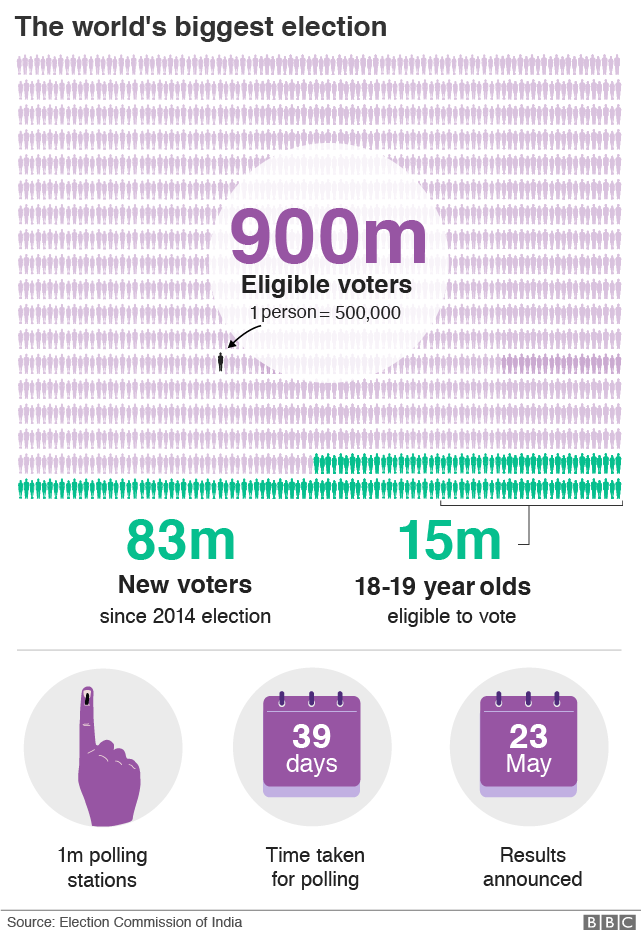
Graphic: The immense scale of India's elections

Who is being elected?

Indians are voting for members of parliament and the job of prime minister tends to go to the leader of the party or coalition with most seats. The current PM is .

His main rival is opposition leader .

Parliament has two houses: the Lok Sabha and the .

The lower house –  – is the one to watch.

It has 543 elected seats and any party or coalition needs a minimum of 272 MPs to form a government.

At the last election in 2014, Mr Modi’s  won 282 seats.

Mr Gandhi’s  only took 44 seats in 2014 – down from 206 in 2009.
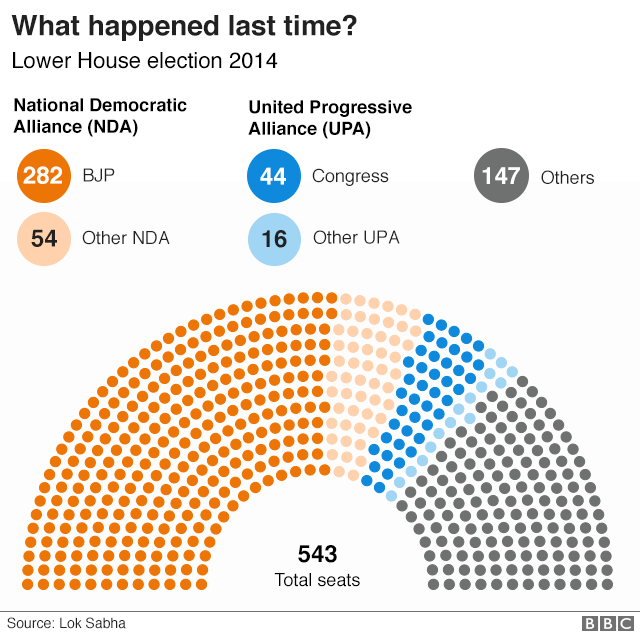
Graphic: The battle for the Lower House of the Indian Parliament

Why does voting take so long?

Because of the enormous number of election officials and security personnel involved, voting will take place in seven stages between 11 April and 19 May.

Different states will vote at different times.

Votes will be counted on 23 May and results are expected on the same day.

Who will win?

This election is being seen as a referendum on Mr Modi, a polarising figure adored by many but also accused of stoking divisions between  and the country’s 200 million Muslims.

Until a few months ago, Mr Modi and his BJP party were seen as the overwhelming favourites. But the  in December’s regional elections injected a sense of serious competition into the national vote.

Analysts are divided on whether Mr Modi will be able to win a simple majority again.

A recent escalation of tensions with Pakistan has given the BJP a new and popular issue to campaign on.

It will be hoping that a focus on patriotism will help the party to get past the serious challenge mounted by powerful regional parties and Congress.

Source: The BBC

27/04/2019

PepsiCo sues four Indian farmers for using its patented Lay’s potatoes

AHMEDABAD/NEW DELHI (Reuters) – PepsiCo Inc has sued four Indian farmers for cultivating a potato variety that the snack food and drinks maker claims infringes its patent, the company and the growers said on Friday.

Pepsi has sued the farmers for cultivating the FC5 potato variety, grown exclusively for its popular Lay’s potato chips. The FC5 variety has a lower moisture content required to make snacks such as potato chips.

The company is seeking more than 10 million rupees (£110,669) each for alleged patent infringement.

The farmers grow potatoes in the western state of Gujarat, a leading producer of India’s most consumed vegetable.

“We have been growing potatoes for a long time and we didn’t face this problem ever, as we’ve mostly been using the seeds saved from one harvest to plant the next year’s crop,” said Bipin Patel, one of the four farmers sued by Pepsi.

Patel did not say how he came by the PepsiCo variety.

A court in Ahmedabad, the business hub of Gujarat, on Friday agreed to hear the case on June 12, said Anand Yagnik, the farmers’ lawyer.

“In this instance, we took judicial recourse against people who were illegally dealing in our registered variety,” a PepsiCo India spokesman said.

“This was done to protect our rights and safeguard the larger interest of farmers that are engaged with us and who are using and benefiting from seeds of our registered variety.”

PepsiCo, which set up its first potato chips plant in India in 1989, supplies the FC5 potato variety to a group of farmers who in turn sell their produce to the company at a fixed price.

The company said the four farmers could join the group of growers who exclusively grow the FC5 variety for its Lay’s potato chips.

“PepsiCo India has proposed to amicably settle with the people who were unlawfully using the seeds of its registered variety. PepsiCo has also proposed that they may become part of its collaborative potato farming programme,” the company spokesman said in a statement.

If the farmers do not wish to grow the FC5 potato variety for PepsiCo, they can simply sign an agreement with the company to cultivate other available varieties, he added.

The All India Kisan Sabha, or All India Farmers’ Forum, has asked the Indian government to protect the farmers.

The forum has also called for a boycott of Lay’s chips and PepsiCo’s other products.

The Ministry of Agriculture & Farmers’ Welfare did not immediately respond to an email seeking comment.

PepsiCo is the second large U.S. company to face patent infringement issues in India.
Stung by a long-standing intellectual property dispute, seed maker Monsanto, now owned by German drugmaker Bayer AG, withdrew from some businesses in India over a cotton-seed dispute with farmers, Reuters reported in 2017. (reut.rs/2ncBknn)
Source: Reuters
27/04/2019

(BRF) Feature: In Schwab’s eyes, BRI growing into mature initiative

BEIJING, April 26 (Xinhua) — The Belt and Road Initiative (BRI) is growing up and gaining global traction, said Klaus Schwab, founder and executive chairman of the World Economic Forum (WEF), here on Friday.

In an interview with Xinhua on the sidelines of the second Belt and Road Forum for International Cooperation (BRF), he said that when he attended the first BRF in 2017, the BRI “was still a child growing up and you don’t know what the end of it will be.”

“Now the BRI has become an adult, which means that it has become an important factor in the global economy. It has grown up,” he told Xinhua.

Illustrating his understanding of the BRI in a speech at the ongoing second BRF, the professor said that through the BRI and institutions like the Asian Infrastructure Investment Bank, China can demonstrate to the world that “the philosophy and concept of the Belt and Road is more than an important initiative.”

The WEF founder, an advocate of “Globalization 4.0,” said that if people want globalization to continue as a positive force, a higher level of globalization is needed to respond to the needs and realities of a transforming world.

The BRI, he added, can be “a building block and a role model of” an advanced pattern of global cooperation that should be more sustainable, more inclusive and more collaborative.

Over the years, Schwab has articulated on many occasions his views of the BRI. At the 2015 Summer Davos Forum in northeast China’s port city of Dalian, he said he was happy to see that China proposed the BRI.

There was a huge infrastructure demand in Asia and Europe, and it was a good thing for China to play a leading role in building infrastructure in the region, he noted.

Partly thanks to the fact that it met the development needs of many countries, the BRI continued with rapid progress, promoting common development in participating countries and bringing Asia and Europe ever closer.

On May 13, 2017, the 1,000th China-Europe freight train that year departed from China’s eastern city of Yiwu to Europe, fully loaded with commodities like smallware and clothes.

The next day, Schwab reaffirmed his full support for the BRI in an address at the first BRF. Not hiding his enthusiasm about the BRI, he said the initiative “takes a long-term and holistic view, and makes a unique contribution to international cooperation and economic development.”

He pointed out that connectivity, a primary focus of the BRI, “is the new meta-pattern of our era and a key driver of our future economy.”

Citing a Chinese saying that “if you want to get rich, build a road,” he said, “I would update this to say: ‘If you seek prosperity, build connectivity.'”

One month later, in an interview with Xinhua ahead of the 2017 Summer Davos Forum, also held in Dalian, Schwab pointed to the BRI’s paradigm-shifting significance.

“The Belt and Road Initiative has great significance because it is a new approach to reach a new and open cooperation … and everybody can participate in a win-win situation as an equal partner,” he said.

Since Chinese President Xi Jinping proposed the initiative six years ago, 126 countries and 29 international organizations have signed BRI cooperation documents with China. The initiative has become the world’s largest platform for international cooperation and the most welcomed global public good.

The BRI “is now growing up into a mature initiative that can have even more impact,” Schwab told Xinhua.

Source: Xinhua

27/04/2019

Chinese top legislator meets Lao president

(BRF)CHINA-BEIJING-LI ZHANSHU-LAO PRESIDENT-MEETING (CN)

Li Zhanshu (R), a member of the Standing Committee of the Political Bureau of the Communist Party of China Central Committee and chairman of the Standing Committee of the National People’s Congress, meets with General Secretary of the Lao People’s Revolutionary Party Central Committee and Lao President Bounnhang Vorachit, who is attending the Second Belt and Road Forum for International Cooperation, in Beijing, capital of China, April 26, 2019. (Xinhua/Yin Bogu)

BEIJING, April 26 (Xinhua) — Li Zhanshu, chairman of the Standing Committee of the National People’s Congress (NPC), on Friday met with Lao President Bounnhang Vorachit, who is attending the Second Belt and Road Forum for International Cooperation in Beijing.

Li, also a member of the Standing Committee of the Political Bureau of the Communist Party of China Central Committee, said that China is willing to strengthen high-level contacts between the two countries and push forward the bilateral relations.

Li said that the NPC is willing to enhance exchanges and cooperation with the Lao National Assembly.

Bounnhang, also general secretary of the Lao People’s Revolutionary Party Central Committee, said Laos is ready to work closely with China to make new progress in building a community with a shared future for the two countries.

Source: Xinhua

27/04/2019

Premier Li meets Vietnamese PM

(BRF)CHINA-BEIJING-LI KEQIANG-VIETNAMESE PM-MEETING (CN)

Chinese Premier Li Keqiang (R) meets with Vietnamese Prime Minister Nguyen Xuan Phuc, who is here attending the Second Belt and Road Forum for International Cooperation, in Beijing, capital of China, April 26, 2019. (Xinhua/Liu Weibing)

BEIJING, April 26 (Xinhua) — Chinese Premier Li Keqiang on Friday met with Vietnamese Prime Minister Nguyen Xuan Phuc, who is here attending the Second Belt and Road Forum for International Cooperation.

Li said China is willing to enhance high-level contacts with Vietnam, deepen pragmatic cooperation, and better align the Belt and Road Initiative (BRI) with Vietnam’s “Two Corridors and One Economic Circle” plan.

China is willing to expand bilateral trade and achieve balanced and sustainable development in trade with Vietnam, and welcomes the entry of quality Vietnamese products into the Chinese market, Li said.

China supports Vietnam in assuming its role as the rotating chair of the Association of Southeast Asian Nations in 2020, and is willing to work with Vietnam and other parties to steadily advance the consultations on the Code of Conduct in the South China Sea, the premier said.

Nguyen Xuan Phuc said Vietnam actively supports the BRI and is willing to build greater synergy of the two countries’ development strategies.

Vietnam is willing to work with China in implementing the high-level consensus and safeguarding the long-term stability in the South China Sea, he said.

Source: Xinhua

27/04/2019

Xi meets UN chief

(BRF)CHINA-BEIJING-XI JINPING-UN CHIEF-MEETING (CN)

Chinese President Xi Jinping (R) meets with United Nations (UN) Secretary-General Antonio Guterres, who is attending the Second Belt and Road Forum for International Cooperation, in Beijing, capital of China, April 26, 2019. (Xinhua/Ding Haitao)

BEIJING, April 26 (Xinhua) — Chinese President Xi Jinping on Friday met with United Nations (UN) Secretary-General Antonio Guterres, who is attending the Second Belt and Road Forum for International Cooperation in Beijing.

China firmly upholds multilateralism, the international system with the UN at its core, and the international order based on international law, and promotes the building of a community with a shared future for humanity, Xi said.

The more complex and grim the situation is, the more important it is to manifest the authority and role of the UN, Xi said, adding that China will continue to support the UN.

Noting that the Chinese people not only pursue a good life for themselves, but also work for common interest and harmony of the world, Xi said the Belt and Road Initiative (BRI) embodies the idea of mutual benefit, and is in line with the UN’s sustainable development concept.

Describing the UN as an important partner in promoting the BRI, Xi said that China is ready to work with the UN to advance the initiative in an all-round way while following the principle of delivering shared benefits through extensive consultation and joint contribution.

Guterres said President Xi’s speech delivered at the forum on Friday morning is very important, as it elaborates the interrelationship between the BRI and global development agenda.

He spoke highly of China’s major measures for further reform and opening up.

China firmly upholds multilateralism, and safeguards equity and justice, as well as the purposes and principles of the UN Charter, the UN chief said, adding that China has played an important role in stabilizing, and brought certainty, confidence and hope to the world.

Calling on countries around the world to seize the opportunities brought about by the BRI cooperation and achieve win-win outcomes, Guterres said history will prove that China’s development is not only an irresistible historical trend, but also a major contribution to human progress.

Source: Xinhua

27/04/2019

Xi hosts banquet for guests attending Belt and Road forum

(BRF)CHINA-BEIJING-BELT AND ROAD FORUM-XI JINPING-BANQUET (CN)

Chinese President Xi Jinping addresses a banquet hosted by him and his wife Peng Liyuan in honor of guests attending the Second Belt and Road Forum for International Cooperation in Beijing, capital of China, April 26, 2019. (Xinhua/Huang Jingwen)

BEIJING, April 26 (Xinhua) — Chinese President Xi Jinping and his wife Peng Liyuan hosted a banquet Friday evening in honor of guests attending the Second Belt and Road Forum for International Cooperation in Beijing.

“On behalf of the Chinese government and Chinese people, my wife and also in my own name, let me extend warm welcome to all guests,” Xi said while proposing a toast at the banquet.

“Today’s gathering makes us recall the beautiful memories in our hearts,” Xi said, adding that “no matter how the international environment changes, the sincere friendship will last forever and the mutually beneficial cooperation will be the eternal melody in our hearts.”

The occasion inspires the participants via exchanges of ideas and insights, he said, calling for fostering global partnerships and creating a bright future of common development.

“Today’s gathering reminds us of the heavy responsibilities on our shoulders,” Xi told the guests that as the world is now undergoing profound changes unseen in a century, “may we all live up to our missions and the times.”

“We should all have faith that people of all countries deserve a better future, and the joint building of the Belt and Road will surely bring about a better world,” he said.

Li Keqiang, Li Zhanshu, Wang Yang, Wang Huning, Zhao Leji, Han Zheng and Wang Qishan also attended the banquet.

After the banquet, Xi and his wife accompanied the guests in watching a gala.

Source: Xinhua

27/04/2019

Cherish the love: China and France should avoid causing unnecessary upset, Beijing says

  • Foreign Minister Wang Yi tells French counterpart Jean-Yves Le Drian the two sides should ensure ties ‘continue to develop in a healthy way’
  • Meeting comes after Paris angers Beijing by sending a warship through the sensitive Taiwan Strait
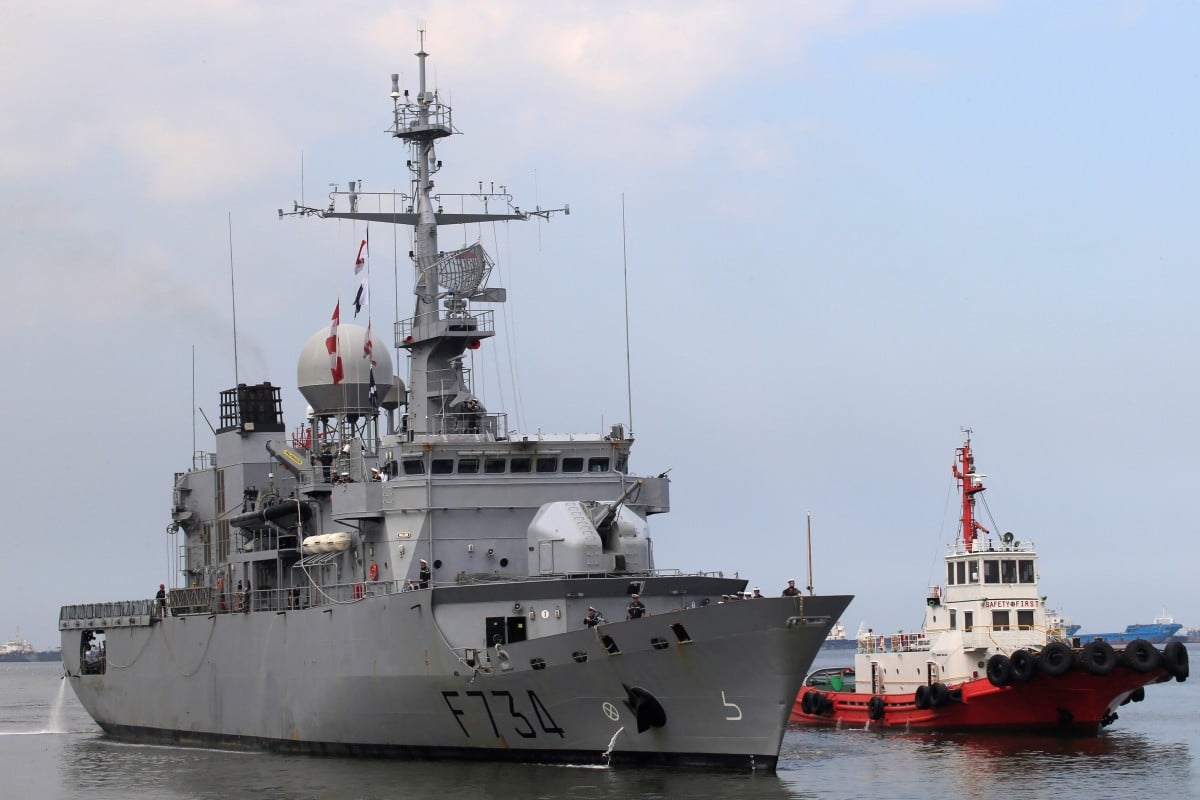
Paris upset Beijing earlier this month by sending its frigate Vendémiaire through the Taiwan Strait. Photo: Reuters
France and China should value their strong relationship and not take actions that disrupt it, China’s foreign minister told his French counterpart on Thursday, just days after 
Beijing expressed its upset

at Paris for sending a warship through the Taiwan Strait earlier this month.

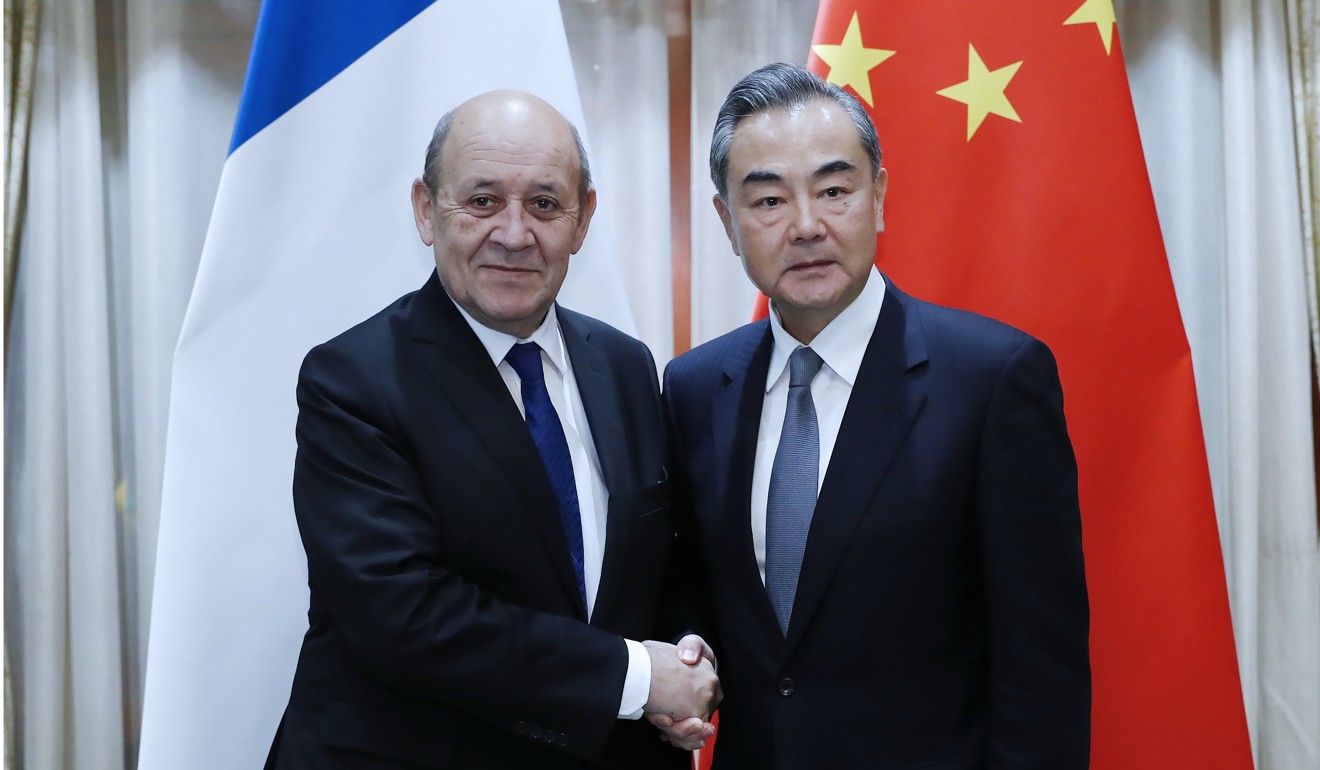
Speaking at a meeting on the sidelines of the Belt and Road Forum in Beijing, Wang Yi told Jean-Yves Le Drian that the two nations “should cherish their hard-won and good relations”.
“[We should] avoid unnecessary disruptions and ensure that bilateral relations continue to develop in a healthy and progressive way,” he was quoted as saying in a statement issued on Friday by the Chinese foreign ministry.

Le Drian responded by saying France was willing to cooperate with China to “maintain the growth momentum of bilateral relations”, according to the statement.

French Foreign Minister Jean-Yves Le Drian told his Chinese counterpart Wang Yi that Paris was willing to cooperate with Beijing. Photo: Xinhua
The

French frigate Vendémiaire

passed through the Taiwan Strait on April 6. It had been expected to take part in a naval parade on Tuesday to celebrate the 70th anniversary of China’s navy, but Beijing withdrew the invitation in response to the action.

The defence ministry in Paris said this week it had been “in close contact with the Chinese authorities” about the incident.
EU’s connectivity plan ‘more sustainable’ than belt and road

A spokesman for the European Union said the trading bloc was committed to a rules-based maritime order based on international law, including freedom of navigation, and that it was in regular contact with the member states.

Chinese academics said that after the transit by the French warship it was likely that more Western countries would make their presence known in the region and that Beijing should remain vigilant.

“France wants to show that as a great power it has a broader concern in Asia-Pacific beyond trade and other ‘soft’ fields,” said Shi Yinhong, an international relations professor at Renmin University of China in Beijing.

“And it will exert its right to free navigation in any international waters regardless of China’s position or sensitivities.”

The Taiwan Strait is about 160km (100 miles) wide and divides mainland China from Taiwan, which Beijing regards as a breakaway province awaiting reunification, by force if necessary. The US, meanwhile, is bound by law to help the self-ruled defend itself and frequently sends warships through the strait in a show of support.

Shi said that US President Donald Trump’s Indo-Pacific strategy, which regards China as a “strategic competitor”, might draw “opportunistic associates” – like France and Britain – into the region.

“Some other states could be encouraged by the French action to do the same,” he said. “But [they] may also be deterred by China’s probable military and diplomatic responses, which would be determined on a case-by-case basis.”

Putin gets behind Xi’s belt and road plan in face of US hostility

Zhu Feng, a professor of international relations at Nanjing University, said France’s conduct was intended to show the “shared concern of Western allies” regarding the security aspect of cross-strait relations.

“China must be vigilant to the new tendency [for nations] to internationalise the Taiwan Strait issue,” he said, though added that the transit of the French warship was “more of a symbolic gesture than actual action”.

Philippe Le Corre, a senior fellow at the Carnegie Endowment for International Peace in Washington and former special assistant for international affairs to the French defence minister, said the Taiwan Strait did not belong to any one nation and, therefore, ships were within their rights to sail through it without prior authorisation.

“From Paris’s point of view, like the rest of the EU, the principles of freedom of navigation are critical to the world economy and trade, therefore there is no reason why European navies or even commercial ships should not be allowed to cross the Taiwan Strait,” he said.

“This is EU policy, not just France or the UK. It has nothing to do with the US, it is international law.”

Source: SCMP

27/04/2019

Europe wants to deal with China as a group – German minister

BEIJING (Reuters) – Major European Union countries want to deal with China as a group rather than sign bilateral agreements as individual states, German Economy Minister Peter Altmaier said on Friday, attending a summit in Beijing on China’s Belt and Road plan.

European countries have generally signalled their willingness to participate in China’s programme to re-create the old Silk Road joining China with Asia and Europe.

But key states like France and Germany have said China must in turn improve access and fair competition for foreign firms.

Italy in March became the first major Western government to back China’s initiative, even as some EU leaders cautioned Rome against rushing into the arms of Beijing.


“In the big EU states we have agreed that we don’t want to sign any bilateral memorandums but together make necessary arrangements between the greater European Economic Area and the economic area of Greater China,” Altmaier said when asked if he could see Germany signing a similar bilateral agreement to Italy.

A spokesman for Altmaier’s office later said he was talking about general arrangements and not specifically the Belt and Road.

The minister said he was encouraged by Chinese President Xi Jinping’s pledge to pursue free trade, multilateralism and sustainability as part of Belt and Road.

“We will take this promise seriously” and make suggestions on how to achieve these goals in both Asia and Europe, he said.

China is a partner and a competitor at the same time and the EU must define its interests, Altmaier said.

“And for that we need an industry strategy. For that we need our own connectivity strategy,” he added.

Source: Reuters

26/04/2019

China eyes new regional development plans to bolster growth

BEIJING, April 26 (Xinhua) — Chinese authorities are looking to renew regional development plans for the country’s less developed western and northeastern regions to bolster broader growth, according to a report by the China Securities Journal.

New guidelines on advancing western development in the new era are set to be released soon, which will focus more on environmental protection and implementation of the Belt and Road Initiative, said the paper.

Supply-side structural reforms will be deepened, and technology innovation will be encouraged in the west to foster high-quality growth.

After China put forward the West Development Strategy in 1999, the country’s western regions have achieved remarkable progress in the past decades.

Since 2012, the western regions have sustained an average annual GDP growth rate of 8.9 percent, 1.8 percentage points higher than the national growth rate, suggesting an ever-shrinking development gap between the country’s east and west.

The upgraded strategy is likely to unleash another round of fast growth for the west, and industries including construction and machinery will benefit the most as infrastructure construction will remain a focus, the paper cited Xu Liying, an analyst with Lang Steel Information Research Center.

The paper also reported that plans on reviving the country’s northeastern regions had been drafted for further deliberations.

In recent years, the northeast, an old industrial base, has faced more difficulties than the rest of the country as the region relies largely on heavy and chemical industries, energy resources, raw materials and a large number of state-owned enterprises.

The government has already released a set of measures aimed at revitalizing the northeast, but more efforts are needed to optimize industrial structure and improve the business environment to narrow the development gap with the rest of the country, said the paper.

The upcoming regional plans came as the government seeks to tap development potential in less-developed regions to support growth while reducing regional disparities.

Official data showed the Chinese economy expanded 6.4 percent year on year in the first quarter, remaining flat with the GDP expansion in the previous quarter.

Source: Xinhua

Law of Unintended Consequences

continuously updated blog about China & India

ChiaHou's Book Reviews

continuously updated blog about China & India

What's wrong with the world; and its economy

continuously updated blog about China & India