Archive for ‘Chindia Alert’

27/11/2019

China, Suriname establish strategic partnership of cooperation

CHINA-BEIJING-XI JINPING-SURINAME-PRESIDENT-TALKS (CN)

Chinese President Xi Jinping holds a welcome ceremony for Suriname’s President Desire Bouterse before their talks at the Great Hall of the People in Beijing, capital of China, Nov. 27, 2019. (Xinhua/Yue Yuewei)

BEIJING, Nov. 27 (Xinhua) — China and Suriname on Wednesday decided to upgrade their relationship to a strategic partnership of cooperation.

The announcement came as Chinese President Xi Jinping held talks with Surinamese President Desire Bouterse at the Great Hall of the People in Beijing.

During the talks, Xi said Suriname is one of the first Caribbean countries to establish diplomatic relations with China. The relations can be considered a model of friendly relations and equal treatment between countries of different sizes.

The development of bilateral ties is in an important historical period, and China is willing to work with Suriname to take the opportunity of the Belt and Road cooperation to uplift the ties to new heights, said Xi.

Xi stressed that the two countries should maintain support on issues involving each other’s core interests and major concerns.

Xi called on the two sides to deepen cooperation in areas such as infrastructure construction, agriculture, forestry, fisheries, communications and energy, and explore cooperation in new areas such as new energy, digital economy, tourism and ocean economy.

“China encourages more capable Chinese companies to invest in Suriname,” said Xi.

Noting that Suriname is one of the countries with the largest overseas Chinese population in the Caribbean area, Xi said it is necessary to promote cultural exchanges, facilitate personnel exchanges and strengthen cooperation in areas such as education and law enforcement. China will also send a medical expert panel to Suriname.

The two sides should maintain communication and coordination on global issues, practice multilateralism, build an open world economy and safeguard the common interests of both countries and all developing countries, said Xi.

China is willing to continue to speak out from a sense of justice for Suriname on multilateral occasions and work together with the international community including Suriname to constructively participate in the multilateral process on global climate issues, he said.

Xi added that China has always respected the right of Latin American people to choose their own development path and supported the process of Latin American integration and the handling of regional issues through dialogue and consultation.

China is willing to work with Latin America to promote the construction of the Belt and Road and deepen China-Latin America cooperation by the principles of equal treatment and mutual benefit, said Xi.

Bouterse extended congratulations on the 70th founding anniversary of the People’s Republic of China, and said under Xi’s leadership, socialism with Chinese characteristics will be a success and will bring benefits to the Chinese people and people around the world.

Underscoring the historic and political significance of his visit, Bouterse said Suriname will firmly uphold the one-China principle and support China’s national reunification.

He said Suriname is grateful for China’s help in his country’s economic and social development, and ready to work with China to enhance exchanges at all levels, cement political mutual trust, expand economic and trade cooperation, deepen people-to-people exchanges and take the joint construction of the Belt and Road as an opportunity to upgrade bilateral strategic relations.

Suriname stands ready to work with China to safeguard multilateralism, international law and basic norms of international relations, Bouterse said.

After the meeting, Xi and Bouterse witnessed the signing of several cooperation documents.

Source: Xinhua
27/11/2019

China overtakes United States to boast world’s biggest diplomatic network, think tank says

  • But Washington still commands more diplomatic influence, analyst says
  • Beijing extends its reach as its interests grow abroad and as Taipei loses allies
China has 276 embassies, consulates and other missions around the world, surpassing the US with 273 missions, according to a global index. Photo: AP
China has overtaken the United States to have the biggest number of diplomatic outposts around the world, as its international ambitions and economic interests expand.
According to the 2019 Global Diplomacy Index, released by the Lowy Institute in Australia on Wednesday, China has 276 embassies, consulates and other missions globally, surpassing the US with 273 missions. France was third on 267.

Bonnie Bley, the index report’s lead researcher, said that while a country’s total did not equate to diplomatic influence, “diplomatic infrastructure is still important”

“China’s newly held lead serves as a telling metric of national ambition and international priorities,” Bley said.

Beijing has 169 embassies or high commissions, while Washington has 168. However, China had 96 consulates while the US had 88, suggesting that Beijing’s diplomatic expansion was closely linked to its economic interests, she said.
Beijing bulks up diplomacy budget as China extends global reach

Renmin University international relations professor Shi Yinhong said China had close and growing trade and investment ties with many developing countries, especially those taking part in the Belt and Road Initiative, increasing the need for consulates.

“One of the consulates’ main goals is to serve the citizens and businesses located in those countries,” Shi said.

Beijing has also expanded its reach at Taipei’s expense. Since 2016, when the index was first published, Taiwan’s total number of embassies fell from 22 to 15, the biggest drop among the 61 places ranked.

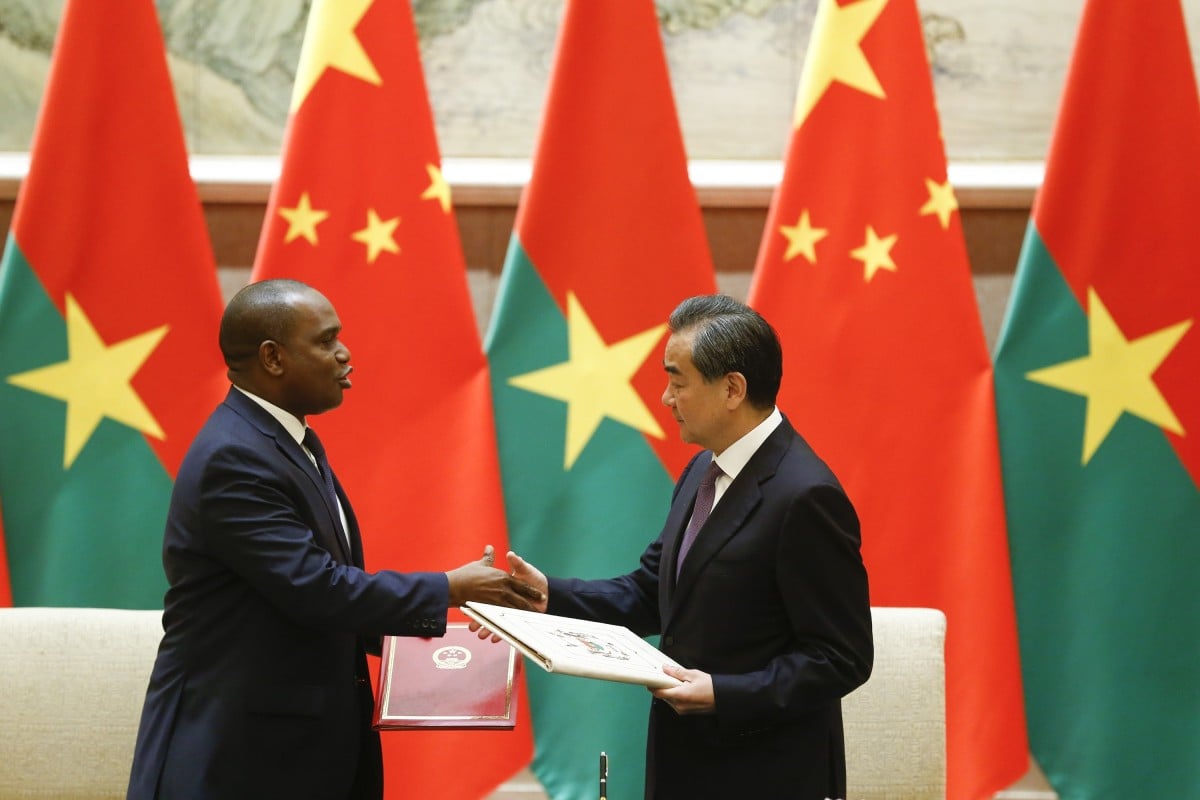
China opened five new embassies – in El Salvador, Burkina Faso, Gambia, São Tomé and Príncipe and the Dominican Republic – countries that severed official diplomatic ties with Taiwan. This directly contributed to China’s lead over the US, the report said.

Beijing’s diplomatic expansion also comes as the US, under the administration of President Donald Trump, is taking an “America first” approach to foreign policy.
Sri Lanka rejects fears of China’s ‘debt-trap diplomacy’ in belt and road projects
Trump has sought to cut funding to the US State Department and the White House has not appointed US ambassadors for at least 17 countries, including Brazil and Egypt, according to the American Foreign Service Association.
“Even though the US has a strong diplomatic base but it is not so proactive any more. It has fewer consulates and fewer foreign service workers,” Shi said.
“For the long term, China is in a more advantageous position.”
But a country’s diplomatic ability and influence did not rest on the number of foreign service postings and the US still held more international diplomatic sway than China, he added.
Some of China’s biggest diplomatic missions include Islamabad in Pakistan, Washington and London.
Source: SCMP
26/11/2019

China, Japan agree to further improve ties, strengthen people-to-people exchanges

JAPAN-TOKYO-CHINA-WANG YI-SHINZO ABE-MEETING

Japanese Prime Minister Shinzo Abe meets with Chinese State Councilor and Foreign Minister Wang Yi in Tokyo, Japan, Nov. 25, 2019. (Xinhua/Du Xiaoyi)

TOKYO, Nov. 25 (Xinhua) — Japanese Prime Minister Shinzo Abe and Chinese State Councilor and Foreign Minister Wang Yi on Monday agreed that both sides should work together to further improve bilateral ties and strengthen people-to-people exchanges.

Japan and China have witnessed frequent high-level exchanges and positive progress in the improvement of bilateral relations recently, said Abe, adding that the Japanese side is eagerly looking forward to Chinese President Xi Jinping’s state visit next spring and believes that it will be a major opportunity for promoting bilateral relations in the new era.

A stable Japan-China relationship is the cornerstone of peace and prosperity in Asia, and is also crucial to addressing current global challenges. Japan is ready to work with China to usher in a new future of bilateral relations, he said.

Japan welcomes the launch of the high-level consultation mechanism on people-to-people exchanges between the two countries and stands ready to work with China to continuously boost the affinity between the two peoples and properly handle sensitive differences so as to create a favorable atmosphere and conditions for the improvement and development of bilateral relations, he added.

Abe also said he is looking forward to further in-depth communication with Chinese leaders on bilateral ties during his visit to China next month to attend the China-Japan-ROK (Republic of Korea) leaders’ meeting.

Wang, for his part, said that with the political guidance of the two leaders and joint efforts of both sides, China-Japan relations have returned to the right track and have seen a sound momentum of improvement and development. The top leaders of the two countries had a successful meeting in Osaka in June and reached important consensus on building bilateral relations that meet the requirements of the new era.

The China-Japan relations have gone through twists and turns and the present situation has not come easily and should be doubly cherished, Wang said.

The two sides should push for continuous improvement and development of China-Japan relations from a longer-term and broader perspective, he said.

He called on the Japanese side to meet China halfway, take more positive actions, properly manage and handle differences so as to create a favorable atmosphere and conditions for the proposed major political and diplomatic agenda of the two countries.

The improvement and development of China-Japan relations not only conform to the interests of the two countries and peoples but also has great positive significance to regional peace and stability, injecting stability into the current world situation which is full of uncertainty, said Wang.

The Chinese side welcomes Abe to attend the China-Japan-ROK leaders’ meeting in China next month. China is willing to work with Japan to give full play to the role of the high-level consultation mechanism on people-to-people exchanges, usher in a new era of exchanges between our peoples, localities and youth, and create a brighter future for bilateral relations, he said.

Source: Xinhua

26/11/2019

Chinese president meets United Russia party delegation

CHINA-BEIJING-XI JINPING-UNITED RUSSIA PARTY-MEETING (CN)

Chinese President Xi Jinping, also general secretary of the Communist Party of China (CPC) Central Committee, meets with a delegation of the United Russia party led by Chairman of the United Russia’s Supreme Council Boris Gryzlov at the Great Hall of the People in Beijing, capital of China, Nov. 25, 2019. (Xinhua/Li Tao)

BEIJING, Nov. 25 (Xinhua) — Chinese President Xi Jinping Monday met with a delegation of the United Russia party at the Great Hall of the People in Beijing.

The delegation, led by Chairman of the United Russia’s Supreme Council Boris Gryzlov, is in Beijing for the seventh meeting of the dialogue mechanism between the ruling parties of China and Russia held Monday.

Xi, also general secretary of the Communist Party of China (CPC) Central Committee, expressed congratulations for the success of the 19th congress of the United Russia party.

This year marks the 70th anniversary of the forging of diplomatic ties between China and Russia, said Xi.

“President Putin and I jointly announced the development of the China-Russia comprehensive strategic partnership of coordination for a new era, agreeing to guide bilateral relations in the direction of mutual support, in-depth integration and innovative cooperation to achieve win-win results,” said Xi.

He said China and Russia have formed strong strategic support for each other, which is of great strategic significance to world peace and development.

Saying that as ruling parties, the CPC and the United Russia party shoulder responsibilities to further promote China-Russia ties, Xi called on delegates to the seventh meeting of the dialogue mechanism to fully exchange views so as to contribute wisdom and strength to bilateral ties as well as world peace and prosperity.

Congratulating China on the fourth plenary session of the 19th CPC Central Committee, Gryzlov said Russia-China ties have reached an unprecedented level as the two countries have sound cooperation in various fields and good coordination in international and regional hotspot issues.

The United Russia party stands ready to enhance cooperation with the CPC to further promote bilateral ties, said Gryzlov.

The dialogue mechanism between the CPC and the United Russia party was launched in June 2009. Its sixth meeting was held in Kazan in March 2017.

Source: Xinhua

25/11/2019

Tuvalu: Pacific nation turns down Chinese islands and backs Taiwan

An aerial image of Funafuti, Tuvalu, on 15 August 2018Image copyrightGETTY IMAGES
Image captionTuvalu is battling rising sea levels

The tiny South Pacific nation of Tuvalu has rejected offers from Chinese firms to build artificial islands that would help it deal with rising sea levels, its foreign minister says.

Simon Kofe told Reuters he saw the offers as an attempt to reduce Taiwan’s influence in the region.

But he instead reaffirmed his country’s support for Taiwan.

China has increased efforts to expand its influence in the Pacific, alarming the United States and its allies.

Only 15 countries recognise Taiwan as a sovereign nation and have full diplomatic relations. A number of countries have switched their allegiance from Taiwan to China in recent years.

China refuses to have diplomatic relations with any country that recognises Taiwan.

In recent months Taiwan lost two allies in the region, when Kiribati and the Solomon Islands switched diplomatic recognition to China. Beijing has been accused of luring them in with the promise of financial aid and airplanes.

Media caption Tuvalu’s foreign minister discusses increasing pressure from China

Mr Kofe expressed his backing for Taiwan and said his nation was setting up a group to unite Taiwan’s four remaining Pacific allies – the Marshall Islands, Palau, Nauru and Tuvalu.

“We believe in the power of grouping together and collaborating,” he told Reuters news agency.

“Together with our partners, we will be able to counter the influence from mainland China.”

Mr Kofe said Chinese companies had approached local communities offering to help with a $400m (£310m) government plan to build artificial islands. He believes the companies were backed by the Chinese government.

“We are hearing a lot of information about debt,” he said. “China buying our islands and looking at setting up military bases in our part of the world. Those are things that are concerning to us.”

Beijing has proposed Taiwan operate under a “one country, two systems” structure, similar to Hong Kong.

Since Taiwan President Tsai Ing-wen took office in 2016, seven countries have dropped Taiwan as a diplomatic ally. The support from Tuvalu could help her as she seeks re-election in January.

Source: The BBC

23/11/2019

Germany’s BASF starts building $10-billion petrochemical project in China

BEIJING (Reuters) – German chemical giant BASF (BASFn.DE) has begun construction of its $10-billion (£7.8 billion) integrated petrochemicals project in China’s southern province of Guangdong, the company said in a statement on Saturday.
The project based in the city of Zhanjiang will be China’s first wholly foreign-owned chemicals complex, for which a framework agreement was signed in January.
It will primarily produce engineering plastics and thermoplastic polyurethane (TPU), and some petrochemical products widely used in automotive, electronics and new energy vehicles industries.
The project’s first phase is expected to be launched in 2022, with production capacity of 60,000 tonnes per year (tpy), taking BASF’s total capacity of engineering plastics and TPU to 290,000 tpy in the Asia-Pacific region.
The entire project is planned to be completed by 2030, the company said, making it the third-largest BASF site worldwide, following Ludwigshafen in Germany and Antwerp in Belgium.
BASF plans to employ a comprehensive smart manufacturing concept at the project, deploying automated packaging, high-tech control systems and automated guided vehicles, it added.
“(The project) will form a solid foundation for a world-class industrial cluster in Zhanjiang and establish stronger business connections between South China and other Asian countries,” Stephan Kothrade, a BASF regional official in China, said in the statement.
The project is “a signal showing China’s efforts of further opening-up are taking effect,” Chinese Premier Li Keqiang said, according to a central government website.
China would treat enterprises with all types of ownership structures, as well as domestic and foreign firms, equally and without discrimination, he added.
Source: Reuters
19/11/2019

China needs to divert more water to north to fight risk of drought, says premier

  • Li Keqiang tells senior officials to step up efforts to channel water from Yangtze River to arid regions
  • Impact of pollution and rising population has prompted increased efforts to improve efficiency and supply
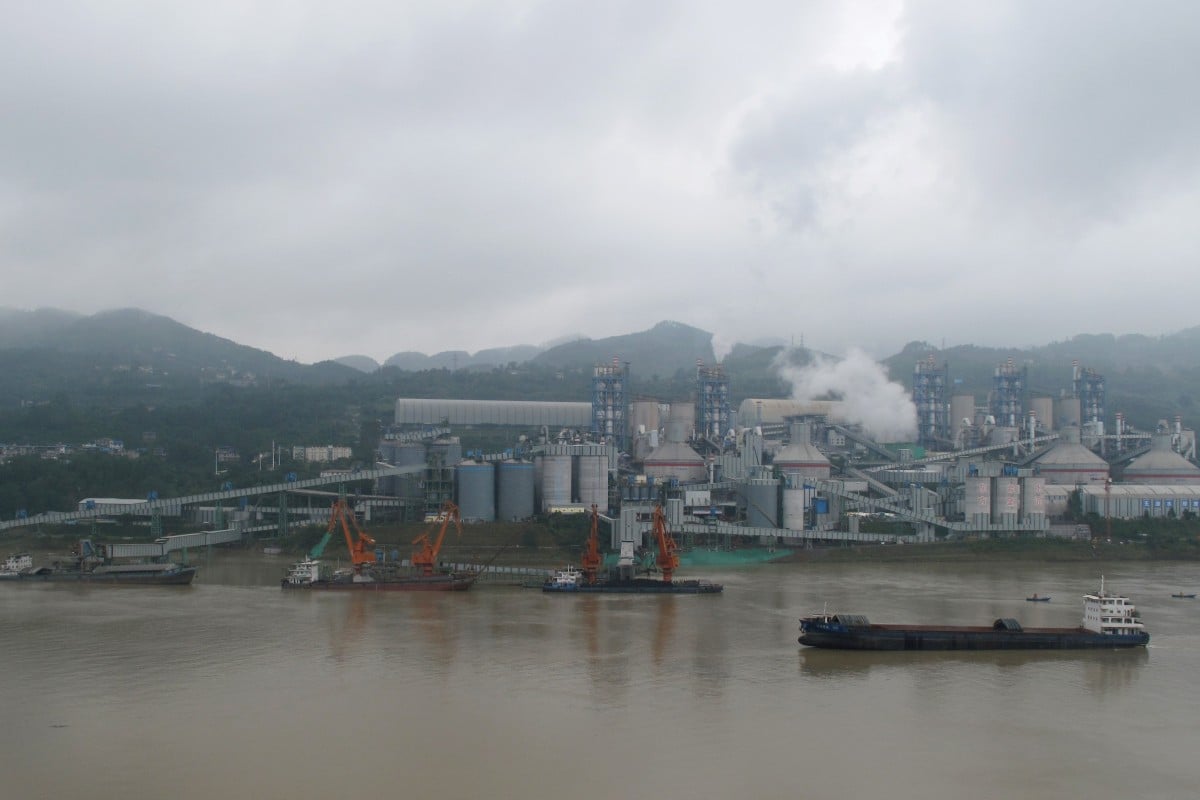
A cement plant on the banks of the Yangtze in Chongqing. The authorities are now trying to stop further development along the river. Photo: Reuters

China needs to divert more water to its arid northern regions and invest more in water infrastructure as shortages get worse because of pollution, overexploitation and rising population levels, Premier Li Keqiang has said.

China’s per capita water supplies are around a quarter of the global average. With demand still rising, the government has sought to make more of scarce supplies by rehabilitating contaminated sources and improving efficiency.

Water remained one of China’s major growth bottlenecks, and persistent droughts this year underlined the need to build new infrastructure, Li told a meeting of senior Communist Party officials on Monday. An account of the meeting was published by China’s official government website.

Local government bonds should be “tilted” in the direction of water infrastructure, he said, and innovative financing tools were also needed.

He also called for research into new pricing policies to encourage conservation.

Li said China’s water supply problems had been improved considerably as a result of the South-North Water Diversion Project, a plan to divert billions of cubic metres of water to the north by building channels connecting the Yangtze and Yellow rivers.

World ‘woefully unprepared’ for climate change’s effects on drinking water supplies drawn from mountains

He said opening up more channels to deliver water to regions north of the Yangtze River Delta would support economic and social development and optimise China’s national development strategy, according to a summary of the meeting on the government website.

China is in the middle of a wide-reaching programme to clean up the Yangtze River, its biggest waterway, and put an end to major development along its banks.

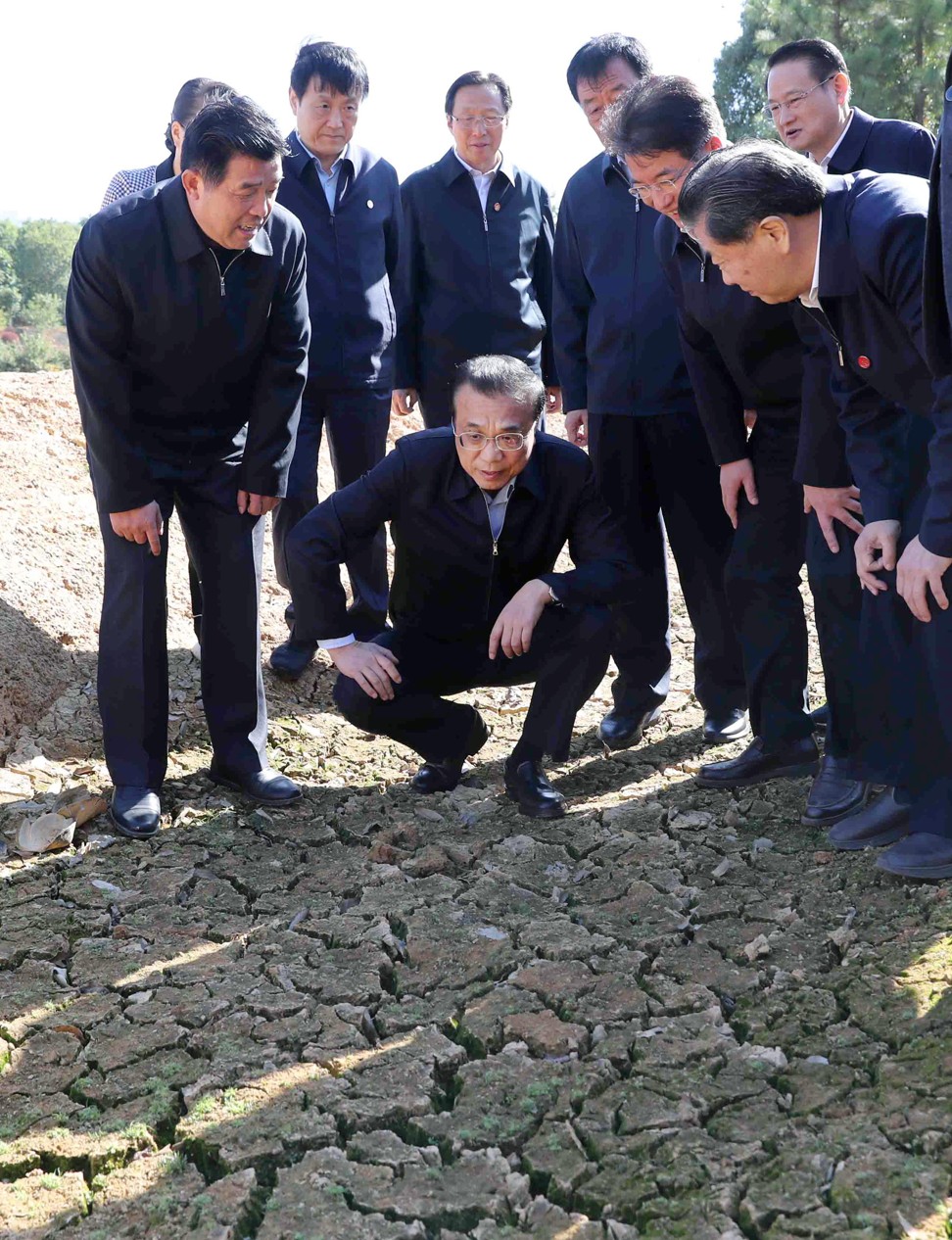
Chinese Premier Li Keqiang inspects an empty reservoir during a visit to Jiangxi province last week. Photo: Xinhua

Local governments have been under pressure to dismantle dams, relocate factories and even ban fishing and farming in ecologically fragile regions.

But experts say the ongoing campaign to divert the course of the Yangtze to other regions is still causing long-term damage to the river’s environmental health.

Many cities that had polluted their own water sources had drawn replacement supplies from the Yangtze, exceeding the river’s environmental capacity, said Ma Jun, founder of the Institute of Public and Environmental Affairs, which monitors water pollution.

Beijing already relied on diversion channels from the Yangtze to supply 70 per cent of its water, but had done little to improve conservation or reduce per capita consumption, which was higher than many Western countries, he said.

“[Diversion] has caused so much suffering and needs so many dams to keep up supply, and that has impacted biodiversity,” he said.

Source: SCMP

15/11/2019

China signs 197 B&R cooperation documents with 137 countries, 30 int’l organizations

BEIJING, Nov. 15 (Xinhua) — China has signed 197 Belt and Road (B&R) cooperation documents with 137 countries and 30 international organizations by the end of October, the country’s top economic planner said Friday.

Apart from developing and developed economies, a number of companies and financial institutions from developed countries have collaborated with China to expand the third-party market as well, Meng Wei, a spokesperson for the National Development and Reform Commission (NDRC), told a news conference.

The construction of the China-Laos railway, China-Thailand railway, Jakarta-Bandung High-Speed Railway and Hungary-Serbia railway are making solid headway while projects including the Gwadar Port, Hambantota Port, Piraeus Port and Khalifa Port have gone smoothly, the NDRC said.

Meanwhile, the building of the China-Belarus industrial park, China-UAE Industrial Capacity Cooperation Demonstration Zone and China-Egypt Suez Economic and Trade Cooperation Zone is also forging ahead.

From January to September, China’s trade with B&R countries totaled about 950 billion U.S. dollars, and its non-financial direct investment in these countries topped 10 billion dollars, Meng said.

She noted that China has made bilateral currency swap arrangements with 20 B&R countries and established RMB clearing arrangements with seven countries.

In addition, the country has also made achievements with B&R countries in other sectors including technology exchange, education cooperation, culture and tourism, green development and foreign aid.

Source: Xinhua

15/11/2019

Xi urges BRICS countries to champion multilateralism

BRAZIL-BRASILIA-CHINA-XI JINPING-BRICS-SUMMIT

Chinese President Xi Jinping delivers a speech entitled “Together for a New Chapter in BRICS Cooperation” at the 11th summit of BRICS in Brasilia, Brazil, Nov. 14, 2019. The 11th summit of BRICS, an emerging-market bloc that groups Brazil, Russia, India, China and South Africa was held on Thursday in Brasilia. Brazilian President Jair Bolsonaro presided over the summit. Chinese President Xi Jinping, Russian President Vladimir Putin, Indian Prime Minister Narendra Modi and South African President Cyril Ramaphosa also attended the summit. (Xinhua/Li Xueren)

BRASILIA, Nov. 14 (Xinhua) — Chinese President Xi Jinping on Thursday called on the BRICS countries to undertake their due obligations in championing and practicing multilateralism.

Xi made the appeal in a speech entitled “Together for a New Chapter in BRICS Cooperation” at the 11th summit of BRICS, an emerging-market bloc that groups Brazil, Russia, India, China and South Africa.

Noting that the summit was held at a time when crucial developments are taking place in the world economy and international landscape, Xi pointed out that a new round of technological revolution and industrial transformation is in the ascendant, and the unstoppable rise of emerging markets and developing countries has injected strong impetus to the reform of the global economic governance system.

Nevertheless, there are also causes for concern, Xi said, referring to rising protectionism and unilateralism; greater deficit of governance, development and trust; and growing uncertainties and destabilizing factors in the world economy.

Faced with profound changes rarely seen in a century, Xi said, the BRICS countries should grasp the trend of the times, respond to the call of the people, and shoulder their responsibilities.

“We must remain true to our unwavering commitment to development and strengthen solidarity and cooperation for the well-being of our people and for the development of our world,” he said, before laying out a three-pronged proposal.

First, the BRICS countries should work to foster a security environment of peace and stability, he said, urging the five members to safeguard peace and development for all, uphold fairness and justice, and promote win-win results.

“It is important that we uphold the purposes and principles of the UN Charter and the UN-centered international system, oppose hegemonism and power politics, and take a constructive part in settling geopolitical flash points,” he said.

The BRICS countries should also maintain close strategic communication and coordination and speak in one voice for a more just and equitable international order, he added.

Second, the BRICS countries should pursue greater development prospects through openness and innovation, said the Chinese president.

The five-member bloc should deepen the BRICS Partnership on New Industrial Revolution, and strive for more productive cooperation in such fields as trade and investment, digital economy and connectivity, so as to achieve high-quality development, Xi said.

He called for the five countries to advocate extensive consultation, joint contribution and shared benefits in global governance, and push for reform of the global economic governance system.

The BRICS countries should stand firm against protectionism, uphold the WTO-centered multilateral trading system, and increase the voice and influence of emerging markets and developing countries in international affairs, Xi said.

The Chinese president also urged the BRICS member states to prioritize development in the global macro policy framework, follow through the UN 2030 Agenda for Sustainable Development and the Paris Agreement on climate change, and promote coordinated progress in the economic, social and environmental spheres.

Third, the BRICS countries should promote mutual learning through people-to-people exchanges and take their people-to-people exchanges to greater breadth and depth, said Xi.

Xi proposed to leverage “BRICS Plus” cooperation as a platform to increase dialogue with other countries and civilizations to win BRICS more friends and partners.

In his speech, the president also stressed that China will open up still wider. “We will import more goods and services, ease market access for foreign investments, and step up intellectual property protection. With these efforts, we will break new ground in pursuing all-dimensional, multi-tiered and all-sectoral opening-up in China,” he said.

China will continue to act in the principle of extensive consultation, joint contribution and shared benefits, and pursue open, green and clean cooperation within the framework of the Belt and Road Initiative, Xi said.

“We will continue to follow a high-standard, people-centered, and sustainable approach to promote high-quality Belt and Road cooperation with partner countries,” he said.

China, added the president, will stay committed to an independent foreign policy of peace and to the path of peaceful development, and continue to enhance friendship and cooperation with all other countries on the basis of the Five Principles of Peaceful Coexistence.

China is committed to working with Africa for an even stronger China-Africa community with a shared future, Xi said, adding that China will pursue closer cooperation with Latin America and the Caribbean (LAC) in various areas and build a China-LAC community with a shared future and common progress.

Meanwhile, China strives for an Asia-Pacific community with a shared future that features openness and inclusiveness, innovation-driven growth, greater connectivity, and mutually beneficial cooperation, Xi said.

“All in all, China will work with the rest of the international community toward the goal of building a new type of international relationship and of building a community with a shared future for mankind,” he said.

Source: Xinhua

14/11/2019

Sabarimala temple: India court to review ruling on women’s entry

Devotees inside the Sabarimala templeImage copyright KAVIYOOR SANTHOSH
Image caption Sabarimala is one of the most prominent Hindu temples in the country

India’s Supreme Court has agreed to review its landmark judgement allowing women of menstruating age to enter a controversial Hindu shrine.

A five-judge bench last year ruled that keeping women out of the Sabarimala shrine in the southern state of Kerala was discriminatory.

The verdict led to massive protests in the state.

Women who tried to enter the shrine were either sent back or, in some cases, even assaulted.

The move is likely to anger women who fought hard to win the right to enter the temple.

Hinduism regards menstruating women as unclean and bars them from participating in religious rituals.

Many temples bar women during their periods and many devout women voluntarily stay away, but Sabarimala had a blanket ban on all women between the ages of 10 and 50.

What did the court say?

On Thursday the five-judge bench, responding to dozens of review petitions challenging the court’s landmark judgement last year, said that the matter would now be heard by a larger bench.

In doing so, however, it did not stay its earlier order. This means women can still legally enter the temple.

But it’s not going to be easy for them.

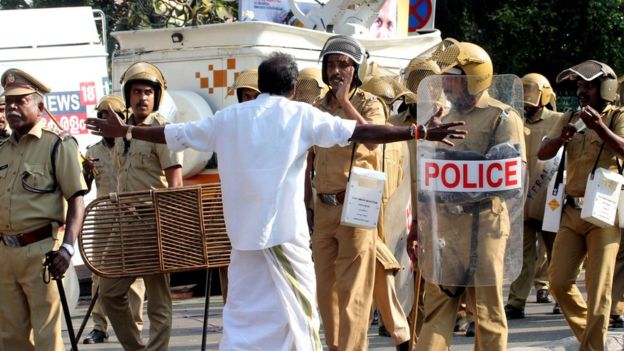
Two women trying to enter the temple in full riot gear
Image caption Some women tried to enter the temple last year

A temple official welcomed the ruling and appealed to women to stay away.

Women trying to enter the temple after the verdict last year were attacked by mobs blocking the way.

Many checked vehicles heading towards the temple to see if any women of a “menstruating age” – deemed to be those aged between 10 and 50 years – were trying to enter.

Following Thursday’s verdict, police in Kerala have appealed for calm, saying that action will be taken “against those who take the law into their own hands”. They added that social media accounts would be under surveillance and those stoking religious tensions online would be arrested.line

‘One step forward, two steps back’

Geeta Pandey, BBC News, Delhi

Today’s verdict will come as a massive disappointment to women’s rights campaigners. It’s a case of one step forward, two steps back.

In 2018, while lifting the ban on women’s entry into the shrine, the Supreme Court had said that everyone had the right to practice religion and that the ban was a form of “untouchability”.

It was seen as a hugely progressive ruling and had given hope to women that they were equal before the law and could now claim equality before the gods too. What happened in court today has taken that sense away.

The Supreme Court has not put its earlier order on hold, but with the ambiguity over women’s entry continuing, it’s very likely they could be kept out in the name of keeping peace.

With the case now to be reopened by a larger seven-judge bench, the fight will have to be fought all over again.line

Why is the temple so controversial?

Part of the violent opposition to the Supreme Court order to reverse the temple’s historical ban on women was because protesters felt the ruling goes against the wishes of the deity, Lord Ayappa, himself.

While most Hindu temples allow women to enter as long as they are not menstruating, the Sabarimala temple is unusual in that it was one of the few that did not allow women in a broad age group to enter at all.

Hindu devotees say that the ban on women entering Sabarimala is not about menstruation alone – it is also in keeping with the wish of the deity who is believed to have laid down clear rules about the pilgrimage to seek his blessings.

Indian Police patrol during clashes between Communist Party of India (Marxist) (CPM) and Bhartiya Janta Party (BJP) in front of the Kerala Government Secretariat in Thiruvnanthapuram on January 02, 2019Image copyright GETTY IMAGES
Image caption The entry of women into the Sabarimala temple sparked angry scenes

Every year, millions of male devotees trek up a steep hill, often barefoot, to visit the shrine. They also undertake a rigorous 41-day fast, abstaining from smoking, alcohol, meat, sex and contact with menstruating women before they begin the journey.

Women’s rights campaigners who appealed to the Supreme Court to lift the ban said that this custom violated equality guaranteed under India’s constitution. They added that it was prejudiced against women and their right to worship.

Supporters of the ban argued that the practice had been in effect for centuries, and there was no need to change it now.

So, were any women able to enter last year?

In January, two women defied protesters and entered the shrine.

Kanakadurga, 39, and Bindu Ammini, 40, made history when they entered the Sabarimala shrine – but they had to do so under heavy police protection and were also met with massive protests after.

Right-wing groups, supported by India’s ruling Hindu nationalist Bharatiya Janata Party (BJP), demanded a state-wide shutdown after, and businesses and transportation became paralysed.

Across the state hundreds were arrested, and at least one person was killed in clashes.

In an interview with the BBC, the women said they felt it necessary to uphold women’s rights and they weren’t afraid of mobs “enraged” by their actions.

Media caption One of the women who defied protesters to enter the Sabarimala temple says she has ‘no fear’

“I am not afraid. But every time women make any progress, society has always made a lot of noise,” Ms Kanakadurga told the BBC in January.

But their decision to enter the temple also came at heavy personal cost.

She alleged that she had been beaten by her mother-in-law and abandoned. She has since filed for divorce.

Source: The BBC

Law of Unintended Consequences

continuously updated blog about China & India

ChiaHou's Book Reviews

continuously updated blog about China & India

What's wrong with the world; and its economy

continuously updated blog about China & India