Archive for ‘Chindia Alert’

13/04/2019

Indonesia 2019 elections: How many Chinese workers are there?

Incumbent president Joko Widodo at a campaign rallyImage copyrightGETTY IMAGES
Image caption President Joko Widodo has welcomed investment from China to help fund an ambitious infrastructure agenda

Indonesia is going to the polls on 17 April for presidential and nationwide elections.

The presidential campaign has been mainly fought over jobs and the economy against a backdrop of rising nationalism.

President Joko Widodo, who is seeking re-election, has embarked on an ambitious infrastructure push. To do it he has welcomed Chinese investment and accepted loans and partnerships with foreign companies.

His rival, former military general Prabowo Subianto, has accused the president of selling out the country to foreigners, and opposition lawmakers are claiming Indonesia is facing an influx of Chinese workers.

A long and occasionally violent history of anti-Chinese sentiment means these are contentious issues, especially in an election year.

Social media is king in Indonesia and in the lead-up to the vote it has been awash with rumours over rising numbers of Chinese workers in the country.

But what does the data show? We’ve taken a look into the figures behind China’s growing role in Indonesia.

Online rumours

In January this year a video showing thousands of workers protesting at an industrial park in Morowali on the island of Sulawesi was widely shared on social media.

The video claimed that these were Indonesian workers demonstrating against Chinese migrants who were earning higher salaries and taking local jobs.

However, the manpower minister dismissed the claims, posting on Twitter that the protest in the video was about wages and not Chinese workers, and the police arrested a suspect accused of spreading false information.

Other widely shared social media posts have shown images of Chinese tourists at airports with alarming captions claiming them to be illegal workers flooding into the country.

And last month, a steel manufacturer in Java was forced to clarify how many Chinese nationals they employed after a video claiming to show foreign workers leaving the factory when viral.

What is Prabowo saying?

On the campaign trail Mr Prabowo hasn’t directly referred to Chinese workers but has taken aim at the president’s changes to foreign worker regulations, which aim to speed up the process of foreign worker applications to Indonesia.

He has said “we are not anti-foreigner but we need to take care of our own people, if we open our door to foreign workers, then what is left for us?”
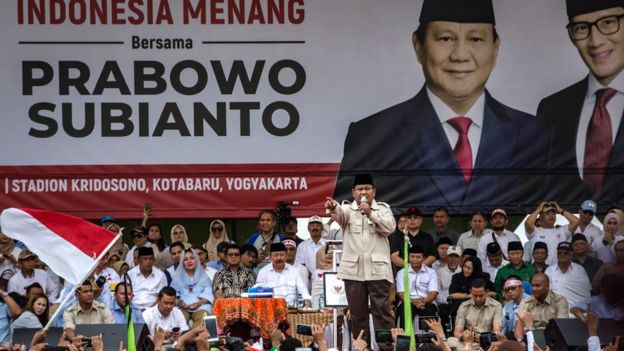
Opposition presidential candidate General Prabowo at a rallyImage copyrightGETTY IMAGES

Mr Prabowo has also suggested that Indonesia could learn from other countries.

“The United States wants to make a wall to keep them out. In Australia people who try to enter are sent to remote islands,” he said during a speech ahead of the campaign.

What does the data show?

China is Indonesia’s third largest source of foreign direct investment behind Singapore and Japan, according to the Indonesian government agency overseeing investment.

These figures show Chinese firms have invested almost $10bn (£7.6bn) in Indonesia since 2014.

Some of these big Chinese-backed projects have run into serious difficulties.

A $6bn project to build high-speed train between Jakarta and the nearest city, Bandung, has been plagued by delays.

In North Sumatra, environmentalists are fighting in the courts to stop a $1.6bn hydroelectric dam supported by the Bank of China that they say threatens to wipe out a critically endangered species of orangutan.

While on the island of Borneo, a Chinese state-owned company is set to build hydropower plants worth almost $18bn.

Indonesia hopes to attract $60bn in investment from China, but it is unlikely to get that much, says Fung Siu, an Asia specialist at the Economist Intelligence Unit.

These Chinese-backed projects often seek to employ Chinese labour as a way to cut costs and increase efficiency.

Where are Indonesia’s foreign workers from?

The most accurate way of measuring the number of registered foreign workers in Indonesia is to look at the number of permits issued.

China receives the most foreign worker permits and the numbers are rising – doubling since 2013.

But the total of just over 30,000 issued in 2018 is substantially less than the millions claimed by some.
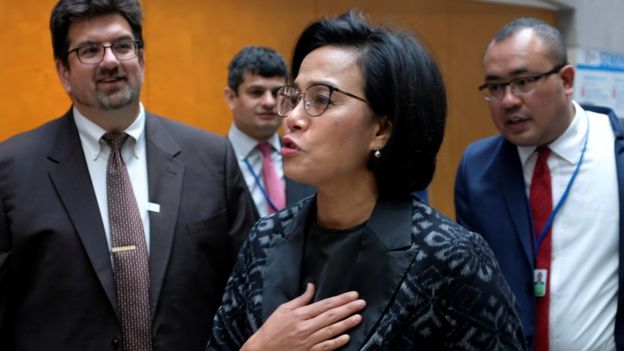
Indonesian Finance Minister Sri MulyaniImage copyrightREUTERS
Image captionIndonesian Finance Minister Sri Mulyani says the current administration has allocated more funds for infrastructure projects than previous governments.

The World Bank estimates that overall, foreign workers made up a fraction, just 0.06%, of Indonesia’s workforce in 2016, significantly less than Singapore, Malaysia and Thailand.

However, there may well be many more Chinese workers in Indonesia than the official tally of work permits suggests, although it’s difficult to know how many.

The Confederation of Indonesian Workers’ Union (KSPI) claims low-skilled Chinese workers are coming in on tourist visas in their hundreds of thousands.

The government also says Indonesian workers benefit from the training they receive from the highly skilled Chinese labour, who eventually return home leaving the local teams to take over.

So, while the available data shows foreign workers from China and elsewhere make up a fraction of the total workforce in Indonesia, the issue remains a divisive and emotional one, easily stirred up during elections.

Source: The BBC
13/04/2019

China targets nuclear fusion power generation by 2040

HEFEI, China (Reuters) – China aims to complete and start generating power from an experimental nuclear fusion reactor by around 2040, a senior scientist involved in the project said, as it works to develop and commercialize a game-changing source of clean energy.

China is preparing to restart its stalled domestic nuclear reactor program after a three-year moratorium on new approvals, but at a state laboratory in the city of Hefei, in China’s Anhui province, scientists are looking beyond crude atom-splitting in order to pursue nuclear fusion, where power is generated by combining nuclei together, an endeavor likened by skeptics to “putting the sun in a box”.

While nuclear fusion could revolutionize energy production, with pilot projects targeting energy output at 10 times the input, no fusion project has up to now created a net energy increase. Critics say commercially viable fusion always remains fifty years in the future.

China has already spent around 6 billion yuan ($893 million) on a large doughnut-shaped installation known as a tokamak, which uses extremely high temperatures to boil hydrogen isotopes into a plasma, fusing them together and releasing energy. If that energy can be utilized, it will require only tiny amounts of fuel and create virtually no radioactive waste.

Song Yuntao, deputy director of the Institute of Plasma Physics at the Hefei Institute of Physical Science, said on Thursday that while technological challenges remain immense, the project has been awarded another 6 billion yuan in funding, and new construction plans are underway.

“Five years from now, we will start to build our fusion reactor, which will need another 10 years of construction. After that is built we will construct the power generator and start generating power by around 2040,” he said at the site, built on a leafy peninsula jutting into a lake.

China has been researching fusion since 1958, but at the current stage, it is still more about international cooperation than competition, Song said. The country is a member of the 35-nation ITER project, a 10-billion euro ($11.29 billion) fusion project under construction in France.

China is responsible for manufacturing 9 percent of ITER’s components, and is playing a major role in core technologies like magnetic containment, as well as the production of components that can withstand temperatures of over 100 million degrees Celsius (180 million degrees Fahrenheit).

ITER is scheduled to generate first plasma by 2025. A demonstration reactor will then be built, with the aim of creating 500 megawatts of power from just 50 megawatts of input, a tenfold return on energy.

Despite the critics who say dependable fusion energy is unrealistic, Song said he was confident breakthroughs are being made.

“Because we have a lot of technology now, a lot of challenges in plasma physics have been overcome, and I think this will speed up the entire process,” he said.

($1 = 6.7188 yuan)

($1 = 0.8859 euros)

Source: Reuters

13/04/2019

Jet Airways halts all international flights

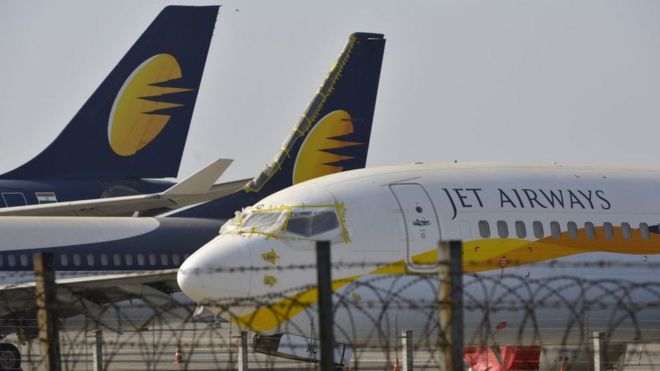
Jet Airways planed parked at Chattrapati Shivaji International Airport in Mumbai on 25 March 2019Image copyrightGETTY IMAGES

Passengers are stranded in India and around the world after Jet Airways suspended all international flights.

Flights from London, Paris and Amsterdam are among those grounded amid fears about the survival of India’s largest private airline.

The airline cancelled all international flights until Monday when, according to reports, it will meet its lenders again to try to secure funding.

Jet Airways is saddled with more than $1bn (£765m) of debt.

It is seeking a financial lifeline to avoid collapse and, on Thursday, grounded 10 planes over unpaid fees to leasing firms .

These were the latest flights to be grounded and it was not clear how many of its fleet of more than 100 planes was still in operation. Local reports suggested that it was barely a dozen.

The airline flies on 600 domestic and 380 international routes – but carriers in India must maintain a fleet of least 20 aircraft to continue to operate international services.

From London, the airline initially confirmed it had cancelled its flights between London, Paris and Amsterdam and India for 12 April, but later said that all international flights would be cancelled between 12 and 15 April.

It said it “regrets the inconvenience caused” to its passengers and was “working to minimise guest inconvenience”.

“In parallel, the airline’s management and its key stakeholders including its consortium of lenders, continue to work closely towards resolving the current situation,” it said.

There was no statement about the status of domestic flights.

Presentational grey line

Wedding party delay

Sandeep Kooner and her three children had been expecting to be on a flight from London to India on Friday evening to attend her niece’s wedding in Punjab.

But the 40 year-old who lives in Walsall will now miss the first few days of the week-long celebrations after her Jet Airways flight was cancelled.

“I had just sat down in the nail salon when I got a text message to say my flight had been cancelled,” she told the BBC.

She has now arranged to fly with Air India, but that will be days later and to Delhi – an eight hour drive to her destination – rather than a local one.

“I’m not 100% sure my problem is 100% sorted,” she says.


‘Necessary steps’

Television channels in India reported that the prime minister’s office had called for an urgent meeting to discuss the airline.

They also reported remarks by government officials saying Jet Airways only had funds to operate six to seven aircraft over the weekend.

India’s Aviation Minister, Suresh Prabhu, had tweeted that his ministry would “review issues related to Jet Airways” and “take necessary steps to minimise passenger inconvenience and ensure their safety”.

The UK’s Civil Aviation Authority said it was aware flights had been suspended.

Jet Airways owes money to employees and suppliers and in recent weeks it has grounded aircraft and cancelled thousands of flights as its financial strains worsened.

The pilots union in India is planning a protest on Saturday and has written to the airline demanding that employees are paid. Staff of the airline were pictured by Priyanka Iyer of Business Television India marching to the company’s headquarters in Mumbai.

Presentational grey line

Rare intervention

By Sameer Hashmi, India business correspondent

In March, when the crisis at Jet Airways led to thousands of flights being cancelled, the government immediately stepped in and asked public sector banks to rescue the private carrier.

It was a rare move. With India holding a national election, Prime Minister Narendra Modi’s government did not want the airline to be grounded as that would have affected 23,000 jobs.

The lenders which took control of the airline have only released a fraction of the amount they had promised so the airline has not been able to pay aircraft leasing companies. This means its fleet has shrunk further from the 100-plus it had at the start of the year.

The lenders have started accepting bids from potential investors, but that process will take a couple of months to complete. And many analysts fear that Jet Airways will not survive even a week if immediate cash is not provided to keep the operations running.

Presentational grey line

Investment sought

The airline was founded by Naresh Goyal more than 25 years ago and he and his family currently own 52% of the airline, although that majority stake is expected to be lost as lenders’ restructure the debt.

A consortium of investors led by the State Bank of India (SBI) took control of the airline in March.

The group is searching for a new investor to acquire a stake of up to 75% in Jet Airways. The deadline for bids had been extended to Friday, according to reports.

Ellis Taylor, deputy Asia editor of Flight Global, told the BBC the airline was in a “precarious position”.

“The interim lifeline that the carrier talked about two weeks ago looks like it won’t materialise any time soon, and that really leaves its future looking bleak,” he said.

There were reports in local media that India’s aviation ministry might review the regulations setting the fleet cap, which could allow the airline to resume international services.

Source: The BBC

13/04/2019

Hundreds participate in march to commemorate Jallianwala Bagh massacre centenary

NEW DELHI (Reuters) – Hundreds of people holding candles and the national flag marched through the northern Indian city of Amritsar on Friday, on the eve of the centenary of the colonial-era Jallianwala Bagh massacre that British Prime Minister Theresa May has called a “shameful scar.”

On April 13, 1919, some 50 British Indian army soldiers began shooting at unarmed civilians who were taking part in a peaceful protest against oppressive laws enforced in the Punjab region.

At least 379 Sikhs were killed, according to the official record, although local residents said in the past the toll was far higher. The massacre took place in the walled enclosure of Jallianwala Bagh, which is still pocked with bullet marks.

The massacre became a symbol of colonial cruelty and for decades Indians have demanded an apology from Britain, including during Queen Elizabeth’s visit to Amritsar in 1997.

On Wednesday, May told the British parliament that “the tragedy of Jallianwala Bagh in 1919 is a shameful scar on British Indian history”, but she did not issue a formal apology.

In 2013, then British Prime Minister David Cameron described the killings as a “deeply shameful event” in a visitor book at the site, now marked by a 46-foot (14-metre) high flame-shaped memorial.

“There are events in the histories of nations which are difficult to forget and they hold a very emotionally charged space in a nation’s memory,” Navtej Sarna, a Sikh who has served as India’s High Commissioner to the United Kingdom, told Reuters.

“We have an excellent relationship with the United Kingdom today but it’s a question of assuaging sentiments and healing a wound which has been festering as part of our shared history.” India gained independence from Britain in 1947.

Security in the city – also home to Sikhism’s holiest shrine the Golden Temple – has been stepped up as hundreds of visitors and groups are likely to arrive at the site, Amritsar Police Commissioner S.S. Srivastava said.

Residents of the city, tourists, visitors, top government officials and students took part in the candle lit evening march from a building called Townhall to the massacre site.

The march of about one kilometre was accompanied by loudspeakers playing patriotic songs and onlookers thronged the roadsides. At the end of the march, people observed a two-minute silence.
Punjab state’s Chief Minister Amarinder Singh and Governor V P Badnore took part in the march while Rahul Gandhi, president of the opposition Congress party, was expected to visit the city later in the evening.
Source: Reuters
11/04/2019

China urges relevant countries to offer fair business environment for enterprises

BEIJING, April 10 (Xinhua) — China on Wednesday urged relevant countries to offer a fair, just and non-discriminatory business environment for enterprises of various countries, including Chinese ones.

Foreign Ministry spokesperson Lu Kang made the remarks at a routine press briefing when asked whether Australia applies double standards on the cybersecurity issue.

Recently, a number of Australian media reported that relevant Australian law mandated communication enterprises install “backdoors” for the Australian government. Google, Apple, Amazon and other technology companies have expressed serious concern about the act, saying it threatens cybersecurity in Australia and the world.

While the Australian side previously claimed that the country does not want any company in its communications networks that have an obligation to any other government. For this reason, Australia banned Huawei from the 5G telecommunications network.

Noting China has been closely following the relevant developments, Lu said the communication market and international cooperation will be seriously affected when it forces enterprises to install “backdoors” by legislation, which builds its own security and interests on the basis of violating other countries’ security and the privacy of their citizens.

“As you can see, the business communities have expressed serious concern about this,” Lu said.

A puzzling thing is that on the one hand, relevant countries use cybersecurity and sensationalize the so-called “security threat” of other countries or enterprises with trumped-up charges. On the other hand, they are doing things that endanger cybersecurity, Lu said.

“I am just as interested as you are in what the Australian government would say,” said the spokesperson.

Emphasizing that China has always attached great importance to and firmly maintained cybersecurity, Lu said that the Chinese side is willing to continue to actively participate in international cooperation in cybersecurity and work with all parties to build a peaceful, secure, open, cooperative and orderly cyberspace.

Source: Xinhua

11/04/2019

Chinese State Councilor calls for enhanced production safety, fire control

CHINA-BEIJING-WANG YONG-PRODUCTION SAFETY-FIRE CONTROL (CN)

Chinese State Councilor Wang Yong (C, back) speaks at a meeting ahead of the central government’s tour of inspection on provincial governments in production safety and fire control in Beijing, capital of China, April 10, 2019. (Xinhua/Ding Haitao)

BEIJING, April 10 (Xinhua) — Chinese State Councilor Wang Yong stressed Wednesday that major accidents must be prevented and contained.

Efforts should be made to stabilize and improve production safety and fire control, Wang said at a meeting ahead of the central government’s tour of inspection on provincial governments in these fields.

The tour of inspection is an important institutional arrangement that focuses on the implementation of the central authorities’ decisions and plans in production safety and fire control, Wang said.

Local governments which failed to rectify their problems and saw recurring accidents will be strictly held accountable, Wang said.

A specific inspection will be held for work related to dangerous chemical products, while checks will be made in coal and non-coal mines, transport, construction and fire control.

Local governments should live up to their supervision duties and take effective prevention measures to fundamentally keep safety accidents from happening, Wang said.

Source: Xinhua

11/04/2019

Guizhou strives to develop clean, efficient electricity industry

GUIYANG, April 10 (Xinhua) — Southwest China’s Guizhou Province will strive to develop a clean and efficient electricity industry, the provincial energy administration said Wednesday.

The province said that it aims to achieve 200 billion yuan (30 billion U.S. dollars) of output value in this field.

To promote the development of clean and efficient power industry, Guizhou will improve the efficiency of existing coal power facilities, speed up energy conservation and emission reduction, and accelerate the development of both coal and power industries.

In 2019, Guizhou will attempt to upgrade 1.8 million kW of coal-fired facilities to realize ultra-low emissions, while 3 million kW of coal-fired facilities are expected to accept energy-saving reconstruction.

The administration said the province would speed up the development of hydropower projects and increase the province’s hydropower capacity.

In addition to hydropower, Guizhou will further develop renewable energy, including wind and solar power. The province aims to add more than 500,000 kW of power in 2019 produced by non-hydro renewable energy.

Source: Xinhua

11/04/2019

Chinese envoy calls for political solution in Venezuela, asks to lift sanctions

UNITED NATIONS, April 10 (Xinhua) — A Chinese envoy on Wednesday called for a political solution to the Venezuela crisis and asked for the lifting of unilateral sanctions against the country.

“China calls on the Venezuelan government and opposition to seek a political solution through dialogue and consultations within the constitutional and legal framework,” Ma Zhaoxu, China’s permanent representative to the United Nations, told the Security Council.

China supports the Venezuelan government’s efforts to safeguard the sovereignty, independence and stability of the country and holds that Venezuelan affairs should be handled independently by the Venezuelan people themselves, said Ma.

China’s position on the Security Council’s involvement in the Venezuela issue has been consistent and clear, he said. “Our point of departure has always been to uphold the spirit of the UN Charter and the basic norms governing international relations, promote a peaceful settlement of the Venezuela issue and maintain long-term peace and development in Latin America.”

“China opposes the interference in Venezuela’s internal affairs by external forces, opposes military intervention in Venezuela and opposes the use of the so-called humanitarian issue to achieve political aims,” said Ma.

He called on relevant countries to lift unilateral sanctions against Venezuela.

History has proven repeatedly that unilateral sanctions will only further complicate situations and affect people’s everyday life. It will not help resolve problems, nor will it bring peace to a country, he said.

“On the one hand, we hear a lot of talk about care for the well-being of Venezuelans. On the other hand, we are seeing increasingly tighter sanctions on the country. They are contradictory and the motive is dubious,” said Ma.

“(We) hope that relevant countries will promptly lift unilateral sanctions against Venezuela, create normal conditions for its economic and social development, and lend help and support to the country in accordance with the basic principles of UN humanitarian assistance.”

He asked the international community to contribute positively to Venezuela’s peace, stability and development.

The peace and stability of Venezuela are in the fundamental interests of the country and its people, and serve the common interests of all parties, Ma said. “We hope the international community will do things that are truly conducive to the stability, economic development, and improved livelihood in Venezuela.”

Under the condition of respect for the sovereignty of Venezuela, the international community should provide constructive assistance to the country and promote a smooth settlement of relevant issues as soon as possible, he said.

The Chinese ambassador said China will continue its cooperation with Venezuela on the basis of mutual respect, equality, mutual benefit, and common development.

To help Venezuelan people overcome temporary difficulties, China has decided to provide emergency supplies for livelihood to Venezuela, said Ma.

Relevant supplies are on their way to Venezuela in batches. On March 29, the first batch of medicines and medical supplies were delivered to the Venezuelan government, he said.

China’s assistance to Venezuela is in keeping with its long-held principles for foreign aid. It is intended to help Venezuelan people overcome negative impacts caused by external interferences and sanctions with no political conditions attached, said the Chinese ambassador.

Source: Xinhua

11/04/2019

China to enhance BRI cooperation with Croatia: premier

CROATIA-ZAGREB-CHINA-LI KEQIANG-PM-TALKS

Chinese Premier Li Keqiang (L, front) attends a grand welcome ceremony held by Croatian Prime Minister Andrej Plenkovic (R, front) at the St. Mark’s Square in Zagreb, Croatia, April 10, 2019. Li held talks with Plenkovic in the Croatian capital of Zagreb on Wednesday. (Xinhua/Shen Hong)

ZAGREB, April 10 (Xinhua) — China is ready to enhance the synergy of the Belt and Road Initiative (BRI) with Croatia’s development strategies, Chinese Premier Li Keqiang said on Wednesday.

Li made the remarks when holding talks with Croatian Prime Minister Andrej Plenkovic in the Croatian capital of Zagreb.

Hailing the long-term friendship between the two countries, Li said China and Croatia have enjoyed a healthy and sound development of bilateral relations since the establishment of diplomatic ties.

He said China stands ready to work with Croatia to strengthen mutually beneficial and win-win cooperation and carry on friendship on the basis of mutual respect, equity and mutual trust, so as to explore new dimensions for bilateral relations and push forward bilateral cooperation to a new level.

On practical cooperation, Li said China is ready to expand the scale of two-way trade, boost the level of two-way investment, and increase the import of Croatian specialty products that suit the demands of the Chinese market, and deepen people-to-people exchanges including culture and tourism.

“China will support its companies to participate in the construction of Croatian ports and railways in line with market principles,” Li said.

The Chinese premier is scheduled to inspect the Peljesac Bridge project with his Croatian counterpart on Thursday. The bridge, which used European Union (EU) standards and funds, is contracted by a Chinese company through bidding.

“The Peljesac Bridge project is a model of tripartite cooperation among China, Croatia and the EU, and realizes mutual benefits and win-win results,” Li said.

Li stressed that the 16+1 cooperation mechanism has played an important role in enhancing cooperation between China and 16 Central and Eastern European Countries (CEEC) and cementing the European integration process.

China appreciates Croatia’s work on facilitating 16+1 cooperation and is ready to make joint efforts with Croatia toward a successful China-CEEC leaders’ meeting, Li said.

This is the first time ever by a Chinese premier to visit Croatia since the establishment of diplomatic ties.

Plenkovic welcomed Li on the visit and said Croatia stands ready to strengthen the understanding of China’s history and culture, share China’s development opportunities, support the building of the Belt and Road so as to benefit the two countries and peoples.

Noting the high-level development of bilateral relations, Plenkovic said Croatia and China will ink a series of cooperation documents during Premier Li’s visit, which demonstrates the latest achievements of practical cooperation between the two sides.

“The Peljesac Bridge is highly rated by the Croatian people and China is Croatia’s important partner on infrastructure construction,” said the Croatian prime minister, adding that Croatia is willing to further enhance cooperation with China in politics, economy, culture, tourism and port infrastructure.

Saying he is looking forward to co-chairing the eighth leaders’ meeting of China-CEEC, Plenkovic also commended positively the outcomes of the 21st China-EU leaders’ meeting and said as an EU member, Croatia stands ready to play an active and constructive role in cementing the development of EU-China ties.

After the meeting, Li and Plenkovic witnessed the signing of multiple bilateral cooperation documents in areas including trade and investment, tourism, quality inspection and sports. The two sides also released a joint communique between the two governments.

Prior to the meeting, Plenkovic held a grand welcome ceremony at the St. Mark’s Square for Li.

Source: Xinhua

11/04/2019

Xi meets with Myanmar’s commander-in-chief of defense services

CHINA-BEIJING-XI JINPING-MYANMAR-MEETING (CN)

Chinese President Xi Jinping (R) meets with Myanmar’s Commander-in-Chief of Defense Services Min Aung Hlaing at the Great Hall of the People in Beijing, capital of China, April 10, 2019. (Xinhua/Li Gang)

BEIJING, April 10 (Xinhua) — Chinese President Xi Jinping met with Myanmar’s Commander-in-Chief of Defense Services Min Aung Hlaing at the Great Hall of the People in Beijing Wednesday.

Noting the long-standing “Paukphaw” (fraternal) friendship between China and Myanmar, Xi spoke of the sound development of bilateral relations at present, the expanding exchanges and cooperation in various fields and at various levels, and new progress in the Belt and Road cooperation.

China attaches great importance to China-Myanmar relations, Xi said, noting that no matter how the international situation changes, China is willing as always to strengthen strategic communication with Myanmar, deepen mutually beneficial cooperation, and constantly enrich the China-Myanmar comprehensive strategic cooperative partnership, so as to bring more tangible benefits to the two peoples and contribute joint efforts to regional stability and prosperity.

Xi said China-Myanmar military cooperation is an important part of the comprehensive strategic cooperative partnership between the two countries.

The armed forces of the two countries should deepen practical exchanges and cooperation, and work together to build a military-to-military relationship based on mutual trust and benefit and devoted to safeguarding the common security and development interests of the two countries, Xi said.

Xi said China supports Myanmar’s peace process and pays attention to the development of situation in northern Myanmar. He expressed the hope that Myanmar will work with China to further strengthen border management and jointly safeguard border security and stability.

Noting the long-standing traditional friendship between Myanmar and China and the sound development of bilateral and military-to-military ties, Min Aung Hlaing said Myanmar appreciates China’s long-term and valuable assistance to the national and military development of Myanmar and the support to its peace process.

He said Myanmar welcomes, supports and stands ready to actively participate in the Belt and Road cooperation, strengthen practical cooperation with China in various fields, and take practical measures to safeguard stability in the Myanmar-China border areas.

Li Zuocheng, member of China’s Central Military Commission (CMC) and chief of staff of the Joint Staff of the CMC, and other officials were present at the meeting.

Source: Xinhua

Law of Unintended Consequences

continuously updated blog about China & India

ChiaHou's Book Reviews

continuously updated blog about China & India

What's wrong with the world; and its economy

continuously updated blog about China & India
