Archive for ‘Chinese civilization’

07/05/2020

Xinhua Headlines: Archaeological findings provide key proof of Chinese civilization origin

— Chinese archaeologists announced significant achievements at the Shuanghuaishu site in central China’s Henan Province, providing key proof of the origin of the over 5,000-year-long Chinese civilization.

— With an area of 1.17 million square meters, the Shuanghuaishu site, dating back to around 5,300 years, is located on the south bank of the Yellow River in the township of Heluo, Gongyi City, and was proposed to be named “Heluo kingdom.”

— A large number of relics of the Yangshao Culture dating back 5,000 to 7,000 years have been discovered at the site.

by Xinhua writers Xu Ruiqing, Wang Ding, Gui Juan, Shuang Rui

ZHENGZHOU, May 7 (Xinhua) — Chinese archaeologists announced Thursday significant achievements at the Shuanghuaishu site in central China’s Henan Province, providing key proof of the origin of the over 5,000-year-long Chinese civilization.

With an area of 1.17 million square meters, the Shuanghuaishu site is located on the south bank of the Yellow River in the township of Heluo, Gongyi City.

The ancient city relic dating back to around 5,300 years ago was proposed by Chinese archaeologists to be named “Heluo kingdom” after its location in the center of the Heluo area, where the Yellow River (known as He in ancient China) and the Luohe River meet.

“The Shuanghuaishu site is the highest-standard cluster with the nature of a capital city discovered so far in the Yellow River basin in the middle and late stage of Yangshao Culture, the early stage of the formation of Chinese civilization,” said Li Boqian, a professor at Peking University, at a press conference on major archaeological discoveries at Shuanghuaishu site held Thursday in Zhengzhou, the provincial capital.
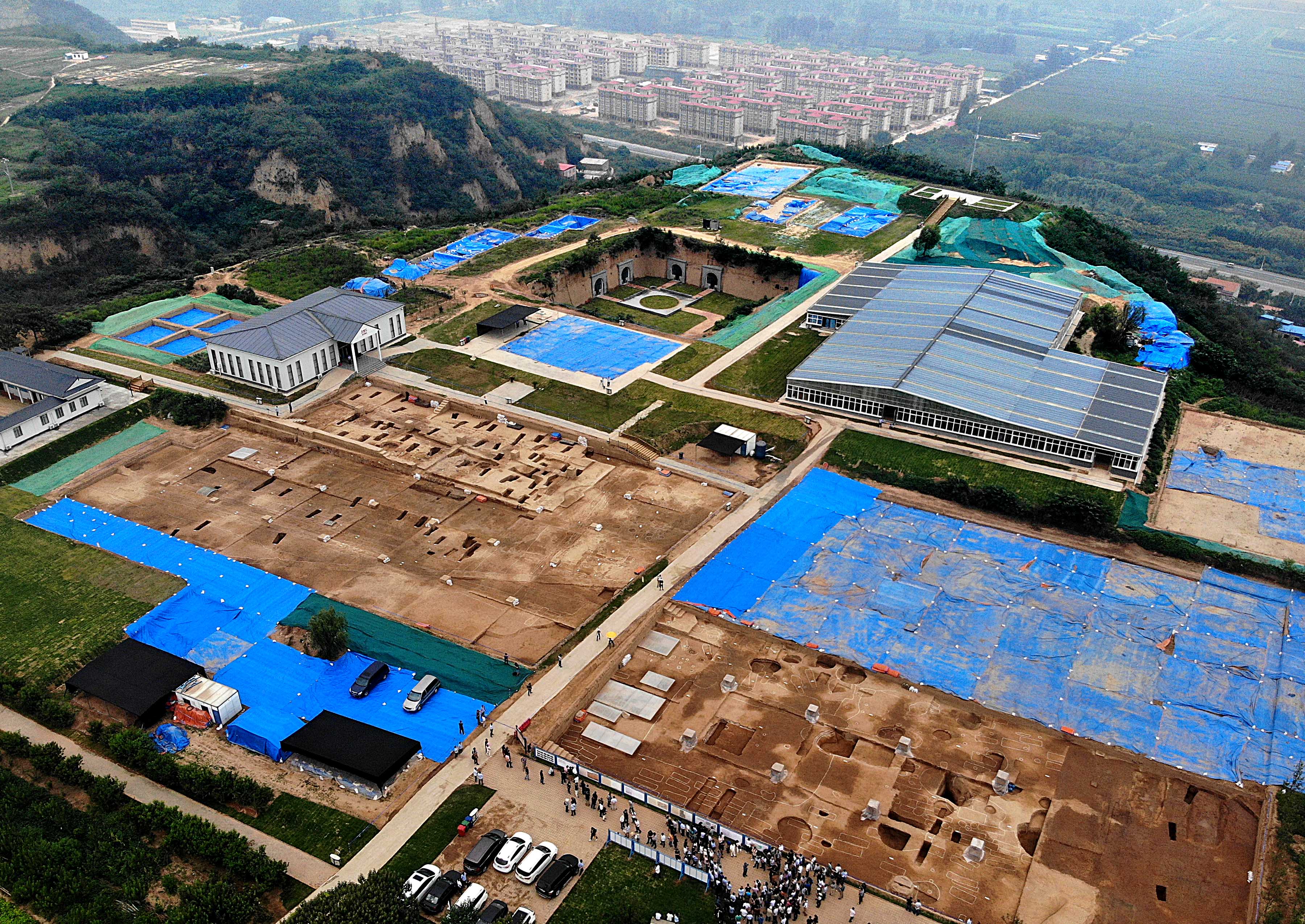
Aerial photo taken on Aug. 27, 2019 shows the Shuanghuaishu site in central China’s Henan Province. (Xinhua/Li An)

A large number of relics of the Yangshao Culture dating back 5,000 to 7,000 years have been discovered at the site, said Gu Wanfa, director of the Zhengzhou Municipal Research Institute of Cultural Relics and Archaeology, at the press conference.

“The important archaeological findings provide key proof of the origin of Chinese civilization, and also prove the representativeness and influence of the Heluo area in the golden stage of the origin of Chinese civilization around 5,300 years ago,” said Wang Wei, a member of the Chinese Academy of Social Sciences.

Since 2013, the Zhengzhou Municipal Research Institute of Cultural Relics and Archaeology and the Institute of Archaeology of the Chinese Academy of Social Sciences have conducted continuous archaeological excavations on the site.

According to archaeologists, the Shuanghuaishu site was about 1,500 meters long from east to west and 780 meters wide from north to south. It was surrounded by three ring trenches with each found to have external access, forming a strict defense system.

Aerial photo taken on Aug. 27, 2019 shows the Shuanghuaishu site in central China’s Henan Province. (Xinhua/Li An)

The central residential area with four rows of houses was found in the northern part of the inner ring moat. Meanwhile, three public cemeteries with more than 1,700 tombs, three sacrificial remains, an astronomical relic, a pottery workshop area, a water storage area, a road system, and other facilities were also discovered at the city ruins.

“The Shuanghuaishu site was a well-selected and scientifically planned settlement site,” said Wang.

“Based on the geographical location and scale, it’s also the only large-scale city settlement discovered so far in the Yellow River basin from the middle and late stage of Yangshao Culture,” Wang added.

Archaeologists believe that the Heluo kingdom was the source of many typical characteristics of Chinese civilization.

Silk originated in China and later became one of the country’s major trade items. “The mulberry-growing and silkworm-raising culture was an important component of Chinese civilization,” said Li.

Among the unearthed relics at Shuanghuaishu, a boar tusk carving of a silkworm, 6.4 cm long, nearly 1 cm wide and 0.1 cm thick, was believed to be China’s earliest carving depicting silkworms.

Undated photo shows a boar tusk carving of a silkworm unearthed at the Shuanghuaishu site in central China’s Henan Province. (Xinhua)

Experts say that the carving depicts a spinning silkworm which is quite similar to modern silkworms in appearance. “The spinning shape of the carving suggests that ancient Chinese people were familiar with the habits of silkworms,” said Gu.

Along with silk fabrics unearthed at the surrounding Wanggou site and Qingtai site, archaeologists said they are solid evidence to prove that the ancient Chinese in the Yellow River basin began raising silkworms and silk production around 5,300 years ago.

“Except Shuanghuaishu and its surrounding settlement sites, there were no definite discoveries from around 5,300 years ago related to the silk textile industry in other parts of the country,” said Li. “In that sense, they are the earliest representatives in the development history of Chinese mulberry cultivation and silkworm-rearing culture.”

Meanwhile, at the astronomical relic at Shuanghuaishu, nine pottery pots were arranged in the pattern of the nine stars of the Big Dipper, which shows that the ancestors of Heluo had relatively mature astronomical knowledge.

Photo taken on April 28, 2020 shows one of nine pottery pots arranged in the pattern of the nine stars of the Big Dipper, at an astronomical relic at the Shuanghuaishu site in central China’s Henan Province. (Xinhua/Li An)

“The relic also indicates the worship of the celestial body may have formed a grand sacrificial ceremony for observing the solar terms and praying for a good harvest,” said Gu.

Experts also believe the astronomical relic and the surrounding sacrificial remains constitute a whole, which is consistent with the records of winter solstice sacrifices in ancient Chinese documents. “It is of great significance to the study of early Chinese astronomy and the origin of Chinese civilization,” added Gu.

Source: Xinhua

23/02/2020

Xi sends reply letter to U.S. elementary school students

BEIJING, Feb. 22 (Xinhua) — Chinese President Xi Jinping has written back to a group of U.S. elementary school students, encouraging them to continue their efforts to learn Chinese language and culture and contribute to promoting friendship between the two peoples.

On the eve of the Spring Festival, 50 fourth-grade students from Cascade Elementary School in the U.S. state of Utah wrote New Year cards to Xi in Chinese, telling him about their Chinese language learning and personal hobbies, expressing their love for China and Chinese culture as well as their hope for a chance to visit China, and wishing “Grandpa Xi” a happy New Year.

In his reply letter dated Feb. 15, Xi told the children that like the United States, China is a big country, that the Chinese civilization has a history of more than 5,000 years, and that the Chinese people are as hospitable as the American people.

He added that they can learn more about Chinese history and culture by learning the Chinese language, which is used by more than 1 billion people around the world.

Xi said he is pleased to see those students write and learn Chinese so well, and hopes that they will continue to work hard, make greater progress and become young ambassadors for the friendship between the two peoples.

Established in 1967, the public school is one of the first schools in Utah to offer a Chinese immersion program, which involves more than half of its students. Utah has one-fifth of all Chinese language learners in the United States. The state’s Chinese immersion program began in 2009 and is now available in 76 elementary and secondary schools.

Source: Xinhua

02/11/2019

Xi congratulates 120th anniversary of oracle bone inscription discovery, research

BEIJING, Nov. 2 (Xinhua) — Chinese President Xi Jinping has sent a congratulatory letter on the 120th anniversary of the discovery and research of oracle bone inscriptions.

Xi, also general secretary of the Communist Party of China (CPC) Central Committee and chairman of the Central Military Commission, stressed enhancing cultural confidence and promoting exchanges and mutual learning among civilizations in the letter.

Xi extended congratulations to experts and scholars who have long been dedicated to the preservation and promotion of fine traditional culture such as oracle bone inscriptions.

The discovery of the oracle bone inscriptions from Yin Ruins is of epoch-making significance in Chinese civilization and even human civilization, Xi said.

Oracle bone inscriptions are considered the origin of Chinese characters and represent the oldest fully-developed system of characters discovered in China so far.

Xi described oracle bone inscriptions as the roots of fine traditional Chinese culture that merits even better preservation and development.

Over the past 70 years, the Party and the state have attached great importance to the preservation and development of fine traditional Chinese culture represented by oracle bone inscriptions, Xi said.

Noting the remarkable progress in the study of oracle bone inscriptions, Xi stressed efforts to continue such research of ancient characters.

He called on researchers to further explore the historic and cultural values of oracle bone inscriptions and promote exchanges and mutual learning among civilizations.

On Friday, a symposium was held at the Great Hall of the People to mark the 120th anniversary of the discovery and research of oracle bone inscriptions. Xi’s letter was read at the symposium.

Vice Premier Sun Chunlan, also a member of the Political Bureau of the CPC Central Committee, addressed the symposium, calling for earnest implementation of Xi’s instructions, and better research and preservation efforts of oracle bone inscriptions.

She spoke of the need to use technologies such as artificial intelligence recognition to push for new breakthroughs in the research.

Discovered in 1899, oracle bone inscriptions are considered one of the world’s four ancient characters and have been included in the UNESCO Memory of the World Register.

Source: Xinhua

25/10/2019

Xi stresses role of traditional Chinese medicine for “Healthy China”

BEIJING, Oct. 25 (Xinhua) — Chinese President Xi Jinping has underlined the important role of traditional Chinese medicine (TCM) in building “Healthy China.”

The country should carry on fine elements in TCM and innovate them, Xi said in a recent instruction, stressing that traditional medicine is a treasure of Chinese civilization embodying the wisdom of the nation and its people.

Xi’s instruction was delivered at a national conference of TCM held Friday in Beijing.

Xi said that equal importance should be placed on traditional Chinese and Western medicines and efforts be made to enable them to supplement each other and prosper together.

He also underlined the efforts to promote TCM internationally and fully develop its unique strength in preventing and treating diseases.

In an instruction also delivered at the conference, Premier Li Keqiang called TCM a great creation of the Chinese nation.

Li stressed promoting talent training, scientific and technological innovation, and research and development of medicines.

He required efforts to promote preservation, innovation and high-quality development of TCM so that it will contribute to the improvement of people’s health and wellbeing.

Addressing the event, Vice Premier Sun Chunlan pledged to thoroughly implement the leaders’ instructions.

People who made outstanding contribution to TCM development were awarded at the conference.

Source: Xinhua

20/10/2019

Discover China: Erlitou Relic Museum opens in central China

CHINA-HENAN-LUOYANG-ERLITOU RELIC MUSEUM-OPEN (CN)

A visitor views an exhibit at the Erlitou Relic Museum in Luoyang, central China’s Henan Province, Oct. 19, 2019. The Erlitou Relic Museum, which exhibits the history of ancient China’s first recorded dynasty of Xia (2070-1600 B.C.), opened Saturday in Luoyang. It exhibits over 2,000 items, including bronze wares, pottery wares and jade wares. Covering an area of 32,000 square meters, the museum exhibits the history of the Xia Dynasty, the first dynasty recorded in ancient China. Construction of the museum cost 630 million yuan (about 89 million U.S. dollars). The Erlitou Relics date back to 3,500 to 3,800 years ago in ancient China’s late Xia or early Shang (1600-1046 B.C.) dynasties. (Xinhua/Li An)

ZHENGZHOU, Oct. 19 (Xinhua) — The Erlitou Relic Museum opened Saturday in Luoyang city in central China’s Henan Province, unveiling the history and culture of ancient China’s first recorded dynasty of Xia (2070-1600 B.C.).

Covering an area of 32,000 square meters, the museum exhibits over 2,000 items, including bronze wares, pottery wares and jade wares.

Construction of the museum cost 630 million yuan (about 89 million U.S. dollars).

The Erlitou Relics date back to 3,500 to 3,800 years ago in ancient China’s late Xia or early Shang (1600-1046 B.C.) dynasties.

Discovered in 1959 in Luoyang by historian Xu Xusheng, Erlitou was identified by Chinese archaeologists as the relics of the capital city of the middle and late Xia Dynasty.

Over the past 60 years, archaeologists have excavated over 10,000 items out of a total area of 40,000 square meters from the site.

Zhao Haitao from the Chinese Academy of Social Sciences (CASS) Erlitou archaeological team, said that China’s earliest palace complex, bronze ware workshop and urban road network were all found at the site.

The museum has three display areas where visitors can experience and better understand the archaeological achievements of the Xia Dynasty, and probe into the history and culture of the Xia Dynasty via various kinds of projects, such as virtual reality, embossment and sand tables.

Li Boqian, a professor with the School of Archaeology and Museology of Peking University, said the Erlitou Relic Museum presents daily utensils, manufacturing tools and decorations for visitors to understand the social development, history and culture of the Xia Dynasty.

The museum will help people around the world learn about ancient Chinese history and culture, said Liu Yuzhu, director of China’s National Cultural Heritage Administration, at the opening ceremony.

In addition, the museum will become a demonstration site for the protection, preservation and exhibition of China’s major cultural heritage sites and a research center for the origin of Chinese civilization.

Source: Xinhua

20/09/2019

Xi Focus: Xi stresses ecological protection and high-quality development of Yellow River

CHINA-HENAN-XI JINPING-SYMPOSIUM-YELLOW RIVER PROTECTION AND DEVELOPMENT (CN)

Chinese President Xi Jinping, also general secretary of the Communist Party of China Central Committee and chairman of the Central Military Commission, chairs and addresses a symposium on the ecological protection and high-quality development of the Yellow River in Zhengzhou, capital of central China’s Henan Province, Sept. 18, 2019. (Xinhua/Ju Peng)

ZHENGZHOU, Sept. 19 (Xinhua) — Chinese President Xi Jinping called for concerted efforts to promote ecological protection and high-quality development of the Yellow River.

Xi, also general secretary of the Communist Party of China Central Committee and chairman of the Central Military Commission, made the remarks while chairing a symposium Wednesday during his inspection tour to Henan Province.

NATIONAL STRATEGY

“The protection of the Yellow River is critical to the great rejuvenation and sustainable development of the Chinese nation,” said Xi, adding that it is a major national strategy.

Noting that the peace of the Yellow River is significant to the stability of China, Xi said Chinese people have struggled against the floods and droughts of the Yellow River since ancient times, and the Party and the state have attached great importance to the harnessing and development of the Yellow River after the founding of New China in 1949.

Originating in Qinghai Province, the Yellow River, known as China’s “Mother River” and the cradle of the Chinese civilization, runs through nine provinces and autonomous regions including Shaanxi and Henan before emptying into the Bohai Sea in east China’s Shandong Province.

The river got its name Huanghe in Chinese because of its yellow, muddy water, which appears as it runs through the Loess Plateau in northwest China.

The 5,464-km-long waterway feeds about 12 percent of China’s population, irrigates about 15 percent of arable land, supports 14 percent of national GDP, and supplies water to more than 60 cities.

Xi also pointed out difficulties and problems in protecting the Yellow River, including fragile ecological environment, severe condition of the water resources preservation and development quality that needs to be improved.

SOUL OF CHINESE NATION

Calling for strengthened protection of the ecological environment of the Yellow River basin, Xi said that differences between the upper, middle and lower reaches of the river should be fully considered, given that the Yellow River ecosystem is an organic whole.

Further efforts should be made to ensure the long-term stability of the Yellow River, Xi said, stressing that although the river has not seen major dangers for many years, we should not relax vigilance.

Over the past 2,500 years, the Yellow River has broken its dikes 1,600 times and has made 26 major changes in its course in the lower reaches.

Xi also stressed better use of water resources, with rational planning of the population, urban and industrial development to resolutely curb unreasonable water demand.

When pursuing high-quality development in the region, authorities should actively explore new ways with regional characteristics and participate in the construction of the Belt and Road to promote higher level of opening-up, Xi noted.

Meanwhile, Xi called for preserving, inheriting and carrying forward the Yellow River culture.

“The Yellow River culture, as an important part of the Chinese civilization, is the root and soul of the Chinese nation,” Xi said, calling for telling well the “Yellow River story” to pool spiritual strength for the realization of the Chinese dream of the great rejuvenation of the Chinese nation.

For over 3,000 years, some major dynasties in Chinese history built their capitals in the river basin, making the region the centers of politics, economy and culture in the country.

The Yellow River witnessed the birth of the four era-defining inventions in ancient China — printing techniques, papermaking, gunpowder and the compass, which all emerged in the drainage basin.

At Wednesday’s meeting, Vice Premier Han Zheng, also a member of the Standing Committee of the Political Bureau of the Communist Party of China Central Committee called for efforts to earnestly study and implement the spirit of Xi’s speech and strive to make new progress in the ecological protection and high-quality development of the Yellow River basin.

Source: Xinhua

Law of Unintended Consequences

continuously updated blog about China & India

ChiaHou's Book Reviews

continuously updated blog about China & India

What's wrong with the world; and its economy

continuously updated blog about China & India