Chindia Alert: You’ll be Living in their World Very Soon
aims to alert you to the threats and opportunities that China and India present. China and India require serious attention; case of ‘hidden dragon and crouching tiger’.
Without this attention, governments, businesses and, indeed, individuals may find themselves at a great disadvantage sooner rather than later.
The POSTs (front webpages) are mainly 'cuttings' from reliable sources, updated continuously.
The PAGEs (see Tabs, above) attempt to make the information more meaningful by putting some structure to the information we have researched and assembled since 2006.
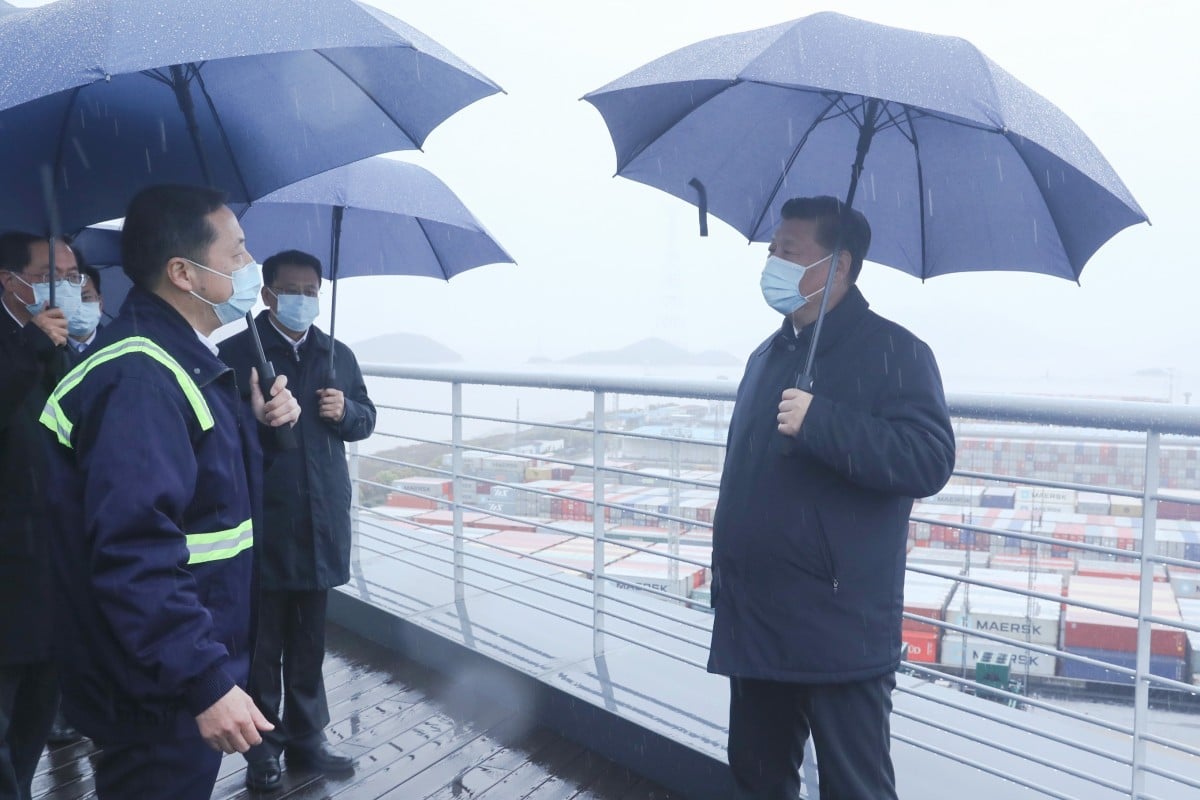
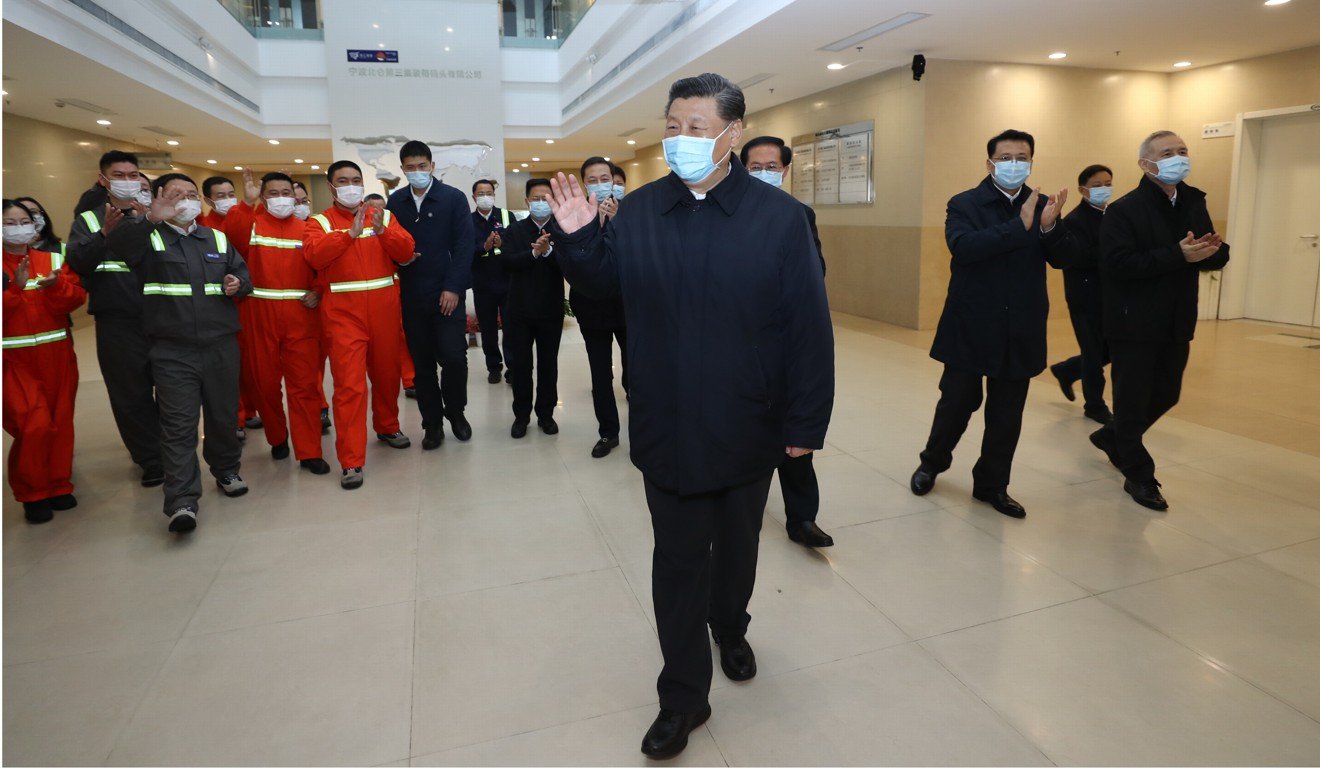
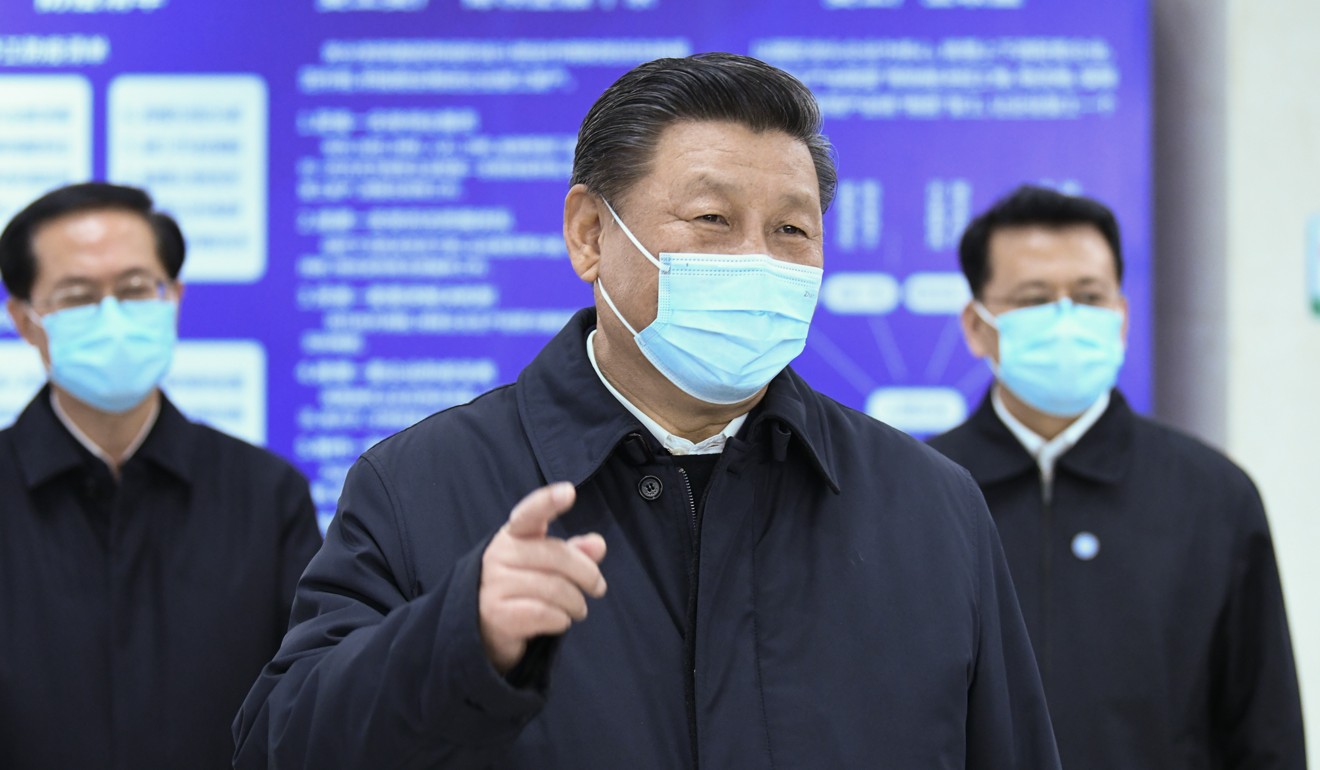
visited the industrial powerhouse of Zhejiang province on Sunday in a move state media described as a clear message the country was ready to get the economy back on track amid the “new normal” of dealing with the coronavirus.
The trip, to Ningbo – one of the world’s busiest ports and a trade hub for eastern China – was Xi’s first outside Beijing since he visited Wuhan, the initial epicentre of the Covid-19 outbreak, earlier in the month.
As well as a visiting the port, he spoke to workers at an industrial zone for car part manufacturers, where he learned about the latest efforts to restart production, Xinhua said in a brief report.
The visit came after two months of almost total lockdown in many parts of the country that disrupted businesses, transport and people’s daily lives, and ground the economy to a near standstill.
While local transmissions of the coronavirus in China appear to be under control, Beijing has implemented strict measures to prevent imported cases, including slashing international flights and banning most foreigners from entering the country.
In a separate report, Xinhua said Xi’s visit sent “a clear message” that China was resuming its industrial production and social activities, and described the fight against the coronavirus as the “new normal”.
Reviving the economy and battling a deadly disease were Xi’s “two tough battles”, it said.
Xi’s choice of destination was a clear message that restarting the economy is a top priority. Photo: Xinhua
Zhejiang is something of a power base for Xi, who spent nearly five years there during his climb through the ranks of the Communist Party.
One of the country’s biggest trading hubs, the province generated 3 trillion yuan (US$423.2 billion) in foreign trade last year, or more than 13 per cent of the national total, according to official figures.
“It’s a highly export-oriented economy … which has made it crucial not only to China’s development plan but also to safeguarding the stability of the global supply chain,” Xinhua said.
Observers said Xi’s visit was evidence of Beijing’s determination to get the economy back up and running as soon as possible.
Zhao Xijun, an economics professor at Renmin University, said Ningbo was a key part of the export economy and a base for many local and foreign entrepreneurs.
“It is a clear signal that China, after getting domestic infections under control, is now prioritising economic growth,” he said.
“It also shows the country will keep developing its economy and opening up its markets.”
But hopes of a quick recovery for the Chinese economy have been dashed by the spread of the coronavirus across Europe and the United States, causing a sharp decline in demand for Chinese goods.
Xi spent five years in Zhejiang while climbing the ranks of the Communist Party. Photo: Xinhua
In a meeting on Friday, the Communist Party’s Politburo said it would step up macroeconomic policy adjustments and pursue a more proactive fiscal policy while optimising measures to control the coronavirus to speed up the restoration of production, doing whatever it could to “minimise the losses caused by the epidemic”.
“China has successfully reopened much of its economy from the extremes of the coronavirus lockdown, but now faces a new problem: an impending collapse in demand for its exports as its customers go into lockdowns of their own,” Gavekal Dragnomics said in a research report.
“That shock to industry and manufacturing employment means that China will not enjoy the hoped-for V-shaped recovery in growth.”
Negotiations going ‘as planned’, foreign ministry says after cancellation of Apec summit at which presidents were set to meet to sign ‘phase-one’ agreement
With an election looming and possible impeachment inquiry, Trump in more of a hurry to reach a deal than Xi, observers say
Talks between China and the US are going well, according to the Chinese foreign ministry. Photo: AFP
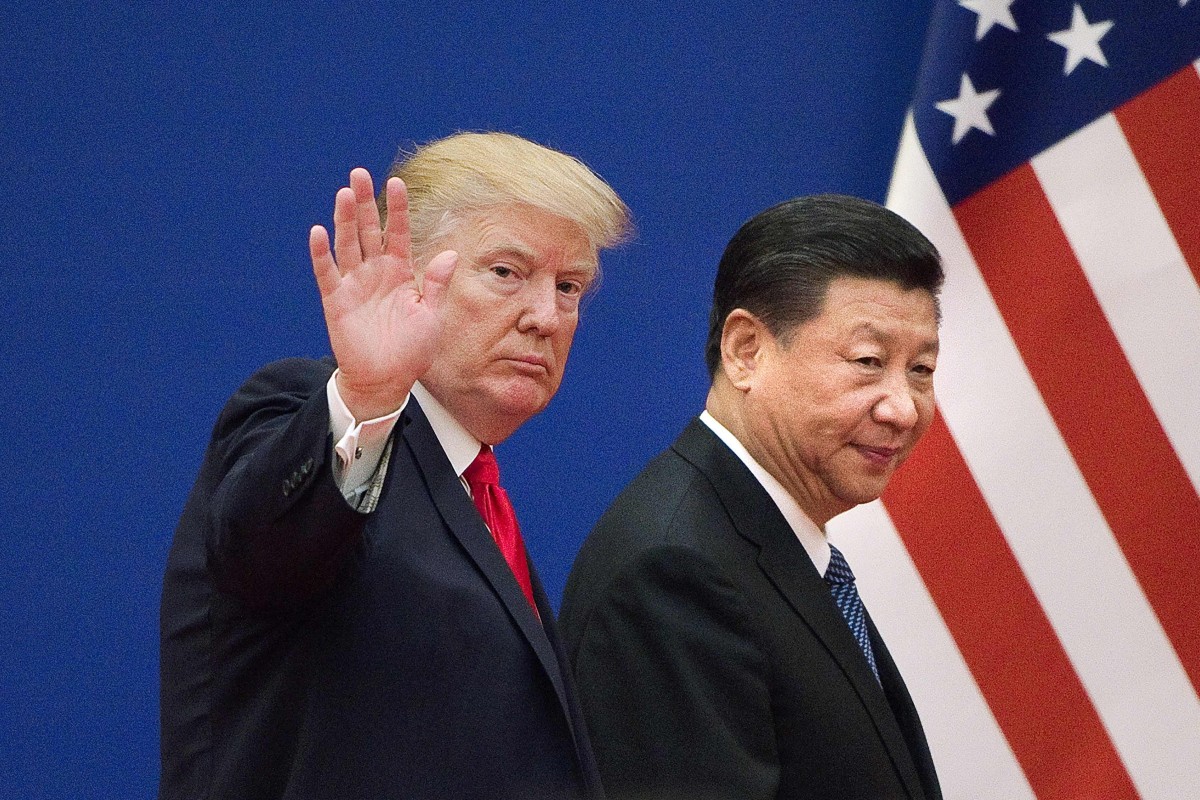
Presidents Xi Jinping and Donald Trump have “maintained contact”, China’s foreign ministry said on Thursday after authorities in Chile announced the cancellation of the upcoming Apec summit at which the US and Chinese leaders were set to meet and possibly sign a trade deal.
Talks between the two nations were going well, ministry spokesman Geng Shuang told a daily press briefing.
“The negotiations are smooth and things are working out as planned,” he said.
“Regarding the meeting between the two state leaders, they have maintained contact through various means.”
Geng’s comments came after China’s commerce ministry said that top trade negotiators from the two countries would hold a telephone conversation on Friday.
Xi and Trump were due to meet on the sidelines of the Asia-Pacific Economic Cooperation summit in Santiago on November 16-17, but the event was cancelled due to the ongoing protests in the country. The leaders were also expected to sign an interim trade deal based on the ground made at the latest negotiations in Washington on October 11.
According to diplomatic observers, while Beijing wants a truce in the trade dispute it is in less of a hurry than Trump, who is facing the threat of impeachment and trying to prepare for an election campaign.
Shen Dingli, an expert in international relations based in Shanghai, said that China faced less domestic opposition to its handling of the trade talks than Washington.
“Trump is facing a lot of problems on both the diplomatic and domestic fronts,” he said. “[But] I think both sides still need an agreement. It is always better to have an agreement than not.”
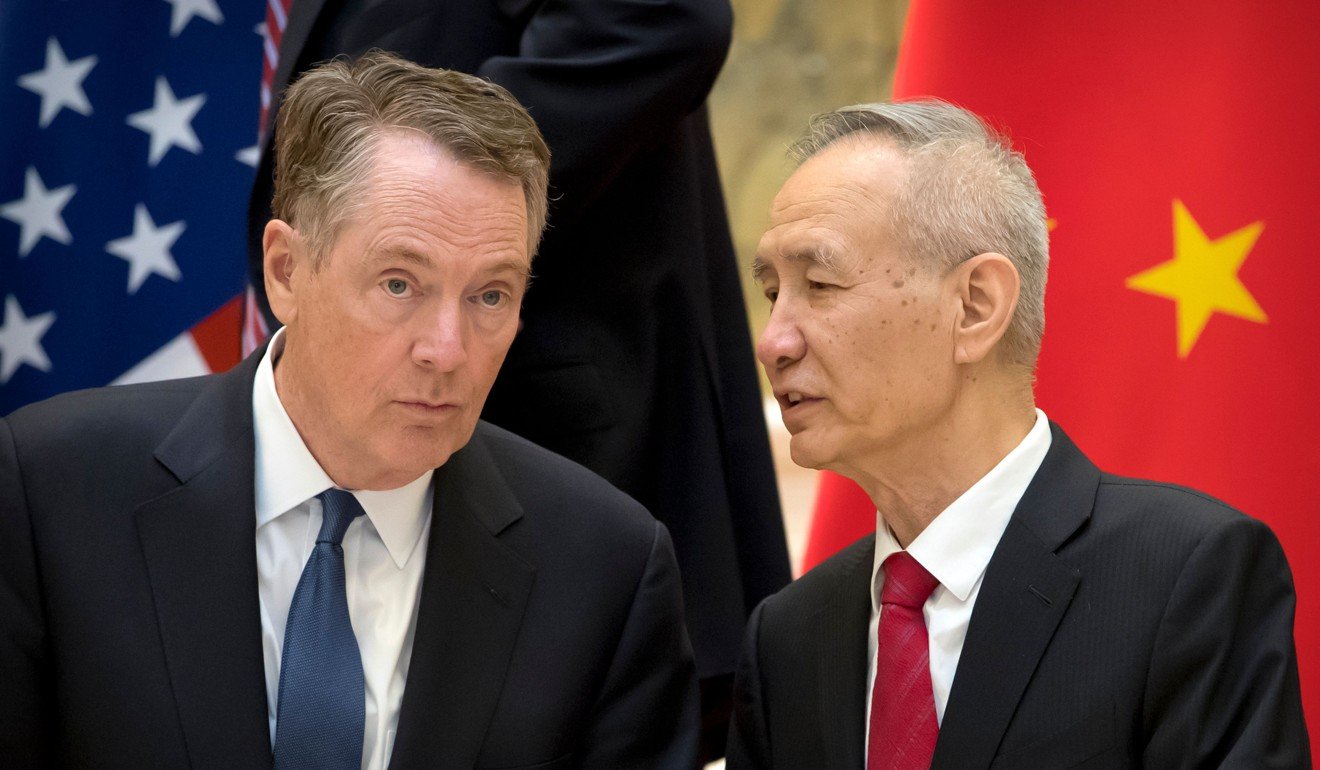
US Trade Representative Robert Lighthizer (left) and Chinese Vice-Premier Liu He met in Washington early this month. Photo: AFP
Yuan Zheng, an expert on China-US relations at the Chinese Academy of Social Sciences, said that while the Apec summit had offered a convenient way for the presidents to meet, the substance of the deal was more important than where it might be signed.
“It’s true that the deal can be signed by representatives instead of the presidents but this depends very much on how keen Trump is for the presidential meeting to happen,” he said.
“He is facing an election and huge domestic pressure, so he … needs to show his strong leadership more than Xi. But of course, if the deal is set and if the details of the meeting are practical, the Chinese side would like a presidential meeting too.”
Shen Dingli, an expert in international relations, says China faces less domestic opposition to its handling of the trade talks than Washington. Photo: AP
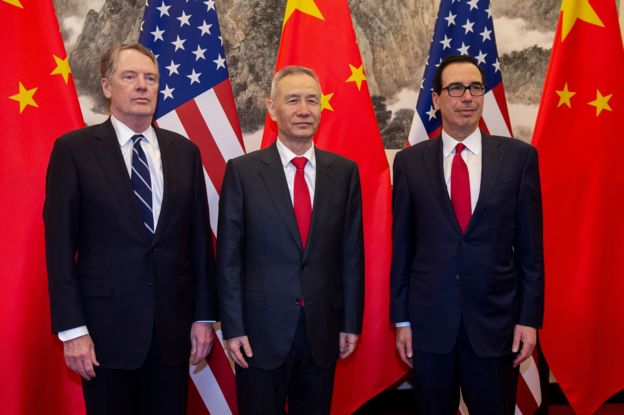
Speaking after the talks in Washington between Chinese Vice-Premier Liu He, US Trade Representative Robert Lighthizer and US Treasury Secretary Steven Mnuchin, Trump said the two sides had reached a “substantial phase one deal” and that after it had been put down on paper it would be signed at the Apec meeting.
Tai Hui, chief market strategist for Asia at JPMorgan Asset Management, said the cancellation of the Chile summit should not stop the US and China agreeing a truce.
“If the two sides are genuinely willing to reach an interim deal before mid-December, when the next increase in tariffs on Chinese goods is due to take place, they will find a venue to get it done,” he said.
Li Zhanshu (L), chairman of the Standing Committee of the National People’s Congress of China, meets with Azerbaijani President Ilham Aliyev in Baku, Azerbaijan, Sept. 19, 2019. Li paid an official goodwill visit to Azerbaijan from Sept. 19 to 21 at the invitation of Ogtay Asadov, speaker of the National Assembly of Azerbaijan. (Xinhua/Pang Xinglei)
BAKU, Sept. 21 (Xinhua) — Li Zhanshu, chairman of the Standing Committee of the National People’s Congress (NPC) of China, and top Azerbaijani officials have agreed here to strengthen bilateral cooperation in various areas.
During an official goodwill visit from Thursday to Saturday, Li met with Azerbaijani President Ilham Aliyev and conveyed Chinese President Xi Jinping’s cordial greetings to him.
Li briefed Aliyev on the great achievements of the People’s Republic of China since its founding 70 years ago, saying that the Communist Party of China is forging ahead on the road of socialism with Chinese characteristics in line with China’s national conditions.
The socialism with Chinese characteristics has now entered a new era, and China under the leadership of Xi is striving to achieve its “two centenary goals” and realize the Chinese dream of the great rejuvenation of the Chinese nation, Li told Aliyev.
China deems Azerbaijan as an important partner in Eurasia and is ready to implement the blueprint made by Xi and Aliyev on the development of bilateral ties, further cement political mutual trust, strengthen practical cooperation in various areas, and jointly safeguard the two countries’ security and development interests, Li said.
Aliyev asked Li to convey his best wishes to Xi and said he had witnessed the great changes in China with his own eyes during his repeated trips to the country and that he admired such achievements.
Azerbaijan-China relations are developing rapidly with a rosy future, he said, adding that his country firmly adheres to the one-China principle, and intends to combat jointly with China the “three forces” of terrorism, separatism and extremism, and improve their coordination and cooperation on international and regional issues.
LEGISLATIVE EXCHANGES
During a meeting with Ogtay Asadov, speaker of the National Assembly of Azerbaijan, Li said his visit was aimed at strengthening cooperation between the two legislatures and implementing the important consensuses reached by the two heads of state.
The Chinese top legislator suggested both sides increase interactions at various levels, exchange experience on governing the countries, and provide legal assurance for bilateral practical cooperation.
Every country has a unique history, national situation and culture, so different civilizations should coexist harmoniously and learn from each other, Li said.
The NPC of China is willing to work with the National Assembly of Azerbaijan to promote cultural and people-to-people exchanges between the two countries, learn from each other, and cement public support for bilateral relations, he said.
Asadov said Li was the first top Chinese legislator to visit Azerbaijan in 19 years and that the trip has injected new vitality into the development of bilateral relations and the interactions between the two legislatures.
Azerbaijan and China have signed many cooperation deals and the two legislatures should help to deliver on the agreements, Asadov said.
An increasing number of Azerbaijani people are interested in Chinese culture and there is a need to promote educational, cultural and youth exchanges, he said.
ECONOMIC COOPERATION
At a meeting with Azerbaijani Prime Minister Novruz Mammadov, Li said Azerbaijan is located at the junction of Europe and Asia and is an important country along the Belt and Road.
Li said China is ready to boost economic and trade exchanges with Azerbaijan and enhance cooperation with the country in jointly building the Belt and Road and achieve more cooperation outcomes in such fields as energy, agriculture, transportation, logistics, tourism and informatization.
He welcomed Azerbaijan to the second China International Import Expo to be held in early November in Shanghai.
Mammadov said his country was among the earliest participants in the Belt and Road Initiative and is ready to expand cooperation with China in various areas.
He welcomed more Chinese investments in Azerbaijan and expected cooperation with China on the construction of a Trans-Caspian International Transport Corridor so that more Chinese goods can hit the Eurasian market via Azerbaijan.
During his stay in Baku, Li also visited the Heydar Aliyev Center and a carpet museum, and laid a wreath at the tomb of former President Heydar Aliyev and the Eternal Flame.
The US has more than doubled tariffs on $200bn (£153.7bn) worth of Chinese products, in a sharp escalation of the countries’ damaging trade war.
Tariffs on affected Chinese goods have risen to 25% from 10%, and Beijing has vowed to retaliate.
China says it “deeply regrets” the move and will have to take “necessary counter-measures.”
It comes as high-level officials from both sides are attempting to salvage a trade deal in Washington.
Only recently, the US and China appeared to be close to ending months of trade tensions.
China’s Commerce Ministry confirmed the latest US tariff increase on its website.
“It is hoped that the US and the Chinese sides will work together… to resolve existing problems through co-operation and consultation,” it said in a statement.
Tariffs are taxes paid by importers on foreign goods, so the 25% tariff will be paid by American companies who bring Chinese goods into the country.
Even though Mr Trump has downplayed the impact of tariffs on the US economy, the rise is likely to affect some American companies and consumers as firms may pass on some of the cost, analysts said.
Deborah Elms, executive director at the Asian Trade Centre, said: “It’s going to be a big shock to the economy.
“Those are all US companies who are suddenly facing a 25% increase in cost, and then you have to remember that the Chinese are going to retaliate.”
Image copyright GETTY IMAGESImage caption US and Chinese officials have held several round of talks in an attempt to strike a deal to end the trade war.
In a statement, the American Chamber of Commerce in China said it was committed to helping both sides find a “sustainable” solution.
“While we are disappointed that the stakes have been raised, we nevertheless support the ongoing effort by both sides to reach agreement on a strong, enforceable deal that resolves the fundamental, structural issues our members have long faced in China.”
French Finance Minister Bruno Le Maire warned that the trade dispute escalation threatened jobs across Europe.
“There is no greater threat to world growth,” Mr Le Maire told CNews. “It would mean that trade tariffs go up, fewer goods would circulate around the world… and jobs in France and in Europe would be destroyed.”
‘Serious escalation’ of the trade war
No breakthrough, and no deal – just, more tariffs.
With this move, US President Donald Trump has effectively dealt a fresh blow to not just the Chinese economy – as he had presumably hoped – but also to US’s.
The previous set of tariffs of 10% on $200bn of Chinese goods have to some extent been absorbed by American importers, but economists say a 25% tariff will be much harder for them to stomach.
They will almost certainly have to pass on that cost to American consumers – and that means higher prices.
Make no mistake, this is a serious escalation – and the trade war between the world’s two largest economies is back on.
This means the rest of us should be prepared for more pain ahead.
How will the tariff increase affect negotiations?
Despite this week’s escalation in tensions, talks were held between Chinese Vice-Premier Liu He, US Trade Representative Robert Lighthizer and Treasury Secretary Steven Mnuchin on Thursday.
A White House spokesman said US officials had agreed with the vice-premier to resume talks on Friday morning, according to media reports.
Even though there had been growing optimism about progress in trade talks recently, sticking points have persisted throughout.
These have included issues around intellectual property protection, how fast to roll back tariffs and how to enforce a deal.
Analysts say the Chinese are still willing to negotiate to retain the moral high ground and because they recognise the importance of solving the trade war.
“A trade war will be bad for China, both the real economy and the financial markets. It will also be bad for the world economy,” said Gary Hufbauer of the Peterson Institute for International Economics.
“Better for China to play the role of conciliatory statesman than angry retaliator.”
Why are the US and China at odds?
China has been a frequent target of Donald Trump’s anger, with the US president criticising trade imbalances between the two countries and Chinese intellectual property rules, which he says hobble US companies.
Some in China see the trade war as part of an attempt by the US to curb its rise, with Western governments increasingly nervous about China’s growing influence in the world.
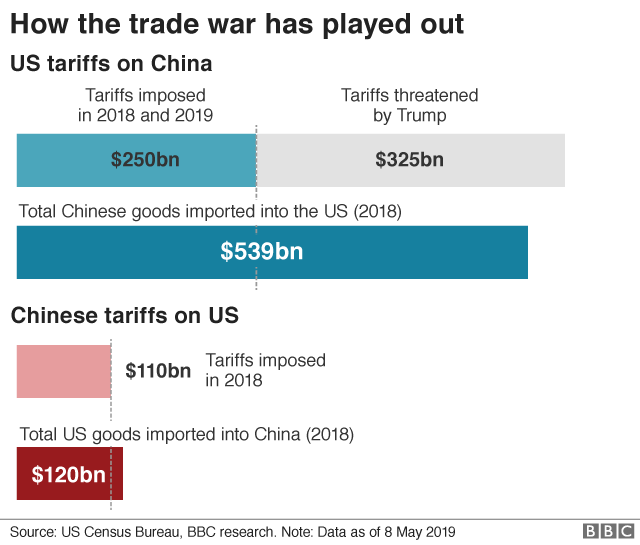
Both sides have already imposed tariffs on billions of dollars worth of one another’s goods. The situation could become worse still, as Mr Trump has also warned he could “shortly” introduce 25% duties on $325bn of Chinese goods.
What exactly sparked the US president’s latest actions, which apparently took China by surprise, is unclear.
Ahead of the discussions, Mr Trump told a rally China “broke the deal” and would pay for it.
The International Monetary Fund said the row poses a “threat to the global economy”.
“As we have said before, everybody loses in a protracted trade conflict,” the body which aims to ensure global financial stability said in a statement, calling for a “speedy resolution”.
Donald Trump has said he will raise tariffs on $200bn in Chinese goods this week, because talks on a US-China trade deal are moving “too slowly”.
The US president tweeted that tariffs of 10% would rise to 25% on Friday, saying: “The Trade Deal with China continues, but too slowly, as they attempt to renegotiate. No!”
Some $325bn of untaxed goods will also face 25% duties “shortly”, he said.
It follows signals from Washington that a US-China trade deal was imminent.
For 10 months, China has been paying Tariffs to the USA of 25% on 50 Billion Dollars of High Tech, and 10% on 200 Billion Dollars of other goods. These payments are partially responsible for our great economic results. The 10% will go up to 25% on Friday. 325 Billions Dollars….
The move dramatically increases the pressure on China, after Mr Trump previously delayed the tariff increases earlier in the year, citing progress in talks.
Trade trade talks are due to resume this week, with Chinese Vice Premier Liu He due to travel to Washington.
That follows talks in April in Beijing that US Treasury Secretary Steven Mnuchin called “productive.”
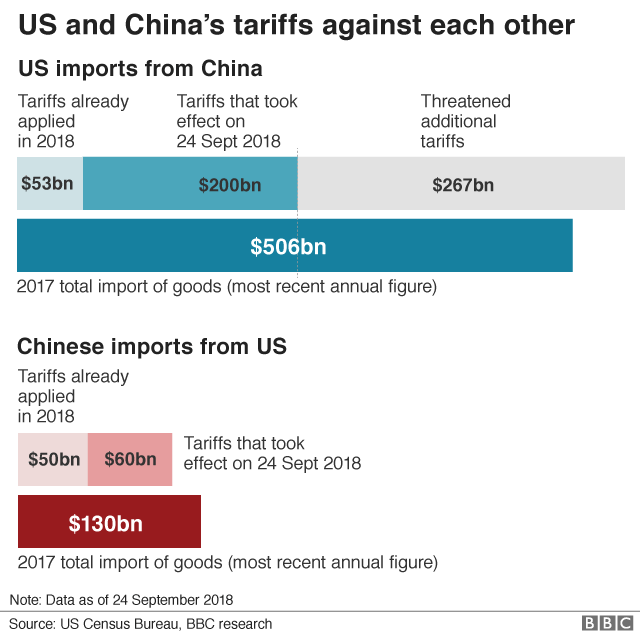
So far, the US has imposed tariffs ranging from 10-25% on $250bn (£191bn) of Chinese goods, having accused the country of various unfair trade practices
Beijing has hit back with duties on $110bn of US goods, blaming the US for starting “the largest trade war in economic history”.
Even though officials have sounded more positive about negotiations with the US recently, failure to achieve a deal would see tariffs on $200bn (£152bn) of Chinese goods rise almost immediately and could see the US impose fresh tariffs.
Still, Mr Evans-Pritchard said “broader weakness in global demand means that, even if Trump and Xi finalise a trade deal soon, the outlook for exports remains gloomy.”
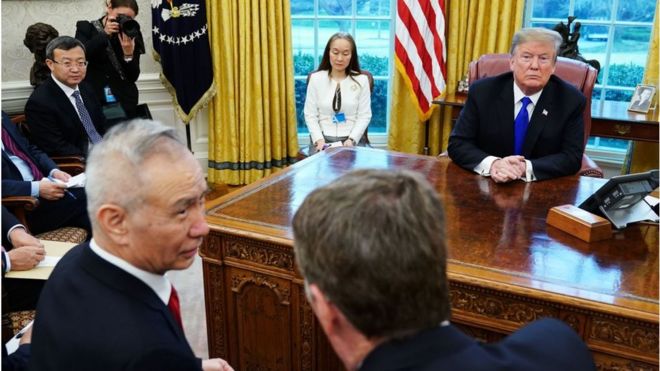
Image copyrightAFPImage captionPresident Trump met China’s Vice Premier Liu He on Friday
President Donald Trump has announced that the US will delay imposing further trade tariffs on Chinese goods.
The rise in import duties on Chinese goods from 10% to 25% was due to come into effect on 1 March.
Mr Trump said both sides had made “substantial progress” in trade talks, which sent Chinese stocks up nearly 5%.
He added that he was planning a summit with Chinese President Xi Jinping in Florida to cement the trade deal if more progress was made.
A report from China’s official news agency Xinhua also noted “substantial progress” on specific issues such as technology transfer, intellectual property protection and agriculture.
Mr Trump’s decision to delay tariff increases on $200bn (£153bn) worth of Chinese goods was seen as a sign that the two sides are making progress on settling their damaging trade war.
Last week, Mr Trump noted progress in the latest round of negotiations in Washington, including an agreement on currency manipulation, though no details were disclosed.
Sources told CNBC on Friday that China had committed to buying up to $1.2 trillion in US goods, but there had been no progress on the intellectual property issues.
What has happened in the trade war so far?
Mr Trump initiated the trade war over complaints of unfair Chinese trading practices.
That included accusing China of stealing intellectual property from American firms, forcing them to transfer technology to China.
The US has imposed tariffs on $250bn worth of Chinese goods, and China has retaliated by imposing duties on $110bn of US products.
Mr Trump has also threatened further tariffs on an additional $267bn worth of Chinese products – which would see virtually all of Chinese imports into the US become subject to duties.







 CHINDIA ALERT: You'll be living in their world, very soon