Archive for ‘Chinese premier Li Keqiang’

28/10/2019

Chinese premier stresses vocational training for people with disabilities

BEIJING, Oct. 27 (Xinhua) — Premier Li Keqiang has urged enhancing the vocational skills of people with disabilities and supporting their employment and business creation.

Li, also a member of the Standing Committee of the Political Bureau of the Communist Party of China Central Committee, made the remarks in a written instruction as the sixth China national vocational skill competition for persons with disabilities and the third national Abilympics that kicked off Sunday in Jiaxing, east China’s Zhejiang Province.

Different regions and relevant government departments at all levels should fully implement the supportive employment policies and strengthen vocational education and training for persons with disabilities, according to the instruction.

In advancing targeted poverty alleviation, greater efforts should be made to assist more poverty-ridden people with disabilities living in rural areas, helping more disabled people realize their dreams of finding jobs and starting businesses, said Premier Li.

About 900 disabled persons from across the country will compete in 26 different contests under five categories, which include fine arts, handicrafts and engineering.

Launched in 1989, the sixth China national vocational skill competition for persons with disabilities has been held every four years since 2003.

The third national Abilympics will showcase participants’ products and skills as well as the nation’s progress in employment and business creation of persons with disabilities.

China now has around 35 million registered persons with disabilities, with 18 million of working age.

Source: Xinhua

25/10/2019

Chinese premier to visit Uzbekistan, Thailand

BEIJING, Oct. 25 (Xinhua) — Chinese Premier Li Keqiang will pay official visits to Uzbekistan and Thailand, at the invitation of Uzbek Prime Minister Abdulla Aripov and Thai Prime Minister Prayut Chan-o-cha, and attend a series of meetings in the two countries from Nov. 1 to 5, Foreign Ministry Spokesperson Hua Chunying announced Friday.

Li will attend the 18th meeting of the Council of Heads of Government (Prime Ministers) of the Shanghai Cooperation Organization (SCO) in the Uzbek capital Tashkent, and attend the 22nd China-ASEAN (10+1) leaders’ meeting, the 22nd ASEAN-China, Japan and Republic of Korea (10+3) leaders’ meeting and the 14th East Asia Summit (EAS) in the Thai capital Bangkok during the visits, the spokesperson added.

Source: Xinhua

25/10/2019

Chinese vice president visits Japan to promote ties

Chinese Vice President Wang Qishan (L) attends a banquet held by Japanese Emperor Naruhito and Empress Masako in Tokyo, Japan, Oct. 22, 2019. Chinese Vice President Wang Qishan on Friday rounded off a fruitful friendly visit to Japan. During the five-day visit as Chinese President Xi Jinping’s special envoy, Wang attended the enthronement ceremony of Japanese Emperor Naruhito. (Xinhua)

SAPPORO, Japan, Oct. 25 (Xinhua) — Chinese Vice President Wang Qishan on Friday rounded off a fruitful friendly visit to Japan, with the two neighbors pledging continued efforts to foster a relationship that fits the needs of the new era.

During the five-day visit as Chinese President Xi Jinping’s special envoy, Wang attended the enthronement ceremony of Emperor Naruhito, and met separately with Prime Minister Shinzo Abe and Deputy Prime Minister and Finance Minister Taro Aso.

On Tuesday, when Emperor Naruhito officially proclaimed his enthronement, Wang conveyed to him and Empress Masako the sincere congratulations of Xi and his wife, Peng Liyuan, and asked the emperor and empress to pass on Xi and Peng’s cordial greetings to Emperor Emeritus Akihito and Empress Emerita Michiko.

Emperor Naruhito, for his part, asked Wang to communicate to the Chinese president and his wife the genuine gratitude and best wishes of the imperial couple as well as of the emperor emeritus and empress emerita.

In his meeting with Abe, Wang conveyed to him the cordial greetings of Xi and Chinese Premier Li Keqiang, and expressed sympathies over the serious casualties and losses caused by Typhoon Hagibis, an unusually monstrous tropical cyclone that recently wreaked havoc in Japan.

The vice president recalled that Xi and Abe met in the Japanese city of Osaka in June and reached a series of important consensus on pushing for a China-Japan relationship that fits the needs of the new era, creating new opportunities for the development of bilateral ties.

The two sides, he added, should abide by the principles set forth in the four political documents between China and Japan, properly address such issues as history and Taiwan, and ensure that their relations will move forward along the right track of peace, friendship and cooperation.

China stands ready to work with Japan to continuously cement political mutual trust, deepen practical cooperation, expand people-to-people exchanges and build a constructive security relationship, said Wang.

He also called on the two countries to join hands to act as defenders of multilateralism, promoters of open cooperation, and practitioners of cross-civilization dialogue, and make positive contributions to advancing global and regional peace, stability and development.

Noting that Xi has accepted in principle Abe’s invitation for a state visit to Japan next spring, Wang said he hopes that the two sides will maintain close contact and coordination, so as to create a favorable environment and a conducive atmosphere and ensure that the visit will materialize smoothly and achieve complete success.

The Japanese prime minister once again extended congratulations on the 70th anniversary of the founding of the People’s Republic of China (PRC), and thanked Xi for sending Wang as his special envoy to attend Emperor Naruhito’s enthronement ceremony and pay a friendly visit to Japan.

Japan and China have a long history of exchanges and boast a solid traditional friendship, Abe said, adding that today the two countries enjoy steadily deepening cooperation on economy and trade, deal with international affairs side by side, and shoulder great responsibility for peace and prosperity in Asia as well as the whole world.

As both countries are entering a new era, and the Osaka meeting has facilitated a full return of Japan-China relations to normal development, the two sides have huge potential in future cooperation, added the Japanese prime minister.

The Japanese side, he said, earnestly looks forward to Xi’s state visit to Japan in the coming spring, and is willing to properly handle the Taiwan question and other sensitive issues.

He added that his country stands ready to make concerted efforts with China to enhance top-level planning for bilateral relations, maintain the momentum of high-level exchanges, and build a Japan-China relationship that is beautiful, harmonious, future-oriented and vigorous.

In his meeting with Aso, Wang said China and Japan, as important countries in Asia and major economies in the world, should more consciously perceive and handle their relationship against the backdrop of the world and the times, and manage and plan it from long-term, strategic perspectives.

In the new era, the two countries have broader common interests and more common concerns, and the strategic value of their relationship is growing ever more prominent, noted the Chinese vice president.

China, he said, stands ready to work with Japan to effectively seize the opportunities and, with their eyes set on the future and the big picture, comprehensively strengthen coordination and communication in various areas including financial cooperation, so as to lift bilateral ties to a higher level.

Aso said that boosting candid, open and constructive exchanges between the two countries is conducive to bilateral relations, and that Japan supports open market and free trade, and is willing to step up communication and cooperation with China in the financial realm.

The Japanese side, added the deputy prime minister, is actively making preparations in order to foster a conducive atmosphere for Xi’s planned visit next year.

Also during his stay in Japan, Wang held separate meetings with Chief Cabinet Secretary Yoshihide Suga, former Prime Minister Yasuo Fukuda, Secretary General Toshihiro Nikai of the ruling Liberal Democratic Party, and Governor Naomichi Suzuki of the Hokkaido prefecture.

In addition, he met with Pakistani President Arif Alvi in Tokyo.

Source: Xinhua

18/10/2019

Chinese premier meets U.S. business delegation

CHINA-BEIJING-LI KEQIANG-U.S.-BUSINESS DELEGATION-MEETING (CN)

Chinese Premier Li Keqiang meets with a business delegation from the United States, which is led by Chairman of the U.S.-China Business Council (USCBC) Evan Greenberg, at the Great Hall of the People in Beijing, capital of China, Oct. 17, 2019. (Xinhua/Yin Bogu)

BEIJING, Oct. 17 (Xinhua) — Chinese Premier Li Keqiang met with a business delegation from the United States on Thursday, which was led by Chairman of the U.S.-China Business Council (USCBC) Evan Greenberg.

Li said that as China and the United States are respectively the world’s largest developing country and the largest developed country, the healthy and stable development of the Sino-U.S. relations will benefit the two sides and the world.

Li called on the two sides to focus on coordination, cooperation and stability, take a long-term perspective and remain down-to-earth, and resolve relevant issues through dialogue and consultation on the basis of equality and mutual respect, so as to advance bilateral economic and trade ties on the right track.

Li expressed the hope that people of U.S. industrial and commercial circles, including those from the USCBC, will continue to play a positive role in promoting the development of bilateral relations and enhancing mutual understanding between the two peoples, he said.

China’s door of opening-up will not be closed, but will only open wider, Li said.

Enterprises from all countries, including the United States, are welcome to expand investment in and cooperation with China to achieve mutual benefit, said Li.

The U.S. delegates said the U.S. business community hopes to maintain contacts with China, does not want to see decoupling between the two countries, and also does not want to see trade wars or imposition of additional tariffs.

They expressed the hope that both sides will seize the opportunities and reach a substantive agreement through negotiations and consultations, so that enterprises from both countries can engage in healthy competition and achieve common development in a fair and determined environment.

Source: Xinhua

18/10/2019

China economy: Third quarter growth misses expectations

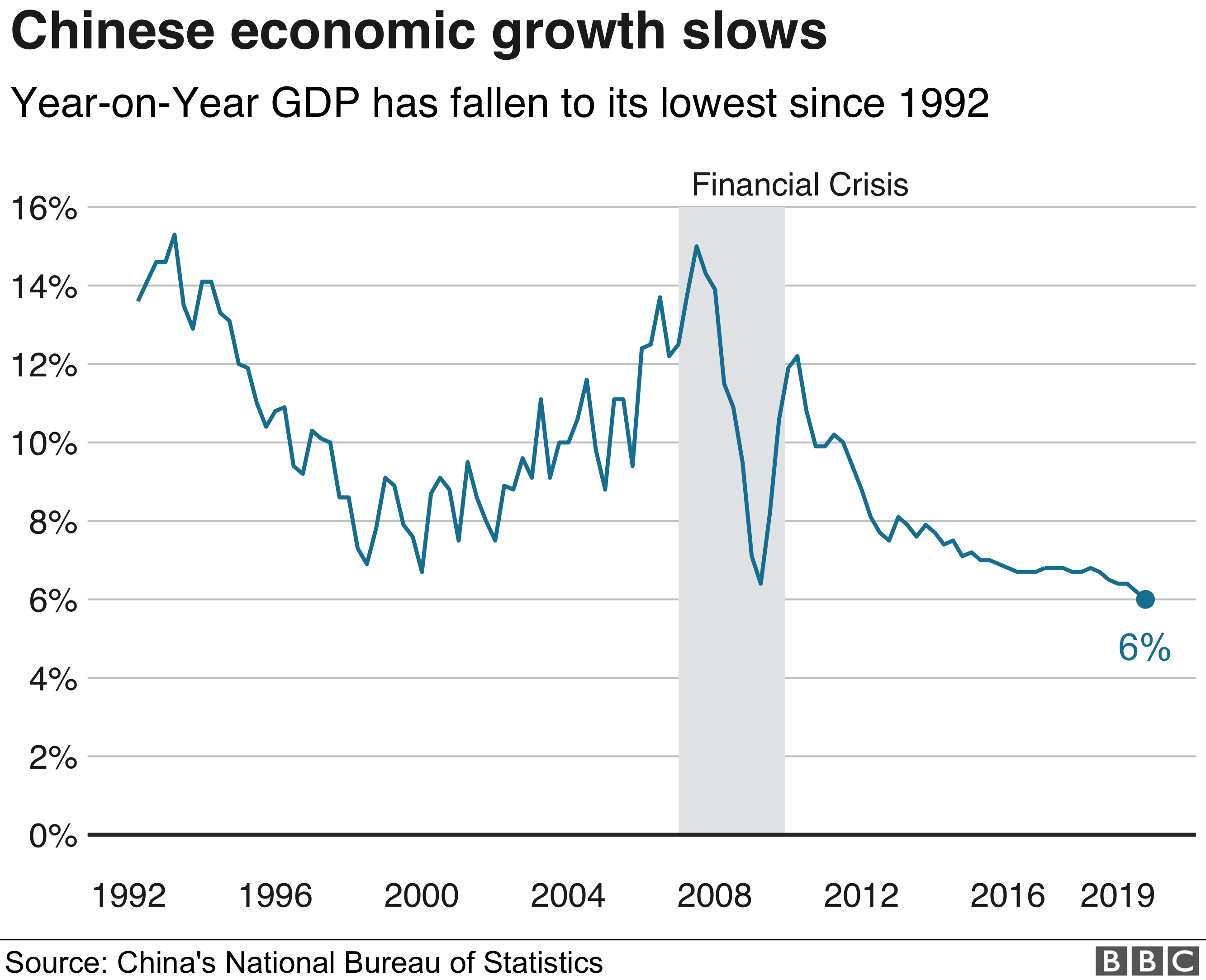
China’s economy grew at a slower pace than expected in the third quarter as it struggled with a US-led trade war and softer domestic demand.

In the three months to September, the economy expanded 6% from a year earlier, official figures showed.

The result fell just short of expectations for 6.1% growth for the period.

The slowdown comes despite government efforts to support the economy, including measures such as tax cuts.

The latest figures mark a further loss of momentum in the world’s second largest economy, which had already seen growth languishing at its slowest pace in around three decades.

The rate remained within the government’s target range for annual growth of between 6% and 6.5%.

The strength of the Chinese economy is closely watched as slowing growth can have far-reaching consequences for the global economy.

The country has become a key engine of growth in recent decades. Its healthy demand for a range of products, from commodities to machinery, has supported growth around the world.

Some analysts worry that a sharp slowdown in China could hurt an already sluggish world economy and increase the risk of a recession.

Chart on China GDP

Julian Evans-Pritchard, senior China economist at Capital Economics, said pressure on the Chinese economy “should intensify in the coming months”.

He said more intervention by policymakers to support the economy was likely “but it will take time for this to put a floor beneath economic growth”.

What challenges does China face?

China has been fighting a trade war with the US for the past year, which has created uncertainty for businesses and consumers.

At the same time, it faces domestic challenges including a swine fever outbreak that has fuelled inflation and hit consumer spending.

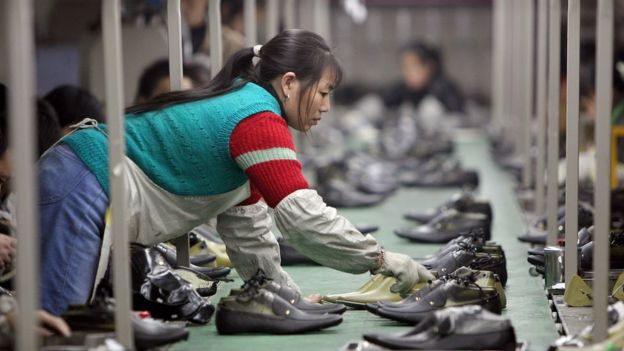
A woman works in a shoe factory in ChinaImage copyright GETTY IMAGES
Image caption China accounted for 16% of global gross domestic product in 2018, according to the McKinsey Global Institute

This week the International Monetary Fund trimmed its 2019 growth forecast for China to 6.1% from 6.2% due to the long-running trade dispute and slowing domestic demand.

But there have been some signs of progress toward resolving the trade battle, with the US and China reaching a “phase one deal” earlier this month.

The government has sought to help the economy through tax cuts and by taking measures to boost liquidity in the financial system.

Still, some analysts say the government has become more cautious in providing stimulus amid growing concerns about China’s rising debt pile.

Presentational grey line
Analysis box by Karishma Vaswani, Asia business correspondent

Any analysis of China’s economic data has to come with a caveat: Many economists believe the actual figures are much lower than what we are told, but it’s the trajectory of growth and signalling from the government that you should pay attention to.

The fact that the growth figures have come in below market expectations indicate that China’s economy is hurting more than many thought.

There were signs from China that these numbers were going to be worrying. Earlier this week, Premier Li Keqiang made the unusual move to warn local officials that they must do “everything” to make sure they hit growth targets for this year.

China’s economy is being hit on three fronts: The US-led trade war, slowing demand at home and rising domestic challenges including the outbreak of swine fever that has dealt a huge blow to its pork farmers. It’s also pushed up prices for consumers.

China’s slowdown is nothing new. But these challenges pose new headaches for policymakers who are trying to manage the slowdown. The country’s political stability depends on economic security – and over the last forty years, that’s what the Communist Party has delivered. They’re under pressure to keep that contract.

Source: The BBC

17/10/2019

China says it hopes to reach phased trade pact with U.S. as early as possible

BEIJING (Reuters) – China’s commerce ministry said on Thursday that China hoped to reach a phased agreement with the United States over trade as early as possible, and make progress on canceling tariffs on each others’ goods.

A phased agreement would help restore market confidence and reduce uncertainty, Gao Feng, spokesman at the ministry, told reporters, adding that both sides were maintaining close communication.

On Oct. 11, U.S. President Donald Trump outlined the first phase of a deal to end the trade war with China and suspended a threatened tariff hike, but officials on both sides said much more work needed to be done before an accord could be agreed.

Trump had originally planned to proceed with a hike in tariffs to 30% from 25% on about $250 billion worth of Chinese goods last week. But the U.S. administration has yet to make a decision on how to address planned 10% tariffs on roughly $156 billion of Chinese goods due to take effect on Dec. 15.

U.S. and Chinese trade negotiators are working on nailing down a Phase 1 trade deal text for their presidents to sign next month, U.S. Treasury Secretary Steven Mnuchin said on Wednesday.

Mnuchin said the Trump administration’s “objective” was for the agreement to be signed between the presidents of the two countries at a Nov. 16-17 summit of Asia-Pacific Economic Cooperation countries in Santiago, Chile.

Working-level representatives from both countries are working on specifics of an agreement now, Gao said.
In recent days, there have been positive signs from China.
China’s securities regulator on Friday unveiled a firm timetable for scrapping foreign ownership limits in futures, securities and mutual fund companies for the first time.
Increasing foreign access to the sector is among the U.S. demands at the trade talks.
A day before, the U.S. Department of Agriculture confirmed net sales of 142,172 tonnes of U.S. pork to China in the week ended Oct. 3, the largest weekly sale to the world’s top pork market on record.
Trump said China had agreed to make purchases of $40 billion to $50 billion in U.S. agricultural goods. Mnuchin said the purchases would be scaled up to that amount annually.
On Wednesday, Chinese Premier Li Keqiang said China will remove business restrictions on foreign banks, brokerages and fund management firms, without giving details.
Source: Reuters
16/10/2019

Premier Li urges efforts to promote stable economic growth, improve people’s livelihood

CHINA-SHAANXI-LI KEQIANG-INSPECTION (CN)

Chinese Premier Li Keqiang, also a member of the Standing Committee of the Political Bureau of the Communist Party of China (CPC) Central Committee, visits a startup community in Xi’an, capital of northwest China’s Shaanxi Province, Oct. 15, 2019. Li made an inspection tour in the cities of Xi’an and Xianyang in northwest China’s Shaanxi Province from Monday to Tuesday. (Xinhua/Pang Xinglei)

XI’AN, Oct. 15 (Xinhua) — Chinese Premier Li Keqiang has stressed deepening reform and opening-up to facilitate steady economic growth and continuously improve people’s livelihood.

Li, also a member of the Standing Committee of the Political Bureau of the Communist Party of China (CPC) Central Committee, made the remarks during his inspection tour in the cities of Xi’an and Xianyang in northwest China’s Shaanxi Province from Monday to Tuesday.

In his visit to a community in Xi’an, Li stressed that the renovation of old residential communities can improve the livelihood of people, especially those with financial difficulties, and is conducive to boosting effective investment and consumption.

In this regard, Li called for efforts to upgrade community facilities and enhance public services such as elderly care and childcare.

When visiting a restaurant, Li said measures should be taken to guarantee the supply of pork and stabilize vegetable prices to ensure the basic livelihood of those facing difficulties. He also urged the implementation of policies of cutting taxes and fees for private businesses.

The country will make unswerving efforts to open up wider, give equal treatment to both domestic and overseas businesses registered in China, continuously improve the business environment, and intensify the protection of intellectual property rights, said the premier during his visit to Samsung China Semiconductor Co., Ltd.

Commenting on the great development potential of China’s western regions, Li urged greater efforts to create a good business environment, pledging more targeted policy support.

At the construction site of the Yinchuan-Xi’an high-speed railway, the premier underscored the acceleration of key infrastructure projects in west China and encouraged effective investment in spurring development and improving people’s livelihood.

Li, while visiting a startup community, urged efforts to improve the business environment for entrepreneurship and innovation.

Source: Xinhua

16/10/2019

China’s former ambassador to India joins team dedicated to fight against climate change

  • Luo Zhaohui, who was credited with helping to resolve 2017 Doklam stand-off peacefully, joins group set up to tackle global warming
Luo Zhaohui previously served as China’s ambassador to India. Photo: Handout

China’s former ambassador to India Luo Zhaohui has joined a national team in charge of fighting climate change, the Chinese government website has announced.

The team, led by Premier Li Keqiang, will be responsible for coming up with proposals to tackle the problem, develop proposals for energy conservation and analyse the impact of climate change on socio-economic development.

China is currently the world’s largest polluter, accounting for a quarter of the world’s total emissions, making it crucial in the effort to curb global warming.

The US withdrawal from the Paris Climate Agreement in 2017 also makes China the largest single economy committed to the efforts to limit emissions.

As well as taking up the position on the National Leading Group Dealing with Climate Change, Energy Conservation and Emissions Reduction, Luo was also promoted to the position of deputy foreign minister in late May.

In this post, Luo is in charge of Beijing’s relations with its Asian neighbours, replacing Kong Xuanyou, who was named China’s new ambassador to Japan.

Luo was credited by diplomatic observers as having helped bring relations with India back on track after the 2017 Doklam stand-off, one of the worst border disputes in decades between the two sides.

In July 2017, Luo told media in New Delhi that the Chinese people were deeply angry over the “occupation” by Indian troops of its sovereign territory but helped to resolve the situation through diplomatic means, paving the way for an informal summit between President Xi Jinping and Prime Minister Narendra Modi in Wuhan last year.

Luo, 57, has also served in diplomatic missions in Singapore and the US and was head of the foreign ministry’s department for Asian affairs.

He previously served as ambassador to Pakistan and Canada before being posted to the embassy in New Delhi in India in 2016.

Source: SCMP

01/10/2019

Foreign experts’ support will not be forgotten: Chinese premier

CHINA-BEIJING-LI KEQIANG-FRIENDSHIP AWARD-MEETING (CN)

Chinese Premier Li Keqiang meets with a group of foreign experts who received the Friendship Award, given annually by the Chinese government to honor outstanding foreign experts, at the Great Hall of People in Beijing, capital of China, Sept. 30, 2019. The meeting was also attended by vice premier Han Zheng. (Xinhua/Rao Aimin)

BEIJING, Sept. 30 (Xinhua) — Chinese people will not forget foreign experts’ support and assistance to China’s development over the 70 years since the founding of the People’s Republic of China (PRC), said Chinese Premier Li Keqiang.

Li made the remarks Monday when meeting at the Great Hall of the People with a group of foreign experts who received the Friendship Award, given annually by the Chinese government to honor outstanding foreign experts in China.

The meeting was also attended by vice premiers Han Zheng and Liu He and State Councilor and Foreign Minister Wang Yi.

Speaking highly of the awardees’ contributions to China, Li said that over the past 70 years, some foreign experts made significant efforts to help China overcome early difficulties, while some introduced advanced technologies, experience and management concepts to China since the beginning of the country’s reform and opening-up.

He noted that China will continue to expand international cooperation in technological innovation, further open up sci-tech projects to foreign experts and encourage them to lead and take part in the country’s sci-tech programs.

China will pursue a more proactive, open and effective policy on training competent professionals, provide more convenience for foreign experts in all respects and create a market-based, legalized and international business environment, Li said.

“We welcome more foreign talent and enterprises to China to start businesses and innovate,” he continued.

The awardees thanked Li and the Chinese government, delivered congratulations on the PRC’s 70th founding anniversary and said they will continue to play a positive part in China’s modernization and the development and progress of the human society.

They then attended a reception held Monday evening at the Great Hall of the People to celebrate the 70th anniversary of the founding of the PRC.

A total of 100 foreign experts from 31 countries received the Friendship Award this year.

Source: Xinhua

24/09/2019

Premier Li holds talks with Iraqi PM on ties, cooperation

CHINA-BEIJING-LI KEQIANG-IRAQI PM-TALKS (CN)

Chinese Premier Li Keqiang holds talks with visiting Iraqi Prime Minister Adel Abdul Mahdi at the Great Hall of the People in Beijing, capital of China, Sept. 23, 2019. (Xinhua/Wang Ye)

BEIJING, Sept. 23 (Xinhua) — Chinese Premier Li Keqiang held talks with Iraqi Prime Minister Adel Abdul Mahdi at the Great Hall of the People in Beijing, voicing support for Iraq’s reconstruction and encouraging more practical cooperation.

Li said China and Iraq are two ancient civilizations and have a long history of friendly exchanges.

He commended the bilateral ties between the two countries since they established diplomatic relations and voiced support for Iraq’s efforts to restore security and stability, promote economic and social reconstruction, and improve people’s livelihood.

China is ready to work with Iraq to deepen mutual political trust, expand practical cooperation across the board, and enhance people-to-people exchanges to promote the China-Iraq strategic partnership for greater development, Li said.

Li pointed out that China is willing to participate in Iraq’s reconstruction, maintain a long-term and stable energy partnership with Iraq, and expand cooperation in capacity, manufacturing and agriculture to fuel the diversified development of the Iraqi economy and achieve win-win results.

The Chinese Premier said his country stands ready to work with Iraq to dovetail the Belt and Road Initiative with Iraq’s reconstruction plan, supports Chinese enterprises to positively take part in Iraq’s infrastructure construction and hopes that Iraq will take forceful measures to guarantee the safety of Chinese institutions and individuals in the country.

Abdul Mahdi said Iraq and China are enjoying the best bilateral relations in their history and his country has experienced war and is rebuilding its homeland.

He said China is a country that loves peace and advocates cooperation, adding that Iraq is willing to work with China to enhance cooperation in the fields of trade, the economy, infrastructure construction, energy and culture to realize greater development of bilateral relations.

After the talks, Li and Abdul Mahdi witnessed the signature of a series of bilateral cooperation documents on the economy and technology, finance and culture.

Prior to the talks, Li held a welcoming ceremony for his Iraqi counterpart in the North Hall of the Great Hall of the People.

Source: Xinhua

Law of Unintended Consequences

continuously updated blog about China & India

ChiaHou's Book Reviews

continuously updated blog about China & India

What's wrong with the world; and its economy

continuously updated blog about China & India