Archive for ‘Chinese President Xi Jinping’

18/01/2020

Myanmar, China ink deals to accelerate Belt and Road as Xi courts an isolated Suu Kyi

NAYPYITAW (Reuters) – China and Myanmar inked dozens of deals on Saturday to speed up infrastructure projects in the Southeast Asian nation, as Beijing seeks to cement its hold over a neighbour increasingly isolated by the West.

But no major new projects were agreed during the two-day visit by President Xi Jinping, the first of any Chinese leader in 19 years. Analysts said Myanmar was generally cautious of investments by Beijing and was also being careful ahead of elections later this year.

Still, Xi and Myanmar leader Aung San Suu Kyi signed 33 agreements shoring up key projects that are part of the flagship Belt and Road Initiative, China’s vision of new trade routes described as a “21st century silk road”.

They agreed to hasten implementation of the China Myanmar Economic Corridor, a giant infrastructure scheme worth billions of dollars, with agreements on railways linking southwestern China to the Indian Ocean, a deep sea-port in conflict-riven Rakhine state, a special economic zone on the border, and a new city project in the commercial capital of Yangon.

They did not address a controversial $3.6 billion Beijing-backed mega dam, where work has been stalled since 2011, reflecting the contentiousness of Chinese investment in Myanmar, where many are uncomfortable with the sway Beijing has over its smaller neighbour.

“While a large number of different agreements have been signed, there is no Big Bang here,” said Richard Horsey, a Yangon-based analyst with the International Crisis Group.

“The overall impression is that Myanmar is being cautious about Chinese investment, especially ahead of elections planned later in the year, he said.

“China will be hoping that this is an incremental step towards realizing its mega-infrastructure goals, and that further progress can be locked in over the coming months,” he said.

‘DERAILED’ BY WEST

At a welcoming ceremony on Friday, Xi hailed a “new era” of relations between the countries.

“We are drawing a future roadmap that will bring to life bilateral relations based on brotherly and sisterly closeness in order to overcome hardships together and provide assistance to each other,” Xi said. He was scheduled to leave later on Saturday.

Suu Kyi called China “a great country playing an important role in the international affairs and the world economy” but urged for economic projects that avoid environmental degradation and benefit locals.

Xi also met leaders from political parties in ethnic areas riven with civil conflict where Chinese infrastructure projects are underway.

Sai Kyaw Nyunt, joint-secretary of the Shan Nationalities League for Democracy, one of the ethnic politicians invited to meet Xi, said it was only a handshake.

“Our country is very small and powerless,” he said, “So they treat us that way.”

The two countries have historically had a fraught relationship, but have moved closer since 2017, when Myanmar was internationally condemned for its treatment of minority Rohingya Muslims in Rakhine state.

More than 730,000 Rohingya were forced to flee western Myanmar after a military crackdown that the United Nations has said was executed with “genocidal intent”. China has defended the country on the global stage and is viewed as the biggest obstacle to a prosecution of its leaders at an international war crimes tribunal.

An article in Chinese state media ahead of the state visit said Myanmar had been “derailed” by its engagement with the West and only China was willing to “pull Myanmar from the sludge”.

“But after some turbulence, Myanmar realized there were double standards in the approach Western countries had taken on human rights issues and began to turn to China for diplomatic and economic help,” the article in the Global Times said.

Source: Reuters

27/12/2019

Pilot shortages could ground China’s plans to develop combat-ready carrier fleet

  • The country’s second aircraft carrier, the Shandong, officially entered service this month, but bottlenecks in training could hamper the navy’s effectiveness
  • Plans to build and launch more modern warships mean the need for fully trained pilots will only grow
A pilot based on the Liaoning is seen during a training exercise. China is facing a shortage of trained naval aviators. Photo: Handout

A shortage of naval pilots is holding back Beijing’s ambitions to develop a truly combat-ready fleet, military analysts have said.

China officially commissioned its second aircraft carrier the Shandong last week, which means it will need at least 70 pilots, along with more supporting flight officers.

However, plans to further expand its fleet to five or six carriers – as well as the more advanced technology that will be used on these vessels – mean the need to train more pilots will become more urgent in the future.

Chinese President Xi Jinping has initiated a sweeping modernisation drive across all branches of the People’s Liberation Army and said “the need to build up a strong navy has never been more pressing”.

The Shandong, China’s second carrier, officially entered service earlier this month. Photo: Handout
But Collin Koh, a research fellow at the S Rajaratnam School of International Studies at Singapore’s Nanyang Technological University, said there was a bottleneck in the recruitment and training of naval pilots.

“The implications of carrier-borne aviation are still relatively unfamiliar to the PLA, especially when there’s an urge to scale up training tempo and recruitment in order to fulfil the top directives of building a viable carrier programme,” he said.

China’s training programme for all military pilots is still developing – particularly when it comes to the naval aviation arm, which was only founded in May 2013.

China’s new carrier set to have smaller jet force than expected

20 Dec 2019

China’s first aircraft carrier, the Liaoning, was commissioned in September 2012, but the first successful fighter landing on the ship did not happen until two months later.

The first successful night landing was not reported by state media until May 2018, almost four years later.

It appears to have taken even longer to fully train helicopter pilots, with the first successful day landing taking place in November 2018, according to China’s Naval Aviation University, and the first night landing in June this year.

The training programme has also been marred by a string of fatal accidents along the way, although Koh said these had been unreported to avoid deterring prospective recruits.

Days after China marked the 70th anniversary of the foundation of the People’s Republic with a huge military parade in Beijing on October 1, three airmen were killed when a transport helicopter crashed in central Henan province.

Just eight days later there was another crash on the Tibetan Plateau, where a J-10 fighter jet on a low-altitude flying drill crashed into a mountain. The pilot was reported to have survived.

“The attrition rate of carrier-borne pilot training, including those who might have been injured or killed in the line of duty, isn’t that well publicised by the PLA,” said Koh.

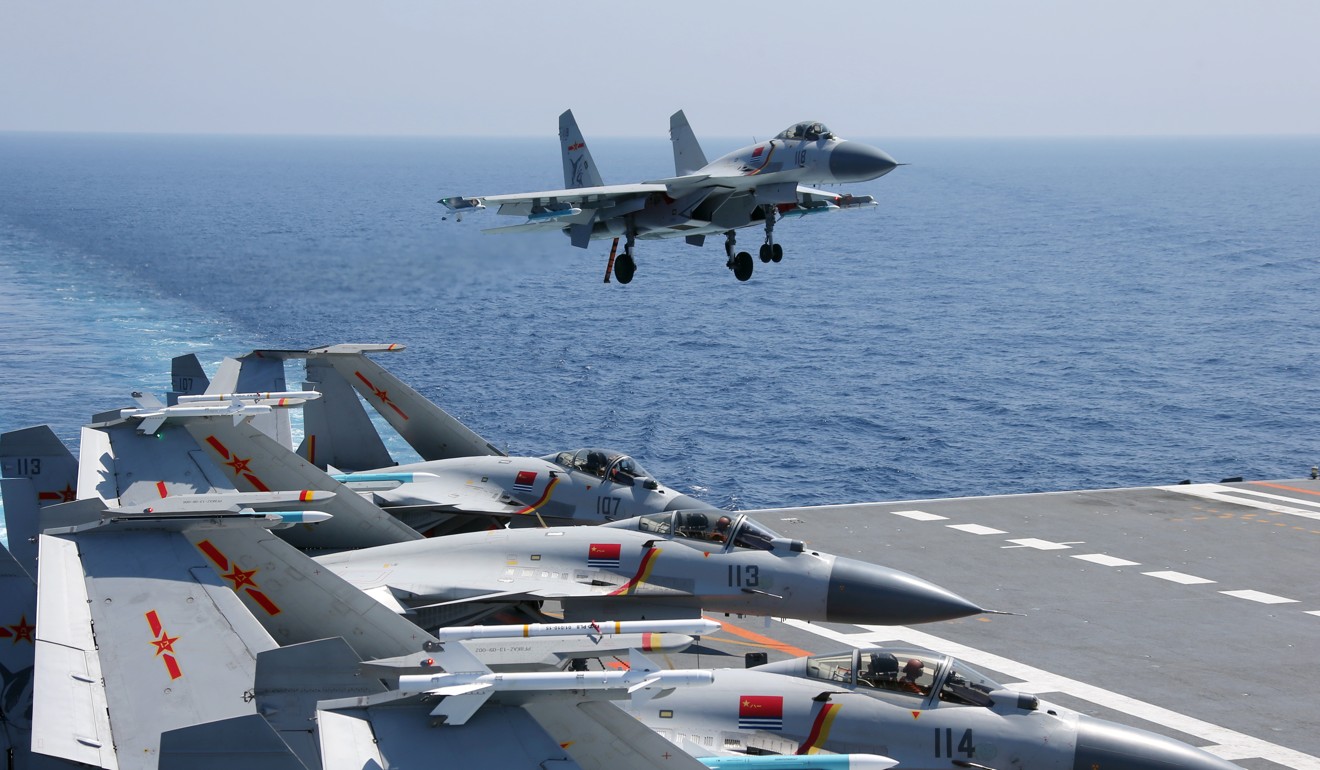
Fighters on the deck of the Liaoning, China’s first carrier. Photo: Xinhua
Li Jie, another Beijing-based military expert, said although the navy is short of pilots now, the problem could be solved within two to three years.
“The insufficient number of carrier-borne warplanes and the substantial training needed for a qualified naval pilot are the two main reasons why China is so short of pilots now. But as China places more and more emphasis on the education and training of the pilots, the problem will be gradually ironed out, ” said Li.
First made-in-China carrier officially enters service
18 Dec 2019

The Naval Aviation University, which is responsible for the training of future naval pilots, has been working with three of the country’s leading universities – Peking, Tsinghua and Beihang – to identify and recruit future pilots.

The authorities have also set up Naval Aviation Experimental Classes in high schools across the country. Each class recruits 50 students, who enjoy a national subsidy and will be put in a priority list to be admitted as a naval pilot.

Source: SCMP

23/12/2019

China presses for nuclear talks in last days till North Korea’s deadline for US

  • Summit between Chinese, South Korean and Japanese leaders could yield results for future of Korean peninsula, analyst says
North Korea has promised an unwelcome “Christmas present” if the US does not show the “right attitude” for talks. Photo: KCNA
Chinese President Xi Jinping has again stressed the need for tensions on the Korean peninsula to be resolved through dialogue, as the deadline looms in North Korea’s threat to give the United States an unwelcome “Christmas gift”
.

With just over a week to go until Pyongyang’s year-end deadline for Washington to change what it says a policy of hostility, Xi held separate talks with South Korean President Moon Jae-in and Japanese Prime Minister Shinzo Abe in Beijing on Monday.

Moon and Abe will also join Chinese Premier Li Keqiang for a trilateral summit in Chengdu, Sichuan province, on Tuesday.

The first trilateral leadership talks took place in 2008, but were not held in 2013 and 2014, or in 2016 and 2017.

Xi said China and South Korea “both insist on maintaining peace and stability on the peninsula, and advocate solving problems through dialogue and consultation”, state news agency Xinhua reported on Monday.
“China supports South Korea in continuing to improve its relationship with

North Korea,

and injecting impetus for the Korean peninsula peace talks,” the report said.

Moon said the suspension of talks between the US and North Korea and heightened tensions along the peninsula “are not beneficial to both our countries and North Korea”, according to South Korean news agency Yonhap.

Moon also said that China had played an “important role” in efforts for the denuclearise the peninsula, the report said.

North Korea has signalled impatience over the stalled talks with the US, and the fading hopes for an end to Washington’s economic sanctions.

In April, North Korean leader Kim Jong-un said that he would “wait” until the end of the year to decide whether the US had the “right attitude” to allow a resumption of negotiations, but no signs of further talks have emerged.

Then earlier this month Pyongyang warned that Washington would receive a “Christmas gift”, and US actions would determine whether the present would be good or bad.

In an apparent sign of frustration with the US, North Korean news agency KCNA reported on Sunday that Kim held a meeting of the Workers’ Party of Korea to “bolster the overall armed forces of the country” to deal with the “the fast-changing situation”.

The US imposed crippling sanctions on North Korea’s economy in 2017, though many countries, including China, South Korea and Japan, have also tightened measures against the North.

South Korea and Japan both scaled back people-to-people links in 2016, China banned coal exports to the North in 2017. Earlier this year, Trump thanked China and Russia for maintaining sanctions against Pyongyang.

As diplomats make last-ditch attempts to stop renewed confrontation, US special envoy for North Korea Stephen Biegun shuttled around the region last week, meeting senior officials in China, South Korea and Japan. Biegun urged North Korea to return to negotiations, and said the US “does not have a deadline” for talks.

China and Russia also proposed last week that the United Nations Security Council 

lift some sanctions

, saying it was necessary to break the deadlock.

Xi’s meeting with Moon also comes as Beijing tries to mend ties with Seoul to prevent neighbouring nations from getting closer to Washington.
Relations between China and South Korea deteriorated in 2017 after Seoul deployed a US-led missile defence system known as THAAD, which Beijing deemed as a security threat to its own territory.
On Monday, both Xi and Moon said in their meeting that they looked forward to improving relations between their countries.
“We have been friends and partners that have continued close cooperation,” Xi said. “We have a wide range of common understandings in various fields, including on further developing bilateral relations, facilitating regional peace, stability and prosperity, and defending multilateralism and a free trade system.”
Sun Xingjie, a North Korea specialist at Jilin University, said the US signal was “very clear” in Beigun’s comments.
“They still want to continue discussions,” he said.
Sun also said the talks in Chengdu on Tuesday would likely play an important role in the future of resolving problems on the Korean peninsula.
“After returning to the platform these last couple years, I believe this will become an important, normalised place for discussions. Whatever problems they run into, the platform should continue to move forward,” Sun said.
Source: SCMP
22/12/2019

North Korea threat looms as China, Japan, South Korea leaders meet

BEIJING (Reuters) – The spectre of new confrontation between Pyongyang and Washington hangs over meetings between China, Japan and South Korea this week, with growing risks North Korean actions could end an uneasy detente and upend recent diplomatic efforts.

South Korean President Moon Jae-in and Japanese Prime Minister Shinzo Abe are expected to meet Chinese President Xi Jinping separately on Monday. They will then travel to the southwestern city of Chengdu for a trilateral meeting with Chinese Premier Li Keqiang. Though they are expected to discuss various economic matters, North Korea appears likely to dominate the agenda.

Pyongyang has grown increasingly frustrated that its halt of nuclear and long-range missile tests has not ended the crippling economic sanctions against it. It set a Dec. 31 deadline for the United States to make concessions, but Washington has been unmoved.

Some experts believe North Korea may be readying to test an intercontinental ballistic missile launch soon, which would likely end the 2018 agreement struck by its leader, Kim Jong Un, and U.S. President Donald Trump.

“Safeguarding the stability and peace of the Korean Peninsula and pushing for a political solution to the Korean Peninsula issue are in the interests of China, Japan and South Korea,” Chinese Vice Foreign Minister Luo Zhaohui told reporters on Thursday at a briefing on the trilateral meetings.

U.S. special envoy for North Korea Stephen Biegun met with two senior Chinese diplomats during his two-day visit to Beijing this week, following similar meeting in South Korea and Japan days earlier, as diplomats make last-ditch attempts to prevent new confrontation.

North Korea has not responded to his public call to resume dialogue, however.

“The silence, even after Biegun’s speech in Seoul, makes me concerned,” Jenny Town, managing editor at the North Korea monitoring website 38 North, said on Twitter.

Beijing, jointly with Russia, proposed on Monday that the United Nations Security Council lift some sanctions in what it calls an attempt to break the current deadlock and seeks to build support. But it’s unclear whether Beijing can convince Seoul and Tokyo to break ranks from Washington, which has made its opposition clear and can veto any resolution.

Though South Korea sees China as instrumental in reviving negotiations, it has so far sidestepped questions on whether it supports the new proposal by Beijing and Moscow. Japan, which has historically been a staunch supporter of sanctions against North Korea, has also refrained from commenting on the proposal.

“With the (2020 Tokyo) Olympics coming up, North Korea going wild would pose a problem for Japan,” said Narushige Michishita, professor at Japan’s National Graduate Institute for Policy Studies.

“But bilateral talks with North Korea, for example, will probably be a better approach for Japan than easing UN sanctions.”

Source: Reuters

20/12/2019

Senior Chinese official meets Republic of Congo president

REPUBLIC OF THE CONGO-BRAZZAVILLE-YANG JIECHI-VISIT

Yang Jiechi (L), a member of the Political Bureau of the Communist Party of China (CPC) Central Committee and director of the Office of the Foreign Affairs Commission of the CPC Central Committee, meets with President of the Republic of the Congo Denis Sassou Nguesso in Brazzaville, capital of the Republic of the Congo, Dec. 19, 2019. (Xinhua/Wang Songyu)

BRAZZAVILLE, Dec. 19 (Xinhua) — Yang Jiechi, a member of the Political Bureau of the Communist Party of China (CPC) Central Committee, met with President of the Republic of the Congo Denis Sassou Nguesso here on Thursday.

Yang, also director of the Office of the Foreign Affairs Commission of the CPC Central Committee, said the two countries are good friends, good partners and good brothers.

In recent years, the two countries’ heads of state have met many times to steer the development of bilateral ties, he said.

Political mutual trust between the two countries continues to deepen, and their practical cooperation has yielded remarkable results, said the Chinese official, adding that financial and aviation cooperation has become a new growth point, and progress has been made in key projects such as the construction of the Pointe Noire special economic zone.

China has always supported the Republic of the Congo in developing its economy, improving people’s livelihood, and adhering to a development path that suits its national realities, Yang said.

He urged the two sides to keep the momentum of high-level exchanges, and to continue to firmly support each other on issues concerning their respective core interests and concerns.

Under the framework of the Belt and Road Initiative (BRI) and the Forum on China-Africa Cooperation, the two sides should expand their cooperation in various fields, strengthen communication and coordination, safeguard the common interests of the two countries and those of developing countries as a whole, so as to demonstrate the high level of the comprehensive strategic cooperative partnership between the two countries.

For his part, Sassou said the Congolese side treasures its friendship with China. The Congolese side highly appreciated that Chinese President Xi Jinping chose the country as one of the destinations of his first foreign trip in 2013 after taking office, Sassou said.

The Congolese people appreciate valuable long-term support from China, particularly recent flood relief assistance and supplies, he said.

Sassou added that the Congolese side will continue its active participation in the BRI, and is looking forward to further strengthening mutual cooperation in key areas, including agriculture, infrastructure and industrial facilities.

Yang also met with Foreign Minister of the Republic of the Congo Jean-Claude Gakosso on the same day.

Source: Xinhua

14/12/2019

Xi holds talks with Micronesian president

CHINA-BEIJING-XI JINPING-FEDERATED STATES OF MICRONESIA-PRESIDENT-TALKS (CN)

 Chinese President Xi Jinping holds a welcome ceremony for President of the Federated States of Micronesia David W. Panuelo before their talks at the Great Hall of the People in Beijing, capital of China, Dec. 13, 2019. (Xinhua/Wang Ye)

BEIJING, Dec. 13 (Xinhua) — Chinese President Xi Jinping on Friday held talks with visiting President of the Federated States of Micronesia David W. Panuelo, calling for joint efforts to advance bilateral ties and better benefit the two peoples.

The two sides should maintain exchanges at all levels, expand communication and exchanges between governmental departments and legislatures, and enhance mutual political trust, Xi said.

Xi welcomed Panuelo’s visit to China as the two countries celebrate their 30th anniversary of the establishment of diplomatic ties, and spoke highly of Panuelo’s commitment to developing bilateral ties and firmly upholding the one-China principle.

China sticks to the path of peaceful development, maintains that all countries, no matter big or small, are always equal, firmly opposes unilateralism and hegemony, and advocates that all countries should work jointly to build a community with a shared future for humanity, he said.

For the past 30 years since the establishment of diplomatic ties, the two countries have respected, trusted and supported each other, and carried out pragmatic cooperation on the basis of equality and mutual benefit, advancing bilateral ties and bringing tangible benefits to the two peoples, Xi noted.

China respects the Micronesian side’s right to take the development path that best suits its national conditions and supports Micronesia’s efforts in maintaining national independence and boosting development, Xi said.

He called on the two sides to complement each others’ advantages and further expand cooperation in such fields as trade, investment, agriculture, fisheries, infrastructure construction and tourism under the framework of the Belt and Road Initiative.

He also welcomed Micronesia to export more products with competitive advantages like tuna to China, make full use of the policies and measures China has announced on cooperation with and support for island countries, and carry out more pragmatic cooperation projects benefiting people’s livelihoods.

“China is willing to offer economic and technical assistance to Micronesia within its own capacity,” he said.

The two sides should take the signing of the visa exemption deal for those holding diplomatic and service passports as well as passports for public affairs as an opportunity to enhance people-to-people exchanges, deepen traditional friendship, and achieve more practical results on local cooperation, Xi said.

He also called on the two sides to strengthen communication and continue to step up coordination on major issues including climate change and marine affairs.

Panuelo said the Micronesian side spoke highly of Xi’s proposal of building a community with a shared future for humanity, which would play an important role in promoting world peace and stability.

Micronesia, as a small country, is appreciative of the equal treatment and respect offered by China, he said, noting that China was the first country to provide support to Micronesia’s national independence and liberation movement as well as assistance to its national development.

He reiterated Micronesia’s stance on abiding by the one-China principle and maintained that Hong Kong, Xinjiang and Tibet affairs are China’s internal affairs and brook no outside interference.

“I have had a personal experience of China’s time-honored history and remarkable development achievement during my visit,” he said, expressing his delight over China’s achievements and confidence in China’s bright future.

Hailing the two countries’ cooperation for the past 30 years, Panuelo pledged to further expand cooperation in economy and trade, infrastructure construction, agriculture, education, and jointly build the Belt and Road.

The Micronesian side spoke highly of China’s important role in global issues like tackling climate change, Panuelo said, hoping to continue strengthening coordination and cooperation with China and playing an active role in promoting ties between China and Pacific island countries.

The two heads of state witnessed the signing of several bilateral cooperation deals after their talks.

Panuelo is on a state visit to China from Dec. 11 to 18.

Source: Xinhua

06/12/2019

“One country, two systems” principle proves feasible, achievable, popular in Macao SAR: liaison office director in Macao

MACAO, Dec. 6 (Xinhua) — The “one country, two systems” principle has proved to be feasible, achievable and popular in the Macao Special Administrative Region (SAR) since Macao returned to the motherland in 1999, said Fu Ziying, director of the Liaison Office of the Central People’s Government in the Macao SAR.

Fu told Xinhua in a recent interview that the Macao SAR government, along with all walks of life, has comprehensively and precisely understood and implemented the “one country, two systems” principle and strictly abided by China’s Constitution and the Basic Law of the Macao SAR since Macao’s return to the motherland.

The Macao SAR government has ensured the steady and practical implementation of the “one country, two systems” principle by devoting to developing economy, improving people’s wellbeing, upholding inclusiveness and mutual support and promoting the unity of the compatriots in Macao under the banner of loving both the motherland and the region, thus opening a new horizon in practicing the “one country, two systems” with Macao characteristics.

Fu eulogized Macao’s success in implementing the “one country, two systems” principle in three aspects.

Firstly, for the past 20 years, the authority of China’s Constitution and the Basic Law has been firmly safeguarded in Macao and the executive-led system has been running smoothly.

The Macao SAR government and all walks of life have always firmly safeguarded the authority of China’s Constitution and the Basic Law by holistically combining upholding the principle of “one country” with respecting the differences of the “two systems,” and maintaining the power of the central government with ensuring the high degree of autonomy of the Macao SAR, ushering in a new era of good political situation in Macao.

The national sovereignty, security and interests are well safeguarded and the capability and level of law-based governance has been significantly promoted in Macao, Fu said.

Secondly, Macao has witnessed rapid economic development and continued improvement of people’s livelihood, with people feeling more satisfied and happier, Fu said.

Macao, by making good use of the advantages of the “one country, two systems” principle, has achieved a leaping development in economy, Fu said.

Over the past 20 years, Macao has witnessed the fastest development in its history, with outstanding performance in various macroeconomic sectors, Fu said.

With the full efforts from the SAR government in building long-term efficient mechanisms in social security, housing, education, health, human resources and disaster prevention and reduction, the social welfare and people’s livelihood have been greatly improved since Macao’s return to the motherland, said Fu,

Thirdly, Macao’s success could be seen in its harmony and inclusiveness in society, where both loving the motherland and the region has become the mainstream value, according to Fu.

He said education on the country’s Constitution and the Basic Law is deep-rooted in the society, as the “one country, two systems,” “Macao people governing Macao” and the high degree of autonomy are well-accepted by residents in Macao.

Fu said Macao has attached great importance to cultivating patriotism among the youth, with patriotic education legalized in Macao in 2006.

The development of the socialism with Chinese characteristics had entered a new era, so is the cause of the “one country, two systems,” said Fu.

Under the leadership of Chinese President Xi Jinping, the practice of “one country, two systems” is included in the Chinese Dream.

In the future, Macao should further exploit the advantages of “one country, two systems” principle, seize the opportunities brought about by the Belt and Road Initiative and the construction of the Guangdong-Hong Kong-Macao Greater Bay Area.

“We will always comprehensively and precisely understand and implement the principle of ‘one country, two systems’,” said Fu.

Fu called on Macao to participate in the country’s reform and opening-up cause more actively so as to help boost the country’s people-to-people exchanges with other countries.

He highlighted the importance of the construction of the Greater Bay Area, hoping that Macao would, by participating in the development, further expand its industries and promote people’s livelihood so as to maintain the economic and social stability.

“Remain true to the original aspiration of the principle of ‘one country, two systems,’ Macao, the land of lotus, will for ever glisten,” Fu added.

Source: Xinhua

28/11/2019

Xi stresses cultivating new type of military personnel

CHINA-BEIJING-XI JINPING-MILITARY ACADEMIES AND SCHOOLS-TRAINING SESSION (CN)

Chinese President Xi Jinping, also general secretary of the Communist Party of China (CPC) Central Committee and chairman of the Central Military Commission, addresses the opening of a training session for heads of military academies and schools at the National Defense University of the People’s Liberation Army in Beijing, capital of China, Nov. 27, 2019. (Xinhua/Li Gang)

BEIJING, Nov. 27 (Xinhua) — Chinese President Xi Jinping on Wednesday called for efforts to cultivate a new type of military personnel who are competent, professional and possess both integrity and ability.

Xi, also general secretary of the Communist Party of China (CPC) Central Committee and chairman of the Central Military Commission, made the requirement at the opening of a training session for heads of military academies and schools held in Beijing.

On behalf of the CPC Central Committee and the Central Military Commission, Xi extended greetings to the heads of military academies and schools as well as those working in the military education field.

In the morning, Xi met with all members of the training session and took photos with them at the National Defense University of the People’s Liberation Army, where the opening was held.

The military education policy in the new era, Xi said, upholds the Party’s absolute leadership over the military, serves the goal of building a strong country with a strong military, and aims to train a new type of military personnel who are competent, professional and possess both integrity and ability.

To deepen reform and innovation of military academies and schools, Xi emphasized efforts to strengthen the top-level design and long-term plans, develop better academic disciplines, build a high-caliber teaching staff and improve support systems and institutions.

Xi required the heads of military academies and schools to have high political integrity, possess a good knowledge of education, warfare research and management while subjecting themselves to strict self-discipline.

Xi stressed more efforts to care for and support military academies and schools and prioritize their development.

The opening ceremony was presided over by Xu Qiliang and attended by other senior military officers including Zhang Youxia, Wei Fenghe, Li Zuocheng, Miao Hua and Zhang Shengmin.

Source: Xinhua

27/11/2019

China, Suriname establish strategic partnership of cooperation

CHINA-BEIJING-XI JINPING-SURINAME-PRESIDENT-TALKS (CN)

Chinese President Xi Jinping holds a welcome ceremony for Suriname’s President Desire Bouterse before their talks at the Great Hall of the People in Beijing, capital of China, Nov. 27, 2019. (Xinhua/Yue Yuewei)

BEIJING, Nov. 27 (Xinhua) — China and Suriname on Wednesday decided to upgrade their relationship to a strategic partnership of cooperation.

The announcement came as Chinese President Xi Jinping held talks with Surinamese President Desire Bouterse at the Great Hall of the People in Beijing.

During the talks, Xi said Suriname is one of the first Caribbean countries to establish diplomatic relations with China. The relations can be considered a model of friendly relations and equal treatment between countries of different sizes.

The development of bilateral ties is in an important historical period, and China is willing to work with Suriname to take the opportunity of the Belt and Road cooperation to uplift the ties to new heights, said Xi.

Xi stressed that the two countries should maintain support on issues involving each other’s core interests and major concerns.

Xi called on the two sides to deepen cooperation in areas such as infrastructure construction, agriculture, forestry, fisheries, communications and energy, and explore cooperation in new areas such as new energy, digital economy, tourism and ocean economy.

“China encourages more capable Chinese companies to invest in Suriname,” said Xi.

Noting that Suriname is one of the countries with the largest overseas Chinese population in the Caribbean area, Xi said it is necessary to promote cultural exchanges, facilitate personnel exchanges and strengthen cooperation in areas such as education and law enforcement. China will also send a medical expert panel to Suriname.

The two sides should maintain communication and coordination on global issues, practice multilateralism, build an open world economy and safeguard the common interests of both countries and all developing countries, said Xi.

China is willing to continue to speak out from a sense of justice for Suriname on multilateral occasions and work together with the international community including Suriname to constructively participate in the multilateral process on global climate issues, he said.

Xi added that China has always respected the right of Latin American people to choose their own development path and supported the process of Latin American integration and the handling of regional issues through dialogue and consultation.

China is willing to work with Latin America to promote the construction of the Belt and Road and deepen China-Latin America cooperation by the principles of equal treatment and mutual benefit, said Xi.

Bouterse extended congratulations on the 70th founding anniversary of the People’s Republic of China, and said under Xi’s leadership, socialism with Chinese characteristics will be a success and will bring benefits to the Chinese people and people around the world.

Underscoring the historic and political significance of his visit, Bouterse said Suriname will firmly uphold the one-China principle and support China’s national reunification.

He said Suriname is grateful for China’s help in his country’s economic and social development, and ready to work with China to enhance exchanges at all levels, cement political mutual trust, expand economic and trade cooperation, deepen people-to-people exchanges and take the joint construction of the Belt and Road as an opportunity to upgrade bilateral strategic relations.

Suriname stands ready to work with China to safeguard multilateralism, international law and basic norms of international relations, Bouterse said.

After the meeting, Xi and Bouterse witnessed the signing of several cooperation documents.

Source: Xinhua

26/11/2019

Chinese president meets United Russia party delegation

CHINA-BEIJING-XI JINPING-UNITED RUSSIA PARTY-MEETING (CN)

Chinese President Xi Jinping, also general secretary of the Communist Party of China (CPC) Central Committee, meets with a delegation of the United Russia party led by Chairman of the United Russia’s Supreme Council Boris Gryzlov at the Great Hall of the People in Beijing, capital of China, Nov. 25, 2019. (Xinhua/Li Tao)

BEIJING, Nov. 25 (Xinhua) — Chinese President Xi Jinping Monday met with a delegation of the United Russia party at the Great Hall of the People in Beijing.

The delegation, led by Chairman of the United Russia’s Supreme Council Boris Gryzlov, is in Beijing for the seventh meeting of the dialogue mechanism between the ruling parties of China and Russia held Monday.

Xi, also general secretary of the Communist Party of China (CPC) Central Committee, expressed congratulations for the success of the 19th congress of the United Russia party.

This year marks the 70th anniversary of the forging of diplomatic ties between China and Russia, said Xi.

“President Putin and I jointly announced the development of the China-Russia comprehensive strategic partnership of coordination for a new era, agreeing to guide bilateral relations in the direction of mutual support, in-depth integration and innovative cooperation to achieve win-win results,” said Xi.

He said China and Russia have formed strong strategic support for each other, which is of great strategic significance to world peace and development.

Saying that as ruling parties, the CPC and the United Russia party shoulder responsibilities to further promote China-Russia ties, Xi called on delegates to the seventh meeting of the dialogue mechanism to fully exchange views so as to contribute wisdom and strength to bilateral ties as well as world peace and prosperity.

Congratulating China on the fourth plenary session of the 19th CPC Central Committee, Gryzlov said Russia-China ties have reached an unprecedented level as the two countries have sound cooperation in various fields and good coordination in international and regional hotspot issues.

The United Russia party stands ready to enhance cooperation with the CPC to further promote bilateral ties, said Gryzlov.

The dialogue mechanism between the CPC and the United Russia party was launched in June 2009. Its sixth meeting was held in Kazan in March 2017.

Source: Xinhua

Law of Unintended Consequences

continuously updated blog about China & India

ChiaHou's Book Reviews

continuously updated blog about China & India

What's wrong with the world; and its economy

continuously updated blog about China & India