Archive for ‘chinese state media’

09/05/2020

Coronavirus: China offers to help North Korea fight pandemic

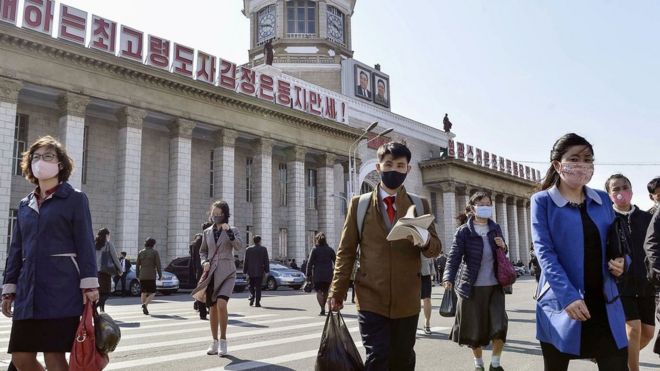
People wear face masks in front of Pyongyang Station in Pyongyang, North Korea (27 April 2020)Image copyright REUTERS
Image caption North Korea’s government maintains has not reported a single case of Covid-19 there

China’s president has expressed concern about the threat of the coronavirus to North Korea and offered help.

Xi Jinping was responding to a message that he received from the North Korean leader, Kim Jong-un.

Chinese state media reported that the message congratulated Mr Xi on China’s apparent success in fighting Covid-19.

North Korea’s government maintains that there has not been a single confirmed case there, though analysts have questioned whether that is possible.

North Korea was the first country to suspend tourism and to shut its borders in response to the virus, in the third week of January.

The country has a fragile health system, which experts fear would be quickly overwhelmed by even a small outbreak of Covid-19.

In his “verbal message of thanks”, Mr Xi said he highly appreciated Mr Kim’s support during China’s outbreak and “showed his personal attention to the situation of the pandemic and people’s health” in North Korea, according to state media.

Mr Xi called for more efforts to strengthen co-operation in preventing the spread of the coronavirus, and said China was “willing to continue to provide assistance within its own capacity for [North Korea] in the fight against Covid-19”.

On Friday, North Korean state media reported that Mr Kim had sent a verbal message to the president that “congratulated him, highly appreciating that he is seizing a chance of  victory in the war against the unprecedented epidemic”.
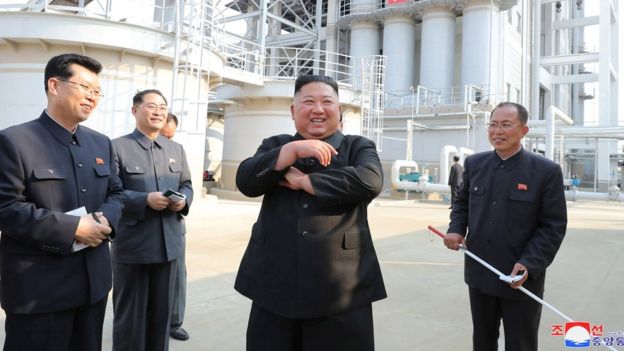
North Korean leader Kim Jong-un visits a fertiliser factory north of Pyongyang, reportedly on 2 May 2020Image copyright REUTERS
Image caption Kim Jong-un disappeared from public view for 20 days, before visiting a factory on 2 May

Mr Kim recently went 20 days without appearing in public, and missed the celebration of his grandfather’s birthday – one of the biggest events of the year.

Some media reports claimed he was “gravely ill”, or even dead.

But he then appeared at a fertiliser factory on 2 May – apparently in good health.

On Wednesday, South Korea’s National Intelligence Service told a parliamentary committee that there had been no signs the health rumours were true.

“He was performing his duties normally when he was out of the public eye,” a member of the committee, Kim Byung-kee, told reporters afterwards.

The lawmaker said the North Korean leader’s absence could have been down to a Covid-19 outbreak that the authorities in Pyongyang had not reported.

Presentational grey line

Analysis

By Celia Hatton, Asia Pacific Editor, BBC World Service

For months, North Korea-watchers have questioned Pyongyang’s claims that it has managed to isolate itself from Covid-19.

Admittedly, North Korea was the first country to suspend travel in response to the virus. There are unconfirmed reports that North Korean guards have been ordered to shoot at those who try to cross the lengthy border the North shares with China. However, it will be difficult to completely seal that dividing line for long. North Korea’s underground economy relies on illicit trade with Chinese entrepreneurs.

Beijing has a few good reasons for wanting to help North Korea. On a practical level, China needs to suppress a possible Covid-19 outbreak there if it wants to keep its own population healthy. Beijing also worries about what might happen inside North Korea if the virus takes hold. The North’s decrepit health system would quickly be overwhelmed by an outbreak of Covid-19, and that could threaten the fragile Kim Jong-un regime. Beijing has been Pyongyang’s biggest aid donor for decades, and it will continue to do what it can to keep Mr Kim in power. The alternatives to Kim Jong-un are much riskier for China, which does not want change on its doorstep.

China’s global political interests are also at play. Diplomatically, Mr Xi’s public exchange with Kim Jong-un underlines the seemingly close ties between China and North Korea. Pyongyang has been slow to accept public offers of help from the United States, and peace talks with Washington have stalled. If North Korea appeared to accept Beijing’s help, China would reassert itself as North Korea’s “true” ally in a time of need.

Presentational grey line

South Korea itself reported 18 new confirmed cases of Covid-19 on Saturday.

Seventeen of them are linked to a 29-year-old man who tested positive after spending time at five nightclubs and bars in Seoul’s Itaewon leisure district last weekend, the Yonhap news agency said.

Mayor Park Won-soon ordered nightclubs, bars and hostess venues across the capital to suspend business in response.

“Carelessness can lead to an explosion in infections – we clearly realised this through the group infections seen in the Itaewon club case,” Mr Park said.

Health officials have urged people who have visited the five venues in Itaewon to self-isolate and get tested to prevent additional transmissions. At least 1,500 people signed their entry logs, according to Yonhap.

The new infections brought the nationwide total to 10,840, while the death toll remained unchanged at 256.

Source: The BBC
05/05/2020

Coronavirus: Chinese state media take aim at US ‘lab theory’

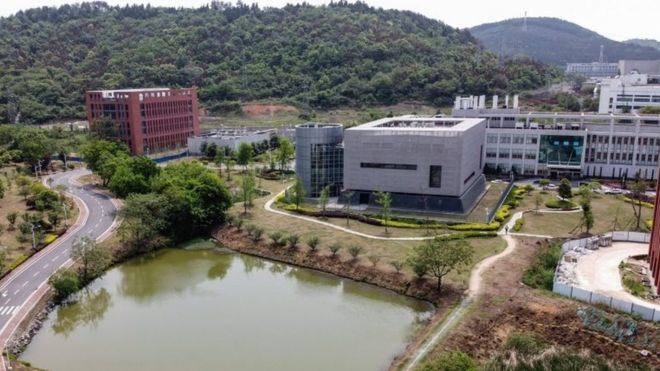
The P4 laboratory (centre) in Wuhan is among a handful of around the world cleared to handle Class 4 pathogens (P4) - dangerous viruses that pose a high risk of person-to-person transmissionImage copyright AFP / GETTY
Image caption The P4 laboratory (centre) in Wuhan is among a handful around the world cleared to handle viruses that pose a high risk of person-to-person transmission

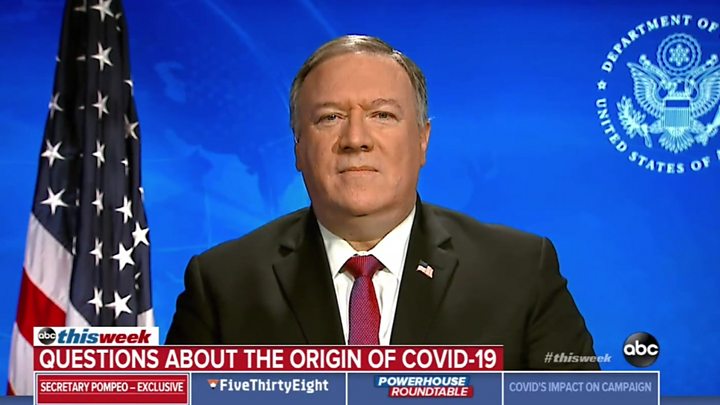
Chinese state media has accused US Secretary of State Mike Pompeo of lying, after he said there was “enormous evidence” the coronavirus emanated from a laboratory in Wuhan.

Mr Pompeo made the claim on Sunday, without going into specifics.

In an editorial on Tuesday, the hawkish Global Times newspaper said Mr Pompeo was “degenerate”.

The World Health Organization says the US claims are “speculative”, and that it has seen no “specific evidence”.

What did Chinese media say?

Editorials in Chinese state media often given an insight into the direction of government thinking, but there has been no official response to Mr Pompeo’s comments as yet.

On Monday, the Global Times accused Mr Pompeo of “absurd theories and twisted facts”, and on Tuesday the attack continued.

“Pompeo aims to kill two birds with one stone by spewing falsehoods,” it said.

“First, he hopes to help Trump win re-election this November…second, Pompeo hates socialist China and, in particular, cannot accept China’s rise.”

Media caption “The Chinese Communist Party has refused to co-operate with world health experts” – Mike Pompeo

The editorial admitted there were “initial problems” in China’s response to the outbreak, but claimed “the overall performance is bright enough to outweigh the flaws”.

It also said it was “conceivable that the virus first contacted humans in other places [than Wuhan]”.

The Global Times is not the only Chinese outlet to take aim at Mr Pompeo and the US.

The People’s Daily said Mr Pompeo had “no evidence”, while a piece on the CCTV site accused US politicians of “nefarious plotting”.

What did Mike Pompeo say?

In an interview with ABC on Sunday, Mr Pompeo said there was “enormous evidence” that the virus had emerged from the Wuhan Institute of Virology.

“Remember, China has a history of infecting the world, and they have a history of running sub-standard laboratories,” he said.

Mr Pompeo – a former director of the Central Intelligence Agency (CIA) – said he did not think the virus was man-made or genetically modified.

The Wuhan laboratory is known to study coronaviruses in bats. In April, President Trump was asked whether “lax safety protocols” allowed such a virus to escape via an intern and her boyfriend.

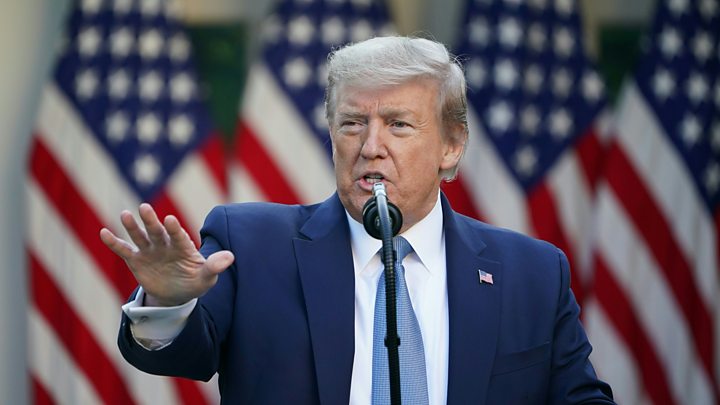
Mr Trump did not confirm the theory, but said: “More and more we’re hearing the story.”

Media caption Donald Trump was recently asked if the virus emanated in a laboratory, rather than a market

Last week, he was asked if he had seen evidence that gave him a “high degree of confidence” that the virus emerged in the Wuhan laboratory.

“Yes I have,” he replied – but said he could not go into specifics.

Last month, the Washington Post reported that US officials visited the laboratory in January 2018, and reported back their safety concerns.

What do the experts say?

On Monday, World Health Organization emergencies director Michael Ryan said it had received “no data or specific evidence” from the US about the virus origins.

“So from our perspective, this remains speculative,” he said.

Last week, the US intelligence community said it “concurred” that the virus “was not man-made or genetically modified”.

But it said it would “continue to examine” whether the outbreak began via “contract with infected animals, or if it was the result of an an accident at a laboratory in Wuhan”.

Australian Prime Minister Scott Morrison said on Tuesday that the most likely source of the virus was a wildlife market. However he said he would not rule out the theory that it originated in a lab.

“What’s really important is that we have a proper review, an independent review which looks into the sources of these things in a transparent way so we can learn the lessons,” he told reporters.

Meanwhile, Western “intelligence sources” have told several news outlets there is “no evidence” to suggest the virus leaked from a laboratory.

Source: The BBC

29/03/2020

Italian professor repeats warning coronavirus may have spread outside China last year

  • Giuseppe Remuzzi’s comments were seized on by Chinese state media amid the acrimonious row with the US, but he says the key question is how far Covid-19 had spread before it was identified
  • Academic says ‘strange pneumonias’ in Italy last November suggest it may have reached Europe before anyone knew what the disease was
Giuseppe Remuzzi told NPR there had been ‘strange pneumonias’ in Italy in November and December. Photo: Handout
The coronavirus that causes Covid-19 may have spread beyond China before the health authorities had even discovered the disease, according to the Italian professor who recently said there had been “very strange pneumonias” in Europe as early as November last year.
The comments by Giuseppe Remuzzi, director of the Mario Negri Institute for Pharmacological Research in Milan, during an interview with US National Public Radio last week were quickly seized upon in the increasingly acrimonious blame game between Washington and Beijing
.
Remuzzi’s comments attracted much attention in China, where the authorities have been working hard to steer the international narrative about the pandemic, and stop people describing it as the “China virus” or “Wuhan virus” after the city where the disease was first identified.
In an interview with the Chinese science and technology news outlet DeepTech, which was published on Tuesday, Remuzzi said the key point in his NPR interview was not where the virus came from, but how far it had spread before it was discovered.
Coronavirus: Italy has a brief glimpse of hope as new cases drop to a five-day low
24 Mar 2020

He said a major question was how long the disease, which has so far infected more than 378,000 and killed over 16,500 people worldwide, had been spreading in China before health authorities realised its severity.

Taking into account the long incubation period, Remuzzi said he would not be surprised if some asymptomatic carriers had travelled around China or even abroad before December.

The professor also said that while it was possible it originated outside Wuhan, there had so far been no proof to support the theory.

As the outbreak gathered pace in the US, where it has now killed more than 500 people, Washington has escalated its rhetoric. President Donald Trump had repeatedly referred to it publicly as the “Chinese virus” until he changed tone on Monday and declined to use the phrase.

China, meanwhile, has described the rhetoric adopted by “certain US politicians and senior officials” as an attempt to defame and stigmatise China over the pandemic.

A number of Chinese state media outlets, including party mouthpiece People’s Daily and its tabloid affiliate Global Times, seized on Remuzzi’s comments about “strange pneumonias” to counter the “Chinese virus rhetoric”.

Coronavirus: why are so many more people dying in Italy than Germany?

23 Mar 2020

In the NPR interview, Remuzzi tried to explain why Italy had been caught off guard when the outbreak started gathering pace in February.

He discussed the difficulty of combating a disease that people did not know existed, and said the unusual cases in November and December could mean that virus was already circulating in Lombardy, the country’s worst-hit region, before people were aware of what was unfolding in Wuhan.

Remuzzi also shared details of the early suspected cases in Lombardy with DeepTech and Chinese state-run international network CGTN.

Remuzzi said he had learned about the cases from a few general practitioners and he has not yet been able to verify the information.

But he said there are some other suspicious cases he “knows for sure”, including two pneumonia cases in Scanzorosciate in northern Italy in December, where the patients developed high fever, a cough and had difficulty in breathing.

He said there had also been 10 patients who developed bilateral interstitial pneumonia in two other nearby towns, Fara Gera D’Adda and Crema, who had similar symptoms.

Coronavirus: confusion as Chinese face masks bound for Italy end up in Czech Republic

23 Mar 2020

Remuzzi said local doctors considered these cases to be “unusual” but ruled out the possibility of seasonal influenza, as all these patients had been vaccinated.

“The reason we don’t know if it was Covid-19 is because at that time this could not be tested; the patients didn’t have X-rays,” he told CGTN.

They recovered within 15 days, with some receiving two or three courses of antibiotics.

Remuzzi added there had also been a patient diagnosed with bilateral interstitial pneumonia in Alzano Lombardo Hospital in Lombardy around the time.

Source: SCMP

Law of Unintended Consequences

continuously updated blog about China & India

ChiaHou's Book Reviews

continuously updated blog about China & India

What's wrong with the world; and its economy

continuously updated blog about China & India