Archive for ‘Chinese Vice Premier’

10/05/2019

Trade war: Trump raises tariffs on $200bn of Chinese goods

The US has more than doubled tariffs on $200bn (£153.7bn) worth of Chinese products, in a sharp escalation of the countries’ damaging trade war.

Tariffs on affected Chinese goods have risen to 25% from 10%, and Beijing has vowed to retaliate.

China says it “deeply regrets” the move and will have to take “necessary counter-measures.”

It comes as high-level officials from both sides are attempting to salvage a trade deal in Washington.

Only recently, the US and China appeared to be close to ending months of trade tensions.

China’s Commerce Ministry confirmed the latest US tariff increase on its website.

“It is hoped that the US and the Chinese sides will work together… to resolve existing problems through co-operation and consultation,” it said in a statement.

Tariffs are taxes paid by importers on foreign goods, so the 25% tariff will be paid by American companies who bring Chinese goods into the country.

Chinese stock markets rose on Friday, with the Hang Seng index up less than 1% and the Shanghai Composite more than 3% higher.

However, earlier in the week stock markets had fallen after US President Donald Trump flagged the tariff rise on Sunday.

The US imposed a 10% tariff on $200bn worth of Chinese products – including fish, handbags, clothing and footwear – last year.

The tariff was due to rise at the start of the year, but the increase was delayed as negotiations advanced.

What will be the impact of the tariff rise?

The US-China trade war has weighed on the global economy over the past year and created uncertainty for businesses and consumers.

Even though Mr Trump has downplayed the impact of tariffs on the US economy, the rise is likely to affect some American companies and consumers as firms may pass on some of the cost, analysts said.

Deborah Elms, executive director at the Asian Trade Centre, said: “It’s going to be a big shock to the economy.

“Those are all US companies who are suddenly facing a 25% increase in cost, and then you have to remember that the Chinese are going to retaliate.”
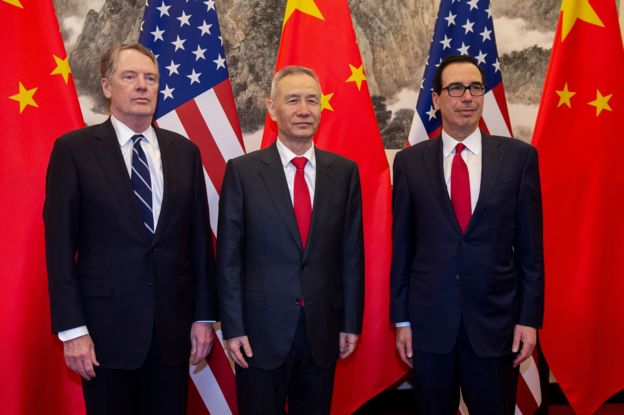
China's Vice Premier Liu He (C) poses for a photo with US Treasury Secretary Steven Mnuchin (R) and US Trade Representative Robert Lighthizer (L) at Diaoyutai State Guesthouse in Beijing on March 29, 2019Image copyright GETTY IMAGES
Image caption US and Chinese officials have held several round of talks in an attempt to strike a deal to end the trade war.

In a statement, the American Chamber of Commerce in China said it was committed to helping both sides find a “sustainable” solution.

“While we are disappointed that the stakes have been raised, we nevertheless support the ongoing effort by both sides to reach agreement on a strong, enforceable deal that resolves the fundamental, structural issues our members have long faced in China.”

French Finance Minister Bruno Le Maire warned that the trade dispute escalation threatened jobs across Europe.

“There is no greater threat to world growth,” Mr Le Maire told CNews. “It would mean that trade tariffs go up, fewer goods would circulate around the world… and jobs in France and in Europe would be destroyed.”

Presentational grey line

‘Serious escalation’ of the trade war

Analysis box by Karishma Vaswani, Asia business correspondent

No breakthrough, and no deal – just, more tariffs.

With this move, US President Donald Trump has effectively dealt a fresh blow to not just the Chinese economy – as he had presumably hoped – but also to US’s.

The previous set of tariffs of 10% on $200bn of Chinese goods have to some extent been absorbed by American importers, but economists say a 25% tariff will be much harder for them to stomach.

They will almost certainly have to pass on that cost to American consumers – and that means higher prices.

Make no mistake, this is a serious escalation – and the trade war between the world’s two largest economies is back on.

This means the rest of us should be prepared for more pain ahead.

Presentational grey line

How will the tariff increase affect negotiations?

Despite this week’s escalation in tensions, talks were held between Chinese Vice-Premier Liu He, US Trade Representative Robert Lighthizer and Treasury Secretary Steven Mnuchin on Thursday.

A White House spokesman said US officials had agreed with the vice-premier to resume talks on Friday morning, according to media reports.

Even though there had been growing optimism about progress in trade talks recently, sticking points have persisted throughout.

These have included issues around intellectual property protection, how fast to roll back tariffs and how to enforce a deal.
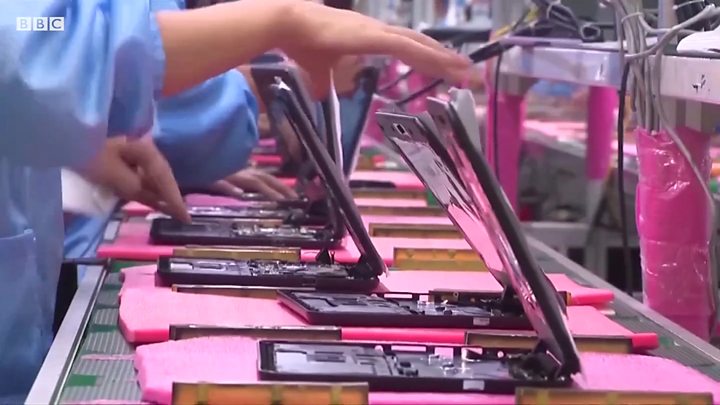
Analysts say the Chinese are still willing to negotiate to retain the moral high ground and because they recognise the importance of solving the trade war.

“A trade war will be bad for China, both the real economy and the financial markets. It will also be bad for the world economy,” said Gary Hufbauer of the Peterson Institute for International Economics.

“Better for China to play the role of conciliatory statesman than angry retaliator.”

Why are the US and China at odds?

China has been a frequent target of Donald Trump’s anger, with the US president criticising trade imbalances between the two countries and Chinese intellectual property rules, which he says hobble US companies.

Some in China see the trade war as part of an attempt by the US to curb its rise, with Western governments increasingly nervous about China’s growing influence in the world.

Both sides have already imposed tariffs on billions of dollars worth of one another’s goods. The situation could become worse still, as Mr Trump has also warned he could “shortly” introduce 25% duties on $325bn of Chinese goods.

What exactly sparked the US president’s latest actions, which apparently took China by surprise, is unclear.

Ahead of the discussions, Mr Trump told a rally China “broke the deal” and would pay for it.
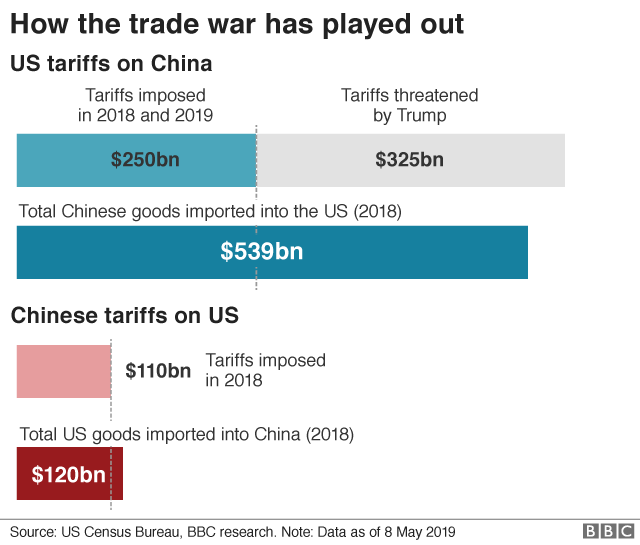
How the trade war has played out

The International Monetary Fund said the row poses a “threat to the global economy”.

“As we have said before, everybody loses in a protracted trade conflict,” the body which aims to ensure global financial stability said in a statement, calling for a “speedy resolution”.

Source: The BBC

08/05/2019

Exclusive: China backtracked on nearly all aspects of U.S. trade deal – sources

The document was riddled with reversals by China that undermined core U.S. demands, the sources told Reuters.

In each of the seven chapters of the draft trade deal, China had deleted its commitments to change laws to resolve core complaints that caused the United States to launch a trade war: theft of U.S. intellectual property and trade secrets; forced technology transfers; competition policy; access to financial services; and currency manipulation.

U.S. President Donald Trump responded in a tweet on Sunday vowing to raise tariffs on $200 billion (153 billion pounds) worth of Chinese goods from 10 to 25 percent on Friday – timed to land in the middle of a scheduled visit by China’s Vice Premier Liu He to Washington to continue trade talks.

The stripping of binding legal language from the draft struck directly at the highest priority of U.S. Trade Representative Robert Lighthizer – who views changes to Chinese laws as essential to verifying compliance after years of what U.S. officials have called empty reform promises.

Lighthizer has pushed hard for an enforcement regime more like those used for punitive economic sanctions – such as those imposed on North Korea or Iran – than a typical trade deal.

“This undermines the core architecture of the deal,” said a Washington-based source with knowledge of the talks.

“PROCESS OF NEGOTIATION”

Spokespeople for the White House, the U.S. Trade Representative and the U.S. Treasury Department did not immediately respond to requests for comment.

Chinese Foreign Ministry spokesman Geng Shuang told a briefing on Wednesday that working out disagreements over trade was a “process of negotiation” and that China was not “avoiding problems”.

Geng referred specific questions on the trade talks to the Commerce Ministry, which did not respond immediately to faxed questions from Reuters.
Lighthizer and U.S. Treasury Secretary Steven Mnuchin were taken aback at the extent of the changes in the draft. The two cabinet officials on Monday told reporters that Chinese backtracking had prompted Trump’s tariff order but did not provide details on the depth and breadth of the revisions.
Liu last week told Lighthizer and Mnuchin that they needed to trust China to fulfil its pledges through administrative and regulatory changes, two of the sources said. Both Mnuchin and Lighthizer considered that unacceptable, given China’s history of failing to fulfil reform pledges.
One private-sector source briefed on the talks said the last round of negotiations had gone very poorly because “China got greedy”.
“China reneged on a dozen things, if not more … The talks were so bad that the real surprise is that it took Trump until Sunday to blow up,” the source said.
“After 20 years of having their way with the U.S., China still appears to be miscalculating with this administration.”
FURTHER TALKS THIS WEEK
The rapid deterioration of negotiations rattled global stock markets, bonds and commodities this week. Until Sunday, markets had priced in the expectation that officials from the two countries were close to striking a deal.
Investors and analysts questioned whether Trump’s tweet was a negotiating ploy to wring more concessions from China. The sources told Reuters the extent of the setbacks in the revised text were serious and that Trump’s response was not merely a negotiating strategy.
Chinese negotiators said they couldn’t touch the laws, said one of the government sources, calling the changes “major.”
Changing any law in China requires a unique set of processes that can’t be navigated quickly, said a Chinese official familiar with the talks. The official disputed the assertion that China was backtracking on its promises, adding that U.S. demands were becoming more “harsh” and the path to a deal more “narrow” as the negotiations drag on.
Liu is set to arrive in Washington on Thursday for two days of talks that just last week were widely seen as pivotal – a possible last round before a historic trade deal. Now, U.S. officials have little hope that Liu will come bearing any offer that can get talks back on track, said two of the sources.


The administration said the latest tariff escalation would take effect at 12:01 a.m. Friday (0401 GMT), hiking levees on Chinese products such as internet modems and routers, printed circuit boards, vacuum cleaners and furniture.
The Chinese reversal may give China hawks in the Trump administration, including Lighthizer, an opening to take a harder stance.
Mnuchin – who has been more open to a deal with improved market access, and at times clashed with Lighthizer – appeared in sync with Lighthizer in describing the changes to reporters on Monday, while still leaving open the possibility that new tariffs could be averted with a deal.
Trump’s tweets left no room for backing down, and Lighthizer made it clear that, despite continuing talks, “come Friday, there will be tariffs in place.”
Source: Reuters
27/02/2019

Chinese vice premier stresses control over African swine fever

CHINA-BEIJING-HU CHUNHUA-AFRICAN SWINE FEVER-MEETING (CN)

Chinese Vice Premier Hu Chunhua, also a member of the Political Bureau of the Communist Party of China (CPC) Central Committee, presides over a meeting on effective prevention of and control over African swine fever, in Beijing, capital of China, Feb. 26, 2019.(Xinhua/Yin Bogu)

BEIJING, Feb. 26 (Xinhua) — Vice Premier Hu Chunhua on Tuesday called for more efforts on the effective prevention of and control over African swine fever to ensure a stable pork supply.

Hu, also a member of the Political Bureau of the Communist Party of China Central Committee, made the remarks when presiding over a specialized meeting on the prevention and control of the disease.

Hu said the situation remained very grave and it was a pressing task to intensify control efforts.

Hu called for strengthened supervision over pig farms, transport links and pork plants to ensure that all control efforts were firmly implemented.

Source: Xinhua

23/02/2019

Trump says he’s inclined to extend China trade deadline and meet Xi soon

WASHINGTON (Reuters) – President Donald Trump said on Friday there was “a very good chance” the United States would strike a deal with China to end their trade war and that he was inclined to extend his March 1 tariff deadline and meet soon with Chinese President Xi Jinping.

“I think that we both feel there’s a very good chance a deal will happen,” Trump said.

Liu agreed there had been “great progress”.

“From China, we believe that (it) is very likely that it will happen and we hope that ultimately we’ll have a deal. And the Chinese side is ready to make our utmost effort,” he said at the White House.

The Republican president said he probably would meet with Xi in March in Florida to decide on the most important terms of a trade deal.


Optimism that the two sides will find a way to end the trade war lifted stocks, especially technology shares. The S&P 500 stock index reached its highest closing level since Nov. 8. Oil prices rose to their highest since mid-November, with Brent crude reaching a high of $67.73 a barrel. [.N] [O/R]

CURRENCY AGREEMENT

Trump and Treasury Secretary Steven Mnuchin said the two sides had reached an agreement on currency. Trump declined to provide details, but U.S. officials long have expressed concerns that China’s yuan is undervalued, giving China a trade advantage and partly offsetting U.S. tariffs.

Announcement of a pact aimed at limiting yuan depreciation was putting “the currency cart before the trade horse,” but would likely be positive for Asian emerging market currencies, said Alan Ruskin, global head of currency strategy at Deutsche Bank in New York.

“How can you agree to avoid excessive Chinese yuan depreciation or volatility if you have not made an agreement on trade that could have huge FX implications?” Ruskin asked in a note to clients.

In a letter to Trump read aloud by an aide to Liu at the White House, Xi called on negotiators to work hard to strike a deal that benefits both country.

Trump said a deal with China may extend beyond trade to encompass Chinese telecommunications companies Huawei Technologies and ZTE Corp.

The Justice Department has accused Huawei of conspiring to violate U.S. sanctions on Iran and of stealing robotic technology from T-Mobile US Inc.

Chinese peer ZTE was last year prevented from buying essential components from U.S. firms after pleading guilty to similar charges, crippling its operations.

MEMORANDUMS NO MORE

Trump appeared at odds with his top negotiator, U.S. Trade Representative Robert Lighthizer, on the preliminary terms that his team is outlining in memorandums of understanding for a deal with China. Trump said he did not like MOUs because they are short term, and he wanted a long-term deal.

“I don’t like MOUs because they don’t mean anything,” Trump said. “Either you are going to make a deal or you’re not.”

Lighthizer responded testily that MOUs were binding, but that he would never use the term again.

Reuters reported exclusively on Wednesday that the two sides were drafting the language for six MOUs covering the most difficult issues in the trade talks that would require structural economic change in China.

Negotiators have struggled this week to agree on specific language within those memorandums to address tough U.S. demands, according to sources familiar with the talks. The six memorandums include cyber theft, intellectual property rights, services, agriculture and non-tariff barriers to trade, including subsidies.

An industry source briefed on the talks said both sides have narrowed differences on intellectual property rights, market access and narrowing a nearly $400 billion U.S. trade deficit with China. But bigger differences remain on changes to China’s treatment of state-owned enterprises, subsidies, forced technology transfers and cyber theft of U.S. trade secrets.

Lighthizer pushed back when questioned on forced technology transfers, saying the two sides made “a lot of progress” on the issue, but did not elaborate.

The United States has said foreign firms in China are often coerced to transfer their technology to Chinese firms if they want to operate there. China denies this.

The U.S. Chamber of Commerce on Friday urged the U.S. government to ensure the deal was comprehensive and addressed core issues, rather than one based on more Chinese short-term purchases of goods.

China has pledged to increase purchases of agricultural produce, energy, semiconductors and industrial goods to reduce its trade surplus with the United States.

China committed to buying an additional 10 million tonnes of U.S. soybeans on Friday, U.S. Agriculture Secretary Sonny Perdue said on Twitter. China bought about 32 million tonnes of U.S. soybeans in 2017. The commitments are a “show of good faith by the Chinese” and “indications of more good news to come,” Perdue wrote.

China was the top buyer of U.S. soybeans before the trade war, but Beijing’s retaliatory tariffs on U.S. soybeans slashed business that had been worth $12 billion annually.

Source: Reuters

22/02/2019

Saudi Arabia strikes $10 billion China deal, talks de-radicalisation with Xi

BEIJING (Reuters) – Saudi Crown Prince Mohammed bin Salman cemented a $10 billion (7.7 billion pounds) deal for a refining and petrochemical complex in China on Friday, meeting Chinese President Xi Jinping who urged joint efforts to counter extremism and terror.

The Saudi delegation, including top executives from state-owned oil company Saudi Aramco, arrived on Thursday on an Asia tour that has already seen the kingdom pledge investment of $20 billion in Pakistan and seek to make additional investments in India’s refining industry.

Saudi Arabia signed 35 economic cooperation agreements with China worth a total of $28 billion at a joint investment forum during the visit, Saudi state news agency SPA said.

“China is a good friend and partner to Saudi Arabia,” President Xi Jinping told the crown prince in front of reporters.

“The special nature of our bilateral relationship reflects the efforts you have made,” added Xi, who has made stepping up China’s presence in the Middle East a key foreign policy objective, despite its traditional low-key role there.

The crown prince said Saudi Arabia’s relations with China dated back “a very long time in the past”.

“In the hundreds, even thousands, of years, the interactions between the sides have been friendly. Over such a long period of exchanges with China, we have never experienced any problems with China,” he said.

Crown Prince Mohammed, who has come under fire in the West following the murder of Saudi journalist Jamal Khashoggi at the kingdom’s Istanbul consulate in October, said Saudi Arabia saw great opportunities with China.

“The Silk Road initiative and China’s strategic orientation are very much in line with the kingdom’s Vision 2030,” he said according to SPA, referring to Saudi Arabia’s sweeping economic reform programme.


Trade between the countries increased by 32 percent last year, he said.

China has had to step carefully in relations with Riyadh, since Beijing also has close ties with Saudi Arabia’s regional foe, Iran.

China is also wary of criticism from Muslim countries about its camps in the heavily Muslim far western region of Xinjiang, which the government says are for de-radicalisation purposes and rights groups call internment camps.

Xi told the crown prince the two countries must strengthen international cooperation on de-radicalisation to “prevent the infiltration and spread of extremist thinking”, Chinese state television said.

Saudi Arabia respected and supported China’s right to protect its own security and take counter-terror and de-radicalisation steps, the crown prince told Xi, according to the same report, and was willing to increase cooperation.

Meeting the crown prince earlier on Friday, Chinese Vice Premier Han Zheng said the two countries should enhance exchanges on their experiences in de-radicalisation, China’s official Xinhua news agency said in a separate report.

Chinese state media made no direct mention of Xinjiang in their stories on the crown prince’s meetings.

DEALS SIGNED

Aramco agreed to form a joint venture with Chinese defence conglomerate Norinco to develop a refining and petrochemical complex in the northeastern Chinese city of Panjin, saying the project was worth more than $10 billion.

The partners would form a company called Huajin Aramco Petrochemical Co as part of a project that would include a 300,000-barrels per day (bpd) refinery with a 1.5-million-metric tonnes per year ethylene cracker, Aramco said.

Aramco will supply up to 70 percent of the crude feedstock for the complex, which is expected to start operations in 2024.

The investments could help Saudi Arabia regain its place as the top oil exporter to China, a position Russia has held for the last three years. Saudi Aramco is set to boost market share by signing supply deals with non-state Chinese refiners.

Aramco also signed an agreement to buy a 9 percent stake in Zhejiang Petrochemical, Saudi state news agency SPA said. This formalised a previously announced plan to gain a stake in a 400,000-bpd refinery and petrochemicals complex in Zhoushan, south of Shanghai.

China sees “enormous potential” in Saudi Arabia’s economy and wants more high-tech cooperation, State Councillor Wang Yi, the Chinese government’s top diplomat, said on Thursday.

But China was not seeking to play politics in the Middle East, the widely read state-run tabloid, the Global Times, said in an editorial.

“China won’t be a geopolitical player in the Middle East. It has no enemies and can cooperate with all countries in the region,” said the paper, published by the ruling Communist Party’s official People’s Daily.

“China’s increasing influence in the Middle East comes from pure friendly cooperation. Such a partnership will be welcomed by more countries in the Middle East.”

Source: Reuters

Law of Unintended Consequences

continuously updated blog about China & India

ChiaHou's Book Reviews

continuously updated blog about China & India

What's wrong with the world; and its economy

continuously updated blog about China & India