10/05/2020

A customer buys products at a time-honored food store in east China’s Shanghai Municipality, April 26, 2020. (Xinhua/Wang Xiang)
Twelve cases were domestically transmitted, with 11 reported in Jilin Province and the other one in Hubei Province.
BEIJING, May 10 (Xinhua) — Chinese health authority said Sunday that it received report of 14 new confirmed COVID-19 cases on the Chinese mainland Saturday, of which two were imported cases reported in Shanghai.
Twelve cases were domestically transmitted, with 11 reported in Jilin Province and the other one in Hubei Province, the National Health Commission said in a daily report.
One new suspected case imported from abroad was reported in the Inner Mongolia Autonomous Region.
No deaths were reported Saturday on the mainland, according to the commission.
On Saturday, 74 people were discharged from hospitals after recovery, while the number of severe cases decreased by two to 13.
As of Saturday, the overall confirmed cases on the mainland had reached 82,901, including 148 patients who were still being treated, and 78,120 people who had been discharged after recovery.
Altogether 4,633 people had died of the disease, the commission said.
By Saturday, the mainland had reported a total of 1,683 imported cases. Of the cases, 1,568 had been discharged from hospitals after recovery, and 115 remained hospitalized with three in severe conditions. No deaths from the imported cases had been reported.
The commission said four people, all from overseas, were still suspected of being infected with the virus.
According to the commission, 5,840 close contacts were still under medical observation after 427 people were discharged from medical observation Saturday.
Also on Saturday, 20 new asymptomatic cases were reported on the mainland. One case was re-categorized as a confirmed case, and 61 asymptomatic cases, including 16 from overseas, were discharged from medical observation, according to the commission.
The commission said 794 asymptomatic cases, including 48 from overseas, were still under medical observation.
By Saturday, 1,044 confirmed cases including four deaths had been reported in the Hong Kong Special Administrative Region (SAR), 45 confirmed cases in the Macao SAR, and 440 in Taiwan including six deaths.
A total of 967 patients in Hong Kong, 40 in Macao, and 361 in Taiwan had been discharged from hospitals after recovery.
Source: Xinhua
Posted in Beijing, buys, Chinese health authority, Chinese mainland, commission, confirmed, COVID-19 cases, customer, deaths, domestically transmitted, east China's, food store, Hong Kong, Hong Kong Special Administrative Region (SAR), hubei province, imported cases, inner mongolia autonomous region, jilin province, Macao, Macao SAR, products, reports, Saturday, Shanghai, Shanghai Municipality, Sunday, Taiwan, time-honored, Uncategorized |
Leave a Comment »
18/04/2020
SHANGHAI (Reuters) – China ordered on Saturday that anyone in Wuhan working in certain service-related jobs must take a coronavirus test if they want to leave the city.
The order comes after the central city, where the coronavirus emerged late last year, lifted a 70-day lockdown that all but ended the epidemic there.
People in Wuhan work in nursing, education, security and other sectors with high exposure to the public must take a nucleic acid test before leaving, the National Health Commission said in an order.
The government of Hubei province, of which Wuhan is capital, will pay for the tests, the commission said.
Since the city relaxed its lockdown restrictions people who arrived in there before Chinese New Year, when the virus was peaking in China, are allowed to go back to their homes.
People working in other sectors aiming to leave Wuhan are encouraged to take voluntary tests before going.
Within seven days of arrival at their destinations, people who can present test results showing they do not carry the virus, as well as a clean bill of health on a health app, can go back to work.
Everyone else will have to spend 14 days in quarantine before returning to work.
Authorities have worked with the China’s tech giants to devise a colour-based health code system, retrieved via mobile app, that uses geolocation data and self-reported information to indicate one’s health status.
Wuhan will speed up its efforts to investigate asymptomatic coronavirus cases and confirm the presence of antibodies in people, which might suggest immunity, the commission said.
Wuhan, which accounts for 60% of infections in China and 84% of the death toll as of Saturday, has been testing inhabitants aggressively throughout the virus’ breakout and many companies had already been asking workers from the city to undergo tests before resuming work.
Wuhan revised up its death toll from the coronavirus by 1,290 on Friday, taking the city’s toll to 3,869, because of incorrect reporting, delays and omissions, especially in the chaotic early stages of the outbreak, authorities said.
China national death toll is 4,632 from 82,719 cases.
Source: Reuters
Posted in 'when', 14 days, 60, 70-day, 84%, after, aggressively, aiming, allowed, antibodies, Anyone, arrived, asking, asymptomatic, authorities, before, breakout, capital, carry, central, certain, chaotic, China, China’s, chinese new year, City, clean bill of health, colour-based, comes, commission, companies, confirm, coronavirus cases, Data, days, death toll, delays, destinations, devise, early stages, education, efforts, else, emerged, encouraged, ended, epidemic, especially, Everyone, Friday, geolocation, go back, Government, health app, health code system, health status, high exposure, homes, hubei province, immunity, incorrect reporting, indicate, infections, information, inhabitants, investigate, key, late last year, leave, leaving, lifted, lockdown, mandates, mobile app, must, National, National Health Commission, nursing, omissions, one’s, order, other, outbreak, pay, peaking, People, presence, present, public, public workers, quarantine, relaxed, restrictions, results, resuming, retrieved, returning, said, Saturday, sectors, security, self-reported, service-related jobs, seven, Shanghai, showing, speed up, spend, suggest, take, tech giants, test, tests, their, there, throughout, Uncategorized, undergo, uses, via, Virus, voluntary, want, work, workers, working, Wuhan |
Leave a Comment »
11/04/2020
BEIJING (Reuters) – China reported on Saturday a rise in new coronavirus cases, as authorities try to head off a second wave of infections, particularly from imported and asymptomatic cases, as curbs on cities and travel are lifted.
The National Health Commission said 46 new cases were reported on Friday, including 42 involving travellers from abroad, up from 42 cases a day earlier.
In its statement the commission added that 34 new asymptomatic cases were reported, down from 47 the previous day.
Mainland China’s tally of infections now stands at 81,953. The death toll rose by three to 3,339.
Tough curbs imposed since January helped rein in infections sharply from the height of the pandemic in February. But policymakers fear a second wave triggered by arrivals from overseas or asymptomatic patients.
Northeastern Heilongjiang recently reported a spike in new cases because of Chinese nationals entering the province from Russia, which has seen a surge of cases.
Provincial health officials said it had 22 new imported cases on Friday, all Chinese nationals coming from Russia, and one new local case, in its capital of Harbin.
Inner Mongolia had a daily tally of 27 new imported cases by Saturday morning, all from Russia, the region’s health authority said.
The central province of Hubei, where the virus emerged late last year, reported no new cases for a seventh successive day.
A rise in virus infections has prompted authorities in Guangzhou to step up scrutiny of foreigners, ordering bars and restaurants not to serve clients who appear to be of African origin, the U.S. consulate in the southern city said.
Anyone with “African contacts” faces mandatory virus tests followed by quarantine, regardless of recent travel history or previous isolation, it said in a statement.
It advised African-Americans or those who feel they might be suspected of contact with nationals of African origin to avoid the city.
Since the epidemic broke out in the provincial capital of Wuhan, it has spread around the world, infecting 1.6 million people and killing more than 100,000.
Source: Reuters
Posted in 100,000, 42, 46, abroad, advised, African, African Americans, Anyone, around the world, Arrivals, asymptomatic, authorities, “African contacts”, bars, capital, cases, central province, China, China’s, Chinese nationals, cities, clients, commission, coronavirus cases, curbs, day, death toll, earlier, emerged, entering, epidemic, February, followed by, Foreigners, Friday, from, Guangzhou, Harbin, head off, Health officials, Heilongjiang, History, Hubei, imported, infecting, infections, Inner Mongolia, isolation, January, killing, late last year, lifted, Mainland China, mandatory, million, morning, National Health Commission, new, Northeastern, ordering, origin, overseas, pandemic, particularly, People, policymakers, previous, province, Provincial, provincial capital, quarantine, recent, regardless, reported, reports, restaurants, rise, Russia, said, Saturday, scrutiny, second wave, seventh, southern city, spike, spread, statement, successive, surge, tally, travel, travellers, triggered, try, U.S. consulate, Uncategorized, up from, Virus, virus tests, Wuhan |
Leave a Comment »
27/09/2019
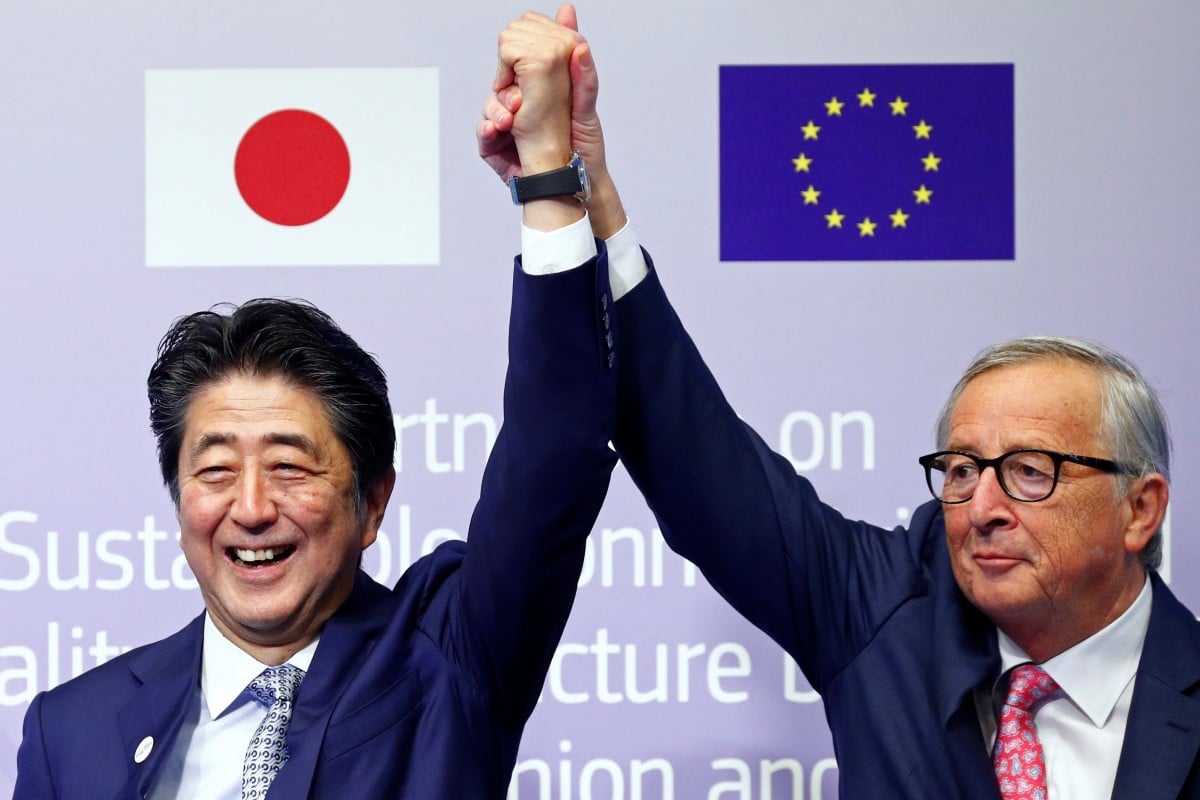
- Japan’s Prime Minister Shinzo Abe and EC President Jean-Claude Juncker mark first anniversary of EU-Asia Connectivity scheme with swipes at China
- Partners reach out to countries in Balkans and Africa and agree US$65.5 billion development plan
Japan’s Prime Minister Shinzo Abe (left) and European Commission President Jean-Claude Juncker mark the anniversary of the EU-Asia Connectivity scheme in Brussels, Belgium. Photo: Reuters
The
European Union and
Japan are stepping up their efforts to counter China’s
, with their leaders vowing to be “guardians of universal values” such as democracy, sustainability and good governance.
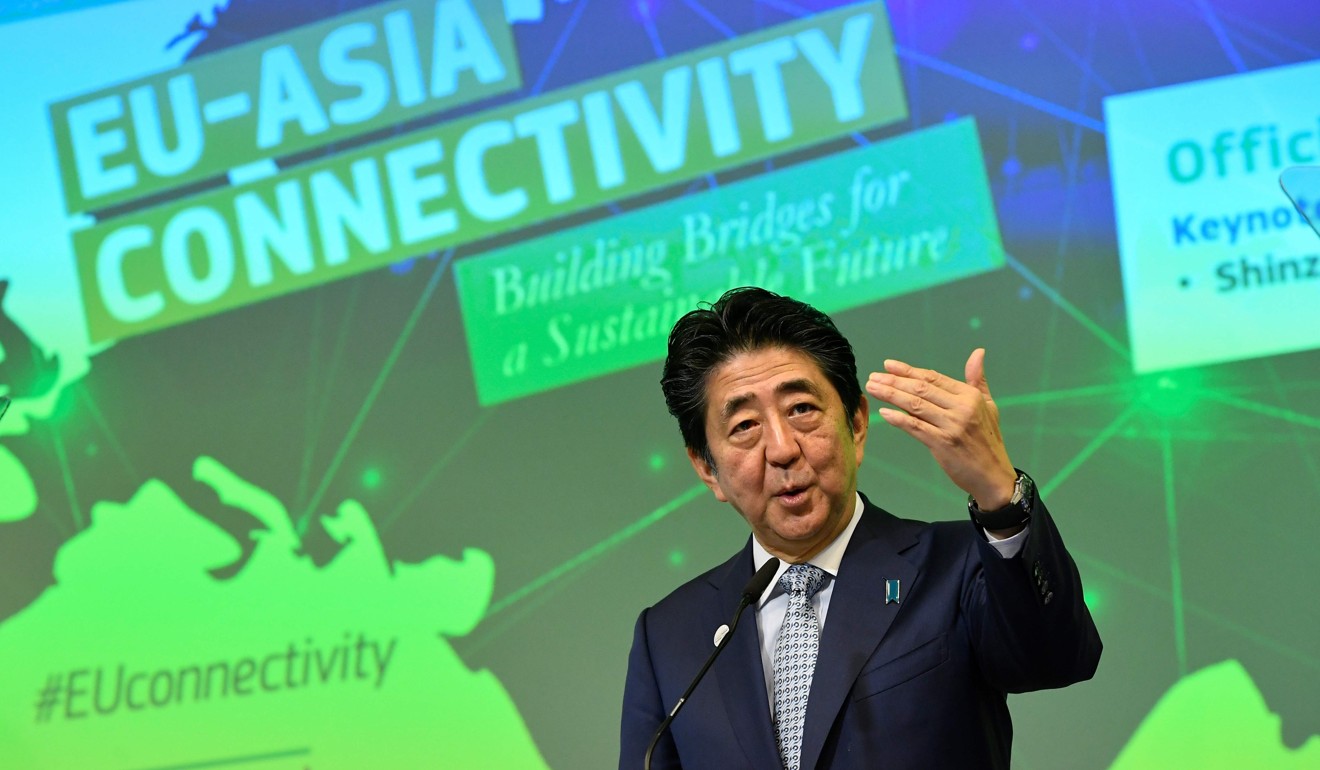
Speaking in Brussels on Friday, Japanese Prime Minister Shinzo Abe said the world’s third-biggest economy would work with the EU to strengthen their transport, energy and digital ties to Africa and the Balkans – key regions for China’s flagship trade and development project.
At a forum to mark the first anniversary of the EU-Asia Connectivity scheme, Abe and European Commission President Jean-Claude Juncker signed an agreement formalising Japan’s involvement in the Europe-Asia plan that will be backed by a €60 billion (US$65.54 billion) EU guarantee fund, development banks and private investors.
Abe said Japan would ensure that officials from 30 African countries would be trained in sovereign debt management over the next three years, a veiled attack on what Western diplomats claim is China’s debt trap for its belt and road partners.
“The EU and Japan are linked through and through,” Abe said. “The infrastructure we build from now on must be [high] quality infrastructure.
“Whether it be a single road or a single port, when the EU and Japan undertake something, we are able to build sustainable, comprehensive and rules-based connectivity, from the Indo-Pacific to the west Balkans and Africa.”
Japan wants to extend its business reach through its alliance with the EU as its economy slows and geopolitical competition from China takes its toll.
Japan indicates China is bigger threat than North Korea in latest defence review
China’s low-key delegation to the forum was led by Guo Xuejun, deputy director general of international affairs at the foreign ministry.
The US was represented by its deputy assistant secretary of state for cyber policy, Robert Strayer, who was in Europe to lobby against Chinese telecoms giant Huawei Technologies and its involvement in fifth-generation telecoms networks.
Abe and Juncker made cybersecurity the highlight of their addresses. Juncker, who will step down from the presidency by the end of October, repeated his attack on China’s trade policies without naming the country.
“Openness is reciprocal, based on high standards of transparency and good governance, especially for public procurement, and equal access to businesses while respecting intellectual property rights,” he said.
Prime Minister Shinzo Abe says Japan will train officials from 30 African countries in sovereign debt management in three years. Photo: AFP
European policymakers and businesses have for years complained about China’s refusal to allow foreign companies in without a Chinese joint venture partner, a practice that critics claimed involved forced transfer of intellectual property to the Chinese side.
“One of the keys to successful connectivity is to respect basic rules and common sense,” Juncker said, stressing that EU-Japanese cooperation focused on the “same commitment to democracy, rule of law, freedom and human dignity”.
European businesses urge EU to take ‘defensive’ measures against China’s state-owned enterprises
When the commission proposed improved transport, energy and digital infrastructure links with Asia last year, it denied it was seeking to stymie Chinese ambitions.
The EU plan, which would be backed by additional funds from the EU’s common budget from 2021, private sector loans and development banks, amounted to a response to China’s largesse in much of central Asia and south-eastern Europe, where Beijing has invested billions of dollars.
Source: SCMP
Posted in africa, African countries, Beijing, Belgium, Belt and Road Initiative, Belt and Road Initiative (BRI), belt and road partners, Brussels, Central Asia, challenge, China alert, commission, cybersecurity, debt management, debt trap, Democracy, digital infrastructure, ean-Claude Juncker, EC President, effort, energy, EU, EU-Asia Connectivity scheme, Europe-Asia plan, European Union, fifth-generation telecoms networks, geopolitical competition, good governance, guardians, huawei technologies, Indo-Pacific, Intellectual property, Japan, Japanese Prime Minister Shinzo Abe, play, south-eastern Europe, state-owned enterprises (SOEs), Sustainability, Transport, Uncategorized, universal values, Western diplomats |
Leave a Comment »
15/02/2019
BEIJING, Feb. 14 (Xinhua) — The Beijing municipal government has published a plan to transform a vacated industrial site in its western suburb into a city landmark by 2035, as part of the preparation for the Beijing 2022 Winter Olympics.
The new area, on the basis of the Shougang Park, a former steel plant relocated to neighboring Hebei Province in 2010, covers an area of 22.3 square km, according to the plan released Wednesday by the city’s development and reform commission.
“Building on the existing facilities, we will create a distinct community composed of museums, industrial incubators and leisure facilities,” said Hong Jiyuan, deputy director of the commission.
Sports facilities including a ski site and a training center are under construction in the park for the Winter Olympics. The facilities will be used after the Games to host international events and exhibitions, according to the plan.
Beijing is also building more lakes, forest parks and waterscapes in the area to create an eco-friendly demonstration space.
Shougang Group will cooperate with enterprises both at home and abroad to rejuvenate the old industrial area, said Wang Shizhong, deputy general manager of the company, adding that Beijing’s first 5G network and an artificial intelligence industrial park will be established there.
Source: Xinhua
Posted in 5G network, Artificial intelligence, Beijing, China alert, commission, deputy director, deputy general manager, forest parks, Hong Jiyuan, Industrial park, municipal government, Shougang Park, Steel City, steel plant, transform, Uncategorized, Wang Shizhong, waterscapes, Winter Olympics |
Leave a Comment »



 CHINDIA ALERT: You'll be living in their world, very soon