

ZADSHI VILLAGE, India (Reuters) – Three years ago, brick mason Pundlik Bhandekar was always busy as farmers in his tiny hamlet in Maharashtra commissioned new houses and nearby towns were undergoing rapid urbanisation. Now, as the rural economy sinks and the pace of construction slows, Bhandekar is struggling to get work.
“I used to get a new construction project before I could even finish one. People would come to my house to check when I would be free to work for them,” said Bhandekar, as he sat with friends under the shade of a tree on a hot afternoon.
From daily wage workers such as masons, to barbers and grocery shop owners – just about everyone in Zadshi village, some 720 km (450 miles) from India’s financial hub Mumbai, says a drop in farm incomes has dented their livelihoods.
Their woes are symptomatic of a wider problem across India, where more than half of the country’s 1.3 billion people are dependent on agriculture for their livelihoods, as the slowdown in the rural economy is felt in the dampening sales of consumer goods, especially the biggest such as car and motorbike sales.
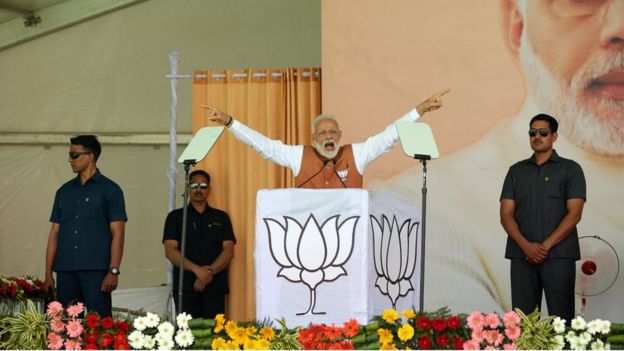
The slowdown has also dented Prime Minister Narendra Modi’s popularity in the hinterland that propelled him to power in 2014, and political strategists say it may mean he struggles to form a majority after voting in a staggered general election that began on April 11 concludes on May 19.
Zadshi has been almost entirely dependent on annual cotton and soybean crops that, according to farmers, have given lacklustre returns in the past few years due to a dip in prices, droughts and pest attacks.
And as incomes have dropped, farmers have cut back on big-ticket spending such as building new houses, digging wells or laying water pipelines, squeezing employment opportunities for people such as Bhandkekar.
“No one is interested in hiring us. We are ready to work even at 250 rupees ($3.60) per day,” said Bhandekar, who charged 300 rupees a day when work was steady, but now gets work only once or twice in a fortnight.
LOWER WAGES, LESS SPENDING
Economic data reflects the plight of farmers and daily wage workers.
Retail food inflation in the fiscal year ended on March 31 fell to 0.74 percent, even as core inflation stood at 5.2 percent, according to Bank of America Merrill Lynch Research, eroding the spending power of farmers.
Inflation adjusted wage growth for workers involved in crop sowing was just 0.6 percent 2018/19 compared with 6.5 percent in 2013/14.
The value of farm produce at constant prices grew 15 percent in the past five years, compared with 23 percent in the previous five, while the manufacturing sector grew 40 percent, against 32.6 percent in the previous five years, government data shows.
“Lower rural wages will result in lesser spending, which in turn will reduce demand for goods and services that are part of the rural basket,” Rupa Rege Nitsure, group chief economist at L&T Finance Holdings in Mumbai, told Reuters.
The government needs to spend more in rural areas to generate employment and boost incomes, Nitsure said.
Modi’s Hindu nationalist government did introduce various support schemes in the past six months, such as a 6,000 rupees yearly handout to small farmers.
The main opposition Congress party has gone much further with its pledges though, saying it would introduce a basic minimum income, where the country’s poorest families would get 72,000 rupees annually, benefiting some 250 million people.
RISING UNEMPLOYMENT
In Zadshi, as the mercury touched a searing 40 degrees Celsius(104F), a group of villagers gathered under the trees lining a dusty road and began chatting about everything from crop prices to politics.
“What else we can do? Had work been available in urban areas, we could have moved there but even in the cities construction has slowed down,” said Amol Sontakke, an unskilled labourer who works in farms and on construction sites.
Job opportunities have slowed even in urban areas and India’s unemployment rate touched 7.2 percent in February, the highest since September 2016, according to data compiled by the Centre for Monitoring Indian Economy (CMIE). Official data is unavailable for recent periods.
The mood in Zadshi was glum. While four dozen villagers interviewed by Reuters were hopeful that if there was a good monsoon this year it could improve farm incomes, they’ve been cutting back on spending in the meantime.
“People are thinking twice before buying new clothes during festivals,” said Avinash Gaurkar, a farmer currently doubling up as a part-time driver. “Buying big-ticket items such as motorcycles or refrigerators is out of the question.”
Two years ago Gaurkar began building a house, but had to give up midway as his five-acre farm could not generate the money needed, he said, pointing towards a half-finished structure without doors.
In 2018, just four villagers bought new motorbikes compared with as many as 10 a year about four years ago, said cotton farmer Raju Kohale, whose son is sitting at home unemployed after graduating as an engineer.
“Poor monsoon or lower prices, something or the other has been hurting us in the past few years,” Kohale said.
MODI AGAIN?
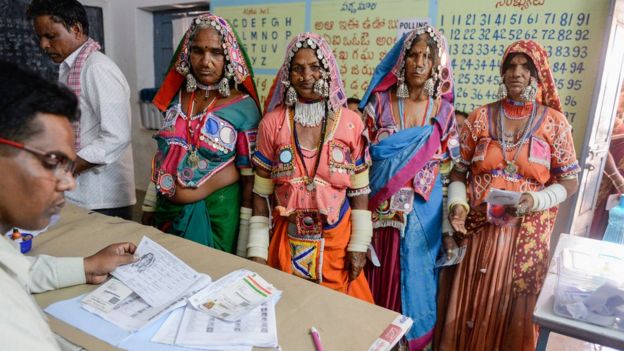
In the 2014 general election, most in Zadshi voted for Modi, but the farmers’ distress has swayed many towards the opposition Congress party. That was clear from Reuters’ interviews with 48 villagers, who cast their ballots last month.
Farmers are at the bottom of the Modi administration’s priority list, said labourer Sagar Bahalavi.
“They are building big roads to connect metros and calling it development. How is that useful for us?” he said.





 CHINDIA ALERT: You'll be living in their world, very soon
India and Pakistan: How the war was fought in TV studios
As tensions between India and Pakistan escalated following a deadly suicide attack last month, there was another battle being played out on the airwaves. Television stations in both countries were accused of sensationalism and partiality. But how far did they take it? The BBC’s Rajini Vaidyanathan in Delhi and Secunder Kermani in Islamabad take a look.
It was drama that was almost made for television.
The relationship between India and Pakistan – tense at the best of times – came to a head on 26 February when India announced it had launched airstrikes on militant camps in Pakistan’s Balakot region as “retaliation” for a suicide attack that had killed 40 troops in Indian-administered Kashmir almost two weeks earlier.
A day later, on 27 February, Pakistan shot down an Indian jet fighter and captured its pilot.
Abhinandan Varthaman was freed as a “peace gesture”, and Pakistan PM Imran Khan warned that neither country could afford a miscalculation, with a nuclear arsenal on each side.
Suddenly people were hooked, India’s TV journalists included.
So were they more patriots than journalists?
Rajini Vaidyanathan: Indian television networks showed no restraint when it came to their breathless coverage of the story. Rolling news was at fever pitch.
The coverage often fell into jingoism and nationalism, with headlines such as “Pakistan teaches India a lesson”, “Dastardly Pakistan”, and “Stay Calm and Back India” prominently displayed on screens.
Some reporters and commentators called for India to use missiles and strike back. One reporter in south India hosted an entire segment dressed in combat fatigues, holding a toy gun.
And while I was reporting on the return of the Indian pilot at the international border between the two countries in the northern city of Amritsar, I saw a woman getting an Indian flag painted on her cheek. “I’m a journalist too,” she said, as she smiled at me in slight embarrassment.
Print journalist Salil Tripathi wrote a scathing critique of the way reporters in both India and Pakistan covered the events, arguing they had lost all sense of impartiality and perspective. “Not one of the fulminating television-news anchors exhibited the criticality demanded of their profession,” she said.
Secunder Kermani: Shortly after shooting down at least one Indian plane last week, the Pakistani military held a press conference.
As it ended, the journalists there began chanting “Pakistan Zindabad” (Long Live Pakistan). It wasn’t the only example of “journalistic patriotism” during the recent crisis.
Two anchors from private channel 92 News donned military uniforms as they presented the news – though other Pakistani journalists criticised their decision.
But on the whole, while Indian TV presenters angrily demanded military action, journalists in Pakistan were more restrained, with many mocking what they called the “war mongering and hysteria” across the border.
In response to Indian media reports about farmers refusing to export tomatoes to Pakistan anymore for instance, one popular presenter tweeted about a “Tomatical strike” – a reference to Indian claims they carried out a “surgical strike” in 2016 during another period of conflict between the countries.
Media analyst Adnan Rehmat noted that while the Pakistani media did play a “peace monger as opposed to a warmonger” role, in doing so, it was following the lead of Pakistani officials who warned against the risks of escalation, which “served as a cue for the media.”
What were they reporting?
Rajini Vaidyanathan: As TV networks furiously broadcast bulletins from makeshift “war rooms” complete with virtual reality missiles, questions were raised not just about the reporters but what they were reporting.
Indian channels were quick to swallow the government version of events, rather than question or challenge it, said Shailaja Bajpai, media editor at The Print. “The media has stopped asking any kind of legitimate questions, by and large,” she said. “There’s no pretence of objectiveness.”
In recent years in fact, a handful of commentators have complained about the lack of critical questioning in the Indian media.
“For some in the Indian press corps the very thought of challenging the ‘official version’ of events is the equivalent of being anti-national”, said Ms Bajpai. “We know there have been intelligence lapses but nobody is questioning that.”
Senior defence and science reporter Pallava Bagla agreed. “The first casualty in a war is always factual information. Sometimes nationalistic fervour can make facts fade away,” he said.
This critique isn’t unique to India, or even this period in time. During the 2003 Iraq war, western journalists embedded with their country’s militaries were also, on many occasions, simply reporting the official narrative.
Secunder Kermani: In Pakistan, both media and public reacted with scepticism to Indian claims about the damage caused by the airstrikes in Balakot, which India claimed killed a large number of Jaish-e-Mohammad (JeM) militants in a training camp.
Hamid Mir, one of the most influential TV anchors in the country travelled to the area and proclaimed, “We haven’t seen any such (militant) infrastructure… we haven’t seen any bodies, any funerals.”
“Actually,” he paused, “We have found one body… this crow.” The camera panned down to a dead crow, while Mr Mir asked viewers if the crow “looks like a terrorist or not?”
There seems to be no evidence to substantiate Indian claims that a militant training camp was hit, but other journalists working for international outlets, including the BBC, found evidence of a madrassa, linked to JeM, near the site.
A photo of a signpost giving directions to the madrassa even surfaced on social media. It described the madrassa as being “under the supervision of Masood Azhar”. Mr Azhar is the founder of JeM.
The signpost’s existence was confirmed by a BBC reporter and Al Jazeera, though by the time Reuters visited it had apparently been removed. Despite this, the madrassa and its links received little to no coverage in the Pakistani press.
Media analyst Adnan Rehmat told the BBC that “there was no emphasis on investigating independently or thoroughly enough” the status of the madrassa.
In Pakistan, reporting on alleged links between the intelligence services and militant groups is often seen as a “red line”. Journalists fear for their physical safety, whilst editors know their newspapers or TV channels could face severe pressure if they publish anything that could be construed as “anti-state”.
Who did it better: Khan or Modi?
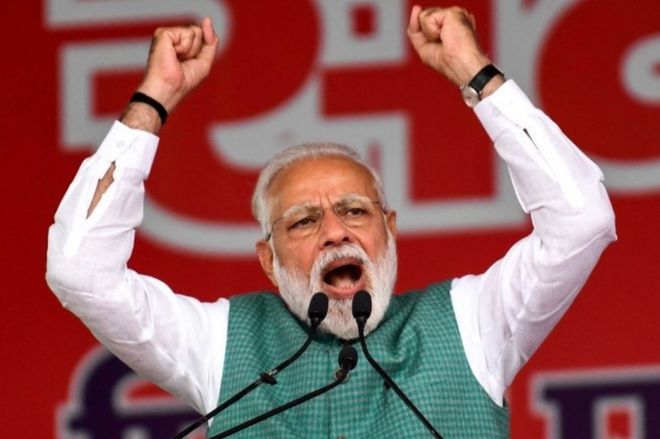
Rajini Vaidyanathan: With a general election due in a few months, PM Narendra Modi continued with his campaign schedule, mentioning the crisis in some of his stump speeches. But he never directly addressed the ongoing tensions through an address to the nation or a press conference.
This was not a surprise. Mr Modi rarely holds news conference or gives interviews to the media. When news of the suicide attack broke, Mr Modi was criticised for continuing with a photo shoot.
The leader of the main opposition Congress party, Rahul Gandhi, dubbed him a “Prime Time Minister” claiming the PM had carried on filming for three hours. PM Modi has also been accused of managing his military response as a way to court votes.
At a campaign rally in his home state of Gujarat he seemed unflustered by his critics, quipping “they’re busy with strikes on Modi, and Modi is launching strikes on terror.”
Secunder Kermani: Imran Khan won praise even from many of his critics in Pakistan, for his measured approach to the conflict. In two appearances on state TV, and one in parliament, he appeared firm, but also called for dialogue with India.
His stance helped set the comparatively more measured tone for Pakistani media coverage.
Officials in Islamabad, buoyed by Mr Khan’s decision to release the captured Indian pilot, have portrayed themselves as the more responsible side, which made overtures for peace.
On Twitter, a hashtag calling for Mr Khan to be awarded a Nobel Peace Prize was trending for a while. But his lack of specific references to JeM, mean internationally there is likely to be scepticism, at least initially, about his claims that Pakistan will no longer tolerate militant groups targeting India.
Source: The BBC
Posted in Adnan Rehmat, airstrikes, airwaves, Al Jazeera, Balakot, BBC, BBC reporter, campaign schedule, casualty, combat fatigues, commentators, congress party, critical questioning, Dastardly Pakistan, Delhi, escalation, factual information, fought, general election, Hamid Mir, hashtag, Imran Khan, India alert, Indian jet fighter, international border, Islamabad, Islamist militant groups, Jaish-e-Mohammad (JeM), JeM, jingoism and nationalism, Journalist, Kashmir, madrassa, Masood Azhar, Media analyst, media editor, militant camps, militants, missiles, nationalistic fervour, Nobel Peace Prize, Pakistan, Pakistani, Pakistani military, Pallava Bagla, pilot, PM Narendra Modi, press, press conference, Prime Time Minister, rahul gandhi, Rajini Vaidyanathan, red line, retaliation, Reuters, Salil Tripathi, Secunder Kermani, Senior defence and science reporter, sensationalism and partiality, Shailaja Bajpai, signpost's, suicide attack, Surgical strike, The Print, Tomatical strike, toy gun, training camp, TV anchors, TV journalists, TV studios, Twitter, Uncategorized, war, war mongering and hysteria, warmonger, Wg Cdr Abhinandan Varthaman | Leave a Comment »