Archive for ‘construction sites’

24/09/2019

China 70th anniversary: Pigeon ban and lockdowns as countdown begins

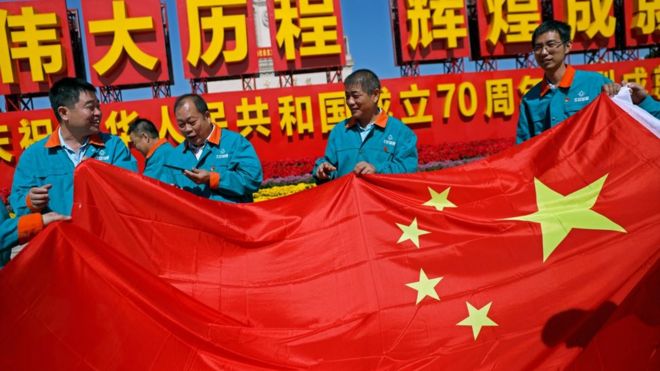
Chinese workers with Chinese flagImage copyright EPA
Image caption China is getting dressed up for its big birthday party

One week from now, the People’s Republic of China will mark its 70th anniversary with celebrations on a scale not seen in China in decades.

Beijing is pulling out all stops and 1 October will be flush with fireworks, fanfare and a huge military parade.

To ensure it goes smoothly, authorities have been ramping up security in the capital – and online – for weeks.

But with yet more protests expected in Hong Kong, the territory might just rain on China’s parade.

What is it all about?

The birth of modern China was declared on 1 October 1949, after the communists under Mao Zedong won the civil war that followed World War Two.
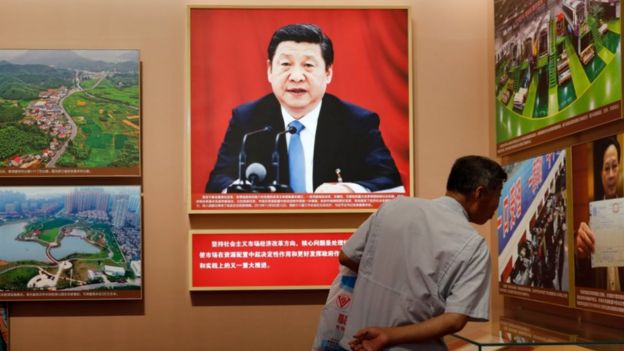
Portrait of Xi JinpingImage copyright EPA
Image caption Exhibitions are highlighting the achievements of the Communist Party

The date is marked every year, but celebrations for this 70th anniversary are expected to eclipse previous events.

It’s the first big anniversary since China has emerged as a global power. While 10 years ago China was a superpower in the making, it is now the world’s second largest economy, almost eye-to-eye with the United States.

What to expect?

The main celebrations will take place in the capital, Beijing, where there will be a grand military parade with “advanced weapons” on display, followed by a “mass pageant”.

President Xi Jinping – considered the most powerful Chinese leader since Mao – will address the Chinese people. His speech is expected to celebrate China’s rapid growth and which will be closely watched for any indication of the country’s direction in the coming years.

The president will also hand out honours for contributions to the country and in the evening there will be a grand gala and fireworks show.

All official Chinese celebrations are carefully choreographed and the success of this one is particularly important to the government.

The Dos and Don’ts

The parade – open to invited guests only – will take place around Tiananmen Square in central Beijing. The surrounding area will be practically under lockdown, and in fact has been so several times already.

During rehearsals leading up to the big day, hotels near Tiananmen Square told guests that for several hours each day, no-one would be able to leave the hotel or return to it should they be out, leading to much travel chaos and rebookings.

Many shops and restaurants in the centre are also closed or have shortened hours and some subway stations are temporarily shut.
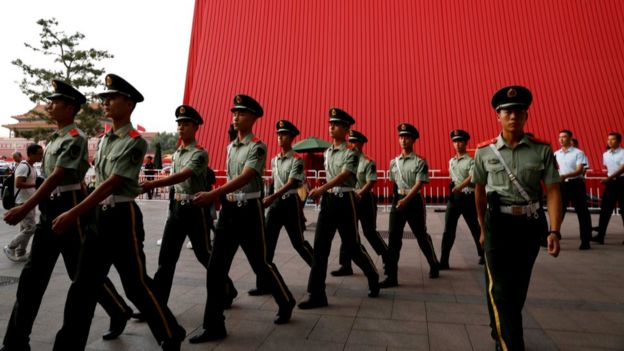
Chinese paramilitary policeImage copyright EPA
Image caption Security is tight ensure the party goes to plan

Trains to Beijing are running numerous safety checks on their passengers and vehicles going into the city are also being tightly watched.

On the big day itself, areas around Tiananmen Square will be blocked and guarded. Local residents will need to identify themselves if they want to pass.

To ensure the sun will shine brightly on the celebration in notoriously polluted Beijing, several coal plants and construction sites in and around the city have been ordered to stop work for the duration.

There’s also a ban on any low-flying aerial vehicles in place. That means anything from light aircraft to drones, balloons and even racing pigeons.

Censorship galore

Across much of the city centre, there are national flags set up at every door. Voluntary inspectors are monitoring the streets and locals have told the BBC they’re being questioned after having even brief conversations with foreigners

One person said she was asked by an inspector: “Who were those foreigners? Why were they here?”

The tight control naturally extends online as well. Popular social media platform Weibo said it was deleting content that “distorts” or “insults” the country’s history ahead of the anniversary.
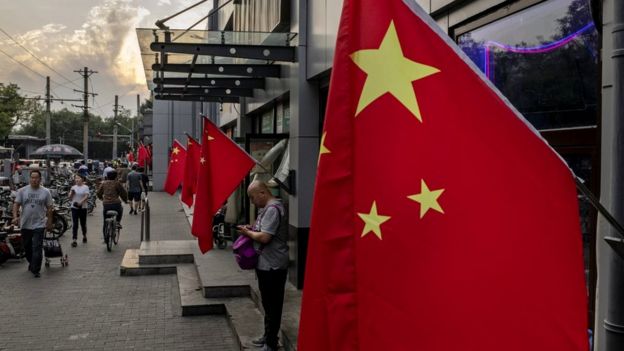
Chinese flags outside a row of shopsImage copyright GETTY IMAGES
Image caption Every house and every shop is sporting a national flag

Chinese journalists are always expected to toe the party line anyway, but starting in October they will have to pass an extra test to prove they are versed particularly in Xi Jinping’s teachings, officially called Xi Jinping Thought on Socialism with Chinese Characteristics, which has been written into the constitution.

Whether or not they pass the exam will then determine whether they’ll be accredited as journalists.

“The fundamental point with this ‘training’ and indoctrination process isn’t so much about the content,” David Bandurski of China Media Watch told the BBC.

“It is about reinforcing the message and understanding among journalists that they work, first and foremost, for the Chinese Communist Party, and serve its agenda.”

So not only will the events be choreographed – the domestic coverage of them will also be tightly guarded.

What about Hong Kong?

Despite Beijing’s determination to let its achievements shine on 1 October, there’s a good chance Hong Kong will pull focus.

Anti-Beijing protests always take place in Hong Kong on China’s National Day, but this time, the activists know that the world is watching.

Anti-government protests have rocked the city for months and the situation shows no sign of dying down.

Clashes between police and activists have been becoming increasingly violent, with police using tear gas and activists storming parliament.
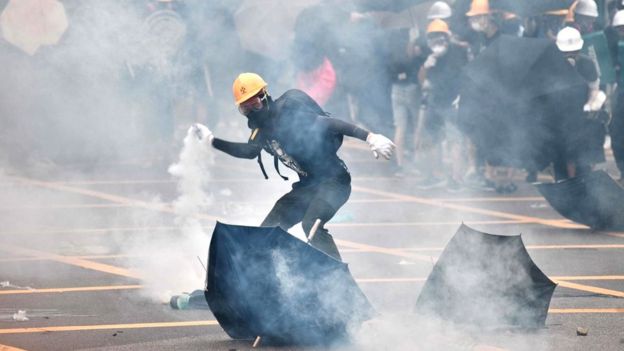
Protester throwing a tear gas can back at the policeImage copyright AFP
Image caption The protests have often escalated into violent clashes

That means two things for 1 October: official celebrations in the territory are being toned down to avoid clashes – the annual fireworks display has been cancelled – while at the same time, activists are planning to step up their protests.

On Sunday 29 September, a “Global Anti Totalitarianism March” is scheduled to take place at various locations around the world in support of Hong Kong.

On 1 October itself, a march in central Hong Kong is planned with everyone asked to wear black.

If the past weeks’ demonstrations are anything to go by, the smiles and celebrations in Beijing will be competing for media space with pictures of tear gas and angry young protesters in Hong Kong.

Source: The BBC

10/06/2019

‘There is no water. Why should people stay here?’

Hatkarwadi
Image caption Hatkarwadi hasn’t seen decent rains in three years

Every morning Dagadu Beldar, 75, wakes up and cooks rice and lentils in his village home in India’s western state of Maharashtra. After that, there’s little else to do.

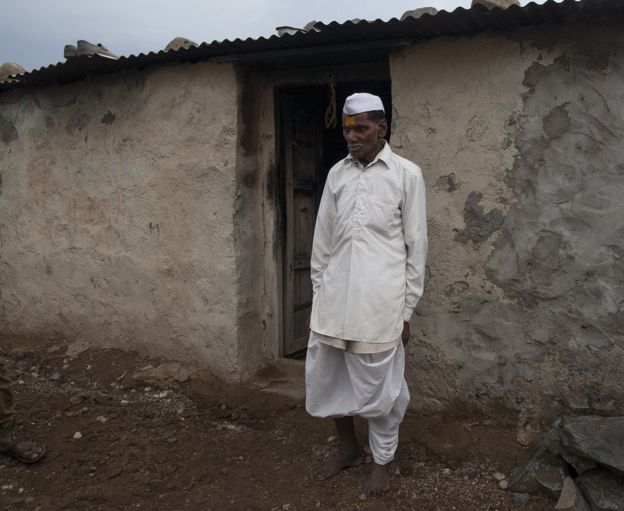
For the past three years, Mr Beldar has lived alone in his gloomy one-room hut in Hatkarwadi, a stony hillside outback ringed by forests. Drought forced his wife and three sons out of the village. The earth was parched and the wells were dry. There was little water to drink and bathe in, and the family’s millet farm lay barren.

Two sons found work at a sugar factory in Sangli, a cane-growing district some 400km (248 miles) away. Their mother looked after the third son, who went to school there. Hatkarwadi had become a bad memory.

With age, Mr Beldare is going deaf. He mostly keeps to himself in his dark room.

“He’s a very lonely man. He hasn’t seen his family in three years. All because of water,” says Ganesh Sadgar, a neighbour.

Dagadu Beldar
Image caption Dagadu Beldar lives alone after his family left the village because of lack of water

Across the lane, 75-year-old Kishan Sadgar’s only son left home a decade ago to work in a sugar factory far away. He lives with his wife and a pet dog. “My son hardly comes home,” he says. “And when he comes he wants to leave after two or three days because there’s no water here.”

A few doors away, Saga Bai lives with her 14-year-old deaf mute daughter, Parvati. Her only son, Appa, left home years ago to work in a factory. “He hardly comes home. He says he will come only if it rains,” says Ms Bai.

And Ganesh Sadgar, the only graduate in the village, is unable to find a bride because “no woman wants to come here because there’s no water”.

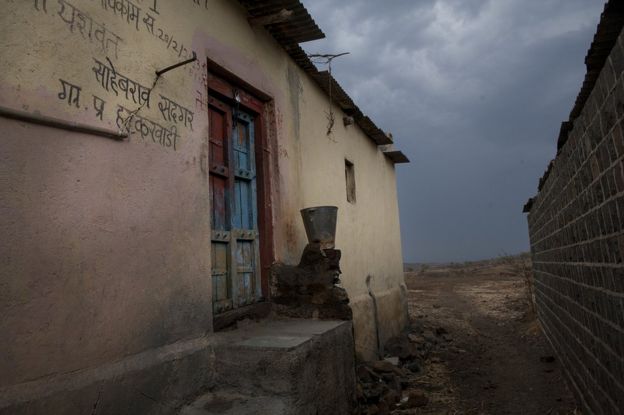
Hatkarwadi is located in Beed, a sprawling sun-baked district which has been impoverished by lack of rain. Not long ago, more than 1,200 people lived in its 125 squat homes. More than half of them, mostly men, have left, leaving behind bolted, abandoned homes. These water refugees eke a living in faraway towns and cities, where they have found work in cane farms, sugar factories, construction sites or as taxi drivers.

Abandoned house in Hatkarwadi
Image caption Yashwant Sahibrao Sadgar locked his home and left the village a year ago because of lack of water

“There is no water. Why should people stay here?” says Bhimrao Beldar, the 42-year-old headman of the village.

The night before I arrived in the village, there had been a brief burst of rain. Next morning, promising grey clouds seemed to be the harbinger of bountiful rains. By mid-afternoon, however, the sky began burning again, extinguishing any such hopes. That’s how fickle hopes are here. The last time the village had “decent rains” was three years ago.

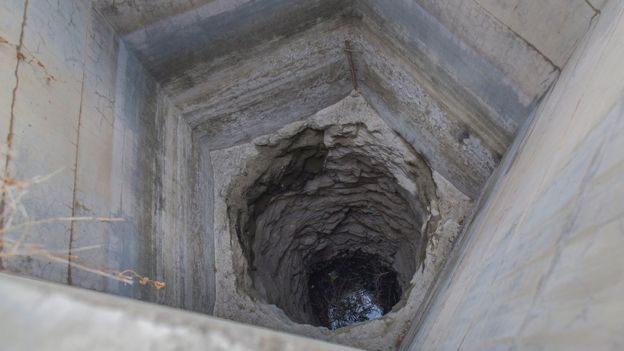
The cruel summer has sucked the life out of Hatkarwadi. The earth is brown and cracked. Cotton and millet farms have withered away. Only two of the 35 wells have some water left. There are a dozen borewells, but the fast receding water table is forcing farmers to drill deep – up to 650ft – to extract water.

Hatkarwadi pump
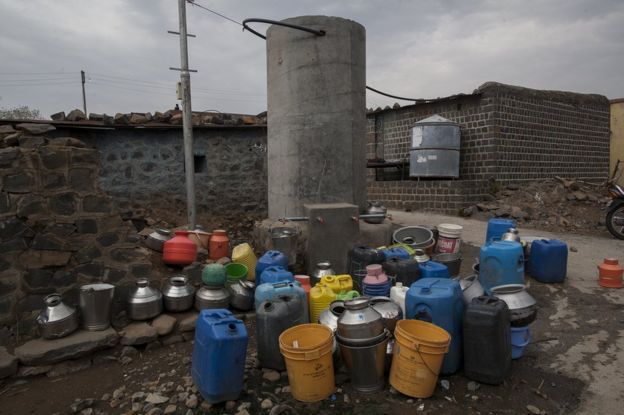
Image caption The only source of water is a few functioning borewells

Even a minor gale snaps electricity lines, so the borewells often don’t work. Water tankers – the lifeline of the drought-hit – refuse to supply because of the precarious state of the narrow strip of tar which serves as the connecting road to the village.

There’s nothing to feed the animals, so 300 buffaloes have been moved to a fodder camp uphill where the animals live with their owners under tarp. Some 75 new toilets built under a federal government programme to end open defecation lie unused because there’s no water. Most villagers borrow drinking and bathing water from well-to-do neighbours who own borewells.

Hatkarwadi is a speck on the map of Beed, where more than a million people have been hit by the drought. Deforestation has reduced forest cover to a bare 2% of the total area of the district. Only 16% of the farms are irrigated. When monsoons are good, the rain-fed farms yield cotton, soya bean, sugarcane, sorghum and millet for 650,000 farmers.

Hatkarwadi well
Image caption Most of the village’s 35 wells are dry

For the last six years, Beed has seen declining rainfall. Irregular rainfall patterns have been playing havoc with crops. A 10-day-pause in rainfall can end up damaging crops. Last year’s abundant rains – 99% of the average yearly rainfall of 690mm – still led to crop failure because there were four long interruptions.

The main Godavari river is running dry. Nearly all of the 140 big and small dams in Beed are out of water, as are the 800-odd wells. Two of the major dams now have what officials call “dead water” – low lying stored water, contaminated with sediments and mud. This is the water which is being pumped into ponds from where nearly a thousand tankers pick up supplies, spike them with chlorine and transport them to 300-odd thirsty villages.

Saga Bai
Image caption Saga Bai says her son returns to the village ‘only when it rains’

Half of Beed’s 800,000 cattle have been moved to more than 600 cattle camps because of lack of fodder. More than 40,000 people have taken up work under a jobs for work scheme, and officials are opening it up for others to prevent people from going into penury. The drought hasn’t spared people living in towns: the 250,000 residents of Beed town are getting piped water only once a week or sometimes a fortnight.

“This is the worst drought in a decade,” says Astik Kumar Pandey, the senior-most official of Beed. “We are hoping that our drinking water supplies last until end of July and then we have abundant rains”.

The crippling drought in Maharashtra is part of a larger climate catastrophe which has gripped India. More than 40% of the land, by one estimate, is facing drought and more than 500 million people living in at least 10 states are badly affected.

Media caption ‘Men don’t care about drought as women fetch the water’

P Sainath, the founder and editor of the online People’s Archive of Rural India, says the lack of water is an “explosive problem”. But drought alone has not contributed to the crisis, he says. It also has to do with the appropriation of water by the well-to-do at the expense of the poor, and the skewed allocation of water.

“The transfer of water from the farms to the industry, from food crops to water guzzling cash crops, from rural to urban areas, and from livelihood to lifestyle purposes for multiple swimming polls in urban high-rises has also led to this situation.”

Back in his office in Beed, Astik Kumar Pandey peers over a live map tracking the movement of GPS-tagged water tankers in the district. It’s a dense mass of red (stationary tankers picking up supplies) and green (tankers on their way with water) trucks clogging the heart of the district.

“This is how bad the situation is. We are hoping that the rains arrive soon”.

Source: The BBC

Law of Unintended Consequences

continuously updated blog about China & India

ChiaHou's Book Reviews

continuously updated blog about China & India

What's wrong with the world; and its economy

continuously updated blog about China & India