Archive for ‘continue’

20/04/2020

India coronavirus lockdown: What stays open and what stays shut

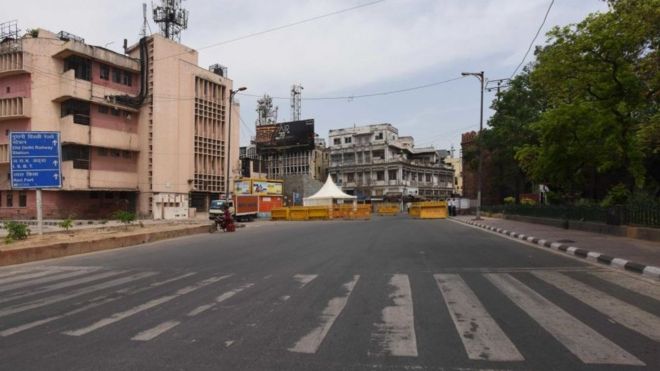
An empty stretch of the road and Delhi Police barricades to screen commuters during lockdown, at Delhi Gate on April 16, 2020 in New Delhi, India.Image copyright GETTY IMAGES
Image caption An empty stretch of the road and Delhi Police barricades to screen commuters during lockdown, at Delhi Gate on April 16, 2020 in New Delhi, India.

India has eased some restrictions imposed as part of a nationwide lockdown to curb the spread of the coronavirus.

Most of the new measures are targeted at easing pressure on farming, which employs more than half the nation’s workforce.

Allowing farms to operate again has been seen as essential to avoid food shortages.

But some other measures announced last week, will not be implemented.

This includes the delivery of non-essential items such as mobile phones, computers, and refrigerators by e-commerce firms – the government reversed its decision on that on Sunday.

And none of the restrictions will be lifted in areas that are still considered “hotspots” for the virus – this includes all major Indian cities.

Domestic and international flights and inter-state travel will also remain suspended.

So what restrictions are being eased?

Most of the new measures target agricultural businesses – farming, fisheries and plantations. This will allow crops to be harvested and daily-wagers and others working in these sectors to continue earning.

To restore the supply chain in these industries, cargo trucks will also be allowed to operate across state borders to transport produce from villages to the cities.

Essential public works programmes – such as building roads and water lines in rural areas – will also reopen, but under strict instructions to follow social distancing norms. These are a huge source of employment for hundreds of thousands of daily-wage earners, and farmers looking to supplement their income.

Banks, ATMs, hospitals, clinics, pharmacies and government offices will remain open. And the self-employed – such as plumbers, electricians and carpenters – will also be allowed to work.

Some public and even private workplaces have been permitted to open in areas that are not considered hotspots.

But all businesses and services that reopen are expected to follow social distancing norms.

Who decides what to reopen?

State governments will decide where restrictions can be eased. And several state chief ministers, including Delhi’s Arvind Kejriwal, have said that none of the restrictions will be lifted in their regions.

Mr Kejriwal said the situation in the national capital was still serious and the decision would be reviewed after one week.

India’s most populous state, Uttar Pradesh, will also see all restrictions in place, as will the southern states of Andhra Pradesh, Telangana and Karnataka.

The southern state of Kerala, which has been widely acknowledged for its success in dealing with the virus, has announced a significant easing of the lockdown in areas that it has demarcated as “green” zones.

This includes allowing private vehicular movement and dine-in services at restaurants, with social distancing norms in place. However, it’s implementing what is known as an “odd-even” scheme – private cars with even and odd number plates will be allowed only on alternate days, to limit the number of people on the road.

Source: The BBC

28/12/2019

China, Senegal continue to deepen comprehensive strategic cooperative partnership in 2019

DAKAR, Dec. 27 (Xinhua) — China has continued to be a key partner for Senegal in 2019, supporting its implementation of the Plan for an Emerging Senegal, proposed by Senegalese president Macky Sall.

Fourteen years after the resumption of diplomatic relations between Beijing and Dakar, China occupies an essential place in Senegal’s political and trade relationships.

At the beginning of the year, during a visit of Chinese State Councilor and Foreign Minister Wang Yi, Senegalese president Sall said the Senegal-China relationship is dynamic, practical and effective, hailing it as a model. He said the Senegalese side hopes to further deepen cooperation with China in various fields.

According to the Chinese Embassy in Senegal, trade between the two partners, at 2.27 billion U.S. dollars in 2018, accelerated in 2019, and China has become one of the most popular destinations among Senegalese businesspeople.

The year 2019 was marked also by numerous visits by Chinese businessmen to study the Senegalese market for potential investments opportunities. The return of Chinese traders in the marketing campaign of peanuts has been hailed by many agricultural stakeholders.

Also in 2019, the inauguration of the Chinese-built Diamniadio Industrial Park, about 30 km from Dakar, won positive response from Senegalese authorities.

In terms of infrastructure, cooperation continued in a good momentum after the opening of the Museum of Black Civilizations, the Thies-Touba, Dakar-Mbour and Dakar-Thies highways, the Grand Theater in Dakar, and the Children Hospital in Diamniadio.

Chinese expertise has won acclaim in Senegal in the construction of the first Bus Rapid Transit (BRT) serving the Senegalese capital and its suburbs. China Road and Bridge Corporation (CRBC) won the international tender for the project mostly funded by the World Bank.

Senegal also counts on China for the construction of sports facilities for the organization of the Youth Olympic Games in 2022. China built Senegal’s largest stadium, Leopold Sedar Senghor Stadium, in the 1980s, and three other regional stadiums will be rehabilitated.

In the political field, Senegal is now co-chair of the Forum on China-Africa Cooperation (FOCAC). China and Senegal have worked closely to push forward their comprehensive strategic cooperative partnership, setting a good example of high-quality and sustainable cooperation.

Throughout the year, the two sides have had in-depth exchanges on bilateral ties and other issues of common interest.

Senegalese President Macky Sall reiterated, during the last visit to Senegal by Yang Jiechi, member of the Political Bureau of the Central Committee of the Communist Party of China (CPC), Senegal firmly supports and actively participates in the Belt and Road Initiative, which was launched in 2013 by his Chinese counterpart, Xi Jinping.

On several occasions, the Senegalese authorities have welcomed the support of China for the realization of development projects in the Plan for an Emerging Senegal.

Senegal and China also increased cultural exchanges in 2019. In November, Dakar hosted an international seminar on China-Africa Cooperation and the joint construction of the Belt and Road Initiative. The event was organized by the Chinese Academy of Social Sciences and the National School of Administration of Senegal.

Senegalese Minister of Infrastructure Oumar Youm said the Belt and Road Initiative meets the real needs of China and African countries.

The initiative reflects the “sincere and firm commitment of both parties to building together a common destiny even stronger and more prosperous,” he said.

In 2019, the Chinese Embassy in Senegal granted scholarships to 48 Senegalese students for them to continue their studies in China in various fields.

Local Confucius Institute students competed in the Senegal country final of the 18th edition of the worldwide “Chinese Bridge” contest.

To mark the 70th anniversary of the People’s Republic of China, Hangzhou Art Troupe performed at the Grand Theater in Dakar to showcase Chinese culture.

In the Museum of Black Civilizations, Shanghai University presented an exhibition, “The emergence of the Chinese countryside through development,” to tell the story of China’s development.

For Birane Niang, secretary general of the Senegalese Ministry of Culture and Communication, “cultural dialogue has this ability to bring people together and strengthen their friendship and mutual respect of their differences.”

China and Senegal have also continued to strengthen cooperation in the field of public health. This year, the 17th Chinese medical team, composed of 13 health professionals, treated 76,489 patients, including nearly 200 critically ill ones, performing 5,000 operations, in Senegal.

A further deepening of relations between China and Senegal is expected in 2020.

Source: Xinhua

Law of Unintended Consequences

continuously updated blog about China & India

ChiaHou's Book Reviews

continuously updated blog about China & India

What's wrong with the world; and its economy

continuously updated blog about China & India