Chindia Alert: You’ll be Living in their World Very Soon
aims to alert you to the threats and opportunities that China and India present. China and India require serious attention; case of ‘hidden dragon and crouching tiger’.
Without this attention, governments, businesses and, indeed, individuals may find themselves at a great disadvantage sooner rather than later.
The POSTs (front webpages) are mainly 'cuttings' from reliable sources, updated continuously.
The PAGEs (see Tabs, above) attempt to make the information more meaningful by putting some structure to the information we have researched and assembled since 2006.
Wuhan, where the first cases of the novel coronavirus were detected, is ending a 76-day lockdown
A day before the lockdown was fully lifted, Tencent announces a slew of initiatives focused on helping to revive the digital industry in the city
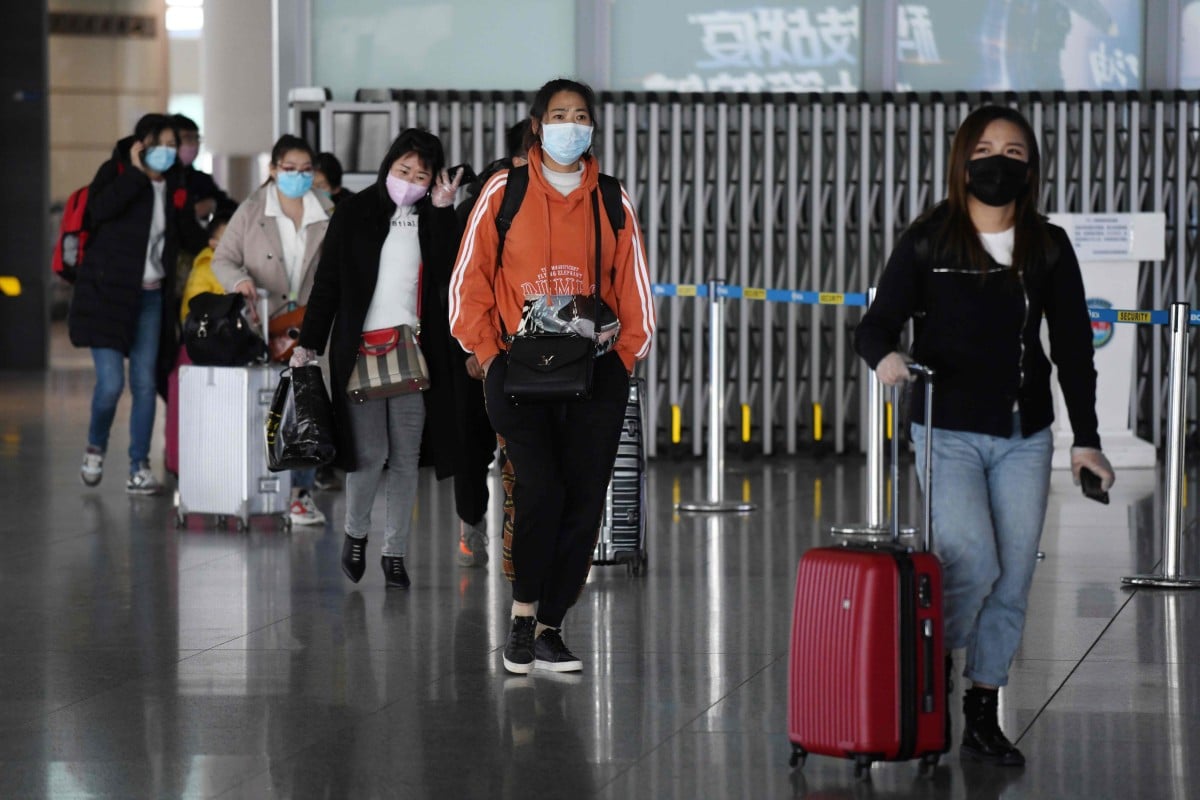
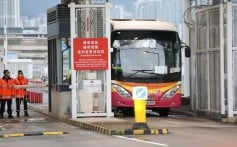
Passengers leaving Wuhan city are pictured at the Hankou Railway Station in Wuhan city, central China’s Hubei province, on Wednesday morning, April 08, 2020. Photo: SCMP/Simon Song
A day before China lifted a months-long lockdown of Wuhan city, the initial epicentre of the coronavirus pandemic, Chinese internet giant Tencent Holdings pledged to invest in digital government, online education and artificial intelligence (AI) in the city, among other fields.
“During the epidemic, Tencent has been supporting Hubei and Wuhan’s fight against the virus through funds and technology,” the company best known for its gaming business said in a statement posted on Tuesday on WeChat. “In the future, we will also fully support Wuhan’s post-pandemic reconstruction and continue to support the development of Wuhan’s digital industry.”
China’s major tech companies have played a big role in the fight against the coronavirus, and are now playing their part in the economic recovery of Wuhan and other areas that have suffered under extended travel restrictions and business closures.
and Pinduoduo each announced their own initiatives to help revive sales of farm goods from Hubei as the province emerges from its months-long lockdown.
Popular mobile payments app Alipay also created a dedicated section for Wuhan merchants to allow users to buy from merchants in the city, and offered loans to small local merchants in need of financial support, according to an Alipay statement. Alipay is operated by Ant Financial, an affiliate of Alibaba, which owns the South China Morning Post.
How tech has helped China in its public health battle with coronavirus
23 Mar 2020
Wuhan, an industrial powerhouse for the steel, semiconductors and automotive sectors, is emerging from an unprecedented lockdown which began on January 23 and prevented people from moving in and out of the city.
Since restrictions began easing gradually in late March, business activity has shown signs of recovery: Tencent’s mobile payment platform WeChat Pay recorded a 162 per cent increase in offline transactions in a 10-day period from March 25, compared to the same period the previous month, according to a separate statement by Tencent on Wednesday.
Searches for “work resumption certificates” – which businesses need to submit to local authorities to prove their staff can safely restart work – also increased 320 per cent on Baidu, China’s biggest search engine, in the past month, Baidu said in a report on Wednesday.
Tencent declined to provide specific details regarding the size of its latest investment in Wuhan or a timeline for its implementation, but said in the statement that it will involve closer cooperation with city authorities in the areas of digital government, education, smart mobility, AI and cybersecurity to help the city with its digital industries.
Among these initiatives, it will push ahead with a plan to build a headquarters focusing on digital industries in Wuhan, specifically digitalisation for the government and smart city initiatives.
It will also establish a base in Wuhan for its online education initiatives, set up an AI lab and cybersecurity academy and build a school focusing on smart mobility in collaboration with Chinese carmaker Dongfeng Motor Corporation, the company said in the statement.
Some 460,000 Chinese firms shut in the first quarter amid fallout from the coronavirus
Registration of new firms between January and March fell 29 per cent from a year earlier
Many Chinese businesses are struggling from the economic fallout of the coronavirus. Photo: Reuters
More than 460,000 Chinese firms closed permanently in the first quarter as the coronavirus pandemic pummeled the world’s second largest economy, with more than half of them having operated for under three years, corporate registration data shows.
The closures comprised of businesses whose operating licenses had been revoked, as well as those who had terminated operations themselves, and included 26,000 in the export sector, according to Tianyancha, a commercial database that compiles public records.
At the same time, the pace of new firms being established slowed significantly. From January to March, around 3.2 million businesses were set up, a 29 per cent drop from a year earlier.
Most of these new companies were in traditional centres of economic power, such as Guangdong province in southern China, and close to half of them were in distribution or retail.
Coronavirus: Is the gig economy dead, and should the self-employed worry?
The number of business closures underlines the challenges facing China as it tries to revive its economy, which is at risk of a contraction in the first quarter for the first time since 1976.
“China has managed to get the Covid-19 outbreak largely under control and domestic supply disruptions have now mostly dissipated,” Yao Wei and Michelle Lam, economists from French bank Societe Generale, said in a recent note.
“However, there are signs of lasting damage to domestic demand, and on top of that the external shock resulting from widespread lockdowns in other major economies is arriving fast and furious.”
In Dongguan, a once thriving industrial hub in the Pearl River Delta, rows of empty shops and closed factories are becoming a noticeable feature of the landscape as companies grapple with slumping international demand.
Coronavirus: Chinese companies cut salaries and staff in industries hit hardest by Covid-19
In March, a local export-oriented manufacturer of tote bags and toys in the city, Dongguan Fantastic Toy Company, collapsed after overseas orders dried up, leaving some workers with unpaid salaries, the local labour authority said last month. The government has ordered the factory’s landlord to pay the outstanding wages.
Chinese business owners who can no longer afford to maintain operations face a number of hurdles before they can walk away from a company.
If an insolvent firm wants to cancel its company registration, it needs to go through bankruptcy procedures or show a liquidation report confirming it had no unpaid debt or other obligations.
Once shareholders or creditors file for bankruptcy, it can take months for courts to accept the case, followed by a long process of verification, creditors’ meetings and asset sales, said Li Haifeng, a partner at Baker McKenzie FenXun.
A new phase of coronavirus blame game: what is the legacy of Covid-19 on global supply chains?
“I expect a surge shortly after the situation settles down. We know many enterprises are already on the verge of bankruptcy. It’s just that they don’t have to declare or file for bankruptcy immediately,” Li said, adding he had received many queries on the matter in recent months.
Given the costly nature of bankruptcy proceedings, particularly for small businesses
struggling with cash flow or without sufficient assets, the number of bankruptcy filings this year would not be high, said Zhu Bao, a Beijing-based lawyer.
Fears over a growing number of companies going bust also appears to have played some part in Chinese courts rejecting and delaying bankruptcy filings, according to lawyers and official documents.
Creditors who filed on behalf of suppliers that helped contain the coronavirus or companies on the brink of bankruptcy as a direct result of the pandemic usually had their claims knocked back, dozens of court documents filed over the past two months showed.
We know many enterprises are already on the verge of bankruptcy. It’s just that they don’t have to declare or file for bankruptcy immediately – Li Haifeng
The courts in these cases encouraged the creditors to reconcile with the struggling firms and ride out the difficulties.
This – along with disruptions to court proceedings due to virus lockdowns – helped slow the review of bankruptcies in Chinese courts to 1,770 in February and March, from 2,160 filings in January, according to the national enterprise bankruptcy information disclosure platform.
“The delay and rejection of taking corporate bankruptcy cases is certainly intended to keep the economy going. Too many bankruptcies cases do not do much to help economic recovery,” Zhu said.
China’s central leadership has maintained it wants to hit economic targets for this year, even as the country braces for a possible second wave virus outbreak.
The delay and rejection of taking corporate bankruptcy cases is certainly intended to keep the economy going – Zhu Bao
The odds of a first quarter economic contraction for China are growing, however, and economists are debating whether it still makes sense for Beijing to set a specific gross domestic product (GDP) growth target for 2020.
Ma Jun, an academic member of the People’s Bank of China’s monetary policy committee, is one prominent voice that has suggested Beijing drop a set target amid the uncertainty caused by the virus outbreak.
However, others like Yu Yongding, an economist from Chinese Academy of Social Sciences, said it was necessary to anchor the country’s economic expansion, though the government should be realistic about the goal, reported the Beijing-based financial media group Caixin.
Buying and paying for meals and supplies online was already second nature for many Chinese before the Covid-19 lockdown
The supply and delivery networks that were already in place were able to work with the authorities in cities like Wuhan
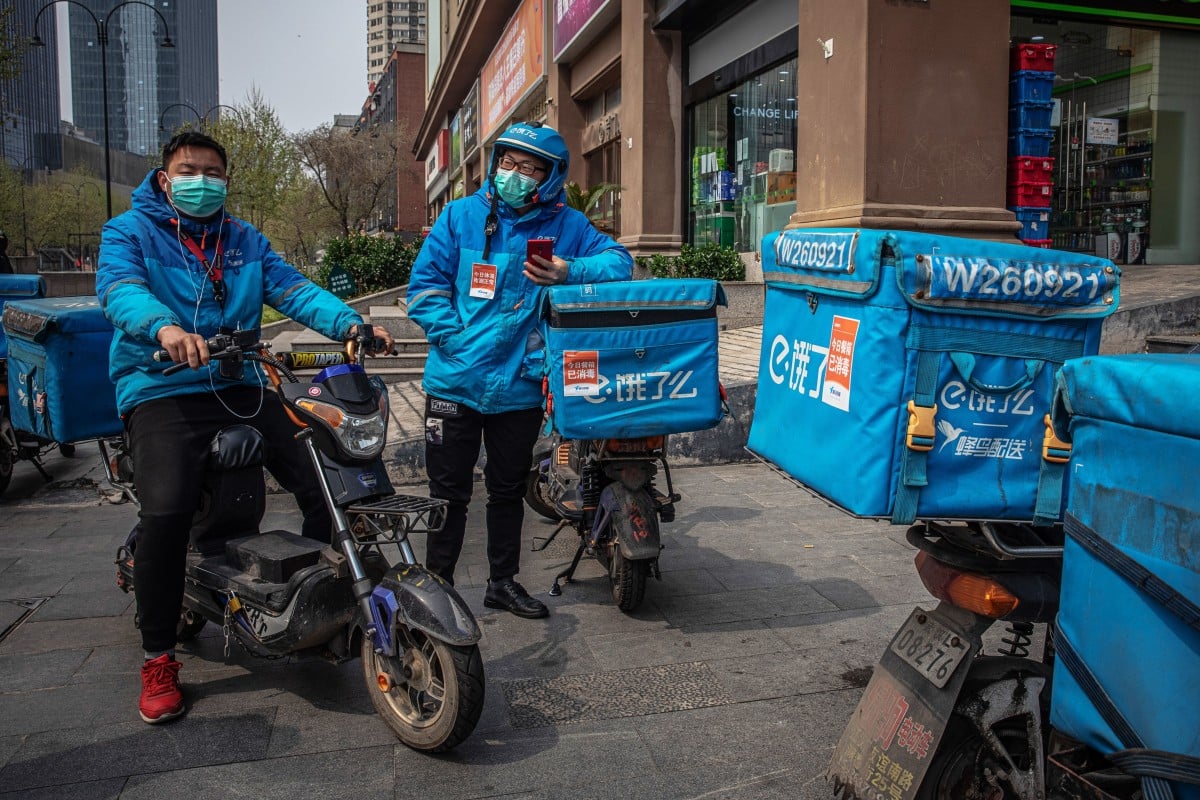
China’s established home delivery system played an important role in getting food and other necessities to residents during the Wuhan lockdown. Photo: EPA-EFE
When Liu Yilin, a retired middle schoolteacher in Wuhan, first heard rumours of a
and shoppers flooded to the markets and malls to snap up supplies.
But as time went on and with residents banned from leaving their homes, he became increasingly concerned about getting hold of fresh supplies of vegetables, fruit and meat until the nation’s vast network of delivery drivers came to the rescue.
“It was such a relief that several necessity purchasing groups organised by community workers and volunteers suddenly emerged on WeChat [a leading social media app] days after the lockdown,” Liu said. “China’s powerful home delivery service makes life much easier at a time of crisis.”
Hu Xingdou, a Beijing-based independent political economist said: “Home delivery played a very important role amid the coronavirus outbreak. To some extent, it prevented people from starving especially in cases when local governments took extreme measures to isolate people.”
According to Liu, people in Wuhan during the lockdown had to stay within their residential communities, with community workers guarding the exits.
Human contact was limited to the internet. Residents placed orders online with farmers, small merchants or supermarkets to buy daily necessities, and community workers helped distribute the goods from deliverymen.
Every morning, Liu passed a piece of paper with his name, phone number and order number to a community worker who would collect the items from a courier at the gate of the residential area.
Thanks to a high population density in urban areas, affluent labour force and people’s openness to digital life, China has built a well-developed home delivery network.
Extensive funding from technology companies has been invested in hardware infrastructure, software to improve logistics and big data and cloud computing to help predict consumers’ behaviour.
Mark Greeven, professor of innovation and strategy at IMD Business School in Lausanne, Switzerland, said: “Whether it is delivery of products, air parcels or fresh food or even medicine or materials for medical use, China has a very well developed system. Much better developed than I think almost any other places in the world.
“Well before the crisis, China had started to embrace digital technology in daily life whether it is in consumption, business, government and smart cities and use of third party payments. All of these things have been in place for a long time and the crisis tested its agility and capability to deal with peak demand.”
China’s e-commerce giants help revive sales of farm goods from Hubei
3 Apr 2020
According to e-commerce giant JD.com, demands for e-commerce and delivery services spiked during the outbreak of Covid-19, the illness caused by the new coronavirus.
It sold around 220 million items between January 20 and February 28, mainly grains and dairy products with the value of beef orders trebling and chicken deliveries quadrupling compared with a year ago.
Tang Yishen, head of JD Fresh, its fresh foods subsidiary, said: “The surge of online demand for fresh merchandise shows the pandemic helped e-commerce providers further penetrate into the life of customers. It also helped upstream farm producers to know and trust us.”
Meituan Dianping, a leading e-commerce platform, said its grocery retail service Meituan Instashopping reported a 400 per cent growth in sales from a year ago in February from local supermarkets.
The most popular items ordered between January 26 and February 8 were face masks, disinfectant, tangerines, packed fresh-cut fruits and potatoes.
The food delivery service Ele.me said that, between January 21 and February 8, deliveries of frozen food surged more than 600 per cent year on year, followed by a nearly 500 per cent growth in delivery of pet-care products. Fresh food deliveries rose by 181 per cent while drink and snack deliveries climbed by 101 per cent and 82 per cent, respectively. Ele.me is owned by Alibaba, the parent company of the South China Morning Post.
Chinese hotpot restaurant chain adapts as coronavirus fears push communal meals off the menu
E-commerce providers used the opportunity to show goodwill and improve their relationship with customers and partners, analysts say.
Sofya Bakhta, marketing strategy analyst at the Shanghai-based Daxue Consulting, said the food delivery sector had made significant headway in reducing physical contact during the outbreak.
Delivery staff left orders in front of buildings, in lifts or temporary shelters as instructed by the clients as most properties no longer allowed them inside.
Some companies also adopted more hi-tech strategies.
In Beijing, Meituan used self-driving vehicles to deliver meals to contactless pickup stations. It also offered cardboard boxes to be used as shields aimed at preventing the spread of droplets among its clients while they ate in their workplaces. In Shanghai, Ele.me employed delivery drones to serve people under quarantine in the most affected regions.
Some companies even “shared” employees to meet the growing labour demand in the food delivery industry that could not be satisfied with their ordinary workforce, Bakhta said.
More employees from restaurants, general retail and other service businesses were “loaned” to food delivery companies, which faced manpower shortages during the outbreak, according to Sandy Shen, senior research director at global consultancy Gartner.
“These arrangements not only ensured the continuity of the delivery service but also helped businesses to retain employees during the shutdown,” she said.
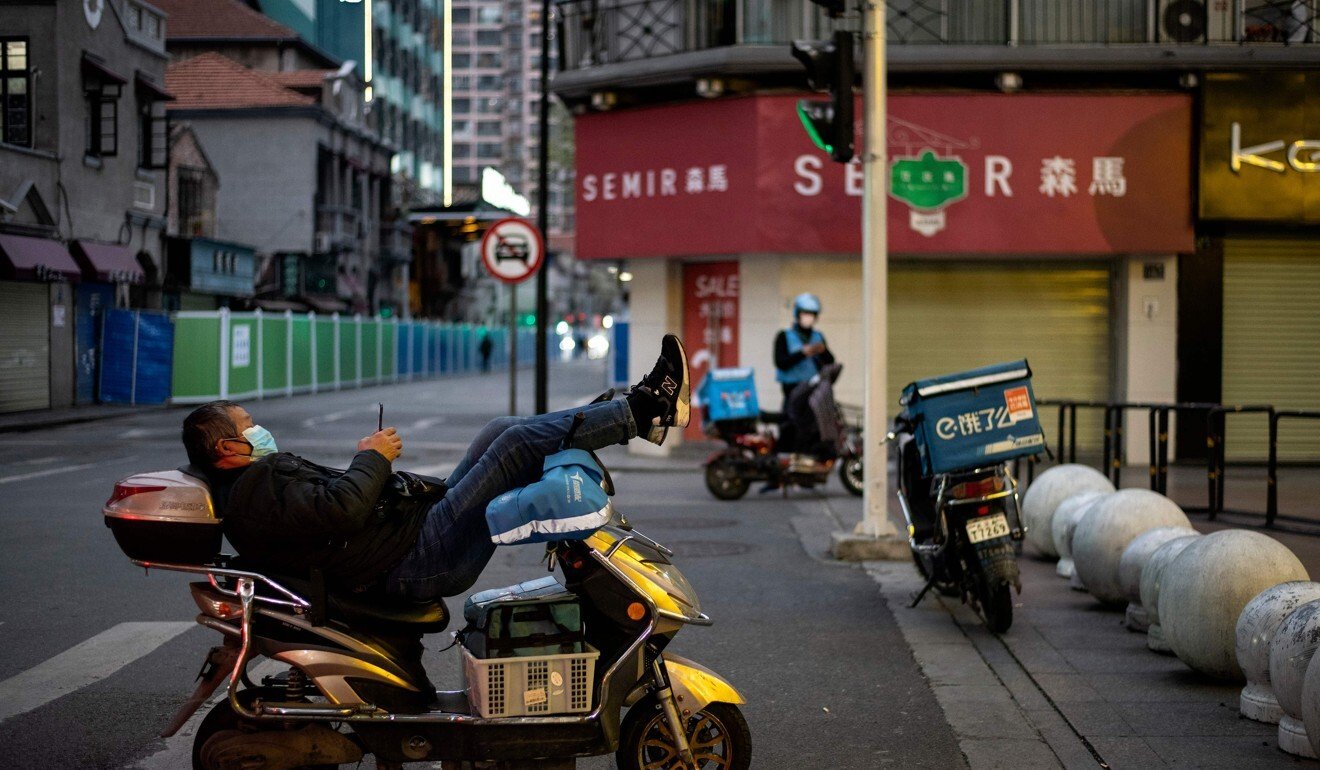
A delivery man takes a break between orders in Wuhan, central China, during the lockdown. Photo: AFP
Mo Xinsheng became one such “on-loan” worker after customers stopped coming to the Beijing restaurant where he worked as a kitchen assistant.
“I wanted to earn some money and meanwhile help people who are trapped at home,” said Mo, who was hired as a delivery man.
But before he could start work he had to go through lengthy health checks before he was allowed into residential compounds.
He also had to work long hours battling the wind and cold of a Beijing winter and carrying heavy loads.
“I work about 10 hours every day just to earn several thousand yuan [several hundred US dollars] a month,” he said.
“Sometimes I almost couldn’t breathe while my hands were fully loaded with packages of rice, oil and other things.
“But I know I’m doing an important job, especially at a time of crisis,” Mo said, “It was not until then that I realised people have become so reliant on the home delivery system.”
Woman uses remote control car to buy steamed buns amid coronavirus outbreak in China
The delivery system has been improved by an effective combination of private sector innovation and public sector coordination, said Li Chen, assistant professor at the Centre for China Studies at Chinese University of Hong Kong.
“[In China,] government units and the Communist Party grass roots organisations have maintained fairly strong mobilisation capabilities to cope with emergencies, which has worked well in the crisis,” he said.
However, Liu, the Wuhan resident, said prices had gone up and vegetables were three times more expensive than they had been over Lunar New Year in 2019.
“There were few varieties that we could choose from, apart from potatoes, cabbage and carrots,” he said.
“But I’m not complaining. It’s good we can still get fresh vegetables at a difficult time. Isn’t it? After all, we are just ordinary people,” he said.
BEIJING (Reuters) – Mainland China reported no coronavirus deaths for the first time since the pandemic began, and a drop in new cases, a day before the central city of Wuhan, where the virus emerged late in December, is set to lift its lockdown.
China had 32 new infections by Monday, down from 39 a day earlier, the National Health Commission said.
For the first time since the commission began publishing nationwide data in late January, Hubei’s provincial capital of Wuhan saw no new deaths, joining the rest of mainland China, which has recorded none since March 31.
Wuhan, a city of 11 million that reported only two new infections in the past fortnight is due to allow residents to leave the city on Wednesday, for the first time since it was locked down on Jan. 23 to curb the spread of the virus.
With mainland China well past February’s peak of infections, authorities have turned their attention to imported cases and asymptomatic patients, who show no symptoms but can still pass on the virus.
Total infections in mainland China stood at 81,740 on Monday with 3,331 deaths, the commission said. It reported 30 new asymptomatic cases, nine involving incoming travellers. Of the new asymptomatic cases, 18 were in Hubei.
By the end of Monday, 1,033 asymptomatic patients were under medical observation.
TIGHTER LAND BORDERS
Overseas arrivals made up all 32 of the new cases with symptoms, down from 38 a day earlier. Total imported infections stand at 983, the commission said.
China faces the “dual risks” of imported infections and domestic cluster outbreaks, a commission spokesman told a briefing on Tuesday.
The northeast province of Heilongjiang reported 20 new cases, all in Chinese citizens returning from neighbouring Russia. It had reported 20 new infections on Sunday, all also cases imported from Russia.
On Tuesday, the Chinese consulate in the Russian city of Vladivostok near the border with China said it strongly reminded Chinese nationals not to return home through the border port of Suifenhe, which is to be closed to all arrivals from Tuesday.
China has shut its borders to foreigners as the virus spread globally, though most imported cases have involved Chinese nationals returning from overseas.
The number of inbound travellers through airports is fewer than 3,000 a day, down from about 25,000 in late March, before China slashed the number of international flights.
It also started testing all international arrivals for the virus this month.
Embassy says those flown back must pay for themselves, and praises the US health system, in a departure from the war of words with Washington
More than a million Chinese students remain overseas, but China is on alert against the threat of imported infections
China has drastically cut flights to try to prevent people who arrive from abroad importing the coronavirus. Photo: AFP
Chinese students could be flown home from coronavirus hotspots such as the United States but will have to pay their own expenses, amid efforts by Beijing to persuade some to remain overseas rather than risk bringing the infection with them.
A statement posted on the website of China’s Washington embassy on Monday said that the Chinese government was aware that many school and university students had encountered difficulties in travelling back to China and was taking steps to arrange charter flights for those who needed to return urgently.
With the initial coronavirus outbreak appearing to have been largely contained in mainland China, some Chinese students have travelled home despite soaring air ticket prices and the requirement that those who have been overseas enter quarantine.
Students brought back on charter flights would still need to pay for the ticket and the costs of the mandatory 14-day quarantine upon arrival in China.
Trump says US approaching a ‘horrendous’ time as coronavirus death toll rises
More than 1.6 million Chinese are studying overseas, including about 410,000 in the US. At least 1.42 million Chinese students remained overseas, vice foreign minister Ma Zhaoxu said on Thursday.
Having initially boasted of its success in stopping the virus, Beijing has become notably cautious in recent weeks about welcoming overseas students back home, especially with imported cases continuing to rise.
China’s foreign ministry and its overseas missions have urged students considering travelling home to exercise caution. The embassy in the US issued a notice on Friday speaking highly of the American medical system and its response to the pandemic, in a marked departure from Beijing’s narrative, which has included pinning the blame for the pandemic on the United States.
Friday’s embassy notice also dismissed rumours that Chinese students had been targeted because of the coronavirus during the closures of universities, and pledged help if students had trouble communicating with universities about campus accommodation.
China advises foreign diplomats to stay away from Beijing until May 15
3 Apr 2020
Ma said that most overseas students had heeded his government’s advice and chosen not to go back to China, but an online survey late last month that was cited by Caixin magazine on Saturday showed nearly 60 per cent of Chinese students in the US wanted to return home.
Most of the 4,000 students polled said they were unable to make the trip because of concerns about contracting the coronavirus during the journey and air fares that had more than doubled recently. Both China and the US have drastically cut back long-haul international flights.
After weeks stranded in Peru, 65 Hongkongers return home
6 Apr 2020
Students under 18 years of age who want to return to China are required by the embassy to register online.
The initial evacuation plan announced on Monday proposed to prioritise school-age children whose parents were not in the US with them. The proposed arrangement appeared to include students from Hong Kong, Macau and Taiwan.
Image copyrigh tREUTERSImage caption India’s prime minister called on the country to “challenge the darkness” of coronavirus
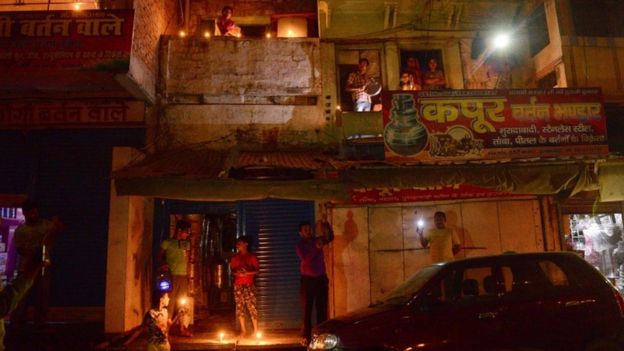
Indians have turned off their lights for a nationwide candle-lit vigil, heeding a call for unity as the country battles coronavirus.
Prime Minister Narendra Modi asked India’s 1.3 billion citizens to observe nine minutes without electricity at 21:00 local time (16:30 GMT) on Sunday.
He urged them to “challenge the darkness” of Covid-19 by lighting candles and lamps.
Millions responded, lighting up the night sky in a show of unity.
“Salute to the light of the lamp which brings auspiciousness, health and prosperity, which destroys negative feelings,” Mr Modi tweeted at the time of the vigil.
But critics have dismissed the event as a stunt, arguing it distracted from the health and economic crisis caused by the coronavirus pandemic.
Mr Modi imposed a nationwide lockdown on 25 March, announced with little warning, leaving millions stranded and without food.
Image copyright GETTY IMAGESImage caption Millions of Indians observed the nine-minute vigil called for by Mr Modi
The true figures, however, are thought to be far higher. India has one of the lowest testing rates in the world, although efforts are under way to ramp up capacity.
Image copyright REUTERSImage caption India has been under lockdown since 25 March
There are fears that a major outbreak in the country – one of the world’s most densely populated – could result in a humanitarian catastrophe.
People are banned from leaving their homes under the lockdown measures. All non-essential businesses have been closed and almost all public gatherings are banned.
Media caption As cases of coronavirus rise and the virus hits India’s congested slums, will the country cope?
But the shutdown sparked an exodus from major cities such as Delhi, forcing thousands of migrant labourers to walk hundreds of kilometres to their native villages.
Last week, Mr Modi apologised for the impact of the strict stay-at-home measures, saying there was “no other way” to stop the spread of the virus.
The coronavirus pandemic has completely changed patterns of consumer psychology across the world, experts say
Complexity of the crisis, the number of variables and its magnitude make a consumer recovery unprecedented and difficult to predict
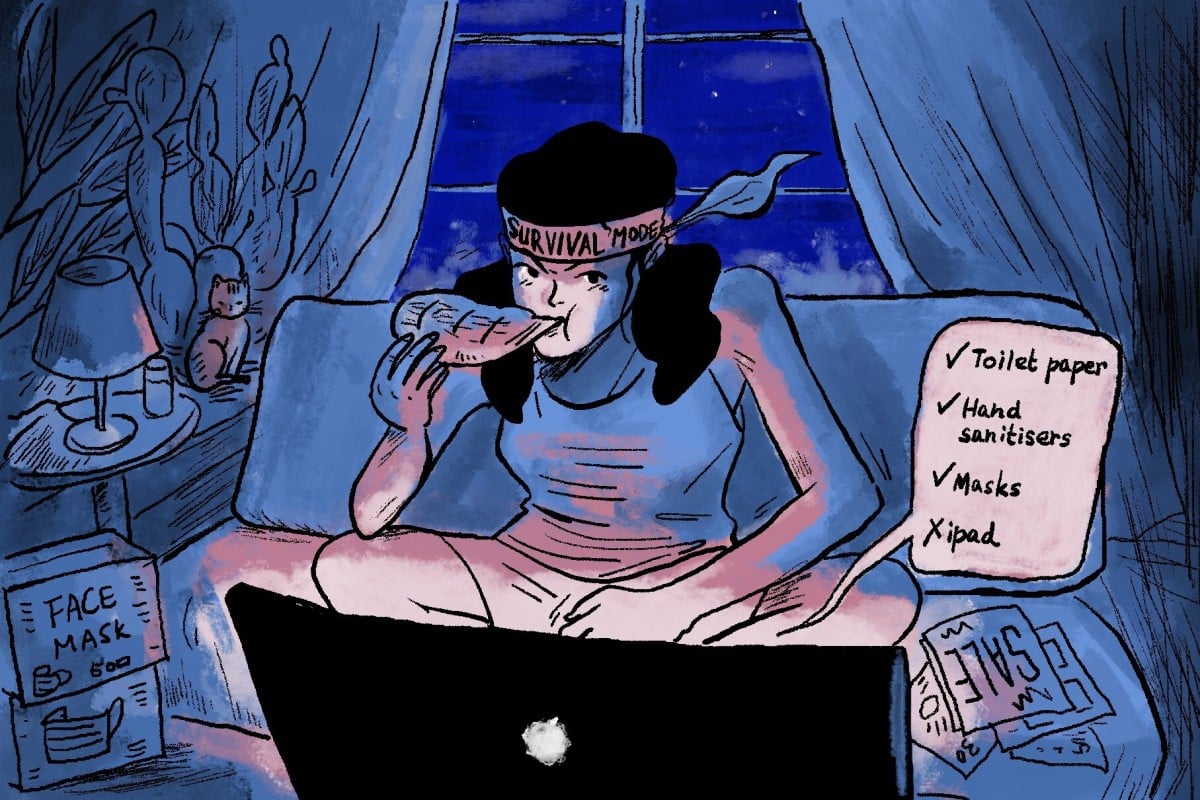
The coronavirus has caused panic buying around the world as consumers frantically stockpile of goods such as toilet paper, hand sanitisers and masks. Illustration: Brian Wang
Before the coronavirus crisis began rippling through the global economy, Susan Wang had big plans for 2020.
Not only was she going to buy a new Apple MacBook and iPad, plus a projector so she could host friends for movies at home, but she was set on making a career move.
“I was planning to change my job, but my headhunter told me that all recruitment has been postponed to the second quarter,” said the 27-year-old who works for a British company in Hong Kong.
“Our headquarters in London has a plan for redundancy, too. It is better to save some money in case I get laid off.”
As Covid-19 spreads across the world, sending stock markets reeling and prompting big companies to slash jobs, Wang has become increasingly frugal like scores of other consumers from China to the United States.
She has stopped eating at restaurants and now tries to keep her weekly food bill under HK$500 (US$64), whereas in the past she wouldn’t think twice about spending HK$100 per meal.
Amid mounting uncertainty, the coronavirus pandemic – which has claimed the lives of more than 41,000 people and infected at least 842,000 worldwide – is fundamentally changing consumer behaviour in Asia, Europe and North America.
Consumer experts said the 2009 global financial crisis, the Great Depression that started in 1929 and the September 11 terrorist attacks give some clues about how and when global consumption might recover. But the complexity of this crisis, the number of variables and its magnitude make this consumer recovery unprecedented and difficult to predict, they added.
Coronavirus: What impact will the economic fallout from the Covid-19 pandemic have on you?
“The coronavirus pandemic has completely changed patterns of consumer behaviour all over the world. People are afraid, and when people are afraid, they go into survival mode,” said Jesse Garcia, a Los Angeles-based consumer psychologist, who is also the CEO of market consulting firm My Marketing Auditors.
plummeted a record 44 per cent in February and those figures are only expected to get worse, with sales forecast to slump between 30 and 40 per cent in the first half of the year, according to the Hong Kong Retail Management Association.
In the US, retail sales dropped by 0.5 per cent in February, even before many states had issued stay-at-home orders to protect the world’s largest economy. The decline was the biggest fall since December 2018.
Experts say non-essential products and services are set to be worst affected by the coronavirus pandemic, while goods and services that can be consumed at home will see a spike in sales.
The coronavirus pandemic has completely changed patterns of consumer behaviour all over the world. People are afraid, and when people are afraid, they go into survival mode – Jesse Garcia
“Online consumer behaviour is frenetic,” said Ross Steinman, a professor of psychology at Widener University in the US state of Pennsylvania. “Consumers are refreshing and refreshing and refreshing websites to secure grocery delivery times, purchase paper towels from their usual big box retailer and scavenge for rice and canned soup from third party sellers on Amazon.
“A pronounced spike in coronavirus cases will only amplify the freneticism.”
So far, one of the biggest shortages for consumers is toilet paper. Television stations across the globe have beamed images of empty supermarket shelves and huge queues as people hoard toilet paper rolls, masks and hand sanitiser.
The frantic stockpiling can be explained by a psychological concept called informational conformity, said Vicki Yeung, associate professor at the Department of Applied Psychology at Lingnan University in Hong Kong.
A pronounced spike in coronavirus cases will only amplify the freneticism – Ross Steinman
“When people lack knowledge and are in an uncertain situation, they tend to follow the group’s behaviour and blindly conform, but once they obtain more information, and digest and process the situation, the panic gradually fades away,” she said.
“During this Covid-19 pandemic, people generally feel jittery and anxious because they feel their sense of control has disappeared.”
Unlike other recent global crises such as the September 11 attacks, the coronavirus is less a one-time sharp shock to the system and more of a rolling source of anxiety that could retreat and resurface repeatedly, consumer behaviour experts said.
This was the pattern with the Black Death plague that hit Europe in 1347 and returned episodically over many years, ultimately killing millions of people.
During this Covid-19 pandemic, people generally feel jittery and anxious because they feel their sense of control has disappeared – Vicki Yeung
“It may be we’ll have to shut down things again in October or August. And this could go on for years,” said Charley Ballard, an economist with Michigan State University in the US. “The more that happens, the more damage it does to buoyant consumer psychology.”
Furthermore, relative to the 2009 financial crisis and even the Great Depression, when much of the damage was concentrated at least initially in the financial sector, this crisis has seen virtually the entire economy grind to a halt all at the same time, devastating employment and consumption.
Last week, a record 3.3 million Americans applied for unemployment benefits within one week, as restaurants, hotels, barber shops, gyms and retail outlets shut down in a nationwide bid to stem the pandemic. The previous record of 695,000 was set in 1982.
On Tuesday, Goldman Sachs predicted the US jobless rate will hit 15 per cent in the second quarter of this year from the coronavirus economic freeze, and could rise further beyond that to near the historic peak of 24.9 per cent seen in 1933 during the Great Depression. Economists at the St. Louis district of the US Federal Reserve projected unemployment could cost as many as 47 million jobs in the US this year, sending the unemployment rate past 32 per cent before making a sharp recovery.
US now has world’s most coronavirus cases, surpassing China
China’s unemployment rate jumped to 6.2 per cent for January and February from 5.2 per cent in December and 5.3 per cent a year earlier. It was the highest level since records began in 2016, but did not include China’s estimated 291 million migrant workers.
Consumer spending accounts for more than 60 per cent of the Chinese economy and drives 70 per cent of the US economy. But with the pandemic causing many people to go into hibernation and likely to lead to cycles of job cuts, economists have predicted a consumer-led global recession by the second quarter of this year.
Just how long it will take for consumer behaviour to return to normal depends on each person’s psychological resilience, including how quickly they can adapt to change, how optimistic they are and whether they can adopt strategies to regain a sense of control, Yeung said.
Anirban Mukhopadhyay, chair professor of marketing at Hong Kong University of Science and Technology said as long as the coronavirus threat was still present, people would remain fearful to some extent. But he added that people were resilient.
Satellite images show world sites deserted amid coronavirus pandemic
“Human beings adapt to events and stimuli over time,” Mukhopadhyay said. “Research has shown that even people who win lotteries tend to return to their earlier levels of life satisfaction after some months, as do people who have to have amputations.
“So even if the source of the fear does not go away, we learn to live with it.”
Ballard, from Michigan State University, estimated it could take upwards of two years for American consumers to feel secure enough in their jobs and gain enough confidence to fully open their wallets. A longer and more episodic duration for the disease could push that higher, he added.
Further complicating the consumer picture, he said, is that many supply chains are at risk of breaking. And consumers will be wary of spending for a while in many traditional areas, including crowded sporting events and concerts, restaurants and flights.
A new phase of coronavirus blame game: what is the legacy of Covid-19 on global supply chains?
Some experts have even suggested that consumer behaviour may be permanently changed as a result of the pandemic.
“It seems very unlikely that people will get back to life as it was before, once the coronavirus is over,” said Andreas Kappes, a lecturer in psychology at City University of London.
“People’s behaviour is extremely orthodox, often referred to as the status quo bias and captured in expressions like ‘past behaviour best predicts future behaviour.’ Now, the crisis forces us to change our behaviour, radically, and we might discover that new way suits us better.”
Pictures of packed trails over the weekend highlight difficulties in maintaining social distancing while trying to get back to normal
Attraction in Anhui province said it would be forced to close on Sunday after exceeding its 20,000-visitor limits
== PICTURE CAPTURED FROM WEIBIO
Huangshan Mountains in China’s Anhui province was forced to close after tens of thousands of people flocked to the popular mountain range over the weekend, highlighting the difficulties in getting the country’s social life back to normal while keeping the coronavirus outbreak under control. Huangshan, or the Yellow Mountains, located in southern Anhui province in eastern China, said in a notice today that it had to close because the number of visitors had reached its limit of 20,000 for the day. Tourists are advised to visit the site on other days or try travelling to other sites. Since April 4, the Anhui government has been offering free access to 29 tourist sites in the Huangshan region, including the Yellow Mountains, to local residents for 2 weeks, in a bid to drum up more business since its reopening in late February as it seeks to get its economy back to normal. Photo: WEIBIO
A popular mountain range in southeast China was forced to close after tens of thousands of people flocked to its trails over the weekend.
The crowds flocking to the Huangshan, or Yellow Mountains, in Anhui province highlight the difficulties the country may face in future as it tries to get back to normal while keeping Covid-19 under control.
Starting from Saturday, the Anhui provincial government had been offering free entry to 29 sites, including Huangshan, to boost visitor numbers.
Visitors were asked to show their health status on an app, wear surgical masks and their body temperatures had to be checked before entering the site.
But on Sunday the park authorities said it would have to close because the number of visitors had reached its daily limit of 20,000 and urged people to visit other sites or come to the mountains at another time.
Coronavirus: China pulls the plug on wasteful, unnecessary research into Covid-19
5 Apr 2020
Pictures and video circulated on the social media platform Weibo showing packs of visitors walking up the mountain range over the three-day Ching Ming festival.
“Tourism has been hit hard, and also its related industries,” said one Weibo comment. “But the epidemic isn’t over. If you must open the sites, you have to restrict the flow [of tourists], and those visitors from outside.”
As of Sunday, the number of confirmed cases being treated in the country had fallen to 2,382, according to the National Health Commission, but the total number of imported cases rose to 913.
Police try to hold back visitors to the mountain range. Photo: Weibo
“I think China is keeping a close eye on Covid-19 detections and may need to tune the social distancing measures that are needed to keep Covid-19 contained. For now, it may be OK to relax some measures, but those measures should be tightened if case numbers pick up,” said Benjamin Cowling, a professor of epidemiology and biostatistics at Hong Kong University.
“I would not be surprised if most countries continue to prohibit mass gatherings for the rest of 2020,” said Cowling, adding that temperature checks at entrances would be a good idea, but it might not be sufficient to protect visitors.
Coronavirus: Beijing’s ban on foreign travellers comes into force months after it criticised other countries for ‘isolating China’
27 Mar 2020
Anhui, which shares its western border with Hubei province, the initial centre of the outbreak, last reported a new infection on Feb 27, according to official figures. The province reported a total of 990 cases of Covid-19, including six deaths.
China’s tourism and cultural sectors are among the worst hit as a result of the outbreak.
A number of Shanghai’s popular tourist spots, including the Shanghai Oriental Pearl Tower and Shanghai Jinmao Tower had to close again last week only two weeks after reopening.
Dai Bin, president of the China Tourism Academy, a research institute under the Ministry of Culture and Tourism, told a forum in February that he expected domestic tourism would contract as much as 56 per cent in the first quarter and 15.5 per cent for the whole year.
Dai also estimated that annual income loss from tourism could hit 1.2 trillion yuan (US$169 billion) this year.
Photo taken on April 4, 2020 shows a press conference of the joint prevention and control mechanism of the State Council in Beijing, capital of China. Chinese officials said Saturday that the country can hold firm its “rice bowl” despite the novel coronavirus impact, with ample grain reserves and measures to boost production. (Xinhua/Pan Xu)
BEIJING, April 4 (Xinhua) — Chinese officials said Saturday that the country can hold firm its “rice bowl” despite the novel coronavirus impact, with ample grain reserves and measures to boost production.
The country has recorded a long streak of bumper years, with grain output reaching a record of 663.85 million tonnes last year. With measures to boost grain production “we have the confidence and determination to hold firm our ‘rice bowl,'” Pan Wenbo, an official at the Ministry of Agriculture and Rural Affairs, told a press conference.
The bumper harvests supported the country’s efforts to boost social and economic development as well as fight the novel coronavirus outbreak, Pan said in response to questions that whether some countries’ grain export ban would strain China’s grain supply.
Pan said China has unveiled a series of “unconventional measures” to stabilize grain production, including setting region-specific grain plantation targets, offering subsidies for farmers and raising minimum prices for state procurement of rice, which secured a good start this year and would ensure stable grain production for the whole year.
The country’s grain reserves have run at a high level, with those of rice and wheat being sufficient to meet the country’s consumer market demand for one year, said Qin Yuyun, an official with the National Food and Strategic Reserves Administration.
Qin said the administration will continue efforts to ensure abundant supply and stable prices.
Lockdown may have been lifted, but shops, bars and restaurants remain empty in Beijing, showing struggle facing economic recovery
Controls have been returning in other parts of China, where cinemas and tourist attractions shut amid fears of new wave of infections
The nearly two month-long lockdown has changed the consumption behaviour of Chinese residents, many of whom have turned to home cooking to cut their spending. Photo: AFP
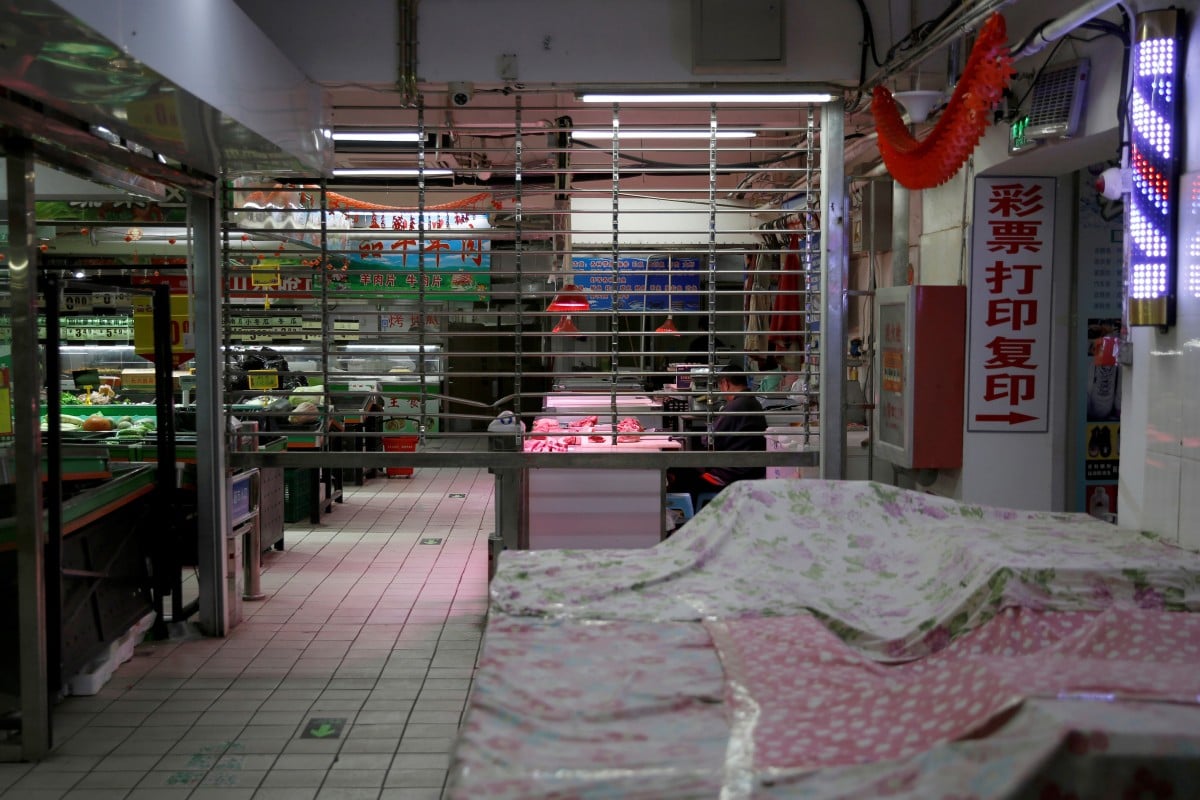
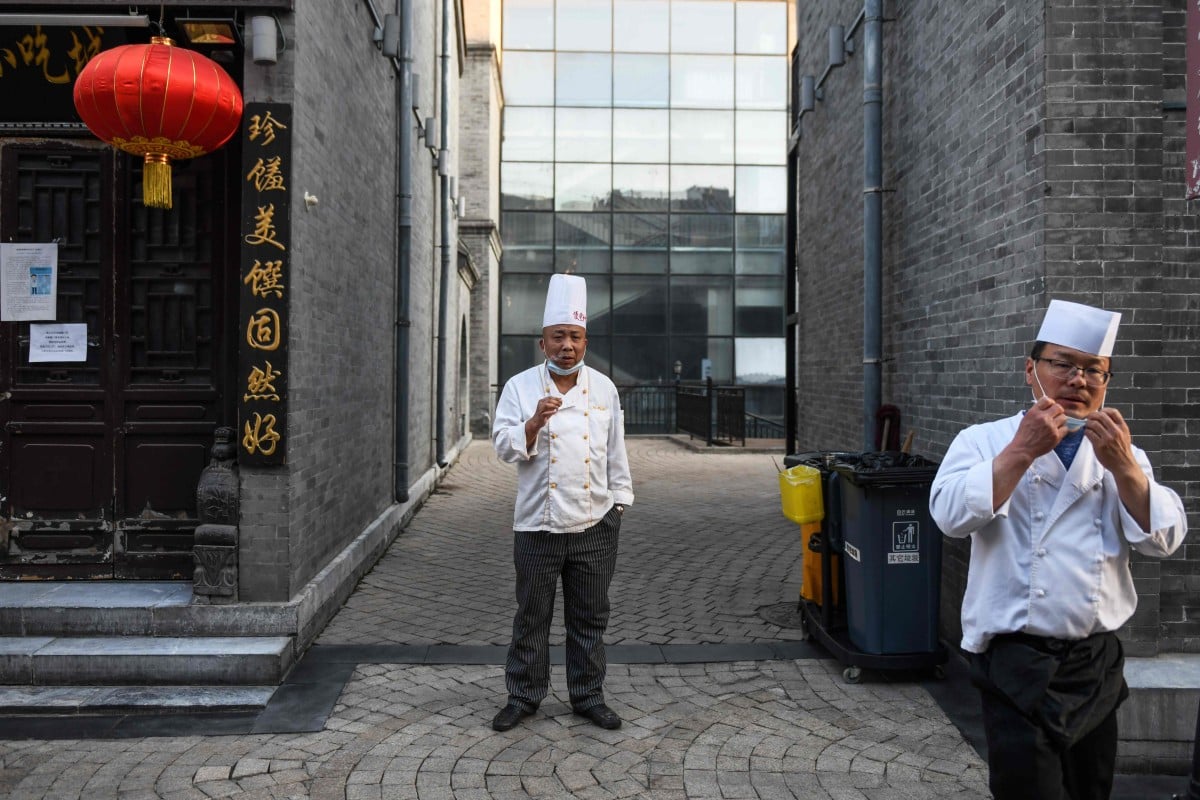
China’s urban lockdown may have eased, but deserted streets and stores in the capital Beijing this week suggest that for the services sector, the impact of the coronavirus outbreak could be deeper and longer than expected.
Many restaurants, cafes and pubs remained closed in the city, where vigilance remains high about a second wave of infections. Among those that were open, there were few customers to be seen.
The usually crowded Wangfujing shopping street was quiet on Wednesday, with just a few shoppers patronising what is usually the heartbeat of the city’s commerce and tourism. There were more staff than consumers at the Apple store, while everyone wore a mask. Shops along the pedestrianised zone closed their doors before sunset, but many did not open at all.
In a downtown food court, a handful of people dined during what would usually be the lunch rush hour, each restricted to their own small table to maintain social distancing, in great contrast with the usual frantic dash for seats.
Coronavirus: What impact will the economic fallout from the Covid-19 pandemic have on you?
While China has largely stemmed the domestic spread of Covid-19, threats of imported cases, with the virus having infected over one million people worldwide, and asymptomatic carriers continue to hamper the recovery in China’s
A survey published on Friday showed that in March, sentiment among small service sector firms remained depressed. The Caixin / Markit services purchasing managers’ index (PMI) was 43.0 for last month, with a number below 50 meaning the sector is shrinking. “There are too few people now. We only sold about a hundred bowls of noodles, that was just half of our normal level,” said one Beijing street vendor, who had also cut many items from the menu due to insufficient demand.
A bookstore in the city centre held an official opening ceremony after a soft opening followed by a two and a half month-long forced shutdown, but received only four visitors on a morning, one of which was the South China Morning Post reporter. All four were required to go through a body temperature check and write down their personal contact details before entering.
Service sector workers said the situation was surreal and that they were worried that there was no end in sight.
“I have never seen KFC look like this,” said an employee of the fast food chain restaurant at Wangfujing, pointing to the virtually empty dining hall.
A grocer at a nearby food market continually shook her head when talking about the decline in customers, but said she felt lucky that she could come back to Beijing from her hometown before the 14-day mandatory quarantine requirement was imposed on February 14.
This situation is not restricted to Beijing. When the Chinese government reopened around 500 cinemas nationwide in March, each one attracted on average
Now, many places across China are reimposing controls amid fears of a new spike in infections, the same fear leading people to stay home instead of going to those venues which have reopened.
Shanghai has closed tourist attractions while Sichuan has again closed karaoke lounges. Cinemas have also been reclosed across the country.
President Xi Jinping said during a visit to Hangzhou last Sunday that China must remain alert. “If you want to watch a movie, rather than going to a cinema, you can watch it online,” Xi said.
Services account for 60 per cent of China’s economy and the majority of employment. The slowness of the sector’s recovery is placing huge pressure on the world’s second
at a time when manufacturers are seeing export orders nosedive.
Liang Zhonghua, chief macro analyst at Zhongtai Securities, a brokerage, said that China’s damaged consumption alone could drag economic growth down by 4.5 per cent in the second quarter.
“(Chinese) residents’ fear of the epidemic is not over,” he wrote in a note this week.
Beijing’s malls still empty after coronavirus lockdown lifted
In Beijing all travellers entering the city are required to undergo a 14-day quarantine, while mass gatherings are still forbidden.
The containment measures have stopped many migrant workers from getting back to
, if they still exist. Many local residents still choose to work from home, even though authorities had been trying to encourage people to go out and spend money.
On April 1, the traffic flow on Beijing’s subway system was 3.05 million passengers a day, less than a third of the level a year ago, according to the operator, while car traffic was still about 15 per cent less than it was last year, government data showed.
I will keep cooking for myself, even when everything goes back to normal, it is much healthier and cheaper – Beijing resident
The nearly two month-long lockdown has changed the consumption behaviour of Chinese residents, many of whom have turned to home cooking to cut their spending.
“I will keep cooking for myself, even when everything goes back to normal, it is much healthier and cheaper,” said a Beijing lawyer whose family name is Li.
The effect of this behavioural shift is borne out in the 17.9 per cent drop in retail sales in the capital over the first two months of the year, only slightly better than the nationwide drop of 20.5 per cent.
Beijing businesses have clubbed together to issue some 150 million yuan in












 CHINDIA ALERT: You'll be living in their world, very soon