Archive for ‘cotton’

13/11/2019

Xinjiang cotton sparks concern over ‘forced labour’ claims

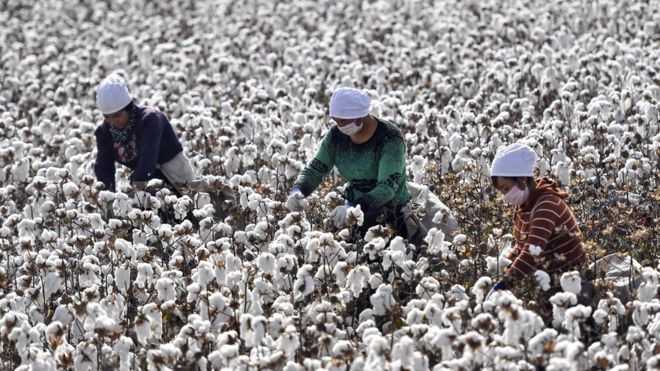
Farmers pick cotton during the harvest on October 21, 2019 in Shaya County, Xinjiang Uygur Autonomous Region of China.Image copyright GETTY IMAGES

Global retailers are facing scrutiny over cotton supplies sourced from Xinjiang, a Chinese region plagued by allegations of human rights abuses.

China is one of the world’s top cotton producers and most of its crop is grown in Xinjiang.

Rights groups say Xinjiang’s Uighur minority are being persecuted and recruited for forced labour.

Many brands are thought to indirectly source cotton products from the Xinjiang region in China’s far west.

Japanese retailers Muji and Uniqlo attracted attention recently after a report highlighted the brands used the Xinjiang-origin of their cotton as a selling point in advertisements.

H&M, Esprit and Adidas are among the firms said to be at the end of supply chains involving cotton products from Xinjiang, according to a Wall Street Journal investigation.

“You can’t be sure that you don’t have coerced labour in your supply chain if you do cotton business in China,” said Nathan Ruser, researcher at the Australian Strategic Policy Institute.

“Xinjiang labour and what is almost certainly coerced labour is very deeply entrenched into the supply chain that exists in Xinjiang.”

What is happening in Xinjiang?

UN experts and human rights groups say China is holding more than a million Uighurs and other ethnic minorities in vast detention camps.

Rights groups also say people in camps are made to learn Mandarin Chinese, swear loyalty to President Xi Jinping, and criticise or renounce their faith.

China says those people are attending “vocational training centres” which are giving them jobs and helping them integrate into Chinese society, in the name of preventing terrorism.

What is produced in Xinjiang?

The Xinjiang region is a key hub of Chinese cotton production.

China produces about 22% of global cotton supplies, according to a report by the Center for Strategic and International Studies (CSIS).

Last year, 84% of Chinese cotton came from Xinjiang, the report said.

That has raised concerns over whether forced labour has been used in the production of cotton from the region.
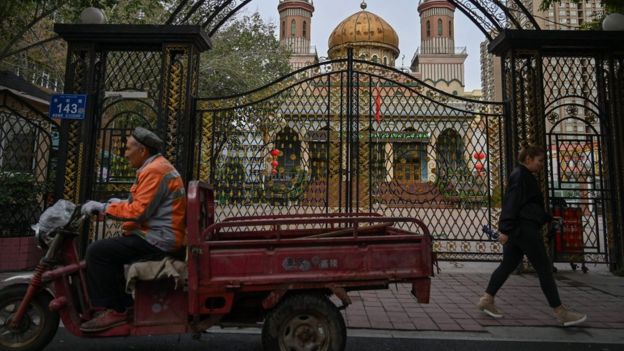
This photo taken on September 11, 2019 shows people walking past a mosque in Urumqi, the regional capital of Xinjiang.Image copyright GETTY IMAGES
Image caption The Uighurs are mostly Muslims, and number about 11 million in China’s Xinjiang region

Nury Turkel, chairman of the Uighur Human Rights Project in Washington, said the Uighurs were being “detained and tormented” and “swept into a vast system of forced labor” in Xinjiang.

In testimony to US congress, he said it was becoming “increasingly hard to ignore the fact” that the goods manufactured in the region have “a high likelihood” of being produced with forced labour.

Which brands use Xinjiang cotton?

Amy Lehr, director of CSIS Human Rights Initiative, said in many cases Western companies aren’t buying directly from factories in Xinjiang.

“Rather, the products may go through several stages of transformation after leaving Xinjiang before they are sent to large Western brands,” she said.

Some, like Muji, are very open about sourcing material from Xinjiang.

The Japanese retail chain launched a new Xinjiang Cotton collection earlier this year.

One of its advertisements boasts “soft and breathable” men’s shirts made from organic cotton “delicately and wholly handpicked in Xinjiang”.

Another Japanese fashion brand Uniqlo had also touted the Xinjiang region in an advertisement advertisment for men’s shirts.

In the fine print of the shirt description, the advert said the shirts were made from Xinjiang cotton, “famous for its superb quality”.

That reference was later removed from the advertisement “given the complexity of this issue”, according to a spokesperson for Uniqlo.

“Uniqlo does not have any production partners located in the Xinjiang region. Moreover, Uniqlo production partners must commit to our strict company code of conduct.

“To the best of our knowledge, this means our cotton comes only from ethical sources,” the spokesperson told the BBC.
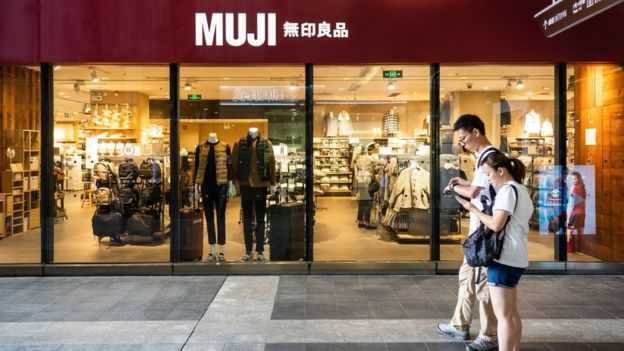
Pedestrians walk past a Japanese household and consumer goods retailer, Muji store in ShenzhenImage copyright GETTY IMAGES

According to the Wall Street Journal report which focused on workers at a mill operated by Huafu Fashion in Aksu, Xinjiang, yarn made in the region was present in the supply chains of several international retailers including H&M, Esprit and Adidas.

Many of the companies looked into the allegations, including those without clear links to the Huafu mill.

In a statement to the BBC, Adidas said: “While we do not have a contractual relationship with Huafu Fashion Co., or any direct leverage with this business entity or its subsidiary, we are currently investigating these claims.”

“We advised our material suppliers to place no orders with Huafu until we have completed those investigations,” the Adidas spokesperson said.

Esprit, which also does not source cotton directly from Xinjiang, said it had made several inquiries earlier this year.

“We concluded that a very small amount of cotton from a Huafu factory in Xinjiang was used in a limited number of Esprit garments,” the firm said in a statement.

The company has instructed all suppliers to not source Huafu yarn from Aksu, the statement said.

H&M said it does not have “a direct or indirect business relationship” with any garment manufacturer in the Xinjiang region.

“We have an indirect business relationship with Huafu’s spinning unit in Shanyu, which is not located in the Xinjiang region, and according to our data, the vast majority of the yarn used for our garment manufacturing comes from this spinning unit,” a spokesperson for H&M said.

“Since we have an indirect business relationship with the yarn supplier Huafu, we also asked for access to their spinning facilities in Aksu. Our investigations showed no evidence of forced labor.”

Source: The BBC

06/09/2019

Chinese medicine herbs could defeat devastating cotton virus, study suggests

  • Scientists find some chemicals can kill the cotton leaf curl Multan virus and others can boost cotton plants’ immunity to it
  • It is feared the virus could wreak havoc in China’s Xinjiang region, which produces most of the country’s cotton
A cotton picker in Xinjiang, where cases of the virus have been reported. Photo: Xinhua

Chinese scientists have found chemicals in medicinal herbs that could tame a destructive plant virus threatening the cotton industry in its western Xinjiang region.

Some small-molecule chemicals in herbs commonly used in Chinese medicine can effectively suppress cotton leaf curl Multan virus, according to ongoing research led by Professor Ye Jian at the Institute of Microbiology in Beijing.

By targeting WRKY20, a gene in the virus’ DNA, the chemicals could disrupt the viral infection and transmission, Ye’s team found.

Some early findings from their research were published last month in the journal Science Advances.

The leaf curl virus – a species of Begomovirus, the largest genus of plant viruses – poses a significant threat to the world’s cotton plantations, causing leaf curling, stunted growth and lower yields of cotton fibre. It costs the cotton industry in the Indian subcontinent about US$1 billion a year, according to a press release about the study from the Chinese Academy of Sciences.

Were there to be a pandemic in China, the drop in output and measures to contain it could cost the cotton farming industry 50 billion yuan (US$7 billion), according to some researchers’ estimates, the academy added.

The first known cases of the virus in China over the past decade were limited to coastal areas in the country’s east, but several cases have now been reported in Xinjiang Uygur autonomous region.

“We are running out of time,” Ye told the South China Morning Post.

Cotton is a pillar industry in Xinjiang, which provides more than 80 per cent of China’s total cotton production. The industry also contributes up to 50 per cent of the income of farmers involved in it, according to government statistics.

Exact figures for infections in the region are not available, but outbreaks so far remain isolated, according to Ye and other researchers with knowledge of the situation.

Double threat to China’s cotton industry: warmer weather and mirid bug

However, Professor Gao Feng, cotton researcher at the Agricultural College of Shihezi University in Xinjiang, warned that leaf curl virus could reduce cotton production in an infected field to almost zero.

“A large-scale outbreak has not occurred yet, but the threat is very serious and people are very nervous,” Gao told the Post. “We are in desperate need of a solution.”

The challenges facing China’s pork industry highlight the danger viruses can pose to the domestic market. A swine fever outbreak that has wiped out 100 million pigs caused pork prices to rise, forcing China to look to new countries to import from, such as Portugal and Argentina.

Its biggest overseas supplier of cotton is the United States, with which it is locked in a protracted trade war. In July, the government allowed some Chinese companies to buy a total of 50,000 tonnes of cotton from the US without tariffs being charged.

The central and regional governments fear that falling incomes caused by the impact of an outbreak on the cotton industry would increase the risk of ethnic conflict, social instability and anti-government thoughts.

Ye’s team adopted two approaches to fighting the virus.

How trade war with the US is changing China’s cotton industry

Some chemicals they discovered could improve cotton plants’ immunity against the infection by stimulating them to generate an antibody that killed the virus. The other chemicals they found could target the virus, directly reducing its intensity.

“They can be used as sprays,” Ye said, adding that he planned to reveal the chemical composites and related herbs in a paper to be published in a peer-reviewed journal in the coming months.

The discovery could offer an environmental benefit, too. Cotton farmers in Xinjiang use pesticides to deter the whiteflies that transmit the virus, but their overuse has affected Xinjiang’s delicate ecology, which in its desert areas is particularly vulnerable to disturbance.

In the agricultural research community, there is growing concern that some whitefly species will become resistant to pesticides. “If that happens, we will have a major problem,” Ye said.

He said the chemicals identified in the ongoing study would not harm the environment.

“These chemicals come from plants, so the negative impact to the environment would be minimal,” he said.

The study also found that it may be possible to use the cotton leaf curl Multan virus to benefit farmers. It stimulates cotton plants to generate a chemical that is harmful to other insects, such as the bollworm, that compete with whiteflies for food, meaning that it could be genetically modified into a pest control agent.

Most cotton species in commercial plantations are genetically modified to produce an insecticide to kill bollworm. Ye said a man-made virus could reduce the dependence on genetically modified plants.

Source: SCMP

10/06/2019

‘There is no water. Why should people stay here?’

Hatkarwadi
Image caption Hatkarwadi hasn’t seen decent rains in three years

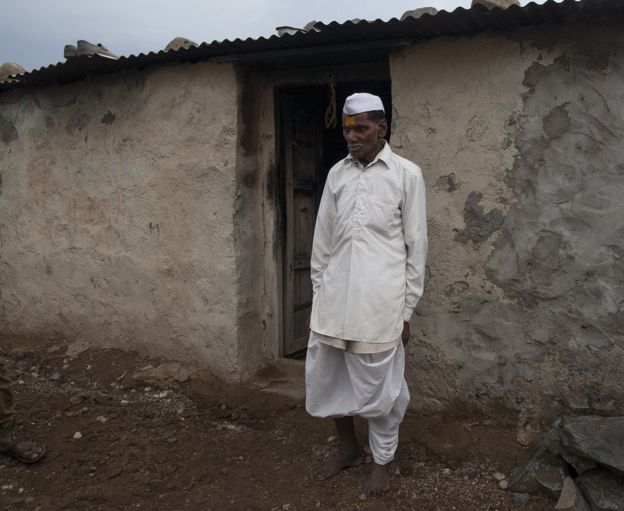
Every morning Dagadu Beldar, 75, wakes up and cooks rice and lentils in his village home in India’s western state of Maharashtra. After that, there’s little else to do.

For the past three years, Mr Beldar has lived alone in his gloomy one-room hut in Hatkarwadi, a stony hillside outback ringed by forests. Drought forced his wife and three sons out of the village. The earth was parched and the wells were dry. There was little water to drink and bathe in, and the family’s millet farm lay barren.

Two sons found work at a sugar factory in Sangli, a cane-growing district some 400km (248 miles) away. Their mother looked after the third son, who went to school there. Hatkarwadi had become a bad memory.

With age, Mr Beldare is going deaf. He mostly keeps to himself in his dark room.

“He’s a very lonely man. He hasn’t seen his family in three years. All because of water,” says Ganesh Sadgar, a neighbour.

Dagadu Beldar
Image caption Dagadu Beldar lives alone after his family left the village because of lack of water

Across the lane, 75-year-old Kishan Sadgar’s only son left home a decade ago to work in a sugar factory far away. He lives with his wife and a pet dog. “My son hardly comes home,” he says. “And when he comes he wants to leave after two or three days because there’s no water here.”

A few doors away, Saga Bai lives with her 14-year-old deaf mute daughter, Parvati. Her only son, Appa, left home years ago to work in a factory. “He hardly comes home. He says he will come only if it rains,” says Ms Bai.

And Ganesh Sadgar, the only graduate in the village, is unable to find a bride because “no woman wants to come here because there’s no water”.

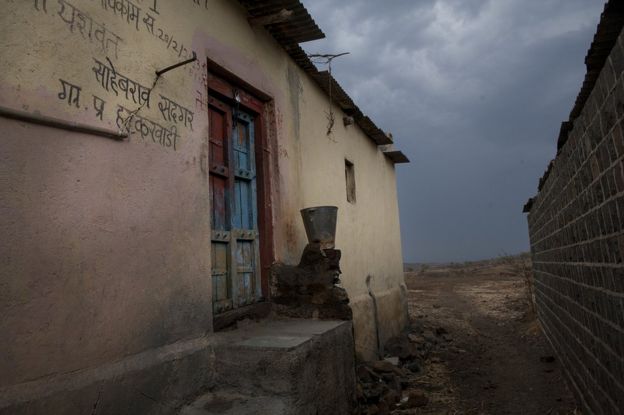
Hatkarwadi is located in Beed, a sprawling sun-baked district which has been impoverished by lack of rain. Not long ago, more than 1,200 people lived in its 125 squat homes. More than half of them, mostly men, have left, leaving behind bolted, abandoned homes. These water refugees eke a living in faraway towns and cities, where they have found work in cane farms, sugar factories, construction sites or as taxi drivers.

Abandoned house in Hatkarwadi
Image caption Yashwant Sahibrao Sadgar locked his home and left the village a year ago because of lack of water

“There is no water. Why should people stay here?” says Bhimrao Beldar, the 42-year-old headman of the village.

The night before I arrived in the village, there had been a brief burst of rain. Next morning, promising grey clouds seemed to be the harbinger of bountiful rains. By mid-afternoon, however, the sky began burning again, extinguishing any such hopes. That’s how fickle hopes are here. The last time the village had “decent rains” was three years ago.

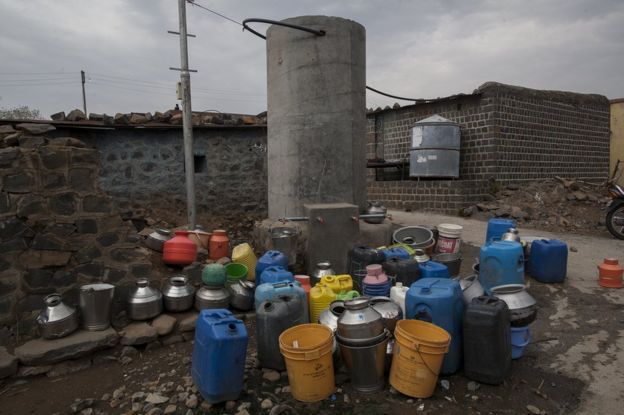
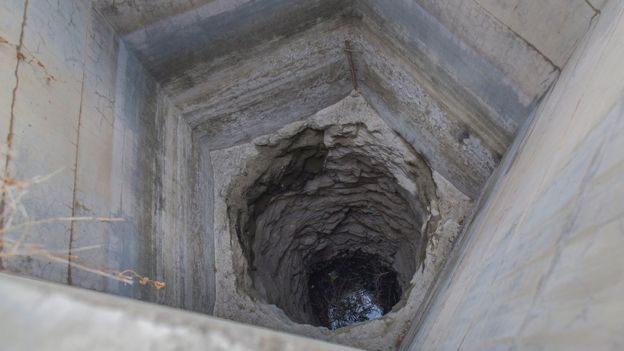
The cruel summer has sucked the life out of Hatkarwadi. The earth is brown and cracked. Cotton and millet farms have withered away. Only two of the 35 wells have some water left. There are a dozen borewells, but the fast receding water table is forcing farmers to drill deep – up to 650ft – to extract water.

Hatkarwadi pump
Image caption The only source of water is a few functioning borewells

Even a minor gale snaps electricity lines, so the borewells often don’t work. Water tankers – the lifeline of the drought-hit – refuse to supply because of the precarious state of the narrow strip of tar which serves as the connecting road to the village.

There’s nothing to feed the animals, so 300 buffaloes have been moved to a fodder camp uphill where the animals live with their owners under tarp. Some 75 new toilets built under a federal government programme to end open defecation lie unused because there’s no water. Most villagers borrow drinking and bathing water from well-to-do neighbours who own borewells.

Hatkarwadi is a speck on the map of Beed, where more than a million people have been hit by the drought. Deforestation has reduced forest cover to a bare 2% of the total area of the district. Only 16% of the farms are irrigated. When monsoons are good, the rain-fed farms yield cotton, soya bean, sugarcane, sorghum and millet for 650,000 farmers.

Hatkarwadi well
Image caption Most of the village’s 35 wells are dry

For the last six years, Beed has seen declining rainfall. Irregular rainfall patterns have been playing havoc with crops. A 10-day-pause in rainfall can end up damaging crops. Last year’s abundant rains – 99% of the average yearly rainfall of 690mm – still led to crop failure because there were four long interruptions.

The main Godavari river is running dry. Nearly all of the 140 big and small dams in Beed are out of water, as are the 800-odd wells. Two of the major dams now have what officials call “dead water” – low lying stored water, contaminated with sediments and mud. This is the water which is being pumped into ponds from where nearly a thousand tankers pick up supplies, spike them with chlorine and transport them to 300-odd thirsty villages.

Saga Bai
Image caption Saga Bai says her son returns to the village ‘only when it rains’

Half of Beed’s 800,000 cattle have been moved to more than 600 cattle camps because of lack of fodder. More than 40,000 people have taken up work under a jobs for work scheme, and officials are opening it up for others to prevent people from going into penury. The drought hasn’t spared people living in towns: the 250,000 residents of Beed town are getting piped water only once a week or sometimes a fortnight.

“This is the worst drought in a decade,” says Astik Kumar Pandey, the senior-most official of Beed. “We are hoping that our drinking water supplies last until end of July and then we have abundant rains”.

The crippling drought in Maharashtra is part of a larger climate catastrophe which has gripped India. More than 40% of the land, by one estimate, is facing drought and more than 500 million people living in at least 10 states are badly affected.

Media caption ‘Men don’t care about drought as women fetch the water’

P Sainath, the founder and editor of the online People’s Archive of Rural India, says the lack of water is an “explosive problem”. But drought alone has not contributed to the crisis, he says. It also has to do with the appropriation of water by the well-to-do at the expense of the poor, and the skewed allocation of water.

“The transfer of water from the farms to the industry, from food crops to water guzzling cash crops, from rural to urban areas, and from livelihood to lifestyle purposes for multiple swimming polls in urban high-rises has also led to this situation.”

Back in his office in Beed, Astik Kumar Pandey peers over a live map tracking the movement of GPS-tagged water tankers in the district. It’s a dense mass of red (stationary tankers picking up supplies) and green (tankers on their way with water) trucks clogging the heart of the district.

“This is how bad the situation is. We are hoping that the rains arrive soon”.

Source: The BBC

05/05/2019

India’s rural pain goes beyond farmers, and it may be a problem for Modi

ZADSHI VILLAGE, India (Reuters) – Three years ago, brick mason Pundlik Bhandekar was always busy as farmers in his tiny hamlet in Maharashtra commissioned new houses and nearby towns were undergoing rapid urbanisation. Now, as the rural economy sinks and the pace of construction slows, Bhandekar is struggling to get work.

“I used to get a new construction project before I could even finish one. People would come to my house to check when I would be free to work for them,” said Bhandekar, as he sat with friends under the shade of a tree on a hot afternoon.

From daily wage workers such as masons, to barbers and grocery shop owners – just about everyone in Zadshi village, some 720 km (450 miles) from India’s financial hub Mumbai, says a drop in farm incomes has dented their livelihoods.

Their woes are symptomatic of a wider problem across India, where more than half of the country’s 1.3 billion people are dependent on agriculture for their livelihoods, as the slowdown in the rural economy is felt in the dampening sales of consumer goods, especially the biggest such as car and motorbike sales.

The slowdown has also dented Prime Minister Narendra Modi’s popularity in the hinterland that propelled him to power in 2014, and political strategists say it may mean he struggles to form a majority after voting in a staggered general election that began on April 11 concludes on May 19.

Zadshi has been almost entirely dependent on annual cotton and soybean crops that, according to farmers, have given lacklustre returns in the past few years due to a dip in prices, droughts and pest attacks.

And as incomes have dropped, farmers have cut back on big-ticket spending such as building new houses, digging wells or laying water pipelines, squeezing employment opportunities for people such as Bhandkekar.

“No one is interested in hiring us. We are ready to work even at 250 rupees ($3.60) per day,” said Bhandekar, who charged 300 rupees a day when work was steady, but now gets work only once or twice in a fortnight.

LOWER WAGES, LESS SPENDING

Economic data reflects the plight of farmers and daily wage workers.

Retail food inflation in the fiscal year ended on March 31 fell to 0.74 percent, even as core inflation stood at 5.2 percent, according to Bank of America Merrill Lynch Research, eroding the spending power of farmers.

Inflation adjusted wage growth for workers involved in crop sowing was just 0.6 percent 2018/19 compared with 6.5 percent in 2013/14.

The value of farm produce at constant prices grew 15 percent in the past five years, compared with 23 percent in the previous five, while the manufacturing sector grew 40 percent, against 32.6 percent in the previous five years, government data shows.

“Lower rural wages will result in lesser spending, which in turn will reduce demand for goods and services that are part of the rural basket,” Rupa Rege Nitsure, group chief economist at L&T Finance Holdings in Mumbai, told Reuters.

The government needs to spend more in rural areas to generate employment and boost incomes, Nitsure said.

Modi’s Hindu nationalist government did introduce various support schemes in the past six months, such as a 6,000 rupees yearly handout to small farmers.

The main opposition Congress party has gone much further with its pledges though, saying it would introduce a basic minimum income, where the country’s poorest families would get 72,000 rupees annually, benefiting some 250 million people.

RISING UNEMPLOYMENT

In Zadshi, as the mercury touched a searing 40 degrees Celsius(104F), a group of villagers gathered under the trees lining a dusty road and began chatting about everything from crop prices to politics.

“What else we can do? Had work been available in urban areas, we could have moved there but even in the cities construction has slowed down,” said Amol Sontakke, an unskilled labourer who works in farms and on construction sites.

Job opportunities have slowed even in urban areas and India’s unemployment rate touched 7.2 percent in February, the highest since September 2016, according to data compiled by the Centre for Monitoring Indian Economy (CMIE). Official data is unavailable for recent periods.

The mood in Zadshi was glum. While four dozen villagers interviewed by Reuters were hopeful that if there was a good monsoon this year it could improve farm incomes, they’ve been cutting back on spending in the meantime.

“People are thinking twice before buying new clothes during festivals,” said Avinash Gaurkar, a farmer currently doubling up as a part-time driver. “Buying big-ticket items such as motorcycles or refrigerators is out of the question.”

Two years ago Gaurkar began building a house, but had to give up midway as his five-acre farm could not generate the money needed, he said, pointing towards a half-finished structure without doors.

In 2018, just four villagers bought new motorbikes compared with as many as 10 a year about four years ago, said cotton farmer Raju Kohale, whose son is sitting at home unemployed after graduating as an engineer.

“Poor monsoon or lower prices, something or the other has been hurting us in the past few years,” Kohale said.

MODI AGAIN?

In the 2014 general election, most in Zadshi voted for Modi, but the farmers’ distress has swayed many towards the opposition Congress party. That was clear from Reuters’ interviews with 48 villagers, who cast their ballots last month.

Farmers are at the bottom of the Modi administration’s priority list, said labourer Sagar Bahalavi.

“They are building big roads to connect metros and calling it development. How is that useful for us?” he said.

Some, though, want to give Modi a second chance.
“Modi’s intentions are good, it’s the bureaucratic system that is not supporting him,” said Gulab Chalakh, who owns a 20-acre farm and is among the richest in the village. “We should give him another chance.”
Source: Reuters
03/03/2019

China Focus: Industrial upgrade moves fast in Xinjiang

URUMQI, March 2 (Xinhua) — Farmers at a small village in western Xinjiang hardly had any days off this winter. Production at a walnut processing factory is going full throttle to meet demand.

Yusup Tursun and his wife are walnut farmers in Kupchi Village in Yecheng County on the edge of the Taklimakan Desert. The couple has been hired by a new walnut processing facility in the village, with the husband a quality inspector and his wife working part-time cracking nuts.

As a main base for walnut production, Yecheng has over 38,000 hectares of high-quality thin-shell walnut groves.

“It used to be quite difficult to sell the walnuts. The factories, with so many products, have made it easier for the sales,” Yusup said.

Seven companies make products from the nuts — walnut milk, walnut candies and edible oil. The shells are made into coloring agent and pollutant-absorbing carbon.

Diversity in the walnut products pushed the industry output to a new high of 2 billion yuan (about 299 million U.S. dollars). Three in every five people work in the walnut industry in Yecheng, where 550,000 people live.

Across Xinjiang, processing facilities are established to add value to agricultural products. Transport and logistical services are improved to boost the sales of Xinjiang’s signature agricultural products such as Hami melons, Korla pears and Turpan grapes.

UP THE VALUE CHAIN

Xinjiang is also moving up the value chain in two of its traditional industries — cotton and coal.

As one of the main cotton production bases in China, Xinjiang holds sway in the textile industry. By making full use of its cotton resources and geographical advantages as a portal for opening up, the region no longer sees itself as just a production base for raw materials. Starting from 2014, China’s leading garment and apparel makers including Ruyi Group, HoDo Group, and Huafu Fashion Co. Ltd invested in the region and built factories.

These factories have produced added benefits and created jobs for the local people. Xinjiang produces 1.5 million tons of yarn and over 40 million ready-made garments every year. More than 400,000 people work in the industry.

In the eastern part of the coal-rich Junggar Basin, workers have found that the snow is cleaner than before. The Zhundong Economic Technological Development Park, about 200 km west of Urumqi, is home to China’s largest coal field.

A stringent environmental requirement is applied to the park, said Ren Jianpin, director of the management committee of the park. Coal enterprises are required to control coal dust, install equipment to recycle water and coal slags are processed into construction materials, he said.

The park is focused on boosting high-end industries in aluminum and silicon materials, which generate more value and have less impact on the environment, he said.

GOING HI-TECH

Last year, a large-scale bio-based plant went into operation in Usu City to turn corn into nylon. The Cathay Industrial Biotech, a Shanghai-based biotech company, is the investor.

Nylon is usually made from petroleum, and the use of crops such as corn and wheat to make recyclable and environment-friendly nylon has promising business prospects, said Wang Hongbo, vice general manager of the company’s Usu branch.

The Usu branch will have an annual output of 100,000 tons of bio-based polyamide, and it is expected to boost the development of downstream industries in the future, he said.

The oil-rich city of Karamay has also received a hi-tech boost as cloud computing firms eye the dry and cold weather in the area. Karamay is home to many key state-level projects and IT-industry leaders, including a global cloud service data center for Huawei, data centers for the China National Petroleum Corp. (CNPC) and China Mobile.

Xinjiang is making new breakthroughs in precision machining, new materials, manufacturing and textiles.

Data from the regional statistics bureau show that the value added of the hi-tech manufacturing in Xinjiang rose by 32.1 percent year-on-year in 2018.

FURTHER OPENING UP

As a core area on the Silk Road Economic Belt, Xinjiang has maintained solid growth momentum in foreign trade. Foreign trade volume between Xinjiang and 36 countries and regions along the Belt and Road (B&R) totaled about 291.5 billion yuan (43.5 billion U.S. dollars) in 2018, up 13.5 percent year on year.

Economic observers say that there is still much room for Xinjiang to scale up its processing trade to raise the level of imports and exports.

Xinjiang will further develop an export-oriented economy in 2019 and participate in economic exchanges with neighboring countries, according to the regional government’s work report released in January.

Source: Xinhua

Law of Unintended Consequences

continuously updated blog about China & India

ChiaHou's Book Reviews

continuously updated blog about China & India

What's wrong with the world; and its economy

continuously updated blog about China & India