Archive for ‘COVID-19’

28/03/2020

China’s central bank pledges improved macro-economic control to limit virus fallout

BEIJING, March 27 (Xinhua) — China’s central bank has pledged to improve its macro-economic control to limit the fallout of the novel coronavirus disease (COVID-19) outbreak and better shore up its economy.

The impacts of the epidemic on China’s economy were generally controllable, the People’s Bank of China (PBOC) said in a statement published Friday after a regular meeting of its monetary policy committee, adding that the country’s economy has maintained strong resilience and its economic fundamentals for long-term sound growth has remained unchanged.

In addition to strengthening international macro-economic policy coordination, China will also take innovative approach to improve its macro-economic regulation and pursue a prudent monetary policy with more moderate flexibility, the meeting decided.

“Though the outbreak was basically curbed in the country and production resumption picked up pace, our containment efforts and economic growth face new challenges arising from intensifying downward economic pressure and the virus-hit global economy,” the central bank said.

The PBOC also vowed to utilize multiple policy tools to maintain market liquidity at a reasonably ample level and keep prices stable, while guiding financial institutions to enhance credit support for production resumption, agricultural production, poverty relief and other key areas.

Financial supply-side structural reform will be advanced to establish a modern financial system featuring high adaptability, competitiveness and inclusiveness, the central bank said.

It will further smooth the transmission mechanism of monetary policies and cut the real interest rate of loans to beef up support for real economy, especially for micro and small enterprises and private firms.

The meeting also called more efforts to strengthen coordination among monetary, fiscal, employment and other policies and deepen market-oriented interest rate reform in a bid to buffer the economic blow from the ongoing epidemic outbreak.

Source: Xinhua

27/03/2020

Chinese enterprises donate more medical supplies to Serbia

JINAN, March 27 (Xinhua) — A shipment of medical supplies donated by Chinese companies in Shandong Province was delivered via a chartered flight on Friday morning from Jinan, the provincial capital, to Serbia to help with local coronavirus fight.

The supplies include 60,000 masks, 100 protective suites, 1,000 goggles and 2,000 boxes of medicine, donated by the Shandong High-speed Group and the First Company of China Eighth Engineering Division Ltd.

A batch of medical supplies donated by Chinese companies earlier, including the HBIS Group Co., Ltd., arrived in Serbia on Thursday with the help of the United Nations Development Programme and the European Union.

As of 3:00 p.m. Thursday local time, Serbia had reported 457 cases of COVID-19 and seven deaths.

Source: Xinhua

27/03/2020

Xi Focus: China underscores unity to save world economy from recession

BEIJING, March 27 (Xinhua) — As the novel coronavirus disease (COVID-19) makes social distancing and working from home the new normal, leaders of the Group of 20, home to almost two-thirds of the world’s population and about 86 percent of the gross world product, convened Thursday for a virtual summit that sent a clear message: We are in the same boat.

The G20 Extraordinary Virtual Leaders’ Summit on COVID-19 was the first of its kind in the history of G20, and also the first major multilateral event attended by President Xi Jinping since the outbreak of the COVID-19.

Speaking to his colleagues via video link from Beijing, Xi put forward four proposals to cope with a situation that is “disturbing and unsettling,” calling for an all-out global war against the COVID-19 outbreak and enhancing international macro-economic policy coordination to prevent a recession.

“At such a moment, it is imperative for the international community to strengthen confidence, act with unity and work together in a collective response,” Xi said. “We must comprehensively step up international cooperation and foster greater synergy so that humanity as one could win the battle against such a major infectious disease.”

In a demonstration of the need for greater global coordination and solidarity, the G20 members were joined by leaders from invited countries including hard-hit Spain as well as multiple international organizations including the United Nations (UN), the World Health Organization (WHO), the World Trade Organization (WTO), and the International Monetary Fund (IMF).

While previous G20 summits often discussed high-stake topics like economic recession and boosting development policy, Thursday’s emergency meeting came at a time when the world is grappling with a dicey pandemic and concerns are mounting over the “black swan” event that could derail the global economy.

As China’s epidemic prevention and control are continuously improving, and the trend of an accelerated restoration of normal production and life is being consolidated and expanded, his remarks at the G20 summit are timely and of critical importance for countries now fighting at the front lines of a battle to stem the pandemic and forestalling a recession.

UNITED WE STAND

The number of COVID-19 cases worldwide topped 462,684, with 20,834 deaths as of 10 a.m. Central European Time, Thursday, according to the data kept by the WHO. The economic toll is also climbing as more businesses and trade come to a grinding halt amid massive lockdowns.

“The COVID-19 pandemic is endangering countries rich and poor, large and small, strong and weak alike,” said Wei Jianguo, vice chairman of the China Center for International Economic Exchanges and former vice minister of Commerce. “We are now at a critical juncture of fighting the pandemic and stabilizing the global economy, and the international community expects the G20 to play a leading role.”

The significance and urgency of Thursday’s meeting hark back to scenarios in the depth of the global financial crisis in 2008 when meetings of G20 finance ministers and central bank governors were raised to the level of heads of state and government for better crisis coordination. What’s different is that grave challenges facing the world today have led to warnings of a downturn even worse than in 2008.

“This pandemic will inevitably have an enormous impact on the economy,” WTO Director-General Roberto Azevedo said in a video clip posted on the website of the organization. “Recent projections predict an economic downturn and job losses that are worse than the global financial crisis a dozen years ago.”

To prevent the world economy from falling into recession, Xi said countries need to leverage and coordinate their macro policies to counteract the negative impact as the outbreak has disrupted production and demand across the globe.

“We need to implement strong and effective fiscal and monetary policies to keep our exchange rates basically stable. We need to better coordinate financial regulation to keep global financial markets stable. We need to jointly keep the global industrial and supply chains stable,” he told the summit in a speech titled “Working Together to Defeat the COVID-19 Outbreak.”

Xi’s remarks on fighting as one echoed. IMF Managing Director Kristalina Georgieva said: “We project a contraction of global output in 2020, and recovery in 2021. How deep the contraction and how fast the recovery depends on the speed of containment of the pandemic and on how strong and coordinated our monetary and fiscal policy actions are.”

“We will get through this crisis together. Together we will lay the ground for a faster and stronger recovery,” she said in a statement released after the conference call.

The important lesson in international solidarity is often forgotten when things are going fine, William Jones, Washington bureau chief of the U.S. publication Executive Intelligence Review, told Xinhua in a recent interview.

“The experience with the COVID-19 will hopefully lead to more collaborative efforts between countries and strengthen the notion of a community with a shared destiny,” he said.

As China is a key driver of global economic growth, its economic performance bears great significance on the outlook of global recovery. In a strong morale and practical boost, Xi reaffirmed China would actively contribute to the global war against COVID-19 and a stable world economy.

“Guided by the vision of building a community with a shared future for mankind, China will be more than ready to share its good practices, conduct joint research and development of drugs and vaccines, and provide assistance where it can to countries hit by the growing outbreak,” Xi said.

Xi said China will contribute to a stable world economy by continuing to advance reform and opening-up, widen market access, improve the business environment and expand imports and outbound investment, and called on all G20 members to take collective actions — cutting tariffs, removing barriers, and facilitating the unfettered flow of trade.

The country is beefing up wider opening-up to foreign investment. Revision of the negative list on foreign investment is underway as part of the plan to improve business environment and expand the catalog of industries where foreign investment is encouraged.

New editions of the list will probably be released in May, expanding market access of the tertiary sector, such as health care, aged service, finance, transportation, logistics, tourism, education and training and value-added services of telecommunications, said Zhang Fei with the Chinese Academy of International Trade and Economic Cooperation.

Noting that a global solution is needed to address the global challenge brought about by the pandemic, Azevedo said cross-border trade and investment flows have a role to play in efforts to combat the COVID-19 pandemic and will be vital for fostering a stronger recovery once the medical emergency subsides.

“No country is self-sufficient, no matter how powerful or advanced it may be. Trade is what allows for the efficient production and supply of basic goods and services, medical supplies and equipment, food and energy that we all need,” he said.

Source: Xinhua

27/03/2020

China describes signing of Taipei Act by Donald Trump as an act of hegemony

  • Legislation ‘blatantly obstructs other sovereignties from developing legitimate diplomatic relations with China’, foreign ministry says
  • US president’s decision could damage efforts by Beijing and Washington to work together in the fight against Covid-19, observers say
The United States’ new Taipei Act aims to discourage Taiwan’s allies from cutting diplomatic ties with the island due to pressure from Beijing. Photo: EPA-EFE
Beijing has condemned US President Donald Trump’s decision to sign into law an act designed to bolster Taiwan’s diplomatic standing in the world, describing it as an act of hegemony.
“China expresses its strong indignation and firmly opposes the bill,” foreign ministry spokesman Geng Shuang told a press conference on Friday.
The legislation, he said, “blatantly obstructs other sovereignties from developing legitimate diplomatic relations with China, which is an act of hegemony” adding that it also “seriously violated the one-China principle … [and] brutally interferes in Chinese domestic affairs”.
Trump signed the Taiwan Allies International Protection and Enhancement Initiative (Taipei) Act of 2019 on Thursday, just hours before speaking to Chinese President Xi Jinping over the telephone to discuss how the two countries can work together to tackle the coronavirus pandemic.
China calls for ‘concrete steps’ from US to cooperate on fighting Covid-19
27 Mar 2020

The legislation aims to discourage Taiwan’s diplomatic allies from cutting ties with the island due to pressure from Beijing. It also requires the US to supplement its own diplomatic presence in countries that support Taiwan and reduce its diplomatic footprint if they side with Beijing.

The bill was written by Republican senator for Colorado Cory Gardner and Democrat senator for Delaware Chris Coons, who said the US should support Taiwan in strengthening its alliances around the world amid increased pressure and “bullying tactics” from Beijing.

It was passed unanimously by the House of Representatives on March 4 after being reconciled with the Senate’s version that was approved in October.

Relations between Beijing and Taipei have been at a low ebb since Tsai Ing-wen, from the independence-leaning Democratic Progressive Party, was elected president in 2016, and re-elected for a further four-year term in January.

Taiwan’s foreign ministry welcomed the legislation, thanking the United States for its support for the island’s “diplomatic space” and right to participate in world affairs.

In the coronavirus fog, tussling over Taiwan goes under the radar
27 Mar 2020

Observers said that while the new act would benefit Taipei on the world stage, it would also be detrimental to its relationship with Beijing, and could be damaging to the commitments made between Xi and Trump to work together to fight Covid-19.

“Given it has been suppressed by Beijing in recent years, the new act will help Taiwan to gain more support from the international community,” said Zheng Zhengqing, an expert on Taiwan affairs at Tsinghua University in Beijing.

He said that Xi believed Taipei’s international role should be decided by Beijing, not Washington.

“What Trump has done comes from the opposite direction … and could hinder engagement and cooperation between [mainland] China and the US amid the coronavirus outbreak and make matters worse,” he said.

Zhu Songling, a professor at the Institute of Taiwan Studies at Beijing Union University, said the Taipei Act had crossed a red line for Beijing and would bring further uncertainty to China-US relations, as well as relations across the Taiwan Strait.

Beijing considers Taiwan part of its sovereign territory awaiting reunification with the mainland, by force if necessary.
Taipei-based political and military commentator Chi Le-yi said that while the new legislation was significant, it remained to be seen how it would affect Taiwan’s global standing or the stability of the Taiwan Strait amid the ongoing strategic gamesmanship between mainland China and the US.
“The bill itself is very meaningful, it has turned the US’s concerns about Taiwan issue into a legal issue,” he said.
“But its impact will depend on how it is implemented by America’s executive units.”
Source: SCMP
27/03/2020

Coronavirus travel: China bars foreign visitors as imported cases rise

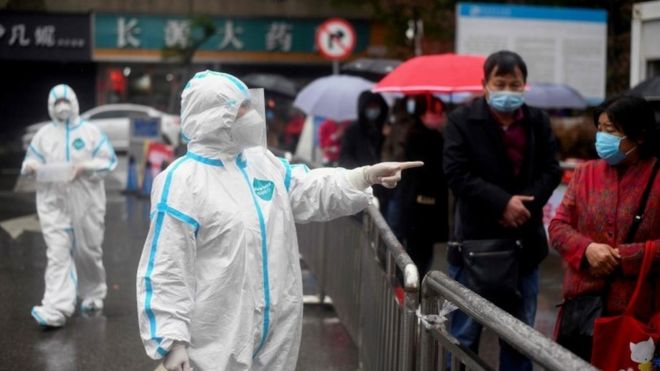
A queue at a fever clinic in Hubei province on FridayImage copyright AFP / GETTY
Image caption A queue at a fever clinic in Hubei province on Friday

China has announced a temporary ban on all foreign visitors, even if they have visas or residence permits.

The country is also limiting Chinese and foreign airlines to one flight per week, and flights must not be more than 75% full.

Although China reported its first locally-transmitted coronavirus case for three days on Friday, almost all its new cases now come from abroad.

There were 55 new cases across China on Thursday – 54 of them from overseas.

What are the new rules?

The Chinese Foreign Ministry said it was “suspending the entry of foreign nationals” because of the “rapid spread of Covid-19 across the world”.

The suspension applies to people with visas and residence passes, but not to diplomats or those with C visas (usually aircraft crew).

People with “emergency humanitarian needs” or those working in certain fields can apply for exceptions.

Although the rules seem dramatic, many foreign airlines had already stopped flying to China – and a number of cities already had restrictions for arrivals.

Last month, for example, Beijing ordered everyone returning to the city into a 14-day quarantine.

What is the coronavirus situation in China?

Although the virus emerged in China, it now has fewer cases than the US and fewer deaths than Italy and Spain.

There have been 81,340 confirmed cases in China and 3,292 deaths, the National Health Commission said on Friday.

In total, 565 of those confirmed cases were classed as “imported” – either foreigners coming into China, or returning Chinese nationals.

In Hubei – the province where the outbreak began – there were no new confirmed or suspected cases on Thursday.

The lockdown in provincial capital Wuhan, which began in January, will be eased on 8 April.

Media caption Stephen McDonell met people in Beijing heading out after the lockdown

Source: The BBC

27/03/2020

U.S. has most coronavirus cases in world, next wave aimed at Louisiana

NEW YORK (Reuters) – The number of U.S. coronavirus infections climbed above 82,000 on Thursday, surpassing the national tallies of China and Italy, as New York, New Orleans and other hot spots faced a surge in hospitalizations and looming shortages of supplies, staff and sick beds.

With medical facilities running low on ventilators and protective masks and hampered by limited diagnostic testing capacity, the U.S. death toll from COVID-19, the respiratory disease caused by the virus, rose beyond 1,200.

“Any scenario that is realistic will overwhelm the capacity of the healthcare system,” New York Governor Andrew Cuomo told a news conference. He described the state’s projected shortfall in ventilators – machines that support the respiration of people have cannot breathe on their own – as “astronomical.”

“It’s not like they have them sitting in the warehouse,” Cuomo added. “There is no stockpile available.”

At least one New York City hospital, New York-Presbyterian/Columbia University Medical Center in Manhattan, has begun a trial of sharing single ventilators between two patients.

While New York was the coronavirus epicenter in the United States this week, the next big wave of infections appeared headed for Louisiana, where demand for ventilators has already doubled. In New Orleans, the state’s biggest city, Mardi Gras celebrations late last month are believed to have fueled the outbreak.

Louisiana Governor John Bel Edwards said New Orleans would be out of ventilators by April 2 and potentially out of bed space by April 7 “if we don’t flatten the infection curve soon.”

“It’s not conjecture, it’s not some flimsy theory,” Edwards told a press conference. “This is what is going to happen.”

About 80% of Louisiana’s intensive care patients are now on breathing machines, up from the normal rate of 30-40%, said Warner Thomas, chief executive of Ochsner Health System, the state’s hospital group.

Scarcities of protective masks, gloves, gowns and eyewear for doctors and nurses – reports abound of healthcare workers recycling old face masks, making their own or even using trash bags to shield themselves – have emerged as a national problem.

“Our nurses across the country do not have the personal protective equipment that is necessary to care for COVID patients, or any of their patients,” Bonnie Castillo, head of the largest U.S. nurses union, National Nurses United, told MSNBC.

In an ominous milestone for the United States as a whole, at least 82,153 people nationwide were infected as of Thursday, according to a Reuters tally from state and local public health agencies. China, where the global pandemic emerged late last year, had the second highest number of cases, 81,285, followed by Italy with 80,539.

At least 1,204 Americans have died from COVID-19, which has proven especially dangerous to the elderly and people with underlying chronic health conditions, Reuters’ tally showed.

MORE BEDS NEEDED

For New York state, Cuomo said a key goal was rapidly to expand the number of available hospital beds from 53,000 to 140,000.

New York hospitals were racing to comply with Cuomo’s directive to increase capacity by at least 50%. At Mount Sinai Hospital’s Upper East Side location, rooms were being constructed within an atrium to open up more space for beds.

At Elmhurst Hospital in New York’s borough of Queens, about a hundred people, many wearing masks with their hoods pulled up, lined up behind barriers outside the emergency room entrance, waiting to enter a tent to be screened for the coronavirus.

The city coroner’s office has posted refrigerated trucks outside Elmhurst and Bellevue Hospital to temporarily store bodies of the deceased.

Deborah White, vice chair of emergency medicine at Jack D. Weiler Hospital in the city’s Bronx borough, said 80% of its emergency room visits were patients with coronavirus-like symptoms.

A ventilator shortfall and surge in hospitalizations has already raised the prospect of rationing healthcare.

Asked about guidelines being drafted on how to allocate ventilators to patients in case of a shortage, New Jersey Governor Phil Murphy told reporters such bioethical discussions “haunted him” but were unavoidable.

Outside New York and New Orleans, other hot spots appeared to be emerging around the country, including Detroit.

Brandon Allen, 48, was buying groceries in Detroit for his 72-year-old mother, who has tested positive and was self-quarantining at home.

“It’s surreal,” Allen said. “People around me I know are dying. I know of a couple people who have died. I know a couple of people who are fighting for their lives. Everyday you hear of another person who has it.”

RECORD UNEMPLOYMENT CLAIMS

Desperate to slow virus transmissions by limiting physical contact among people, state and local governments have issued stay-at-home orders covering about half the U.S. population. A major side effect has been the strangulation of the economy, and a wave of layoffs.

The U.S. Labor Department reported Thursday the number of Americans filing claims for unemployment benefits last week soared to a record of nearly 3.28 million – almost five times the previous weekly peak of 695,000 during the 1982 recession.

Dr. Anthony Fauci, director of the U.S. National Institute of Allergy and Infectious Diseases, said warmer weather may help tamp down the U.S. outbreak as summer approaches, though the virus could re-emerge in the winter.

“We hope we get a respite as we get into April, May and June,” Fauci said on WNYC public radio.

Washington state Governor Jay Inslee said he may extend a stay-at-home order tentatively set to expire April 6, encouraged by what he called a “very modest improvement” in the Seattle area.

Washington experienced the first major U.S. outbreak of COVID-19 and has been among the hardest-hit states. As of Thursday the state reported about 3,200 cases and 147 deaths.

In California’s Coachella Valley, a region rife with retirees who are especially vulnerable, 25 members of the state’s National Guard helped a non-profit distribute food to people stuck in their homes, as most of the regular volunteers are senior citizens.

More than 10,000 troops have been deployed in 50 states to provide humanitarian aid during the pandemic.

Source: Reuters

25/03/2020

Xinhua Headlines: A reviving Wuhan with the pace of spring

People enjoy sunset on a plank road at the East Lake in Wuhan, capital of central China’s Hubei Province, March 18, 2020. (Xinhua/Shen Bohan)

Arduous efforts have been made since Wuhan was locked down and the efforts have paid off, with the outbreak of the COVID-19 gradually brought under control in this once hardest-hit Chinese city. With sacrifices and persistence, a bright dawn is finally around the corner.

WUHAN, March 24 (Xinhua) — Xia Yongli starts a workday at dawn by having his temperature taken, disinfecting his bus and going through safety checks before hitting the road at 7:00 a.m. sharp.

Over the past eight weeks, the bus driver in the central Chinese city of Wuhan had not driven his familiar route, which is 14 km long and usually takes 40 minutes. Instead, he has been shuttling medics and delivering supplies to shops and supermarkets.

The city, with a population of over 10 million, pressed a “pause” button on Jan. 23 to contain the spread of the rampaging coronavirus behind the COVID-19 epidemic, with all public transport and outbound channels shut down and all residents staying indoors.

The streets of Wuhan are no longer bustling. Shopping blocks, pedestrian streets and other popular places where local people would stroll around are largely left to still figure sculptures.

Arduous efforts have been made since Wuhan was locked down and the efforts have paid off, with the outbreak of the COVID-19 gradually brought under control. Once hardest-hit, Wuhan only had one newly confirmed COVID-19 case reported for six consecutive days between March 18 and 23.

Wuhan had reported a total of 50,006 confirmed cases by March 23, and 43,214 patients had been cured and discharged from hospitals.

With sacrifices and persistence, a bright dawn is finally around the corner. People will be allowed to leave the city and the province from April 8, local authorities said Tuesday.

A staff member conducts disinfection at a subway station in Wuhan, central China’s Hubei Province, March 23, 2020. (Xinhua/Shen Bohan)

To reduce the risk of imported cases, all personnel coming to Wuhan from overseas have to be brought under closed-loop management, with timely quarantine and epidemiological surveys conducted, said Ying Yong, secretary of Hubei Provincial Committee of the Communist Party of China.

“Wuhan had pressed the pause button and is currently in urgent need of restoring its urban functions with safe and ordered operations,” Ying said.

More than 110 bus routes citywide have conducted no-load test runs. Disinfection has been carried out at local metro and railway stations. Checkpoints for epidemic control, 27 on cross-river bridges and nearly 80 others in main urban areas, have been removed.

Infrared thermometers have been installed at subway entrances, with posters of QR codes for real-name registration inside the stations and carriages.

Staff members conduct disinfection on a subway train in Wuhan, central China’s Hubei Province, March 23, 2020. (Xinhua/Xiao Yijiu)

“The traffic on the road is coming back,” said Hu Lijun, general manager of the Wuhan Zhengyuan Gaoli Optical Co., Ltd., a photoelectric encoder manufacturer, whose production capacity has been restored by 80 percent.

Traffic flow at highway exits is also increasing by about 10 percent per day due to a growing number of people returned as Wuhan speeds up resumption of work and production.

There were health staff, community workers and police in each lane at toll-gate checkpoints, scanning health codes and taking body temperatures of the returning workers, disinfecting their vehicles and making registrations.

“Drivers had to queue up at the highway exits in the past to spend five minutes filling a registration form,” said Dong Hongxiang, a police officer, noting that registration time has been cut short now by using PDA scanners.

On March 21, a special train arrived in Wuhan with 1,013 passengers on board, all of whom were employees of Dongfeng Honda, a local joint venture. They were picked up at the train station and sent directly to the factory or their residences.

Workers are busy on the production lines at the workshop of Dongfeng Passenger Vehicle Company in Wuhan, central China’s Hubei Province, March 24, 2020. (Xinhua/Xiao Yijiu)

Wuhan-based enterprises that are important to the national and global industry chains and those closely related to people’s livelihood are allowed to continue operation or resume work, said Cao Guangjing, deputy governor of Hubei.

Hubei serves as one of China’s major auto producers and phosphate fertilizers. Cao said that relevant companies play significant role in the production chains. Their resumption of operation counts.

Preferential measures have been taken to support restart of engine in the city. The State Grid Wuhan electric power company has rolled out new policies to cut or exempt electricity bills for local enterprises, an estimated reduction of 389 million yuan (about 55 million U.S. dollars) by the end of June.

People have also started to venture out, although they cannot go as far or wherever they want.

Wang Tan, a Wuhan resident, stepped out of his home for the first time in two months to get some medicine for his father-in-law at a nearby pharmacy Monday morning.

With a health code on WeChat, Wang said he could visit convenience stores, green groceries and drug stores close to his home and have some free time outdoors inside his residential community, which has been clear of COVID-19 cases for 14 days in a row.

The Guoxinyuan community in Jiang’an District has been epidemic-free for 26 consecutive days. There were kids skipping ropes and the gray-haired doing exercises in open public areas. People observed social distancing while reclaiming a long-lost conversation.

“The public space in our community is quite small, thus no more than 80 people are allowed to have outdoor activities at one time,” said Wei Jilai, who heads the neighborhood committee.

A woman purchases daily necessities at a convenience store in Wuhan, central China’s Hubei Province, March 19, 2020. (Xinhua/Shen Bohan)

As the epidemic recedes, more than 21,000 medical staff from across the country who had fought on the frontline in Wuhan and other places in Hubei are returning home. Before departure, some visited East Lake, one of the well-known tourist attractions in Wuhan, having group photos before cherry trees in blossom to mark the unforgettable days in the city.

Some are leaving, while others stand their ground. Ma Xin, vice president of the Huashan Hospital affiliated to Fudan University in Shanghai, stayed at Wuhan’s Tongji Hospital with his team, treating severe and critically ill patients.

“Most of them have underlying diseases and have to be treated for their complications,” Ma said, stressing that vigilance is still needed at present, especially against imported cases and relapse.

Source: Xinhua

25/03/2020

Across China: Largest oilfield revs up production to secure supply

HARBIN, March 24 (Xinhua) — After climbing an iron ladder and mounting a 10-meter-high drilling platform, Ge Yifan, a driller in the Daqing Oilfield, keeps a close eye on the control room screen and uses a microphone to instruct his workmates cleaning mud off the platform.

Ge works in the 1205 Drilling Team in Daqing Oilfield, the country’s largest oil production base in northeast China’s Heilongjiang Province.

“Since the oilfield resumed production on Feb. 11, we have been working around the clock to speed up oil production to mitigate the effects caused by the epidemic,” said Zhang Jing, head of the drilling team.

Discovered in 1959, the oilfield has produced about 2.4 billion tonnes of crude oil over the past 60 years. Its overseas business projects have covered 26 countries and regions, with overseas market revenue exceeding 10 billion yuan (around 1.4 billion U.S. dollars) and overseas equity output exceeding 9 million tonnes.

“While fighting against COVID-19, our domestic and overseas colleagues have been making efforts to promote the resumption of oil production to ensure the domestic and global supply,” said Xie Yuxin, manager of the market development department of the Daqing Oilfield of the China National Petroleum Corporation (CNPC).

Since the epidemic outbreak, Daqing Oilfield has taken stringent prevention measures to contain the spread of the deadly virus in the work areas.

Visitors who enter an oil extraction plant on the oilfield production base are asked to get disinfected and have their body temperatures measured at the entrance.

“Start the No. 1 oil pump.” “Roger.” In a dehydration pump room of the plant, the only worker, Wang Zhongying, operates equipment following instructions from the command room.

“We have carried out information technology updates on equipment operations over the past years,” said Zhao Shiqing, a worker of the plant. “It plays a significant role in reducing the gathering of employees during the epidemic.”

“In the fight against COVID-19, everyone is a soldier. We will stick to our posts and make every effort to help secure the global oil supply chain,” said Wang Hongchen, a project manager of Daqing Oilfield of CNPC in Indonesia.

Source: Xinhua

25/03/2020

Coronavirus: Wuhan to ease lockdown as world battles pandemic

Medical staff clean up the empty hospital after all patients were discharged at Wuchang Fangcang hospital, a temporary hospital set up at Hongshan gymnasium to treat people infected with the coronavirus and Covin-19 disease, in Wuhan, Hubei Province, China, 10 March 2020 (issued 11 March 2020)Image copyright EPA
Image caption Wuhan has been sealed off since mid-January

The lockdown in Wuhan, the Chinese city where the global coronavirus outbreak began, will be partially lifted on 8 April, officials say.

Travel restrictions in the rest of Hubei province, where Wuhan is located, will be lifted from midnight on Tuesday – for residents who are healthy.

A single new case of the virus was reported in Wuhan on Tuesday following almost a week of no reported new cases.

Countries around the world have gone into lockdown or imposed severe curbs.

The UK is getting to grips with sweeping new measures to tackle the spread of coronavirus, including a ban on public gatherings of more than two people and the immediate closure of shops selling non-essential goods.

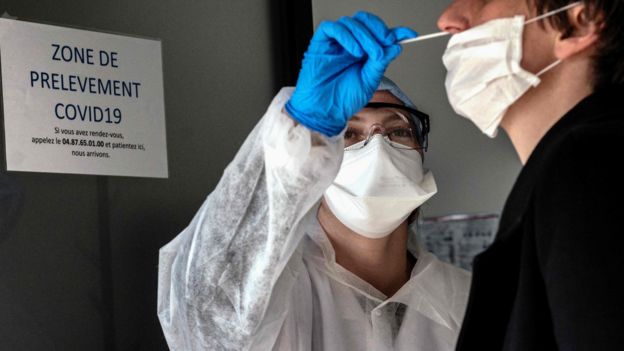
A person is tested for the Covid-19 virus in Villeurbanne, France (23 March 2020)Image copyright AFP
Image caption The WHO has urged the G20 group of nations to boost production of protective equipment

Meanwhile, health experts say Americans must limit their social interactions or the number of infections will overwhelm the health care system in the US.

Spanish soldiers helping to fight the coronavirus pandemic have found elderly patients in retirement homes abandoned and, in some cases, dead in their beds, the defence ministry has said.

An ice rink in Madrid is to be used as a temporary mortuary for Covid-19 victims.

The World Health Organization (WHO) has warned that the pandemic is accelerating, with more than 300,000 cases now confirmed. It is urging countries to adopt rigorous testing and contact-tracing strategies.

Wuhan has been shut off from the rest of the world since the middle of January. But officials now say anyone who has a “green” code on a widely used smartphone health app will be allowed to leave the city from 8 April.

Earlier, the authorities reported a new case of coronavirus in Wuhan, ending a five-day run of no reported new cases in the city.

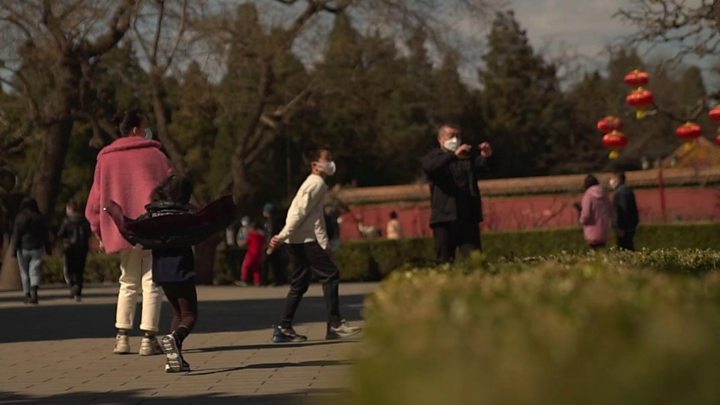
Media caption Coronavirus: People in Beijing begin to head outdoors

It comes after health officials there confirmed that they were not counting cases of people who were positive but had not been admitted to hospital or did not show any symptoms of the disease.

Official government figures say there have been 78 new cases reported on the Chinese mainland in the last 24 hours. All but four of them were caused by infected travellers arriving from abroad.

This so-called “second wave” of imported infections is also affecting countries like South Korea and Singapore, which had been successful in stopping the spread of disease in recent weeks.

South Korea has been seeing a drop in its daily tally of new cases. On Tuesday it reported its lowest number since 29 February.

Presentational grey line

China looks to repair its reputation

By Robin Brant, BBC News, Shanghai

China considers itself to be – very nearly – a “post corona” country.

In the last week we’ve heard Wuhan medics warning the UK and others that they need to do more to protect frontline health workers, citing the mistakes they made early on when some treated patients without wearing proper protective clothing.

But there’s also been reporting in state media of the reported death toll in Italy surpassing that in China. This has been combined with some commentary from prominent media figures that has appeared distasteful, almost triumphalist.

At the same time there is a panic about the threat of a second wave from imported cases – travellers arriving from abroad. This has fuelled the view – right or wrong – that some other countries aren’t taking the threat seriously because they aren’t doing what China did. (Almost all the cases in Beijing that have been made public are of Chinese nationals returning home).

Meanwhile, well away from senior leaders, there are some high-profile diplomatic figures using international-facing social media to spread theories that the US may have weaponised and dumped the virus in China. Or that Italy had cases that may have been Covid-19 earlier than China. China is sowing seeds of doubt and questioning assumed truths as it looks to repair its reputation.

Presentational grey line
Banner image reading 'more about coronavirus'
Banner

What’s the latest from around Asia?

  • Almost all of India with its 1.3bn people is under lockdown. Buses, trains and other forms of public transport are suspended. On Monday, the authorities said domestic flights would also stopped. The country has reported 485 cases and nine people have died. Prime Minister Narendra Modi will address the nation again this evening.
People travel in Central Railway's first air-conditioned EMU local train, on January 30, 2020, in Mumbai, India.Image copyright GETTY IMAGES
Image caption Mumbai’s suburban train network carries eight million passengers a day
  • Neighbouring Pakistan has almost twice as many confirmed cases – 878 as of Monday evening. Sweeping restrictions are in place although the government has stopped short of imposing a nationwide lockdown. However, several provinces have announced them independently. The army is being brought in to help enforce the restrictions.
  • Bangladesh, which has reported 33 cases and three deaths, is also deploying its armed forces to help maintain social distancing and boost Covid-19 preventive measures. The soldiers will also monitor thousands of quarantined expatriate returnees. Across South Asia, there are concerns that the actual number of cases could be much higher than is being reported.
  • Indonesia, which has 49 confirmed Covid-19 deaths – the highest in South-East Asia – has converted an athlete’s village built for the 2018 Asian Games into a makeshift hospital for coronavirus patients. A state of emergency was declared in Jakarta on Monday.
  • In Thailand, a month-long state of emergency which will include curfews and checkpoints will begin on Thursday. The government has been criticised for failing to take strong action so far. Four people have died and nearly 900 tested positive.
  • Talks between the Japanese PM and the International Olympic Committee are expected this evening.
  • The most populous country that was without a case until now – Myanmar – has announced two cases.

Europe’s battle against virus intensifies

UK Prime Minister Boris Johnson announced on Monday night that, with immediate effect, “people will only be allowed to leave their home…for very limited purposes”. They include shopping for basic necessities, taking one form of exercise per day, fulfilling any medical need, or travelling to work if working from home is impossible.

Media caption Reality Check tackles misleading health advice being shared online

The number of people who have died in the UK rose to 335 on Monday.

In Italy, the worst-hit country in the world, the authorities said 602 people with Covid-19 had died in the past 24 hours, bringing the total death toll there to 6,077.

But the daily increase in cases was the smallest since Thursday, raising hope that the stringent restrictions imposed by the government were starting to have an effect.

Spain, however, said on Tuesday that its death toll had risen by 514 to 2,696. Nearly 40,000 are infected, about 5,400 of them healthcare workers.

Source: The BBC

25/03/2020

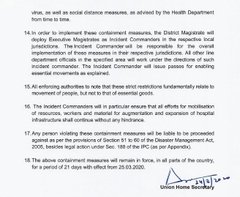
Coronavirus: India enters ‘total lockdown’ after spike in cases

People panicked after the prime minister said everyone should “forget about” leaving their homes for any reason

India’s Prime Minister Narendra Modi has imposed a nationwide lockdown in an attempt to slow the spread of the coronavirus.

The restrictions came into force at midnight local time (18:30 GMT) and will be enforced for 21 days.

“There will be a total ban on venturing out of your homes,” Mr Modi said in a televised address.

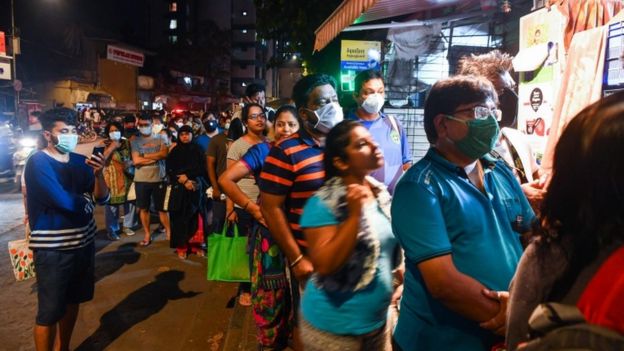
He appealed for people not to panic – but crowds quickly mobbed stores in the capital, Delhi, and other cities.

Correspondents say it is not clear how – or even if – people will now be allowed out to buy food and other essentials.

The new measures follow a sharp increase in cases in recent days. There have been 519 confirmed cases across India and 10 reported deaths.

India – which has a population of 1.3bn – joins a growing list of countries that have imposed similar measures.

Nearly 400,000 people have tested positive for the virus worldwide, and around 17,000 have died.

Banner image reading 'more about coronavirus'
Banner

“The entire country will be in lockdown, total lockdown,” Mr Modi said on Tuesday.

He added: “To save India, to save its every citizen, you, your family… every street, every neighbourhood is being put under lockdown.”

Mr Modi warned that if India does not “handle these 21 days well, then our country… will go backwards by 21 years”.

“This is a curfew,” he said. “We will have to pay the economic cost of this but [it] is the responsibility of everyone.”

Media caption We explain why staying in is a matter of life and death

Mr Modi later warned that panic-buying would only spread the disease. He said the government would ensure supplies.

But in Delhi and the financial capital, Mumbai, people fearing shortages quickly thronged shops and pharmacies.

“I have never witnessed such a chaos in my life,” the owner of one store in the Shakarpur district of Delhi said, quoted by the Press Trust of India.

“All our stocks, including rice, flour, bread, biscuits, edible oils, have been sold out.”

Police in the busy city of Ghaziabad, in Uttar Pradesh state, patrolled the streets with megaphones to tell residents to stay indoors.

People line up outside a store in Mumbai on March 24, 2020.Image copyright AFP
Image caption People in Mumbai rushed to stock up on essentials following Mr Modi’s address

Under the new measures, all non-essential businesses will be closed but hospitals and other medical facilities will continue to function as normal. Schools and universities will remain shut and almost all public gatherings will be banned.

Anyone flouting the new rules faces up to two years in prison and heavy fines.

In his address, Prime Minister Modi also:

  • Stressed that the 21-day lockdown was “very necessary to break the chain of coronavirus”
  • Emphasised the seriousness of the situation and said that even developed countries had faced problems in combating it
  • Said that “social distancing was the only way to stop” the virus spreading
  • Announced that nearly $2bn (£1.8bn) would be made available to boost the country’s health infrastructure
  • Called on people not to “spread rumours” and to follow instructions

His announcement came after several Indian states introduced measures of their own, such as travel restrictions and the closure of non-essential services.

India has already issued a ban on international arrivals and grounded domestic flights. The country’s rail network has also suspended most passenger services.

Presentational grey line
Analysis box by Rajini Vaidyanathan, South Asia correspondent

Many parts of India, including cities such as Delhi and Mumbai, are already under tight restrictions. But this move extends those provisions to every corner of the country.

An earlier one-day curfew, which was seen as a trial, was flouted by many.

Mr Modi called on Indians to clap and cheer the emergency services from their balconies on Sunday. But many misunderstood the call and congregated in the streets as they danced and chanted.

“It’s impossible to fathom the cost that India may have to pay if such irresponsible behaviour continues,” Mr Modi warned at the time. “Social distancing is the only option to combat coronavirus.”

The implications of a total lockdown in India are huge, not just economically, but socially.

This is a nation where community is everything. Going to worship at a temple, mosque or church is an essential part of daily life for so many.

This is a seismic cultural shift but – like the rest of the world facing similar restrictions – a necessary one.Presentational grey line

What’s the latest from around Asia?

  • Neighbouring Pakistan has almost twice as many confirmed cases – 878 as of Monday evening. Sweeping restrictions are in place although the government has stopped short of imposing a nationwide lockdown. However, several provinces have announced them independently. The army is being brought in to help enforce the restrictions
  • Bangladesh, which has reported 33 cases and three deaths, is also deploying its armed forces to help maintain social distancing and boost Covid-19 preventive measures. The soldiers will also monitor thousands of quarantined expatriate returnees. Across South Asia, there are concerns that the actual number of cases could be much higher than is being reported.
  • Indonesia, which has 49 confirmed Covid-19 deaths – the highest in South East Asia – has converted an athlete’s village built for the 2018 Asian Games into a makeshift hospital for coronavirus patients. A state of emergency was declared in Jakarta on Monday
  • In Thailand, a month-long state of emergency which will include curfews and checkpoints will begin on Thursday. The government has been criticised for failing to take strong action so far. Four people have died and nearly 900 tested positive
  • The most populous country that was without a case until now – Myanmar – has announced two cases

And what about the rest of the world?

  • Elsewhere, governments are continuing to work to stem the spread of the virus which has now affected more than 190 countries worldwide
  • More than 2.6 billion people are in lockdown now India has introduced its new measures, according to a tally by the AFP news agency
Media caption Reality Check tackles misleading health advice being shared online
  • Europe remains at the epicentre of the pandemic. On Tuesday, the death toll jumped by 514 in a single day in Spain and other European countries also reported sharp increases
  • Italy is the worst affected country in the world in terms of deaths. The virus has killed almost 7,000 people there over the past month
  • The UK, meanwhile, is spending its first day under tight new restrictions. Prime Minister Boris Johnson announced unprecedented measures on Monday and ordered the immediate closure of shops selling non-essential goods
  • And in the US, New York’s governor has said the federal government is not sending enough equipment to combat the crisis. The state has been hit especially hard by the virus
  • The World Health Organization (WHO) has warned that the US has the potential to become the new epicentre of the pandemic
  • In other developments, Japanese Prime Minister Shinzo Abe said the International Olympic Committee has agreed that the 2020 Tokyo Olympics should be postponed by a year
  • Source: The BBC
Law of Unintended Consequences

continuously updated blog about China & India

ChiaHou's Book Reviews

continuously updated blog about China & India

What's wrong with the world; and its economy

continuously updated blog about China & India