Archive for ‘cranes’

23/04/2020

China Focus: China-Europe freight trains help stabilize global supply chain

SHENYANG, April 23 (Xinhua) — With trucks standing bumper to bumper and large cranes loading containers on the train, work returned to normal at a logistics base in northeast China’s Liaoning Province.

The base, where the China-Europe freight trains are set to depart in Shenyang, the provincial capital, has seen stable departures since early April as the novel coronavirus epidemic ebbs away.

With the global supply chain being affected by restrictions in air, land, and port travel due to the global pandemic, China-Europe railway has been playing a more important role, experts say.

“The train was operated by staff in different sections, which means it does not require cross-border personnel health inspections, giving it advantages during the pandemic,” said Shan Jing, an industry insider who wrote a book on China-Europe freight trains.

In March, a total of 809 China-Europe freight trains carrying 73,000 containers were sent across China. Both numbers hit a monthly record.

At the Shenyang logistics base, trains depart to travel through Russia, Belarus, Poland and finally reach Germany in around 18 days. As of April 13, a total of 130 trains carrying 11,200 standard containers had departed from the base.

“The province sends a stable number of five trains each week,” said He Ruofan, a business manager with the Shenyang branch of China Railway Container Transport Corp., Ltd, operator of the trains.

The stable operation has made the route a top choice for many Chinese enterprises, said Yao Xiang, a manager with logistics group Sinotrans’s northeast company.

“Many shipping routes have been canceled, and the rest are more and more expensive amid the epidemic,” said Yao, noting the price for air cargo surged 5 to 10 times the normal price as flights decreased from China to Europe.

With increasing departing trains, returning trains on the route have also been increasing, Yao said.

Among the 130 trains that have been sent from the Shenyang base so far this year, 33 returned, carrying construction materials, car parts, mechanical equipment, and daily products.

“These goods provide supplies to large companies like BMW and Michelin’s Shenyang factories,” Yao said.

Medical supplies have also been sent to hard-hit Europe to fight against the coronavirus pandemic.

As of April 18, a total of 448,000 pieces of medical supplies weighing 1,440 tonnes had been sent to European countries via the route, according to China State Railway Group Company, Ltd.

“China-Europe freight trains have shown great service capabilities during the epidemic,” said Shan, the industry insider. “It serves as a new choice for European enterprises, and I believe more people will come to realize the importance of the route.”

Source: Xinhua

13/04/2019

China’s trade boom and building frenzy of ports help home-grown producers corner the world market of containers and cranes

  • Shanghai Zhenhua Heavy Industries now exports quay cranes, gantry cranes to more than 300 ports in 100 countries, with 70 per cent of the global market
  • China International Marine Containers Group (CIMC), took a little more than a decade to become the world’s largest maker of shipping containers
Quay cranes along a berth at the Yangshan deep-water port in Shanghai on September 14, 2011. Shanghai Zhenhua Heavy Machineries, established in 1992, has grown along with the explosive development of China’s ports to control 70 per cent of the global market for cranes, loaders and lifting equipment used in ports. Photo: Xinhua
The explosive growth of China’s container ports has turned one of the most important vendors in shipping into a best-in-class industry leader, whose cranes can now be found in 300 wharves in 100 countries, with 70 per cent of the global market share.
Shanghai Zhenhua Heavy Industries, a unit of China’s state-run construction behemoth China Communications Construction Company, makes quay cranes, gantry cranes, loaders and stackers used for loading and unloading shipping containers. It also developed the infrastructure for the automated berths in Phase IV of Shanghai’s Yangshan port, and in Qingdao.
Its net profit jumped 47.6 per cent last year to 443 million yuan, while sales was little changed at 21.8 billion yuan (US$3.25 billion).

“It is a major showcase of China’s manufacturing capability,” said Sun Can, a Chuancai Securities analyst. “The company has its own technologies and is a powerful player in the global port machinery industry.”

Why China now has six of the world’s 10 busiest container ports
Established in 1992, the company was formerly known as Zhenhua Port Machinery for its speciality in making lifting equipment on the harbourfront. Taking advantage of China’s low wages, Zhenhua quickly carved out a big chunk of the global market share by selling machines at lower prices than its competitors.
The company’s former chief executive Guan Tongxian, a confessed workaholic known for his hard-driving working ethic, retired at the age of 76 in 2009, the same year that the company renamed itself to reflect its forays into marine transport and installations, as well as the construction of special steel structures including the Las Vegas Ferris wheel, the San Francisco-Oakland Bay Bridge and Norway’s Hardangerfjord bridge.
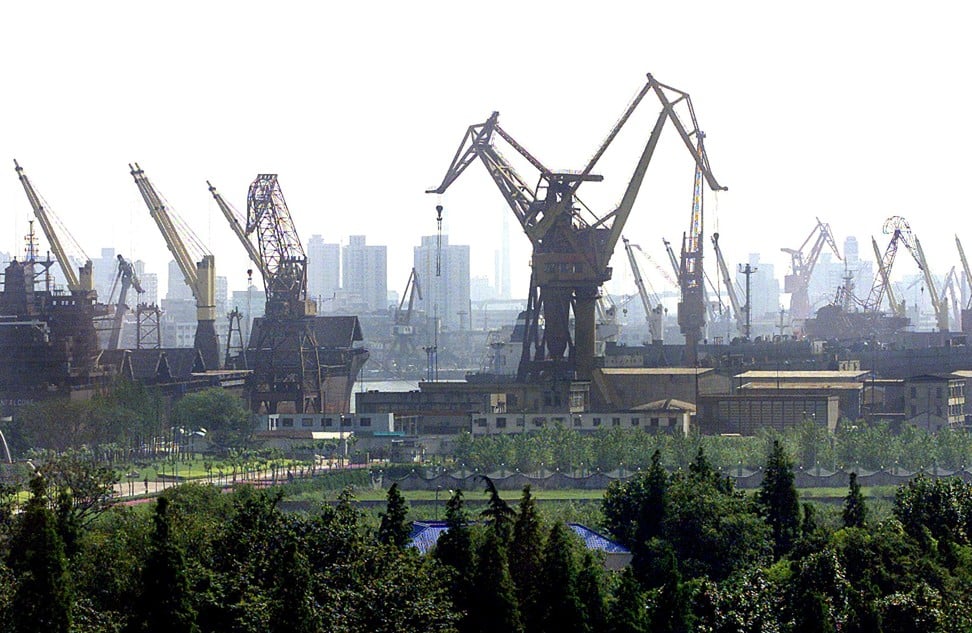
Rows of gantry cranes standing along the Huangpu River in Shanghai on 26 June 2002. A consortium of Chinese domestic banks provided a 17 billion yuan (US$2 billion) credit line toward the construction of Shanghai's Yangshan deep-sea container port. Photo: AFP
Rows of gantry cranes standing along the Huangpu River in Shanghai on 26 June 2002. A consortium of Chinese domestic banks provided a 17 billion yuan (US$2 billion) credit line toward the construction of Shanghai’s Yangshan deep-sea container port. Photo: AFP

Listed on the Shanghai exchange in 1997, Zhenhua’s shares have risen 41 per cent in the past 12 months, ending 2.1 per cent lower at 4.46 yuan on Friday. All three analysts who cover the stock recommend their clients either “buy” or “accumulate” the stock, expecting Zhenhua to be a major winner in China’s megaplan to build infrastructure along the old Silk Road in its Belt and Road Initiative (BRI).

Another major company that has emerged with China’s rising tide was China International Marine Containers (Group), or CIMC, a unit of the state-run conglomerate China Merchants Group. Established in 1980, the company took a little more than a decade to dominate the global industry, becoming the world’s largest maker of shipping containers since 1996.

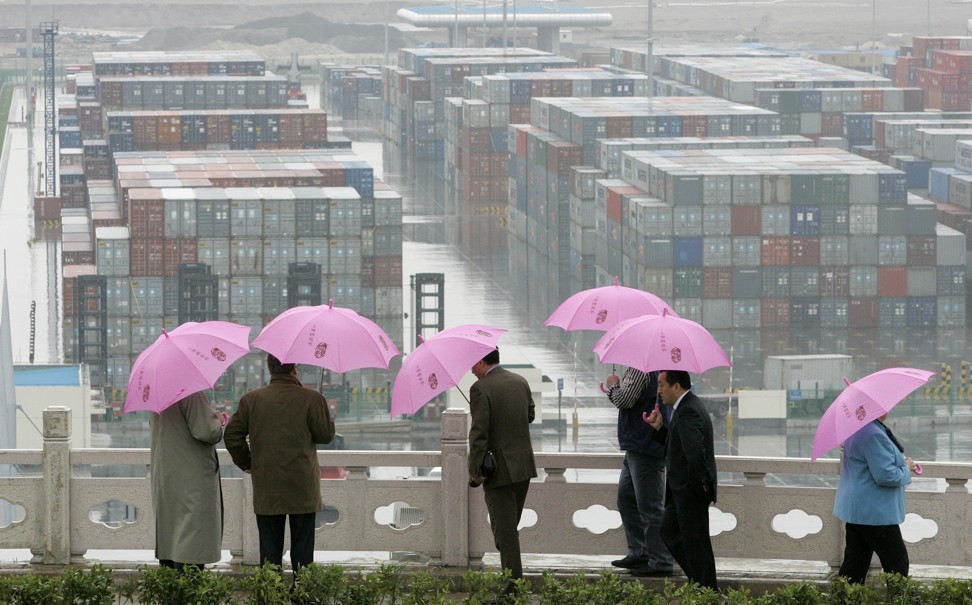
Visitors look at rows of containers at the Yangshan deep water port in Shanghai on April 6, 2006. Photo: AP

Guosen Securities said in a research report that CIMC would face lower profit margin this year amid rising raw material costs and fiercer competition from global rivals.

Its shares have risen 43.7 per cent in the past 12 months on the Shenzhen exchange to 15.20 yuan as of Friday.

Source: SCMP

Law of Unintended Consequences

continuously updated blog about China & India

ChiaHou's Book Reviews

continuously updated blog about China & India

What's wrong with the world; and its economy

continuously updated blog about China & India