Chindia Alert: You’ll be Living in their World Very Soon
aims to alert you to the threats and opportunities that China and India present. China and India require serious attention; case of ‘hidden dragon and crouching tiger’.
Without this attention, governments, businesses and, indeed, individuals may find themselves at a great disadvantage sooner rather than later.
The POSTs (front webpages) are mainly 'cuttings' from reliable sources, updated continuously.
The PAGEs (see Tabs, above) attempt to make the information more meaningful by putting some structure to the information we have researched and assembled since 2006.
The statement, issued on 27 April but only reported this week, singles out stadiums, exhibition centres, museums and theatres as public facilities where it’s especially important to ban plagiarism.
“City constructions are the combination of a city’s external image and internal spirit, revealing a city’s culture,” the government statement says.
It calls for a “new era” of architecture to “strengthen cultural confidence, show the city’s features, exhibit the contemporary spirit, and display the Chinese characteristics”.
Image copyright STR / AFP / GETTYImage caption – Not the Arc de Triomphe, but a college gate in Wuhan
The guidelines on “foreign” architecture were mostly welcomed on Chinese social media.
“The ban is great,” wrote a Weibo user, according to state media the Global Times. “It’s much better to protect our historical architectures than build fake copycat ones.”
Another recalled seeing an imitation White House in Jiangsu province. “It burned my eyes,” she said.
Image copyright OLIVIER CHOUCHANA / GETTYImage caption Thames Town, an English-themed town near Shanghai, pictured in 2008
In 2013, the BBC visited “Thames Town”, an imitation English town in Songjiang in Shanghai.
The town features cobbled streets, a medieval meeting hall – even a statue of Winston Churchill – and was a popular spot for wedding photos.
“Usually if you want to see foreign buildings, you have to go abroad,” said one person. “But if we import them to China, people can save money while experiencing foreign-style architecture.”
Image copyright WANG ZHAO / GETTYImage caption – Raffles City, Chongqing, in 2019 – mimicking the Marina Bay Sands hotel in Singapore
China, of course, is not the only country to borrow – or copy – other countries’ designs.
Las Vegas in the US revels in its imitations of iconic foreign architecture including the Eiffel Tower and Venetian canals.
Thailand also has developments that mimic the Italian countryside and charming English villages, mainly aimed at domestic tourists.
Around 200 Shincheonji Church of Jesus members continued to meet in the Chinese city amid rumours of virus, but ‘no one took [claims] seriously’ at first
Around half the Covid-19 cases in South Korea have been linked to members of the religious group
The Shincheonji church in Daegu has been linked to a cluster of infections. Photo: Yonhap via AP
Members of the Christian sect linked to a cluster of coronavirus cases in South Korea held meetings in Wuhan until December, only stopping when they realised that their community had been hit by Covid-19, the previously unknown disease caused by the virus.
The South China Morning Post has learned that the Shincheonji Church of Jesus in Wuhan, the Chinese city at the centre of the epidemic, has around 200 members, most of whom are currently under quarantine outside the city.
“Rumours about a virus began to circulate in November but no one took them seriously,” said one member, a 28-year-old kindergarten teacher.
“I was in Wuhan in December when our church suspended all gatherings as soon as we learned about [the coronavirus],” said the woman, who declined to be named because of the sensitivity of the matter.
She said the group was continuing to share sermons and teachings online, but most members had returned home at the start of the Lunar New Year holiday in late January.
The 250,000-member Shincheonji Church of Jesus is regarded by mainstream Christian groups as a secretive and unorthodox sect. Its founder, Lee Man-hee, has claimed that he is the second coming of Jesus Christ.
Around half the Covid-19 infections in South Korea have been linked to a branch of the church in Daegu.
Coronavirus spreads through Europe from Italy to Austria, Croatia, Tenerife
26 Feb 2020
According to the Korea Centres for Disease Control and Prevention, there were 977 confirmed cases as of Tuesday – the second highest number outside China – and 11 deaths.
Of the 84 new cases reported on Tuesday, over half were recorded in Daegu city.
Coronavirus: Churches on high alert as South Korea confirms huge rise in infections
A member of the church from Daegu reportedly visited China in January, and health officials in South Korea are investigating whether a cluster of infections in Cheongdo city is linked to a three-day funeral ceremony held at a local hospital.
Chinese sources said that the Shincheonji church has about 20,000 members in China – most of whom live in major cities such as Beijing, Shanghai, Dalian, Changchun and Shenyang.
One Christian pastor in Hubei province, who declined to be named, said that Shincheonji church members were hard-working and some continued to proselytise even during the outbreak.
Chinese cities quarantine travellers from South Korea amid spike in coronavirus cases
25 Feb 2020
The Wuhan kindergarten teacher said she was confident that the recent mass outbreaks in South Korea were not linked to Shincheonji church members from the city.
“I don’t think the virus came from us because none of our brothers and sisters in Wuhan have been infected. I don’t know about members in other places but at least we are clean. None of us have reported sick,” she said.
“There are so many Chinese travelling to South Korea, it’s quite unfair to pin [the disease] on us.”
Coronavirus: China reports 508 new Covid-19 cases, with only nine outside outbreak epicentre
She sidestepped questions on whether church members had travelled from Wuhan to South Korea after the outbreak.
The teacher said that in 2018 the Wuhan group’s “holy temple” in Hankou district had been raided by police “who branded us a cult”, but members continued to worship in small groups.
“We are aware of all the negative reporting out there after the outbreak in South Korea, but we do not want to defend ourselves in public because that will create trouble with the government,” she said. “We just want to get through the crisis first.”
Airfares from South Korea to China shoot up amid Covid-19 fears
25 Feb 2020
Bill Zhang, a 33-year-old Shanghai resident and a former missionary with Shincheonji, said the group’s secretive nature made it hard for the authorities to effectively crackdown on its activities.
He said the Shanghai branch held its main meetings on Wednesdays and Saturdays, attracting 300 to 400 people at a time.
“The Shincheonji church in Shanghai has been raided many times and police spoke to church leaders regularly.
“But the church members simply continued their meetings in smaller groups of eight-to-10 people and regrouped when the surveillance was relaxed.”
Zhang continued: “Shincheonji holds that it is the only real church that upholds the biblical truth and all other churches – mainstream or cults – are evil.”
After nearly 10 years of planning, the country’s two shipbuilders will be reunited with a combined revenue of US$141.5 billion
China’s two shipbuilding giants have built hundreds of military vessels over the past few years as the country’s navy seeks to modernise rapidly. Photo: Xinhua
China on Friday announced the merger of the country’s two largest state-owned shipbuilding giants, a step Beijing has been preparing for nearly a decade to strengthen the competitiveness of its shipbuilding industry.
The intention to merge the Shanghai-based China State Shipbuilding Corp (CSSC) and the China Shipbuilding Industry Co (CSIC), based in Dalian, Northern Liaoning province, was announced in a statement on the website of the state-owned Assets Supervision and Administration Commission of the State Council, China’s cabinet.
The merger would enable China to establish a shipbuilding giant with a combined revenue up to 1 trillion yuan (US$141.5 billion), capable of building vessels ranging from warships, like aircraft carriers, to civilian ships such as container ships and oil tankers, said a source familiar with the merger plan.
“This merger has been in the making since Hu Wenming, a former party leader of the state-owned aviation industry, was assigned to CSSC as party secretary in 2010,” the source said, requesting anonymity because of the sensitivity of the issue.
“The merger plan was put on the drawing board at a time when the world shipping industry had entered a golden period in 2009, and the business of CSSC and CSIC was at its peak, but [China’s] analysis indicated a decline was on the horizon, as has actually happened in recent years.”
Chinese shipbuilder touts warships in push to expand arms sales in region
CSIC and CSSC were part of the same group until 1999 when they were split into two separate entities. Since then, China has overtaken South Korea and Japan to become the world’s largest builder of merchant ships, a rise spurred by the boom in world trade and the country’s accession to the World Trade Organisation in 2001.
CSSC manages shipbuilding business in the east and south of China, while CSIC oversees activities in the northern and western parts of the country. Both are also primary contractors for PLA naval ships.
Commercial shipbuilding was the major source of revenue for both enterprises, given they were generally less technologically challenging and of lower cost to build, the source said.
“Developing and building warships for the PLA needs more manpower and more advanced technologies because naval ships, which are built for sea battles, take longer to build and require cutting-edge technologies, hence the higher costs,” the source said.
China tests new warships in live-fire drills near Vietnam
CSSC and CSIC have built hundreds of military vessels over the past few years as the Chinese navy seeks to modernise rapidly. These have included aircraft carriers, Type 055 destroyers, Type 075 amphibious assault ships and Type 094A nuclear submarines.
But, the source said, the two giants’ naval warship building mission would be cut back next year, as Beijing expected greater financial pressure as a result of slower economic growth. The merger would allow the two companies to pool their resources and enhance their competitiveness, especially in the development of mega vessels.
But the source said the two giants’ naval warships building missions would be cut back beginning next year as Beijing foresees greater financial pressure as a result of slower economic growth. The merger will allow the two companies to pool their resources and enhance their competitiveness, especially in areas of mega vessels.
“The merger is also part of China’s long-term maritime energy development plan to meet President Xi Jinping’s sustainable and clean energy goal, because China needs more giant vessels to help ship oil and gas from other countries,” the source said.
Maritime authorities close off area of Yellow Sea near vessel’s home port of Dalian for naval training exercise
Analysts say trials have been faster and more efficient than those carried out by its sister ship the Liaoning
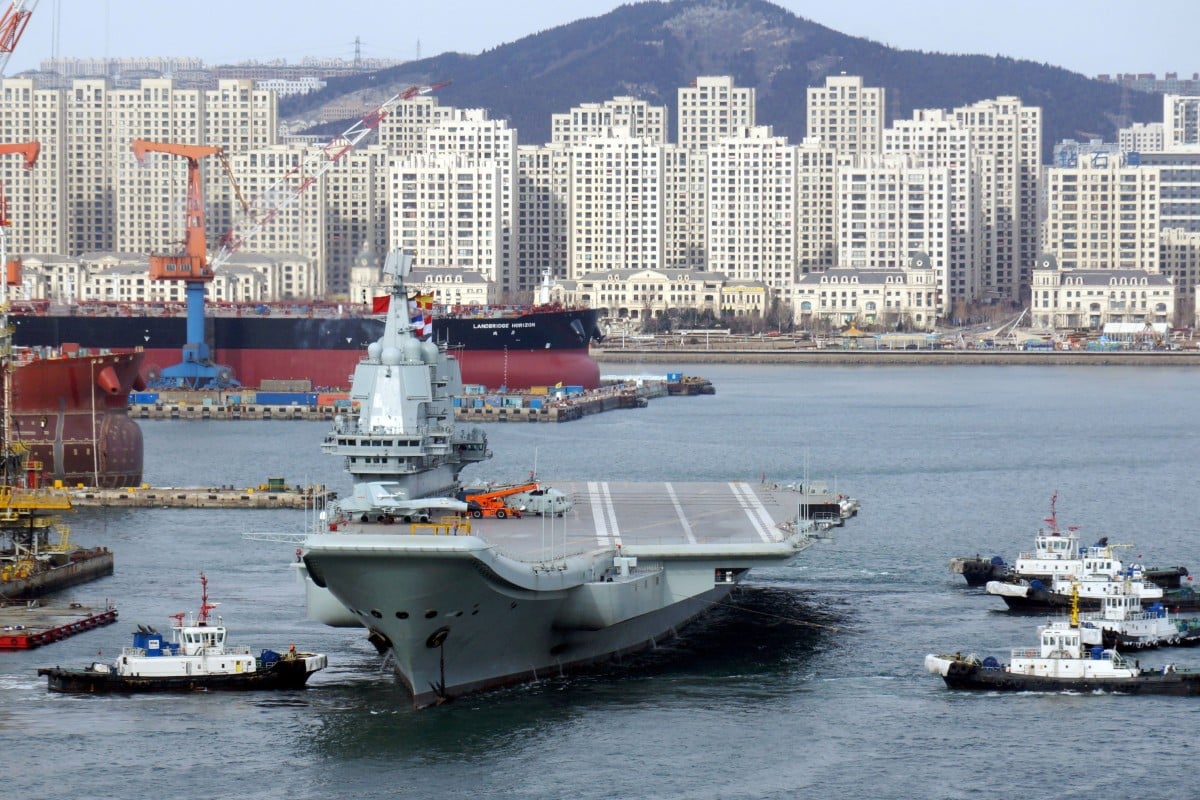
The carrier leaves the port of Dalian for a sea trial in December. Photo: Reuters
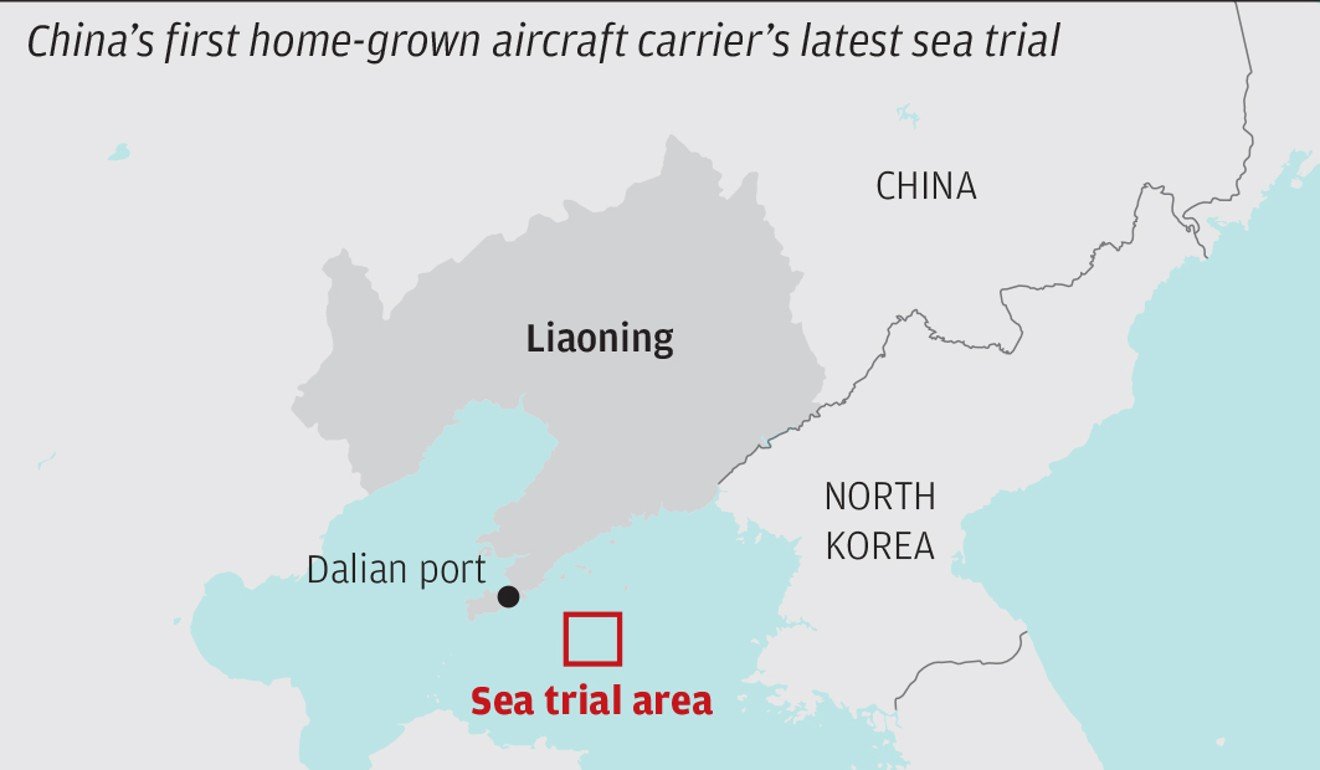
China’s first home-grown aircraft carrier the Type 001A is expected to start a four-day sea trial on Thursday, which military experts said signalled that it would soon be ready for official commissioning.
Liaoning Maritime Safety Administration issued a statement on its website on Wednesday saying a naval exercise would take place in a designated zone in the north of the Yellow Sea between Thursday and Monday, and warned other vessels not to enter the area.
The statement gave little detail about the exercise, but military experts said the location of the drill – near the carrier’s home port of Dalian – pointed to new sea trials for the ship.
Song Zhongping, a military commentator for Hong Kong-based Phoenix Television, said it would be the seventh such trial for the carrier, adding: “It is likely that the carrier will join the navy for trial runs in the coming months.”
Song said that sea trials for the Type 001A had been faster and more efficient compared with those for its sister ship, the Liaoning, China’s first aircraft carrier.
The Liaoning started life as a Soviet Kuznetsov-class vessel, and was still incomplete when China bought it from Ukraine in 1998. It underwent 10 sea trials before being commissioned in 2012.
“China has accumulated more experience with the Liaoning and that has helped in the construction and operation of Type 001A,” Song said.
North Korea fires two ballistic missiles in latest ‘warning’ to South
Beijing-based naval expert Li Jie said the upcoming sea trial for the Type 001A would be led by naval officers instead of the engineers and technicians from the Dalian Shipyard, which built the warship.
“Besides testing the carrier’s propulsion system and electronic communication systems, the sea trial will focus on inspection and acceptance. Both are critical parts of the testing before the ship can be handed over to the navy,” he said.
The trials will be held near the ship’s home port of Dalian. Graphic: SCMP
The 65,000-tonne Type 001A was built using the Liaoning as a prototype. It was launched in 2017 and conducted its latest sea trial in May. When it returned to Dalian on May 31 after the test it was seen to have J-15 fighter jets and Z-18 helicopters on its deck.
Li said aircraft take-off and landing exercises would be conducted on the high seas after the Type 001A formally entered service.
Both he and Song said the carrier was likely to be named after Shandong province, in line with the practice of giving warships geographical names.
Some naval enthusiasts and China watchers were disappointed when the Type 001 failed to appear at a grand naval parade held off the coast of Shandong in April to celebrate the 70th anniversary of the PLA Navy.
Chinese navy tests new Z-20 helicopter for use on its warships
TIANJIN/BEIJING, July 6 (Xinhua) — Even at the age of 100, Yang Enze, one of the founders of China’s optical communication, does not stop his research and teaching as a professor at Tianjin University.
Besides his pioneering achievements as the chief engineer of China’s first optical communication project for practical use in the 1970s, Yang is also known as a survivor and a witness of the war of Japanese aggression against China.
“I was admitted to Wuhan University in 1937, the year when Japanese troops attacked the Lugou Bridge, also known as Marco Polo Bridge, on the outskirts of Beijing, on July 7,” said the senior recalling the start of his academic study.
The incident marked the beginning of Japan’s full-scale war against China during World War II and triggered China’s full-scale resistance against the invasion.
Ahead of the 82nd anniversary of the incident that falls on Sunday, Yang said because of the war, his university in central China’s Hubei Province was relocated to southwestern province of Sichuan to avoid the enemy forces. “Even in Sichuan, there were a lot of Japanese bombings, but none of the students missed any of the classes as long as there was no air-raid siren,” he recalled.
It was at that time he and many of his peers cemented the belief that the country needed advanced science and technology for reconstruction and revival.
“I have always kept in mind late chairman Mao Zedong’s words that it was Japanese militarists’ crime that was to blame for the war, not Japanese civilians, ” Yang said, noting that he still gets in touch with many Japanese scholars.
He established the first optical communication laboratory in Tianjin in 1985, when he was invited to teach at Tianjin University. In Yang’s career, he has made friends with several leading experts from Japan at international conferences and even kept friendship with some of them.
Also in Tianjin, Morita Naomi, a Japanese language teacher in Nankai University, works as a consultant to the school’s research institute of Zhou Enlai-Daisaku Ikeda.
“By involving in the research of the friendship between the late Chinese premier and the Japanese philosopher, I want to search for the core factors that help consolidate the friendship between the two peoples,” said Naomi.
She came to Nankai to pursue a master-degree study in Modern Chinese and Chinese Literature in 2010 and has stayed ever since.
When she first arrived, she had troubles even in learning Chinese phonics. Now she can read and speak Chinese fluently, write beautiful Chinese characters, and study ancient Chinese literature independently.
As a teacher, she feels frustrated that most of her Chinese students are more likely to be attracted by Japanese animation and games rather than Japanese literature.
According to the school’s statistics, nearly half of the undergraduates in the 2019 class of Japanese major chose to work in Japanese-funded enterprises or Japanese-related enterprises after graduation.
Naomi said Japanese visitors to China are more likely to choose destinations like Beijing, Shanghai and Guangzhou. Peking University in Beijing impresses young Japanese most.
According to a report released by the China Tourism Academy, China received 2.69 million Japanese visitors in 2018, making Japan China’s fourth largest source of foreign tourists. In the same year, Chinese made 9.06 million outbound visits to Japan as a direct destination.
The academy released the report at the 2019 China-Japan Tourism Forum Dalian held on May 26, which focused on promoting win-win cooperation on cultural exchanges and tourism between the two countries.
China and Japan agreed to push forward bilateral relations along the right track of peace, friendship and cooperation, at the summit of the Group of 20 (G20) major economies held in Osaka, Japan, in June.
This year marks the 70th anniversary of the founding of the People’s Republic of China, and Japan has also entered the Era of Reiwa. It is also the China-Japan Youth Exchange Promotion Year, for promoting friendship and cooperation in a wide range of areas between the two peoples.
“We keep the wartime memory not because we bear the hatred, but because we want the younger generations to cherish what they own today and move towards a better future,” said 70-year-old Zhen Dong, who on Friday visited an exhibition on Beijing’s past, held in Beijing Municipal Archives.
Zhao Hongwei, a professor with Tokyo-based Hosei University, said when it comes to the bilateral relations between China and Japan, it is very important to promote the free trade agreement and expand the markets of both sides.
Chinese Premier Li Keqiang, also a member of the Standing Committee of the Political Bureau of the Communist Party of China Central Committee, hears a briefing on development driven by the opening-up of Liaoning’s coastal areas while inspecting the Liaoning Port Group in Dalian, northeast China’s Liaoning Province, July 1, 2019. Li on Monday went on an inspection tour to Dalian. (Xinhua/Liu Weibing)
DALIAN, July 1 (Xinhua) — Implementing the policy of reform and opening-up is a crucial step toward the revitalization of northeast China, Chinese Premier Li Keqiang said Monday.
Li, a member of the Standing Committee of the Political Bureau of the Communist Party of China (CPC) Central Committee, made the remarks during his tour in Dalian, a coastal city in northeast China’s Liaoning Province.
The province should maximize the market’s decisive role in allocating resources while strengthening governmental regulation, Li said, calling for more efforts to improve the business environment by reducing administrative burdens and enhancing services.
Hailing Liaoning’s excellent geographic conditions for opening-up, Li said it should be dedicated to deepening domestic and international cooperation and pioneering the revitalization of the northeastern region.
In his visit to an innovation center for major equipment manufacturing, Li emphasized the significance of innovation in revitalizing northeast China, encouraging scientific researchers to produce more market-oriented products and push forward the upgrading of the industry.
At Dalian University of Technology, Li stressed the employment of university graduates and urged Chinese universities to place more emphasis on vocational training and education.
Image copyright KOREA FUTURE INITIATIVEImage caption The trade of North Korean women in China is said to be worth $100m a year for criminal organisations
Thousands of North Korean women and girls are being forced to work in the sex trade in China, according to a new report by a London-based rights group.
They are often abducted and sold as prostitutes, or compelled to marry Chinese men, says the Korea Future Initiative.
The trade is worth $100m (£79m) a year for criminal organisations, it says.
The women are often trapped because China repatriates North Koreans, who then face torture at home, it says.
“Victims are prostituted for as little as 30 Chinese yuan ($4.30; £3.40), sold as wives for just 1,000 yuan, and trafficked into cybersex dens for exploitation by a global online audience,” the report’s author Yoon Hee-soon said.
They are coerced, sold, or abducted in China or trafficked directly from North Korea. Many are sold more than once and are forced into at least one form of sexual slavery within a year of leaving their homeland, it adds.
Many are enslaved in brothels in districts in north-east China with large migrant worker populations.
The girls – some as young as nine – and women working in the cybersex industry are forced to perform sex acts and are sexually assaulted in front of webcams. Many of the subscribers are thought to be South Korean.
Women forced into marriage were mostly sold in rural areas for 1,000 to 50,000 yuan, and were raped and abused by their husbands.
Media caption North Korean defectors who had to escape twice
The group collected its information from victims in China and exiled survivors in South Korea.
One woman, named as Ms Pyon from Chongjin City, North Korea, is quoted as saying in the report:
“I was sold [to a brothel] with six other North Korean women at a hotel. We were not given much food and were treated badly…After eight months, half of us were sold again. The broker did bad things to me.”
“When I arrived [at the new brothel] I had bruises on my body. [The broker] was beaten then stabbed in the legs by some members of the gang.”
Another, Ms Kim, said: “There are many South Koreans [in Dalian, China]…We put advertising cards under their doors [in hotels]…The cards are in the Korean-language and advertise what we offer…We are mostly taken to bars [by the pimp].
“South Korean companies want [North Korean prostitutes] for their businessmen…Prostitution was my first experience of meeting a South Korean person.”
BEIJING (Reuters) – China’s housing regulator has urged four more cities to prevent their residential property markets from overheating in the latest sign that authorities are not about to relax their grip on the real estate business in order to spur the economy.
The cities of Suzhou, Foshan, Dalian and Nanning have been told by the Ministry of Housing and Urban-Rural Development to stabilize land and housing prices as well as market expectations, the official Xinhua news agency reported late on Saturday.
Six other cities were warned by the ministry last month to monitor the growth of home prices in their markets, after some cities, including, Foshan quietly started to relax some curbs since December to spur demand.
China’s home property market is a key plank of the economy, influencing tens of related sectors such as construction and financial services.
The sector has held up well despite a slowdown in growth in the world’s second-biggest economy, with policymakers walking a fine line between preserving stability and hurting market sentiment.
Renewed tensions between China and the United States over trade have also added pressure on Chinese policymakers to keep the domestic economy on a stable footing, while continuing to fend off risks such as housing bubbles.
Average new home prices in China’s 70 major cities rose 0.6% in April, unchanged from the pace of growth in March, according to a monthly official survey.
Most of the 70 cities surveyed by the National Bureau of Statistics still reported monthly price gains for new homes. The number increased to 67 in April from 65 in March, signaling a slight strengthening in the market.
The housing ministry reiterated that “houses are for living in, not for speculation”, according to the Xinhua news agency on Saturday.
Even before the ministry’s latest warning, the prosperous city of Suzhou, just northwest of Shanghai, had already rolled out new property curbs.
On May 11, Suzhou said it would restrict buyers of new homes in some districts from selling their property within three years.
SINGAPORE (Reuters) – Some 20 million barrels of Iranian oil sitting on China’s shores in the northeast port of Dalian for the past six months now appears stranded as the United States hardens its stance on importing crude from Tehran.
Iran sent the oil to China, its biggest customer, ahead of the reintroduction of U.S. sanctions last November, as it looked for alternative storage for a backlog of crude at home.
The oil is being held in so-called bonded storage tanks at the port, which means it has yet to clear Chinese customs. Despite a six-month waiver to the start of May that allowed China to continue some Iranian imports, shipping data shows little of this oil has been moved.
Traders and refinery sources pointed to uncertainty over the terms of the waiver and said independent refiners had been unable to secure payment or insurance channels, while state refiners struggled to find vessels.
The future of the crude, worth well over $1 billion at current prices, has become even more unclear after Washington last week increased its pressure on Iran, saying it would end all sanction exemptions at the start of May.
“No responsible Chinese company with any international exposure will have anything to do with Iran oil unless they are specifically told by the Chinese government to do so,” said Tilak Doshi of oil and gas consultancy Muse, Stancil & Co in Singapore.
Iran previously stored oil in 2014 at Dalian during the last round of sanctions that was later sold to buyers in South Korea and India. reut.rs/2yo9Se6
China last week formally complained to the United States over the unilateral Iran sanctions, but U.S. officials have said Washington is not considering a further short-term waiver or a wind-down period.
The 20 million barrels is equal to about a month’s worth of China’s imports from Iran over the past six months, or about two days of the country’s total imports.
Iran says it will continue to export oil in defiance of U.S. sanctions.
A senior official with the National Iranian Tanker Company (NITC), who spoke on condition of anonymity, told Reuters: “We will continue to sell our oil.”
“Iran is now desperate and will deal with anyone with steep discounts as long as they get paid somehow,” said Doshi.
SOME OIL TAKEN
Some Iranian oil sent to Dalian has moved, according to a ship tracking analyst at Refinitiv.
Dan, a supertanker owned by NITC moved 2 million barrels of oil from Dalian more than 1,000 km (620 miles) to the south to the Ningbo Shi Hua crude oil terminal in March, according to Refinitiv data.
Ningbo is home to Sinopec’s Zhenhai refinery, one of the country’s largest oil plants with a capacity of 500,000 barrels a day and a top processor of Iranian oil.
Sinopec declined to comment.
The Iranian tanker was chartered by state-run Chinese trader Zhuhai Zhenrong Corp, according to Refinitiv analyst Emma Li. The NITC official confirmed the oil was taken by Zhuhai Zhenrong.
Zhenrong was started in the 1990s and brokered the first oil supply deals between Iran and China. At that time, Iran was supplying oil to China to pay for arms supplied by Beijing during the 1980-88 Iran-Iraq war. Zhuhai Zhenrong still specializes mainly in buying Iranian oil.(reut.rs/2IHlvEx)
An official at the general manager’s office with Zhuhai Zhenrong’s office in Beijing said he could not immediately comment. The company did not reply to a fax seeking comment.
For now, more Iranian oil is heading to China, with the supertankers Stream and Dream II due to arrive in eastern China from Iran on May 5 and May 7, respectively, Refinitiv data showed.
Some of this crude may be from Chinese investments into Iranian oilfields, a sanctions grey area.
Whether China will keep buying oil from Iran remains unclear, but analysts at Fitch Solutions said in a note “there may be scope for imports via barter or non-compliance from … China.”
Muse, Stancil & Co’s Doshi said the only way to get the Iranian oil out of Dalian now was by cheating.
“Only rogue parties might try to cheat the system and try to pass the Iranian oil at Dalian as something else via fraudulent docs. But I doubt this is easy or can amount to much in terms of volume.”
(MAP: Iranian supertanker frees some oil from China storage in March, tmsnrt.rs/2W1FJvK)
BEIJING, April 26 (Xinhua) — The Belt and Road Initiative (BRI) is growing up and gaining global traction, said Klaus Schwab, founder and executive chairman of the World Economic Forum (WEF), here on Friday.
In an interview with Xinhua on the sidelines of the second Belt and Road Forum for International Cooperation (BRF), he said that when he attended the first BRF in 2017, the BRI “was still a child growing up and you don’t know what the end of it will be.”
“Now the BRI has become an adult, which means that it has become an important factor in the global economy. It has grown up,” he told Xinhua.
Illustrating his understanding of the BRI in a speech at the ongoing second BRF, the professor said that through the BRI and institutions like the Asian Infrastructure Investment Bank, China can demonstrate to the world that “the philosophy and concept of the Belt and Road is more than an important initiative.”
The WEF founder, an advocate of “Globalization 4.0,” said that if people want globalization to continue as a positive force, a higher level of globalization is needed to respond to the needs and realities of a transforming world.
The BRI, he added, can be “a building block and a role model of” an advanced pattern of global cooperation that should be more sustainable, more inclusive and more collaborative.
Over the years, Schwab has articulated on many occasions his views of the BRI. At the 2015 Summer Davos Forum in northeast China’s port city of Dalian, he said he was happy to see that China proposed the BRI.
There was a huge infrastructure demand in Asia and Europe, and it was a good thing for China to play a leading role in building infrastructure in the region, he noted.
Partly thanks to the fact that it met the development needs of many countries, the BRI continued with rapid progress, promoting common development in participating countries and bringing Asia and Europe ever closer.
On May 13, 2017, the 1,000th China-Europe freight train that year departed from China’s eastern city of Yiwu to Europe, fully loaded with commodities like smallware and clothes.
The next day, Schwab reaffirmed his full support for the BRI in an address at the first BRF. Not hiding his enthusiasm about the BRI, he said the initiative “takes a long-term and holistic view, and makes a unique contribution to international cooperation and economic development.”
He pointed out that connectivity, a primary focus of the BRI, “is the new meta-pattern of our era and a key driver of our future economy.”
Citing a Chinese saying that “if you want to get rich, build a road,” he said, “I would update this to say: ‘If you seek prosperity, build connectivity.'”
One month later, in an interview with Xinhua ahead of the 2017 Summer Davos Forum, also held in Dalian, Schwab pointed to the BRI’s paradigm-shifting significance.
“The Belt and Road Initiative has great significance because it is a new approach to reach a new and open cooperation … and everybody can participate in a win-win situation as an equal partner,” he said.
Since Chinese President Xi Jinping proposed the initiative six years ago, 126 countries and 29 international organizations have signed BRI cooperation documents with China. The initiative has become the world’s largest platform for international cooperation and the most welcomed global public good.
The BRI “is now growing up into a mature initiative that can have even more impact,” Schwab told Xinhua.


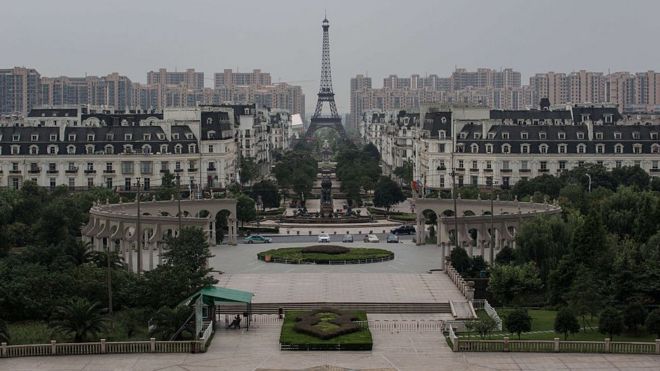 Image copyright GUILLAUME PAYEN / GETTY
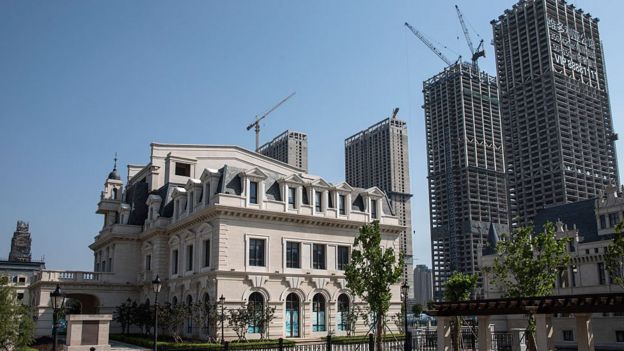 Image copyright THIERRY FALISE / GETTY
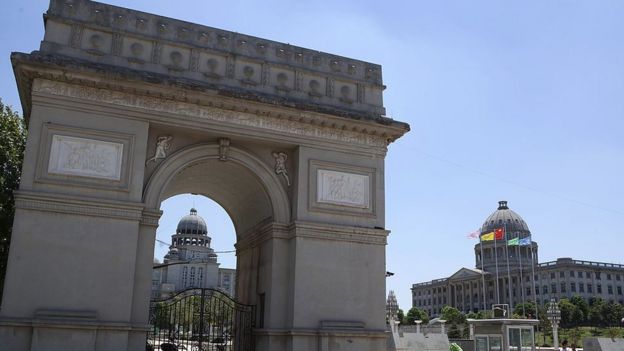 Image copyright STR / AFP / GETTY
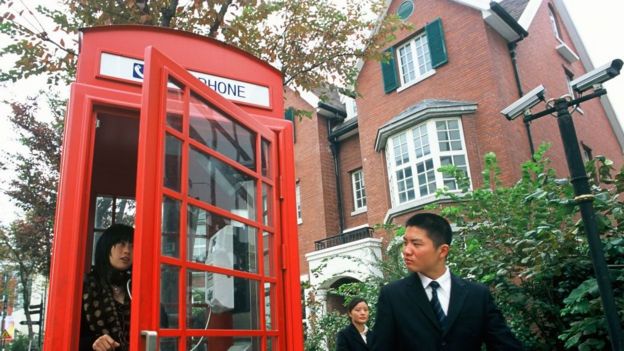 Image copyright OLIVIER CHOUCHANA / GETTY
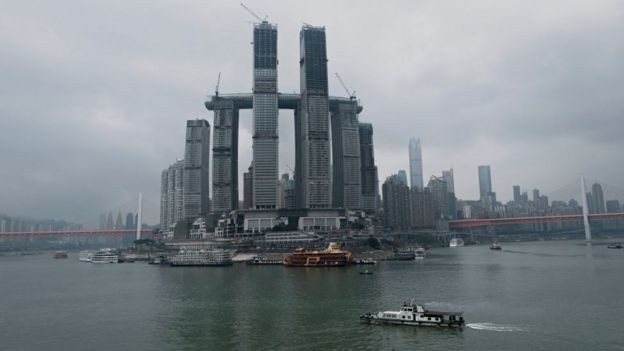 Image copyright WANG ZHAO / GETTY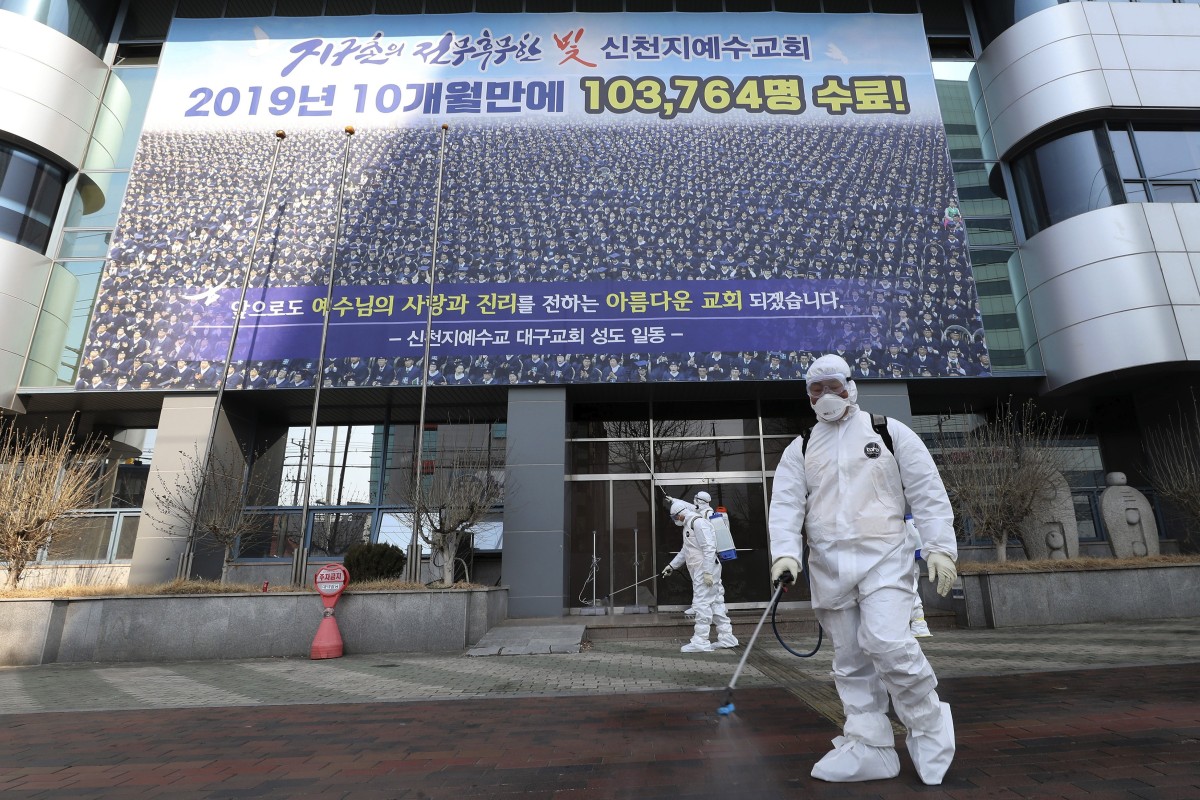







 CHINDIA ALERT: You'll be living in their world, very soon