

 Image copyright GETTY IMAGES
India’s Supreme Court has reversed one of its previous judgements that was criticised for “diluting” protections to lower castes.
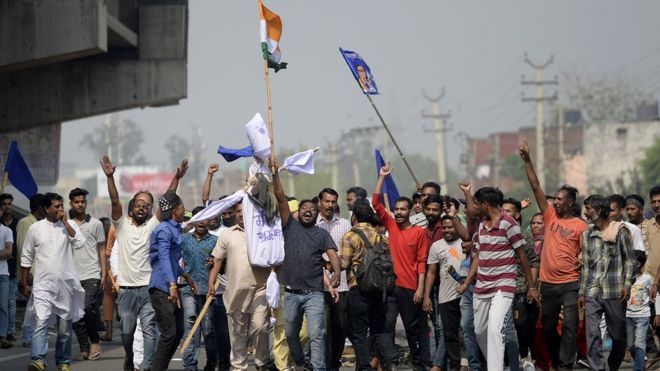
The earlier ruling on the Scheduled Caste and Scheduled Tribe (Prevention of Atrocities) Act, known as the SC/ST Act, had fuelled mass protests.
Tuesday’s judgement came after the federal government asked the top court to review its original decision.
Caste violence continues to be a massive problem in the country.
More than 40,000 crimes against lower castes were reported in 2016 alone, according to official statistics.
Huge caste protests against the judgment last year saw a number of people killed after the demonstrations turned violent.
In its ruling, the court had stopped instant arrests and the automatic registration of criminal cases under the law. Critics said at the time that the decision would pave the way for officials to turn a blind eye to caste atrocities. They also warned that this would lead to increased violence against lower castes.
What is the SC/ST Act?
The Scheduled Caste and Scheduled Tribe (Prevention of Atrocities) Act, 1989 was brought into law to prevent crimes against people belonging to lower castes and tribes in India.
The act was passed as it was felt that the existing legal framework did not provide adequate protection to lower castes.
The law allows for instant arrests, severely limits opportunities for bail and the automatic registration of criminal cases against anyone accused of committing an offence against a member of a lower caste or tribe.
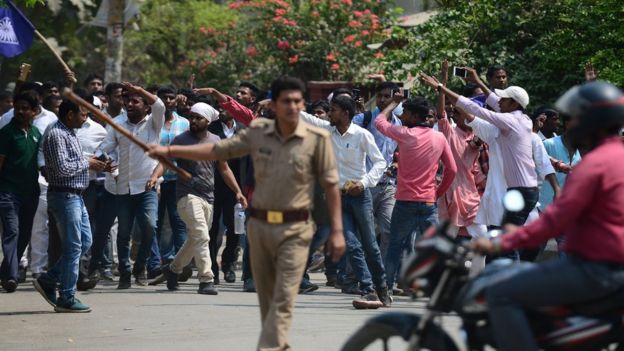 Image copyright AFP
It also prescribes several other stringent measures such as the attachment and forfeiture of the property of an accused.
The act also allows public servants to be prosecuted for neglect of duties – a significant step given that many lower caste people allege that their complaints were often ignored by officials who belonged to the same communities as those they were accusing.
It was amended in 2015 to cover newer forms of discrimination and crimes against lower caste communities.
Why do Dalits need protection?
Dalits are some of India’s most downtrodden citizens because of an unforgiving Hindu caste hierarchy that condemns them to the bottom of the ladder.
Despite laws that protect them, discrimination remains a daily reality for the Dalit population, thought to number around 200 million.
Traditionally, they have been segregated from the upper castes and are not allowed to attend the same temples, schools or even drink from the same cups as upper caste people. They do not get equal access to education or jobs, and are often victims of exploitation, abuse and violence.
- Indian men ‘beaten up over moustaches’
- India woman fights family over ‘low caste’ husband’s murder
- What is India’s caste system?
Lately, activists say that rising aspirations among young Dalits have improved their lives, but this has also increased violence against them by upper caste community members who are unable to accept this.
Source: The BBC



 CHINDIA ALERT: You'll be living in their world, very soon