Chindia Alert: You’ll be Living in their World Very Soon
aims to alert you to the threats and opportunities that China and India present. China and India require serious attention; case of ‘hidden dragon and crouching tiger’.
Without this attention, governments, businesses and, indeed, individuals may find themselves at a great disadvantage sooner rather than later.
The POSTs (front webpages) are mainly 'cuttings' from reliable sources, updated continuously.
The PAGEs (see Tabs, above) attempt to make the information more meaningful by putting some structure to the information we have researched and assembled since 2006.
Countries must respect each others’ systems and be wary of US political forces who want to ‘hijack relations’, Wang tells press conference at ‘two sessions’
Beijing is not looking for confrontation and wants to work with Washington to fight coronavirus, minister says
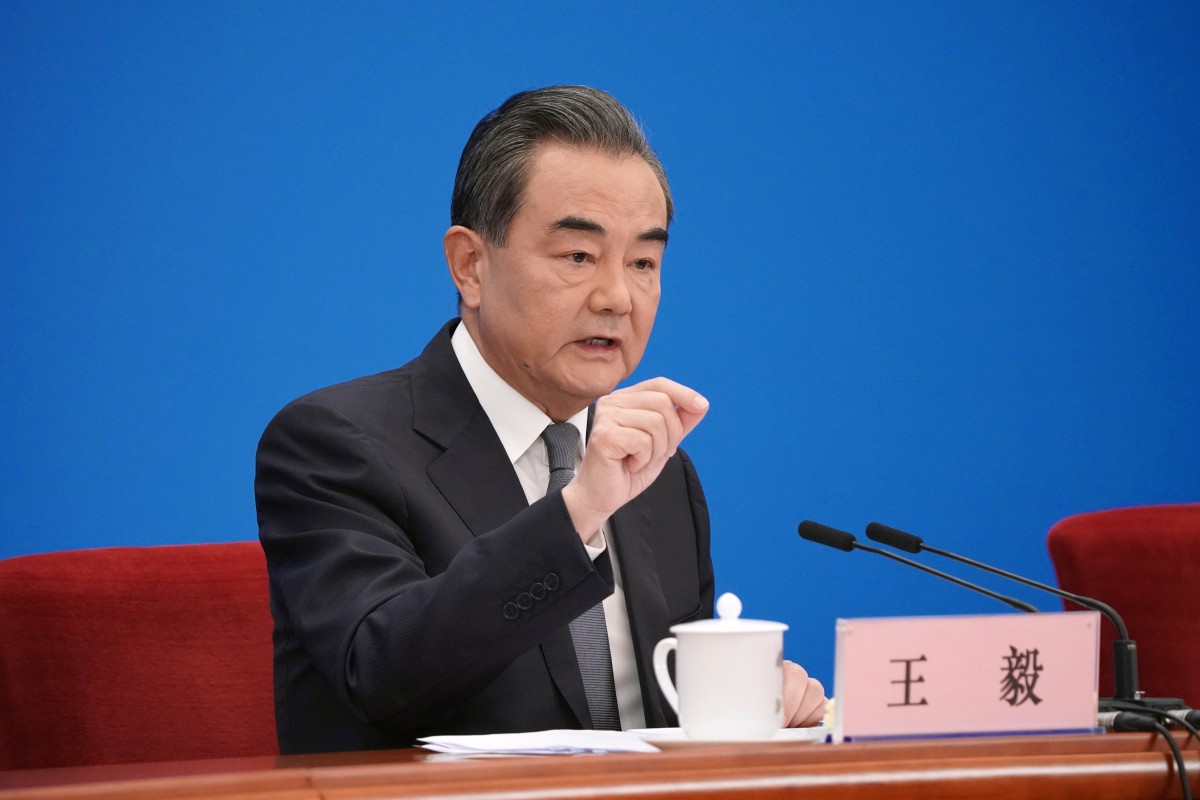
Foreign Minister Wang Yi said China did not want to replace or change the US. Photo: Xinhua
China and the US should try to avoid a new cold war and find new ways to cooperate despite their differences, China’s Foreign Minister Wang Yi said on Sunday.
“We need to be alert to efforts by some political forces in America to hijack China-US relations and who try to push the two countries towards a so-called ‘new cold war’.
“This is a dangerous attempt to turn back the course of history,” Wang told a press conference on the sidelines of the annual parliamentary meetings known as the ‘two sessions’.
Ties between the two countries have further worsened due to escalating tensions over the handling of the Covid-19 pandemic.
Voices calling for decoupling have been on the rise in the US, with some arguing that the two countries are edging towards a new cold war akin to that against the Soviet Union.
Wang called for the two countries to respect each other’s political systems and to find a way to get along despite their differences.
The two nations should step up cooperation on global pandemic control, and coordinate on macro policies to deal with the economic impact.
“China has no intention of changing the United States, much less replacing it. The US should give up the wishful thinking that it can change China.”
“For the benefit of the two peoples, as well as the future and well-being of humankind, China and the US should and must find a way to coexist peacefully despite the differences in system and cultures of the two societies.”
Wang said China will not seek confrontation with the United States, but China is determined to protect its sovereignty, territorial integrity and development.
TAIPEI (Reuters) – China accused the United States on Thursday of playing a dangerous game with its support for Taiwan, after a U.S. warship passed through the sensitive Taiwan Strait following heightened military tension between China and Taiwan.
China has been angered by the Trump administration’s stepped-up support for the island it considers its own, such as more arms sales, U.S. patrols near Taiwan and last month’s visit to Washington by Taiwan Vice President-elect William Lai.
Anthony Junco, a spokesman for the U.S. Seventh Fleet, said the guided-missile destroyer USS McCampbell conducted “a routine Taiwan Strait transit” on March 25, in line with international law.
“The ship’s transit through the Taiwan Strait demonstrates the U.S. commitment to a free and open Indo-Pacific,” he added. “The U.S. Navy will continue to fly, sail and operate anywhere international law allows.”
Taiwan’s defence ministry said the ship sailed north through the waterway and was monitored by Taiwan’s armed forces, on what it called an “ordinary mission”, adding there was no cause for alarm.
In Beijing, Chinese defence ministry spokesman Ren Guoqiang denounced “continued negative actions” by the United States on Taiwan, including sailings through and flights over the Taiwan Strait.
“U.S. moves have seriously interfered in China’s internal affairs, severely harmed peace and stability in the Taiwan Strait and poisoned Sino-U.S. military ties,” Ren told a monthly news conference.
The actions were “extremely dangerous”, he added.
Taiwan is China’s most sensitive territorial and diplomatic issue and Beijing has never ruled out the use of force to bring the island under its control. The narrow Taiwan Strait that separates the island from China is a frequent source of tension.
In recent weeks China’s air force has conducted several exercises close to Taiwan, prompting its mostly U.S.-equipped military to scramble fighters to intercept and warn away the Chinese aircraft.
Taiwan has called the drills provocative, and urged China to pay more attention to fighting a coronavirus pandemic, rather than menace it.
The United States, like most countries, has no official relations with Taiwan, but is the island’s most important international supporter and main source of arms.
In January another U.S. warship sailed through the Taiwan Strait less than a week after President Tsai Ing-wen won re-election by a landslide on a platform of standing up to China.
MUNICH (Reuters) – Germany’s president took an indirect swipe at U.S. President Donald Trump on Friday in accusing Washington, China and Russia of stoking global mistrust and insecurity with a “great powers” competition” that could threaten a new nuclear arms race.
In opening remarks at the annual Munich Security Conference, German President Frank-Walter Steinmeier deplored the three big powers’ approach to global affairs and, without naming Trump, took issue with his vow to “make America great again”.
“‘Great again’ – even at the expense of neighbours and partners,” quipped Steinmeier, a former Social Democrat foreign minister whose comments on foreign policy carry authority.
As foreign minister in 2014, he was central to the so-called “Munich consensus” when German leaders said Berlin was ready to assume more responsibility in global affairs. Steinmeier pressed that point again on Friday, but not before bemoaning the foreign policy approaches of Russia, China and the United States.
“Russia…has made military force and the violent shifting of borders on the European continent the means of politics once again,” he said in the text of a speech for delivery at the opening of the conference.
“China…accepts international law only selectively where it does not run counter to its own interests,” Steinmeier said.
“And our closest ally, the United States of America, under the present administration itself, rejects the idea of an international community.”
The upshot is “more mistrust, more armament, less security…all the way to a new nuclear arms race,” he said.
In response, he said, Germany should raise defence spending to contribute more to European security and to maintain its alliance with the United States, recognising that U.S. interests were gravitating away from Europe toward Asia.
He also called for a European policy towards Russia “that is not limited to condemning statements and sanctions alone”.
Europe, he added, “must find its own balance with China between intensifying competition between systems and the need for cooperation.”
NEW DELHI (Reuters) – Indian Prime Minister Narendra Modi called on the nation to work toward ending the consumption of single-use plastics by 2022, in a speech on Wednesday.
“Hygiene, protection of environment and protection of life were of keen interest to Gandhi,” said Modi, speaking on the anniversary of the freedom movement leader’s birth. “Plastic is dangerous to all these three goals. So we need to reach the goal of ending single-use plastic by 2022.”
Meanwhile, India held off a plan to impose a blanket ban on single-use plastics as it was seen as a measure too disruptive for industry at a time when India is dealing with an economic slowdown and job losses, officials told Reuters on Tuesday.
In a tweet on Wednesday, India’s environment ministry however, denied that it had planned to issue a ban.
“India, today is on the verge of starting a historic movement against #SingleUsePlastic, setting an example for the world. At such a time, discovering a shelved ban, when none was planned is indeed misleading & doesn’t do justice to its fight against single use plastic,” the ministry said in a tweet.
Reuters had in August reported that India was set to impose a nationwide ban on plastic bags, cups and straws on Oct. 2, in a sweeping measure to stamp out single-use plastics from cities and villages that rank among the world’s most polluted.
Concerns are growing worldwide about plastic pollution, especially in oceans, where nearly 50% of single-use plastic products end up, killing marine life and entering the human food chain, studies have shown.
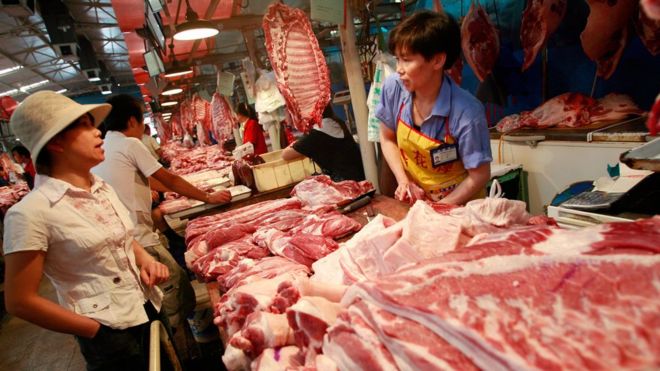
China is set to release pork supplies from its central reserves as it moves to tackle soaring prices and shortages caused by an outbreak of swine fever.
A state-backed body will auction 10,000 tonnes of frozen pork from its strategic reserves on Thursday.
China, the world’s biggest producer and consumer of pork, has struggled to control the spread of the disease.
In a bid to stabilise prices, a state-backed group that manages the pork reserves will auction imported frozen pork from countries including Denmark, France, the US and UK.
Only 300 tonnes will be sold to each bidder at the auction.
Pork is used widely in Chinese festivals, and the auction comes as the country prepares to celebrate a week-long national holiday for the 70th anniversary of the People’s Republic of China.
Julian Evans-Pritchard, senior China economist at Capital Economics, said the auction would provide slight relief to the industry but would not do much to contain prices.
“In itself, I don’t think it will be able to prevent pork prices from rising further unless they manage to get the disease under control,” he said.
Beijing created its strategic pork reserve in 2007 but the size of the stockpile is not known.
Capital Economics estimates that at most, the stockpile would hold four days’ worth of pork supplies to feed China.
About 1.2 million pigs have been culled in China in an effort to halt the spread of swine fever since August 2018, according to data from the Food and Agriculture Organization, a UN agency.
In April, Rabobank estimated Chinese pork production would fall by up to 35% this year due to swine fever.
The supply shortage has sent pork prices soaring and has eaten into household incomes.
That poses a fresh challenge for the Chinese economy, which is already facing a slowdown and a trade war between Beijing and Washington.



 CHINDIA ALERT: You'll be living in their world, very soon