Archive for ‘death toll’

06/04/2020

South Korea reports fewer than 50 new coronavirus cases

SEOUL (Reuters) – South Korea reported fewer than 50 new coronavirus cases for the first time since its peak at the end of February as daily infections in Asia’s largest outbreak outside China continued to trend downward.

The Korea Centers for Disease Control and Prevention (KCDC) said on Monday there were 47 new infections as of midnight on Sunday compared with 81 recorded a day earlier, taking the national cumulative tally to 10,284.

The death toll rose by three to 186, while another 135 people have recovered from the virus for a total of 6,598.

South Korea has largely managed to bring the epidemic under control for now, with around 100 or fewer new daily cases for the past month, but it was the first time the rate of daily cases dropped below 50 since 909 were reported on Feb. 29.

But officials urged even greater vigilance, saying a large epidemic could reemerge at any time, with smaller outbreaks in churches, hospitals and nursing homes, as well as infections among travellers, continuing to arise.

A fall in daily demand for tests to some 6,000 from around 10,000 over the weekend contributed to the decline in numbers, Vice Health Minister Kim Gang-lip said.

“We are taking great caution against any optimistic expectations with this one-off figure,” he told a regular briefing.

BREAKING OUT OF ISOLATION

On Saturday, the government extended its intensive social distancing campaign by two weeks, citing sustained infections among small clusters and travellers.

South Koreans had refrained from socialising in February when the number of patients exponentially rose, but more people started going out recently as the weather became warmer and fatigue grew about social distancing, Kim said.

The movement of citizens spiked about 20% over the weekend compared to the end of February, he said, citing data from the state-run statistics agency and SK Telecom, the country’s largest mobile operator.

Starting Sunday, the government toughened penalties for those who violate self-quarantine rules to up to 10 million won ($8,100) in fines or one year in prison from 3 million won ($2,400) in fines.

Authorities have reported several cases of breaching quarantine rules over the past few days. The Gunpo city government south of Seoul said on Sunday it has filed a complaint with police against a couple in their 50s and their children who broke away from isolation and went out even after testing positive for the virus.

A Korean student residing in the United States sparked public uproar after taking fever remedy before flying home late last month. The student was found to have contracted the virus, putting some 20 other people who took the same flight in self quarantine.

“We cannot maintain social distancing for ever,” Kim said. “But it is the most effective measure to help protect others and yourself.”

Source: Reuters

27/03/2020

U.S. has most coronavirus cases in world, next wave aimed at Louisiana

NEW YORK (Reuters) – The number of U.S. coronavirus infections climbed above 82,000 on Thursday, surpassing the national tallies of China and Italy, as New York, New Orleans and other hot spots faced a surge in hospitalizations and looming shortages of supplies, staff and sick beds.

With medical facilities running low on ventilators and protective masks and hampered by limited diagnostic testing capacity, the U.S. death toll from COVID-19, the respiratory disease caused by the virus, rose beyond 1,200.

“Any scenario that is realistic will overwhelm the capacity of the healthcare system,” New York Governor Andrew Cuomo told a news conference. He described the state’s projected shortfall in ventilators – machines that support the respiration of people have cannot breathe on their own – as “astronomical.”

“It’s not like they have them sitting in the warehouse,” Cuomo added. “There is no stockpile available.”

At least one New York City hospital, New York-Presbyterian/Columbia University Medical Center in Manhattan, has begun a trial of sharing single ventilators between two patients.

While New York was the coronavirus epicenter in the United States this week, the next big wave of infections appeared headed for Louisiana, where demand for ventilators has already doubled. In New Orleans, the state’s biggest city, Mardi Gras celebrations late last month are believed to have fueled the outbreak.

Louisiana Governor John Bel Edwards said New Orleans would be out of ventilators by April 2 and potentially out of bed space by April 7 “if we don’t flatten the infection curve soon.”

“It’s not conjecture, it’s not some flimsy theory,” Edwards told a press conference. “This is what is going to happen.”

About 80% of Louisiana’s intensive care patients are now on breathing machines, up from the normal rate of 30-40%, said Warner Thomas, chief executive of Ochsner Health System, the state’s hospital group.

Scarcities of protective masks, gloves, gowns and eyewear for doctors and nurses – reports abound of healthcare workers recycling old face masks, making their own or even using trash bags to shield themselves – have emerged as a national problem.

“Our nurses across the country do not have the personal protective equipment that is necessary to care for COVID patients, or any of their patients,” Bonnie Castillo, head of the largest U.S. nurses union, National Nurses United, told MSNBC.

In an ominous milestone for the United States as a whole, at least 82,153 people nationwide were infected as of Thursday, according to a Reuters tally from state and local public health agencies. China, where the global pandemic emerged late last year, had the second highest number of cases, 81,285, followed by Italy with 80,539.

At least 1,204 Americans have died from COVID-19, which has proven especially dangerous to the elderly and people with underlying chronic health conditions, Reuters’ tally showed.

MORE BEDS NEEDED

For New York state, Cuomo said a key goal was rapidly to expand the number of available hospital beds from 53,000 to 140,000.

New York hospitals were racing to comply with Cuomo’s directive to increase capacity by at least 50%. At Mount Sinai Hospital’s Upper East Side location, rooms were being constructed within an atrium to open up more space for beds.

At Elmhurst Hospital in New York’s borough of Queens, about a hundred people, many wearing masks with their hoods pulled up, lined up behind barriers outside the emergency room entrance, waiting to enter a tent to be screened for the coronavirus.

The city coroner’s office has posted refrigerated trucks outside Elmhurst and Bellevue Hospital to temporarily store bodies of the deceased.

Deborah White, vice chair of emergency medicine at Jack D. Weiler Hospital in the city’s Bronx borough, said 80% of its emergency room visits were patients with coronavirus-like symptoms.

A ventilator shortfall and surge in hospitalizations has already raised the prospect of rationing healthcare.

Asked about guidelines being drafted on how to allocate ventilators to patients in case of a shortage, New Jersey Governor Phil Murphy told reporters such bioethical discussions “haunted him” but were unavoidable.

Outside New York and New Orleans, other hot spots appeared to be emerging around the country, including Detroit.

Brandon Allen, 48, was buying groceries in Detroit for his 72-year-old mother, who has tested positive and was self-quarantining at home.

“It’s surreal,” Allen said. “People around me I know are dying. I know of a couple people who have died. I know a couple of people who are fighting for their lives. Everyday you hear of another person who has it.”

RECORD UNEMPLOYMENT CLAIMS

Desperate to slow virus transmissions by limiting physical contact among people, state and local governments have issued stay-at-home orders covering about half the U.S. population. A major side effect has been the strangulation of the economy, and a wave of layoffs.

The U.S. Labor Department reported Thursday the number of Americans filing claims for unemployment benefits last week soared to a record of nearly 3.28 million – almost five times the previous weekly peak of 695,000 during the 1982 recession.

Dr. Anthony Fauci, director of the U.S. National Institute of Allergy and Infectious Diseases, said warmer weather may help tamp down the U.S. outbreak as summer approaches, though the virus could re-emerge in the winter.

“We hope we get a respite as we get into April, May and June,” Fauci said on WNYC public radio.

Washington state Governor Jay Inslee said he may extend a stay-at-home order tentatively set to expire April 6, encouraged by what he called a “very modest improvement” in the Seattle area.

Washington experienced the first major U.S. outbreak of COVID-19 and has been among the hardest-hit states. As of Thursday the state reported about 3,200 cases and 147 deaths.

In California’s Coachella Valley, a region rife with retirees who are especially vulnerable, 25 members of the state’s National Guard helped a non-profit distribute food to people stuck in their homes, as most of the regular volunteers are senior citizens.

More than 10,000 troops have been deployed in 50 states to provide humanitarian aid during the pandemic.

Source: Reuters

24/03/2020

WHO chief calls for aggressive tactics as coronavirus cases soar across the world

  • ‘Aggressive and targeted’ tactics needed to curb spread of Covid-19 as more than 100,000 new infections recorded in just four days
  • Global political commitment and coordination needed to halt trajectory, agency chief says
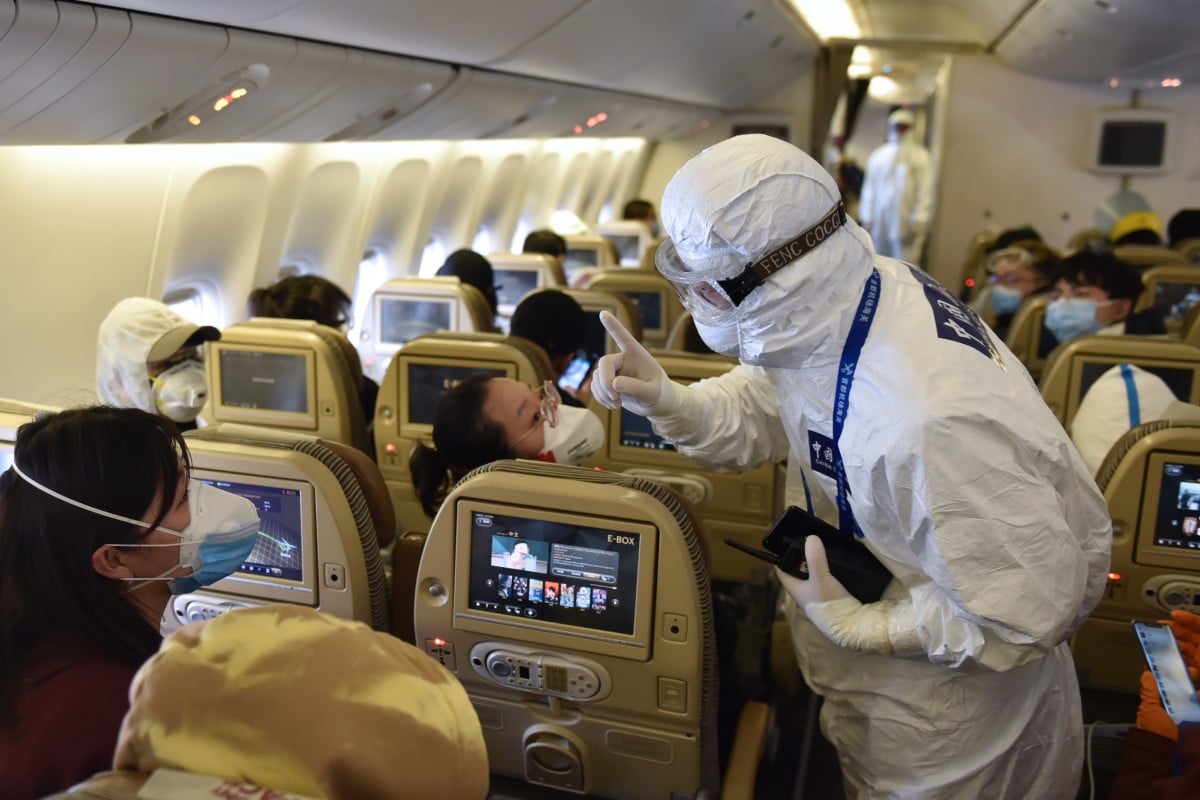
A customs officer speaks to passengers on board an inbound flight at Beijing Capital International Airport. Photo: Xinhua
The World Health Organisation has warned that the Covid-19 pandemic is accelerating, calling for “aggressive and targeted tactics” to curb its spread after more than 100,000 new infections were recorded in just four days.
The warning, by the UN agency chief Tedros Adhanom Ghebreyesus, came as the number of deaths from the disease, caused by the new coronavirus, continued to rise, and as mainland China reported a doubling in new cases.
The outbreak, which was first reported in December in China, is rapidly spreading across the globe. Tedros said it had taken 67 days from the first reported case to the first 100,000 infections, and just 11 days for the number to soar to the second 100,000.

“[It was] just four days for the third 100,000 cases. You can see how the virus is accelerating,” he said on Tuesday.

“But we’re not prisoners to statistics. We’re not helpless bystanders. We can change the trajectory of this pandemic.”

China’s National Health Commission reported 74 imported coronavirus infections on Monday – the highest since March 4, when it began including data on such cases and noted two infections that had originated abroad.

They bring the total number of imported cases on the mainland to 427, as of Monday. The total number of infections there now stands at 81,171, and the death toll has risen to 3,277, with seven new fatalities.

Tedros said political commitment and coordination at the global level were needed to stop the spread, but warned against using untested medicines, saying they could raise false hope.

“To win, we need to attack the virus with aggressive and targeted tactics – testing every suspected case, isolating and caring for every confirmed case, and tracing and quarantining every close contact,” he said.

Italy’s number of new Covid-19 cases dropped to a five-day low on Monday, easing the strain on overstretched hospitals, but the situation in Spain continued to worsen.

Italian health authorities announced 4,789 new cases on Monday, a drop from 5,560 on Sunday and 6,557 on Saturday. Spanish authorities announced 462 deaths on Monday, the country’s worst day since the start of the epidemic.

Italy has a glimpse of hope as new coronavirus cases drop to a 5-day low

24 Mar 2020

The British government said on Monday that another 54 people had died in the previous 24 hours after testing positive for the coronavirus, raising the country’s deaths from the pandemic to 335. The number of confirmed cases in Britain rose to 6,650 on Monday, from 5,683 on Sunday.

Mainland China officials have said the risk facing the nation was to contain imported infections. Among the new imported infections, 31 were recorded in Beijing, 14 in Guangdong and nine in Shanghai.

Beijing has stepped up measures to contain imported infections, diverting all arriving international flights from Monday to other cities, including Shanghai and as far west as Xian, where passengers will undergo virus screening.

Guangzhou also requires all travellers to the city, except for those from Hong Kong, Macau and Taiwan, to undergo the coronavirus test. Beijing has required the test for incoming travellers with symptoms and epidemic history.

The coastal province of Zhejiang, near Shanghai, will also put all arrivals from overseas in centralised quarantine facilities for 14 days, according to media reports.

Source: SCMP

01/02/2020

Britain pulls embassy staff, families from China as coronavirus spread

  • The decision, which follows a similar move by the US this week, came as the death toll from the outbreak soared to 259
  • Health officials on Friday confirmed the first cases in the UK after two people tested positive for the virus
A coach carrying British nationals evacuated from Wuhan arrives at the Arrowe Park Hospital in Wirral, near Liverpool in northwest England. Photo: AFP
Britain on Saturday said it was temporarily withdrawing some staff and their families from its diplomatic sites in China, as Beijing struggles to contain the nationwide new

coronavirus

epidemic.

The decision, which follows a similar move by the United States this week, came as the death toll from the outbreak soared to 259 and the total number of cases neared 12,000 within China.
The Sars-like virus has also begun to spread around the world, with more than 100 infections reported in more than 20 countries.

“We are committed to ensuring the safety and well-being of our staff and their families,” a spokesman for the British Foreign Office said.

“We are therefore temporarily withdrawing some UK staff, and their dependents from our embassy and consulates in China.”

He added that Britain’s ambassador in Beijing and staff needed to continue critical work will remain, and that British nationals in China would still have access to constant consular assistance.

The US, which on Friday temporarily banned the entry of foreign nationals, who had travelled to China over the past two weeks, has also made similar changes.

Two people in UK test positive for coronavirus

31 Jan 2020

On Wednesday, it authorised the departure of non-emergency government employees and their family members from its offices in Beijing, Chengdu, Guangzhou, Shanghai, and Shenyang.

And on Friday, it ordered all relatives of staff members under the age of 21 to leave China immediately.

A spokesman for the US Embassy in Beijing said it made the decision “out of an abundance of caution related to logistical disruptions stemming from restricted transportation and overwhelmed hospitals related to the novel coronavirus”.

Coronavirus outbreak: global businesses shut down operations in China
British health officials on Friday confirmed the first cases in the UK, after two members of the same family tested positive for the virus.

One of the two individuals is a student at the University of York, a university spokesman said on Saturday.

Also on Friday, 83 British citizens returned on a UK government-chartered flight from Wuhan, the Chinese city at the centre of the epidemic.

They were immediately taken to a hospital in northwest England for a two-week quarantine.

Source: SCMP

11/08/2019

Death toll from typhoon in eastern China rises to 30 as storm moves north

SHANGHAI (Reuters) – The death toll from a major typhoon in eastern China rose to 30 on Sunday, with 18 people missing, state broadcaster CCTV reported, as the country braced for more travel disruptions as the storm moved further north up the coast.

Typhoon Lekima made landfall early on Saturday in the eastern province of Zhejiang with winds gusting to 187 km (116 miles) per hour, causing travel chaos with thousands of flights canceled and rail operations suspended.

The typhoon damaged more than 173,000 hectares of crops and 34,000 homes in Zhejiang, provincial authorities said in estimating the economic losses at 14.57 billion yuan ($2 billion), the state news agency Xinhua said.

Lekima, China’s ninth typhoon of this year, is expected to make a second landing along the coastline in Shandong province, prompting more flight cancellations and the closure of some expressways, Xinhua and state broadcaster CCTV said.

In Zhejiang, many of the deaths occurred about 130 km north of the coastal city of Wenzhou, where a natural dam collapsed in an area deluged with 160 mm (6.3 inches) of rain within three hours, causing a landslide, Xinhua reported.

State media reports showed rescuers wading in waist-high waters to evacuate people from their homes, while the Ministry of Emergency Management said that more than one million people in the financial hub of Shanghai, as well as Zhejiang and Jiangsu provinces, have been evacuated due to the typhoon.

An estimated 3,200 flights were canceled, state broadcaster CCTV reported, although some suspensions on high-speed railway lines were lifted on Sunday.

Source: Reuters

07/07/2019

China’s Sichuan earthquake death toll rises to 12, with 134 injured

  • Authorities report roads closed and 10,000 buildings damaged after magnitude 6.0 quake on Monday night
  • More than 100,000 people affected
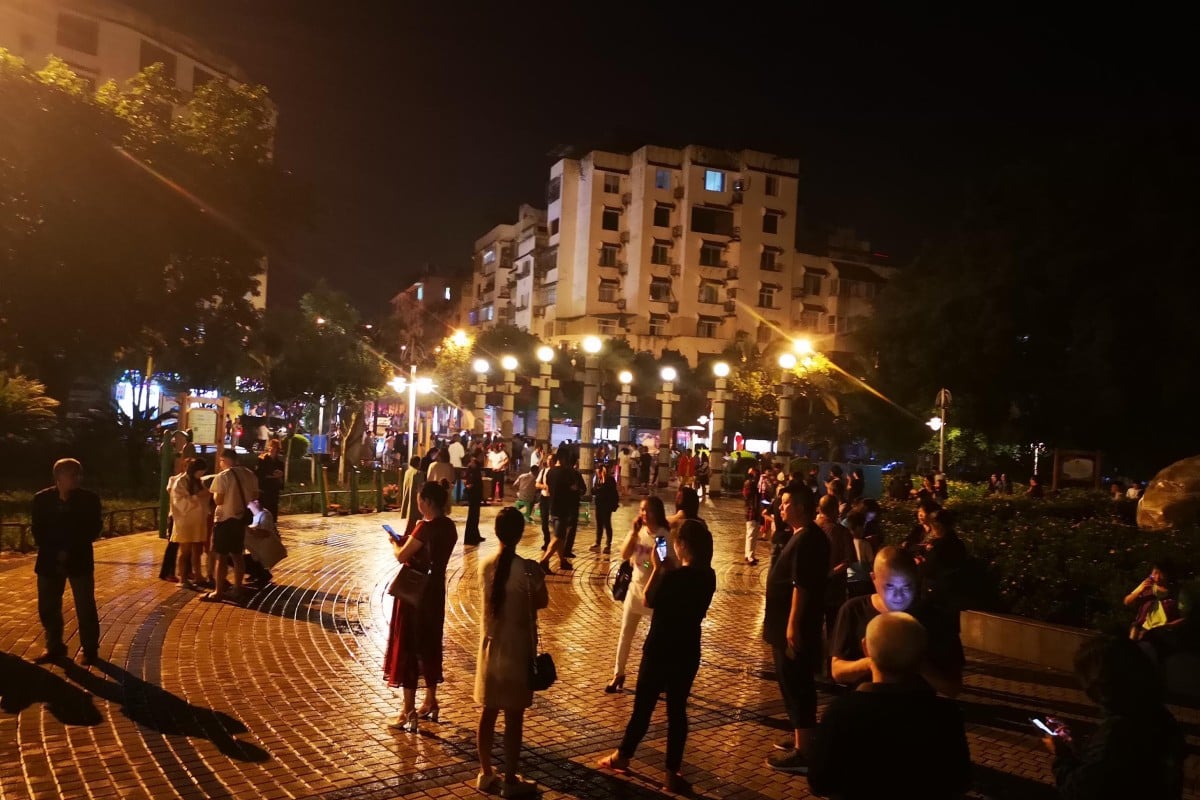
Residents gather in the open in Changning county on Monday night after a magnitude 6.0 hit the area. Photo: Xinhua
The death toll from a strong earthquake which hit the southern Chinese province of Sichuan late on Monday night has risen to 12, with 134 people injured.
More than 100,000 people were affected – mostly in the epicentre at Changning county in Yibin, while more than 10,000 buildings were damaged, according to a statement by the local government on Tuesday.
Land subsidence and a landslide caused by the magnitude 6.0 quake, blocked a highway, several major roads and numerous village roads, the statement said, while a major bridge in the area was also at risk.
The Yixu highway in Changning had been closed and authorities were assessing the Dongdi Bridge. The Yibin government statement also said workers had been sent to clear the affected village roads.

According to the US Geological Survey, the earthquake was centred at a fairly shallow depth of 10km (6 miles). Shallow earthquakes tend to cause more damage to buildings and infrastructure.

An aftershock measuring magnitude 5.2 later hit the same area, the USGS said.

More than 300 firefighters were sent to the scene overnight, as well as rescue personnel with 5,000 tents, 10,000 folding cots and other emergency supplies, according to state news agency Xinhua.

In 2008, China’s worst earthquake in recent years struck the mountainous western portion of Sichuan province, leaving 87,000 dead, 370,000 injured and 5 million people homeless. That earthquake was about 400km (249 miles) from Monday’s earthquake.

A 1976 earthquake centred in the northeastern city of Tangshan killed at least 250,000 people.

Source: SCMP

22/03/2019

China chemical blast death toll rises to 47

The death toll in a huge blast at a chemical plant in eastern China has jumped to 47, with 90 badly injured, according to state news agency Xinhua.

The powerful explosion followed a fire at the factory which produces fertiliser.

China’s earthquake administration reported a tremor equivalent to 2.2-magnitude at the time of the blast.

The death toll makes it one of the country’s worst industrial accidents in recent years.

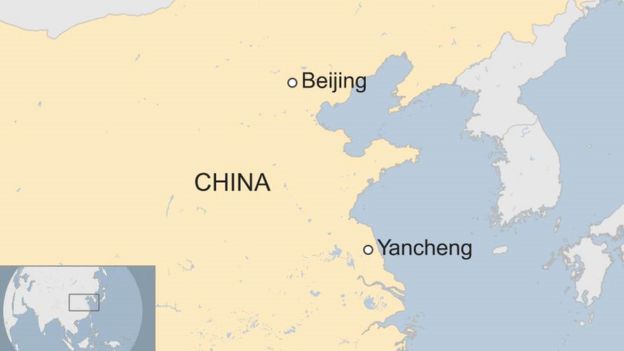
The blast happened at about 14:50 local time (06:50 GMT) on Thursday at a plant in Yancheng, run by Tianjiayi Chemical.

According to Xinhua, a total of 640 people were sent to hospital. Many were in critical condition and dozens had severe injuries, the agency reports.

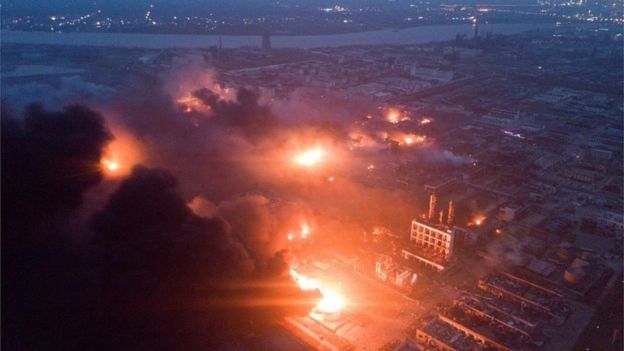
Overhead view of the Tianjiayi Chemical plant on fire with smoke billowingImage copyrightREUTERS
Image captionThe scale of the destruction is clear
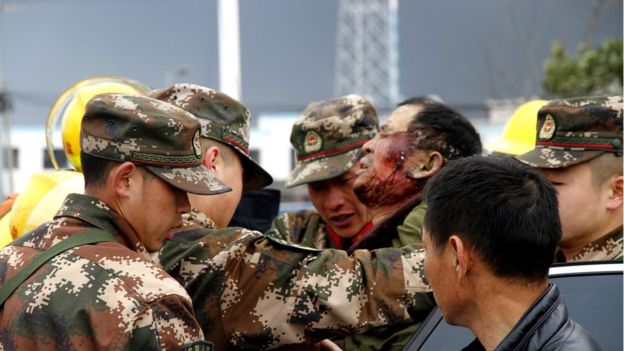
Armed police officers carry an injured man after an explosion at a chemical industrial parkImage copyrightGETTY IMAGES
Image captionHundreds were injured in the explosion, which was reportedly started by a fire at the plant

Images of the site showed a fireball exploding, billowing clouds enveloping the area, injured people, and damage to buildings.

The blast was so powerful that it knocked down factory buildings some distance away, trapping workers, according to local media.

Staff at the Henglida Chemical Factory, 3km (1.8 miles) from the explosion, said its roof collapsed as they fled, and windows and doors were blown out.

Provincial authorities said firefighters had to be brought in from across the province.

The fire was brought under control at around 03:00 local time on Friday, state TV said.

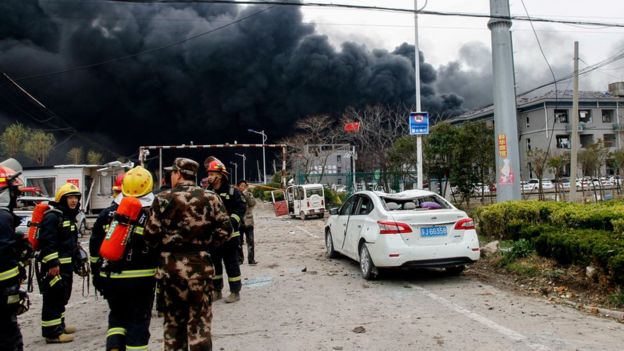
Police at the site of the explosionImage copyrightGETTY IMAGES
Image captionThe cause of the accident is under investigation

One woman, who gave her surname as Xiang, said she had been concerned about safety and pollution levels at the plant for some time.

“We knew we’d be blown up one day,” said told AFP.

Reuters quoted local officials as saying there had been no abnormalities detected at the site before the blast, but that the province would be conducting emergency inspections of other chemical producers and warehouses.

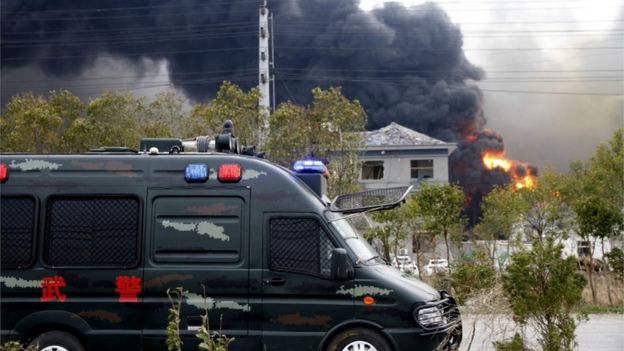
A police van in front of a house with blown out windows, the factory on fire in the background, in Yancheng, ChinaImage copyrightREUTERS
Image captionThe blast blew out windows of buildings across a wide area

Industrial accidents ranging from factory fires to mining disasters are common in China, often due to poorly enforced safety standards.

The biggest accident in recent years was the August 2015 Tianjin explosion, which killed more than 160 people and injured nearly 1,000.

The exact cause of Thursday’s explosion is still under investigation. Tianjiayi Chemical, founded in 2007, has received six government penalties in the past over waste management and air pollution, according to the South China Morning Post.

President Xi Jinping has called for an “all-out effort” to aid the injured and said authorities must learn lessons from the blast prevent future accidents.

Yancheng, China

Source: The BBC

Law of Unintended Consequences

continuously updated blog about China & India

ChiaHou's Book Reviews

continuously updated blog about China & India

What's wrong with the world; and its economy

continuously updated blog about China & India