Chindia Alert: You’ll be Living in their World Very Soon
aims to alert you to the threats and opportunities that China and India present. China and India require serious attention; case of ‘hidden dragon and crouching tiger’.
Without this attention, governments, businesses and, indeed, individuals may find themselves at a great disadvantage sooner rather than later.
The POSTs (front webpages) are mainly 'cuttings' from reliable sources, updated continuously.
The PAGEs (see Tabs, above) attempt to make the information more meaningful by putting some structure to the information we have researched and assembled since 2006.
Malfunction happened during third stage of launch after earlier stages were completed successfully, state media says
Failed mission is second in less than a month after Long March-7A encountered problems after lift-off on March 16
A Long March-3B carrier rocket blasts off from the Xichang Satellite Launch Centre in Sichuan province in November. A similar launch on Thursday ended in failure. Photo: Xinhua
China’s space programme suffered another setback on Thursday night with its second rocket launch failure in less than a month.
Officials are investigating what caused a malfunction during the third stage of the Long March-3B launch after lift-off from the Xichang Satellite Launch Centre in southwest Sichuan province at 7.46pm with an Indonesian Palapa-N1 satellite, Xinhua reported.
“The first and second stages of the rocket performed well, but the third stage malfunctioned,” the report said.
“Debris from the third stage of the rocket and the satellite fell [to the ground]. The launch mission failed.”
Debris from the failed mission rained down over Guam on Thursday night. Photo: Twitter
China’s state media did not say where the rocket landed, but the office of Guam Homeland Security and Civil Defence said “a fiery object over the Marianas sky” observed on Thursday evening was likely connected to the failed launch.
Video footage of the burning debris falling from the sky was widely circulated on social media.
The setback follows another failed launch on March 16, when China’s new Long March-7A, a three-stage, medium-lift, liquid-fuel rocket, encountered an “abnormality” minutes after lifting off from its launch site in the southern island province of Hainan.
China’s BeiDou system one satellite closer to full operation
11 Mar 2020
The satellite lost on Thursday – the Nusantara 2 – was built in China for Indonesian telecommunication companies Pasifik Satelit Nusantara and Indosat Ooredoo. It was intended to replace an older satellite to provide internet and broadcasting services in Indonesia and across the Asia-Pacific region to Australia, The Jakarta Post reported earlier this month.
It is not known if the failed launch will have an impact on other Long March-3B satellite launches planned for later in the year.
Introduced in 1996, the Long March-3B – also known as the CZ-3B or LM-3B – has been the main orbital carrier rocket of China’s space programme. It was used to carry many of the satellites that make up China’s BeiDou navigation system, with the latest addition being in March.
For that launch, engineers used parachutes to control where the rocket’s boosters would land after being discarded after lift-off so as to minimise the impact on people living below, state media reported.
The latest version of the Long March-3B entered service in 2007 and is dedicated to launching heavy communications satellites of up to 5.5 tonnes into geostationary transfer orbits.
In late September, pictures from a Nasa spacecraft had showed the targeted landing site of the Vikram rover.
Many people had downloaded the image released by Nasa’s Lunar Reconnaissance Orbiter Camera (LROC) team, a statement by the space agency said.
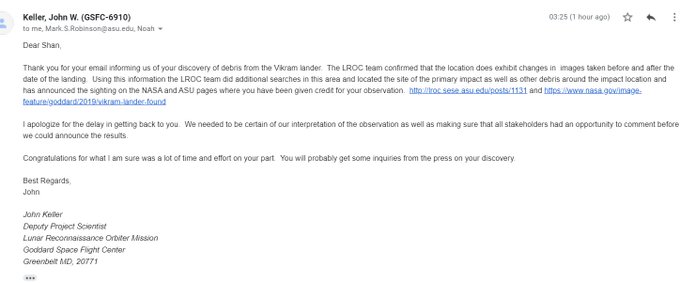
It said after receiving Mr Subramanian’s tip about the location of the debris, the LROC team “confirmed the identification by comparing before and after images”.
Mr Subramanian has tweeted an email sent to him by the space agency congratulating him for his effort.
“We had the images from Nasa [of] the lander’s last location. We knew approximately where it crashed. So I searched pixel-by-pixel around that impact area,” the 33-year-old Chennai-based engineer told BBC Tamil.
Mr Subramanian said he had always “been interested in space” and had watched the July launch of the rocket.
The rover (called Pragyan – wisdom in Sanskrit) had the capacity to travel 500m from the lander in its 14-day life span, and would have sent data and images back to Earth for analysis.
The mission would have focussed on the lunar surface, searching for water and minerals and measuring moonquakes, among other things.
Why would it have been significant?
A soft landing on another planetary body – a feat achieved by just three other countries so far – would have been a huge technological achievement for Isro and India’s space ambitions, says science writer Pallava Bagla.
He adds that it would also have paved the way for future Indian missions to land on Mars, and opened up the possibility of India sending astronauts into space.
For the first time in India’s space history, the interplanetary expedition was led by two women – project director Muthaya Vanitha and mission director Ritu Karidhal.
Media caption Is India a space superpower?
It was also a matter of national pride – the satellite’s lift-off in July was broadcast live on TV and Isro’s official social media accounts.
The mission also made global headlines because it was so cheap – the budget for Avengers: Endgame, for instance, was more than double at an estimated $356m. But this wasn’t the first time Isro has been hailed for its thrift. Its 2014 Mars mission cost $74m, a tenth of the budget for the American Maven orbiter.
HONG KONG (Reuters) – China’s People’s Liberation Army (PLA) soldiers in shorts and t-shirts made a surprising appearance in some Hong Kong streets on Saturday, briefly helping residents clean up debris after anti-government protests blocked roads, witnesses said.
The presence of PLA troops on the streets, even to help clean up roads near their base, could stoke further controversy over the Chinese-ruled territory’s autonomous status.
Hong Kong has been rocked by more than five months of demonstrations by protesters angry at perceived Communist Party meddling in the former British colony, which was guaranteed its freedoms when it returned to Chinese rule in 1997.
Beijing denies interfering and has blamed the unrest on foreign influences.
Clashes between protesters and police have become increasingly violent. China has warned that any attempt at independence for Hong Kong will be crushed, but troops have remained inside their base.
RELATED COVERAGE
China’s PLA soldiers seen helping clean up streets after Hong Kong protests – RTHK
Saturday’s clean up followed some of the worst violence seen this year, after a police operation against protesters at the Chinese University of Hong Kong on Tuesday.
The authorities have since largely stayed away from at least five university campuses that had been barricaded by thousands of students and activists who stockpiled petrol bombs, catapults, bows and arrows and other weapons.
Many protesters appeared to have left the campuses by late Saturday, though some remained behind to man makeshift barricades. Hong Kong’s Cross-Harbour Tunnel was still blocked by protesters occupying Polytechnic University.
Earlier, hundreds of pro-China demonstrators gathered by the city’s legislature and police headquarters, waving Chinese and Hong Kong flags. Some held up posters reading “Police we stand with you”, while others chanted “Support the police”.
Pro-China protests have so far attracted much smaller numbers than those angry at Beijing.
RARE TROOP PRESENCE
By late afternoon, the PLA soldiers had left the streets outside Baptist University, beside their barracks in leafy Kowloon Tong.
Chinese troops have appeared on local streets only once since the 1997 handover, to help with cleanup operations after a typhoon in late 2018. It was not immediately clear how many were involved on Saturday.
Calls to the PLA Hong Kong garrison office and a media liaison officer went unanswered.
Demosistō, a pro-democracy organisation, said Saturday’s cleanup operation could set a “grave precedent” if the city’s government invites the military to deal with internal problems.
In August, Beijing moved thousands of troops across the border into Hong Kong in what state news agency Xinhua described as a routine “rotation”.
Foreign envoys and security analysts estimate up to 12,000 troops are now based across Hong Kong — more than double the usual garrison number.
Standing beside a black flag with the slogan “Liberate Hong Kong, Revolution of our Times,” James Wong, 23, was among a handful of protesters still manning a bridge at Baptist University.
“We didn’t want to confront the people and the PLA troops directly,” he told Reuters. “We are not directly against the PLA, but rather the government. But the PLA should not leave their base because this is Hong Kong territory.”
Wong said even after the campus fortifications have been dismantled “Hong Kong will keep resisting until the government responds to our demands”.
Hundreds of residents moved in to help clear barricaded roads near several universities.
Clashes on Saturday saw at least one petrol bomb thrown before anti-government protesters at the campuses retreated. No soldiers appeared to have been involved in the confrontations.
“We just want our lives to continue,” said one resident who was helping clear streets near HKU. “There are many elderly who need to go the hospital and children who need to go to school. I am very sad to see what is happening in my community.”
PRO-POLICE DEMONSTRATION
Saturday’s rally to denounce the anti-government violence drew a mix of young and elderly.
“From the bottom of our hearts, we believe it is the correct thing to support the police in fighting the rioters for Hong Kong citizens,” said a 49-year-old housewife surnamed Kong.
“A lot of people keep silent, afraid of the rioters. It’s time for all the people who are silent to step up and say that’s enough.”
A 70-year-old street cleaner died on Thursday after being hit on the head by one of several bricks police said had been thrown by “masked rioters”. On Monday, police blamed a “rioter” for dousing a man in petrol and setting him on fire. The victim is in critical condition.
On the same day, police shot a protester in the abdomen. He was in a stable condition.
Many pro-police protesters laid white flowers outside the government office to pay their respects to the cleaner. Others applauded and cheered the police, some bowing and giving thumbs up as they walked past riot police on duty.
Authorities said on Saturday that a highway blocked by anti-government protesters on Friday had reopened after being cleared of debris and petrol bombs.
Train services suspended earlier in the week were gradually resuming, metro operator MTR Corp (0066.HK) said.
Cheng Qiang was just 12 when a magnitude 8 tremor destroyed his village, but he never forgot the heroism of the soldiers sent to help and swore one day to join their ranks
Now a squad leader, on October 1 he will also be part of the National Day celebrations in Tiananmen Square
Cheng Qiang was just 12 when his home in Sichuan was hit by a massive earthquake and airborne troops were sent to help. Photo: People.cn
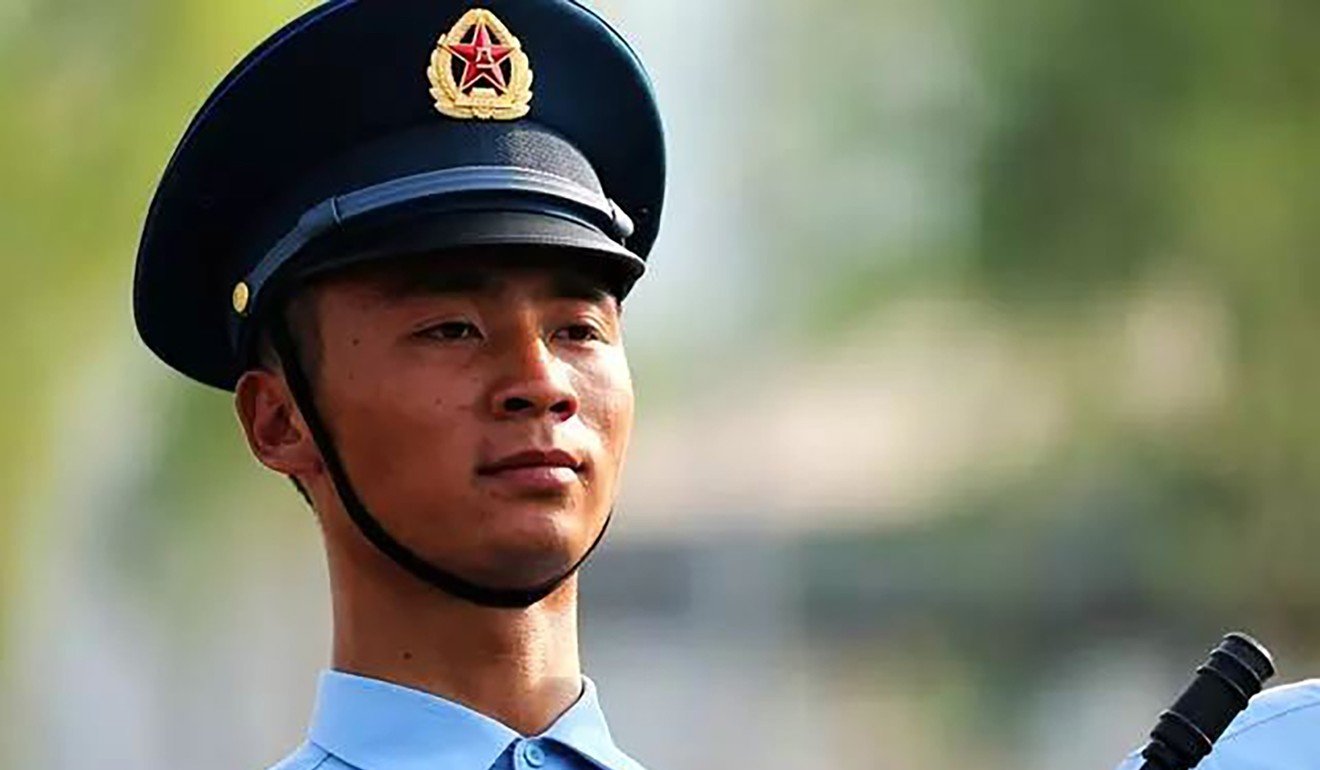
A young man who survived the devastating Sichuan earthquake and vowed to one day join the ranks of the soldiers who spent months rescuing people from the rubble will on Tuesday lead his very own squad of airborne troops in Tiananmen Square as part of the celebrations for the country’s 70th anniversary.
Now 23, Cheng Qiang was just 12 when on May 12, 2008 he and a group of friends played truant from school to go swimming in a local river, Xinhua reported on Thursday.
When the boys had finished their fun they returned to their village in the township of Luoshui to find their school and many other buildings had been razed to the ground. The death toll from the magnitude 8 quake would eventually rise to 87,000, with 370,000 people injured.
Cheng says he is ready to “continue the glory of the airborne troops” at Tuesday’s parade. Photo: Thepaper.cn
In the days and weeks that followed the devastation, tens of thousands of people from around China and the world descended on towns and villages across Sichuan to help with the rescue effort.
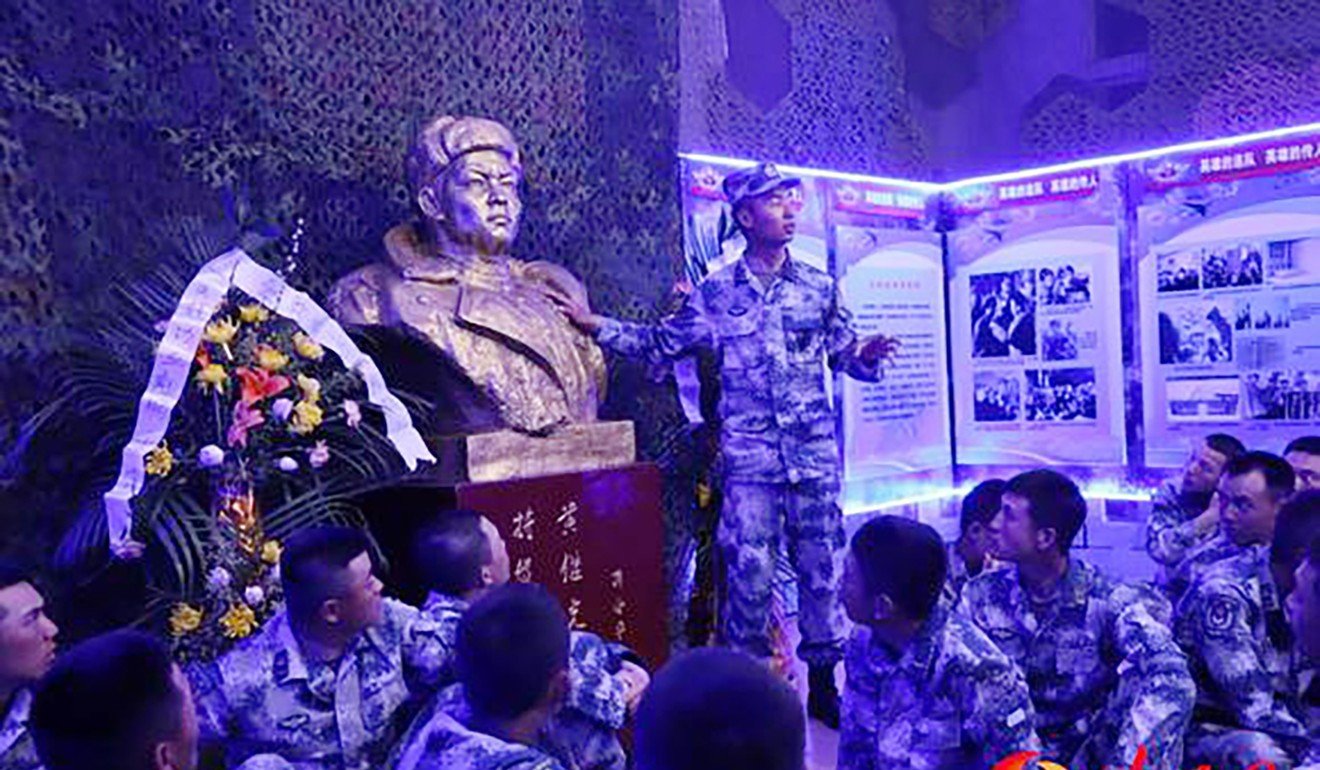
But the ones who impressed Cheng the most were the soldiers from the People’s Liberation Army (PLA) with the word “Airborne” printed on the helmets.
“Sometimes they had to remove the debris with their bare hands which were already covered in blood,” he said.
“But they just carried on and eventually pulled dozens of people out of the rubble. I knew then that I wanted to be one of them.”
Cheng said that after the quake having the troops in his village made him feel safe. Photo: People.cn
Having the troops in his village made Cheng feel safe, he said, and he spent his days following them around and doing what he could to help.
Three months later, when the soldiers had completed their work and were preparing to pull out, Cheng said he was determined to show his new heroes just how grateful he was to them.
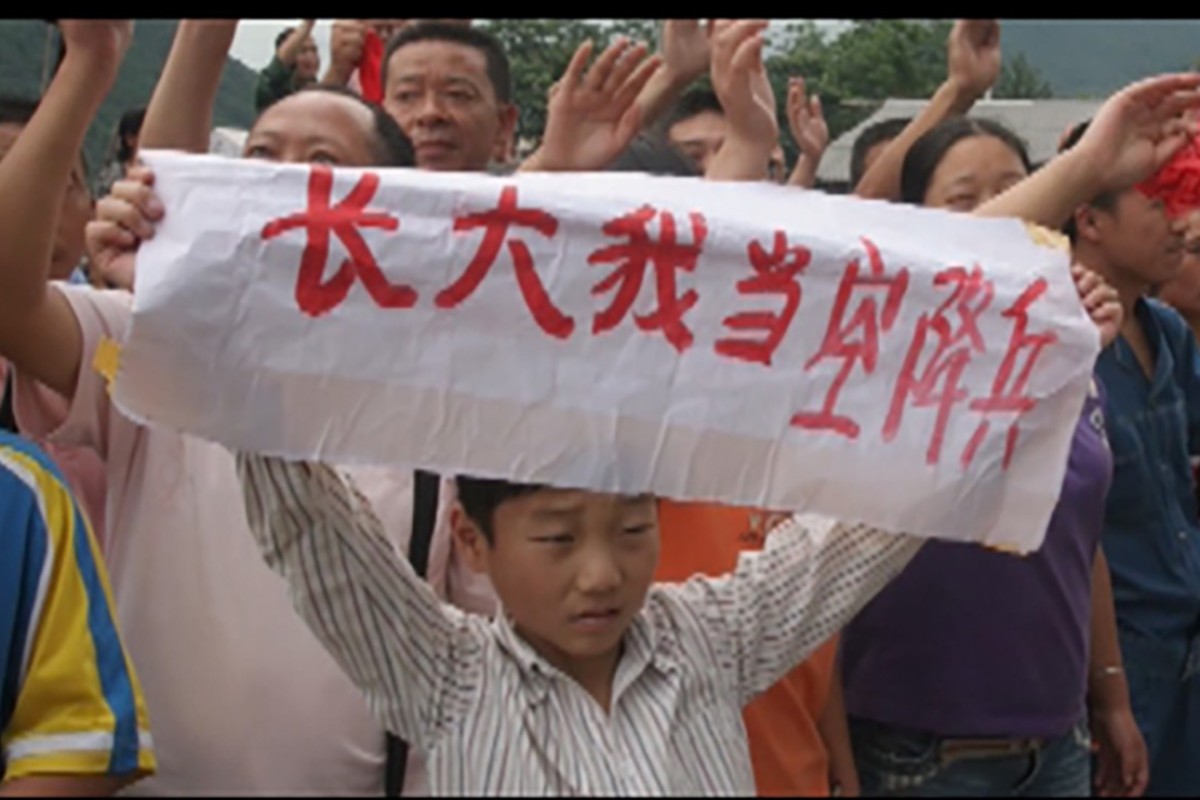
As the villagers gathered at the roadside to bid farewell to the men who had become their saviours, the young boy held up a handwritten sign. It said simply: “I want to be an airborne soldier when I grow up.”
The moment was captured on camera by a press photographer, and the image soon became a symbol of the gratitude felt by the people who had seen their lives and communities shattered but knew they had not been forsaken.
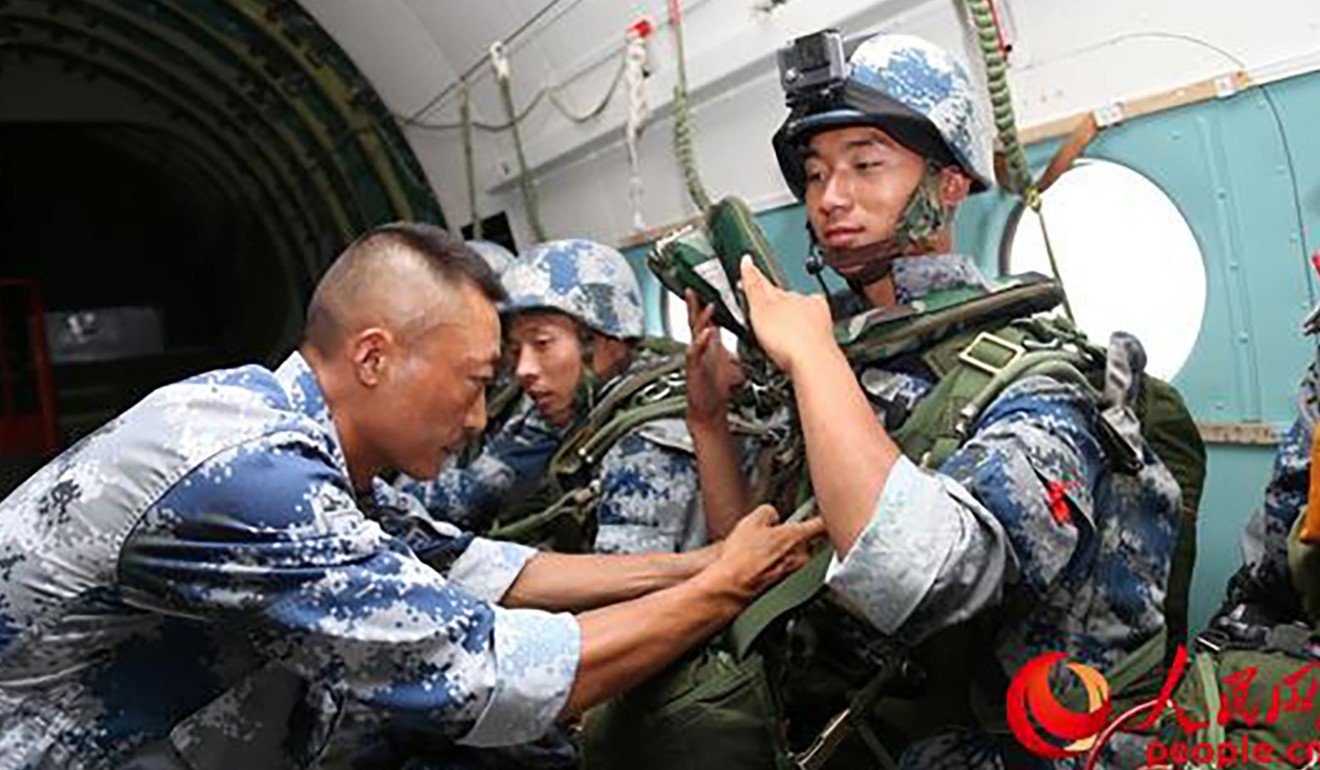
Cheng said he felt dizzy when he first jumped out of a plane. Photo: People.cn
Five years after the troops rolled out, Cheng was preparing to go to college when he heard the PLA was recruiting and that there were places available with the airborne division.
The teenager did not need a second invitation, and after securing a place on a training course and successfully completing it he joined the ranks of his heroes in 2013.
Not that everything was plain sailing, however.
“When I first jumped out of a plane I felt very dizzy and didn’t really know what was going on,” he said.
Thankfully Cheng managed to overcome his vertigo and went on to become a squad leader.
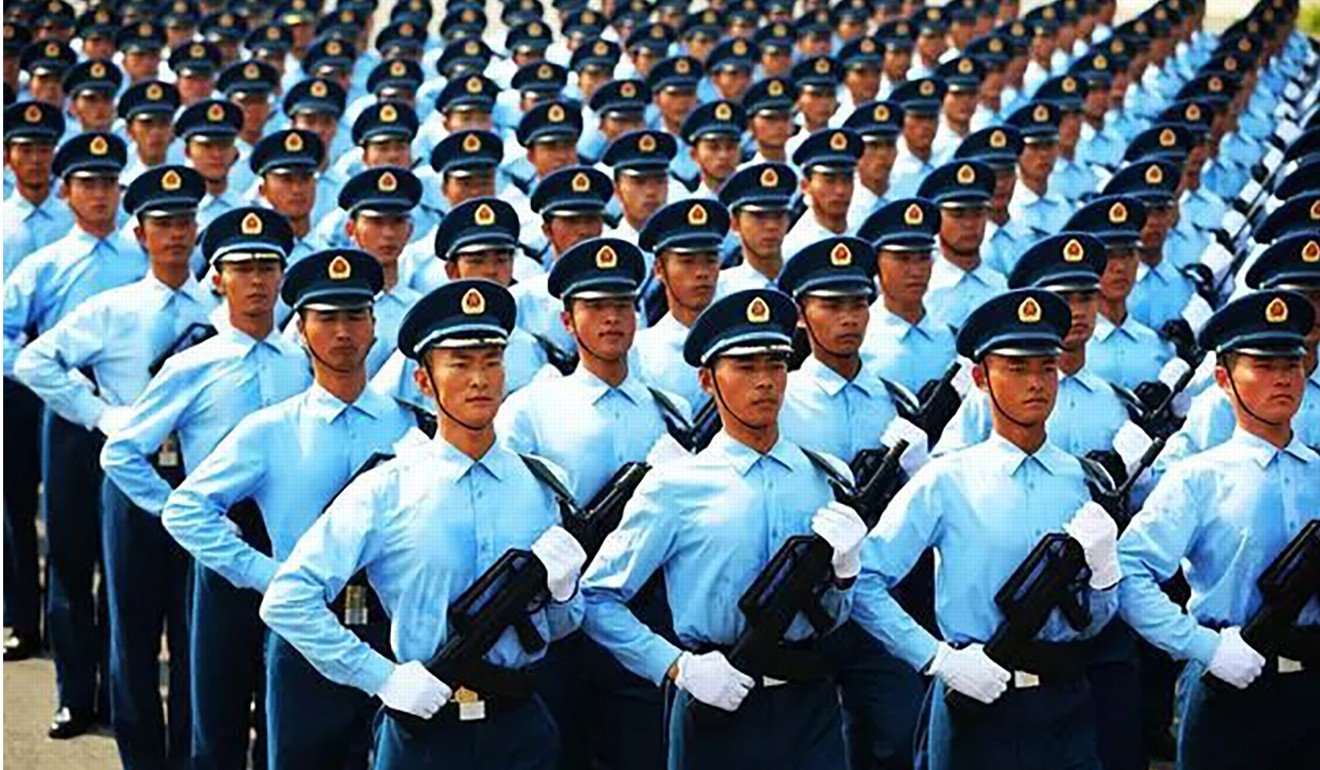
Tens of thousands of troops will take part in China’s National Day parade on October 1. Photo: Thepaper.cn
When the preparations were being made for next week’s anniversary celebrations in Beijing, Cheng said he and his squad were chosen to take part.
He said that during the rehearsals for the grand parade, he was repeatedly reprimanded by his trainer for not keeping his knees close enough together, for lifting his feet too high and for letting his gun slip off shoulder.
But he was determined to get it right, and after weeks of hard work and 11 years on from the tragedy that devastated his world, he said he was now ready to put his best foot forward.
“The nightmare of earthquake has long gone,” he said. “I am here to continue the glory of the airborne troops. I am ready for inspection.”










 CHINDIA ALERT: You'll be living in their world, very soon