15/04/2020
TAIPEI (Reuters) – Taiwan waded into the hotly contested politics of the Pacific on Wednesday, donating face masks and thermal cameras to its four diplomatic allies there to combat the coronavirus in a region where China is challenging traditional power of the United States.
The small developing nations lie in the highly strategic waters of the Pacific, dominated since World War Two by the United States and its friends, who have been concerned over China’s moves to expand its footprint there.
Democratic Taiwan has faced intense pressure from China, which claims the island as its territory with no right to state-to-state ties, and is bent on wooing away its few allies.
Taiwan has only 15 formal allies left worldwide after losing two Pacific nations, the Solomon Islands and Kiribati, to China in September.
Beijing has ramped up its diplomatic push into the Pacific, pledging virus aid and medical advice.
In its own aid programme, Taiwan has donated 16 million masks to countries around the world.
“We are a very small country, so it’s easier for us to work with Taiwan than mainland China,” Neijon Edwards, the Marshall Islands ambassador to Taiwan, told Reuters at the donation ceremony in Taipei.
China has been too overbearing, she added.
“It’s pressing too much, and it’s been trying to come to the Marshall Islands, several times, but up to this time we haven’t even opened the door yet.”
While the masks presented at the ceremony are going to Taiwan’s Pacific allies, all its 15 global allies are sharing the thermal cameras.
“Today’s ceremony once again shows that Taiwan is taking concrete actions not only to safeguard the health of Taiwanese people but also to contribute to global efforts to contain COVID-19,” said Foreign Minister Joseph Wu.
Though Pacific Island states offer little economically to either China and Taiwan, their support is valued in global forums such as the United Nations and as China seeks to isolate Taiwan.
China has offered to help developing countries including those of the Pacific, and many see Chinese lending as the best bet to develop their economies.
But critics say Chinese loans can lead countries into a “debt trap”, charges China has angrily rejected.
The debt issue was a serious problem and would only lead to the spread of Chinese influence regionwide, said Jarden Kephas, the ambassador of Nauru.
“They will end up dominating or having a lot of say in those countries because of the amount of debt,” he told Reuters, wondering how the money could ever be repaid. “We are not rich countries.”
Source: Reuters
Posted in 15, 16, aid programme, allies, Ambassador, Beijing, challenging, China, China’s, claims, combat, coronavirus, countries, Country, COVID-19, debt trap, democratic, developing nations, diplomacy, diplomatic, diplomatic push, dominated, donated, donating, donation ceremony, expand, face masks, footprint, foreign minister, formal allies, four, friends, hotly contested, intense, island, isolate, Kiribati, losing, Mainland China, Marshall Islands, masks, Medical advice, million, moves, Nauru, overbearing, Pacific, pledging, Politics, power, pressure, ramped up, region, Reuters, right, September, Solomon Islands, strategic waters, Taipei, Taiwan, Taiwanese, territory, thermal cameras, traditional, two, Uncategorized, United Nations, United States, virus aid, wades, Wednesday, wooing, World, World War Two, worldwide |
Leave a Comment »
27/09/2019
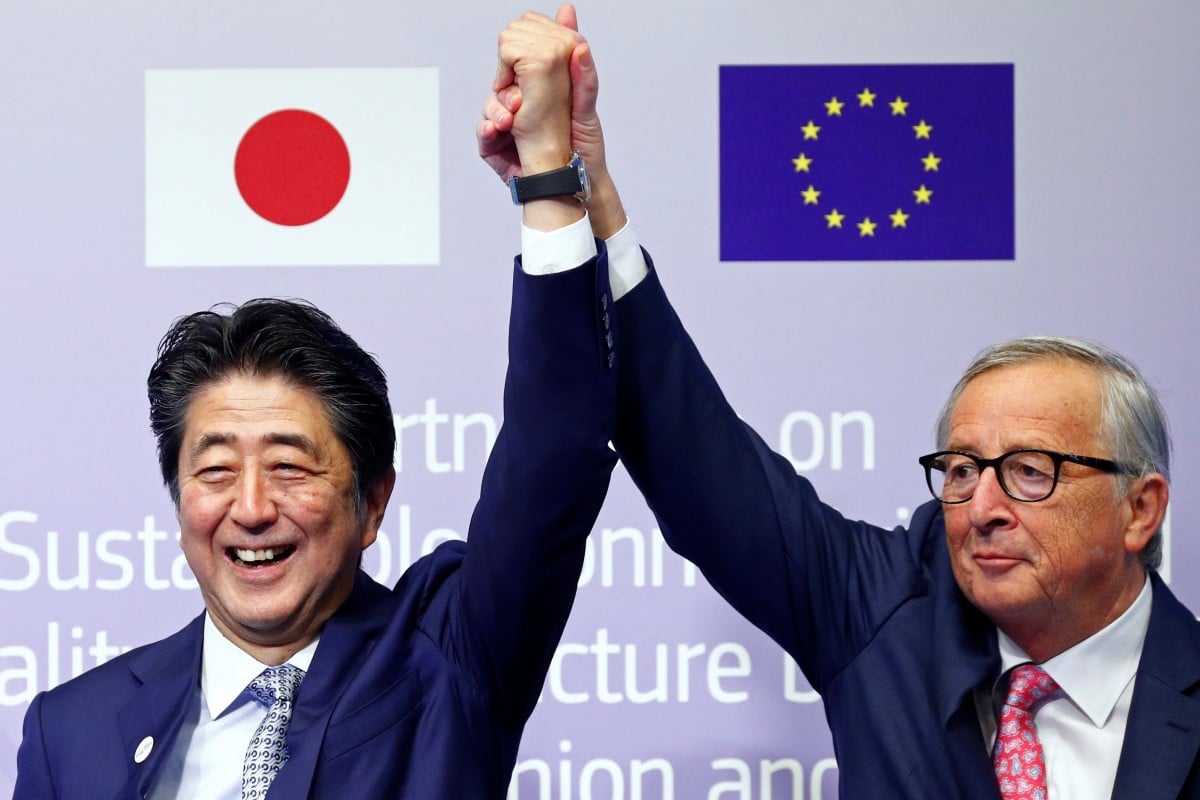
- Japan’s Prime Minister Shinzo Abe and EC President Jean-Claude Juncker mark first anniversary of EU-Asia Connectivity scheme with swipes at China
- Partners reach out to countries in Balkans and Africa and agree US$65.5 billion development plan
Japan’s Prime Minister Shinzo Abe (left) and European Commission President Jean-Claude Juncker mark the anniversary of the EU-Asia Connectivity scheme in Brussels, Belgium. Photo: Reuters
The
European Union and
Japan are stepping up their efforts to counter China’s
, with their leaders vowing to be “guardians of universal values” such as democracy, sustainability and good governance.
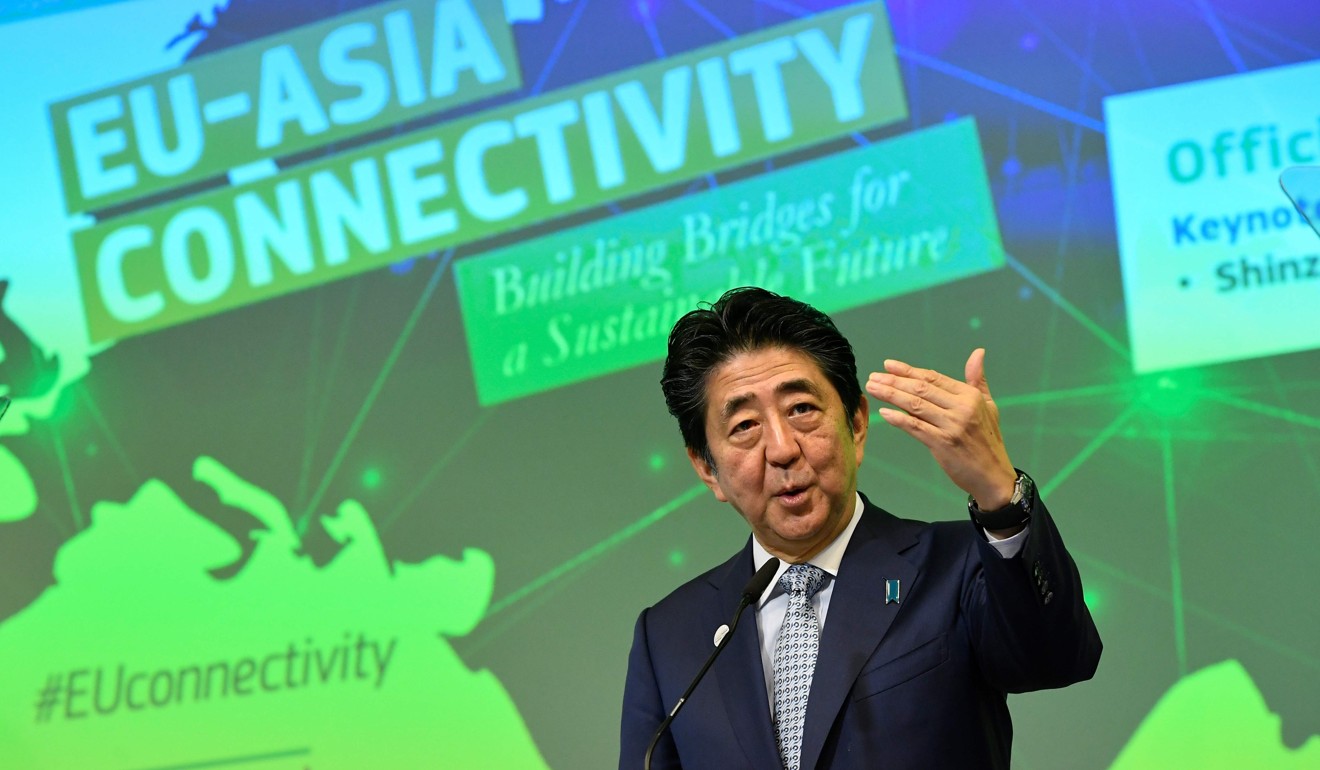
Speaking in Brussels on Friday, Japanese Prime Minister Shinzo Abe said the world’s third-biggest economy would work with the EU to strengthen their transport, energy and digital ties to Africa and the Balkans – key regions for China’s flagship trade and development project.
At a forum to mark the first anniversary of the EU-Asia Connectivity scheme, Abe and European Commission President Jean-Claude Juncker signed an agreement formalising Japan’s involvement in the Europe-Asia plan that will be backed by a €60 billion (US$65.54 billion) EU guarantee fund, development banks and private investors.
Abe said Japan would ensure that officials from 30 African countries would be trained in sovereign debt management over the next three years, a veiled attack on what Western diplomats claim is China’s debt trap for its belt and road partners.
“The EU and Japan are linked through and through,” Abe said. “The infrastructure we build from now on must be [high] quality infrastructure.
“Whether it be a single road or a single port, when the EU and Japan undertake something, we are able to build sustainable, comprehensive and rules-based connectivity, from the Indo-Pacific to the west Balkans and Africa.”
Japan wants to extend its business reach through its alliance with the EU as its economy slows and geopolitical competition from China takes its toll.
Japan indicates China is bigger threat than North Korea in latest defence review
China’s low-key delegation to the forum was led by Guo Xuejun, deputy director general of international affairs at the foreign ministry.
The US was represented by its deputy assistant secretary of state for cyber policy, Robert Strayer, who was in Europe to lobby against Chinese telecoms giant Huawei Technologies and its involvement in fifth-generation telecoms networks.
Abe and Juncker made cybersecurity the highlight of their addresses. Juncker, who will step down from the presidency by the end of October, repeated his attack on China’s trade policies without naming the country.
“Openness is reciprocal, based on high standards of transparency and good governance, especially for public procurement, and equal access to businesses while respecting intellectual property rights,” he said.
Prime Minister Shinzo Abe says Japan will train officials from 30 African countries in sovereign debt management in three years. Photo: AFP
European policymakers and businesses have for years complained about China’s refusal to allow foreign companies in without a Chinese joint venture partner, a practice that critics claimed involved forced transfer of intellectual property to the Chinese side.
“One of the keys to successful connectivity is to respect basic rules and common sense,” Juncker said, stressing that EU-Japanese cooperation focused on the “same commitment to democracy, rule of law, freedom and human dignity”.
European businesses urge EU to take ‘defensive’ measures against China’s state-owned enterprises
When the commission proposed improved transport, energy and digital infrastructure links with Asia last year, it denied it was seeking to stymie Chinese ambitions.
The EU plan, which would be backed by additional funds from the EU’s common budget from 2021, private sector loans and development banks, amounted to a response to China’s largesse in much of central Asia and south-eastern Europe, where Beijing has invested billions of dollars.
Source: SCMP
Posted in africa, African countries, Beijing, Belgium, Belt and Road Initiative, Belt and Road Initiative (BRI), belt and road partners, Brussels, Central Asia, challenge, China alert, commission, cybersecurity, debt management, debt trap, Democracy, digital infrastructure, ean-Claude Juncker, EC President, effort, energy, EU, EU-Asia Connectivity scheme, Europe-Asia plan, European Union, fifth-generation telecoms networks, geopolitical competition, good governance, guardians, huawei technologies, Indo-Pacific, Intellectual property, Japan, Japanese Prime Minister Shinzo Abe, play, south-eastern Europe, state-owned enterprises (SOEs), Sustainability, Transport, Uncategorized, universal values, Western diplomats |
Leave a Comment »



 CHINDIA ALERT: You'll be living in their world, very soon