Archive for ‘deepen’

16/03/2020

In Indian capital, riots deepen a Hindu-Muslim divide

NEW DELHI (Reuters) – For years, Hindus and Muslims lived and worked peacefully together in Yamuna Vihar, a densely populated Delhi district.

But the riots that raged through the district last month appear to have cleaved lasting divisions in the community, reflecting a nationwide trend as tensions over the Hindu nationalist agenda of Prime Minister Narendra Modi boil over.

Many Hindus in Yamuna Vihar, a sprawl of residential blocks and shops dotted with mosques and Hindu temples, and in other riot-hit districts of northeast Delhi, say they are boycotting merchants and refusing to hire workers from the Muslim community. Muslims say they are scrambling to find jobs at a time when the coronavirus pandemic has heightened pressure on India’s economy.

“I have decided to never work with Muslims,” said Yash Dhingra, who has a shop selling paint and bathroom fittings in Yamuna Vihar. “I have identified new workers, they are Hindus,” he said, standing in a narrow lane that was the scene of violent clashes in the riots that erupted on Feb. 23.

The trigger for the riots, the worst sectarian violence in the Indian capital in decades, was a citizenship law introduced last year that critics say marginalises India’s Muslim minority. Police records show at least 53 people, mostly Muslims, were killed and more than 200 were injured.

Dhingra said the unrest had forever changed Yamuna Vihar. Gutted homes with broken doors can be seen across the neighbourhood; electricity cables melted in the fires dangle dangerously above alleys strewn with stones and bricks used as makeshift weapons in the riots.

Most Hindu residents in the district are now boycotting Muslim workers, affecting everyone from cooks and cleaners to mechanics and fruit sellers, he said.

“We have proof to show that Muslims started the violence, and now they are blaming it on us,” Dhingra said. “This is their pattern as they are criminal-minded people.”

Those views were widely echoed in interviews with 25 Hindus in eight localities in northeast Delhi, many of whom suffered large-scale financial damages or were injured in the riots. Reuters also spoke with about 30 Muslims, most of whom said that Hindus had decided to stop working with them.

Suman Goel, a 45-year-old housewife who has lived among Muslim neighbours for 23 years, said the violence had left her in a state of shock.

“It’s strange to lose a sense of belonging, to step out of your home and avoid smiling at Muslim women,” she said. “They must be feeling the same too but it’s best to maintain a distance.”

Mohammed Taslim, a Muslim who operated a business selling shoes from a shop owned by a Hindu in Bhajanpura, one of the neighbourhoods affected by the riots, said his inventory was destroyed by a Hindu mob.

He was then evicted and his space was leased out to a Hindu businessman, he said.

“This is being done just because I am a Muslim,” said Taslim.

Many Muslims said the attack had been instigated by hardline Hindus to counter protests involving tens of thousands of people across India against the new citizenship law.

“This is the new normal for us,” said Adil, a Muslim research assistant with an economic think tank in central Delhi. “Careers, jobs and business are no more a priority for us. Our priority now is to be safe and to protect our lives.”

He declined to disclose his full name for fear of reprisals.

Emboldened by Modi’s landslide electoral victory in 2014, hardline groups began pursuing a Hindu-first agenda that has come at the expense of the country’s Muslim minority.

Vigilantes have attacked and killed a number of Muslims involved in transporting cows, which are seen as holy animals by Hindus, to slaughterhouses in recent years. The government has also adopted a tough stance with regard to Pakistan, and in August withdrew semi-autonomous privileges for Jammu and Kashmir, India’s only Muslim-majority state.

In November, the Supreme Court ruled that a Hindu temple could be built at Ayodhya, where a right-wing mob tore down a 16th-century mosque in 1992, a decision that was welcomed by the Modi government.

The citizenship law, which eases the path for non-Muslims from neighbouring Muslim-majority nations to gain citizenship in India, was the final straw for many Muslims, as well as secular Indians, sparking nationwide protests.

Modi’s office did not respond to questions from Reuters about the latest violence.

NIGHT VIGILANTES

During the day, Hindus and Muslims shun each other in the alleys of the Delhi districts that were hardest hit by the unrest in February. At night, when the threat of violence is greater, they are physically divided by barricades that are removed in the morning.

And in some areas, permanent barriers are being erected.

On a recent evening, Tarannum Sheikh, a schoolteacher, sat watching two welders install a high gate at the entrance of a narrow lane to the Muslim enclave of Khajuri Khas, where she lives. The aim was to keep Hindus out, she said.

“We keep wooden batons with us to protect the entrance as at any time, someone can enter this alley to create trouble,” she said. “We do not trust the police anymore.”

In the adjacent Hindu neighbourhood of Bhajanpura, residents expressed a similar mistrust and sense of insecurity.

“In a way these riots were needed to unite Hindus, we did not realise that we were surrounded by such evil minds for decades,” said Santosh Rani, a 52-year-old grandmother.

She said she had been forced to lower her two grandchildren from the first floor of her house to the street below after the building was torched in the violence, allegedly by a Muslim.

“This time the Muslims have tested our patience and now we will never give them jobs,” said Rani who owns several factories and retail shops. “I will never forgive them.”

Hasan Sheikh, a tailor who has stitched clothing for Hindu and Muslim women for over 40 years, said Hindu customers came to collect their unstitched clothes after the riots.

“It was strange to see how our relationship ended,” said Sheikh, who is Muslim. “I was not at fault, nor were my women clients, but the social climate of this area is very tense. Hatred on both sides is justified.”

Source: Reuters
25/02/2020

After raucous welcome in India, Trump clinches $3 billion military equipment sale

NEW DELHI (Reuters) – U.S. President Donald Trump said on Tuesday that India will buy $3 billion worth of military equipment, including attack helicopters, as the two countries deepen defence and commercial ties in an attempt to balance the weight of China in the region.

India and the United States were also making progress on a big trade deal, Trump said. Negotiators from the two sides have wrangled for months to narrow differences on farm goods, medical devices, digital trade and new tariffs.

Trump was accorded a massive reception in Indian Prime Minister Narendra Modi’s home state on Monday, with more than 100,000 people filling into a cricket stadium for a “Namaste Trump” rally.

On Tuesday, Trump sat down for one-on-one talks with Modi followed by delegation-level meetings to try and move forward on issues that have divided them, mainly the festering trade dispute.

After those meetings, Trump said his visit had been productive with the conclusion of deals to buy helicopters for the Indian military. India is buying 24 SeaHawk helicopters from Lockheed Martin equipped with Hellfire missiles worth $2.6 billion and also plans a follow-on order for six Apache helicopters.

India is modernising its military to narrow the gap with China and has increasingly turned to the United States over traditional supplier, Russia.

Trump said the two countries were also making progress on a trade deal, which had been an area of growing friction between them.

“Our teams have made tremendous progress on a comprehensive trade agreement and I’m optimistic we can reach a deal that will be of great importance to both countries,” said Trump in remarks made alongside Modi.

The two countries had initially planned to produce a “mini deal”, but that proved elusive.

Instead both sides are now aiming for a bigger package, including possibly a free trade agreement.

Trump said he also discussed with Modi, whom he called his “dear friend”, the importance of a secure 5G telecoms network in India, ahead of a planned airwaves auction by the country.

The United States has banned Huawei, arguing the use of its kit creates the potential for espionage by China – a claim denied by Huawei and Beijing – but India, where telecoms companies have long used network gear from the Chinese firm, is yet to make a call.

Trump described Monday’s rally in Ahmedabad and again praised Modi and spoke of the size of the crowd, claiming there were “thousands of people outside trying to get in..

“I would even imagine they were there more for you than for me, I would hope so,” he told Modi. “The people love you…every time I mentioned your name, they would cheer.”

In New Delhi, Trump was given a formal state welcome on Tuesday at the red sandstone presidential palace with a 21-cannon gun salute and a red coated honour guard on horseback on a smoggy day.

HUG GETS TIGHTER

India is one of the few big countries in the world where Trump’s personal approval rating is above 50% and Trump’s trip has got wall-to-wall coverage with commentators saying he had hit all the right notes on his first official visit to the world’s biggest democracy.

They were also effusive in their praise for Modi for pulling off a spectacular reception for Trump.

“Modi-Trump hug gets tighter,” ran a headline in the Times of India.

But in a sign of the underlying political tensions in India, violent protests broke out in Delhi on Monday over a new citizenship law that critics say discriminates against Muslims and is a further attempt to undermine the secular foundations of India’s democracy. They say the law is part of a pattern of divisiveness being followed by Modi’s Hindu nationalist Bharatiya Janata Party.

At least 7 people were killed and about 150 injured in the clashes that took place in another part of the capital, away from the centre of the city where Modi is hosting Trump.

In his speech on Monday, Trump extolled India’s rise as a stable and prosperous democracy as one of the achievements of the century. “You have done it as a tolerant country. And you have done it as a great, free country,” he said.

Delhi has also been struggling with high air pollution and on Tuesday the air quality was moderately poor at 193 on a government index that measures pollution up to a scale of 500. The WHO considers anything above 60 as unhealthy.

Source: Reuters

28/12/2019

China, Senegal continue to deepen comprehensive strategic cooperative partnership in 2019

DAKAR, Dec. 27 (Xinhua) — China has continued to be a key partner for Senegal in 2019, supporting its implementation of the Plan for an Emerging Senegal, proposed by Senegalese president Macky Sall.

Fourteen years after the resumption of diplomatic relations between Beijing and Dakar, China occupies an essential place in Senegal’s political and trade relationships.

At the beginning of the year, during a visit of Chinese State Councilor and Foreign Minister Wang Yi, Senegalese president Sall said the Senegal-China relationship is dynamic, practical and effective, hailing it as a model. He said the Senegalese side hopes to further deepen cooperation with China in various fields.

According to the Chinese Embassy in Senegal, trade between the two partners, at 2.27 billion U.S. dollars in 2018, accelerated in 2019, and China has become one of the most popular destinations among Senegalese businesspeople.

The year 2019 was marked also by numerous visits by Chinese businessmen to study the Senegalese market for potential investments opportunities. The return of Chinese traders in the marketing campaign of peanuts has been hailed by many agricultural stakeholders.

Also in 2019, the inauguration of the Chinese-built Diamniadio Industrial Park, about 30 km from Dakar, won positive response from Senegalese authorities.

In terms of infrastructure, cooperation continued in a good momentum after the opening of the Museum of Black Civilizations, the Thies-Touba, Dakar-Mbour and Dakar-Thies highways, the Grand Theater in Dakar, and the Children Hospital in Diamniadio.

Chinese expertise has won acclaim in Senegal in the construction of the first Bus Rapid Transit (BRT) serving the Senegalese capital and its suburbs. China Road and Bridge Corporation (CRBC) won the international tender for the project mostly funded by the World Bank.

Senegal also counts on China for the construction of sports facilities for the organization of the Youth Olympic Games in 2022. China built Senegal’s largest stadium, Leopold Sedar Senghor Stadium, in the 1980s, and three other regional stadiums will be rehabilitated.

In the political field, Senegal is now co-chair of the Forum on China-Africa Cooperation (FOCAC). China and Senegal have worked closely to push forward their comprehensive strategic cooperative partnership, setting a good example of high-quality and sustainable cooperation.

Throughout the year, the two sides have had in-depth exchanges on bilateral ties and other issues of common interest.

Senegalese President Macky Sall reiterated, during the last visit to Senegal by Yang Jiechi, member of the Political Bureau of the Central Committee of the Communist Party of China (CPC), Senegal firmly supports and actively participates in the Belt and Road Initiative, which was launched in 2013 by his Chinese counterpart, Xi Jinping.

On several occasions, the Senegalese authorities have welcomed the support of China for the realization of development projects in the Plan for an Emerging Senegal.

Senegal and China also increased cultural exchanges in 2019. In November, Dakar hosted an international seminar on China-Africa Cooperation and the joint construction of the Belt and Road Initiative. The event was organized by the Chinese Academy of Social Sciences and the National School of Administration of Senegal.

Senegalese Minister of Infrastructure Oumar Youm said the Belt and Road Initiative meets the real needs of China and African countries.

The initiative reflects the “sincere and firm commitment of both parties to building together a common destiny even stronger and more prosperous,” he said.

In 2019, the Chinese Embassy in Senegal granted scholarships to 48 Senegalese students for them to continue their studies in China in various fields.

Local Confucius Institute students competed in the Senegal country final of the 18th edition of the worldwide “Chinese Bridge” contest.

To mark the 70th anniversary of the People’s Republic of China, Hangzhou Art Troupe performed at the Grand Theater in Dakar to showcase Chinese culture.

In the Museum of Black Civilizations, Shanghai University presented an exhibition, “The emergence of the Chinese countryside through development,” to tell the story of China’s development.

For Birane Niang, secretary general of the Senegalese Ministry of Culture and Communication, “cultural dialogue has this ability to bring people together and strengthen their friendship and mutual respect of their differences.”

China and Senegal have also continued to strengthen cooperation in the field of public health. This year, the 17th Chinese medical team, composed of 13 health professionals, treated 76,489 patients, including nearly 200 critically ill ones, performing 5,000 operations, in Senegal.

A further deepening of relations between China and Senegal is expected in 2020.

Source: Xinhua

20/12/2019

China, Brazil deepen aerospace cooperation

TAIYUAN, Dec. 20 (Xinhua) — China and Brazil will continue to develop more satellites together and deepen aerospace cooperation, said Chinese and Brazilian officials after a new satellite jointly produced by the two countries was sent into space on Friday.

The launch of the China-Brazil Earth Resource Satellite-4A (CBERS-4A) also marks the 45th anniversary of the establishment of diplomatic relations between China and Brazil.

The two countries will expand the application of the CBERS satellite data in their own countries and those participating in the Belt and Road Initiative, said Wu Yanhua, deputy director of the China National Space Administration (CNSA).

China and Brazil have devised a 10-year plan to collaborate in developing remote-sensing, meteorological and communication satellites. The cooperation could also be expanded to deep space exploration, lunar exploration, manned space and aerospace education, said Wu.

In 1988, the two countries signed an agreement to start the China-Brazil earth resource satellite program. They shared the costs and separately developed its systems. Both sides brought different advantages to the table and were highly complementary.

In 1999, the first China-Brazil earth resource satellite was successfully launched, giving each country their first transmission-type remote-sensing satellite. It was rated one of the top 10 scientific and technological advances of the year in China.

It was also the first satellite jointly developed by China and another country, and was a model for space technology cooperation among developing countries.

The partnership has lasted more than 30 years. The two countries have sent six satellites into space, and the resolution of the images has gradually improved.

The China-Brazil earth resource satellites have provided more than 6 million images to users in the two countries, and the data have been widely used in agriculture, forestry, water conservation, land and resources, environmental protection, and disaster prevention and mitigation, helping the Brazilian government monitor the Amazon rainforest and the country’s environmental changes, according to the CNSA.

The remote-sensing data are also provided to developing countries for free, and have helped monitor disasters such as forest fires in Australia, floods in Pakistan, and an earthquake and tsunami in Japan.

China has also helped train Brazilian personnel, and scientists and technologists of the two countries have conducted many exchanges over the past 30 years.

“The space cooperation between China and Brazil has been very successful, and sets a good example for space cooperation among developing countries,” Wu said.

Brazilian Minister of Science, Technology, Innovation and Communication Marcos Cesar Pontes said the cooperation has contributed to international economic and social development.

Source: Xinhua

02/11/2019

Germany, India sign wide-ranging agreements to deepen bilateral ties

NEW DELHI (Reuters) – German Chancellor Angela Merkel and Indian Prime Minister Narendra Modi signed wide-ranging agreements in New Delhi on Friday to deepen strategic cooperation and exchanged notes on ways to boost bilateral trade.

Merkel, accompanied by several cabinet colleagues and a business delegation, is in India on a three-day visit that began on Thursday.

“We’re encouraging our private sectors to give an impetus to our growing bilateral trade and Chancellor Merkel and I will meet some of the top business and industry leaders,” Modi told a joint news conference with the German leader.

“We’re encouraging our private sectors to give an impetus to our growing bilateral trade and Chancellor Merkel and I will meet some of the top business and industry leaders,” Modi said.

Bilateral trade between the two countries rose to $24.06 billion (18.5 billion pounds) in the 2018/19 fiscal year ending in March from $22 billion the previous year, while German companies have invested nearly $12 billion in India since 2000.

Germany is India’s largest trading partner in Europe and more than 1,700 German companies are operating in India.

The agreements struck on strategic cooperation, included agriculture, cyber security and artificial intelligence. Modi said the two countries would also bolster ties to combat “terrorism and extremism”.

Germany and India also agreed to join hands in the area of education.

“As many as 20,000 Indian nationals are studying in Germany and we would like to see more,” Merkel said.

Although Merkel and Modi didn’t mention anything about restarting talks on finalising a free trade agreement between India and the European Union, sources earlier said the two leaders could take up the trade deal.

Eric Schweitzer, president of the Association of German Chambers of Commerce and Industry (DIHK), earlier said India had enormous potential but there has been uncertainty among companies after an investment protection agreement between the two countries ended in 2016.

“Small and medium-sized German companies stand in a labyrinth of regulations and shy away from larger investment. Negotiations should restart and Merkel’s visit could help,” he said.

VDA, Germany’s car industry association that counts automakers like Volkswagen (VOWG_p.DE), Daimler, BMW and Audi as members, also wanted India to restart the FTA talks.

Daimler’s Mercedes-Benz, BMW and Audi dominate India’s luxury car market.

Source: Reuters

09/10/2019

Kashmir conflict: Woes deepen as lockdown stifles economy

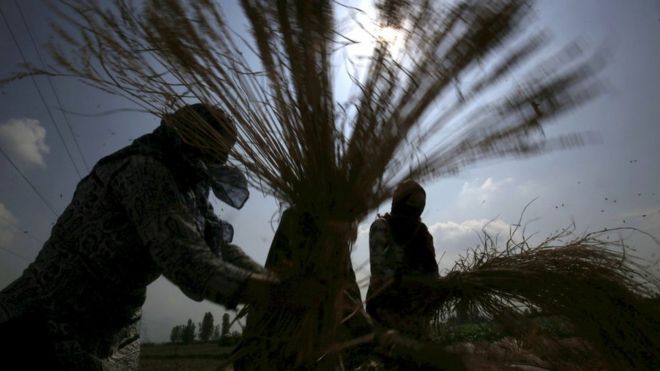
Farmers thresh paddy, separating grain from chaff, during the harvest season on October 2, 2019 on the outskirts of Srinagar, India.Image copyright GETTY IMAGES

The lockdown in Indian-administered Kashmir has cost the region’s economy more than $1bn in two months, according to industry experts. BBC Hindi’s Vineet Khare reports.

Mushtaq Chai recalls the afternoon of 2 August when he received a “security advisory” from the administration. A prominent local businessman, he owns several hotels across the Muslim-majority valley in Indian-administered Kashmir.

The note warned of “terror threats” and advised that tourists and Hindu pilgrims should “curtail their visit… and return as soon as possible”.

Mr Chai, like many others, took the advisory seriously. Two years before, seven Hindu pilgrims were killed in a militant attack while returning from the Amarnath cave, a major Hindu shrine in Kashmir’s Anantnag district.

“This was the first time in Kashmir’s history that tourists and pilgrims were asked to leave,” Mr Chai says.

Indian tourists seen leaving the City during the curfew in Srinagar on 16 August 2019.Image copyright GETTY IMAGES
Image caption Tourists left Kashmir amid a curfew in August

Soon officials arrived to enforce the order, and Mr Chai and his staff made arrangements for all of the guests to leave immediately.

Days later, on 5 August, the federal government stripped the region of its special status and placed it under a communications lockdown.

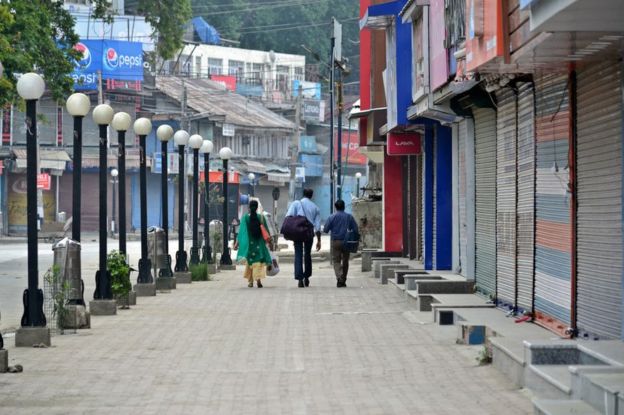
Two months on, the situation is far from normal. Internet and mobile phone connections remain suspended, public transport is not easily available, and most businesses are shut – some in protest against the government, and others for fear of reprisals from militants opposed to Indian rule.

There is also a shortage of skilled labour, as some 400,000 migrants have left since the lockdown began.

What’s more, the streets are deserted and devoid of the tourist business which had supported up to 700,000 people.

Presentational grey line

Read more about Kashmir

Presentational grey line

The lockdown has not come cheap.

A government official, who did not wish to be named, says they are “awaiting a financial package” from the federal government. But the Kashmir Chamber of Commerce and Industry estimates the shutdown has already cost the region more than $1.4bn (£1.13bn), and thousands of jobs have been lost.

“There are around 3,000 hotels in the valley and they are all empty. They have loans to pay off and daily expenses to bear,” says Mr Chai, sitting in his mostly empty hotel in the capital, Srinagar.

Only a handful of his 125 staff are at work. Many haven’t returned because of lack of transport – or fear. Tensions have been high in the region, and there have been a number of protests in the city.

But the situation may improve in the coming days as the government has announced that tourists will allowed in the state from Thursday.

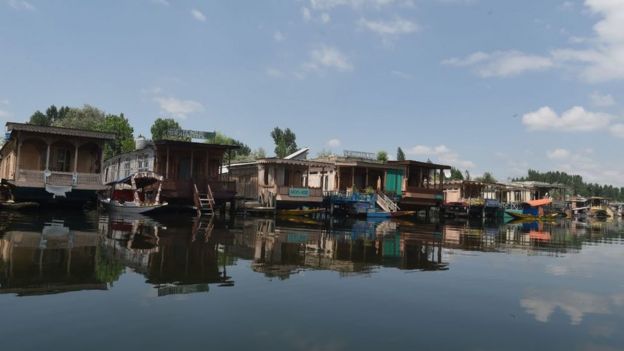
Empty houseboats on Srinagar's Dal lake.Image copyright GETTY IMAGES
Image caption Hundreds of houseboats have been lying vacant

But it isn’t just the hotels which have suffered.

“No internet has meant more than 5,000 travel agents have lost work,” says Javed Ahmed, a travel agent himself. “The government says give jobs to the youth. We are young but jobless. We have nothing to do with politics. We want jobs.”

Srinagar’s almost 1,000 iconic houseboats have also been running empty.

“Every houseboat needs up to $7,000 a year for maintenance,” says Hamid Wangnoo from the Kashmir Houseboats Owners Association. “For many, this is the only source of livelihood.”

And it isn’t just tourism.

“More than 50,000 jobs have been lost in the carpet industry alone,” according to Shiekh Ashiq, president of the chamber of industry.

He says July to September is when carpet makers usually receive orders for export – especially overseas, so they can deliver by Christmas.

But they are unable to contact importers, or even their own employees, because of the communications lockdown.

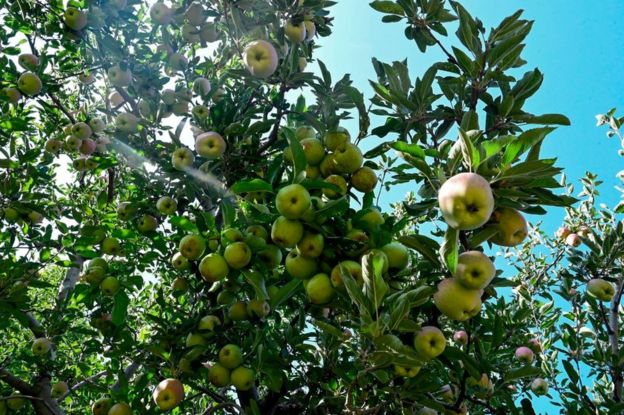
Apples are ready to be harvested in an orchard in Shopian district of southern Kashmir valley.Image copyright GETTY IMAGES
Image caption Kashmir’s famous apple orchards have also been hit hard

In southern Kashmir, the region’s famous apples are still waiting to be plucked from the trees. But shops and cold storage units are shut, and the main apple market is empty. Last year, it did business worth $197m, local farmers say.

“I feel so much pain seeing my apples hanging from the trees that I don’t go to the orchard anymore,” says a worried apple grower, who did not wish to be named.

“Apples account for 12–15% of Kashmir’s economy, but more than half of this year’s produce has not been plucked,” says economic journalist Masood Hussain. “If this continues through October, it will have devastating consequences.”

In Srinagar, some shop owners wait outside their stores and open them for a customer before closing them hurriedly – until the next customer arrives.

One such owner says he is unhappy with the government’s decision, but he is also scared of angry locals who want him to keep his business closed.

“But how do I survive without my daily earnings?” he asked.

Media caption Two wars, a 60-year dispute – a history of the Kashmir conflict

Source: The BBC

Law of Unintended Consequences

continuously updated blog about China & India

ChiaHou's Book Reviews

continuously updated blog about China & India

What's wrong with the world; and its economy

continuously updated blog about China & India