Archive for ‘Delhi’s’

21/04/2020

India coronavirus: Can the Covid-19 lockdown spark a clean air movement?

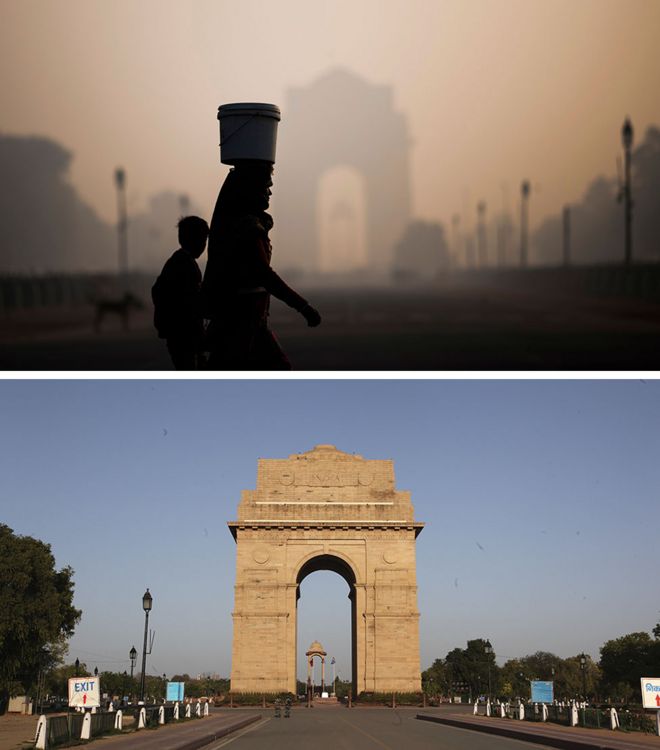
Delhi before and after the lockdownImage copyright GETTY IMAGES
Image caption Delhi’s air quality has improved remarkably during the shutdown

When India shut down last month and suspended all transport to contain the spread of coronavirus, the skies over its polluted cities quickly turned an azure blue, and the air, unusually fresh.

As air pollution plummeted to levels unseen in living memory, people shared pictures of spotless skies and even Himalayan peaks from cities where the view had been obscured by fog for decades.

On one social messaging group, a resident of the capital, Delhi, which regularly records some of the foulest air in the world, celebrated the city’s “alpine weather“. Politician and author Shashi Tharoor wrote that the “blissful sight of blue skies and the joy of breathing clean air provides just the contrast to illustrate what we are doing to ourselves the rest of the time”.

Media caption India coronavirus lockdown cleans up Ganges river

Less than six months ago, Delhi was gasping for breath. Authorities said air quality had reached “unbearable levels”. Schools were shut, flights were diverted, and people were asked to wear masks, avoid polluted areas and keep doors and windows closed.

Delhi and 13 other Indian cities feature on a list of the world’s 20 most polluted. It is estimated that more than a million Indians die every year because of air pollution-related diseases. Industrial smoke, vehicular emissions, burning of trash and crop residue, and construction and road dust are the major contributors.

As urban Indians gazed at the skies and breathed clean air inside their homes, researchers hunkered down to track data on how the grinding lockdown – now extended to 3 May – was impacting air pollution across the country.
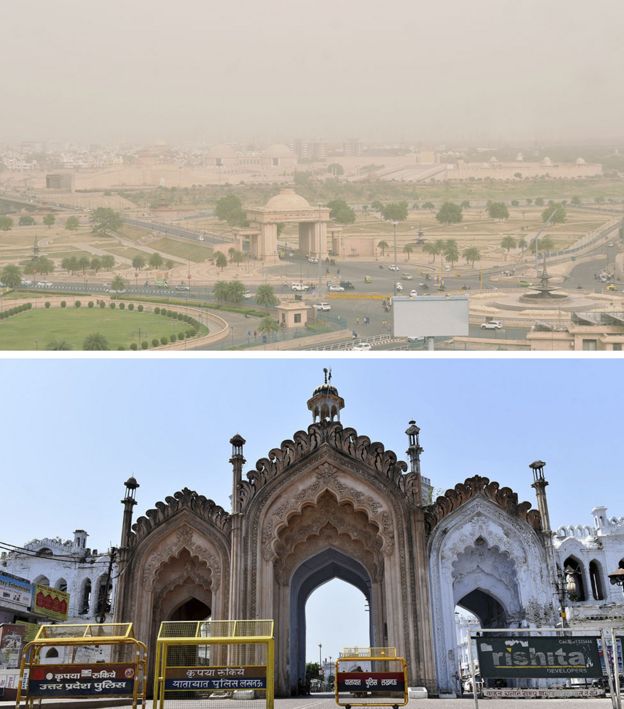
LucknowImage copyright GETTY IMAGES
Image caption Lucknow is another city on the top 20 world’s most polluted list

“This was an unprecedented opportunity for us to take a close look at how air pollution levels have responded to an extraordinary development,” Sarath Guttikunda, who heads Urban Emissions, an independent research group that provides air quality forecasts, told me.

Federal pollution control authorities quickly reported a marked improvement in air quality levels in 85 cities.

Dr Guttikunda and his team of researchers looked at the data spewed out by the 100-odd air quality monitoring stations all over India. They decided to concentrate on the capital Delhi and its suburbs – a massive sprawl called the National Capital region, where more than 20 million people live. Last winter, air pollution here had reached more than 20 times the World Health Organization’s safe limit.
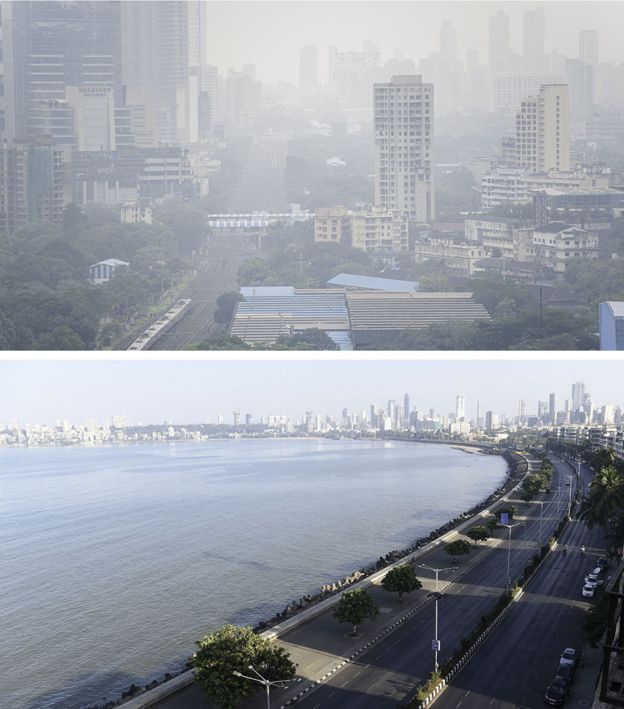
Mumbai before and after the lockdownImage copyright HINDUSTAN TIMES
Image caption The financial capital Mumbai also seems very different

The deadliest particle in Delhi’s foul air is the tiny but deadly PM 2.5, which increases the likelihood of respiratory and cardiovascular diseases. They primarily come from combustion – fires, automobiles and power plants.

Urban Emissions found the levels of PM 2.5 in Delhi during the lockdown plummeted to 20 micrograms per cubic metre with a 20-day average of 35.

To put this into context, between 2017 and 2019, the monthly average of PM 2.5 in the capital was up to four times higher. (The national standard is set at 40, and the WHO has an annual average guideline of just 10 micrograms per cubic metre.)

“If 35 is the average lowest available PM2.5 with limited local emissions, it means that at least 70% of the pollution is locally generated,” Mr Guttikunda told me.

Media caption India coronavirus lockdown cleans up Ganges river

His study also found a marked dip in PM 10, caused mainly by road and construction dust, and nitrogen dioxide, which comes mainly from vehicular emissions, and nearly 90% of vehicles are off the road.

“The current crisis has shown us that clear skies and breathable air can be achieved very fast if concrete action is taken to reduce burning of fossil fuels,” says Sunil Dahiya, of the Centre for Research on Energy and Clean Air, which has also been tracking air pollution levels during the lockdown.

But will this prompt change? After all, urban Indians’ and the media’s panic and outrage during the deadly winter pollution every year soon gets lost in the fog of summer heat and concerns over monsoon rains and droughts.

“We don’t yet have a democratic demand for clean air,” Arunabha Ghosh, Chief Executive Officer of the Council on Energy, Environment and Water, a leading climate think tank, told me. Orders to clean up the air have almost always come from the courts, responding to pleas by NGOs.
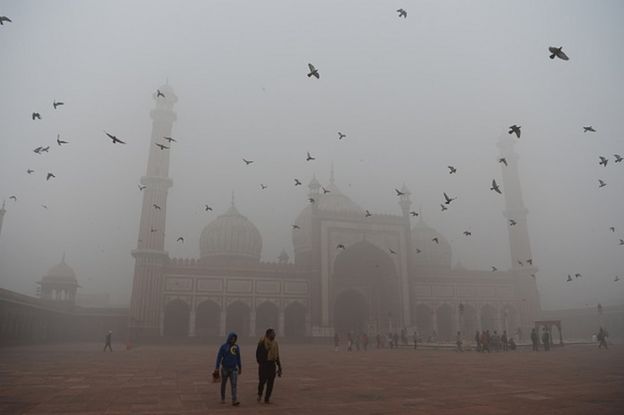
Delhi pollutionImage copyright GETTY IMAGES
Image caption Pollution in Delhi peaks during winter

However, Dr Ghosh still hopes that “the experience of blue skies and fresh air could be a trigger to create a democratic demand for clean air in India”.

Crises often trigger life changing reforms. A fatal four-day “pea-souper” that engulfed London in 1952 and killed thousands provoked the passing of the Clean Air Act to reduce the use of smoky fuels.

China tried to clean up its air several times before hosting marquee international events – like the Beijing Olympics in 2008, the World Expo in Shanghai and the Guangzhou Asian Games in 2010 – before sliding back to grey, smoky skies.

But many believe the 2014 Apec meeting in Beijing, when China hosted 21 heads of Asia-Pacific economies, was a turning point. The rare blue skies over Beijing spawned the phrase ‘Apec blue‘. In a rush to clean its air, China introduced a set of far-reaching measures. Over the next four years, this resulted in a 32% drop in average pollution across major Chinese cities.

So could a lockdown to prevent the spread of a pandemic, which has imperilled the health and livelihoods of millions, trigger similar policy changes to clean up India’s air?
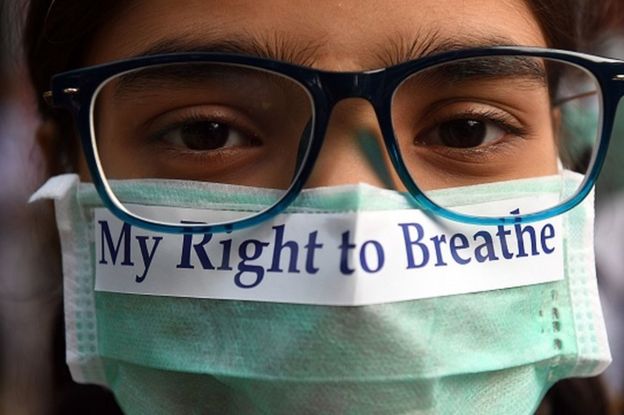
pollution campaignImage copyright GETTY IMAGES
Image caption The movement for clean air has been sporadic and mainly pushed by NGOs

Could it move to a shift in reducing traffic on the road by asking people to work from home in shifts now that millions have experienced clean air for the first time in years? (Facing energy shortages after the loss of the Fukushima nuclear power plant, Japan unleashed a Cool Biz campaign to cut down air conditioning in workplaces and reduce carbon emissions by asking office workers to shed their suits.)

Or can India use some of the money from an inevitable stimulus to help kick-start the economy go towards helping green industries? Renewables, experts say, creates more jobs than coal: India has already created nearly 100,000 jobs in solar and wind energy firms.

Can the country use the windfall revenues accruing from the steep decline in oil prices – most of India’s oil is imported – to provide rebates to polluting factories to set up much-needed emission control equipment?

“We have to learn lessons to deploy the economic recovery from the pandemic. We need growth, jobs and sustainable development,” says Dr Ghosh. Cleaning up the air could be the key. For too long, India – and Indians – have ignored their right to breathe easy.

What’s more, if China can reduce air pollution by 32% in four-and-a-half years, why can’t India pledge to reduce pollution by 80% in 80 cities by 2027, which is our 80th anniversary of Independence? asks Dr Ghosh.

It’s a good question.

Source: The BBC
20/04/2020

India coronavirus lockdown: What stays open and what stays shut

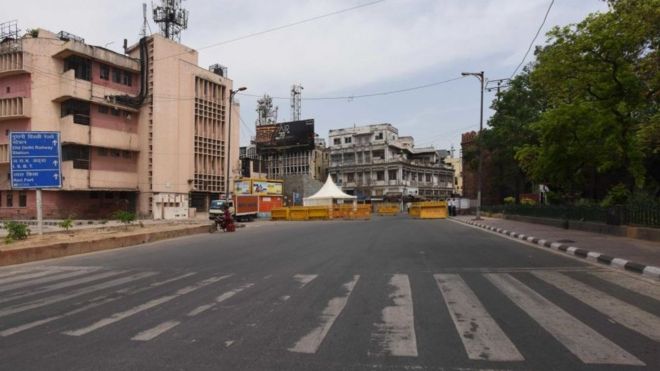
An empty stretch of the road and Delhi Police barricades to screen commuters during lockdown, at Delhi Gate on April 16, 2020 in New Delhi, India.Image copyright GETTY IMAGES
Image caption An empty stretch of the road and Delhi Police barricades to screen commuters during lockdown, at Delhi Gate on April 16, 2020 in New Delhi, India.

India has eased some restrictions imposed as part of a nationwide lockdown to curb the spread of the coronavirus.

Most of the new measures are targeted at easing pressure on farming, which employs more than half the nation’s workforce.

Allowing farms to operate again has been seen as essential to avoid food shortages.

But some other measures announced last week, will not be implemented.

This includes the delivery of non-essential items such as mobile phones, computers, and refrigerators by e-commerce firms – the government reversed its decision on that on Sunday.

And none of the restrictions will be lifted in areas that are still considered “hotspots” for the virus – this includes all major Indian cities.

Domestic and international flights and inter-state travel will also remain suspended.

So what restrictions are being eased?

Most of the new measures target agricultural businesses – farming, fisheries and plantations. This will allow crops to be harvested and daily-wagers and others working in these sectors to continue earning.

To restore the supply chain in these industries, cargo trucks will also be allowed to operate across state borders to transport produce from villages to the cities.

Essential public works programmes – such as building roads and water lines in rural areas – will also reopen, but under strict instructions to follow social distancing norms. These are a huge source of employment for hundreds of thousands of daily-wage earners, and farmers looking to supplement their income.

Banks, ATMs, hospitals, clinics, pharmacies and government offices will remain open. And the self-employed – such as plumbers, electricians and carpenters – will also be allowed to work.

Some public and even private workplaces have been permitted to open in areas that are not considered hotspots.

But all businesses and services that reopen are expected to follow social distancing norms.

Who decides what to reopen?

State governments will decide where restrictions can be eased. And several state chief ministers, including Delhi’s Arvind Kejriwal, have said that none of the restrictions will be lifted in their regions.

Mr Kejriwal said the situation in the national capital was still serious and the decision would be reviewed after one week.

India’s most populous state, Uttar Pradesh, will also see all restrictions in place, as will the southern states of Andhra Pradesh, Telangana and Karnataka.

The southern state of Kerala, which has been widely acknowledged for its success in dealing with the virus, has announced a significant easing of the lockdown in areas that it has demarcated as “green” zones.

This includes allowing private vehicular movement and dine-in services at restaurants, with social distancing norms in place. However, it’s implementing what is known as an “odd-even” scheme – private cars with even and odd number plates will be allowed only on alternate days, to limit the number of people on the road.

Source: The BBC

30/03/2020

Coronavirus: India’s pandemic lockdown turns into a human tragedy

Stranded workersImage copyright GETTY IMAGES
Image caption Millions are workers are defying a curfew and returning home

When I spoke to him on the phone, he had just returned home to his village in the northern state of Rajasthan from neighbouring Gujarat, where he worked as a mason.

In the rising heat, Goutam Lal Meena had walked on macadam in his sandals. He said he had survived on water and biscuits.

In Gujarat, Mr Meena earned up to 400 rupees ($5.34; £4.29) a day and sent most of his earnings home. Work and wages dried up after India declared a 21-day lockdown with four hours notice on the midnight of 24 March to prevent the spread of coronavirus. (India has reported more than 1,000 Covid-19 cases and 27 deaths so far.) The shutting down of all transport meant that he was forced to travel on foot.

“I walked through the day and I walked through the night. What option did I have? I had little money and almost no food,” Mr Meena told me, his voice raspy and strained.

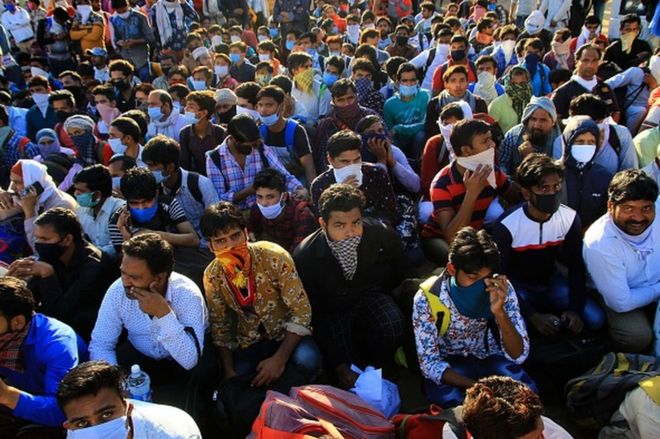
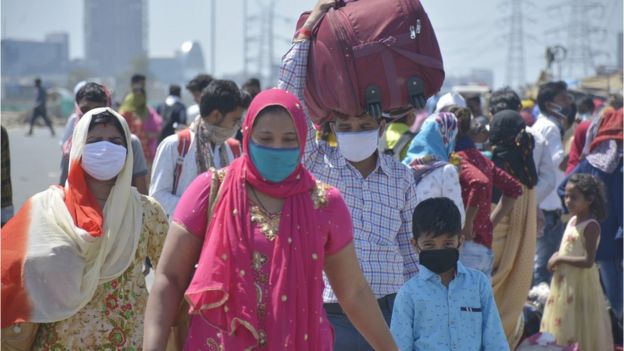
He was not alone. All over India, millions of migrant workers are fleeing its shuttered cities and trekking home to their villages.

These informal workers are the backbone of the big city economy, constructing houses, cooking food, serving in eateries, delivering takeaways, cutting hair in salons, making automobiles, plumbing toilets and delivering newspapers, among other things. Escaping poverty in their villages, most of the estimated 100 million of them live in squalid housing in congested urban ghettos and aspire for upward mobility.

Migrant workers head home on Day 5 of the 21 day nationwide lockdown imposed by PM Narendra Modi to curb the spread of coronavirus, at NH9 road, near Vijay Nagar, on March 29, 2020 in Ghaziabad, IndiaImage copyright GETTY IMAGES
Image caption Informal workers are the backbone of India’s big city economies

Last week’s lockdown turned them into refugees overnight. Their workplaces were shut, and most employees and contractors who paid them vanished.

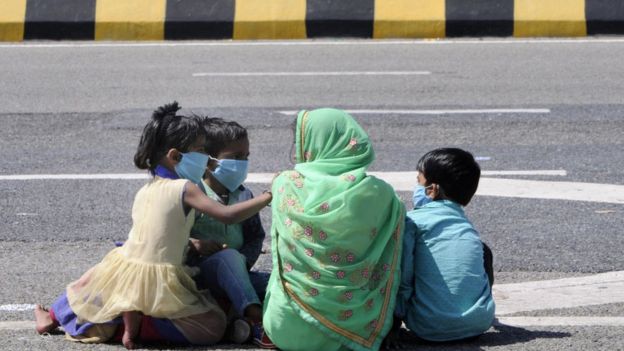
Sprawled together, men, women and children began their journeys at all hours of the day last week. They carried their paltry belongings – usually food, water and clothes – in cheap rexine and cloth bags. The young men carried tatty backpacks. When the children were too tired to walk, their parents carried them on their shoulders.

They walked under the sun and they walked under the stars. Most said they had run out of money and were afraid they would starve. “India is walking home,” headlined The Indian Express newspaper.

The staggering exodus was reminiscent of the flight of refugees during the bloody partition in 1947. Millions of bedraggled refugees had then trekked to east and west Pakistan, in a migration that displaced 15 million people.

migrant worker with children headed back home pauses for break, on day 5 of the nationwide lockdown imposed by PM Narendra Modi to check the spread of coronavirus, at Yamuna expressway zero point, on March 29, 2020 in Noida, India. (Photo by Sunil Ghosh /Hindustan Times via Getty Images)Image copyright GETTY IMAGES
Image caption Migrant labourers feel they have more social security in their villages

This time, hundreds of thousands of migrant workers are desperately trying to return home in their own country. Battling hunger and fatigue, they are bound by a collective will to somehow get back to where they belong. Home in the village ensures food and the comfort of the family, they say.

Clearly, a lockdown to stave off a pandemic is turning into a humanitarian crisis.

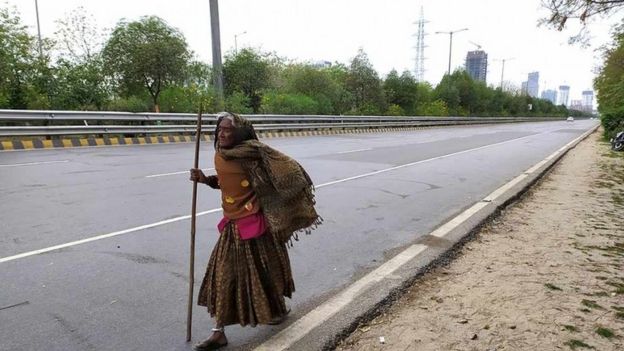
Among the teeming refugees of the lockdown was a 90-year-old woman, whose family sold cheap toys at traffic lights in a suburb outside Delhi.

Kajodi was walking with her family to their native Rajasthan, some 100km (62 miles) away. They were eating biscuits and smoking beedis, – traditional hand-rolled cigarettes – to kill hunger. Leaning on a stick, she had been walking for three hours when journalist Salik Ahmed met her. The humiliating flight from the city had not robbed her off her pride. “She said she would have bought a ticket to go home if transport was available,” Mr Ahmed told me.

Others on the road included a five-year-old boy who was on a 700km (434 miles) journey by foot with his father, a construction worker, from Delhi to their home in Madhya Pradesh state in central India. “When the sun sets we will stop and sleep,” the father told journalist Barkha Dutt. Another woman walked with her husband and two-and-a-half year old daughter, her bag stuffed with food, clothes and water. “We had a place to stay but no money to buy food,” she said.

Then there was Rajneesh, a 26-year-old automobile worker who walking 250km (155 miles) to his village in neighbouring Uttar Pradesh. It would take him four days, he reckoned. “We will die walking before coronavirus hits us,” the man told Ms Dutt.

He was not exaggerating. Last week, a 39-year-old man on a 300km (186 miles) trek from Delhi to Madhya Pradesh complained of chest pain and exhaustion and died; and a 62-year-old man, returning from a hospital by foot in Gujarat, collapsed outside his house and died. Four other migrants, turned away at the borders on their way to Rajasthan from Gujarat, were mowed down by a truck on a dark highway.

As the crisis worsened, state governments scrambled to arrange transport, shelter and food.

Kajodi DeviImage copyright SALIK AHMED/OUTLOOK
Image caption Ninety-year-old Kajodi Devi is walking from Delhi to her village

But trying to transport them to their villages quickly turned into another nightmare. Hundreds of thousands of workers were pressed against each other at a major bus terminal in Delhi as buses rolled in to pick them up.

Delhi chief minister Arvind Kejriwal implored the workers not to leave the capital. He asked them to “stay wherever you are, because in large gatherings, you are also at risk of being infected with the coronavirus.” He said his government would pay their rent, and announced the opening of 568 food distribution centres in the capital. Prime Minister Narendra Modi apologised for the lockdown “which has caused difficulties in your lives, especially the poor people”, adding these “tough measures were needed to win this battle.”

Whatever the reason, Mr Modi and state governments appeared to have bungled in not anticipating this exodus.

Mr Modi has been extremely responsive to the plight of Indian migrant workers stranded abroad: hundreds of them have been brought back home in special flights. But the plight of workers at home struck a jarring note.

“Wanting to go home in a crisis is natural. If Indian students, tourists, pilgrims stranded overseas want to return, so do labourers in big cities. They want to go home to their villages. We can’t be sending planes to bring home one lot, but leave the other to walk back home,” tweeted Shekhar Gupta, founder and editor of The Print.

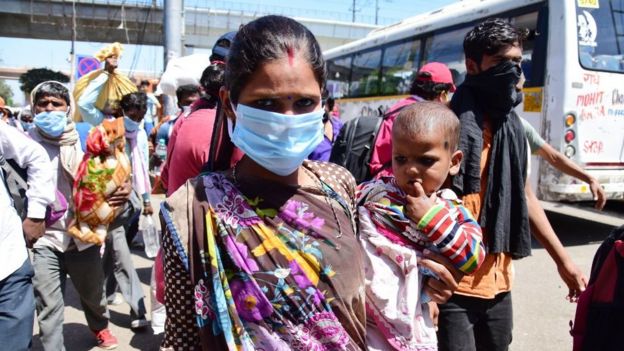
Migrant woman with a baby wearing a face mask as a preventive measure, at Anand vihar bus terminal during the nationwide lock downImage copyright GETTY IMAGES
Image caption There is a precedent for this kind of exodus during crisis

The city, says Chinmay Tumbe, author of India Moving: A History of Migration, offers economic security to the poor migrant, but their social security lies in their villages, where they have assured food and accommodation. “With work coming to a halt and jobs gone, they are now looking for social security and trying to return home,” he told me.

Also there’s plenty of precedent for the flight of migrant workers during a crisis – the 2005 floods in Mumbai witnessed many workers fleeing the city. Half of the city’s population, mostly migrants, had also fled the city – then Bombay – in the wake of the 1918 Spanish flu.

When plague broke out in western India in 1994 there was an “almost biblical exodus of hundreds of thousands of people from the industrial city of Surat [in Gujarat]”, recounts historian Frank Snowden in his book Epidemics and Society.

Half of Bombay’s population deserted the city, during a previous plague epidemic in 1896. The draconian anti-plague measures imposed by the British rulers, writes Dr Snowden, turned out to be a “blunt sledgehammer rather than a surgical instrument of precision”. They had helped Bombay to survive the epidemic, but “the fleeing residents carried the disease with them, thereby spreading it.”

More than a century later, that same fear haunts India today. Hundreds of thousands of the migrants will eventually reach home, either by foot, or in packed buses. There they will move into their joint family homes, often with ageing parents. Some 56 districts in nine Indian states account for half of inter-state migration of male workers, according to a government report. These could turn out to be potential hotspots as thousands of migrants return home.

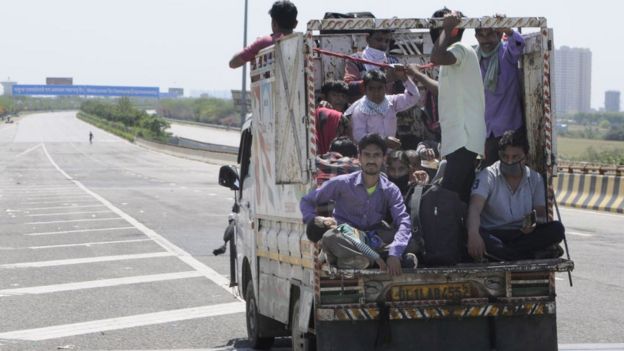
Migrant workers headed back to their towns and villages hitch a ride, on day 5 of the nationwide lockdown imposed by PM Narendra Modi to check the spread of coronavirus, at Yamuna expressway zero point, on March 29, 2020 in Noida, IndiaImage copyright GETTY IMAGES
Image caption The fleeing migrants could spread the disease all over the country

Partha Mukhopadhyay, a senior fellow at Delhi’s Centre for Policy Research, suggests that 35,000 village councils in these 56 potentially sensitive districts should be involved to test returning workers for the virus, and isolate infected people in local facilities.

In the end, India is facing daunting and predictable challenges in enforcing the lockdown and also making sure the poor and homeless are not fatally hurt. Much of it, Dr Snowden told me, will depend on whether the economic and living consequences of the lockdown strategy are carefully managed, and the consent of the people is won. “If not, there is a potential for very serious hardship, social tension and resistance.” India has already announced a $22bn relief package for those affected by the lockdown.

The next few days will determine whether the states are able to transport the workers home or keep them in the cities and provide them with food and money. “People are forgetting the big stakes amid the drama of the consequences of the lockdown: the risk of millions of people dying,” says Nitin Pai of Takshashila Institution, a prominent think tank.

“There too, likely the worst affected will be the poor.”

Source: The BBC

28/02/2020

Amid Delhi’s blood-letting, a Hindu bride weds in a Muslim neighbourhood

NEW DELHI (Reuters) – As deadly clashes between Hindu and Muslim groups rocked parts of the Indian capital Delhi this week, the family of a young Hindu woman living in a Muslim-majority area was forced to cancel her wedding.

Dressed in her wedding finery, her hands laced maroon with henna and her skin cleansed with turmeric, 23-year-old Savitri Prasad said she was weeping in her home as violent mobs battled outside on Tuesday, which was to have been her wedding day.

But Savitri’s father then organised the wedding for the following day, saying his Muslim neighbours were family and he was comforted by their presence.

“My Muslim brothers are protecting me today,” Savitri told a Reuters team that visited the house on the day of the ceremony, breaking down again as her family and neighbours comforted her.

The rituals took place at Savitri’s home, a small brick building in a narrow alley in the Chand Bagh district. Steps away, the main street looked like a war zone, with cars and shops vandalised, a Muslim shrine torched and the area littered with rocks used in pitched battles between mobs on both sides.

At least 32 people have been killed in the fighting in Chand Bagh and nearby areas of the capital this week, and hundreds of Hindus and Muslims have been injured in the worst sectarian riots in the Indian capital in decades.

“We went to the terrace and just saw smoke and more smoke,” Bhoday Prasad, Savitri’s father, said of the scene on Monday and Tuesday. “It is terrifying. We just want peace.”

Bhoday Prasad said he has lived in the area for years alongside Muslims without any trouble.

“We don’t know who the people behind the violence are, but they are not my neighbours. There is no enmity between Hindus and Muslims here.”

On Monday evening, the day Savitri was to have henna applied on her hands in a pre-wedding ritual, violence had already spiralled out of control.

“We could hear a lot of commotion outside, but I had the henna applied, hoping things would be better next day,” she said. Instead, they got worse.

Her father told the groom and his family it was too dangerous to come to the house.

“Our heart pains for her, who would want their daughter to be sitting home crying when she is supposed to be happy?” said Sameena Begum, one of the Muslim neighbours.

Violence ebbed on Wednesday, but markets remained shut and residents stayed indoors, fearful of further clashes. Savitri’s father said he decided to organise a scaled-down ceremony.

“Hindu or Muslim, we are all humans and we are all terrified of the violence,” said Savitri’s cousin Pooja, as she helped the bride dress for the ceremony. “This fight was not about religion, but it has been made so.”

Muslim neighbours gathered to offer blessings as the groom arrived and the wedding rituals took place, with a Hindu priest reciting holy verses and the groom and bride taking the rounds of a small pyre set up inside the house.

“We live peacefully with our Hindu brothers,” said Aamir Malik, who was standing guard with several other men outside the home. “We are everything for them. It’s been like that. We are here for them.”

Following an exchange of garlands, Savitri, her husband and his family were escorted out of the alleys by her family and neighbours.

“Today, none of our relatives could attend my daughter’s wedding,” said Bhoday Prasad. “But our Muslim neighbours are here. They are our family.”

Source: Reuters

Law of Unintended Consequences

continuously updated blog about China & India

ChiaHou's Book Reviews

continuously updated blog about China & India

What's wrong with the world; and its economy

continuously updated blog about China & India