05/05/2020
- Modified version of country’s most powerful rocket carries next-generation capsule designed to take astronauts to its planned space station
- It will be able to launch and land with three crew members and up to 500kg of cargo, according to state media
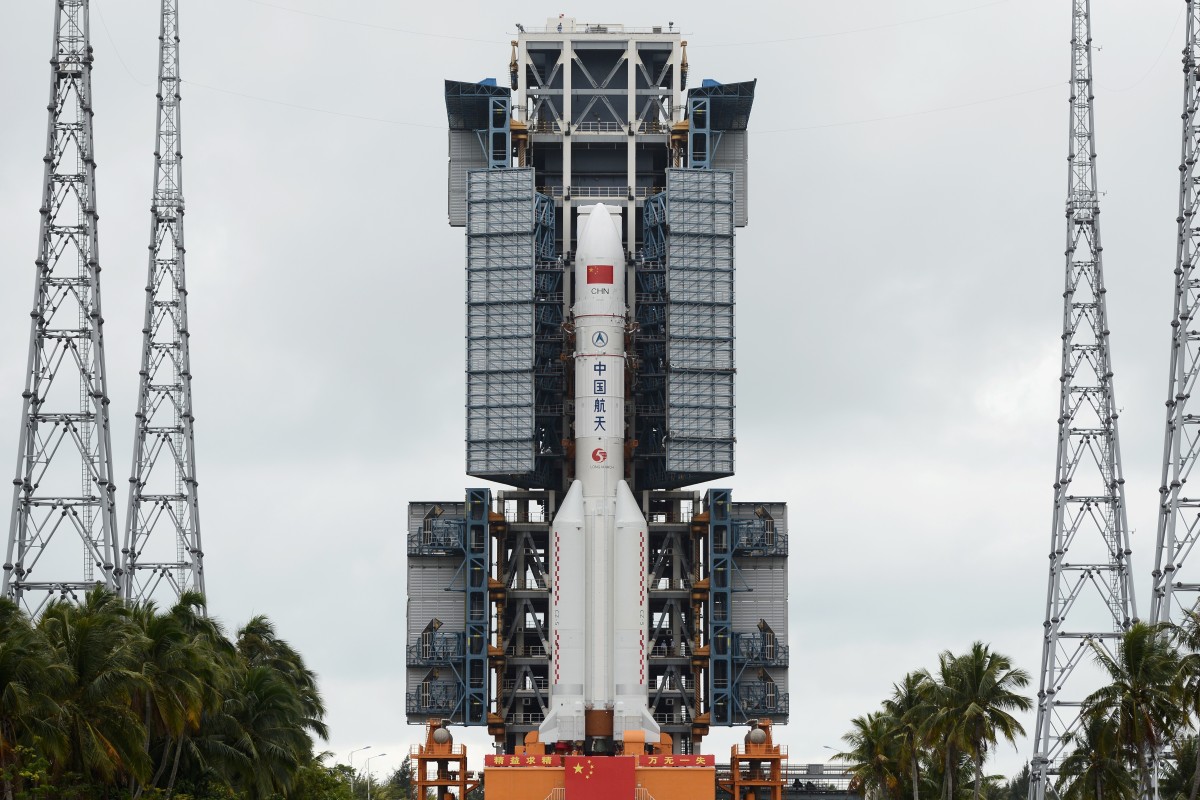
China launched a new version of its heavy-lift Long March 5 rocket on Tuesday. Photo: Reuters
China successfully launched a prototype of its next-generation manned spacecraft – without astronauts – along with a new version of its heavy-lift Long March 5 rocket on Tuesday, its space agency said.
The Long March 5B rocket was launched into low-Earth orbit from the Wenchang Satellite Launch Centre on Hainan Island in the country’s south.
The launch marks a significant step forward for China’s two big space exploration ambitions – building a space station and a mission to Mars.
A modified version of China’s most powerful rocket, the Long March 5B is 53.7 metres (176 feet) tall. It will carry the next-generation crew capsule prototype designed to replace the Shenzhou spacecraft, to transport astronauts to its planned space station in low-Earth orbit.
China aims to launch the core module of that space station designed for three crew members, the Tianhe, in 2021. Beijing has been planning to build its own space station for decades as an alternative to the International Space Station, from which China has been excluded by the United States over security concerns.
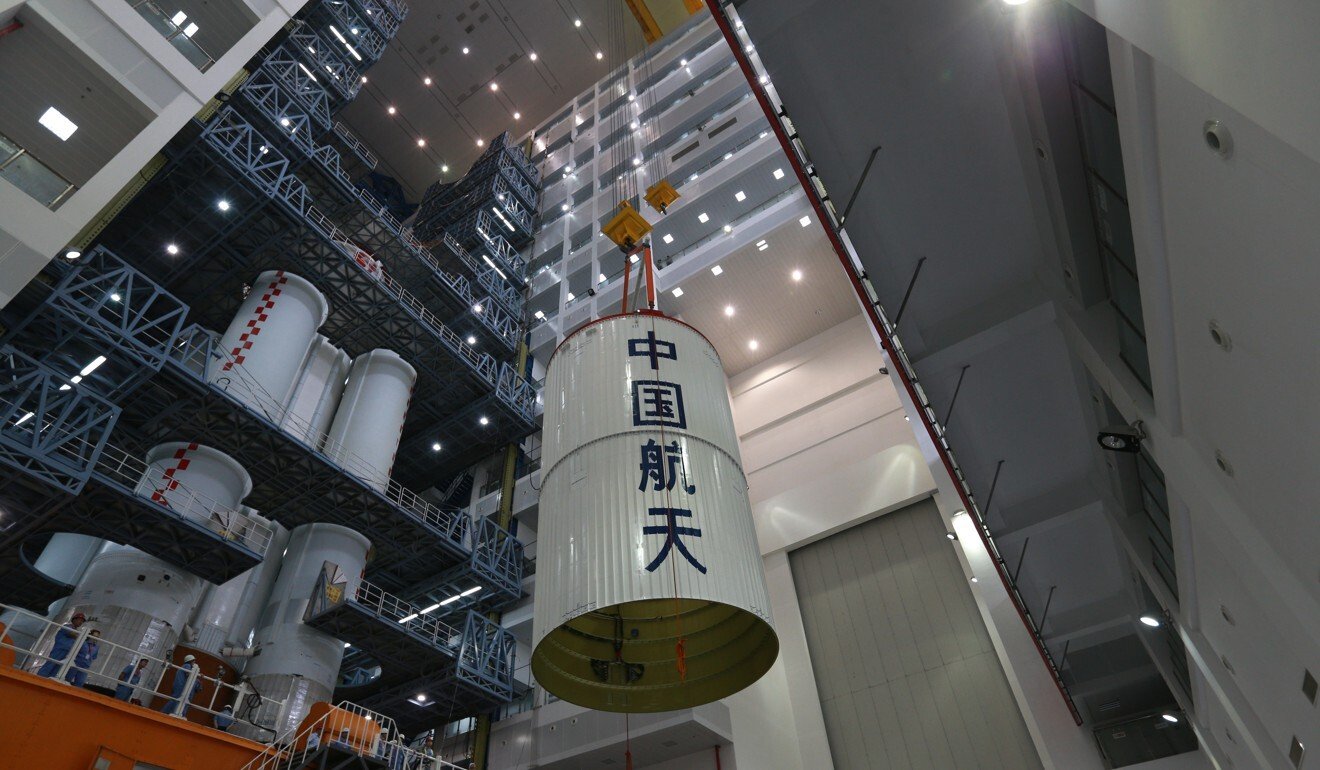
China’s space station project has been delayed by problems with its heavy-lift rockets. Photo: Xinhua
The prototype capsule has a different configuration to Shenzhou’s and it will be able to launch and land with three astronauts on board as well as up to 500kg of cargo, according to state news agency Xinhua. That will mean it can be used to transport research specimens and hardware from the space station back to Earth.
While the Shenzhou can ferry three astronauts, the new capsule design will be able to accommodate up to six crew members and, unlike the Shenzhou, it will be capable of carrying them to the moon, according to Chinese media reports.
Its systems, performance in orbit and parachute deployment are among the areas that will be put to the test during the launch.
Why China’s next Long March 5 rocket mission will be about restoring national pride
14 Dec 2019
The long-anticipated space station project has been delayed by problems in the development of heavy-lift rockets to carry the modules. In 2017, an oxygen supply problem caused the failure of the second Long March 5 launch, and it
plunged into the Pacific Ocean shortly after take-off. But in December it successfully
carried a Shijian-20 satellite into orbit, while the liquid oxygen-liquid hydrogen engines used in both the Long March 5 and 5B rockets passed testing in January.
China’s other space ambitions include a Mars probe, and landing astronauts on the moon within the next decade. For the Mars mission, the unmanned orbiter and rover Tianwen-1 will be launched by the Long March 5 and it is expected to take up to seven months for the probe to reach the red planet. China would be the third country to do so – after the United States and the Soviet Union.
Zhang Kejian, head of the China National Space Administration, said China was on track to launch the mission this year, with July the likely launch date.
Source: SCMP
Posted in 2021, ambitions, astronauts, Beijing, cargo, China, China National Space Administration, country’s south, crew members, December, delayed, designed, Earth, Excluded, Hainan, hardware, heavy-lift rockets, International Space Station, island, July, launches, liquid oxygen-liquid hydrogen engines, Long March 5B rocket, Low Earth orbit, manned, Mars probe, mission to Mars, Moon, national pride, next-generation capsule, orbit, oxygen supply, Pacific Ocean, parachute, planned, problems, prototype, research specimens, restoring, rover, security concerns, Shenzhou spacecraft, Shijian-20 satellite, Soviet Union, Space exploration, space station, space station project, spacecraft, third country, Three, Tianhe, Tianwen-1, Transport, Tuesday, Uncategorized, United States, Wenchang Satellite Launch Centre |
Leave a Comment »
02/05/2020
BEIJING/SHANGHAI (Reuters) – A northeastern Chinese city of 10 million people struggling with currently the country’s biggest coronavirus cluster shut dine-in services on Saturday, as the rest of China eases restrictions designed to hamper the spread of the disease.
Harbin, the provincial capital of Heilongjiang and its biggest city, said it temporarily suspended dine-in services for all eateries, reported the official CCTV citing an emergency epidemic prevention notice.
Catering services operating in the city, such as barbecue eateries and those selling skewers, shabu shabu, and stew, shall suspend dine-in meals until further notice and in accordance with changes in the epidemic situation, the notice said.
While mainland China reported only one case on Saturday and crowds returned to some of its most famous tourist attractions for the 5-day May holiday, the northern province of Heilongjiang is hunkering down to prevent further clusters from forming.
Of the 140 local transmissions in mainland China, over half have been reported as from Heilongjiang, according to a Reuters tally.
Heilongjiang province borders Russia and has become the frontline in the fight against a resurgence of the coronavirus epidemic, with many new infections from citizens entering from Russia.
The province has already banned entry to residential zones by non-locals and vehicles registered elsewhere. It had also ordered isolation for those arriving from outside China or key epidemic areas.
On the back of the outbreak, deputy secretary of the Provincial Party Committee Wang Wentao said at a Friday meeting “we deeply blame ourselves”, according to local media.
“We had an inadequate understanding of epidemic prevention and control,” said Wang, adding that the failure to carry out testing in a timely manner contributed to the clusters.
Source: Reuters
Posted in 5-day, accordance, arriving, banned entry, Barbecue, Beijing, biggest, biggest city, borders, Catering services, CCTV, changes, China, Chinese city, citing, Citizens, cluster, coronavirus, coronavirus epidemic, country’s, crowds, curbs, currently, deputy secretary, designed, Disease, ease, eateries, elsewhere, emergency, entering, epidemic areas, epidemic prevention, epidemic prevention and control, epidemic situation, fight, forming, Friday, frontline, hamper, Harbin, Heilongjiang, Heilongjiang province, hunkering down, inadequate understanding, isolation, key, local transmissions, Mainland China, May holiday, meals, meeting, million, most famous, new infections, non-locals, Northeastern, northern province, notice, Official, operating, ordered, outbreak, outside, People, prevent, provincial capital, Provincial Party Committee, registered elsewhere, reported, residential zones, rest of, restrictions, resurgence, returned, Reuters tally, Russia, Saturday, selling, Shanghai, shut, shuts, skewers, spread, stew, struggling, suspended, temporarily, tourist attractions, Uncategorized, vehicles |
Leave a Comment »
01/05/2020
GUBEI WATER TOWN, China (Reuters) – The mock Qing dynasty village nestled below the Great Wall would normally be teeming with tourists on Labour Day, but the thin crowds on Friday showed that while China’s coronavirus epidemic has subsided, people’s fears could take longer to fade.
During holidays, some 100,000 visitors a day would traipse round the quaint stone-paved streets of Gubei Water Town, 110 kilometres (68 miles) northeast of Beijing. Its marketing manager reckoned on getting just a tenth of that number this year.
“People have concerns about the virus and are unwilling to travel long distances,” said Guo Baorong. For a start, there will be no international tourists this time, he said, noting foreigners would normally make up around 15% of visitors.
About 70% of China’s tourist attractions had reopened as of Thursday, according to China’s Ministry of Culture and Tourism, but all sites have had to cap visitors to 30% of designed capacity.
More sites, including the Forbidden City in Beijing, were set to reopen Friday.
Staff at the entrance to Gubei Water Town checked visitors’ temperatures and health tracking codes. And inside, lines on the ground directed tourists to stand one meter apart and stores used ropes to keep crowds from forming. Like everywhere in China since the lockdowns were imposed to stem the epidemic, everyone wore masks.
Still, in places where tourists squeezed together as the streets narrowed, staff shouted at them to spread out.
Some tourists enjoyed the smaller crowds.
Xiao Chen, a 24-year-old student wearing traditional Chinese garb known as “Hanfu” came to Gubei to take pictures around ancient architecture.
“It’s good to come out of the city. There was barely anyone in Gubei Water Town yesterday, and even today, it’s not crowded,” she said.
The tranquility may not last. Room bookings jumped on Thursday after Beijing and nearby areas began easing coronavirus restrictions, with about 90% of accommodation now reserved.
“We were not expecting that many people to come in,” said Guo.
Source: Reuters
Posted in 100,000, 15%, 30%, 90%, accommodation, according, ancient architecture, Beijing, cap, capacity, checked, China's, coronavirus epidemic, crowds, curbs, designed, entrance, fade, Fears, Forbidden City in Beijing, Foreigners, Friday, Great Wall, Gubei, GUBEI WATER TOWN, hanfu, health tracking codes, holidays, international, jumped, kilometres, Labour Day, lockdowns, marketing manager, masks, miles, Ministry of Culture and Tourism, mock, nestled, Normally, Northeast, number, pictures, Qing Dynasty, quaint, reckoned, relaxed, reserved, Room bookings, sites, squeezed, staff, stone-paved, streets, Student, subsided, teeming, temperatures, tenth, this year, Thursday, tourists, traditional, traipse, tranquility, trickle, Uncategorized, Village, Virus, visitors, wearing |
Leave a Comment »
14/08/2019
Participants pose for photos at the New Inclusive Asia Dialogue in Kuala Lumpur, Malaysia, Aug. 14, 2019. The China-proposed Belt and Road Initiative (BRI) was formulated with economic development agenda through increased connectivity, infrastructure and capacity building, according to academics and experts at the New Inclusive Asia Dialogue here on Wednesday. (Photo by Chong Voon Chung/Xinhua)
KUALA LUMPUR, Aug. 14 (Xinhua) — The China-proposed Belt and Road Initiative (BRI) was formulated with economic development agenda through increased connectivity, infrastructure and capacity building, according to academics and experts at a conference here on Wednesday.
Speaking at the New Inclusive Asia Dialogue, multiple experts said BRI, as a flexible economic oriented initiative, stood in contrast with attempts by certain country to piece together its own trade network, which was described as being focused on political agendas.
Dr S Mahmud Ali, an associate fellow with the University of Malaya’s Institute of China Studies, said countries like Malaysia, which aspired to reach developed nation status, had recognized the real gains to be had from participation in BRI.
Mahmud said once several on-going BRI related projects were completed in the country, the country’s economic capacity would be greatly boosted.
Malaysia does play a significant role and substantial amounts of Chinese investments funding projects will boost Malaysia’s productivity, total production capacity, its ability to export and produce good that will rise quite dramatically once these projects are completed, he said.
Proposed by China in 2013, the Belt and Road Initiative refers to the Silk Road Economic Belt and the 21st century Maritime Silk Road, which aims at building trade and infrastructure networks connecting Asia with Europe and Africa along the ancient trade routes of the Silk Road.
Chairman of the Committee of International Information of the Foreign Affairs Ministry of Kazakhstan Timur Shaimergenov said that the flexible, economically focused BRI had gained strong support due to the inclusive approach taken by China.
“The Belt and Road Initiative is a flexible economic oriented project. It does not come with political pressure but instead it is about giving participating countries the opportunity to take advantage of economic opportunities.”
Criticism against BRI has taken on a political dimension and they are completely ignoring that while BRI started as a Chinese initiative, it has really become a Eurasian initiative,” he said.
Olga Kuznetsova, a professor with the Moscow Lomonosov State University said infrastructure development had the potential to benefit countries along BRI route, calling on countries to formulate clear plans to take advantage of the economic spillover.
“Russia is interested in the development of Eurasian transport corridors and invests in the implementation of projects to create them,” she said.
Chinese Ambassador to Malaysia Bai Tian said China had made it clear that it would continue to be a supporter of fair and equitable international trade and globalization, especially in the backdrop of unilateral protectionism.
“We look forward to joining hands with Asian countries to promote trade and investment facilitation, to accelerate the process of regional free trade zone, and to deepen regional and sub-regional cooperation,” he said.
Hosted by the Center for New Inclusive Asia, a Malaysian based think tank, the two-day dialogue aims to foster better understanding of connectivity as a means to promote inclusive growth in Asia, bringing together prominent scholars, senior government officials and corporate leaders from some 10 countries and regions.
Source: Xinhua
Posted in 21st Century Maritime Silk Road,, africa, Asia, Asian countries, Belt and Road Initiative (BRI), BRI, capacity building, Center for New Inclusive Asia, Chairman of the Committee of International Information of the Foreign Affairs Ministry of Kazakhstan, China-proposed, Chinese Ambassador to Malaysia, designed, Economic development, Eurasian transport corridors, Europe, Institute of China Studies, Malaysia, Moscow Lomonosov State University, New Inclusive Asia Dialogue, Russia, Silk Road, Silk Road Economic Belt, Uncategorized, University of Malaya |
Leave a Comment »




 CHINDIA ALERT: You'll be living in their world, very soon