Chindia Alert: You’ll be Living in their World Very Soon
aims to alert you to the threats and opportunities that China and India present. China and India require serious attention; case of ‘hidden dragon and crouching tiger’.
Without this attention, governments, businesses and, indeed, individuals may find themselves at a great disadvantage sooner rather than later.
The POSTs (front webpages) are mainly 'cuttings' from reliable sources, updated continuously.
The PAGEs (see Tabs, above) attempt to make the information more meaningful by putting some structure to the information we have researched and assembled since 2006.
Researchers conclude that the virus was circulating undetected in France in February
Findings highlight the difficulties governments face in tracing the source of coronavirus outbreaks
Researchers in France have carried out genetic analysis and found that the dominant types of the viral strains in the country did not come from China or Italy. Photo: AP
The coronavirus outbreak in France was not caused by cases imported from China, but from a locally circulating strain of unknown origin, according to a new study by French scientists at the Institut Pasteur in Paris.
Genetic analysis showed that the dominant types of the viral strains in France belonged to a clade – or group with a common ancestor – that did not come from China or Italy, the earliest hotspot in Europe.
“The French outbreak has been mainly seeded by one or several variants of this clade … we can infer that the virus was silently circulating in France in February,” said researchers led by Dr Sylvie van der Werf and Etienne Simon-Loriere in a non-peer reviewed paper released on bioRxiv.org last week.
The Covid-19 pandemic has infected more than 128,000 people in France and caused more than 23,000 deaths.
France detected the virus in late January, before any other country in Europe. A few patients with a travel history that included China’s Hubei province were sampled on January 24 and tested positive.
The Covid-19 pandemic has infected more than 128,000 people in France and caused more than 23,000 deaths. Photo: AFP
The French government took quick and decisive measures to trace contacts of the infected people and shut down the chance of further infection.
However, these strains were not found in patients tested after the initial imported cases, suggesting “the quarantine imposed on the initial Covid-19 cases in France appears to have prevented local transmission”, the researchers said.
The Pasteur institute collected samples from more than 90 other patients across France and found the strains all came from one genetic line. Strains following this unique path of evolution had so far only been detected in Europe and the Americas.
Singapore Covid-19 cases to rise as not all migrant workers being tested
28 Apr 2020
The earliest sample in the French clade was collected on February 19 from a patient who had no history of travel and no known contact with returned travellers.
Several patients had recently travelled to other European countries, the United Arab Emirates, Madagascar and Egypt but there was no direct evidence that they contracted the disease in these destinations.
To the researchers’ surprise, some of the later strains collected were genetically older – or closer to the ancestral root – than the first sample in this clade.
Spanish official cries reading names of health workers killed by coronavirus
A possible explanation, according to the authors, was that local transmission had been occurring in France for some time without being detected by health authorities.
The French government may have missed detecting the transmission. According to the researchers, a large proportion of those patients might have had mild symptoms or none at all.
The researchers also found that three sequences later sampled in Algeria were closely related to those in France, suggesting that travellers from France might have introduced the virus to the African country and caused an outbreak.
China says US politicians are lying as Trump calls for Covid-19 damages
29 Apr 2020
Benjamin Neuman, professor and chair of biological sciences with the Texas A&M University-Texarkana, said the French strains might have come from Belgium, where some sequences most closely related to the original strain from China were clustered.
“Since the earliest European strains of [the coronavirus] Sars-CoV-2 seem to be associated with Belgium, the idea that the virus spread from Belgium to both Italy and France at around the same time seems plausible, as this paper contends,” he said.
France is the latest in a growing number of countries and areas where no direct link between China and local outbreaks could be established.
The dominant strains in Russia and Australia, for instance, came from Europe and the United States, respectively, according to some studies.
These findings have drawn fire from some politicians who have tried to deflect domestic anger over their handling of the crisis by blaming China.
Is this the next big hotspot for the ‘little flu’?
28 Apr 2020
“So now the Fake News @nytimes is tracing the CoronaVirus origins back to Europe, NOT China. This is a first!” he tweeted on April 11, referring to a story about the studies in the The New York Times’ science section.
The findings also highlight the difficulties governments face in tracing the source of coronavirus outbreaks.
Less-developed countries may never know where their strains came from due to inadequate testing and sequencing capability.
India, for example, has released the genetic sequence of fewer than 40 samples to the public so far, a small number considering its huge population.
Most of the strains sampled in 35 early cases came from clades that could be traced to Italy and Iran, with only a few from China, according to a recent study. But researchers were not able to track further because of the lack of data.
A scientist on the study, Dr Mukesh Thakur, of the Zoological Survey of India, said it was too early to rule out China as the source of outbreaks in India because the number of samples at hand was limited.
A 20-year-old student studying medicine in Wuhan, for instance, might have come in contact with many people on the way home before she was tested positive on January 30.
Thakur said local media reported that the Indian government quarantined 3,500 people possibly linked to three positive cases imported from Wuhan.
“God knows how many of them tested positive in the subsequent stages,” Thakur said in an email response to the Post’s queries on Tuesday.
Some prominent scientists, including Francis Collins, director of the US National Institutes of Health, said the virus might have been spreading quietly in humans for years, or even decades, without causing a detectable outbreak.
The virus had thus adapted well to the human body. Some genes regulating its binding to host cells were similar, or even identical, to those found in some other highly infectious human viruses, such as HIV and Ebola.
According to some estimates, the ancestor of Sars-CoV-2, the virus causing Covid-19, might have left bats between 50 and 70 years ago. A recent study by a team of geneticists in Oxford University estimated the first outbreak of the current pandemic could have occurred as early as September last year.
They found that the dominant strains circulating in China and Asia were genetically younger than some popular strains in the United States.
Six animals inoculated with vaccine candidate then exposed to virus did not catch Covid-19 after 28 days
Up to 60 million doses could be produced by Serum Institute of India this year
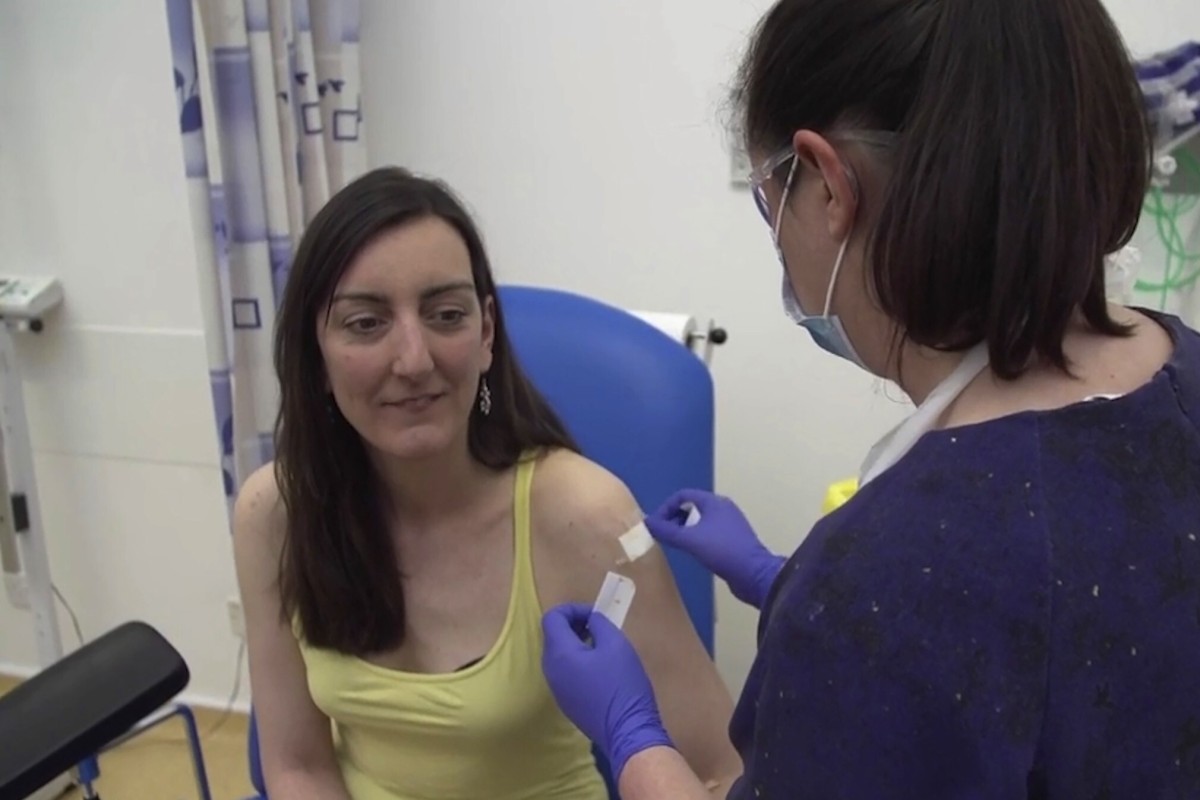
Microbiologist Elisa Granato gets an injection on Thursday as part of the first human trials in Britain for a potential coronavirus vaccine. Photo: University of Oxford via AP
A leading candidate for a Covid-19 vaccine has shown promising results in animal trials, and is expected to see mass production in India within months.
The Serum Institute of India, the world’s largest maker of vaccines by volume, said on Tuesday that it plans this year to produce up to 60 million doses of a potential vaccine developed by the University of Oxford, which is under clinical trial in Britain.
While the vaccine candidate, called “ChAdOx1 nCoV-19”, is yet to be proven to work against Covid-19, Serum decided to start manufacturing it as it had shown success in animal trials and had progressed to tests on humans, Serum Chief Executive Adar Poonawalla said.
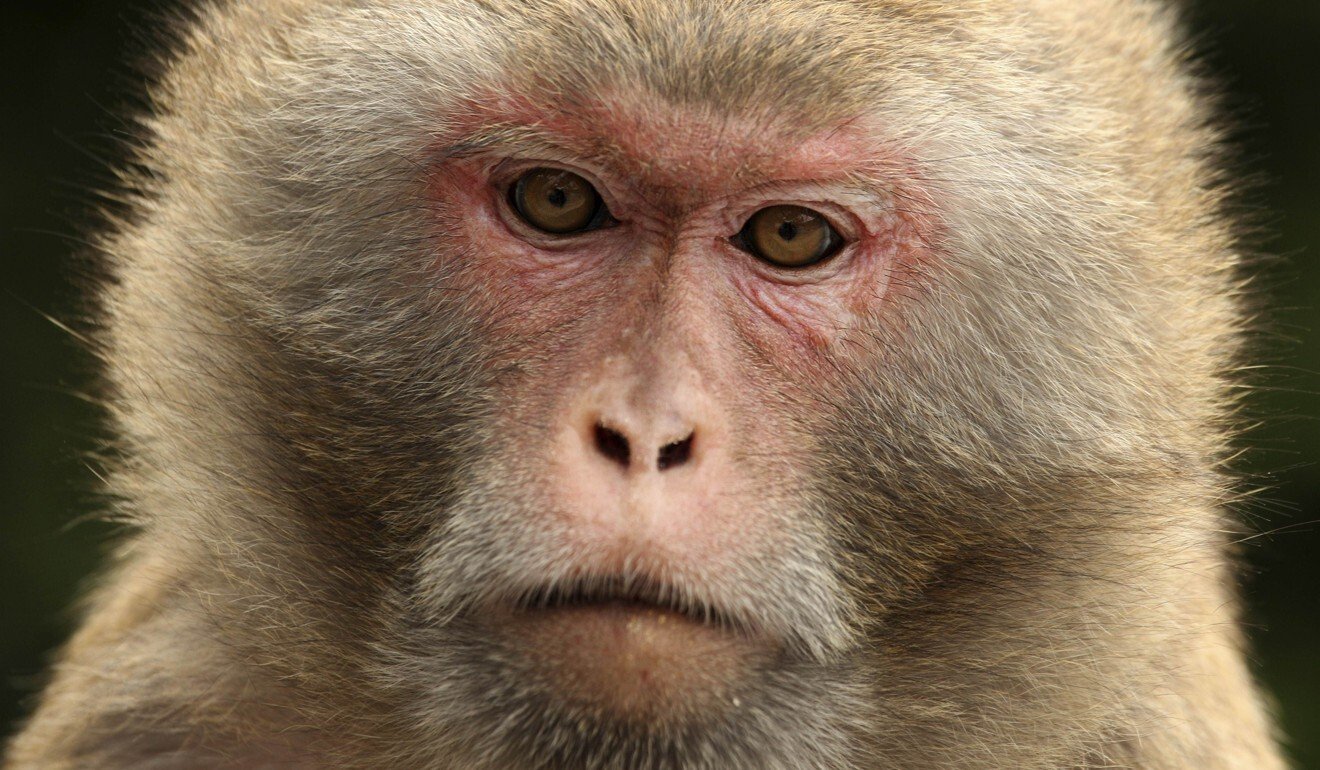
Six rhesus macaque monkeys were inoculated with the vaccine candidate at the National Institutes of Health’s Rocky Mountain Laboratory in Montana last month, according to The New York Times.
Covid-19 vaccine trial starts in Oxford, but remdesivir treatment reportedly flops in China tests
The subjects were exposed afterwards to large quantities of the novel coronavirus, but all six remained healthy after more than 28 days, the newspaper reported, citing researcher Vincent Munster, who conducted the test.
More than 3 million people have been reported to be infected globally and over 210,000 have died from Covid-19, the respiratory disease caused by the coronavirus.
“They are a bunch of very qualified, great scientists [at Oxford] … That’s why we said we will go with this and that’s why we are confident,” Poonawalla told Reuters in a phone interview.
“Being a private limited company, not accountable to public investors or bankers, I can take a little risk and sideline some of the other commercial products and projects that I had planned in my existing facility,” Poonawalla said.
Bill Gates hopes his virus vaccine ‘manufacturing within a year’
27 Apr 2020
As many as 100 potential Covid-19 candidate vaccines are now under development by biotech and research teams around the world, and at least five of these are in preliminary testing in people in what are known as phase one clinical trials.
Poonawalla said he hoped trials of the Oxford vaccine, due to finish in about September, would be successful. Oxford scientists said last week the main focus of initial tests was to ascertain not only whether the vaccine worked but that it induced good immune responses and no unacceptable side effects.
Serum, owned by the Indian billionaire Cyrus Poonawalla, plans to make the vaccine at its two manufacturing plants in the western city of Pune, aiming to produce up to 400 million doses next year if all goes well, Poonawalla said.
“A majority of the vaccine, at least initially, would have to go to our countrymen before it goes abroad,” he said, adding that Serum would leave it to the Indian government to decide which countries would get how much of the vaccine and when.
Rhesus macaque monkeys are often used in animal testing because of their similarity to humans. Photo: AFP
Serum envisages a price of 1,000 rupees (US$14.70) per vaccine, but governments would give it to people without charge, he said.
He said Prime Minister Narendra Modi’s office was “very closely” involved in the vaccine production and the company is hoping the government will help foot the cost of making it.
Over roughly the next five months, Serum will spend some 300 million to 400 million rupees (US$4.4 million to US$5.9 million) on making around 3-5 million doses per month, he said. “[The government] are very happy to share some risk and fund something with us, but we haven’t really pencilled anything down yet,” Poonawalla said.
Coronavirus: clinical trial begins on third vaccine candidate in China
22 Apr 2020
Serum has also partnered with the US biotech firm Codagenix and Austria’s Themis on two other Covid-19 vaccine candidates and plans to announce a fourth alliance in a couple of weeks, he said.
Serum’s board last week also agreed to invest roughly 6 billion rupees (US$8.8 billion) on making a new manufacturing unit to solely produce coronavirus vaccines, Poonawalla said.








 CHINDIA ALERT: You'll be living in their world, very soon