09/05/2020
- Incident happened on Friday afternoon in waters close to Diaoyu Islands, which are controlled by Tokyo but claimed by Beijing
- Japanese fishing boat had three crew members on board but no one was hurt, reports say
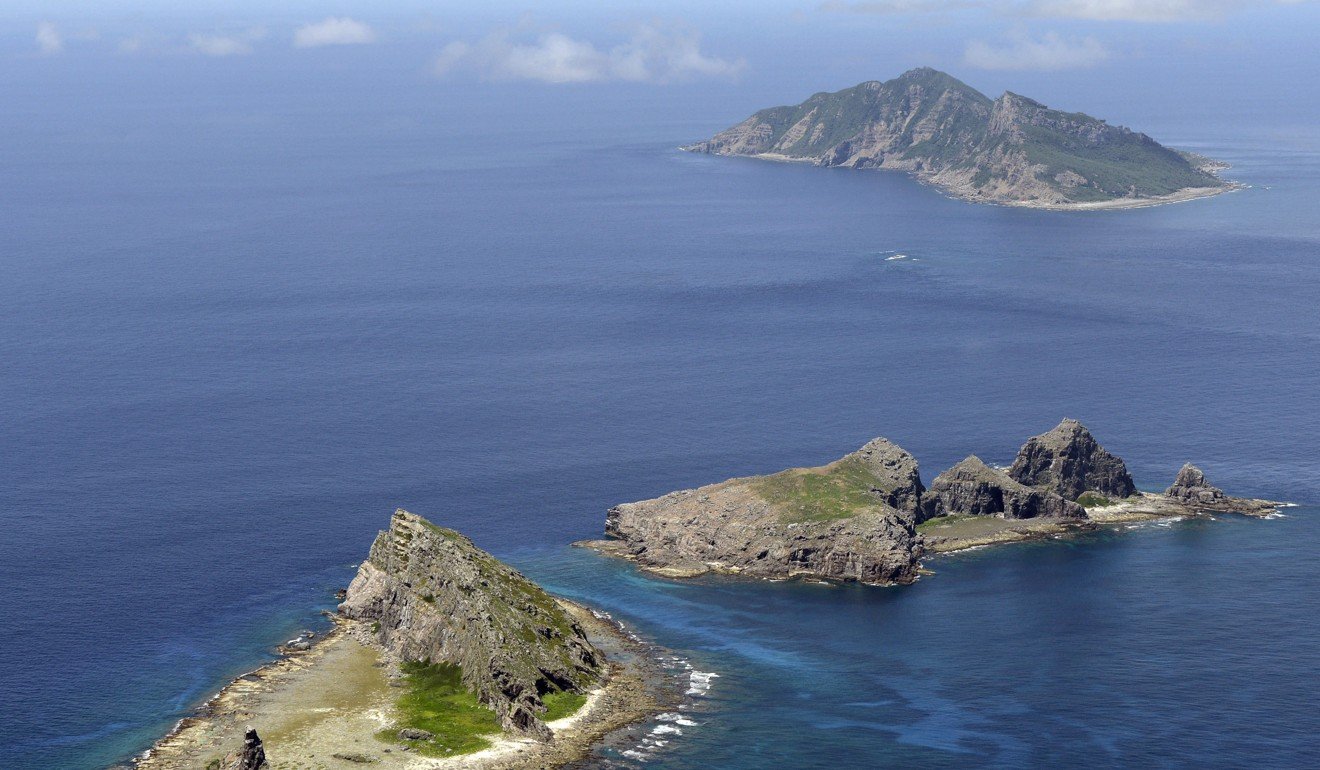
The Diaoyu Islands are the focus of a long-running territorial dispute between China and Japan. Photo: Kyodo
Japan said it deployed patrols and issued warnings to a group of Chinese coastguard vessels spotted pursuing a Japanese fishing boat in the hotly contested waters of the East China Sea on Friday.
The Japan Coast Guard said on Saturday that four Chinese coastguard vessels entered waters close to the Diaoyu Islands – a group of uninhabited islands controlled by Tokyo and known locally as known as Senkaku – at about 4pm.
The face-off took place about 50 minutes later, when two of the Chinese vessels began to chase a Japanese fishing boat in a stretch of water about 12km (7.5 miles) southwest of Uotsuri, one of the largest islands in the group, news agency Jiji Press cited the coastguard’s regional headquarters in Naha as saying.
After the maritime agency sent patrol ships to the scene and issued a warning over the radio, the Chinese ships left the area, the report said.
The fishing vessel had three crew members on board at the time of the pursuit but no one was hurt, it said.
An unnamed official from the Japanese coastguard was quoted as saying that “we don’t think that a dangerous event has happened”.
Earlier on Friday, China Coast Guard said on its official Weibo social media account that a fleet of its vessels had “patrolled the territorial waters around the Diaoyu Islands”.
The four Chinese vessels were in the region for about two hours, Japan’s Kyodo News reported.
China’s foreign ministry did not immediately respond to requests for comment.
The uninhabited but resource-rich islands and reefs of the East China Sea have been the setting for territorial disputes between China and Japan for decades, though relations between the two Asian giants have been steadily improving in recent years.
Japanese Prime Minister Shinzo Abe has visited Beijing twice since 2018, while officials from the two sides are working to rearrange a state visit to Japan by Chinese President Xi Jinping that had been planned for last month but had to be postponed because of the coronavirus pandemic.
The Japanese government bought the Diaoyu Islands from a private owner in 2012, but Beijing claims them. Patrols by Chinese coastguard vessels are common in the area, with the latest – excluding Friday – happening on April 17.
Beijing has also sought to assert its sovereignty in the region by imposing annual summer fishing bans in the East China Sea, including in the waters off the Diaoyu Islands. This year’s ban began on May 1 and runs until August 16.
Source: SCMP
Posted in Beijing, caught, chasing, Chinese, Chinese President Xi Jinping, Coronavirus pandemic, diaoyu islands, East China Sea, fishing boat, Japan, Japanese government, Japanese Prime Minister Shinzo Abe, Jiji Press, private owner, Senkaku, sovereignty, Tokyo, Uncategorized, wards off |
Leave a Comment »
22/03/2020
- Move will help air force with patrols and combat-readiness near Taiwan and in the East and South China seas, according to observers
- Markings including national flag and service insignia will also be standardised under new guidelines
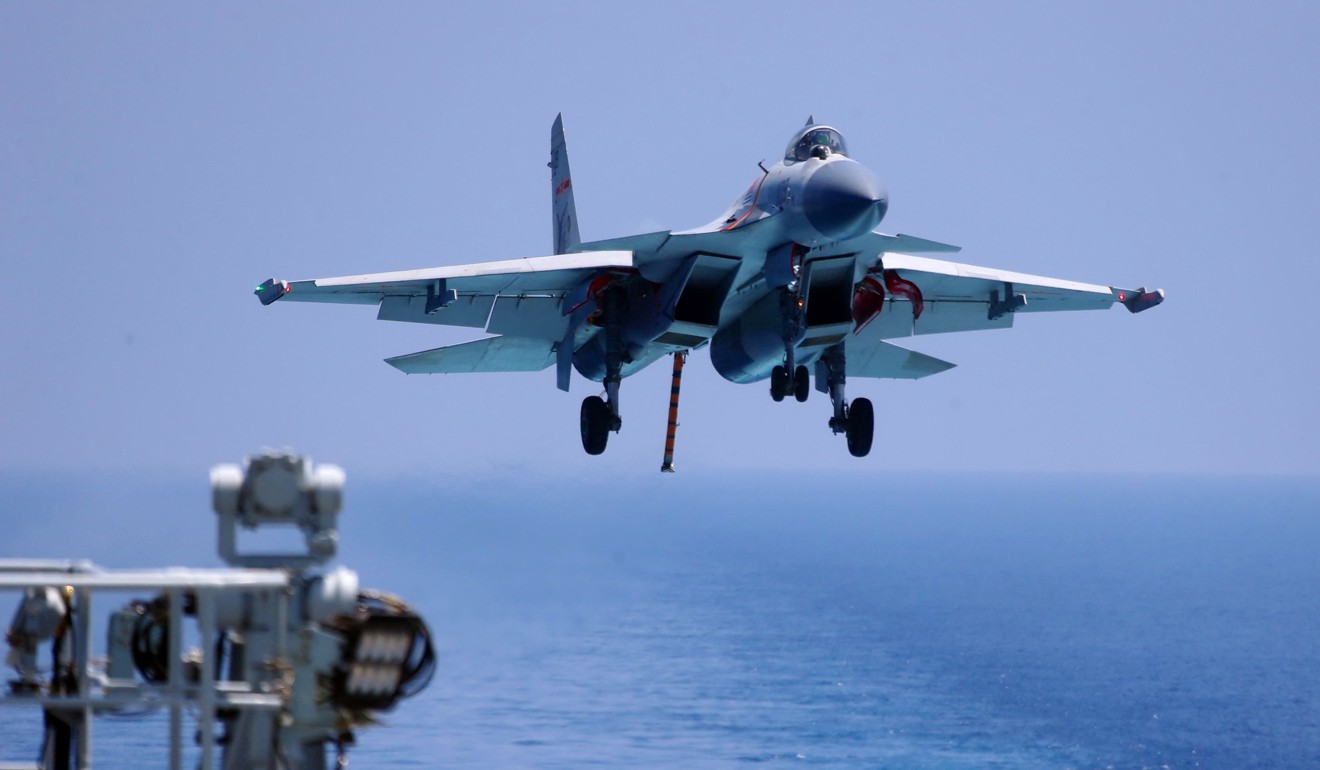
Chinese military aircraft will get “low observable” coatings and standardised markings. Photo: Xinhua
Chinese military aircraft are to be painted with “low observable” coatings and standardised markings under new guidelines, a move observers say will assist with operations near Taiwan and in the East and South China seas.
The guidelines require markings including the national flag and service insignia to be gradually standardised on both active and future warplanes, the official PLA Daily newspaper said earlier this month.
The move comes two years after the Chinese navy started experimenting with its J-16 strike fighter, using a dark grey low-visibility coating instead of blue-grey, and replacing its service insignia with a new design, according to military magazine Ordnance Industry Science Technology.
Some of the navy’s only active aircraft carrier-based fighter jets, the J-15s, have also been given new coatings and markings, according to the People’s Liberation Army’s official website.
PLA Daily said the move aimed to give Chinese warplanes a combat advantage as they “will be less likely to be detected by both the naked eye and military radar”. It said the new guidelines would be gradually implemented this year.
Some of the aircraft carrier-based J-15 fighter jets already have the new coatings. Photo: AFP
Macau-based military observer Antony Wong Dong said the move would help the air force improve patrols and combat-readiness as it carried out more drills near the Taiwan Strait and in the East and South China seas.
China’s air force and navy have sent warplanes including Su-35 fighter jets, H-6K strategic bombers and advanced KJ-2000 airborne early warning aircraft to conduct “encirclement” drills around Taiwan since 2018, as Beijing applies pressure on the self-ruled island that it sees as part of its territory. But none of the aircraft seen in photographs of the exercises had low-visibility coatings or standardised markings, as used on the navy’s J-16s and J-15s.
US spy plane pilots use China’s satellite navigation system as backup
“Aircraft used by the PLA Air Force have different coatings and markings because they are still in a transitional period,” Wong said. “Its counterparts like Taiwan have learned from Western countries like the United States to standardise coatings and markings and designs [since the 1990s].”
Beijing insists that Taiwan, which split from the mainland in 1949, remains part of China and they will eventually be reunited – by force if necessary.
The PLA also regularly sends aircraft to monitor freedom of navigation operations by the US Navy in the
South China Sea. Beijing has territorial disputes in the resource-rich waterway with countries including Vietnam, the Philippines, Malaysia and Brunei.
A military insider in Beijing said the US move to send hundreds of its new-generation F-35 stealth fighter jets to South Korea and Japan had also pushed the PLA to upgrade the coatings on its aircraft.
“These coatings are a highly technical area, and China puts a tremendous amount of resources into research on this every year,” said the insider, who requested anonymity due to the sensitivity of the issue. “The coating that’s used on
China’s first stealth fighter jet, the J-20, is more advanced than they used on the Lockheed Martin F-22s, but it’s not yet at the level of the F-35s.”
Hong Kong-based military expert Song Zhongping said military aircraft used to have a bright red national flag and service insignia that made them more detectable on radar systems, or even with the naked eye.
“The red they used is striking, but it’s not in line with the ‘low observable’ requirement for all fighter jets,” said Song, who is a military commentator for Phoenix Television.
“All fighter jets must have stealth and low-visibility capabilities, and the coatings and markings on them are part of how they can do this and meet requirements for combat.”
Source: SCMP
Posted in Beijing, Brunei, Chinese, Chinese navy, Chinese warplanes, coatings, detect, East China Sea, F-35 stealth fighter jets, H-6K strategic bombers, harder, J-16 strike fighter, Japan, KJ-2000 airborne early warning aircraft, Lockheed Martin F-22s,, Malaysia, national flag, Ordnance Industry Science Technology, Philippines, PLA Air Force, PLA Daily, service insignia, South China Sea, South Korea, Su-35 fighter jets,, Taiwan, Taiwan Strait, Uncategorized, United States, Vietnam |
Leave a Comment »
13/09/2019
- Operations aimed to caution Beijing that US forces can carry out amphibious campaigns far from home
- Washington has power to intervene directly in territorial disputes between its allies and China
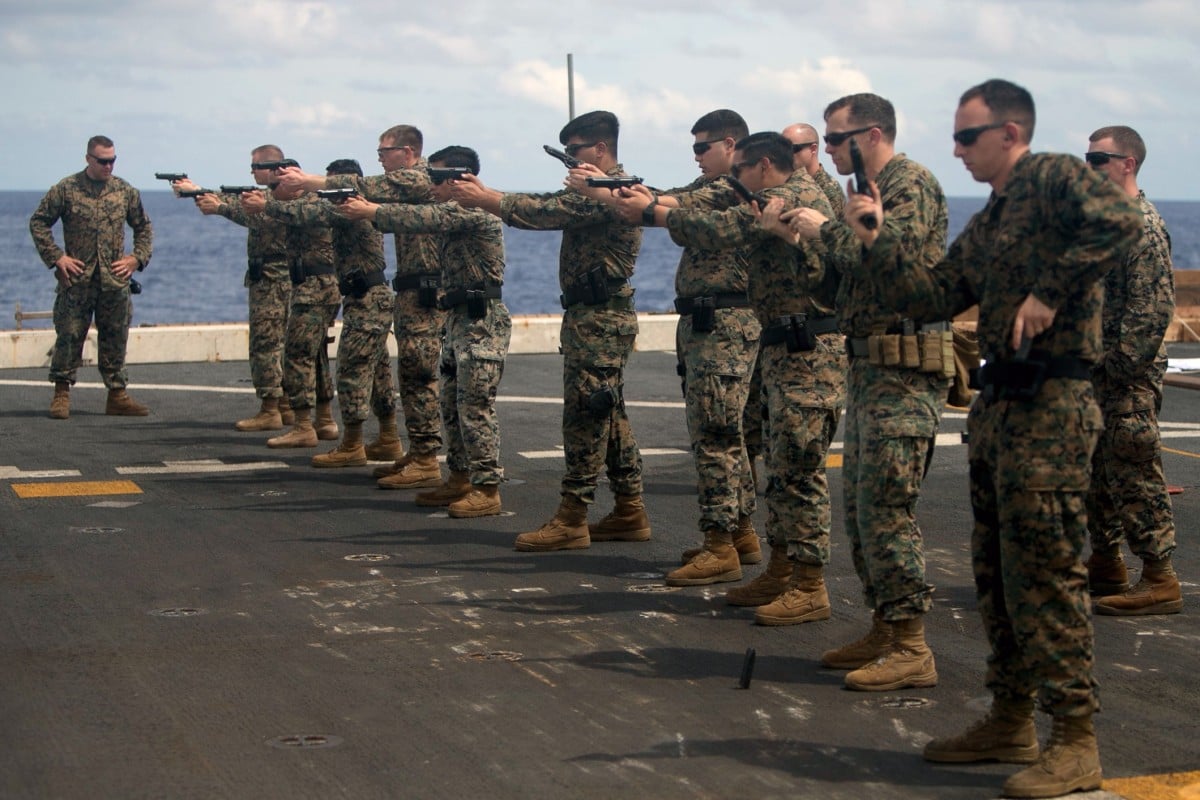
US Marines practise speed reloads on August 9 aboard the USS Green Bay, part of the Wasp Amphibious Ready Group, in the Indo-Pacific region. Photo: Handout
US Marines have conducted airfield- and island-seizure drills in the East and South China seas in what observers say is meant to remind Beijing of US military supremacy in the Asia-Pacific.
The 11-day naval drills were conducted near the Philippines and around the Japanese island of Okinawa by Okinawa-based US marine expeditionary units, the 31st Marine Expeditionary Unit said.
Observers said the operations were meant as a warning to Beijing that the US military could carry out amphibious campaigns far from home if Washington needed to intervene in territorial disputes between China and America’s allies in the region.
The 31st Marine Expeditionary Unit and Amphibious Squadron 11 conducted joint weapons drills from their Wasp Amphibious Ready Group ships from August 9-19, the Okinawa-based marine unit said in a statement.
The activity took place in the Philippine and East China seas and around an American naval base in Japan, it said.
The unit’s Amphibious Reconnaissance Platoon also performed a reconnaissance and surveillance mission through a high-altitude, low-opening parachute jump onto Okinawa.
A tilt-rotor aircraft, which hovers like a helicopter but flies like an aeroplane, afterward sent a landing team from a Wasp ship more than 400km (250 miles) away to establish the arming and refuelling point. The team achieved its objective in just over one hour, the statement said.
“The speed with which the Marines were able to establish the forward arming and refuelling point demonstrates a capability that is critical to conducting expeditionary operations in a contested environment,” the statement quoted Lieutenant Guirong Cai, a FARP officer-in-charge from the Marine Air Traffic Control Mobile Team, as saying.
“Their proficiency in swiftly setting up a refuelling point with 5,500 pounds (2.5 tonnes) of fuel demonstrates the 31st MEU’s ability to rapidly refuel and redeploy our air assets as the mission requires.”
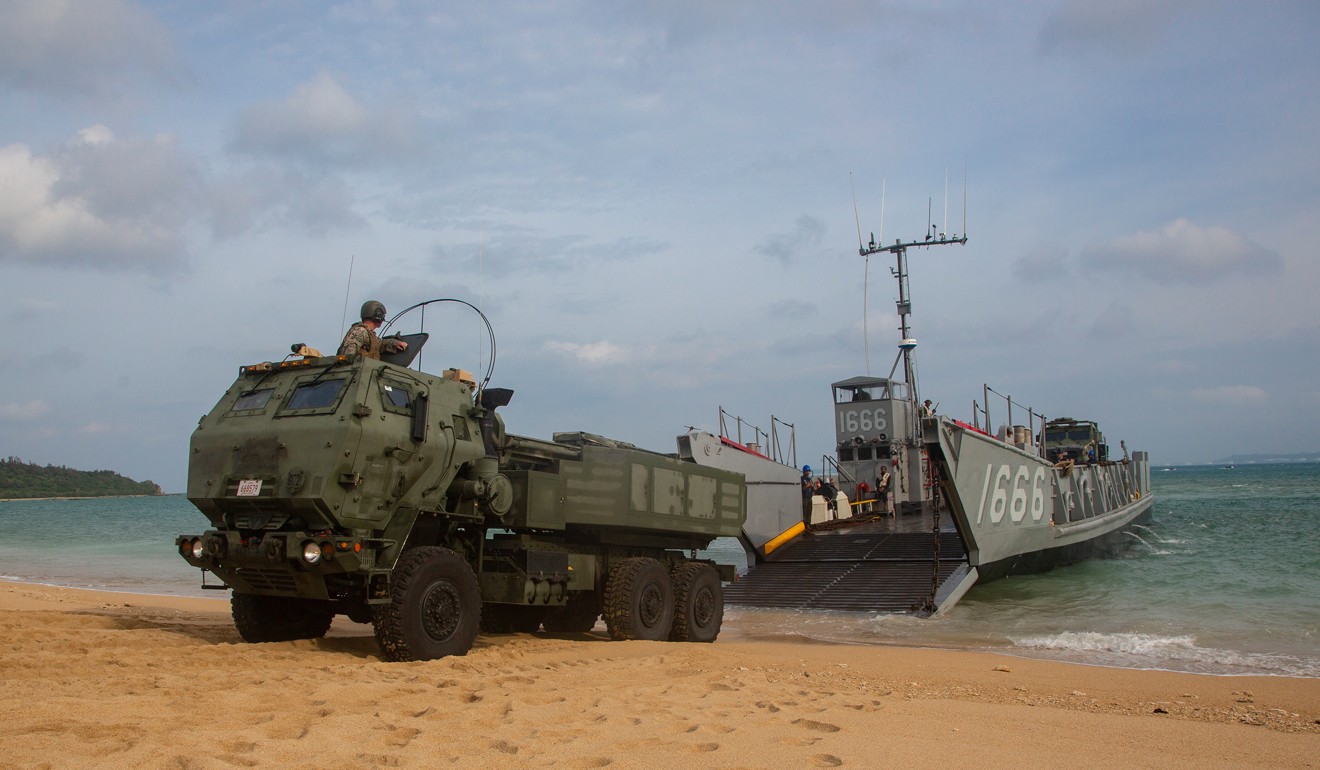
A US landing craft lowers its ramp to unload a high mobility artillery rocket system as part of a simulated amphibious raid at Kin Blue on Okinawa on August 14. Photo: Handout
China has a territory dispute with Japan over Diaoyu Islands, known as the Senkakus in Japan, in the East China Sea, while both Beijing and Manila have put in claims on the Scarborough Shoal – also known in China as Huangyan Dao – in the South China Sea.
Adam Ni, a China specialist at Sydney’s Macquarie University, said the drills near the Philippines and Okinawa showed that such a campaign would encompass a wide area, including the South and East China seas, where the US has joined other countries in the region to conduct freedom of navigation operations since 2015.
Maritime drills between US, Asean coincide with rising tensions
“It is a clear reminder to China of US military supremacy despite the narrowing of gaps in military capability in recent years,” Ni said. “The message is that the US military can still take China-controlled South China Sea features in high-intensity conflict.”
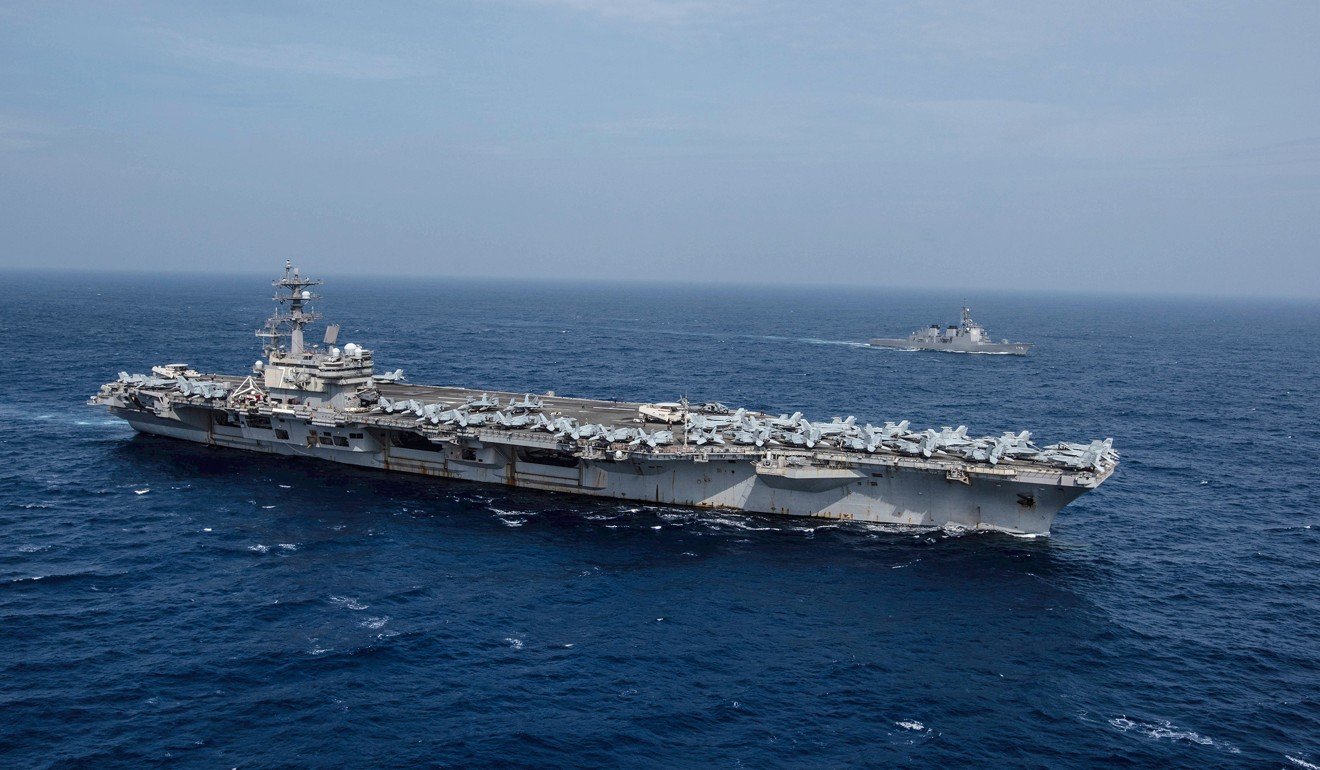
The USS Ronald Reagan aircraft carrier sails alongside a Japan Maritime Self-Defence Force guided-missile destroyer during drills. Photo: Handout
The statement did not say whether the Philippine navy and Japanese maritime self-defence force took part in the drills. But Hong Kong-based military commentator Song Zhongping said the US government would call on its two allies to observe the exercises.
“Whether Washington will intervene in territorial disputes between China and the Philippines as well as China and Japan, the American [military] has used [these drills] to strengthen its island-capture and airfield seizure capabilities in unfamiliar waters and areas,” Song said.
“To show its close relationship with and commitments to Manila and Tokyo, the Americans would invite the two allies to watch the drills. That could also be a good time to sell their amphibious warships and new model aircraft to Japan.”
During the drills, 10 simulated casualties were treated by three medical technicians from the US Air Force’s special operations group and given blood transfusions before being loaded onto a KC-130 transport aircraft for in-flight medical treatment en route to Marine Corps Air Station Futenma on Okinawa, the US Marines said.
Source: SCMP
Posted in 31st Marine Expeditionary Unit, Aircraft carrier, airfield- and island-seizure drills, America’s military edge, American naval base, amphibious campaigns, amphibious raid, Amphibious Reconnaissance Platoon, ASEAN, Asia-Pacific, Asia-Pacific drills, Beijing, China alert, Diaoyu Islands dispute, East China Sea, East China seas, guided missile destroyer, high mobility artillery rocket system, high-altitude, Huangyan Dao, Indo-Pacific region, Japan, Japan Maritime Self-Defence Force, Japanese island, Kin Blue, low-opening parachute jump, Macquarie University, Manila, Marine Air Traffic Control Mobile Team, Marine Corps Air Station Futenma, Marines, Maritime drills, Okinawa, Philippine Navy, Philippines, reconnaissance, remind, Scarborough Shoal, Senkakus, South China Sea, surveillance mission, Sydney, Uncategorized, US, US landing craft, US Marines, US military supremacy, USS Green Bay, USS Ronald Reagan, Washington, Wasp Amphibious Ready Group |
Leave a Comment »
12/09/2019
- Military stresses combat readiness and war mentality in production released just weeks before 70th anniversary of the People’s Republic
China’s air force shows a more assertive side in a new propaganda video. Photo: Handout
The Chinese air force has ramped up its combat rhetoric in its latest propaganda video, with pilots warning enemies in English and top brass stressing the need for crisis mode.
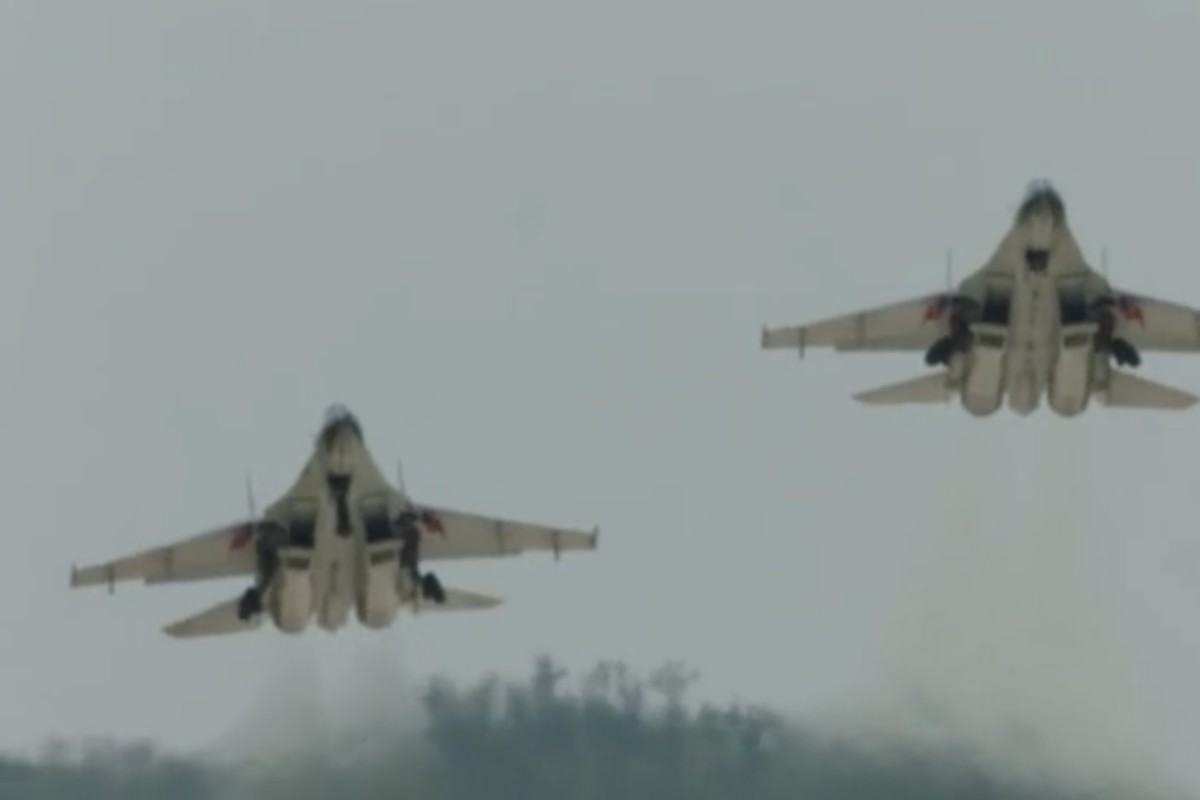
The four-minute video was posted on the Ministry of National Defence’s website on Wednesday and begins with two J-20 stealth fighters taking off from an unidentified airbase.
At least three missile-carrying J-11 jets are then shown make low passes and various aerobatics at sea.
After that, a pilot shouts in English: “This is the PLA Air Force speaking. You are about to enter Chinese airspace. Leave immediately. Leave immediately.”
The video also features members of an elite brigade called the “Eagles of Liaoning province”, a frequent winner of PLA Air Force competitions.
PLA Air Force formation ‘a sign of stealth fighter mass production’ in China
Brigade member Bai Long, a J-20 fighter pilot, says the team have a higher calling.
“Winning over enemies is more important than winning competitions,” Bai says.
Also featured is Wang Hai, a 93-year-old combat veteran from the Korean war, who encourages air force personnel to fear nothing during combat.
“You cannot do anything if you are not brave enough. You can’t be a pilot if you fear death,” Wang says.
Wang Yongtong, a brigade commander, is also quoted as saying that the Chinese air force is using war games to strengthen its combat readiness.
“We will meticulously prepare for war and improve our combat capacity to resolutely safeguard national sovereignty, security and interests,” he says.
The video’s release comes just a few weeks before China marks the 70th anniversary of the founding of the People’s Republic with a massive military parade showcasing its military weapons.
It also underlines China’s increasingly assertive efforts to defend its interests.
On Wednesday, China hit out at Canada for sending a warship to traverse the Taiwan Strait.
And in late July, South Korea claimed that two Chinese warplanes entered South Korea’s air defence identification zone, a claimed denied by the Chinese foreign ministry.
And in late January, a Chinese surveillance plane crossed the Sea of Japan and the East China Sea via the Tsushima Strait, prompting the Japanese air self-defense force to scramble fighter jets.
Posted in 70th anniversary, Aerobatics, air defence identification zone, airbase, brigade commander, canada, China alert, Chinese air force, Chinese foreign ministry, Chinese warplanes, deploys, Eagles of Liaoning province, East China Sea, English, fighter jets, founding of the People’s Republic, interests, J-20 stealth fighters, Japanese air self-defense force, Korean War, mass production, massive military parade, military weapons, Ministry of National Defence, national sovereignty, PLA Air Force, safeguard, scramble, Sea of Japan, security, South Korea, stealth fighter, surveillance plane, Taiwan Strait, Tsushima Strait, Uncategorized, veteran, video rallying cry, warship |
Leave a Comment »
12/06/2019
- Ship was en route to Pacific for routine exercise when spotted in East China Sea on Tuesday, state media says
- PLA Navy has plenty of other military options to contest maritime conflicts over sovereignty
China’s state media says it is unlikely aircraft carriers will ever be used to resolve maritime disputes. Photo: AFP
The appearance of a Chinese aircraft carrier in the East China Sea on Tuesday had nothing to do with the country’s territorial disputes in the region but was rather part of a routine training exercise, Beijing said.
The
, the country’s only fully operational carrier, and several other naval vessels were spotted passing through the Miyako Strait that separates the Japanese islands of Miyako and Okinawa en route to the Pacific Ocean, according to Japanese broadcaster NHK.
Beijing said it was a routine mission that had been conducted in accordance with international law, and called on other nations to respect its right of passage.
Xiakedao, a social media account run by the overseas edition of Communist Party mouthpiece People’s Daily, said in a commentary that the Liaoning had no role to play in sovereignty disputes.
Instead its operations covered the four areas of maritime traffic protection, naval diplomacy, regional deterrence, and humanitarian aid and rescue missions.
“It is very unlikely that Chinese carriers will ever be involved in resolving maritime disputes with neighbouring countries,” the article said, adding that the People’s
Liberation Army, China’s military, had plenty of other options, like long-range aircraft, missiles and destroyers, for such missions. “Why bother using aircraft carriers?” it said.
China forced to rethink navy spending as trade war bites
The Liaoning’s Pacific mission involved at least five other vessels – two guided missile destroyers, two frigates and a supply ship – according to photographs released by Japan’s defence ministry.
The presence of the 45,000-tonne Type 901 Hulun Lake fast combat support ship – the first time such a vessel has taken part in one of the carrier’s missions – suggested the Liaoning was headed for the high seas.
“This is probably going to be a long journey,” naval expert Li Jie said. “We will see how far they go [but] … the whole purpose of an aircraft carrier is that it can operate far out in the ocean.”
Having a supply ship as part of the strike group, which would allow the Liaoning to travel an extra 10,000 nautical miles or conduct thousands of hours of operations, was essential on such missions, he said.
The exercise is the carrier’s first Pacific deployment since undergoing a major maintenance programme earlier in the year.
The 300km (186 mile) wide Miyako Strait is the most convenient route for China’s navy and air force to access the Western Pacific through the so-called first island chain, which sits between the Chinese coast and the vast ocean.
“The Miyako Strait is wide enough and the sea conditions are usually stable,” Li said. “Pacific training missions will become routine and other Chinese carriers will probably also take this route.”
Details of new carrier revealed in sea trial footage
The Liaoning, accompanied by a fleet of eight vessels, first passed through the strait in December 2016 as part of its first Pacific mission. In April last year, the carrier and its escorts conducted an exercise in the ocean after reaching it via the Bashi Strait, which runs between the Philippines and Taiwan.
As well as the Liaoning, China’s first home-grown aircraft carrier – the
– is conducting sea trials and expected to go into full service later this year, while at least one more is under construction.
Chinese defence ministry spokesman Wu Qian said in 2017 that the navy would increase its activities in the Miyako Strait until the Japanese side “gets used to it”.
Source: SCMP
Posted in Chinese aircraft carrier, East China Sea, Liaoning, pla navy, territorial disputes, Uncategorized |
Leave a Comment »
13/05/2019
- Three-day visit comes ahead of Chinese President’s planned attendance at G20 summit in Osaka next month
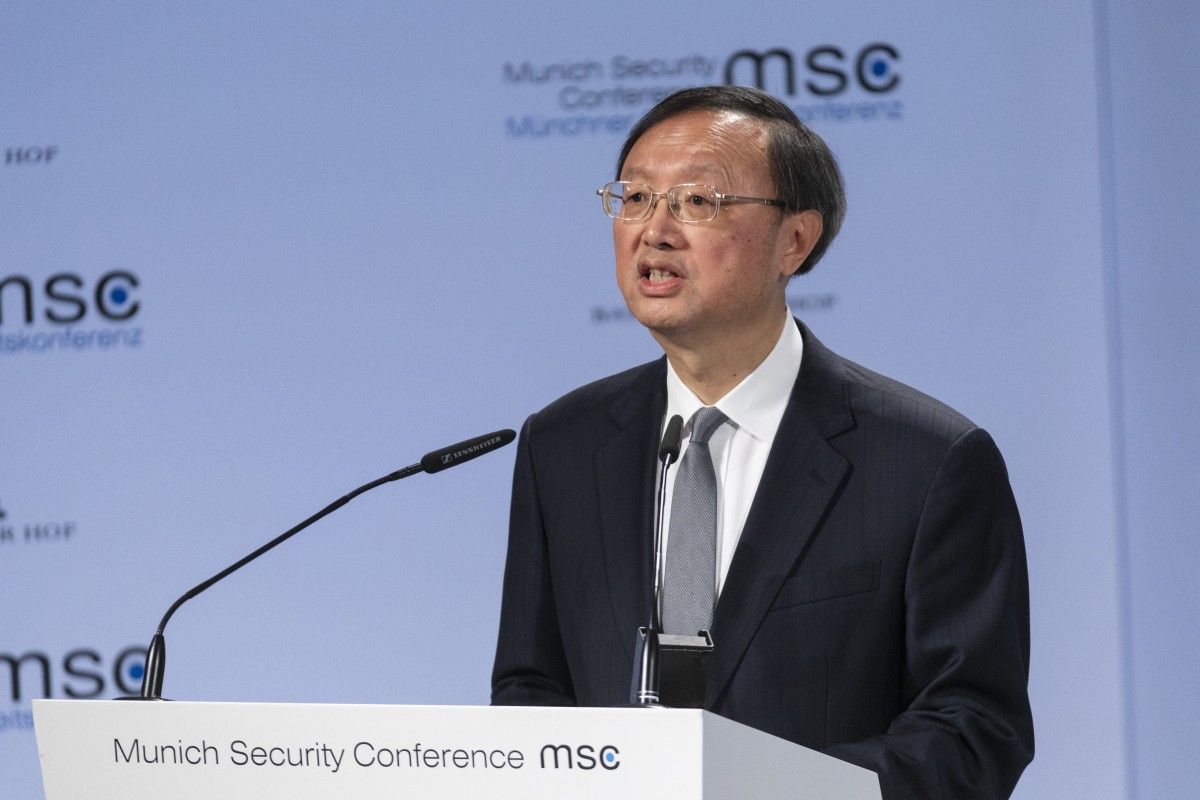
Yang Jiechi’s three-day visit to Japan starts on Thursday. Photo: Bloomberg
China’s top diplomat Yang Jiechi will visit Japan for three days from Thursday, the Chinese Foreign Ministry said on Monday.
The visit is likely to work out details of President Xi Jinping’s planned visit to Japan for this year’s summit of the Group of 20 major economies in Osaka in late June, sources familiar with bilateral relations had said last week.
Yang, a member of the Political Bureau of the Chinese Communist Party’s Central Committee, is likely to meet the country’s national security adviser Shotaro Yachi on Thursday and Prime Minister Shinzo Abe the following day, according to the sources.
Xi’s visit, if it goes ahead, would be his first since he came to power in 2013 and the first by a Chinese head of state since Hu Jintao in November 2010.
Yang and Yachi will also hold the sixth China-Japan high-level political dialogue.
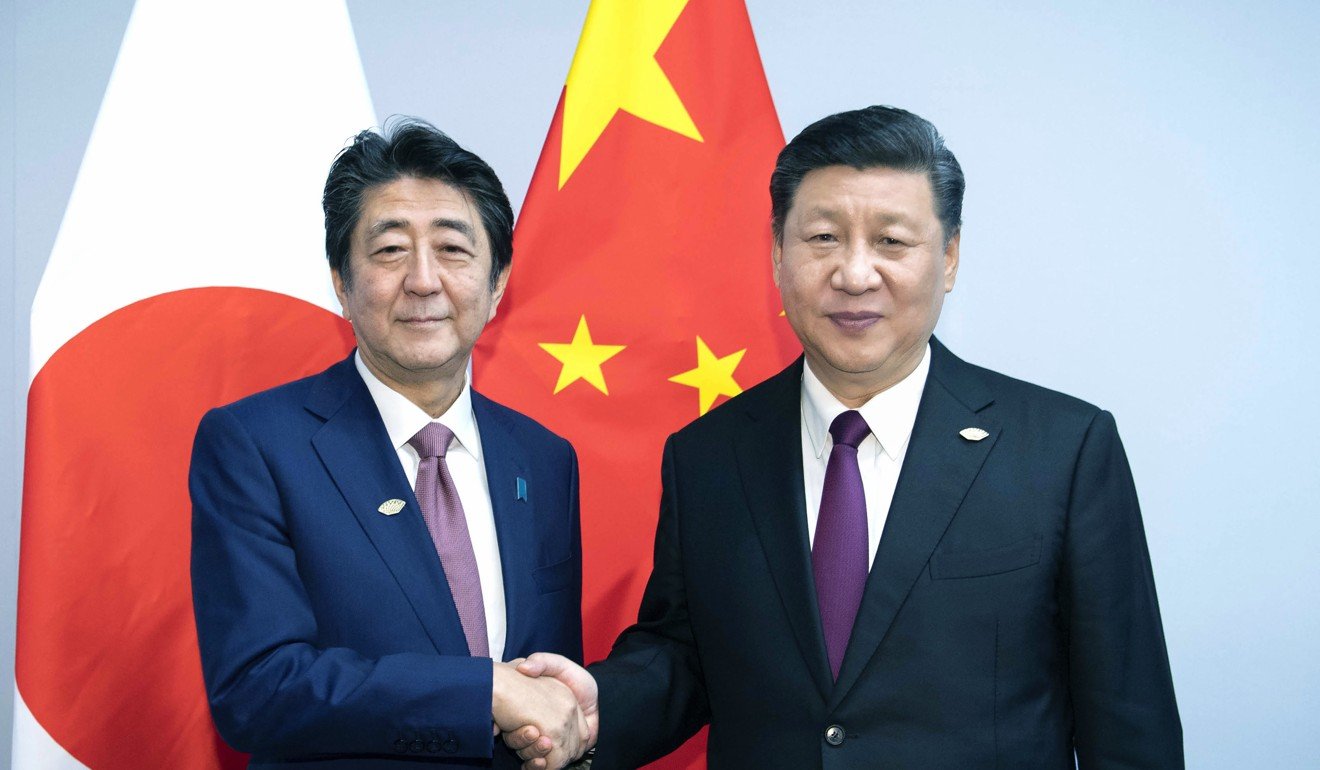
Chinese President Xi Jinping and Japanese Prime Minister Shinzo Abe pictured at the G20 summit in Argentina last year. Photo: AP
At this dialogue, which is an annual consultation plan agreed on by the two sides, the two sides will exchange views on China-Japan relations and issues of common concern, Chinese Foreign Ministry spokesperson Geng Shuang said at a regular press briefing.
For years, the two neighbours have been mired in a territorial dispute over the Senkaku Islands in the East China Sea. The group of uninhabited islets, which are called Diaoyu in Chinese, are controlled by Japan but claimed by China.
But Sino-Japanese ties have been markedly improving recently, with 2018 – the 40th anniversary of the signing and entering into force of the bilateral Treaty of Peace and Friendship – serving as an incentive to forge better relations.
The dispute over the Senkaku – or Diaoyu – Islands is a long-standing barrier to better relations. Photo: Kyodo
In an interview with Japanese media, Chinese vice foreign minister Kong Xuanyou said the relationship between China and Japan has just returned to normal after going through ups and downs over the years, and both sides need to treasure the development.
“China is willing to work with Japan to further promote China-Japan relations,” he was quoted as saying in a Chinese foreign ministry transcript.
Kong also rejected suggestions that ties between China and Japan have become closer because of the China-US trade war – which pushed Beijing to seek support from its neighbours.
“Putting the relations between China, Japan and the US at opposite from each other is a zero-sum game and cold war mentality. China does not agree with it,” he said. “The friendly relationship among these two nations can be developed in parallel. This is welcomed by the region and the world”.
Source: SCMP
Posted in Beijing, China-US trade war, China’s top diplomat, Chinese vice foreign minister, Diaoyu, East China Sea, Geng Shuang, Japan, Japanese Prime Minister, Japanese Prime Minister Shinzo Abe, Kong Xuanyou, Osaka, Senkaku Islands, Sino-Japanese ties, Treaty of Peace and Friendship, Uncategorized, Vice-President Hu Jintao, Xi JinPing, Yang Jiechi |
Leave a Comment »
01/05/2019
- Xi’s message talks of promoting ‘peaceful development’ as Reiwa era begins in Japan
- Analysts see diplomacy as latest steps towards bringing an end to bitter rivalry
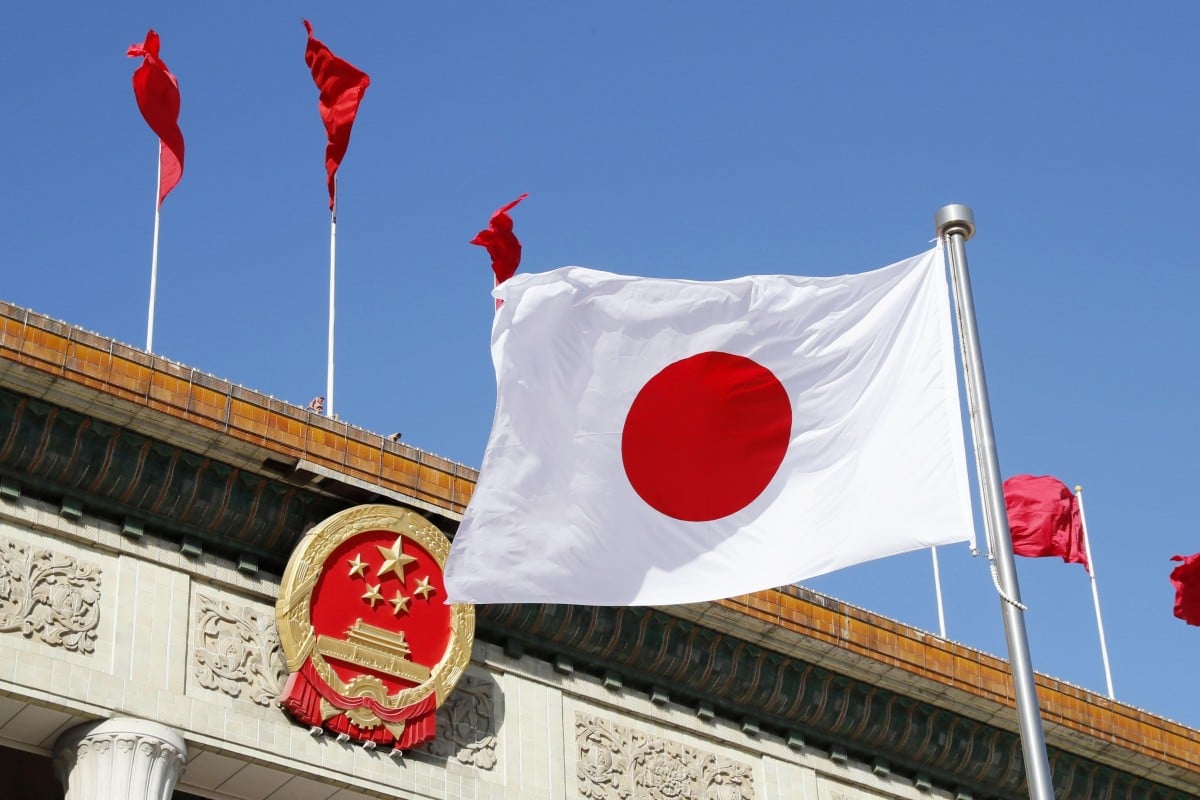
The Japanese flag flies at the Great Hall of the People in Beijing on October to mark the visit of Japanese Prime Minister Shinzo Abe to China. Photo: Kyodo
Chinese President Xi Jinping congratulated Emperor Naruhito on his ascent to the throne of Japan in an effort to strengthen China’s ties with its neighbour and competitor as Beijing’s trade dispute with the United States went on.
Xi sent greetings on Wednesday in which the president stressed the importance of relations between Beijing and Tokyo, China’s state-run Xinhua news agency reported.
The two countries should “work together to promote peaceful development and create a bright future for bilateral relations”, Xi said.
The president also sent a message to Akihito, now Japan’s emperor emeritus, and “expressed his greetings and wishes”, Xinhua said.
Akihito, 85, relinquished the throne to his son at midnight on Tuesday, bringing the Heisei era that spanned his 30-year reign to an end.
Naruhito took the Chrysanthemum Throne to begin the Reiwa era with a pledge to become a “symbol of unity”.
Xi’s message came as China and Japan tried to repair relations damaged by disputes over the East China Sea and the bitter legacy of the second world war.
Washington was locked in a trade tariff war with Beijing, and President Donald Trump’s America First policy had prompted fears about the US’ commitment to Asia at the highest levels of Japanese government. These have pushed Beijing and Tokyo closer and, in October, Japanese Prime Minister Shinzo Abe visited Beijing.
China set to appoint new ambassador to Japan, as Xi Jinping prepares for June visit
Xi was expected to attend a Group of 20 summit to be held in Osaka in June. A source said officials were considering whether Xi would dovetail a state visit to Japan with the summit.
Felix Wiebrecht, a China researcher at the Chinese University of Hong Kong, said in the international environment China was more willing to put a deep-seated rivalry aside and take Japan as a partner.
“Facing increasing tensions with the US, China is naturally turning towards other potential opportunities for cooperation,” Wiebrecht said.
“Xi is indeed very likely to visit Japan this year since it seems that both he and Abe are interested in strengthening their cooperation. A visit this year could be seen as a culmination in normalising their relationship and comes at the right time for China as its conflict with the US intensifies”.
Ryo Hinata-Yamaguchi, a visiting professor at Pusan National University in South Korea and an adjunct fellow at the Pacific Forum foreign policy research institute, said Xi’s message could be seen as Beijing’s expectation on Tokyo to keep relations positive.
“[But] this would raise questions in Japan, particularly regarding regional and bilateral security issues, as well as the trade issues between the US and China,” he said.
As Japan prepares to mark end of an era, a look back at how China started the system
“The big question is whether China – as well as the US – expects Japan to work as some kind of mediator between Beijing and Washington, causing dilemmas for the Japanese government”.
Some observers remarked on the possibility of sideline meeting between the two leaders at Osaka.
“Xi could meet with Abe [at G20] in a bilateral context too,” Zhang Baohui director of the Centre for Asian Pacific Studies at Lingnan University in Hong Kong, said.
He also felt that Xi may make a separate state visit to Japan, after the G20 meeting closed.
“Japan is reportedly interested in having a second and separate visit by Xi later in the year … The Japanese efforts are part of a broader attempt by the Abe administration to improve relations with China,” Zhang said.
“A separate state visit would cement the full recovery of Sino-Japanese relations since the 2012 Diaoyu Islands dispute,” Zhang said.
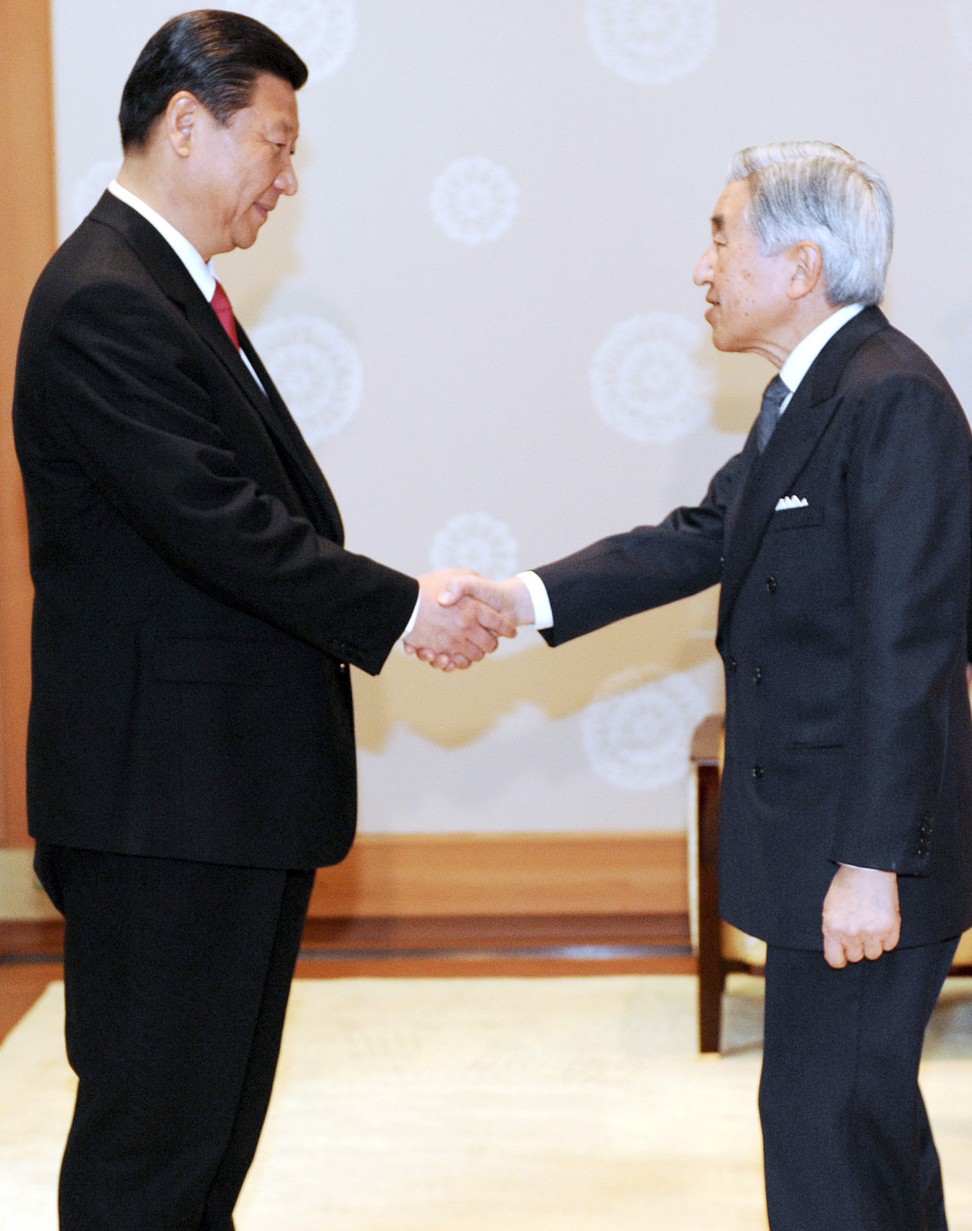
Xi Jinping, then Chinese Vice-President, meets Emperor Akihito in Tokyo in December 2009. Photo: Xinhua
Japan and China both claim the territorial rights over the Senkaku Islands – also known as the Diaoyu Islands – in the East China Sea.
In 2012, Japanese government purchased three of the disputed islands from private owners, which prompted large-scale protests in China. In the following year, Beijing set up the East China Sea Air Defense Identification Zone which included the islands, requiring all aircraft entering the zone to file a flight plan, further intensifying the conflict between the two countries.
Efforts this summer to intensify diplomacy “should bring greater stability to the East China Sea and may even lead to greater Sino-Japanese cooperation on regional issues like economic integration”, Zhang said.
“But Japan’s concern for a rising China and China’s expanding maritime activities in the East China Sea will continue,” Zhang added, noting that Japan has also expanded its military capabilities in disputed areas such as the South China Sea.
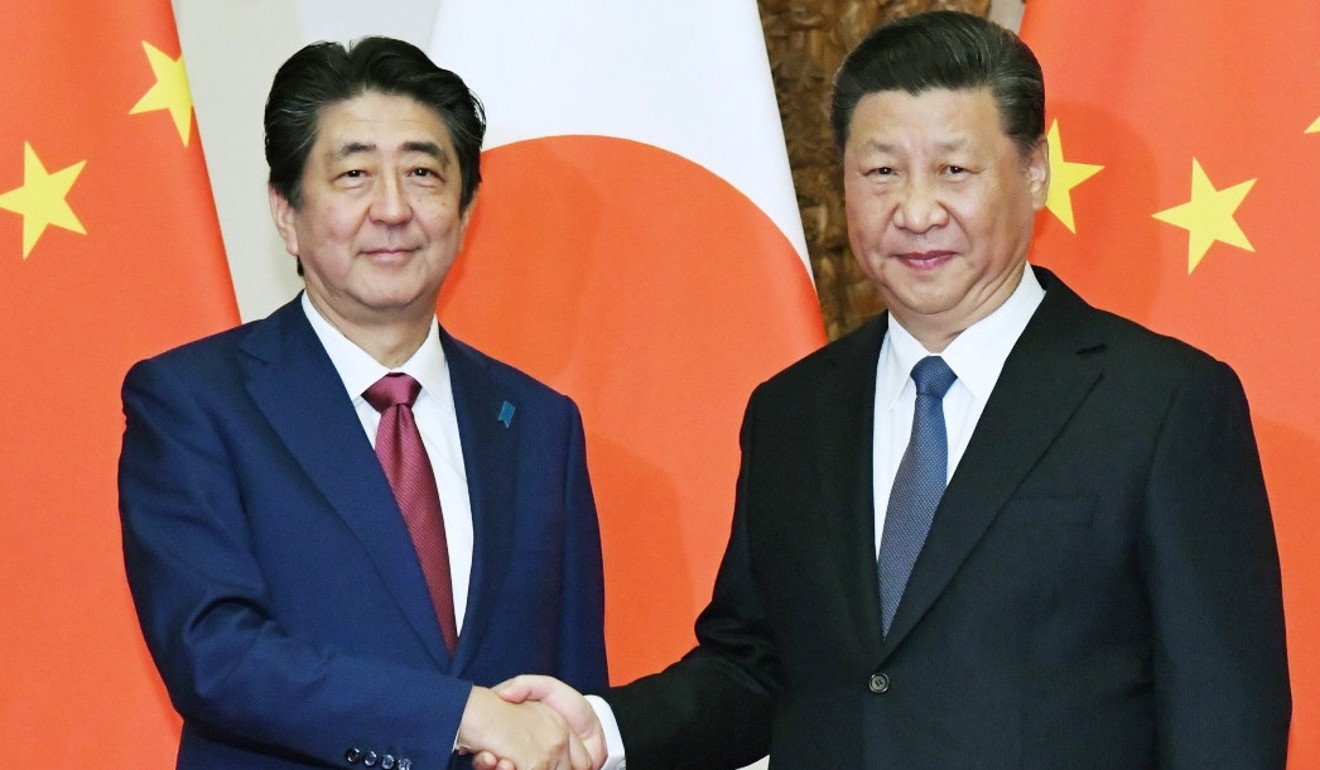
Chinese President Xi Jinping and Japanese Prime Minister Shinzo Abe are likely to continue their diplomacy during and after June’s G20 summit in Osaka. Photo: EPA
Source: SCMP
Posted in Abe administration, Akihito, Beijing, Centre for Asian Pacific Studies, Chinese President Xi Jinping, Chrysanthemum Throne, Diaoyu Islands dispute, East China Sea, East China Sea Air Defense Identification Zone, emperor emeritus, Emperor Naruhito, Great Hall of the People, Hong Kong, Japan’s new emperor, Japanese flag, Lingnan University, Osaka, Pacific Forum foreign policy research institute, Prime Minister Shinzō Abe, Pusan National University, Reiwa era, Ryo Hinata-Yamaguchi, Sino-Japanese relations, Uncategorized, Washington, Zhang Baohui |
Leave a Comment »





 CHINDIA ALERT: You'll be living in their world, very soon