Archive for ‘Economic policy’

31/05/2020

Is Beijing preparing to decouple from the US?

  • China’s leadership has made it clear to its people that the world will become more dangerous and they must be prepared for hard times
  • Beijing’s relatively small stimulus response to Covid-19 suggests it wants to save its economic policy ammunition for a bigger battle China opted not to set a GDP target for 2020. Photo: Xinhua
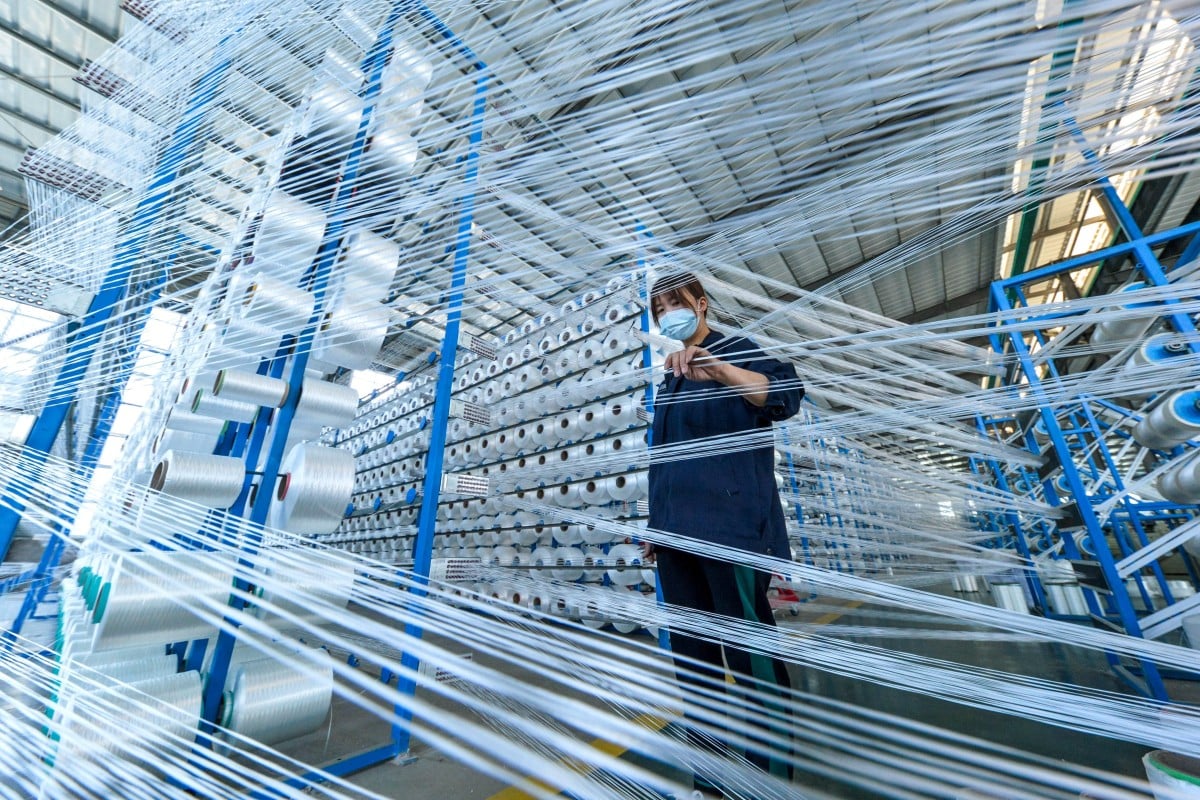
China opted not to set a GDP target for 2020. Photo: Xinhua
Beijing’s decision not to set an annual GDP target for 2020 – for the first time since 2002 – is a sign it is putting stability ahead of growth as part of its preparations for an escalating conflict with the United States.
Economic development has always been the central theme for Beijing since it established diplomatic relations with the US in 1979. But this year it has given priority to job creation and tackling poverty. The coronavirus outbreak might appear to have been the reason for the shift, but the underlying factor is the tension with the US.
Covid-19 offered a preview of what a decoupling of China and US might look like: aircraft grounded, cargo flows disrupted, value chains broken, goodwill and cooperation lost, blame games started.
Both countries have suffered heavy human and economic losses from the coronavirus, yet that did not inspire them to work together. Instead, hostility and rivalry has thrived, and neither wants to blink first.

The Chinese leadership has made it clear to its people that the world will become more dangerous and they must be prepared for hard times. As such, the government is saving its economic policy ammunition.

While the stimulus plans introduced in the US, Germany, Japan and France exceed 10 per cent of their national GDP and interest rates have been cut to the bone, Beijing stopped at just 1 trillion yuan (US$140 billion) worth of special treasury bonds and 1.6 trillion yuan of additional local government bonds. In total, about 2.6 per cent of GDP.

Interest rates in China – 2.7 per cent on 10-year bonds – are some of the highest among major economies.

China’s 6.6 per cent defence spending boost lowest in three decades
23 May 2020

China’s budget fiscal deficit has increased to 3.6 per cent of GDP for 2020, but the larger deficit is mainly from tax and fee cuts instead of increased fiscal expenses, except for an increased military spending.

Beijing is calling on provincial and local authorities to tighten their belts, which is unusual for a government that has huge assets and can increase spending at any time through quantitative easing.

So why is the government, which is known for intervening in the economy, being so restrained?

It is bracing itself for a perceived period of turbulence and hardship as its relationship with the US turns sour. It is putting jobs and social stability on top of its agenda, instead of growth.

Beijing is refraining from excessive spending, eliminating sources of potential instability, making appeals to the most vulnerable social groups, and saving its power for a bigger test.

Against that backdrop, the National People’s Congress passed the national security legislation on Hong Kong. Beijing knew the bill would anger the US, but did it anyway.

Hong Kong is known as China’s gateway to the international capital market and the largest offshore yuan market, but Beijing is ready to trade losses on the financial and economic front for potential gain on a fortified national security fence.

All this points to the suggestion that Beijing is preparing for the possibility of decoupling from the US, even if it doesn’t necessarily want to.

The threat of a new Cold War is clouding the world. The theme of life for one or two generations of people on both sides of the Pacific may shift from growth and prosperity to struggle and confrontation.

China and the US have yet to collide totally, but that moment is drawing near.

Source: SCMP

16/01/2019

Exclusive – Modi’s party wants expansionary economic policy ahead of India election

NEW DELHI (Reuters) – Indian Prime Minister Narendra Modi’s ruling party is in favour of an expansionary economic policy and does not consider the government’s plan to keep the fiscal deficit to 3.3 percent of GDP as “sacrosanct”, a party spokesman told Reuters.

Ahead of a general election that must be held by May and after a string of losses in recent state polls, the government run by Modi’s Bharatiya Janata Party (BJP) has announced several stimulus measures for the countryside where millions of farmers are grappling with low crop prices. Other fiscal moves have been aimed at helping small businesses.

The measures are likely to be a drain on finances in Asia’s third-biggest economy, though the Modi administration is expected to get the Reserve Bank of India to agree to transfer an interim dividend of 300-400 billion rupees (£3.36 billion-£4.51 billion) to the government by March, Reuters reported last week quoting sources.

Weak consumer spending and the fragile farm sector have already been a drag on economic growth, creating a headache for Modi as he struggles to meet ambitious job creation targets.

India lost 11 million jobs last year, with around 83 percent in rural areas, according to independent think-tank the Centre for Monitoring Indian Economy, as operational costs surged for small businesses. Those costs were boosted by the launch of a national sales tax in 2017 and the economic impact of an earlier ban on high value currency notes.

SPONSORED

ADVERTISING

“There’s a demand, there’s a debate – all my colleagues are saying what’s the need of keeping the fiscal deficit in check when there is a distress in a particular sector,” said Gopal Krishna Agarwal, the economic affairs spokesman for the Hindu nationalist BJP, referring to the farm sector.

“Even think-tanks associated with us are talking in this sense. Very few people domestically are talking about fiscal prudence. Only foreign think-tanks are talking fiscal prudence, fiscal prudence. I strongly believe an expansionary policy can benefit the party,” he said in an interview on Tuesday night.

India’s 10-year benchmark bond yield IN071728G=CC rose 4 basis points to 7.53 percent after the news, its highest since Jan. 8 on worries about the fiscal deficit. The rupee INR=D4 also weakened to 71.23 to the dollar from its previous close of 71.03.

Agarwal, a chartered accountant who is a director at state-run Bank of Baroda (BOB.NS) and a member of a government committee on small and medium-sized businesses, said Modi was aware of his party colleagues’ thinking but that no final decision had been taken.

D.S. Malik, a spokesman for the Ministry of Finance, did not respond to calls and emails seeking comment. Finance Minister Arun Jaitley, who is in the United States for a medical check-up, said in a Facebook post on Tuesday that India’s “fiscal discipline during the past five years has been amongst the best as compared to any preceding period”.

NEED TO REACH LANDLESS

Agarwal said the government understands that farmers are in distress and that directly transferring money to their bank accounts was an option to help them out. He said the government was, however, trying to figure out how to distribute funds to landless tillers to make sure any such transfer programme was effective and didn’t just benefit those with land.

The government is studying a programme launched by the eastern state of Odisha under which farmers with landholdings of up to 5 acres would get cash assistance to buy seeds, pesticides, fertilisers and pay for labour. Sharecroppers, who cultivate rented land will also get the benefits, which include life insurance coverage.

Agarwal said Modi and many financial institutions were not in favour of waiving farm loans, as done by states recently won by the main opposition Congress party, because doing so mainly helps banks and not so much farmers in duress.

“There’s definitely a suggestion to give interest-free loans to farmers. Banks won’t have to pay, it has to be incorporated into the budget,” he said.

“And what’s the so sacrosanct issue about keeping the fiscal deficit at less than 3.5 percent? If you don’t adopt an expansionary economic policy, then the government alone can’t create demand by just spending on infrastructure. It has to come from both public and the private sector. The economy will grow only when demand will be created.”

He said increasing the income tax exemption limit for individuals was also being considered for the interim budget to be presented on Feb. 1 by Jaitley.

William Foster, vice president at Moody’s Investors Service, said that it expects the country’s fiscal deficit to slip to 3.4 of GDP this fiscal year ending March 31 due to revenue shortfalls from goods and services tax, lower excise duty and below-target receipts from sale of government assets.

“Increased expenditure on income transfers, farm loan waivers or other forms of subsidies would weigh further on government finances,” Foster told Reuters.

Reporting by Krishna N. Das and Aftab Ahmed; Additional reporting by Suvashree Dey Choudhury; Edited by Martin Howell

Source: Reuters

Law of Unintended Consequences

continuously updated blog about China & India

ChiaHou's Book Reviews

continuously updated blog about China & India

What's wrong with the world; and its economy

continuously updated blog about China & India