Archive for ‘BRICS’

13/02/2020

Why do many India MPs have criminal records?

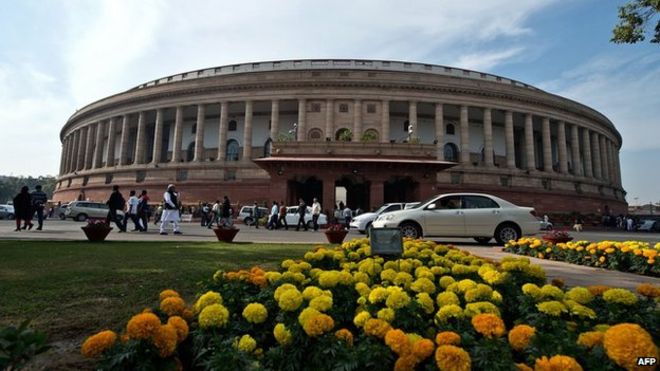
Indian parliamentImage copyright AFP
Image caption A third of the current members of parliament have criminal cases pending against them

“We need to build a consensus on how to prevent individuals with a criminal record from contesting elections.”

A necessary, even obvious fundamental you would think of building the world’s largest democracy.

And when Sonia Gandhi, India’s most powerful politician, uttered those words three years ago, even her main opponent, the leader of the BJP agreed.

Yet since then, things have gone in the opposite direction – with more alleged lawbreakers among India’s lawmakers than ever, a third of the current parliament according to a watchdog called the Association for Democratic Reforms.

By some calculations, politicians with a criminal record are more likely to be elected than those with a clean slate – because, says the ADR, they have more illicit funds with which to buy votes.

And on Tuesday night, India’s cabinet sought to ensure there was even less chance of criminal politicians facing their own laws.

It issued an order overturning a Supreme Court ruling demanding the disqualification of any politician convicted for crimes punishable with more than two years in jail.

This was “to ensure that governance is not adversely impacted“, the government had argued, with no apparent irony intended.

Unusual speed

Arguably, of course, the government is right. Losing tainted local or national politicians – among them many accused murderers, rapists and fraudsters – could upset delicate political alliances and make it even harder to get laws passed.

So often derided for doing nothing, this time round the cabinet acted with unusual speed.

The urgency it appears is the impending conclusion of two cases involving key politicians, due before Prime Minister Manmohan Singh gets back to India from a trip to the US.
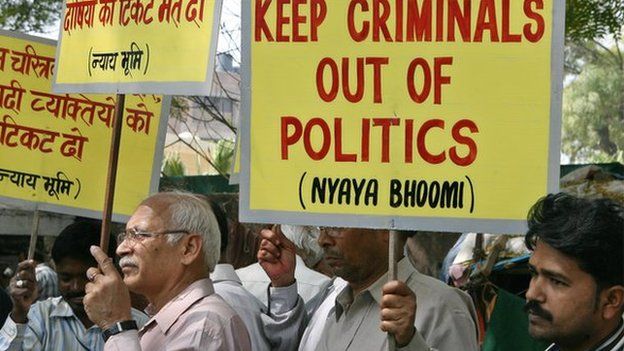
Protest against criminals contesting the parliamentary elections in Delhi on March 14, 2009Image copyright AFP
Image caption There’s been some criticism of criminal politicians

One concerns Lalu Prasad Yadav, a former railways minister and Congress party ally, charged with pocketing millions of dollars in subsidies for non-existent livestock.

Another concerns Congress MP Rashid Masood, already convicted of corruption and due to be sentenced next week. When the BBC asked his office for a comment, his assistant told us “he is unwell”.

“Don’t know whether to laugh or cry” tweeted MP Baijayant Panda in response to the government’s protective move.

He is a rare voice though inside the chamber campaigning against criminals sitting alongside him.

There’s been some other criticism outside, but not much. Indians have become very used to these kinds of shenanigans.

Almost forgotten already are calls in the Verma commission report into the December 16 Delhi gang rape case for all politicians accused of sexual crimes to be barred from office. Instead, six politicians charged with rape remain in office.

The opposition BJP has said it will oppose the cabinet order. But its record is just as murky, with even more accused criminals among its elected members in parliament and state assemblies than the Congress.

And with elections round the corner, none of the parties want to risk real reform right now, whatever they have signed up to in the past.

The world’s largest democracy is not alone in allowing so many questionable people to run it. Fellow Brics member Brazil has similar numbers of alleged criminals running the country.

The difference though is that in Brazil, brazen political abuses have provoked major protest.

But, says Indian MP Baijayant Panda: “This is a phase all democracies have gone through – look at the US.”

Voters will start to demand change, he predicts: “This is the last era of brazenness.”

Source: The BBC

12/02/2020

China appreciates BRICS statement supporting epidemic fight: FM spokesperson

BEIJING, Feb. 12 (Xinhua) — China highly appreciates a BRICS chairmanship statement in support of China’s fight against the novel coronavirus epidemic, Foreign Ministry Spokesperson Geng Shuang said Wednesday at an online press briefing.

Russia, holding this year’s chairmanship of the emerging-market bloc that groups Brazil, Russia, India, China and South Africa, on Tuesday issued the statement representing the BRICS countries to support the “firm commitment and decisive efforts of the Chinese government” to combat the epidemic.

The statement also called for international cooperation and coordination within the World Health Organization framework to protect regional and global public health security, and underlined the importance of avoiding discrimination, stigmatization and overreaction while responding to the outbreak.

Calling other BRICS countries as important partners for China, Geng said this statement delivered positive and constructive messages, voiced support for China’s efforts and called for greater international cooperation in safeguarding public health security.

“This demonstrates the BRICS spirit of helping each other during difficult times. It also epitomizes the support China has received from the international community. We highly appreciate it,” he said.

“We will continue to work with the international community including the BRICS countries to combat the epidemic and safeguard regional and global public health security,” said the spokesperson.

Source: Xinhua

30/10/2019

Premier Li meets South African deputy president

CHINA-BEIJING-LI KEQIANG-SOUTH AFRICA-MEETING

Chinese Premier Li Keqiang meets with South African Deputy President David Mabuza at the Great Hall of the People in Beijing, capital of China, Oct. 29, 2019. (Xinhua/Ding Haitao)

BEIJING, Oct. 29 (Xinhua) — Chinese Premier Li Keqiang met with South African Deputy President David Mabuza Tuesday in Beijing, calling on the two sides to promote bilateral relations for new development.

Noting that South Africa is an important African country, Li said the continued development of bilateral relations is beneficial to China-Africa cooperation.

China is ready to work with South Africa to consolidate mutual political trust and promote practical cooperation and people-to-people exchanges to push for new development in bilateral relations, he said.

“Both China and South Africa are developing countries and have broad common interests,” said Li, adding that China stands ready to work with South Africa to closely communicate and coordinate in international and regional affairs and enhance cooperation in multilateral mechanisms such as the UN and BRICS, to jointly safeguard developing countries’ interests and maintain regional and world peace.

Mabuza, who is on an official visit to China and will co-chair the seventh plenary session of the China-South Africa Bi-National Commission with his Chinese counterpart, offered his congratulations for the 70th anniversary of the founding of the People’s Republic of China.

He thanked China for its long-standing support for South Africa and African countries’ development and conveyed his admiration for China’s great development achievements.

Mabuza said his country is willing to learn from China’s development experience, deepen practical cooperation across the board with China and push bilateral relations to reach a new level.

Source: Xinhua

08/07/2015

The Brics Are Harming Each Other’s Trade, and India Is Largely to Blame – India Real Time – WSJ

Like most families, the Brics bloc isn’t as happy as it looks from the outside.

Brazil, Russia, India, China and South Africa, whose leaders begin a two-day summit today in Russia, are responsible for a growing share of the world’s trade-distorting policies but an even larger portion of trade-liberalizing ones, a new report finds.

However, the temporary nature of some of the market-opening measures means that overall these countries are still discriminating significantly against their trade partners—many of which are fellow emerging markets.

The finding, documented by the Global Trade Alert project of the London-based Centre for Economic Policy Research, highlights some of the awkward contradictions in the effort to unite the Brics.

“On the one hand, the Brics have sought to bolster trade between themselves with more generous credit lines for exporters and the like,” writes the report’s author, Simon Evenett, a professor of economics at the University of St. Gallen, Switzerland. “On the other hand, the Brics are responsible for a third of the instances of the harm to each other’s commercial interests. This cannot make sense.”

Global Trade Alert monitors trade-distorting moves such as tariffs, investment restrictions, “buy local” requirements for public procurement and export-promotion tools such as tax incentives and trade finance. GTA says its dataset includes more than 4,500 trade-related policies enacted globally since the financial crisis, more than double the number tracked by the World Trade Organization.

The GTA database documents three major spikes in protectionism since 2008. Over that period, the Brics governments have implemented a total of 1,451 policies that favor domestic commercial interests over foreign ones, or 32% of such measures world-wide. The Brics countries have since unwound just a fifth of these, suggesting that protectionist walls weren’t raised merely as temporary crisis-fighting measures. The Brics account for 17% of world trade.

Within the bloc, India stands out as an offender. According to GTA, the country is second only to the European Union both in the number of discriminatory measures imposed since November 2008—452 against the EU’s 604—and in the number of product categories affected by such measures—1,174 against the EU’s 1,220, both out of a possible 1,229.

Rich-country protectionism is still alive and kicking, the report shows. Of the 2,733 economic policies that harmed at least one Brics member, a fifth came from a member of the G-7 group of nations—the U.S., Canada, Japan, Germany, France, U.K. and Italy—or Australia. Nearly a third, however, came from fellow Brics nations.

All told, a greater share of G-7 policies were discriminatory, but the Brics’ protectionism affected a broader range of products. China was the most-common victim, with 2,153 foreign measures hitting its commercial interests.

The Brics also account for an increasing share of reforms world-wide to lower obstacles to foreign firms and investors, the report finds. But 28% of these liberalizations have already lapsed, compared to the global average of 15%.

Some economists say developing countries, in order to kick-start industrialization, need to shield and nurture local firms until they’re ready to compete on world markets. But Mr. Evenett argues that condoning “special and differential treatment” for poor countries doesn’t straightforwardly protect them against rich countries’ discrimination—it also provides cover for developing countries to step on other developing countries’ toes. China is the only one of the Brics whose exports haven’t stagnated over the past four years.

Hence, “a less selective approach to tackling crisis-era protectionism would seem to be in order,” Mr. Evenett writes. “The frequency with which Brics commercial interests are harmed by beggar-thy-neighbor interests ought to make the Brics champions of the monitoring of protectionism by international organizations.”

via The Brics Are Harming Each Other’s Trade, and India Is Largely to Blame – India Real Time – WSJ.

12/06/2015

India to Widen Its Growth Lead Over China, World Bank Says – India Real Time – WSJ

India will continue to be the world’s fastest growing big economy and expand its lead on China over the next two years, the World Bank said Wednesday.

The bank expects global growth to slow this year, only to rebound next year. However, it expects India’s gross domestic product expansion to accelerate to 7.4% this calendar year, 7.8% next year and 8.0% in 2017.

Over the same three years, the multi-lateral lender predicts China’s growth to slow from 7.1% this year to 7.0% in 2016 and 6.9% the year after that.

While, India’s GDP expansion was faster than China’s during the third quarter of last calendar year and the first quarter of this year, it looks as if 2015 will be the first full calendar year India has outpaced China in decades.

Much of India’s progress on paper has more to do with a radical and controversial rejigging of how it calculates GDP, economists say.

To continue to outpace China—and improve the lives of India’s own billion-person populace—the South Asian nation needs to work harder to revamp its economy and build infrastructure, the World Bank said.

“To the extent that credible reform agendas boost investor sentiment, they will also help create a virtuous cycle of stronger investment (including foreign investment) and output growth in the short term,” the bank said in its Global Economic Prospects Report. “If, however, reforms stall, this could result in significantly lower investment and growth than projected in the baseline.”

Meanwhile the other three BRICS countriesBrazil, Russia and South Africa—do not seem to be living up to the hype from the days that acronym was created.  The World Bank predicts that the Brazilian and Russian economies will both shrink this year while South Africa’s will only expand by 2%. Things will improve for the three economies in the next two years but even then, they will each only see their GDPs expand by 2.5% or less in 2017.

via India to Widen Its Growth Lead Over China, World Bank Says – India Real Time – WSJ.

11/05/2015

Private banker KV Kamath named first BRICS bank head | Reuters

Indian private banker K.V. Kamath has been named as the first head of a new development bank being set up by the BRICS group of emerging market economies, Finance Secretary Rajiv Mehrishi told reporters on Monday.

K.V.Kamath gestures during the Reuters India Summit at his office in Mumbai in this November 25, 2008 file photo. REUTERS/Stringer/Files

The BRICS – Brazil, Russia, India, China and South Africa – agreed to set up the $100 billion development bank last July, in a step toward reshaping the Western-dominated international financial system.

“Kamath has been appointed as the head of the BRICS bank, the appointment will become effective when he becomes free from his current assignments,” Mehrishi told reporters in New Delhi.

It was agreed then that the New Development Bank, which will fund infrastructure projects in developing nations, would be based in Shanghai. It would be headed by an Indian for a first five-year term, followed by a Brazilian and then a Russian.

via Private banker KV Kamath named first BRICS bank head | Reuters.

22/07/2014

BRICS Summit: A Show of Economic Might Is Nothing to Fear – Businessweek

As Brazilians were recovering last week from the World Cup, the country held another global event: the BRICS summit, a gathering of leaders from Brazil, Russia, India, China, and South Africa. The outcome was no doubt more pleasing to Brazil’s President Dilma Rousseff than her country’s soccer performance. The countries agreed to set up a $50 billion “BRICS bank” to invest in development projects in the developing world, alongside a $100 billion pool of reserve currencies earmarked as “a kind of mini-IMF,” according to Russian Finance Minister Anton Siluanov. It was a strong statement of the grouping’s growing global economic heft and a challenge to the order established by the International Monetary Fund and the World Bank.

China President Xi Jinping being welcomed by President Rousseff at Planalto Palace in Brasilia

Some in the West have perceived that challenge as a threat. The U.S. has veto power over major decisions at the International Monetary Fund. Without European or American backing, it is almost impossible to get a loan through the World Bank. The North Atlantic powers will have no such say in the operations of the BRICS bank, another sign that the global balance of economic and financial power is shifting.

The BRICS do pose a threat, but their own development bank isn’t it. The more worrisome risk is that the BRICS won’t grow as quickly as they have in the past, that the grand plans hatched in Brazil will dwindle along with the economies supporting them. If pessimistic forecasts of Asian and Latin American economic performance turn out to be justified, that’s no reason for cheer in Washington or Brussels—collapsing growth in the developing world would be terrible news for the West.

via BRICS Summit: A Show of Economic Might Is Nothing to Fear – Businessweek.

15/07/2014

Shanghai most likely headquarters for BRICS development bank | Reuters

Shanghai looks set to become the headquarters of a development bank being launched by the BRICS emerging market nations, despite fears by some members of the group that China could hijack the bank to serve its interests.

A man walks past a signage decoration for the BRICS summit outside Sheraton Hotel, the venue for the third BRICS summit in Sanya, Hainan province April 14, 2011. REUTERS/Jason Lee/Files

Brazil, China, India, Russia and South Africa are due to sign off on the new institution on Tuesday, along with an emergency reserves fund, after two years of negotiations, a major step for the diverse group known more for its anti-Western rhetoric than coordinated action.

Russian presidential adviser Yuri Ushakov told Kremlin reporters late last week that bank would be based in Shanghai, mainland China’s financial capital, citing discussion papers prepared by the member countries.

Earlier, Russia’s finance minister said India was vying with China to host the new infrastructure lender.

“The bank’s headquarters will be located in Shanghai. This is fixed in the documents,” Ushakov said.

In a further sign that an agreement had been reached on the headquarters, an Indian government official on Monday played down the debate and said India’s top priority was to make sure members of the institutions all had equal voting rights, unlike Western-run multilaterals they seek to challenge, such as the World Bank.

“Equitable shareholding is the principal goal for India,” the official said. Second on India’s list of concerns was giving the bank a name that would allow non-BRICS nations to join in future, the official said.

The Chinese Finance Ministry did not immediately respond to a request for comment.

via Shanghai most likely headquarters for BRICS development bank | Reuters.

09/12/2013

Guest post: Senkaku – accelerating the China relocation trade? | beyondbrics

The debate continues on the motivations and risks of China’s decision on November 23 to announce an East China Sea Air Defence Identification Zone (ADIZ) which critically includes the disputed Senkaku Islands (know in China as Daioyu). There is little dispute that the standoff between China, Japan and the US has the capacity to escalate into something much more dangerous unless US Vice-President Joe Biden’s recent Asia trip is effective in ratcheting down tensions.

Has China miscalculated in terms of the rapid US response of B52 bomber sorties over the disputed Islands or prospective US naval deployment build-up in the region? Or is this the preliminary phase of a much longer-term slow creep by China in fulfilling its ambitions in establishing a more dominant regional role? Vietnam, the Philippines, Taiwan, Malaysia and Brunei (all US allies) are – like Japan – enmeshed in arguments with Beijing over relatively minor but potentially strategic bits of maritime real estate. Does the US administration have the willingness to back its allies on all fronts

Others have argued that the new Chinese leadership under President Xi Jinping are using nationalist sentiment to distract the Chinese public from the growth slowdown as well as solidify support among the Chinese military. Meanwhile Japan has been busily building up mutual defence and security ties across southeast Asia, and with Australia and India, as a hedge against Beijing. The state visit of the Japanese Emperor to India to has taken on even more significance.

While the geopolitical dynamics remain fluid and uncertain, a more definite consequence of the dispute may well be to accelerate the China relocation macro theme with major implications for FDI flows in the rest of the region. Up until now the primary motivation for foreign companies with large scale manufacturing operations to relocate from China has been the rapid rise in Chinese labour costs and the growing signs of worker shortages. The case was made most effectively by former World Bank Chief Economist Justin Yifu Lin (see Chandra, Lin and Wang (2012)) who suggested that:

industrial upgrading has increased wages and is causing China to graduate from labor-intensive to more capital-and technology-intensive industries. These industries will shed labor and create a huge opportunity for lower wage countries to start a phase of labor-intensive industrialization.

This process, which they called the Leading Dragon Phenomenon, offers an unprecedented opportunity to low-income countries where the industrial sector is underdeveloped and investment capital and entrepreneurial skills are leading constraints to manufacturing. They also note that low income countries such can seize the opportunity and resolve the constraints by attracting some of the FDI flowing currently from China, India and Brazil into the manufacturing sectors of other developing countries.

So the relocation of factories as a result of China economic rebalancing is a multi-year structural trend that is likely to be the dominant macro theme for developing economies for the next decade and beyond. But it is becoming more apparent that political risk mitigation in the face of resurgent Chinese regional territorial ambitions and aggressiveness will re-inforce the macroeconomic justification for diversifying away from China. Japanese outward FDI has increased for two years in succession, with 2012 the second highest increase in history ($122.4bn, an increase of 12.5 per cent over the previous year). Japan’s total outward FDI stock exceeded $1tn. However what is more interesting, as illustrated in the diagram below, is that Japan’s FDI flow to ASEAN has grown relative to that towards China.

Even if it’s a remote scenario, what if accidental engagement between Japanese and Chinese fighters in the newly announced ADIZ rapidly escalated into a more serious conflict or even declaration of war? The hundreds of billions of dollars of Japanese investment into factories in China would appear at risk. Even if we exclude the expropriation of factories directly, at the very minimum, the experience of Chinese nationalist protests over the Yasukune shrine visits by Japanese politicians or in the more distant past the US bombing of the Chinese embassy in Belgrade are clearly risks that policy makers and boards of Japanese multinationals must be increasingly worried about. And, unlike Chinese holdings of US treasuries that could be liquidated reasonably quickly, albeit potentially at the risk of self-destructively causing a meltdown in global financial markets, FDI in factory assets is, by its very nature, immobile. Moreover Japanese managers and workers in China would also be vulnerable. One might argue that there is a risk of a similar level of concern developing in Seoul or Taipei or perhaps even Washington.

via Guest post: Senkaku – accelerating the China relocation trade? | beyondbrics.

Ifty Islam is the managing partner of AT Capital in Dhaka, Bangladesh. Ifty.islam@ at-capital.com

25/03/2013

* China’s Xi tells Africa he seeks relationship of equals

Reuters: “China’s new president told Africans on Monday he wanted a relationship of equals that would help the continent develop, responding to concerns that Beijing is only interested in shipping out its raw materials.

TANZANIA-DAR ES SALAAM-CHINA-XI JINPING-ARRIVAL

On the first stop on an African tour that will include a BRICS summit of major emerging economies, Xi Jinping told Tanzanian President Jakaya Kikwete that China’s involvement in Africa would help the continent grow richer.

“China sincerely hopes to see faster development in African countries and a better life for African people,” Xi said in a speech laying out China’s policy on Africa, delivered at a conference center in Dar es Salaam built with Chinese money.

Renewing an offer of $20 billion of loans to Africa between 2013 and 2015, Xi pledged to “help African countries turn resource endowment into development strength and achieve independent and sustainable development”.

Africans broadly see China as a healthy counterbalance to Western influence but, as ties mature, there are growing calls from policymakers and economists for a more balanced trade deal.

“China will continue to offer, as always, necessary assistance to Africa with no political strings attached,” Xi said to applause. “We get on well and treat each others as equals.”

But gratitude for that aid is increasingly tinged with resentment about the way Chinese companies operate in Africa where industrial complexes staffed exclusively by Chinese workers have occasionally provoked riots by locals looking for work.

Countering concerns that Africa is not benefitting from developing skills or technology from Chinese investment, Xi said China would train 30,000 African professionals, offer 18,000 scholarships to African students and “increase technology transfer and experience”.”

via China’s Xi tells Africa he seeks relationship of equals | Reuters.

Law of Unintended Consequences

continuously updated blog about China & India

ChiaHou's Book Reviews

continuously updated blog about China & India

What's wrong with the world; and its economy

continuously updated blog about China & India