Archive for ‘Tunnel’

25/04/2019

Chinese media call for crackdown on motorists using mobile phones after latest fatal crash

  • Stiff penalties like those given to drink-drivers needed to make people wake up to the risks, newspaper says
  • Commentary comes after woman who died in high-speed crash is found to have used her phone 34 times in 30 minutes
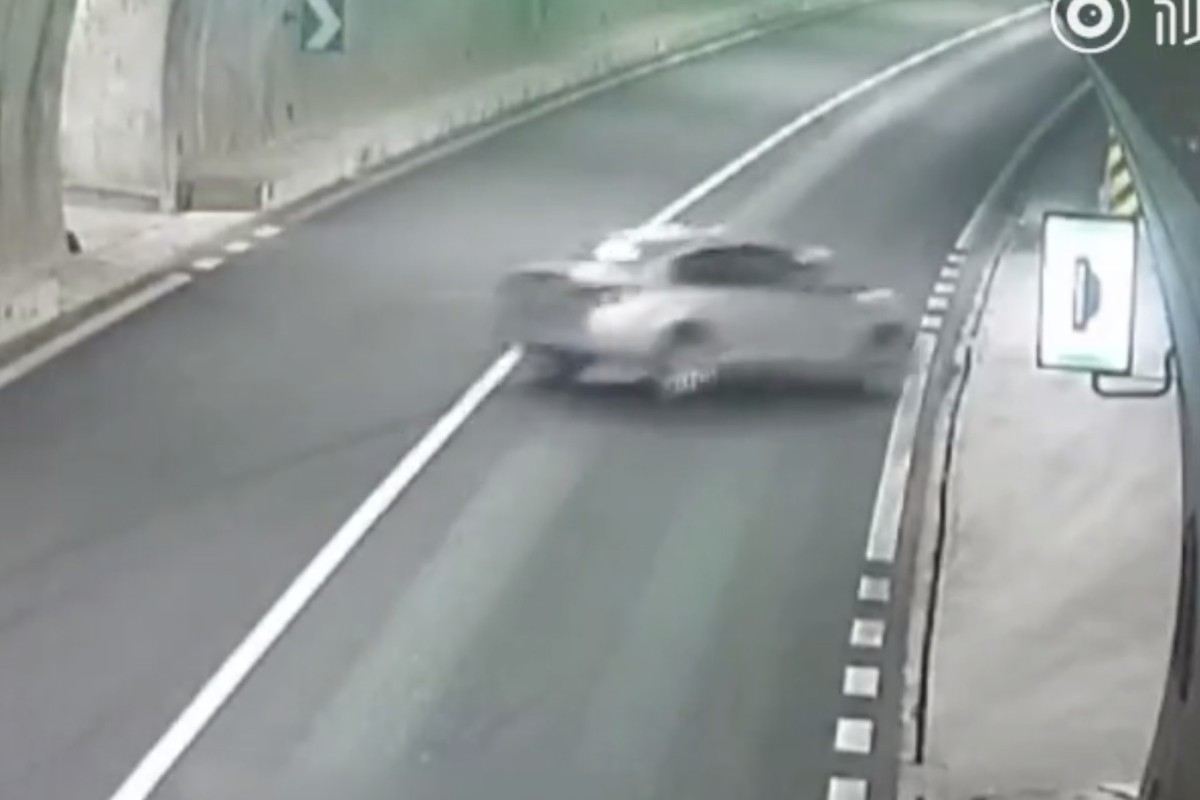
The fatal crash in Fujian province was caught on surveillance camera and the footage was shown by Pearvideo.com. Photo: Weibo
The death of a woman in a high-speed car accident who is believed to have been sending messages on her phone at the time of the crash has sparked calls in the Chinese media for harsher punishments for reckless driving.
“Death or causing death as the result of driving when using a phone is a very serious consequence of people becoming slaves to mobile phones,” Beijing Youth Daily said in a commentary on Thursday.
“To reverse the harm caused by this behaviour, they must be punished in line with the punishments for drink-driving.”
The article came after Pearvideo.com on Sunday published footage from a surveillance camera of the fatal accident in southeast China’s Fujian province. The film shows the woman’s car speeding through a tunnel before veering on to the wrong side of the road and crashing into a wall. It then flips over and bursts into flames.
The victim is believed to have been using her phone at the time of the crash. Photo: Weibo

A police officer interviewed in the video said the driver, who was not identified, had not been wearing a seat belt at the time of the accident and had been observed speeding, cutting in and out of lanes and using her phone 34 times in just 30 minutes.

“I think all four factors contributed to her accident,” he said. “But the fundamental ones were speeding and using a mobile phone when driving.”

Five children killed as driver crashes into group crossing road

The video report said the woman sent a total of 16 text and voice messages from behind the wheel, one of which said that she was driving at 120km/h (75mph).

While drink-driving is a criminal offence in China – with a maximum penalty of six months’ detention, loss of licence and a five-year ban – the top punishment for using a phone while behind the wheel is a 200 yuan (US$30) fine and the loss of two licence points. Drivers start with 12 points and can be suspended from driving if they lose them all.
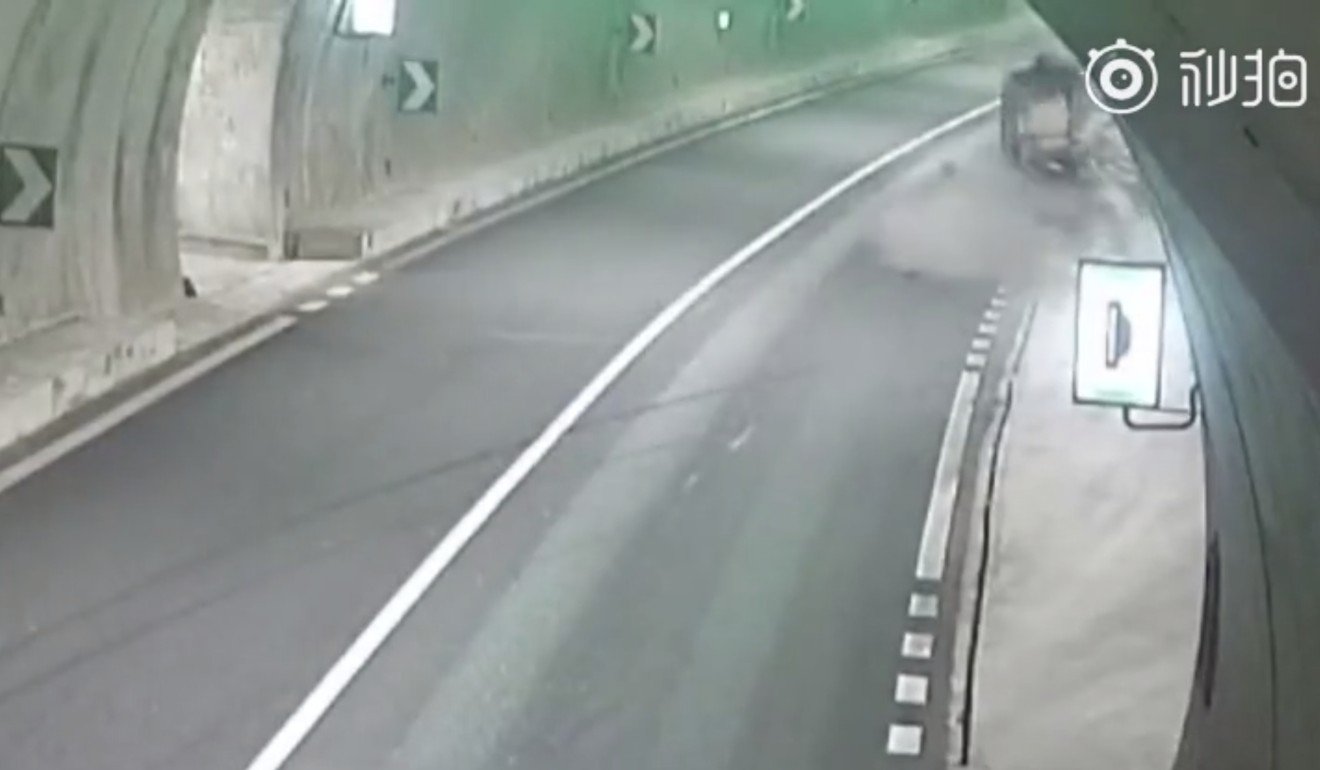
The film shows the car crashing into a wall before flipping over and bursting into flames. Photo: Weibo

According to a Ministry of Transport survey cited by Beijing Youth Daily, people are 2.8 times more likely to have an accident if they make a phone call while driving and 23 times more likely if they look at their handset.

While the strict enforcement of drink-driving laws has helped to change motorists’ behaviour, using a phone behind the wheel is still widely regarded as acceptable behaviour, the commentary said.

“I don’t know how many disasters like the woman in Sanming [a city in Fujian] are needed to alert people,” it said.

“[But] amending the road traffic safety law to make [the offence of] driving while using a mobile phone equivalent to that of drink-driving and implementing corresponding penalties can … help to reduce the devastating consequences.”

A commentary on Gmw.com, the website of the official Guangming Daily newspaper, also called for the offence to be criminalised.

People know the risks but disregard them because the legal consequences are very small, it said.

Source: SCMP
03/05/2017

China Focus: Key component of world’s longest cross-sea bridge installed – Xinhua | English.news.cn

Chinese engineers installed a 6,000-tonne key part of the world’s longest cross-sea bridge linking Hong Kong, Zhuhai and Macao.

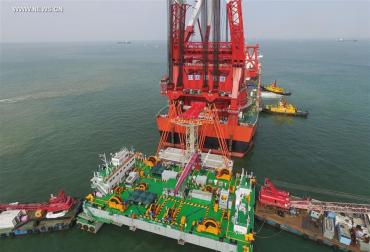
A gigantic crane, which was transformed from a tanker, hoists a 6,000-ton key structure of the world’s longest cross-sea bridge linking Hong Kong, Zhuhai and Macao, May 2, 2017. The wedge, 12-meter-long and weighing more than 25 Airbus A380 jets, was lowered to connect the immersed tubes of the underground tunnel of the bridge. The 55-kilometer bridge connects Zhuhai in Guangdong Province with Hong Kong and Macao. It includes a 22.9-km bridge and 6.7-km underground tunnel. (Xinhua/Liu Dawei)

The wedge, 12 meters long, and weighing more than 25 Airbus A380 jets, was lowered to connect the tubes which will form the tunnel section of the bridge, said Lin Ming, chief engineer of the island and tunnel section of the bridge.

The 55-kilometer bridge connects Zhuhai in Guangdong Province with Hong Kong and Macao. It includes a 22.9-km bridge and 6.7-km tunnel.

Before the wedge was installed on Tuesday, 33 immersed tubes, each 180 meters long and weighing 80,000 tonnes, had been installed.

“There is only one wedge for a tunnel, and we cannot afford to fail in its installation. It took two years to prepare for today,” said Chen Yue, director of the chief engineer’s office of the bridge’s island and tunnel section. The installation procedure took more than 10 hours.

“The margin of error for the wedge is 1.5 centimeters. We have to measure precisely the influence of wind, current and buoyancy force,” said Lin.

“It is like putting a needle through a hole in the sea — a truly unprecedented event in the history of transportation,” Lin said.

A gigantic crane, which was transformed from a tanker, was used to hoist the wedge, lowering it to the desired destination between the tubes.The wedge will be welded and finished by June, Lin said.

By the end of the year, the bridge will be open to traffic, said Zhu Yongling, director of the bridge management bureau.

Construction began in December of 2009 at Zhuhai. The Y-shaped bridge connects Lantau Island in Hong Kong with Zhuhai and Macao.

Tan Guoshun, an expert in bridge construction who has participated in many big projects, told Xinhua that breakthroughs were made in construction management, technique, safety and environmental protection.

For instance, the bridge is designed to be used for 120 years. “Anticorrosion and quake-proof measures were improved so as to make the goal possible,” he said.

The bridge was pieced together with different parts built in different locations like building blocks. “The progress of China’s equipment manufacturing industry made this construction method possible,” said Zhong Huihong, deputy chief engineer of the bridge management bureau.

Take the floating crane as an example. In the 1990s, China’s floating cranes could only handle about one hundred tonnes. “Now their capacity has reached 10,000 tonnes,” Zhong said.

“Some foreigners believe that completion of the bridge marks a leap forward of China’s construction industry,” said Su Quanke, chief engineer of the bridge management bureau.

The bridge will cut land travel time between Hong Kong and Zhuhai from three hours on the road to a 30-minute drive.

“As economic exchanges between Hong Kong, Macao and Zhuhai deepen, an urban agglomeration has formed. The bridge will further boost the interconnection,” said Zheng Tianxiang, vice president of the Asia-Pacific Innovation Economic Research Institute.

Guo Wanda, executive vice president of the Shenzhen-based China Development Institute, believes that the bridge could also help boost the industrial gradient transfer of inland provinces like Guizhou, Yunnan, Hunan and Jiangxi.

“The area will become an important hub of the Belt and Road Initiative,” he said.

Source: China Focus: Key component of world’s longest cross-sea bridge installed – Xinhua | English.news.cn

Law of Unintended Consequences

continuously updated blog about China & India

ChiaHou's Book Reviews

continuously updated blog about China & India

What's wrong with the world; and its economy

continuously updated blog about China & India