25/04/2020
- But trade with partner countries might not be as badly affected as with countries elsewhere in the world, observers say
- China’s trade with belt and road countries rose by 3.2 per cent in the January-March period, but second-quarter results will depend on how well they manage to contain the pathogen, academic says
China’s investment in foreign infrastructure as part of its Belt and Road Initiative has been curtailed because of the coronavirus pandemic. Photo: Xinhua
The
coronavirus pandemic is set to cause a slump in Chinese investment in its signature
and a dip in trade with partner countries that could take a year to overcome, analysts say.
But the impact of the health crisis on China’s economic relations with nations involved in the ambitious infrastructure development programme might not be as great as on those that are not.
China’s total foreign trade in the first quarter of 2020 fell by 6.4 per cent year on year, according to official figures from Beijing.
Trade with the United States, Europe and Japan all dropped in the period, by 18.3, 10.4 and 8.1 per cent, respectively, the commerce ministry said.
By comparison, China’s trade with belt and road countries increased by 3.2 per cent in the first quarter, although the growth figure was lower than the 10.8 per cent reported for the whole of 2019.
China’s trade with 56 belt and road countries – located across Africa, Asia,
Europe and South America – accounts for about 30 per cent of its total annual volume, according to the commerce ministry.
Despite the first-quarter growth, Tong Jiadong, a professor of international trade at Nankai University in Tianjin, said he expected China’s trade with belt and road countries to fall by between 2 and 5 per cent this year.
His predictions are less gloomy than the 13 to 32 per cent contraction in global trade forecast for this year by the
World Trade Organisation.
“A drop in [China’s total] first-quarter trade was inevitable but it slowly started to recover as it resumed production, especially with Southeast Asian, Eastern European and Arab countries,” Tong said.
“The second quarter will really depend on how the epidemic is contained in belt and road countries.”
Nick Marro, Hong Kong-based head of global trade at the Economist Intelligence Unit, said he expected China’s total overseas direct investment to fall by about 30 per cent this year, which would be bad news for the belt and road plan.
“This will derive from a combination of growing domestic stress in China, enhanced regulatory scrutiny over Chinese investment in major international markets, and weakened global economic prospects that will naturally depress investment demand,” he said.
The development of the Chinese built and operated special economic zone in the Cambodian town of Sihanoukville is reported to have slowed, while infrastructure projects in Bangladesh, including the Payra coal-fired power plant, have been put on hold.
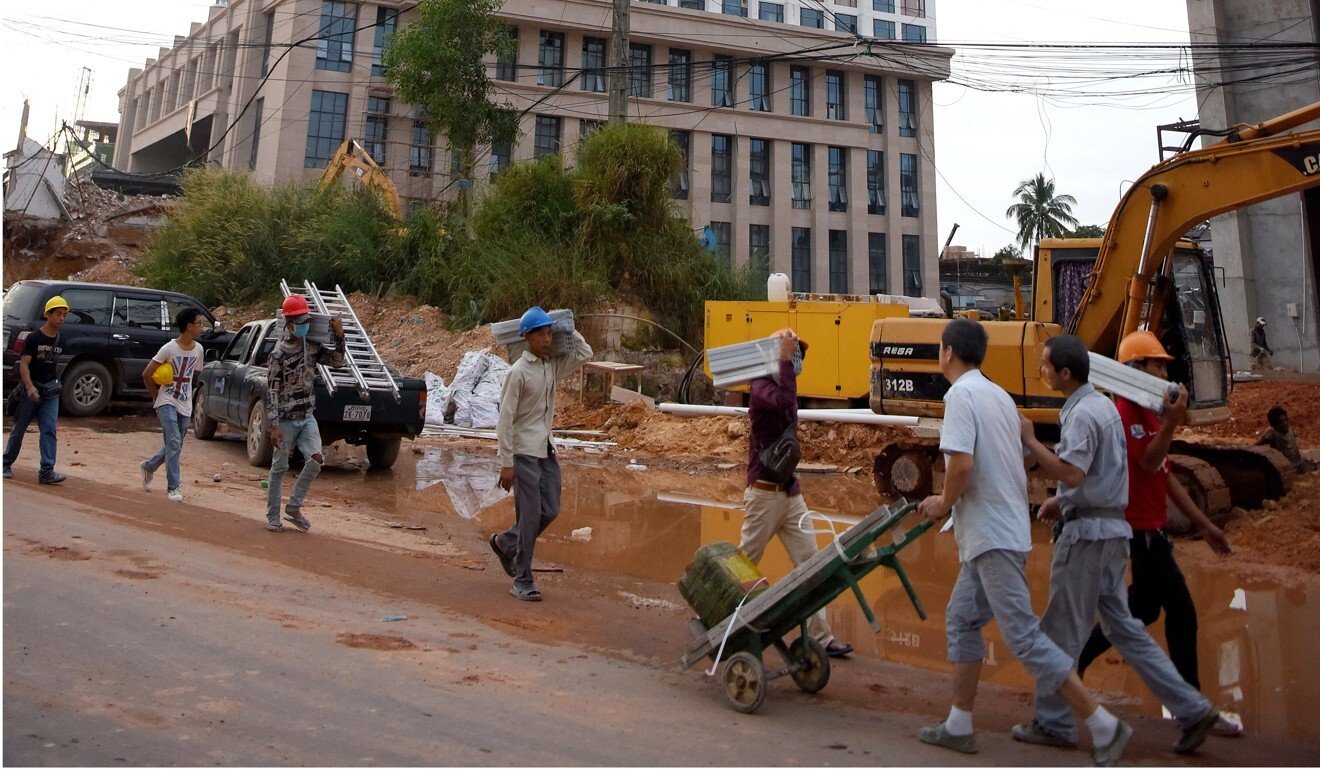
The development of the Chinese built and operated special economic zone in the Cambodian town of Sihanoukville is reported to have slowed. Photo: AFP
Marro said the reduction of capital and labour from China might complicate other projects for key belt and road partner, like Pakistan, which is home to infrastructure projects worth tens of billions of US dollars, and funded and built in large part by China.
“Pakistan looks concerning, particularly in terms of how we’ve assessed its sovereign and currency risk,” Marro said.
“Public debt is high compared to other emerging markets, while the coronavirus will push the budget deficit to expand to 10 per cent of GDP [gross domestic product] this year.”
Last week, Pakistan asked China for a 10-year extension to the repayment period on US$30 billion worth of loans used to fund the development of infrastructure projects, according to a report by local newspaper Dawn.
China’s overseas investment has been falling steadily from its peak in 2016, mostly as a result of Beijing’s curbs on capital outflows.
Last year, the direct investment by Chinese companies and organisations other than banks in belt and road countries fell 3.8 per cent from 2018 to US$15 billion, with most of the money going to South and Southeast Asian countries, including Singapore, Vietnam, Indonesia and Pakistan.
Tong said the pandemic had made Chinese investors nervous about putting their money in countries where disease control measures were becoming increasingly stringent, but added that the pause in activity would give all parties time to regroup.
“Investment in the second quarter will decline and allow time for the questions to be answered,” he said.
“Past experience along the belt and road has taught many lessons to both China and its partners, and forced them to think calmly about their own interests. The epidemic provides both parties with a good time for this.”
Dr Frans-Paul van der Putten, a senior research fellow at Clingendael Institute in the Netherlands, said China’s post-pandemic strategy for the
belt and road in Europe
might include a shift away from investing in high-profile infrastructure projects like ports and airports.
Investors might instead cooperate with transport and logistics providers rather than invest directly, he said.
“Even though in the coming years the amount of money China loans and invests abroad may be lower than in the peak years around 2015-16, I expect it to maintain the belt and road plan as its overall strategic framework for its foreign economic relations,” he said.
Source: SCMP
Posted in 10-year, 2018, 2019, 2020, 30, academic, according, accounts, across, activity, africa, airports, allow, ambitious, analysts, annual volume, answered, Arab countries, Asia, bad news, Bangladesh, because, Beijing, Belt and Road Initiative, belt and road plan, billion, billions, budget deficit, Cambodian, capital, capital outflows, cause, China, China’s, Chinese, Clingendael Institute, combination, Commerce Ministry, compared, comparison, complicate, contained, contraction, cooperate, coronavirus, Coronavirus pandemic, countries, curbs, Currency, curtailed, Dawn, decline, demand, depend, depress, derive, development, dip, direct investment, disease control measures, domestic stress, dropped, Eastern European, economic prospects, economic relations, Economist Intelligence Unit, elsewhere, Emerging markets, enhanced, epidemic, especially, Europe, extension, fall, falling, Fell, figure, first-quarter, forecast, foreign, foreign trade, GDP [gross domestic product], global trade, gloomy, great, growth, health crisis, high, impact, increased, increasingly, Indonesia, inevitable, Infrastructure, infrastructure projects, international markets, International trade, Investment, investors, involved, January, Japan, Labour, last week, loans, local newspaper, located, logistics, lower, Major, manage, March, might not, nations, naturally, nervous, Netherlands, observers, official figures, on hold, other, overall strategic framework, overcome, overseas, Pakistan, pandemic, parties, partner, pathogen, pause, Payra coal-fired power plant,, per cent, Period, ports, predictions, production, professor, programme, providers, Public debt, put, questions, recover, reduction, regroup, regulatory scrutiny, repayment, reported, results, resumed, Risk, second-quarter, signature, Singapore, slowed, slower, slump, South, South America, Southeast Asian, sovereign, special economic zone, stringent, take, this year, Tianjin, time, Total, town, Trade, Transport, Uncategorized, United States, US dollars, US$30, Vietnam, weakened, while, World, world trade organisation, worth, year, year-on-year |
Leave a Comment »
11/04/2019
WASHINGTON (Reuters) – The United States and China have largely agreed on a mechanism to police any trade agreement they reach, including establishing new “enforcement offices,” U.S. Treasury Secretary Steven Mnuchin said on Wednesday.
Mnuchin, speaking on CNBC television, said that progress continues to be made in the talks, including a “productive” call with China’s Vice Premier Liu He on Tuesday night. The discussions would be resumed early on Thursday, Washington time, he added.
“We’ve pretty much agreed on an enforcement mechanism, we’ve agreed that both sides will establish enforcement offices that will deal with the ongoing matters,” Mnuchin said, adding that there were still important issues for the countries to address.
Mnuchin declined to comment on when or if U.S. tariffs on $250 billion worth of Chinese goods would be removed. Although President Donald Trump said recently that a deal could be ready around the end of April, Mnuchin declined to put a timeframe on the negotiations, adding that Trump was focused on getting the “right deal.”
“As soon as we’re ready and we have this done, he’s ready and willing to meet with President Xi (Jinping) and it’s important for the two leaders to meet and we’re hopeful we can do this quickly, but we’re not going to set an arbitrary deadline,” Mnuchin added.
The United States is demanding that China implement significant reforms to curb the theft of U.S. intellectual property and end forced transfers of technology from American companies to Chinese firms.
Washington also wants Beijing to curb industrial subsidies, open its markets more widely to U.S. firms and vastly increase purchases of American agricultural, energy and manufactured goods.
The Chinese commerce ministry on Thursday confirmed that senior trade negotiators from both countries discussed the remaining issues in a phone call following the last round of talks in Washington.
“In the next step, both trade teams will keep in close communication, and work at full speed via all sorts of effective channels to proceed with negotiations,” Gao Feng, the ministry’s spokesman told reporters in a regular briefing in Beijing.
Mnuchin did not address whether the enforcement structure would allow the United States a unilateral right to reimpose tariffs without retaliation if China fails to follow through on its commitments.
People familiar with the discussions have said that U.S. negotiators are seeking that right, but that China is reluctant to agree to such a concession. Alternatively, the United States may seek to keep tariffs in place, only removing them when China meets certain benchmarks in implementing its reforms.
Mnuchin said he and U.S. Trade Representative Robert Lighthizer, who is leading the negotiations, are focused on “execution” of drafting the documents in the trade agreement.
The two sides are working on broad agreements covering six areas: forced technology transfer and cyber theft, intellectual property rights, services, currency, agriculture and non-tariff barriers to trade, according to two sources familiar with the progress of the talks.
“Some of the chapters are close to finished, some of the chapters still have technical issues,” Mnuchin said.
Source: Reuters
Posted in agricultural products, agriculture, China alert, Currency, cyber theft, energy, forced technology transfer, Intellectual Property Rights, manufactured goods, non-tariff barriers, President Donald Trump, President Xi Jinping, Robert Lighthizer, Services, Steven Mnuchin, tariffs, trade deal enforcement offices, U.S. Trade Representative, U.S. Treasury Secretary, Uncategorized, US, Vice-Premier Liu He, Washington |
Leave a Comment »
10/01/2017
After India’s government took 86% of currency out of circulation a couple of months ago, its main policy think-tank has a new plan for the country: rendering plastic money “irrelevant” by 2020.Amitabh Kant, Chief Executive Officer of NITI Aayog, which helps the government formulate long-term policies, said Sunday that India was in the midst of a “huge disruption” in financial technology and innovation, which will enable the country to transition from using plastic money to mobile transactions.

“By 2020, India will make all debit cards, all credit cards, all ATM machines, all [point-of-sale] machines totally irrelevant,” Mr. Kant said at the Pravasi Bharatiya Divas event inaugurated by Prime Minister Narendra Modi in Bangalore.
“In 30 seconds flat, we’ll all be doing our transactions by using our thumb.”
The annual event is aimed at increasing engagement between the government and Indians living overseas.
Mr. Kant was referring to a new mobile app launched by Mr. Modi last week as the 50-day deadline for depositing invalidated 500- and 1000-rupee bank notes came to an end.

Prime Minister Narendra Modi speaks at the Pravasi Bharatiya Divas event in Bangalore, India on Sunday.
Mr. Modi had on Nov. 8 announced the withdrawal of the country’s largest bank notes to crackdown on corruption and counterfeiting. The move caused a severe cash shortage in the economy, although Mr. Modi said later that the problems would abate in 50 days once new bills were back in circulation.
“Give me time until Dec. 30. After that, if any fault is found in my intentions or my actions, I am willing to suffer any punishment given by the country,” he had said.
After 50 days, queues were still forming outside ATMs to withdraw cash, despite the work to recalibrate almost all of the country’s 215,000 ATM machines to issue the new, slimmer notes being completed.
“Bhim,” the new digital payments app currently allows users of Google’s Android platform to transfer money directly from one bank account to another. The government plans to link the app to “Aadhar,” India’s unique identification program. Once that is done, consumers will be able to transact by using their thumbprints to authorize transactions.
“In the next two years, the power of ‘Bhim’ will be such that you wouldn’t need a smartphone, feature phone or even Internet. Your thumb would be enough,” Mr. Modi said at the unveiling of the app on Dec. 30.
The app has already been downloaded by more than 10 million users, Mr. Modi said in a tweet on Monday.
He also took to twitter to tell Indians how the app was a “fine example” of the government’s ‘Make in India’ plan aimed at encouraging local manufacturing, and also the use of technology to end corruption and black money.
On Sunday, Mr. Modi thanked 30 million Indians living abroad for contributing about $69 billion to India’s economy through remittances and hit back at the critics of his government’s currency move.
“It is unfortunate that some worshipers of black money are calling our move anti-people,” he said.
Source: Will India Get Rid of Plastic Money by 2020? – India Real Time – WSJ
Posted in Credit card, Currency, Debit card, Economics, India alert |
Leave a Comment »
09/11/2016
India’s move to curb corruption and counterfeiting by replacing high-denomination bank notes with new ones will likely have a significant impact on some sectors wrapped up in the cash economy.

Here are five industries likely to see change.
1 Real Estate
Many property transactions in India are made using cash. Builders often accept 10% to 20% of an asking price in cash to lower both the buyer’s and seller’s tax liability.“You may yourself have experienced when buying land or a house, that apart from the amount paid by check, a large amount is demanded in cash. This creates problems for an honest person in buying property,” Indian Prime Minister Narendra Modi said Tuesday.The use of counterfeit or undeclared earnings in this way has increased the price of real estate, Mr. Modi said. The move to scrap the current 500 and 1,000 rupee bills could reduce prices, analysts said.“This will clean up the real estate sector and bring down the cost of doing business,” says Dhiraj Relli, chief executive of HDFC Securities.
2 Gold
Investing in gold is another way some Indians keep money from the eyes of tax officials. The country is one of the world’s biggest consumers of the precious metal, along with China.According to various estimates, the current volume of gold in Indian households is above 20,000 tons. Analysts say if people are no longer able to use wads of 500- and 1,000-rupee notes to buy gold, they will have to put it into the formal banking system or invest it in stocks, mutual funds or bonds instead. This is also likely to slow down India’s gold imports and reduce foreign-currency outflows.
3 Two-Wheelers
India is one of the largest two-wheeler markets globally. In rural India, many farmers buy motorbikes and scooters with cash after they sell their their crops.The current measure may slow down two-wheeler sales as buyers are expected to postpone their purchases until they replace their existing bank notes with the new ones.No wonder, two-wheelers stocks are one of the biggest losers on India’s benchmark S&P BSE Sensex index today, falling between 4% and 6%.
4 Consumer Durables
rMany people in India also prefer to buy televisions, fridges or air-conditioners with cash. Some of those purchases involve money derived from corruption.Others are made by people who might not have a bank account and are purchasing the products as dowry items. As a result, the move to replace the existing high-denomination notes is expected to hurt sales in this segment.
5 Microfinance
rMicrofinance companies that disburse loans to poor people will likely face difficulty collecting or disbursing cash in the near term. In the worst case, they may have to postpone loan-repayment installments and disbursements may not happen in the next 10 days due to a shortage of currency notes, says broker Religare Capital Markets Ltd. However, things will likely stabilize after few weeks, it adds.
Source: 5 Sectors Likely to Be Affected by India’s Surprise Move to Replace Large Rupee Notes – Briefly – WSJ
Posted in Currency, Economics, India alert |
Leave a Comment »



 CHINDIA ALERT: You'll be living in their world, very soon