Archive for ‘inequality’

02/05/2020

Take a cue from China’s policies to eradicate poverty:experts

WINDHOEK, May 1 (Xinhua) — China’s poverty eradication policy and deliberate attempts to improve the lives of the rural population is a model for Namibia and Africa in general to follow in dealing with inequality in society, experts have said.

University of Namibia social and political analyst Ndumbah Kwamwayah said China has laid a strong foundation in dealing with poverty and emancipating its people since the days of Mao Zedong.

“Chinese literature especially the life journey of Chairman Mao is a good benchmark for developing countries that want to find ways of creating equal societies. If you check here in Namibia inequality and rural poverty are there despite our economy being agro-based.

“We need to take a cue from countries like China who have created better societies through improving agriculture production and mechanization through investing heavily in local people,” he said.

According to Kamwayah, China continues to value its agro-based economy as well as investment in rural development.

“China through its leaders in the past and present has come up with strong policies of decentralizing key services and also curbing rural urban drift through developing villages. Chinese literature also strongly captures the aspect of local development.

“In Namibia there are many regions including the Kunene, Zambezi and Kavango which are heavily affected by poverty. These need deliberate policies to be improved,” he said.

Political analyst from University of Namibia, Hoze Riruako said poverty eradication remains one of the biggest challenges confronting Namibia in contemporary times.

“What is more important is not to reproduce the Chinese way of doing things but to pick certain traits that can dent poverty and rural development from them,” he said.

Source: Xinhua

01/11/2019

Help pours in for Chinese student who lived on 30 cents a day

Wu Huayan on her hospital bedImage copyright FENG VIDEO
Image caption Wu Huayan ate only rice and chillies in order to save money to help her ill brother

Well-wishers have donated almost a million yuan to a Chinese student who was hospitalised after living on 2 yuan ($0.30, £0.20) a day for five years.

The case of Wu Huayan shocked Chinese people after it hit the headlines earlier this week.

The 24-year old woman became seriously malnourished while struggling to study and support her sick brother.

Ms Wu’s story also sparked anger at authorities for failing to recognise her plight and help her much earlier.

After the story was reported, donations began pouring in for the college student in the city of Guiyang – reportedly totalling some 800,000 yuan ($114,000, £88,000).

What is Wu Huayan’s story?

Earlier, this month, the young woman went into hospital after having difficulty breathing, according to Chinese media.

She was only 135cm (4ft 5ins) tall, weighing barely more than 20kg (43 pounds; three stones).

The doctors found she was suffering from heart and kidney problems due to five years spent eating minimal amounts of food. She said she needed to save money to support her sick brother.

Wu Huayan lost her mother when she was four and her father died when she was in school.

She and her brother were then supported by their grandmother, and later by an uncle and aunt who could only support them with 300 yuan ($42, £32) each month.

Most of that money went on the medical bills of her younger brother, who had mental health problems.

This meant Ms Wu spent only 2 yuan a day on herself, surviving largely off chillies and rice.

The siblings are from Guizhou, one of the poorest provinces in China.

Media caption China’s uphill struggle fighting extreme poverty

What has the reaction been?

The case sparked an outpouring of concern – and anger at authorities.

Many people on social media said they wanted to help with donations, and many voiced concern about her college not helping her.

One user called her situation “worse than that of refugees in Afghanistan”, while another pointed to the extravagant cost of China’s 70th anniversary celebrations, saying the money could have been better spent.

Others expressed their admiration at her efforts to help her brother, while also persevering with her studies in college.

Aside from the donations on crowd funding platforms, her teachers and classmates donated 40,000 yuan ($5,700; £4,400), while local villagers collected 30,000 yuan to help her.

Officials released a statement saying Ms Wu had been receiving the minimum government subsidy – thought to be between 300 and 700 yuan a month – and was now getting an emergency relief fund of 20,000 yuan.

“We will keep following the case of this strong-minded and kind girl,” the Tongren City Civil Affairs Bureau said.

“We will actively co-operate with other relevant departments to solve the problem according to the minimum living standard and temporary assistance responsibility that the civil affairs department bears.”

How bad is poverty in China?

The case of Wu Huayan has echoes of a story from 2018 when a Chinese boy arrived at school with his hair full of frozen ice.

Dubbed “Little Wang”, his story also went viral, leading to international donations from people impressed by his resilience, and shocked at his poverty.

Wang, a left-behind migrant childImage copyright PEOPLE’S DAILY

While China’s economy has skyrocketed over the past decades, poverty has not disappeared, and inequality has grown.

One major reason cited is the huge divide between rural and urban areas.

According to the bureau, the per capita disposable income of a household in the capital Beijing was 57,229 yuan ($8,090; £6,300) in 2017.

As a point of comparison, in rural region of Guizhou where Ms Wu lives, that figure is around 16,703 yuan.

China has moved from being “moderately unequal in 1990 to being one of the world’s most unequal countries,” according to a 2018 report by the International Monetary Fund.

According to the National Bureau of Statistics in 2017, 30.46 million rural people were still living below the national poverty line of $1.90 a day.

China has previously pledged to “eliminate” poverty by 2020.

Source: The BBC

01/10/2019

China anniversary: How the country became the world’s ‘economic miracle’

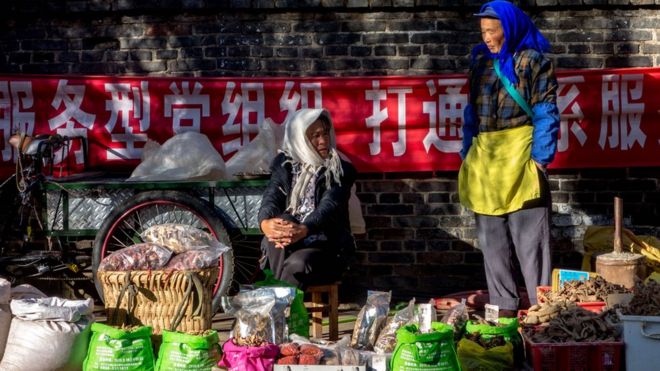
Local women sell produce in the market. Zhongyi market, located at the southern gate of Dayan ancient city, in Lijian, Yunnan Province in ChinaImage copyrightGETTY IMAGES

It took China less than 70 years to emerge from isolation and become one of the world’s greatest economic powers.

As the country celebrates the anniversary of the founding of the People’s Republic of China, we look back on how its transformation spread unprecedented wealth – and deepened inequality – across the Asian giant.

“When the Communist Party came into control of China it was very, very poor,” says DBS chief China economist Chris Leung.

“There were no trading partners, no diplomatic relationships, they were relying on self-sufficiency.”

Over the past 40 years, China has introduced a series of landmark market reforms to open up trade routes and investment flows, ultimately pulling hundreds of millions of people out of poverty.

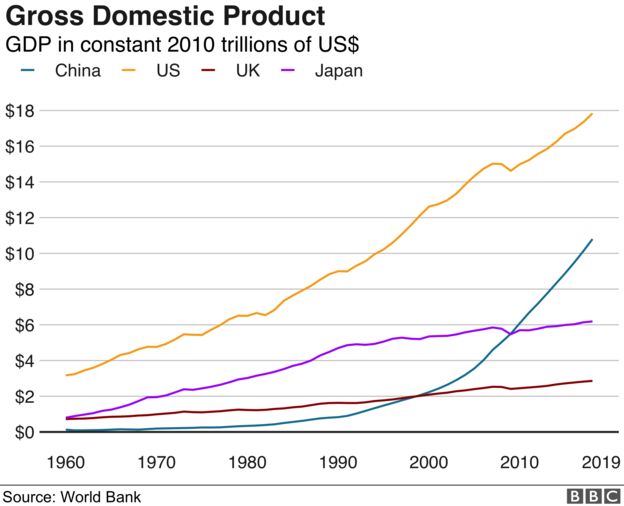
Chart showing gross domestic product of US, China, Japan and the UK

The 1950s had seen one of the biggest human disasters of the 20th Century. The Great Leap Forward was Mao Zedong’s attempt to rapidly industrialise China’s peasant economy, but it failed and 10-40 million people died between 1959-1961 – the most costly famine in human history.

This was followed by the economic disruption of the Cultural Revolution in the 1960s, a campaign which Mao launched to rid the Communist party of his rivals, but which ended up destroying much of the country’s social fabric.

‘Workshop of the world’

Yet after Mao’s death in 1976, reforms spearheaded by Deng Xiaoping began to reshape the economy. Peasants were granted rights to farm their own plots, improving living standards and easing food shortages.

The door was opened to foreign investment as the US and China re-established diplomatic ties in 1979. Eager to take advantage of cheap labour and low rent costs, money poured in.

“From the end of the 1970s onwards we’ve seen what is easily the most impressive economic miracle of any economy in history,” says David Mann, global chief economist at Standard Chartered Bank.

Through the 1990s, China began to clock rapid growth rates and joining the World Trade Organization in 2001 gave it another jolt. Trade barriers and tariffs with other countries were lowered and soon Chinese goods were everywhere.

“It became the workshop of the world,” Mr Mann says.

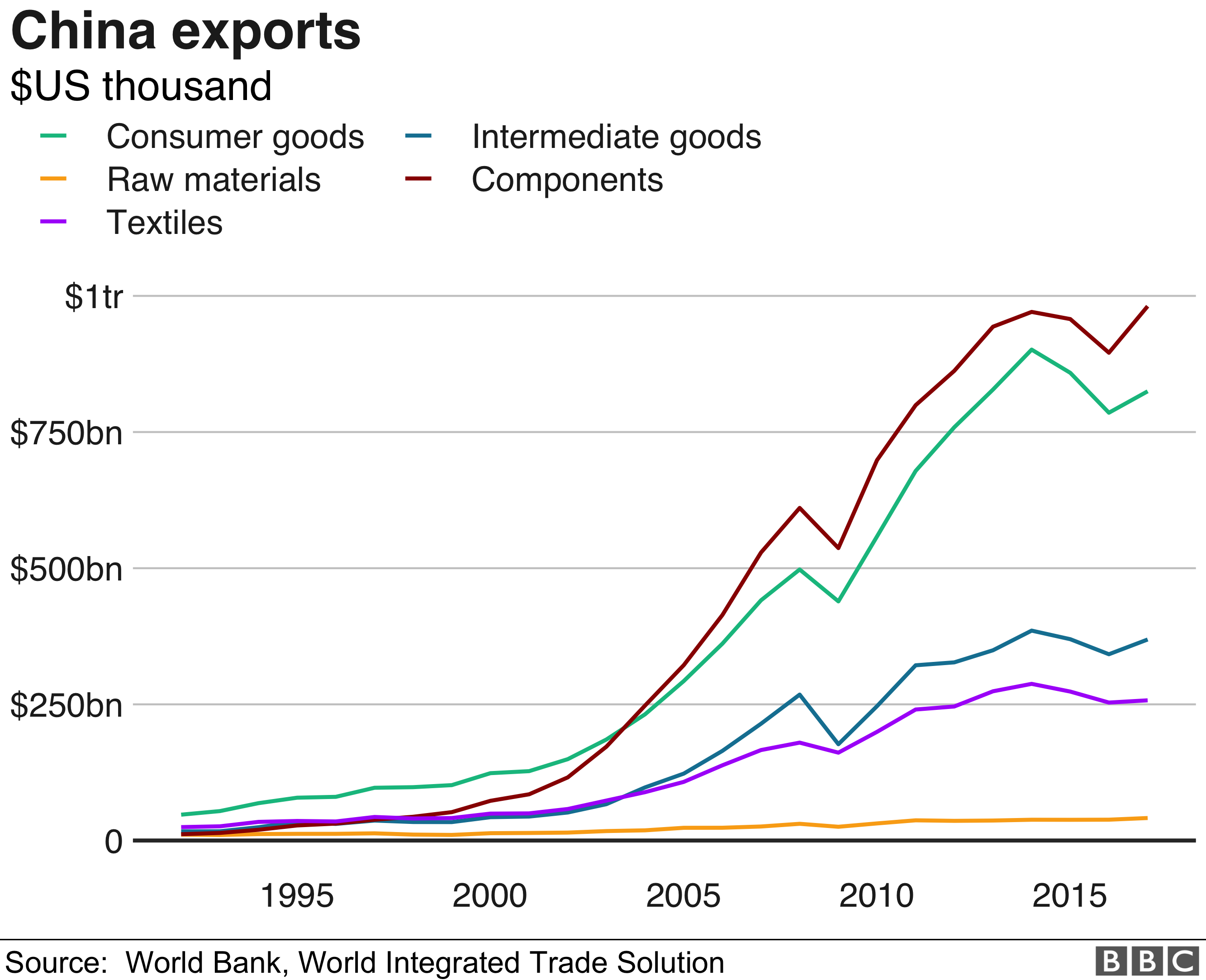
Chart showing China exports

Take these figures from the London School of Economics: in 1978, exports were $10bn (£8.1bn), less than 1% of world trade.

By 1985, they hit $25bn and a little under two decades later exports valued $4.3trn, making China the world’s largest trading nation in goods.

Poverty rates tumble

The economic reforms improved the fortunes of hundreds of millions of Chinese people.

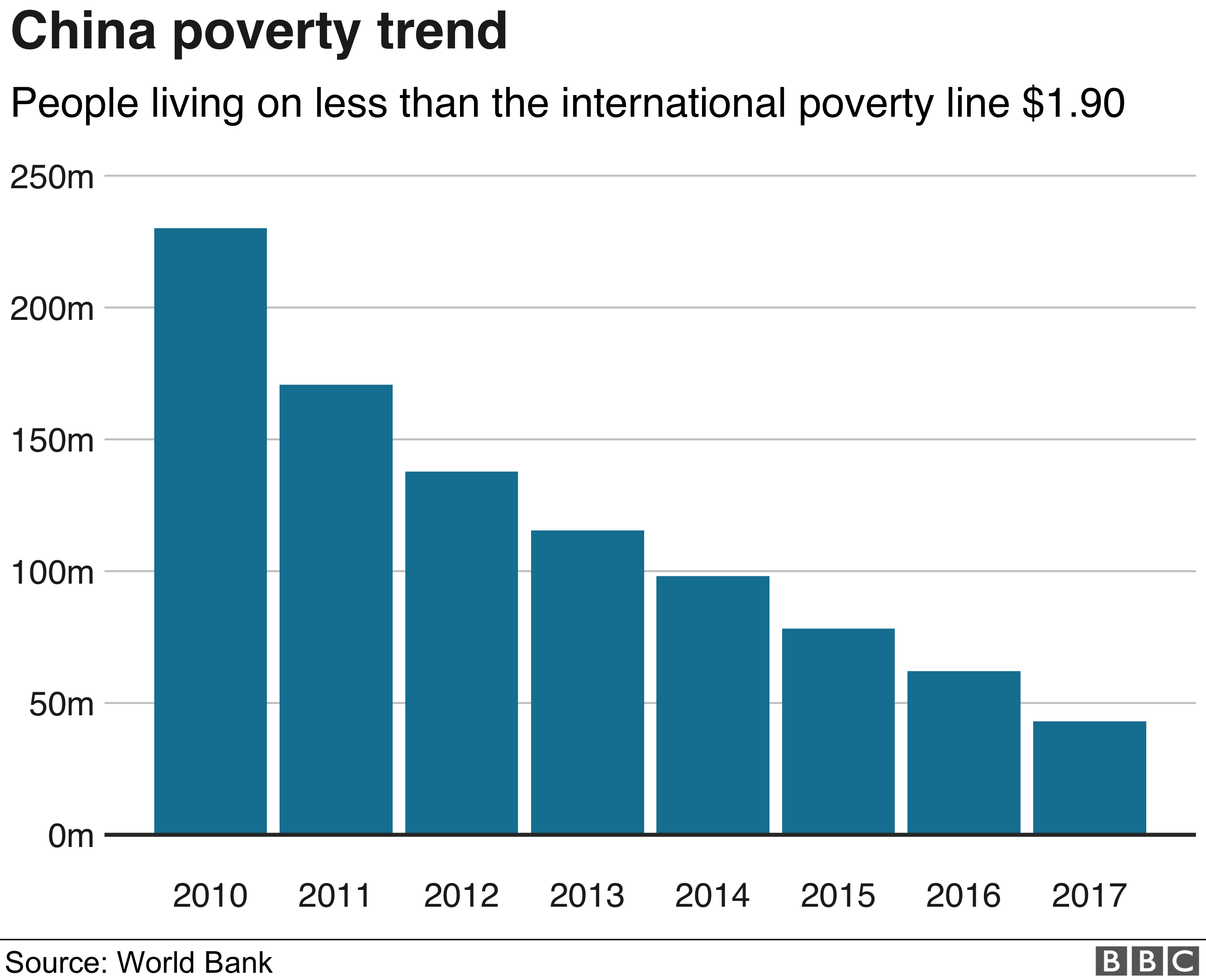
The World Bank says more than 850 million people been lifted out of poverty, and the country is on track to eliminate absolute poverty by 2020.

At the same time, education rates have surged. Standard Chartered projects that by 2030, around 27% of China’s workforce will have a university education – that’s about the same as Germany today.

China poverty rates

Rising inequality

Still, the fruits of economic success haven’t spread evenly across China’s population of 1.3 billion people.

Examples of extreme wealth and a rising middle class exist alongside poor rural communities, and a low skilled, ageing workforce. Inequality has deepened, largely along rural and urban divides.

“The entire economy is not advanced, there’s huge divergences between the different parts,” Mr Mann says.

The World Bank says China’s income per person is still that of a developing country, and less than one quarter of the average of advanced economies.

China’s average annual income is nearly $10,000, according to DBS, compared to around $62,000 in the US.

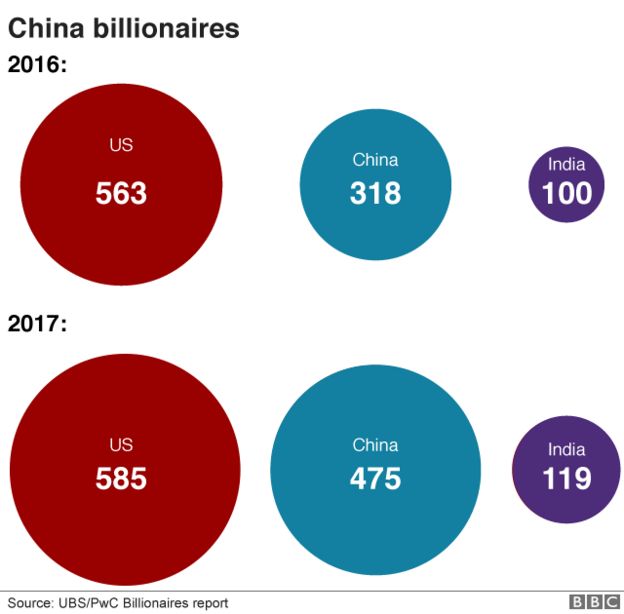
Billionaires in China, the US and India

Slower growth

Now, China is shifting to an era of slower growth.

For years it has pushed to wean its dependence off exports and toward consumption-led growth. New challenges have emerged including softer global demand for its goods and a long-running trade war with the US. The pressures of demographic shifts and an ageing population also cloud the country’s economic outlook.

Still, even if the rate of growth in China eases to between 5% and 6%, the country will still be the most powerful engine of world economic growth.

“At that pace China will still be 35% of global growth, which is the biggest single contributor of any country, three times more important to global growth than the US,” Mr Mann says.

The next economic frontier

China is also carving out a new front in global economic development. The country’s next chapter in nation-building is unfolding through a wave of funding in the massive global infrastructure project, the Belt and Road Initiative.

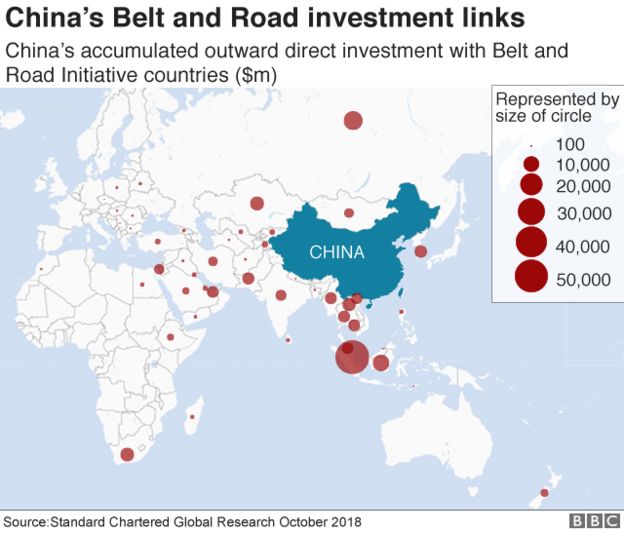
Map showing Chinese investment as part of the Belt and Road initiative

The so-called new Silk Road aims to connect almost half the world’s populations and one-fifth of global GDP, setting up trade and investment links that stretch across the world.

Source: The BBC

12/09/2017

Why inequality in India is at its highest level in 92 years – BBC News

Did India’s economic reforms lead to a sharp rise in inequality?

New research by French economists Lucas Chancel and Thomas Piketty, author of Capital, the 2013 bestselling book on capitalism and increasing inequality, clearly points to this conclusion.

They studied household consumption surveys, federal accounts and income tax data from 1922 – when the tax was introduced in India – to 2014.

The data shows that the share of national income accruing to the top 1% of wage earners is now at its highest level since Indians began paying income tax.

The economists say the top 1% of the earners captured less than 21% of the total income in the late 1930s, before dropping to 6% in the early 1980s and rising to 22% today. India, in fact, comes out as a country with one of the highest increase in top 1% income share concentration over the past 30 years,” they say.

How India’s currency ban is hurting the poorIs India winning the war on poverty?

To be sure, India’s economy has undergone a radical transformation over the last three decades.Up to the 1970s, India was a tightly regulated, straitlaced economy with socialist planning. Growth crawled (3.5% per year), development was weak and poverty endemic.

Some easing of regulation, decline in tax rates and modest reforms led to growth picking up in the 1980s, trundling at around 5% a year. This was followed by some substantial reforms in the early 1990s after which the economy grew briskly, nudging close to double digits in the mid-2000s.

Last November’s controversial cash ban slowed down the economy

Growth has slowed substantially since then, but India still remains one of the fastest-growing economies in the world. The ongoing slowdown – growth was 5.7% in the April-June quarter, the slowest pace in three years – largely triggered by feeble demand, a controversial cash ban, declining private investment and weak credit growth, is a cause for concern.

And the need for fast-paced growth, according to Nobel Prize winning economist Amartya Sen, is “far from over since India, after two decades of rapid growth, is still one of the poorest countries in the world”.

From their latest work on income inequality, Lucas Chancel and Thomas Piketty contend that there has been a “sharp increase in wealth concentration from 1991 to 2012, particularly after 2002”. Also, they conclude, India has only been really shining for the top 10% of the population – roughly 80 million people in 2014 – rather than the middle 40%.

The economists plan to release the first World Inequality Report, produced by a network of more than 100 researchers in December, where they will compare India’s inequality with other countries and suggest ways to tackle it.

Striking transition

They agree that unequal growth over a period of time is not specific to India, but market economies are not bound to be unequal. India’s case is striking in the fact that it is the country with the highest gap between the growth of the top 1% and that of the full population. Incomes of those at the very top have actually grown at a faster pace than in China.

The economists contend that the growth strategy pursued by successive governments has led to a sharp increase in inequality. China also liberalised and opened up after 1978, and experienced a sharp income growth as well as a sharp rise in inequality. This rise was however stabilised in the 2000s and is currently at a lower level than India.

In Russia, the move from a communist to a market economy was “swift and brutal” and today has a similar level of inequality to India.

“This shows that there are different strategies to transit from a highly regulated economy to a liberalised one. In the arrays of possible pathways, India pursued a very unequal way but could probably have chosen another path,” Dr Chancel told me.

India’s economy grew at its slowest pace for three years in the April-to-June quarter

While inequality is rising in most parts of the world, certain countries are resisting this trend. For example, he says, the rise in inequality is much lesser in western Europe than in the Anglo-Saxon world or in emerging markets.

“This largely owes to social security mechanisms that are relatively more favourable to workers than capital as compared to other parts of the world, to relatively more efficient tax systems and government investment in public goods such as education, housing, health or transport.”

Clearly, the new research should help promote a vigorous debate on what more can be done to promote more inclusive growth in India and the need for more transparent income and wealth data.

Source: Why inequality in India is at its highest level in 92 years – BBC News

18/01/2017

This Is Just How Unequal India Is – India Real Time – WSJ

New report from Oxfam highlights how the country’s wealth is concentrated in the hands of a few

Country Percentage of wealth top 1% has
Global

51

Australia

22

Belgium

18

Brazil

48

Canada

26

Denmark

31

France

25

Germany

31

India

58

Italy

25

Mexico

38

Netherlands

24

New Zealand

20

South Africa

42

Sweden

36

U.K.

24

U.S.

42

The richest 1% of Indians hold 58% of the country’s total wealth, according to Oxfam India.

The stark inequality in India is worse than the global data put out by the organization, which show that the richest 1% have more than 50% of the total world wealth, Oxfam said.

It said recently improved data on the distribution of wealth, particularly in countries like India and China, indicate that the poorest half of the world has less wealth was previously thought. Oxfam singled out India repeatedly in the report.

It said that companies are increasingly driven to pay higher returns to their shareholders. In India, the amount of profits corporations share with shareholders is as high as 50% and growing rapidly, the report said.

A family sits atop a pile of hay on a horse cart on a highway near Amritsar, India, Nov. 4, 2016.

The report said the annual share dividends paid by from Zara’s parent company to Amancio Ortega – the world’s second richest man – are equal to around 800,000 times the annual wage of a worker employed by a garment factory in India.

Oxfam said that the combined wealth of India’s 57 billionaires is equivalent to that of the country’s poorest 70%.“India is hitting the global headlines for many reasons, but one of them is for being one of the most unequal countries in the world with a very high and sharply rising concentration of income and wealth,” Nisha Agarwal, chief executive of Oxfam said in a statement.

Oxfam said India should introduce an inheritance tax and raise its wealth levies as well as increasing public spending on health and education. It said it should end the era of tax havens and crack down on rich people and corporations avoiding tax.

Source: This Is Just How Unequal India Is – India Real Time – WSJ

06/10/2016

Chinese people optimistic about the future, says Pew survey – BBC News

At a time of Brexit and talk of a wall between the United States and Mexico, it seems the Chinese are embracing international engagement.

They think their country’s power is rising, that their living standards will keep improving, that corruption is being cleaned up and that air pollution should be fixed even if it means slowing down economic growth.

These are the views which have emerged from a broad survey from Washington-based the Pew Research Center.

Elsewhere there is fear and uncertainty. Here optimism trumps all.

When asked about economic globalisation, 60% of people said it is a good thing and only 23% think it is bad for China.

While some China watchers are warning that this country’s mounting local government debt could mean that a hard landing is on the way, Chinese people don’t appear to share this pessimism.

Nearly 90% of respondents amongst this group of 3,154, interviewed face-to-face in China earlier this year, think that the state of their country’s economy is either “very good” or “somewhat good”.

GETTY IMAGES – Chinese people seem to remain optimistic

Looking into the future things will apparently get even better: 76% of people think the economy will improve over the next 12 months, 70% said their personal financial situation will improve and eight out of 10 people believe that their children will have a better standard of living than they do.

Bread and butter issues

It’s not that people are without concerns.

“Corrupt officials” is at the top of the table when it comes to people’s worries (83% said this was a “very big” or “moderately big” problem) and yet here too we see optimism.

Some 64% of them said that President Xi Jinping‘s massive anti-corruption drive would improve the situation over the next five years.

Running down the concern list, an alarmingly high number of people see income inequality and the safety of food and medicine as “very big” problems.

This should give the Chinese Communist Party pause for concern.

If you enjoy monopoly power on the basis that you are delivering “socialism with Chinese characteristics” then a small group of ultra-rich driving around in their sports cars and showing off their wealth while most struggle to pay the rent is surely at odds with your central message.

Then, if ordinary Chinese people can’t even trust the food and medicine they are giving their children, the possibility for social unrest over bread and butter issues is looming large.

The environment also emerges as a massive challenge with water and air pollution at the front of people’s minds.

Air pollution is so bad in China that half of those polled said their country should fight air pollution harder even if it means sacrificing economic growth.

GETTY IMAGES – Emissions from coal-powered industries, cars and heating systems generate the smog

Only 24% saw air deterioration as a necessary price to pay.

When it comes to the war of ideas in the top echelons of power here, those ministers in favour of tougher environmental protection measures could do worse than table this research.

A “major threat” to China?

The South China Sea and other geo-strategic tensions offer some of the most bleak opinions.

Nearly six out of 10 people think that territorial pressures with neighbours could lead to military conflict; 77% say their way of life needs to be protected from “foreign influence” (up by 13 percentage points since 2002) and only 22% say China should help other nations.

Regarding relations with rival superpower the United States people views are complex and, at times, seemingly contradictory.

Around half of Chinese respondents rated the US favourably but more than half think that Washington is trying to prevent China from becoming an equal power.

About 45% said that US power and influence poses a “major threat” to China. In fact the US came in at number one as the top international threat to the country.

GETTY IMAGES – More than half of Chinese people think that Washington is trying to prevent China from becoming an equal power

It’s interesting that some would see the Obama administration’s so-called “pivot to Asia” as a greater threat than say jihadist extremist groups just across the western border promoting bloody conflict in China’s vast Muslim region of Xinjiang.

Either way, whatever the perceived threat, China is seen as becoming ever more important and with ever more power at its disposal.Information is being controlled here ever more tightly – whether it is coming from the traditional media or sources online – so some analysts will see these views as the inevitable result of messages being delivered to the Chinese people by their government.

This may the be case but, in a world where politicians in various countries are accused of exploiting people’s fear and insecurity, could it be that a quarter of the globe’s population are going around with a smile on their dial because every day they look out the window and to them it just gets better and better?

Source: Chinese people optimistic about the future, says Pew survey – BBC News

30/09/2016

Rich province, poor province | The Economist

EARLY in the summer Xi Jinping, China’s president, toured one of the country’s poorest provinces, Ningxia in the west. “No region or ethnic group can be left behind,” he insisted, echoing an egalitarian view to which the Communist Party claims to be wedded.

In the 1990s, as China’s economy boomed, inland provinces such as Ningxia fell far behind the prosperous coast, but Mr Xi said there had since been a “gradual reversal” of this trend. He failed to mention that this is no longer happening. As China’s economy slows, convergence between rich and poor provinces is stalling. One of the party’s much-vaunted goals for the country’s development, “common prosperity”, is looking far harder to attain.

This matters to Mr Xi (pictured, in Ningxia). In recent years the party’s leaders have placed considerable emphasis on the need to narrow regional income gaps. They say China will be a “moderately prosperous society” by the end of the decade. It will only be partly so if growth fails to pick up again inland. Debate has started to emerge in China about whether the party has been using the right methods to bring prosperity to backward provinces.

China is very unequal. Shanghai, which is counted as a province, is five times wealthier than the poorest one, Gansu, which has a similar-sized population (see map). That is a wider spread than in notoriously unequal Brazil, where the richest state, São Paulo, is four times richer than the poorest, Piauí (these comparisons exclude the special cases of Hong Kong and Brasília).

To iron out living standards, the government has used numerous strategies. They include a “Go West” plan involving the building of roads, railways, pipelines and other investment inland; Mr Xi’s signature “Belt and Road” policy aimed partly at boosting economic ties with Central Asia and South-East Asia and thereby stimulating the economies of provinces adjoining those areas; a twinning arrangement whereby provinces and cities in rich coastal areas dole out aid and advice to inland counterparts; and a project to beef up China’s rustbelt provinces in the north-east bordering Russia and North Korea. The central government also gives extra money to poorer provinces. Ten out of China’s 33 provinces get more than half their budgets from the centre’s coffers. Prosperous Guangdong on the coast gets only 10%.

The number, range and cost of these policies suggest the party sees its legitimacy rooted not only in the creation of wealth but the ability to spread it around. Deng Xiaoping’s economic reforms, launched in the late 1970s, helped seaboard provinces, which were then poorer than inland ones, to catch up by making things and shipping them abroad. (Mao had discouraged investment in coastal areas, fearing they were vulnerable to attack.) In the 1990s the coast pulled ahead. Then, after 2000, the gap began to narrow again as the worldwide commodity boom—a product of China’s rapid growth—increased demand for raw materials produced in the interior (see chart).

That was a blessing for Mr Xi’s predecessor Hu Jintao, who made “rebalancing” a priority after he became party chief in 2002. It also boosted many economists’ optimism about China’s ability to sustain rapid growth. Even if richer provinces were to slow down, they reckoned, the high growth potential of inland regions would compensate for that.

But convergence is ending. GDP growth slowed across the country last year, but especially in poorer regions. Seven inland provinces had nominal growth below 2%, a recession by Chinese standards (in 2014 only one province reported growth below that level). In contrast, the rich provincial-level municipalities of Shanghai, Beijing and Tianjin, plus a clutch of other coastal provinces including Guangdong, grew between 5% and 8%. Though there were exceptions, the rule of thumb in 2015 was that the poorer the region, the slower the growth. Most of the provinces with below-average growth were poor.

Of course, 2015 was just one year. But a longer period confirms the pattern. Of 31 provinces, 21 had an income below 40,000 yuan ($6,200) per person in 2011. Andrew Batson of Gavekal Dragonomics, a research firm, says that of these 21, 13 (almost two-thirds) saw their real GDP growth slow down by more than 4 points between 2011 and 2014. In contrast, only three of the ten richer provinces (those with income per person above the 40,000 yuan mark) slowed that much. In 2007 all of China’s provinces were narrowing their income gap with Shanghai. In 2015 barely a third of them were. In other words, China’s slowdown has been much sharper in poorer areas than richer ones.

There are three reasons why convergence has stalled. The main one is that the commodity boom is over. Both coal and steel prices fell by two-thirds between 2011 and the end of 2015, before recovering somewhat this year. Commodity-producing provinces have been hammered. Gansu produces 90% of the country’s nickel. Inner Mongolia and Shanxi account for half of coal production. In all but four of the 21 inland provinces, mining and metals account for a higher share of GDP than the national average.

Commodity-influenced slowdowns are often made worse by policy mistakes. This is the second reason for the halt in convergence. Inland provinces built a housing boom on the back of the commodity one, creating what seemed at the time like a perpetual-motion machine: high raw-material prices financed construction which increased demand for raw materials. When commodity prices fell, the boom began to look unsustainable.

The pace of inland growth was evident in dizzying levels of investment in physical assets such as buildings and roads. Between 2008 and last year, as a share of provincial GDP, it rose from 48% to 73% in Shanxi, 64% to 78% in Inner Mongolia, and from 54% to an astonishing 104% in Xinjiang. In the country as a whole, investment as a share of GDP rose only slightly in that period, to 43%. In Shanghai it fell.

This would be fine if the investments were productive, but provinces in the west are notorious for waste. In the coal-rich city of Ordos in Inner Mongolia, on the edge of the Gobi desert, a new district was built, designed for 1m people. It stood empty for years, a symbol of ill-planned extravagance (people are at last moving in).

Investment by the government is keeping some places afloat. Tibet, for example, logged 10.6% growth in the first half of this year, thanks to net fiscal transfers from the central government amounting to a stunning 112% of GDP last year. Given the region’s political significance and strategic location, such handouts will continue—Tibet’s planners admit there is no chance of the region getting by without them for the foreseeable future.

Tibet is an extreme example of the third reason why convergence is ending. Despite oodles of aid, both it and other poor provinces cannot compete with rich coastal ones. In theory, poorer places should eventually converge with rich areas because they will attract businesses with their cheaper labour and land. But it turns out that in China (as elsewhere) these advantages are outweighed by the assets of richer places: better skills and education, more reliable legal institutions, and so-called “network effects”—that is, the clustering of similar businesses in one place, which then benefit from the swapping of ideas and people. A recent study by Ryan Monarch, an economist at America’s Federal Reserve Board, showed that American importers of Chinese goods were very reluctant to change suppliers. When they do, they usually switch to another company in the same city. This makes it hard for inland competitors to break into export markets.

There are exceptions. The south-western region of Chongqing has emerged as the world’s largest exporter of laptops. Chengdu, the capital of neighbouring Sichuan province, is becoming a financial hub. But by and large China’s export industry is not migrating inland. In 2002 six big coastal provinces accounted for 80% of manufactured exports. They still do.

This contrast is worrying. Though income gaps did narrow after 2000 and only stopped doing so recently, provinces have not become alike in other respects. Rich ones continue to depend on world markets and foreign investment. Poor provinces increasingly depend on support from the central government.

A divergence of views

Officials bicker about this. Mr Xi asserted the Robin-Hood view in Ningxia that regional gaps matter and that redistribution is needed. “The first to prosper,” he said, “should help the latecomers.” But three months earlier, an anonymous “authoritative person” (widely believed to be Mr Xi’s own adviser, Liu He) took a more relaxed view, telling the party’s mouthpiece, the People’s Daily, that “divergence is a necessity of economic development,” and “the faster divergence happens, the better.”

It is unclear how this difference will be resolved, though the money must surely be on Mr Xi. Economically, though, Mr Liu is right. Regional-aid programmes have had little impact on the narrowing of income gaps. More of them will not stop those gaps widening. Socially, a slowdown in poorer provinces should not be a problem so long as jobs are still being created in richer ones, enabling migrants from inland to find work there and send money home. But politically the end of convergence is a challenge to Mr Xi, who has been trying to appeal to traditionalists in the party who extol Mao as a champion of equality. Wasteful and ineffective measures to achieve it will remain in place.

Source: Rich province, poor province | The Economist

Law of Unintended Consequences

continuously updated blog about China & India

ChiaHou's Book Reviews

continuously updated blog about China & India

What's wrong with the world; and its economy

continuously updated blog about China & India