Archive for ‘railways’

13/01/2017

Opinion is divided on China’s massive infrastructure projects | The Economist

CHINA is proud of its infrastructure: its cavernous airports, snaking bridges, wide roads, speedy railways and great wall. This national backbone (minus the wall) bears the weight of the world’s second-largest economy and its biggest human migration, as hundreds of millions of people move around the country during the lunar new-year holidays—the rush officially begins on January 13th.

Western leaders often shake their heads in disbelief at the sums China spends on its huge projects. And some analysts question how much of it has been wisely spent. In a widely circulated study published last autumn, Atif Ansar of Oxford University’s Saïd Business School and his co-authors say the world’s “awe and envy” is misplaced. More than half of China’s infrastructure projects have “destroyed economic value”, they reckon. Their verdict is based on 65 road and rail projects backed by the Asian Development Bank (ADB) or the World Bank since the mid-1980s. Thanks to the banks’ involvement, these projects are well documented.

One example is a 147-km, four-lane toll road in southern Yunnan province, which was built with the help of an ADB loan approved in 1999. The ADB expected the Yuanjiang-Mohei highway (Yuan-Mo for short) to cut travel times, reduce traffic accidents and lower the costs of fuelling and repairing vehicles, adding up to a compelling economic return of 17.4% a year. By 2004, however, traffic was 49% below projections and costs were more than 20% over budget, thanks to unforgiving terrain prone to landslides.

Were such setbacks enough to damn over half of the projects they examined? As a rule, the ADB and World Bank will approve an undertaking only if they expect its broad benefits (the economic gains from reduced travel times, fewer accidents, etc) to exceed its costs by a large margin, leaving ample room for error. Mr Ansar and his co-authors assume this margin is 40%: they posit a ratio of expected benefits to costs of 1.4 for every project. They scoured the banks’ review documents for examples of cost overruns and traffic shortfalls. Given these assumptions, a project becomes unviable if costs overrun by more than 40%, traffic undershoots by 29%, or some combination of the two. Of the 65 projects, 55% fell into this category. Yuan-Mo was one.

These projects may not be representative of China’s infrastructure-building as a whole. But there is little reason to think they are unusually bad. They are often managed with greater rigour, thanks to the involvement of outside lenders.The authors’ conclusion, however, rests on their assumption about the margin for error built into the projects they looked at. Take Yuan-Mo, for example. Its projected benefits, over its first 20 years of operation, were several times greater than its costs. But as often with roads, the costs arrive early; the benefits are spread thinly over many years. In the time it takes for an investment to pay off, the resources used could have been earning a return elsewhere. So it is necessary to reduce the future payoffs by some annual percentage, known as a “discount rate”. The higher this is, the lower the value placed today on tomorrow’s gains.

So a lot turns on what rate is chosen. For historical reasons, the ADB adopts a high one of 12%. At that rate, Yuan-Mo’s ratio of expected benefits to costs equals 1.5, roughly in line with the authors’ assumptions. But at a gentler rate of 9%, the ratio improves to about 2. At a rate of 5.3% (more in line with government borrowing costs) the ratio rises to 3. With these higher margins for error, many fewer elephants turn white. At a ratio of 2, the share falls to 28%. If the ratio is assumed to be 3, the proportion of duds falls to just 8%.

The authors also assume that any traffic shortfall persists throughout its life. That is not always the case. Traffic on Yuan-Mo, for example, has rebounded, according to the road’s operator. By 2015 it was 31% higher than the ADB projected back in 1999. Around last year’s lunar new-year holiday the road handled record numbers. Some white elephants turn grey with age.

Source: Opinion is divided on China’s massive infrastructure projects | The Economist
04/06/2016

This Spanish Company Says It Holds the Key to Speed on India’s Crooked Railways – India Real Time – WSJ

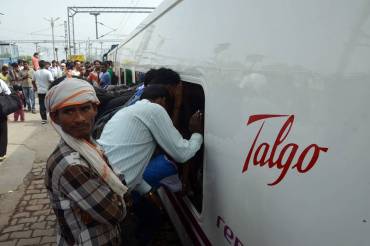
India’s trains are notoriously slow and outdated, but a Spanish train maker says it can change that with coaches that can squeeze much more speed out of the country’s crooked railways.

Talgo S.A. has been wooing India for years as the South Asian nation has one of the largest railway networks in the world and big plans to upgrade its rail infrastructure.

The Madrid-based company got its breakthrough this year when it got the go-ahead to test its coaches on few routes in India to prove its trains can slash travel times for the 13 million people who use the state-owned Indian Railways every day. Talgo claims its coaches can cut travel time by up to 30%.

The existing average maximum speed of Indian passenger trains is 110 kilometers per hour, according to Vijay Kumar, executive director for infrastructure and mechanical engineering at Indian Railways.

One of Indian Railways’ current fastest trains–the Rajdhani Express–travels between Delhi and Mumbai in around 16 hours. Talgo says the same journey with its coaches will take less than 11 hours.

India has traditionally built its own trains and Talgo is the first foreign train-manufacturer to be given permission to conduct trials, said Mr. Kumar.

The tests of the trains began last weekend between Bareilly and Moradabad in northern Indian state of Uttar Pradesh and will be expanded to two other routes.

The main selling point of the Talgo coaches is that India won’t need to change the tracks for them.

“For any conventional train you need a lot of investment in the existing infrastructure but with Talgo train you don’t need any investment in the infrastructure and it can start going at higher speed,” said Subrat Nath, director for India and Asia-Pacific region at Talgo.

Despite India’s dependence on its railways, the system has become outdated and overburdened.

“India is unique and alone among the major countries of the world in not having a single high-speed rail corridor,” said a document presented to the Indian Parliament in 2009 titled “Indian Railways Vision 2020.”

The Congress party-led government back then said it would upgrade the current tracks and build “state-of-the-art high-speed corridors” for the trains to run up to 350 kilometers, or 217 miles, per hour.

In the latest step in that direction, India launched its first “semi-high speed” train in April–the Gatimaan Express– between Delhi and Agra, home of the Taj Mahal. The train has a maximum speed of 160 kilometers, or 99 miles, per hour, cutting the fastest travel time between the capital and Agra by more than 15 minutes.

One of the biggest factors slowing down Indian Railways’ 7,000 passenger trains is the country’s long and winding railroads. There are 495 speed-killing curves in the tracks between Delhi and Mumbai alone, said Mr. Kumar at Indian Railways.

Straightening out existing tracks or building straight ones from scratch is too expensive, said Mr. Kumar, so the trains from Talgo and others which offer more speed on curvy lines could be the best option.

Talgo coaches use a “natural tilting mechanism” which allows them to go up to 20% faster on curves than conventional coaches, Mr. Kumar said.

He said the trials will test whether the trains perform as promised. India has not committed to ordering from Talgo yet.

Talgo’s Mr. Nath says the company is ready to build the coaches in India if it can get the orders.“India can be a key market for us,” he said.

Source: This Spanish Company Says It Holds the Key to Speed on India’s Crooked Railways – India Real Time – WSJ

30/12/2015

Historian praises China’s global infrastructure building, criticizes West’s destructive methods – Xinhua | English.news.cn

China, with its impressive international infrastructure initiatives, has injected impetus into global growth, a U.S.-German historian has said, while criticizing Washington’s hawkish attitude, as reported by Sputnik.

China is “leading an economic renaissance of a scale not seen in more than a century,” said F. William Engdahl, a historian and economic researcher, in his recent article for New Eastern Outlook. “Beijing is, with customary Chinese speed, linking its economy by land and by sea lanes to all Eurasia,” the historian wrote, previously saying that China is “moving forward with an impressive array of major international infrastructure projects” in various regions. “For my side, I infinitely prefer the peaceful building projects to the destroying ones,” Engdahl said.

During the Johannesburg Summit of the Forum on China-Africa Cooperation (FOCAC) in early December in South Africa, Chinese President Xi Jinping unveiled the 60-billion-U.S.-dollar aid package for Africa in the next three years. The package seeks to help Africa to industrialize, modernize its agricultural production, boost the skills of its workers, build infrastructure and improve its health care.

“Unlike NATO’s endless wars, construction of infrastructure — railways, water navigation, electric power grids, lifts people up and enhances peace and stability,” Engdahl said, pointing out that Xi’s offer benefits both Africa and China.

China is also establishing a more amicable, vibrant neighborhood and is deepening economic ties with European countries through its Belt and Road initiative. The Belt and Road initiative, comprising the Silk Road Economic Belt and the 21st Century Maritime Silk Road, was brought up by Xi in 2013, with the aim of building a trade and infrastructure network connecting Asia with Europe and Africa along the ancient Silk Road routes.

The initiative creates a “golden opportunity” for the countries of Central and Eastern Europe that are facing economic difficulties, linking the East and the West of the Eurasian continent through a vast network of high-speed railways and maritime routes, Engdahl said.

“China is the world address in rail infrastructure today, while the West, led by the pathetic rail construction record of the USA, falls farther and farther behind,” Engdahl said, referring to China’s planned construction of a Hungary-Serbia high-speed railway. The railway linking the capitals of Hungary and Serbia, Budapest and Belgrade, has a total length of 350 km, with 184 km in Serbia. It is designed for electric passenger and cargo trains with a maximum speed of 200 km per hour. Once complete, it will help create a fast lane for importing and exporting products between China and Europe.

Besides recognizing the export of “Chinese rail technology” to Europe, the researcher also mentioned Beijing’s intentions to invest in constructing and upgrading port facilities in the Baltic, Adriatic, and Black Seas.

Source: Historian praises China’s global infrastructure building, criticizes West’s destructive methods – Xinhua | English.news.cn

25/11/2014

China’s Railroad Ventures Abroad Project Soft Power – Businessweek

Last week state-owned China Railway Construction Corp. (CRCC) signed a lucrative contract with Nigeria to build an 870-mile coastal railroad from Lagos to Calabar, two of the West African nation’s leading cities. The price tag: $12 billion. That makes it the largest single overseas engineering contract awarded to any Chinese company, according to state-run Xinhua newswire.

Chinese and Venezuelan construction workers build an elevated platform at China Railway Engineering Corporation's (CREC) Tinaco-Anaco railway project in Los Dos Caminos, Venezuela in 2012

Beijing hopes many more deals will follow. In recent months, Chinese leaders on overseas missions have often bragged of the country’s prowess in building railroads, including high-speed bullet trains.

In May, Li Keqiang made his first diplomatic trip as China’s premier to Africa, visiting Ethiopia, Nigeria, Angola, and Kenya. At the headquarters of the African Union in Addis Ababa, Ethiopia, he said he envisioned a bright future for the continent when African capitals would be connected by high-speed rail. And China, he added, according to Xinhua, could “help make this dream come true.”

In early November, a consortium of Chinese companies led by CRCC won a $3.7 billion contract to build a bullet train in Mexico; that contract was canceled a few days later due to suspected corruption on the Mexican side. But the aborted deal is still a sign of overseas demand for China’s rail technology.

Nor are rail deals limited to developing nations: In October, Boston’s transit authority signed a $567 million contract with China’s CNR Corp. to build 284 subway cars.

In addition to stimulating domestic manufacturing demand for steel and rail equipment exports, China’s leaders hope the flurry of railway deals will have soft power benefits as well. The Nigerian railroad will be “a mutually beneficial project,” as CRCC Chairman Meng Fengchao told Xinhua. He pledged to hire at least several thousand workers from Nigeria; in the past, Chinese companies have been criticized for bringing in Chinese workers to complete large engineering projects, thus denying work opportunities to local populations.

via China’s Railroad Ventures Abroad Project Soft Power – Businessweek.

11/02/2014

Rail budget: Mallikarjun Kharge likely to announce more trains, new lines – The Times of India

Faced with a revenue shortfall, railway minister Mallikarjun Kharge will not bring about reduction in basic passenger fares in the interim budget on Wednesday but is likely to make adjustment in fuel adjustment component so that impact on fares is minimum in an election year.

Kharge is likely to announce more trains, new lines and better passenger amenities in the interim budget.

Railway ministry sources said it will be a growth-oriented budget and not a deficit one despite fall in earnings.

via Rail budget: Mallikarjun Kharge likely to announce more trains, new lines – The Times of India.

Enhanced by Zemanta
15/01/2014

Wuhan overpass swings into place[1]- Chinadaily.com.cn

A 17,000-ton section of an overpass was rotated 106 degrees, one step closer to the completion of an elevated highway in Wuhan city, Central China\’s Hubei province, on Jan 14, 2014. The section on pier number Z63, at a height of 15 meters, was built along the railway to not disturb trains. It finished rotating and joined its other parts in 90 minutes. The completed overpass will be 256 meters long and span 11 railways, including the Beijing-Guangzhou Railway and Wuhan-Hefei Railway. It is expected to open to traffic this month.

Wuhan overpass swings into place

via Wuhan overpass swings into place[1]- Chinadaily.com.cn.

Enhanced by Zemanta
11/01/2014

Seeing India by Luxury Train – India Real Time – WSJ

WHEN WE STEPPED off the train at the small station of Pachora, 250 miles northeast of Mumbai, Lord Ganesha was waiting.

A man costumed as the Hindu god was carried by turbaned attendants and accompanied by folk dancers who whirled to ancient stringed instruments, reedy horns and hand drums. Ganesha sported a pinkish elephant head, complete with trunk and oversize ears, but he blessed us with a very human hand. Locals must have felt like the circus had arrived in town, for despite the early hour, they had come to watch the welcome arranged specially for us.

It was appropriate to be greeted by the god of good fortune: We were a lucky group—passengers taking a 2,000-mile journey from Mumbai to New Delhi on the Maharajas’ Express, one of the most luxurious trains in the world.

Roger Toll

Guests playing elephant polo in the private garden of the Maharaja of Jaipur.

The train’s name conjures images of hilltop forts, bejeweled scimitars and armies on camels and elephants— for good reason. The maharajas (“great kings”) ruled India’s hundreds of princely states from as early as the 1600s to the mid-20th century. In Rajasthan, in particular, the warrior-kings built impressive cities they named for themselves: Udaipur, Jodhpur, Jaipur. Their heirs, allying themselves with the British Raj, continued a sumptuous style of living until Indian independence in 1947. (While the princely families lost their power post-Raj, they kept most of their palaces and forts.)

The Maharajas’ Express pays tribute to that regal lifestyle. Nearly half a mile long, the train is a glossy burgundy on the outside. Inside, guests sleep in cabins that feel like upscale hotel rooms, with silk window treatments, carved wood paneling and marble-tiled floors. Travelers feast off fine china and crisp linens in the two dining cars. The staff seems almost to outnumber the guests, which total 88 at full capacity. In the morning, valets brought tea to our rooms. When we trundled through the long line of cars to dinner, staffers folded down our beds, delivered clean laundry and left behind chocolates or a flower. Upon our return from outings, they greeted us with fresh juice or cocktails and cool, damp cloths for wiping the dust from our faces.

via Seeing India by Luxury Train – India Real Time – WSJ.

Enhanced by Zemanta
16/04/2013

* Henan villagers ‘beaten up by hundreds of rail workers’ over land dispute

SCMP: “Villagers in central China’s Henan province who were protesting a land grab in Huangchuan county said they were beaten up by hundreds of employees from the China Railway 13th Bureau at the weekend.

rail.jpg

The villagers were demonstrating against the bureau, which planned to build a new railway line. They said they were “indiscriminately” attacked on Sunday morning by more than 300 uniformed construction workers with metre-long sticks, news portal Dahe.cn reported on Monday.

The protesters said the attackers spoke in northeastern Chinese accents and destroyed 30 mobile phones of those who had tried to film the incident. A villager’s car was also smashed up.

Police were called in but were “forced to turn back” by the 300 workers, the report said.

More than 10 people were injured and two were still in hospital on Monday.

The land dispute arose after villagers tried to prevent the bureau from acquiring the land for a new line for the Nanjing-Xian Railway. Villagers said the compensation offered to them was too low.

The China Railway 13th Bureau is a large state-owned construction enterprise and subsidiary of the China Railway Construction Corporation. Prior to 1948, it was part of the People’s Liberation Army Railway Corps No 3 Division.”

via Henan villagers ‘beaten up by hundreds of rail workers’ over land dispute | South China Morning Post.

15/01/2013

Another spur to the New Orient Express.

See also: https://chindia-alert.org/2013/01/14/5857/

Law of Unintended Consequences

continuously updated blog about China & India

ChiaHou's Book Reviews

continuously updated blog about China & India

What's wrong with the world; and its economy

continuously updated blog about China & India