Archive for ‘local government debt’

29/04/2020

Coronavirus: China risks local government debt surge as Beijing tries to spur economic growth

  • Concerns are rising that China is repeating its mistake of a decade ago by pursuing short-term debt-fuelled economic growth at the cost of long-term sustainability
  • Local governments are stepping up spending on infrastructure projects in a bid to offset the slowdown caused by the coronavirus outbreak and subsequent lockdowns
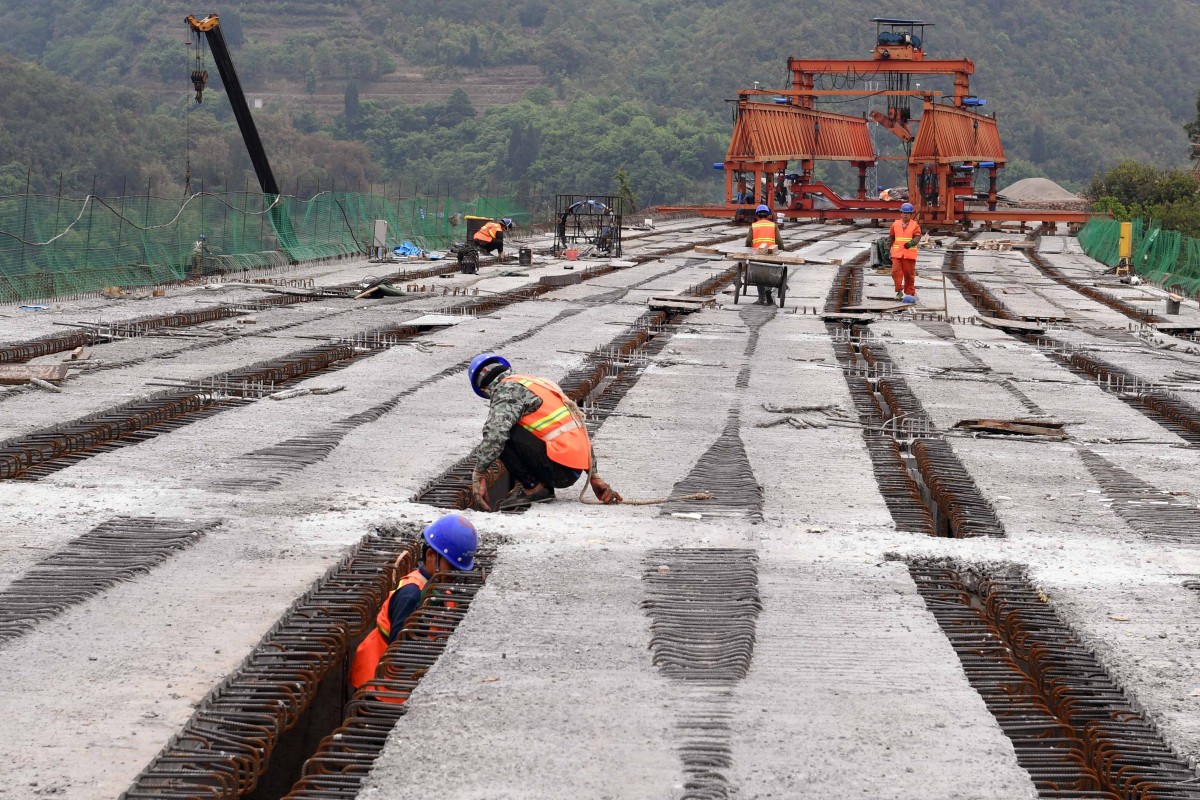
Construction of high-speed railways, motorways and airports is an old tactic that Beijing dusted off after the pandemic led to a 6.8 per cent economic contraction in the first quarter. Photo: Xinhua

China’s huge stockpile of local government debt, one of the biggest “grey rhino” risks threatening the Chinese economy’s future, is set to rise steeply as local authorities rush to increase capital spending to help offset the damage caused by the coronavirus outbreak.

As Beijing discusses increasing the central government budget deficit and monetary policy easing to spur economic growth, many local governments see the situation as a golden opportunity to realise their investment ambitions, fanning concerns that China is repeating its mistake of a decade ago by pursuing short-term debt-fuelled economic growth at the cost of long-term sustainability.
In one of the latest investment drives, the southeastern province of Fujian announced on Sunday that it had signed contracts for 391 new projects with a combined investment value of 783.6 billion yuan (US$110.6 billion). Projects undertaken by central government-owned companies, which received significant lending support in the first quarter, accounted for more than half of the promised investment in Fujian, some 92 projects worth 424.5 billion yuan.
The landlocked eastern province of Anhui is also planning 2,583 new projects this year at a cost of 450 billion yuan, a third of which have been created in the last two weeks.
Construction begins for major sea crossing to link Shenzhen and Zhongshan in Greater Bay Area
In addition to work on existing construction projects, costing around 850 billion yuan, the province has also prepared a list of 3,300 reserve projects with a total investment value of 5.4 trillion yuan (US$762 billion) which could theoretically be started at any point in the future, pending government approval and funding support.

“The most powerful and effective way to offset the economic slowdown is to increase the size of investments,” Wang Qikang, an official with the Anhui economic planning office said on Friday. “[We] must quicken the pace of construction, working day and night to win back the lost time [from the coronavirus lockdowns].”

Construction of high-speed railways, motorways and airports is an old tactic that Beijing dusted off after the pandemic led to a 6.8 per cent economic contraction in the first quarter.

Infrastructure construction has already been hit hard amid the lockdowns, plunging 19.7 per cent in the first three months of the year compared to a year earlier.

Many [local governments] are still striving to achieve a high growth rate without the guidance of a national [gross domestic product] target – Liu Xuezhi

“The investment stimulus mindset has hardly been eradicated at the local level,” said Liu Xuezhi, a senior researcher with the Bank of Communications in Shanghai. “In particular, many [local governments] are still striving to achieve a high growth rate without the guidance of a national [gross domestic product] target.”

Before the start of the coronavirus outbreak, Beijing was thought to be targeting a

growth rate

of around 6 per cent this year after achieving 6.1 per cent in 2019, although many local governments appear to be setting their own annual targets still using the original expected goal as a guide.

However, that target was never made public because the meeting of the

National People’s Congress (NPC)

scheduled for early March, where the growth target would normally have been released, was postponed due to the virus.

The government announced on Wednesday that the NPC will be held from May 22, when a new, likely lower, growth target could be announced.
China’s first-quarter GDP shrinks for the first time since 1976 as coronavirus cripples economy
International rating agency Moody’s warned that greater infrastructure spending would result in higher debt for regional and local governments, increasing their financial risks amid a sharp slowdown in tax revenues.

“Such investments are less likely to be a main support measure [chosen by Beijing] now given the government’s focus on avoiding a rapid increase in leverage and asset price inflation,” Moody’s analysts Michael Taylor and Lilian Li said on Tuesday.

At the end of March, local government debt stood at 22.8 trillion yuan (US$3.2 trillion), according to the Ministry of Finance. But implicit liabilities, which are hidden in local financing vehicles, state firms and public-private partnership projects, are believed to be much larger, with some estimates pointing towards an additional debt of over 30 trillion yuan.

Chinese central bank governor Yi Gang, along with other officials, have already warned against excessive economic stimulus, saying it would add risks to China’s financial system.

A key risk is that local governments are front-loading China’s long-term investment plan, especially in the railway sector, with more than 357 railway projects proposed by local governments.

Shandong province, for example, is preparing to build four new railway lines, including the Shandong portion of a second high-speed railway between Beijing to Shanghai.

“There is still a chance for infrastructure investment growth to hit 10 per cent if the government releases 2 trillion yuan (US$282 billion) in funding through local special purpose bonds and special treasury bonds,” said Haitong Securities’ chief economist Jiang Chao on Monday.

However, a local government debt monitoring report issued on Tuesday by the National Institution of Finance and Development warned that China’s local government fiscal situation is worsening rapidly as expenses surge and revenues drop.

“All levels of local governments in China will face huge debt repayment pressure in five years,” warned Yin Jianfeng, deputy director of the Beijing-based think-tank.

Source: SCMP

10/12/2013

China to judge local governments by their debt: Xinhua | Reuters

China will soon rate the performance of local governments partly by how much debt they incur, as Beijing tries to wean the country off heavy government investment, state media said.

A farmer carries a shovel over his shoulder as he walks to tend his crops in a field that includes an abandoned building, that was to be part of an amusement park called 'Wonderland', on the outskirts of Beijing December 5, 2011. REUTERS/David Gray

The central organization department, which oversees the appointment of senior party, government, military and state firm officials, said debt will be key when evaluating performances, according to the state news agency Xinhua.

Large-scale government investment has helped China\’s gross domestic product expand at double-digit rates for the past three decades. But analysts say China\’s economy has now hit a turning point, and domestic consumption must grow and investment fall to ensure a healthy expansion.

via China to judge local governments by their debt: Xinhua | Reuters.

23/11/2013

Property in China: Haunted housing | The Economist

IN CHINA, property prices can keep going up forever. At least, that is what optimists seem to think. They point out that the country is undergoing the largest urbanisation in history. The throngs of migrants from the countryside all need homes, the argument runs. China’s swelling middle classes, many of whom live in shoddy 1980s housing, are also eagerly moving to fancier flats or McMansions. The result has been a spectacular property boom over the past decade.

At first glance, it seems the good times are still rolling (see chart). During the first three quarters of this year residential sales shot up by 35% versus the same period a year ago. Prices for new homes rose year-on-year in September in 69 of the 70 biggest cities. In Shanghai, Shenzhen and Beijing prices jumped by more than 20%; in slightly smaller cities, such as Nanjing and Xiamen, they rose by around 15%.

Despite these signs of rude health, even some of China’s biggest property moguls appear to be growing uneasy. Wang Shi, the chairman of China Vanke, the country’s largest residential-property firm by volume, has called the market a bubble. Wang Jianlin, the country’s richest man and the chairman of Dalian Wanda, a property giant turned entertainment firm, acknowledges that parts of the country may be experiencing a property bubble, though he thinks it “controllable”. Li Ka-Shing, a Hong Kong tycoon who has long been bullish on China, has started to sell his mainland holdings.

The problem is not the wealthiest cities with the most vertiginous valuations. Indeed, in those markets prices may yet go higher. People from all over China buy trophy apartments in Shanghai and Beijing, making their markets as resilient as those of Manhattan and central London. In fact, policies aimed at squelching speculation may be artificially suppressing demand in those places.

Shanghai and Shenzhen recently followed Beijing’s lead by requiring that buyers of second homes put up 70% of the purchase price as a deposit. In Beijing, the sale of a second home incurs a 20% capital-gains tax. (This is supposedly a nationwide policy, but is not always enforced in other cities.) Couples with two homes are reportedly divorcing to avoid the tax, since once officially single they can each own a primary residence, and thus sell either one without penalty.

Demand does not look so robust, however, in places like Yingkou Coastal Industrial Base, in north-eastern China. This development was promoted by the local government as a future hub of economic activity, but the future has not yet arrived. There are rows of empty buildings and few people on the streets. Property salesmen claim that big companies ranging from Coca-Cola to PetroChina are building factories nearby. But even Xinhua, an official media outlet, is sceptical: except for street lamps and the occasional passing vehicle, it reported recently, “at night the base was completely dark.”

Many property developments outside the big cities appear to be ghost towns of this sort. Moody’s, a credit-rating agency, laments that a large and rising share of new supply has gone to smaller cities. People’s Daily, another official organ, recently fulminated against the “huge waste of resources” such construction represents. Nonetheless, by the government’s count, 144 cities in 12 provinces are planning 200 new towns.

via Property in China: Haunted housing | The Economist.

23/05/2013

* China urbanization plan hits roadblock over spending fears – sources

Reuters: “China’s plan to spend $6.5 trillion on urbanization to bolster the economy is running into snags, sources close to the government said, as top leaders fear another spending binge could push up local debt levels and inflate a property bubble.

A general view of newly built houses at Dadun village of Lingshui ethnic Li Autonomous County, Hainan province, in this January 18, 2013 file photo. REUTERS-Stringer-Files

Premier Li Keqiang has rejected an urbanization proposal drafted by the National Development and Reform Commission (NDRC), seeking changes to put more emphasis on economic reform, according to the sources, who are familiar with the matter.

Many local authorities have already lobbied to get funding for projects, ringing alarm bells among top leaders in Beijing.

State-owned China Development Bank recently pledged to lend 150 billion yuan ($24.47 billion) to southeastern Fujian province to support its urbanization and channel 30 billion yuan into urban projects in central Anhui province, according to Chinese media.

“The urbanization plan could be delayed. Top leaders have seen potential risks if the program cannot be kept on the right path,” said an economist at a top think-tank which advises the cabinet.

“The leadership aims to jumpstart reforms, but local governments see this in a different perspective – they view this as the last opportunity to boost investment,” said the economist who requested anonymity due to the sensitivity of the issue.

China plans to spend some 40 trillion yuan ($6.5 trillion) to bring 400 million people to its cities over the next decade as leaders such as Li try to sustain economic growth that slowed to a 13-year low of 7.8 percent in 2012.

Li, the driving force behind urbanization, has turned more cautious following warnings from leading academics over the risks, said the think-tank sources who are involved in the policy discussions.

The NDRC is racing against the clock to amend the long-term plan in a bid to publish it by the end of June.”

via Exclusive :China urbanization plan hits roadblock over spending fears – sources | Reuters.

Law of Unintended Consequences

continuously updated blog about China & India

ChiaHou's Book Reviews

continuously updated blog about China & India

What's wrong with the world; and its economy

continuously updated blog about China & India