Archive for ‘Economics’

19/04/2014

Sustainable Design Is a Given in India – India Real Time – WSJ

“Architecture should be ethical and show empathy toward the human condition,” said Bijoy Jain, whose firm Studio Mumbai received the Global Award for Sustainable Architecture from L’Institut Francais D’Architecture in 2009. The Indian modernist—known for blurring the boundaries between indoors and outdoors, and creating oases of peace from local stone and wood—studied in the U.S. and worked on the Getty Center in Los Angeles. He established his practice in 1996, building a compound that houses dozens of the craftsmen he employs near his own handsome but humble residence in the countryside of Alibag, not far from central Mumbai.

Mr. Jain’s home was recently part of “Where Architects Live,” an installation at the global design fair Salone del Mobile in Milan that re-created the residences of world-renowned talents including Zaha Hadid, Daniel Liebeskind and Shigeru Ban. Mr. Jain said he sees his live-work complex as a laboratory for new ideas and a standard-bearer for old traditions. “There’s a lineage of carpentry and masonry, building with high skill and great efficiency that’s specific to India, and I am transferring that ideology to projects around the world,” said the globe-trotting architect, 49, who is working on projects in Switzerland, Spain and Japan and will teach a semester at Yale this fall. Mr. Jain spoke to us about sustainable design, how he’d blow $20,000 and the most beautiful restaurant in the world.

via Sustainable Design Is a Given in India – India Real Time – WSJ.

Enhanced by Zemanta
19/04/2014

A Panda Watches TV in China: Caption Contest Winners – China Real Time Report – WSJ

How many words is a picture really worth? In an ongoing feature, China Real Time is asking readers to dream up captions for a recent news photo. This week, a giant panda munches bamboo while contemplating a TV screen in Yunnan Province.

UPDATE: We have our winner via Twitter

First runner up is from “Glen” in the comments:

“A rerun! Dang it!”

And the best of the rest, also from the comments section:

Slim: “Chinese TV really IS as bad as everyone says! How can I stream House of Cards?”

Saif Ali: “Hmm, the camera adds 10 pounds.”

_____________________________________

via A Panda Watches TV in China: Caption Contest Winners – China Real Time Report – WSJ.

Enhanced by Zemanta
19/04/2014

Audi expects to sell half million cars in China this year | Reuters

Volkswagen‘s (VOWG_p.DE) luxury division Audi plans to sell about half a million cars this year in China, the world’s biggest auto market, and raise the number of its Chinese dealers to 500 by 2017.

The company logo is seen on the bonnet of a Audi car during the media day ahead of the 84th Geneva Motor Show at the Palexpo Arena in Geneva March 5, 2014. REUTERS/Arnd Wiegmann

The German automaker hopes its car sales will exceed 500,000 this year, executives told reporters on Friday before the Beijing auto show, which opens on Sunday.

Foreign auto makers, such as General Motors Co (GM.N) and Toyota Motor Corp (7203.T), and domestic players such as SAIC Motor Corp (600104.SS) have been competing aggressively in China, where rising affluence is boosting car ownership.

“This country has an increasing number of mega cities,” Audi Chief Executive Rupert Stadler said, naming Beijing, Shanghai and Guangzhou as examples. “In these three areas, there are as many people as, for example, in Germany.”

In 2013, Audi sold 488,000 vehicles in China and a total of 492,000 including Hong Kong. Executives said it aimed to take advantage of the increasing popularity of SUVs and rising demand for compact premium cars.

China’s auto market is expected to grow 8-10 percent this year, easing from last year when it expanded 13.9 percent to 21.98 million vehicles.

Audi is stepping up efforts to unseat German rival BMW (BMWG.DE) as global luxury-car sales leader.

via Audi expects to sell half million cars in China this year | Reuters.

Enhanced by Zemanta
17/04/2014

Why China Needs to Let More Companies Go Bankrupt – China Real Time Report – WSJ

China needs to let more companies go bust.

That was the message from several executives at a real-estate conference in Shanghai on Thursday, as the latest string of loan defaults among real-estate developers and a small construction firm have some people talking about bankruptcy more freely.

It’s crazy that China hasn’t had a major bankruptcy in recent years, said Ronnie Chan, chairman of Hong Kong-listed property developer Hang Lung Group.

Although the country has a bankruptcy code somewhat similar to that in the U.S., it’s rarely used. Borrowers sometimes flee rather than try to work out problems under bankruptcy law, and there are few judges, administrators or lawyers who specialize in the field.

Last month, property developer Zhejiang Xingrun Real Estate Co. couldn’t repay nearly $600 million of loans. Local officials in Fenghua, the eastern city where the developer is based, are worried that a bankruptcy could hurt the city’s reputation and have said they’ve set up a task force to deal with the outstanding debt and remaining land assets.

On Wednesday, a Shenzhen-listed shipbuilder said property firm Nanjing Fudi Property Developing Co. has failed to repay 105.4 million yuan ($16.9 million) loan, including interest.

While China has seen developers default before, government officials have arranged bailouts for troubled firms that allow their underlying financial problems to fester. On Thursday, analysts argued that authorities have to be willing to address the other option: Let the companies go broke, and send a warning to markets, even if it leads to some financial turmoil in the near term.

Mr. Chan argues that real-estate firms declaring bankruptcy isn’t a social problem. “Another firm takes over the land or project, and no one has to be fired.”

Developers and government officials must be “forced to accept reality,” he said.

To be sure, the developer isn’t saying massive waves of bankruptcies are the way to go either. This is acceptable as long as not too many companies go broke at the same time and doesn’t result too much disruption, Mr. Chan added. In other words, they don’t want a “Lehman Brothers” moment.

“That’s why we prune trees,” said John Allen, chief executive officer of private investment firm Greater China Corporation in a later speech. “Bankruptcy is one of the healthiest things around. You want to get rid of the weak players.”

via Why China Needs to Let More Companies Go Bankrupt – China Real Time Report – WSJ.

Enhanced by Zemanta
17/04/2014

Non Residents Are Stakeholders in India’s Future Too – India Real Time – WSJ

Conversations in Mumbai are usually about the elections these days – be it at roadside food stalls or in the boardrooms of India’s financial capital.

The stakes, after all, are high: following a period of robust growth, the country’s economy has slowed considerably in the past few years – largely because of (depending on who you talk to) the global crisis, policy paralysis, corruption and such. Inflation too is a massive concern.

The need of the hour, most agree, is a secular, stable and investment-friendly government that helps create prosperity for India’s multitude, and not just for a few seen close to the powerful.

That in essence is also the main topic of discussion some 2000kms to the west of the city – for non-resident Indians in Dubai, a fast growing regional financial hub.

Back in the 70s and 80s, hordes of Indians left the country in search of better opportunities – many of whom came to the oil-producing Middle East countries. The tech boom of the 90s provided them another global opening, though by then economic reforms at home were also taking effect – helping drive growth and creating more and better-paying jobs in the next decade.

Many Indians still look abroad for livelihood, but have increasingly channelled a big chunk of their earnings back home in search of returns. And why not? Even global investors are happily betting on the country’s future.

India topped the global list for remittances in 2013 – receiving some $70 billion, according to a World Bank report last week, underscoring its importance as an important source of foreign exchange. To be sure, remittances last year were “more than the $65 billion earned from the country’s flagship software services exports,” the World Bank noted.

That the country has been among the leading recipients of remittances over the past few years is not surprising, given that some 25 million Indians (variously classified) live abroad and, in several cases, continue to have strong familial ties back home.

The importance of Indians living overseas and their contribution to the country has been recognised on various platforms – such as the Pravasi Bharatiya Divas, which has been held every year since 2003 to “mark the contribution of Overseas Indian community in the development of India,” according to the Ministry of Overseas Indian Affairs.

The ministry says these conventions facilitate the overseas Indian community to engage with the government and people for “mutually beneficial activities”. Simply put, Indians living overseas are increasingly participating more actively back home.

But they – the millions of NRIs – still can’t vote from foreign locations and choose a government of their liking in the country’s general elections.

via Non Residents Are Stakeholders in India’s Future Too – India Real Time – WSJ.

Enhanced by Zemanta
16/04/2014

A Green Group Sees Hope in ‘The End of China’s Coal Boom’ – NYTimes.com – NYTimes.com

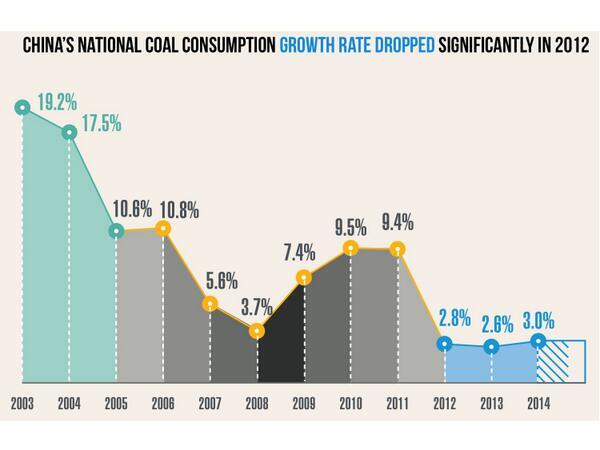
A report from Greenpeace charts slowing growth in China’s coal use.

Through much of its history, Greenpeace has been big on what I call “woe is me, shame on you” messaging on the environment. As I explained at a TEDx event in Portland, Ore., over the weekend, fingerpointing (including Greenpeace’s) is appropriate in many instances, but doesn’t work well with human-driven global warming. The blame game too often ends up resembling a circular firing squad.

This is why “The End of China’s Coal Boom,” a valuable new report from Greenpeace’s East Asia office, is so refreshing and worth exploring. I was led to it by a Twitter item from the group’s outgoing director, Phil Radford, that focused on a telling graphic:

View image on Twitter

via A Green Group Sees Hope in ‘The End of China’s Coal Boom’ – NYTimes.com – NYTimes.com.

Enhanced by Zemanta
16/04/2014

India Signs Power Contracts for 700 Megawatts of Solar Capacity – Businessweek

India signed contracts to purchase solar power from companies building 700 megawatts of capacity awarded in a national auction.

English: Photovoltaic system with 19 Megawatts...

English: Photovoltaic system with 19 Megawatts peak near Thüngen/Bavaria Deutsch: Solarpark/photovoltaikanlage mit 19 Megawatt Spitzenleistung nahe Thüngen/Bayern (Photo credit: Wikipedia)

The government is waiting to sign purchase agreements for the remaining 50 megawatts from the auction in February, Tarun Kapoor, joint secretary at the Ministry of New and Renewable Energy, said today in an interview in New Delhi. The agreements, which lock in rates for the power generated for 25 years, bind developers to complete the plants within 13 months.

Two developers dropped out after winning bids, including St. Peters, Missouri-based SunEdison Inc. (SUNE:US), which said last week it gave up a 20-megawatt project because local equipment shortages and prices make it unviable. The other developer that Kapoor didn’t identify forfeited its project after failing to get permission from its parent to proceed, he said.

via India Signs Power Contracts for 700 Megawatts of Solar Capacity – Businessweek.

Enhanced by Zemanta
15/04/2014

China in numbers: beans means trouble as commodity markets highlight rising credit risks | The Times

500,000 . . . is the total tonnage of soya bean cargoes on which Chinese importers have defaulted recently, unsettling markets already nervous about the world’s second biggest economy.

Soya bean meal is unloaded at Fangchenggang

Those defaults look alarming. Commodity markets can provide livid symptoms of an economic malaise and the numbers seem to offer evidence of rising credit risk in China. The country’s first corporate bond default earlier in the year merely sharpened sensitiv-ity to any sign of contagion.

Shipping industry sources in Singapore and Tokyo believe that there are six soya bean cargoes at Chinese ports that cannot be unloaded and the same number still at sea. Their total value is somewhere around £180 million, which makes this China’s highest-stakes soya bean default since 2004. This in a country that imports nearly two thirds of all the soya beans traded worldwide.

Explanations are focused on China’s tightening credit markets and the inability of soya bean buyers to secure the necessary letters of credit from banks. It does not take much of a leap to wonder what that type of credit contraction is having on an economy that has been fuelled lately by an epic creation of new credit.

As with other vulnerable sectors in China, the companies that process soya beans have been making losses: suddenly the banks are unprepared to take risks on them and the cargoes have been stranded.

The defaults have highlighted other market distortions that go far beyond the inability of an oilseed processor to turn a profit from a hill of beans. Trading companies have routinely used soya bean cargoes, in common with shipments of copper and other commodities, as collateral to secure cheap financing for potentially more lucrative deals and businesses. Because the interest payable on letters of credit is low and the payment terms generous, some have sold the product itself at a loss simply to get their hands on the cash.

The reality of these defaults, though, is that they are probably a good thing — or at least part of a well-intentioned plan. Beijing has been uncharacteristically relaxed about these defaults for the same reason that it has been uncharacteristically relaxed about internet giants such as Alibaba infuriating the banks by introducing innovative financial products. Beijing knows it has to reform the financial sector, realises that it will face huge resistance and is looking for leverage. Creating a series of micro crises forces China’s banks to become better at what they are supposed to do. Defaults (on soya beans and bonds) have been noisily paraded in state media to show the banks that they are expected to start pricing risk accurately and coldly.

via China in numbers: beans means trouble as commodity markets highlight rising credit risks | The Times.

Enhanced by Zemanta
15/04/2014

As Growth Slows in India, Rural Workers Have Fewer Incentives to Move to Cities – WSJ.com

As a teenager, Ram Singh left this remote rural village and moved to fast-growing New Delhi to chase the spoils of his country’s economic boom.

For 14 years, he toiled in tiny, primitive factories making everything from auto parts to components for light switches. His wages barely kept pace with the cost of living and eventually he gave up on city life.

Today, he is back on the farm, scratching out a living from a small plot of land near his birthplace where he grows corn, wheat, potatoes and mustard.

“Whenever someone leaves his village for the city, he thinks, ‘I will earn money,'” says Mr. Singh, who isn’t certain of his age but says he is around 30 years old. “Everyone has dreams, but it’s not always in their power to turn them into reality.”

Just a few years after India was hailed as a rising economic titan poised to rival China—even surpass it—growth in gross domestic product has slowed to a pace not seen in a decade. The Indian economy expanded at an annual rate of 4.7% in the last quarter of 2013. That may be sizzling by Western standards, but it is a serious comedown for a country whose GDP growth peaked at 11.4% in 2010. Inflation is high, workers aren’t finding jobs, and industrialization and urbanization are stalling.

via As Growth Slows in India, Rural Workers Have Fewer Incentives to Move to Cities – WSJ.com.

Enhanced by Zemanta
15/04/2014

How a Chinese Company Built 10 Homes in 24 Hours – China Real Time Report – WSJ

Chinese companies have been known to build major real-estate projects very quickly. Now, one company is taking it to a new extreme.

Suzhou-based construction-materials firm Winsun New Materials says it has built 10 200-square-meter homes using a gigantic 3-D printer that it spent 20 million yuan ($3.2 million) and 12 years developing.

Such 3-D printers have been around for several years and are commonly used to make models, prototypes, plane parts and even such small items as jewelry. The printing involves an additive process, where successive layers of material are stacked on top of one another to create a finished product.

Winsun’s 3-D printer is 6.6 meters (22 feet) tall, 10 meters wide and 150 meters long, the firm said, and the “ink” it uses is created from a combination of cement and glass fibers. In a nod to China’s green agenda, Winsun said in the future it plans to use scrap material left over from construction and mining sites to make its 3-D buildings.

Winsun says it estimates the cost of printing these homes is about half that of building them the traditional way. And although the technology seems efficient, it’s unlikely to be widely used to build homes any time soon because of regulatory hurdles, Mr. Chen said.

The Chinese firm isn’t the first to experiment with printing homes. Architects in Amsterdam are building a house with 13 rooms, with plans to print even the furniture. The Dutch architect in charge of the project said on the project’s website it would probably take less than three years to complete.

via How a Chinese Company Built 10 Homes in 24 Hours – China Real Time Report – WSJ.

Enhanced by Zemanta
Law of Unintended Consequences

continuously updated blog about China & India

ChiaHou's Book Reviews

continuously updated blog about China & India

What's wrong with the world; and its economy

continuously updated blog about China & India