Chindia Alert: You’ll be Living in their World Very Soon
aims to alert you to the threats and opportunities that China and India present. China and India require serious attention; case of ‘hidden dragon and crouching tiger’.
Without this attention, governments, businesses and, indeed, individuals may find themselves at a great disadvantage sooner rather than later.
The POSTs (front webpages) are mainly 'cuttings' from reliable sources, updated continuously.
The PAGEs (see Tabs, above) attempt to make the information more meaningful by putting some structure to the information we have researched and assembled since 2006.
China has attacked Ms Meng’s arrest and the extradition process as a “political incident”. She denies all the charges against her.
What does Ms Meng’s lawsuit say?
Ms Meng’s claim – filed in British Columbia’s Supreme Court on Friday – seeks damages against the Royal Canadian Mounted Police (RCMP), Canadian Border Services Agency (CBSA) and the federal government for allegedly breaching her civil rights under Canada’s Charter of Rights and Freedoms.
She says CBSA officers held, searched and questioned her at the airport under false pretences before she was arrested by the RCMP.
Image copyrightREUTERSImage caption Ms Meng has a property in Vancouver and is currently out on bail
Her detention was “unlawful” and “arbitrary”, the suit says, and officers “intentionally failed to advise her of the true reasons for her detention, her right to counsel, and her right to silence”.
Where are we in the extradition process?
Ms Meng, 47, will next appear in court on Wednesday, when it will be confirmed that Canada has issued a legal writ over her extradition to the US. A date for an extradition hearing will be set.
But this is still the early stages. A judge must authorise her committal for extradition and the justice minister would then decide whether to surrender her to the US.
There will be chances for appeal and some cases have dragged on for years.
The Meng Wanzhou case – how did we get here?
1 December: Ms Meng, the daughter of Huawei’s founder, is arrested while changing planes at Vancouver airport
7 December: Ms Meng first appears in court in Vancouver, where it is revealed she is accused of breaking US sanctions on Iran. China demands her release
10 December: Canadian citizens Michael Kovrig and Michael Spavor are arrested in China
11 December: Ms Meng is released on bail
28 January: US formally charges Ms Meng with fraud and Huawei with circumventing US sanctions on Iran and stealing technology from T Mobile
2 March: Canada says Ms Meng’s extradition can move forward but the process is expected to be long
What is Huawei accused of?
The US alleges Huawei misled the US and a global bank about its relationship with two subsidiaries, Huawei Device USA and Skycom Tech, to conduct business with Iran.
US President Donald Trump’s administration has reinstated all sanctions on Iran removed under a 2015 nuclear deal and recently imposed even stricter measures, hitting oil exports, shipping and banks.
It also alleges Huawei stole technology from T Mobile used to test smartphone durability, as well as obstructing justice and committing wire fraud.
In all, the US has laid 23 charges against the company.
Some Western nations are reviewing business with the firm over spying concerns, although Huawei has always maintained it acts independently.
How has China reacted?
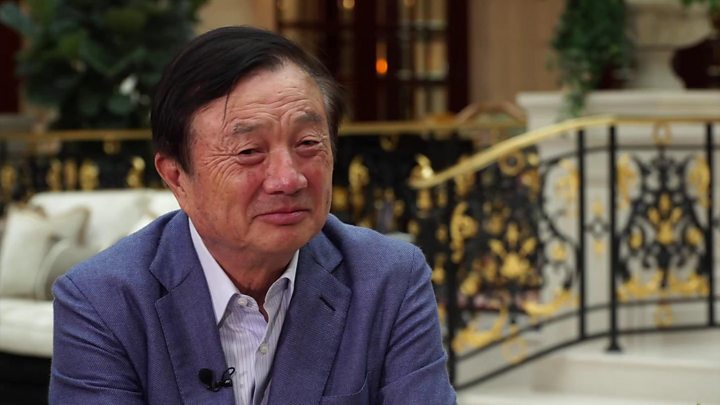
Media caption – Huawei founder Ren Zhengfei on the arrest of his daughter
The arrest has seriously strained relations between China, and the US and Canada.
Beijing says it is an “abuse of the bilateral extradition treaty” between Canada and the US, and has expressed its “resolute opposition” and “strong dissatisfaction” with the proceedings.
China also says the accusations against Huawei, the world’s second biggest smartphone maker by volume, are a “witch-hunt”.
Two Canadian citizens are thought to have been detained in China in retaliation for the arrest.
China and the US are also engaged in tough trade negotiations to end a major tariff dispute.
URUMQI, March 2 (Xinhua) — Farmers at a small village in western Xinjiang hardly had any days off this winter. Production at a walnut processing factory is going full throttle to meet demand.
Yusup Tursun and his wife are walnut farmers in Kupchi Village in Yecheng County on the edge of the Taklimakan Desert. The couple has been hired by a new walnut processing facility in the village, with the husband a quality inspector and his wife working part-time cracking nuts.
As a main base for walnut production, Yecheng has over 38,000 hectares of high-quality thin-shell walnut groves.
“It used to be quite difficult to sell the walnuts. The factories, with so many products, have made it easier for the sales,” Yusup said.
Seven companies make products from the nuts — walnut milk, walnut candies and edible oil. The shells are made into coloring agent and pollutant-absorbing carbon.
Diversity in the walnut products pushed the industry output to a new high of 2 billion yuan (about 299 million U.S. dollars). Three in every five people work in the walnut industry in Yecheng, where 550,000 people live.
Across Xinjiang, processing facilities are established to add value to agricultural products. Transport and logistical services are improved to boost the sales of Xinjiang’s signature agricultural products such as Hami melons, Korla pears and Turpan grapes.
UP THE VALUE CHAIN
Xinjiang is also moving up the value chain in two of its traditional industries — cotton and coal.
As one of the main cotton production bases in China, Xinjiang holds sway in the textile industry. By making full use of its cotton resources and geographical advantages as a portal for opening up, the region no longer sees itself as just a production base for raw materials. Starting from 2014, China’s leading garment and apparel makers including Ruyi Group, HoDo Group, and Huafu Fashion Co. Ltd invested in the region and built factories.
These factories have produced added benefits and created jobs for the local people. Xinjiang produces 1.5 million tons of yarn and over 40 million ready-made garments every year. More than 400,000 people work in the industry.
In the eastern part of the coal-rich Junggar Basin, workers have found that the snow is cleaner than before. The Zhundong Economic Technological Development Park, about 200 km west of Urumqi, is home to China’s largest coal field.
A stringent environmental requirement is applied to the park, said Ren Jianpin, director of the management committee of the park. Coal enterprises are required to control coal dust, install equipment to recycle water and coal slags are processed into construction materials, he said.
The park is focused on boosting high-end industries in aluminum and silicon materials, which generate more value and have less impact on the environment, he said.
GOING HI-TECH
Last year, a large-scale bio-based plant went into operation in Usu City to turn corn into nylon. The Cathay Industrial Biotech, a Shanghai-based biotech company, is the investor.
Nylon is usually made from petroleum, and the use of crops such as corn and wheat to make recyclable and environment-friendly nylon has promising business prospects, said Wang Hongbo, vice general manager of the company’s Usu branch.
The Usu branch will have an annual output of 100,000 tons of bio-based polyamide, and it is expected to boost the development of downstream industries in the future, he said.
The oil-rich city of Karamay has also received a hi-tech boost as cloud computing firms eye the dry and cold weather in the area. Karamay is home to many key state-level projects and IT-industry leaders, including a global cloud service data center for Huawei, data centers for the China National Petroleum Corp. (CNPC) and China Mobile.
Xinjiang is making new breakthroughs in precision machining, new materials, manufacturing and textiles.
Data from the regional statistics bureau show that the value added of the hi-tech manufacturing in Xinjiang rose by 32.1 percent year-on-year in 2018.
FURTHER OPENING UP
As a core area on the Silk Road Economic Belt, Xinjiang has maintained solid growth momentum in foreign trade. Foreign trade volume between Xinjiang and 36 countries and regions along the Belt and Road (B&R) totaled about 291.5 billion yuan (43.5 billion U.S. dollars) in 2018, up 13.5 percent year on year.
Economic observers say that there is still much room for Xinjiang to scale up its processing trade to raise the level of imports and exports.
Xinjiang will further develop an export-oriented economy in 2019 and participate in economic exchanges with neighboring countries, according to the regional government’s work report released in January.
SHENZHEN, March 2 (Xinhua) — Zhao Xiaoyong was once called “China’s Van Gogh,” as the farmer turned oil painter made over 100,000 replicas of Van Gogh’s work over the past 20 years.
However, he never saw a single authentic piece of the Dutch post-impressionist painter until 2014 when he finally saved enough for a trip to the Netherlands.
The trip inspired him to think over his business and create his own works. “The masterpieces that I saw at the European museums made me realize that I have to develop my own style.”
Zhao is from Dafen, a village known for oil paintings in southern China’s Shenzhen City. Home to 1,200 studios and 8,000 painters, the village produces millions of replicas of Van Gogh, Monet and Picasso that are sold at home and abroad. According to statistics, 80 percent of oil paintings exported from China come from Dafen.
While the market demand for replicas is shrinking, Zhao and other painters in the village are creating their own art styles and attracting tourists.
Neighboring Hong Kong, Shenzhen is one of China’s first special economic zones for the country’s reform and opening drive. The painting industry started in Dafen Village in 1989 when Hong Kong purchasers sought to establish an oil painting base nearby.
Zhao, who quit his job at a craft factory, started learning how to paint from scratch in 1996. He imitated Van Gogh’s works via a painting album, including “sunflowers” and “almond blossoms.”
He sold his first works in 1999 when an American buyer ordered 20 paintings. More orders later came from abroad, prompting Zhao to recruit apprentices.
“My wife and my younger brothers are all my students,” he said with a smile. “I was even called ‘China’s Van Gogh’ in a documentary.”
Zhao and his team worked from 1 p.m. to 3 a.m. painting eight pieces per person every day at most. Prices for the replicas ranged from 200 yuan (30 U.S. dollars) to 3,000 yuan per piece, depending on the size.
In 2008, when the economic recession hit most parts of the world, a drastic reduction of foreign orders forced Zhao to explore the domestic market. Profits kept shrinking after 2012 due to consumers’ diversifying tastes and rising costs.
Since then, many painters in the village have given up making replicas and turned to innovation and creation.
Chen Qiuzhi, who used to paint copies of masterpieces like Zhao, has worked hard to develop his own style, combining Chinese calligraphy with painting. To support him, his wife sold two apartments and had an art center built.
The center, located at the far end of Dafen village, covers an exhibition area of over 3,000 square meters and has become a landmark of Dafen. Some 100 calligraphy works are exhibited at the center with other craftwork.
Ten years of hard work has won him fame, with his works popular in the auction market. Now, one piece of his calligraphy is worth tens of thousands of yuan, almost 100 times the value of replicas he painted in the past. The art center also draws visitors.
“Only by creation can one’s works be remembered,” said Chen.
Today, Dafen has gathered nearly 300 art creators. In 2017, the annual output value of Dafen reached 4.15 billion yuan, among which the original works have accounted for 20 to 30 percent.
From imitation to creation, Dafen Village has been making the transition from a low-end oil painting workshop cluster to an art center, said Liu Yajing, director of the village’s oil painting office.
She said an oil painting museum, a performance theater, a training center and a hotel are being built to develop the village into a tourist resort featuring oil painting production, trade, training and exhibition.
Compared with his Van Gogh replicas, painter Zhao finds his own works hard to sell. But he believes that he will finally be recognized someday in the future.
“Imitation leads me nowhere. I will continue to concentrate on creation for the market and also for my dream as a real artist,” Zhao said.
NEW YORK, March 2 (Xinhua) — Capital inflow into Chinese on-shore stock market would accelerate in 2019 thanks to global index supplier MSCI’s decision to hike the inclusion factor of China’s A-Shares from 5 percent to 20 percent in three steps within 2019, according to a research note by Swiss multinational investment bank UBS AG.
The weighting for Chinese A-shares in MSCI Emerging Market index would rise to 3.3 percent by November, up from around 0.7 percent at present, said MSCI.
“This latest MSCI weight increase should help trigger at least 60 billion U.S. dollars in inflows to A-shares in 2019, pushing cumulative foreign ownership above 160 billion U.S. dollars,” said the research note issued on Friday.
Higher A-share allocation is a long-term structural trend for international investors, it added.
Incremental buying in the short term will probably remain biased toward select sectors and stocks currently prefered by overseas capital, such as white goods, insurance, healthcare and electronics, it said.
Meanwhile, the sharp run-up in onshore brokers, partially stoked by recent recovery in onshore stock markets, offers attractive levels to take profits in the sector, according to UBS.
MSCI’s announcement of higher A-share inclusion factor will bring a new pool of international investors to the A-share market, which overtime will help raise transparency and improve governance to these listed companies, said Jorge Mariscal, chief investment officer on emerging markets with UBS Wealth Management.
The weight of China’s A-shares in MSCI Emerging Market index could increase to 15 percent within the next 10 years and active emerging market investors would find it hard to brush aside exposure to Chinese onshore portfolios amid similar moves by other international index providers, according to UBS.
UBS said it remains tactically overweight on Chinese equities in its Asian portfolios and continues to prefer onshore to offshore Chinese stocks with the former set to benefit from capital inflow, more accommodative monetary policy and fiscal stimulus.
Widely-followed Shanghai Composite Index has entered territory of bull market thanks to solid growth so far this year and closed just shy of 3000 points on March 1.
HANGZHOU, March 1 (Xinhua) — East China’s Zhejiang Province plans to increase its trade volume with Africa to 40 billion U.S. dollars by the end of 2022 to account for at least 20 percent of the total Sino-Africa trade.
Zhejiang’s department of commerce issued an action plan revealing the details on Friday as China’s first provincial-level plan on economic cooperation with African countries.
The 40-billion-dollar target will mark a significant rise from the 30.1-billion-dollar trade between Africa and Zhejiang, home to many of China’s most successful private businesses, in 2018.
The plan also promises to increase investments in Africa’s industries of textiles, garments, chemicals, equipment manufacturing and pharmaceuticals to meet the continent’s development needs.
The province, however, will bar investments that are polluting and highly energy-consuming from going to Africa, said the plan, which also calls for more agricultural investments and cooperation.
The document also said the province would expand goods imports from Africa, especially in the non-resources category.
According to China Customs, China’s foreign trade with Africa reached 204.19 billion dollars in 2018, up 19.7 percent year-on-year and 7.1 percentage points higher than the growth of China’s overall foreign trade during the same period.
Specifically, the country’s exports to Africa rose 10.8 percent to 104.91 billion dollars in 2018, while its imports from Africa surged 30.8 percent to reach 99.28 billion dollars.
BEIJING, March 1 (Xinhua) — An official with China’s Ministry of Commerce on Friday commented on a World Trade Organization (WTO) panel report regarding the complaint from the United States about Chinese agricultural subsidies.
The WTO panel report, released Thursday Geneva time, ruled against the United States in terms of China’s corn subsidy policies. “The Chinese side welcomes this [ruling],” the unidentified official said.
China regrets that the panel did not support China’s proposition on calculating the subsidy levels in its minimum procurement price policies for wheat and rice, the official said.
Agriculture is a basic industry that concerns the national economy and people’s wellbeing. It is a common practice for governments to support agriculture, ensure farmers’ incomes and safeguard grain security, and such practices are allowed under WTO rules.
China consistently respects WTO rules and will seriously evaluate the panel report and properly handle the case following WTO dispute settlement procedure, safeguard the stability of the multilateral trade mechanism and continue to push ahead with its agricultural development in lines with WTO rules, the official said.
HONG KONG, Feb. 27 (Xinhua) — The financial secretary of China’s Hong Kong Special Administrative Region (HKSAR) government delivered Hong Kong’s annual budget on Wednesday, saying the Guangdong-Hong Kong-Macao Greater Bay Area offers golden opportunities for Hong Kong to explore new directions and open up new horizons.
To support implementation of various measures, the budget, themed “supporting enterprises, safeguarding jobs, stabilizing the economy, strengthening livelihoods,” provides new resources ready for use of about 150 billion HK dollars (about 19.1 billion U.S. dollars), with additional resources earmarked for various purposes.
“This demonstrates our determination to enhance public services, support enterprises, relieve people’s burden and invest for the future,” Financial Secretary of the HKSAR government Paul Chan said.
Under mounting external pressures, Hong Kong’s economic growth moderated from 4.1 percent in the first half of 2018 to 2.1 percent in the second half of the year, with growth for the fourth quarter at a mere 1.3 percent, the lowest since the first quarter of 2016, he said.
Overall, Hong Kong’s economy grew by 3 percent in 2018, at the lower end of the range projected in last year’s Budget but still higher than the trend growth rate of 2.8 percent over the past decade, he added.
Chan forecast a surplus of 58.7 billion HK dollars for 2018-19. Fiscal reserves are expected to reach 1,161.6 billion HK dollars by March 31, 2019; economic growth of 2 to 3 percent in real terms for Hong Kong in 2019.
He said the development of innovation and technology (I&T) will bring huge economic benefits to Hong Kong, adding that sufficient resources, with a commitment of over 100 billion HK dollars has been allocated in this area so far.
More efforts will be made to support scientific research and I&T sectors by developing I&T infrastructure, promoting research and development (R&D), pooling talent, supporting enterprises and promoting reindustrialization.
Talking about national development strategy, Chan emphasized that the Greater Bay Area development and the Belt and Road Initiative are providing rare opportunities for Hong Kong.
Chan said that the outline development plan for the Greater Bay Area, promulgated last week, is a milestone setting out the development directions for the Greater Bay Area up to 2035.
Hong Kong, positioned as international financial, transportation and trade centers as well as an international aviation hub in the Greater Bay Area, will strengthen its roles as a global offshore Renminbi business hub and an international asset and risk management center; and will devote great efforts to develop I&T industries as well as international legal and dispute resolution services, the financial chief said.
Meanwhile, the Belt and Road Initiative will create greater room for Hong Kong’s economic and social development. There has been positive outcomes in areas such as supporting industries in exploring markets, establishing business matching platforms for enterprises and encouraging Hong Kong’s professional services sector to participate in Belt and Road projects.
As for land supply, Chan said, the HKSAR government will ensure that adequate resources are provided to support fully the short, medium and long-term measures to increase land and housing supply.
The estimated public housing production for the next five years is about 100,400 units and the supply of first-hand private residential units is expected to remain at a relatively high level in the coming three to four years at about 93,000 units, according to Chan. (1 U.S. dollar = 7.84 HK dollars)
BEIJING, Feb. 27 (Xinhua) — Chinese lawmakers have met at a bimonthly legislative session to discuss a research report on poverty relief, and brainstormed methods to seal the country’s victory against poverty.
The report was based on the investigation led by three National People’s Congress (NPC) Standing Committee vice chairpersons into poverty alleviation efforts in 16 provinces and regions last year.
It was reviewed at the two-day committee session, which ended Wednesday.
Delivered at the session by Wu Weihua, vice chairperson of the NPC Standing Committee, the report said that “decisive progress” had been made in the anti-poverty fight but circumstances remained challenging.
Support for extremely impoverished regions should be continuously strengthened, according to Li Yuefeng, a member of the standing committee, who said that areas in abject poverty still posed the most difficult tasks in the battle against poverty, and called for consistent efforts to make sure they did not lag behind.
Fellow lawmaker Liu Yuankun believes the problems for extremely poor areas are rooted in their economy and society, and suggested poverty relief in such areas be integrated with local economic and social development.
“As soon as transportation works, everything will work,” he said, stressing the construction of infrastructure, which allows funds, talent and industries to flow into impoverished areas.
Another member Zheng Gongcheng said that only by building inner faith and hope could the endogenous power to defeat poverty be long-lasting, and suggested prioritizing efforts in education and employment to enhance the capacity of people in poverty.
In 2018, China lifted 13.86 million people in rural areas out of poverty, with the number of impoverished rural residents dropping from 98.99 million in late 2012 to 16.6 million by the end of last year.
The number is still high, however, and many of the impoverished are long suffering from illnesses, disabled, or elderly people with no family, according to the report.
“A long-term and effective mechanism to prevent people from falling back into poverty due to illness is significant,” said Li Xueyong, a member of the NPC Standing Committee, who asked for more measures to cut major illnesses at the root.
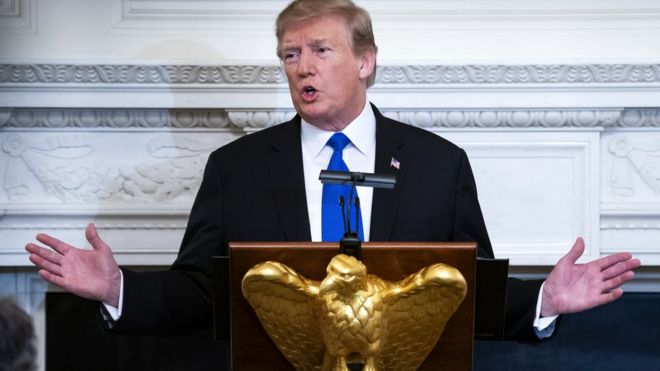
President Donald Trump has said that the US and China are “very very close” to signing a trade agreement, potentially ending the long-running feud between the two countries.
Mr Trump told US governors on Monday that both nations “are going to have a signing summit”.
“Hopefully, we can get that completed. But we’re getting very, very close,” he said.
It follows a decision to delay imposing further trade tariffs on Chinese goods.
Mr Trump’s decision to delay tariff increases on $200bn (£153bn) worth of Chinese goods was seen as a sign that the two sides were moving ahead in settling their damaging trade war.
Last week, Mr Trump noted progress in the latest round of negotiations in Washington, including an agreement on currency manipulation, though no details were disclosed.
Sources told CNBC on Friday that China had committed to buying up to $1.2 trillion in US goods, but there had been no progress on the intellectual property issues.
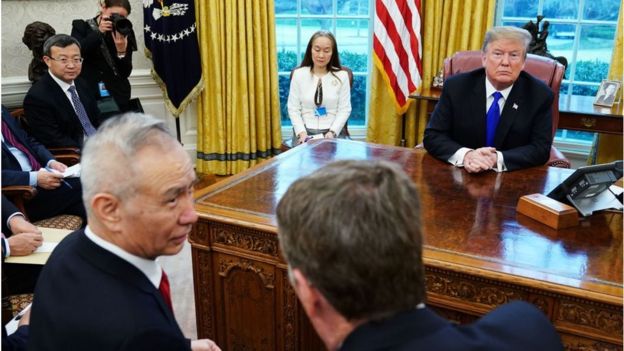
Image copyrightAFPImage captionPresident Trump met China’s Vice Premier Liu He on Friday
Gregory Daco, chief US economist at Oxford Economics, said: “We had anticipated such a delay and believe a handshake agreement in which China will promise to import more agricultural products, work towards a stable currency and reinforce intellectual property rights protection will be achieved in the coming weeks.
“However, we don’t foresee a significant rollback of existing tariffs, and see underlying tensions regarding China’s strategic ambitions, its industrial policy, technological transfers and ‘verification and enforcement’ mechanisms remaining in place.”
What has happened in the trade war so far?
Mr Trump initiated the trade war over complaints of unfair Chinese trading practices.
That included accusing China of stealing intellectual property from American firms, forcing them to transfer technology to China.
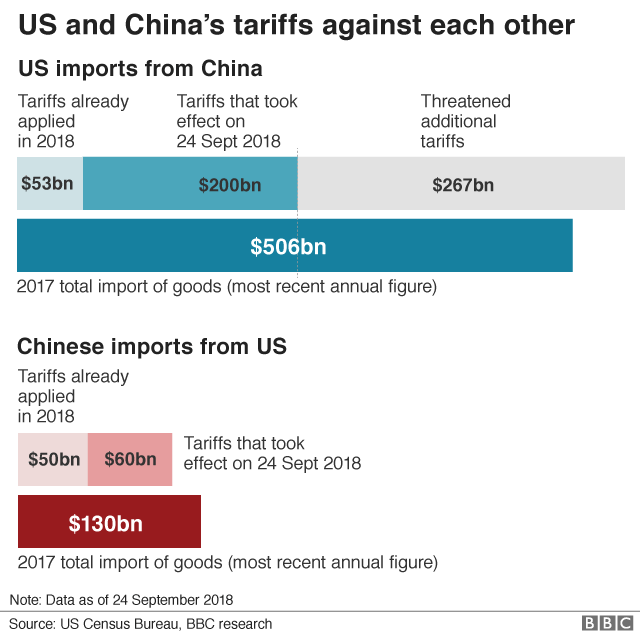
The US has imposed tariffs on $250bn worth of Chinese goods, and China has retaliated by imposing duties on $110bn of US products.
Mr Trump has also threatened further tariffs on an additional $267bn worth of Chinese products – which would see virtually all of Chinese imports into the US become subject to duties.
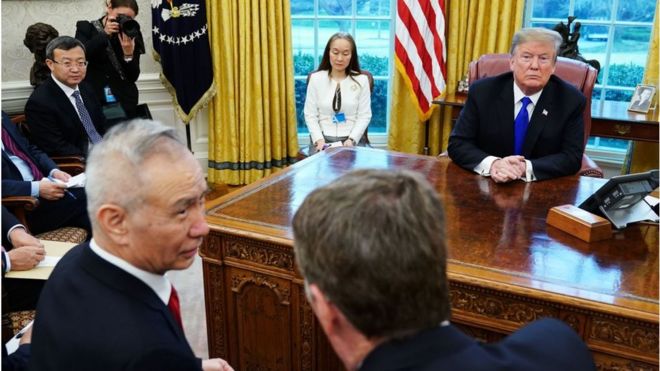
Image copyrightAFPImage captionPresident Trump met China’s Vice Premier Liu He on Friday
President Donald Trump has announced that the US will delay imposing further trade tariffs on Chinese goods.
The rise in import duties on Chinese goods from 10% to 25% was due to come into effect on 1 March.
Mr Trump said both sides had made “substantial progress” in trade talks, which sent Chinese stocks up nearly 5%.
He added that he was planning a summit with Chinese President Xi Jinping in Florida to cement the trade deal if more progress was made.
A report from China’s official news agency Xinhua also noted “substantial progress” on specific issues such as technology transfer, intellectual property protection and agriculture.
Mr Trump’s decision to delay tariff increases on $200bn (£153bn) worth of Chinese goods was seen as a sign that the two sides are making progress on settling their damaging trade war.
Last week, Mr Trump noted progress in the latest round of negotiations in Washington, including an agreement on currency manipulation, though no details were disclosed.
Sources told CNBC on Friday that China had committed to buying up to $1.2 trillion in US goods, but there had been no progress on the intellectual property issues.
What has happened in the trade war so far?
Mr Trump initiated the trade war over complaints of unfair Chinese trading practices.
That included accusing China of stealing intellectual property from American firms, forcing them to transfer technology to China.
The US has imposed tariffs on $250bn worth of Chinese goods, and China has retaliated by imposing duties on $110bn of US products.
Mr Trump has also threatened further tariffs on an additional $267bn worth of Chinese products – which would see virtually all of Chinese imports into the US become subject to duties.


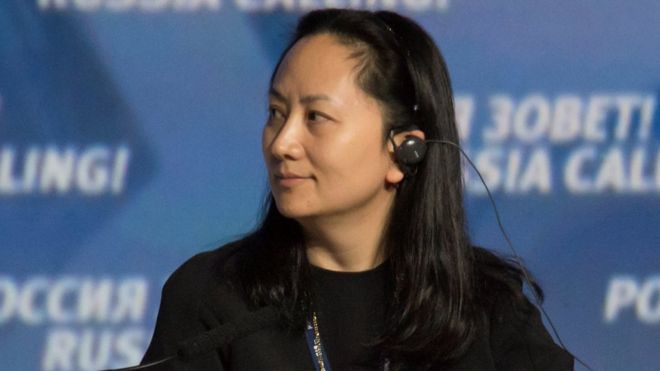 Image copyrightREUTERS
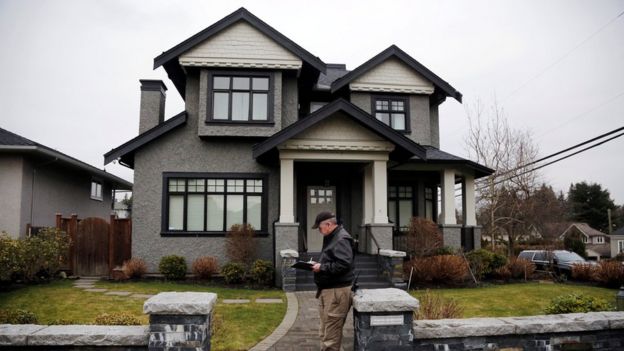 Image copyrightREUTERS

 CHINDIA ALERT: You'll be living in their world, very soon