Archive for ‘Economics’

28/02/2017

Are motorbikes a barometer of India’s economy? – BBC News

India’s latest economic growth numbers are expected to reflect the impact that the sudden withdrawal of currency notes in November had on the country.

So how has the economy been doing? Sales of two-wheelers are among the best indicators.

Source: Are motorbikes a barometer of India’s economy? – BBC News

Tags:
28/02/2017

India’s annual economic growth slows to 7 percent in December quarter | Reuters

India’s annual economic growth slowed to 7.0 percent in the three months through December from a revised 7.4 percent expansion in the previous quarter, government data showed on Tuesday.

Analysts polled by Reuters had forecast 6.4 percent growth for the October-December period.

The central statistics office also retained the growth forecast for the fiscal year ending in March 2017 at 7.1 percent.

Source: India’s annual economic growth slows to 7 percent in December quarter | Reuters

28/02/2017

China voices disquiet over new EU anti-dumping move on steel | Reuters

China expressed concerns on Tuesday over what it said was increasing protectionism after European Union regulators imposed new duties on steel imports from the world’s biggest producer.

The European Commission is seeking to protect EU steelmakers while avoiding tensions with Beijing, which it sees as a possible ally against protectionism and climate change.It imposed definitive anti-dumping duties of between 65.1 percent and 73.7 percent on imports of heavy plate non-alloy or other alloy steel from China on Tuesday, confirming provisional tariffs set in October.

This prompted a statement from China’s Commerce Ministry calling on Europe to treat Chinese companies “fairly and impartially”, adding it was ready to strengthen communication with the EU to tackle issues in the industry.

The companies named in the Commission’s ruling included Nanjing Iron & Steel Co Ltd, Minmetals Yingkou Medium Plate Co Ltd, Wuyang Iron and Steel Co Ltd [WYIAS.UL] and Wuyang New Heavy & Wide Steel Plate Co Ltd.

The EU executive said it acted after an investigation found Chinese companies to be heavily dumping their products on the EU market by selling them at well below half of the price on the producers’ home market.

“The Commission has responded forcefully and quickly to unfair competition, while at the same time ensuring that the rights of all interested parties have been protected,” the Commission said in a statement.

Eurofer, which represents the European steel sector, said the Commission had found clear evidence of dumping.”Tens of thousands of steel jobs have been lost in Europe over the past few years, and dumping, particularly demonstrably from China, has been one of the causes,” it said in a statement.

The EU has strengthened its policy against what it considers unfair competition for its steel industry, and said its new approach had allowed it to decide on trade sanctions more quickly than in the past.

It said on Tuesday it has 41 anti-dumping and anti-subsidy measures in place, 18 of which are on products from China.Also on Tuesday, Europe’s second highest court backed anti-dumping and anti-subsidy duties imposed by the EU nearly four years ago on imports of Chinese solar panels.

Source: China voices disquiet over new EU anti-dumping move on steel | Reuters

Tags:
28/02/2017

Building Binge: ADB Calls for More Infrastructure Across Asia – China Real Time Report – WSJ

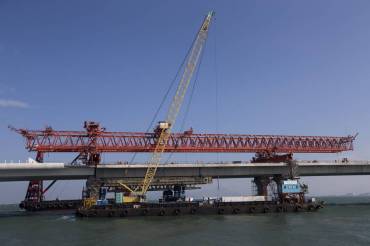
BEIJING–Asia needs at least $1.5 trillion of roads, bridges and other infrastructure annually between now and 2030 to maintain its growth momentum, a doubling of earlier projections, according to the Asian Development Bank.

In a report released Tuesday, the Manila-based development bank said the tab would run even higher if climate change is factored in: Upgrading power plants, transport systems and other facilities would boost regional investment by another $241 billion annually among some 45 Asia and Pacific countries.

Infrastructure has gained favor as a way to boost flagging growth following the 2009 global financial crisis. U.S. President Donald Trump has vowed to spend $1 trillion over a 10-year period rebuilding U.S. roads and bridges. China spent 15.2 trillion yuan [$2.2 trillion] in infrastructure fixed-asset investment in 2016 alone. The world’s second-biggest economy is promoting its infrastructure-led growth model, creating the Beijing-led Asian Infrastructure Investment Bank, which touts itself as a more efficient alternative to the likes of the World Bank and ADB.

Countries that fail to invest in infrastructure may see economic growth pinched by bottlenecks and lackluster job-creation. The ADB’s current projections represent a doubling of the $750 billion in annual infrastructure requirements the bank forecast in 2009 for the 2010-2020 period. The Asia-Pacific region currently invests around $880 billion annually in infrastructure, according to ADB.Governments currently pay around 92% of the cost of infrastructure in the region, the bank estimates in its report. Boosting spending levels, it said, is going to require tax, regulatory and institutional changes to draw in the private sector.

“Governments can get more bang out of their infrastructure investment,” said ADB economist Rana Hasan. Mr. Hasan acknowledged that the Asian region is unlikely to spend the full $1.7 trillion annually, but said the ADB hopes its recommendations can bring governments closer to those levels. “They need to make it more attractive for the private sector,” he said.

Of the estimated $26 trillion in projects required between 2016 and 2030 to bolster economic output, alleviate poverty and respond to climate change, $14.7 trillion is needed for the power sector, $8.4 trillion for transport, $2.3 trillion for telecommunications and $800 billion for water and sanitation projects, the report said.While acknowledging the need for better and more infrastructure, some economists caution that corruption and politics can significantly undercut the economic benefits of big building initiatives.

“Most developing countries could use more infrastructure. But the problem is not a lack of demand. It’s a lack of credibility,” said Guanghua School of Management professor Michael Pettis. “If your debt gets too high, you start running into debt-servicing problems, defaults and other problems.”China has relied on infrastructure investment as a form of economic stimulus since the global financial crisis in 2009. Since then, local government debt, much of it to fund infrastructure, has risen by two-thirds, according to Standard & Poor’s Financial Services LLC. That debt stood at more than 41% of economic output in 2015, according to Bank of America Merrill Lynch.Beijing has also struggled to attract private investors. Though it has strongly promoted public-private partnerships, some have stumbled during implementation, many due to mismatched expectations of private companies and the state sector.

More favorable reviews have been given to China’s ambitious plans to modernize the ancient Silk Road trade routes. Known as “One Belt, One Road,” the program envisions a network of ports, bridges, rail lines, industrial parks and telecommunication links linking China to the rest of Asia, Europe and points beyond.

The large sums have caught the attention of foreign engineering and equipment companies such as Caterpillar, ABB Group and Vermeer Corp., which are hoping for a slice of future projects.

Source: Building Binge: ADB Calls for More Infrastructure Across Asia – China Real Time Report – WSJ

Tags:
25/02/2017

Room to grow: India’s hostels for the upwardly mobile | The Economist

IF SEVERAL hundred million Indians do migrate from the countryside to cities between now and 2050, as the UN expects, it will be a fiendishly busy few decades for Vivek Aher, who runs a low-cost hostel, one of five, on the outskirts of Pune, a well-off city three hours’ drive from Mumbai.

A fair few of the new arrivals will have their first experience of urban living bunking in one of the hostels’ 1,350 beds. Should recent experience be anything to go by, most of the new arrivals will test Mr Aher’s patience by tacking posters on his hostel’s walls, or endlessly complaining about the Wi-Fi.

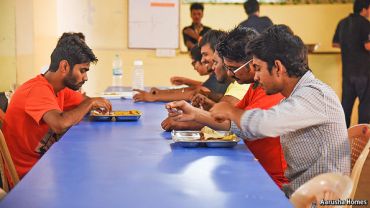
India has two main drags on economic growth. One is the difficulty of finding a job, especially in the places people live. The other is a chronic shortage of cheap housing. Aarusha Homes, Mr Aher’s employer, started in 2007 to help people seize economic opportunities far from home. Its rooms are basic and cheap. They include up to six beds, a bathroom for every three or four residents, some common areas and little else. Rent ranges between 3,500 and 10,000 rupees ($52-$149) a month including food.

Most of Aarusha’s tenants are young, many of them taking first steps into the middle-class as IT or business-processing outsourcing professionals. Paying up to six months’ deposit for a city flat is beyond their means, as is the down payment for a motorbike that would allow them to live far from their employer. Aarusha’s successful pitch is that its hostels are safer than slums or informal “guest houses”, especially for women. It now has 4,300 beds in 1,300 rooms spread out over 20 hostels in four cities. The typical tenant stays for six months. Satyanarayana Vejella, the firm’s co-founder, plans to raise another $10m to increase capacity by 12,000 beds in nearly 70 new hostels, all in the next two years. Operating-profit margins are in the mid-teens.

The chain’s backers include investment funds who seek social as well as financial returns. The latter would be improved if the chain dodged taxes by operating in the informal economy, like much of its competition, but it sticks to the formal side. The problems it faces are those confronted by any Hilton or Hyatt: finding properties big enough to offer over 100 beds is hard. Tenants have to be chased for payments. An attempt to cater to blue-collar workers at an even lower price didn’t work out. So Aarusha is reliant on the IT and outsourcing sectors, which are hiring less eagerly than before.Aarusha can probably depend on continuing strong demand for a room from which to make sense of it all before people can get their own places. The hostels have something of a communal feel, and parents find them reassuring because residents put up with not being able to drink, smoke, or mingle with the opposite sex. Soon enough, they will have moved on, taking their aspirations and their posters with them.

Source: Room to grow: India’s hostels for the upwardly mobile | The Economist

24/02/2017

Shock and ore: Furious with North Korea, China stops buying its coal | The Economist

FEW television dramas boast a plot as far-fetched as the one that has unfolded in North-East Asian geopolitics over the past two weeks. Days after North Korea tested a ballistic missile on February 12th, two women assassinated the half-brother of Kim Jong Un, North Korea’s leader, by throwing chemicals in his face at a Malaysian airport. The alleged killers said they were duped into taking part, believing the attack was a prank for a TV comedy. Malaysian police suspect that a North Korean diplomat in Malaysia may have been among the organisers, several of whom are thought to have fled to Pyongyang.

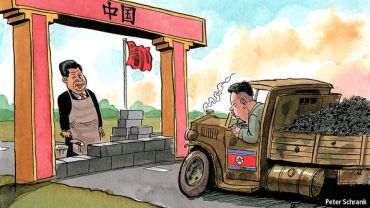
Amid such skulduggery, China’s announcement on February 18th that it would suspend imports of coal from North Korea, from the next day to the end of this year, seemed a little mundane. But China’s state-controlled media played up the decision. Global Times, a newspaper in Beijing, said the move would make it harder for North Korea to exploit international differences over the imposition of UN sanctions aimed at curtailing its nuclear programme. China appeared to be signalling to the world that it was ratcheting up pressure on its troublesome friend, as the Americans have long insisted it should.

Or it may just be posturing. On February 21st China’s foreign ministry softened the message somewhat. It said imports were being suspended because China had already bought as much coal from North Korea this year as it was allowed to under the UN’s sanctions, to which China gave its approval last March. But North Korea-watchers doubt that China could have imported its yearly quota of 7.5m tonnes in a mere six weeks. It had not appeared likely to reach its annual limit until April or May. And exceeding that cap had not been expected to matter much to China. In 2016 it imported about three times the permitted amount, using a loophole that allows trade if it helps the “livelihood” of ordinary North Koreans.

Advancing the date of the suspension, if that is what happened, would certainly have sent a strong message to North Korea, which depends on coal exports for much of its foreign currency. Announcing the move so publicly, and unexpectedly, will have shown to North Korea that China is ready to take the initiative instead of waiting to be prodded by America, as it usually does when North Korea offends.

The test of an intermediate-range missile will have rattled China. It suggested that North Korea has learned how to fire such weapons at short notice, from hard-to-detect mobile launchers. The murder of Kim Jong Nam may have been an even bigger blow. Mr Kim had been living on Chinese soil in the gambling enclave of Macau, probably under Chinese government protection. Some Chinese officials may have hoped that Mr Kim, who favours economic opening, would one day replace his half-brother. With his death “you lose one option”, says Jia Qingguo of Peking University. It has reminded China that North Korea’s dictator is doggedly determined to rule in his own way, regardless of China’s or anyone else’s views.

Growing frustration with North Korea is evident in China’s more relaxed attitude towards criticism of its neighbour. In 2013 an editor of a Communist Party-controlled publication was fired for arguing in an article that “China should abandon North Korea.” These days, academics often air that idea. Debate about North Korea now rages openly online, largely uncensored (except when people use it as a way of attacking their own regime, jokingly referred to as “West Korea”). The murder of Kim Jong Nam unleashed a torrent of ridicule towards his country by Chinese netizens. China still sees North Korea as a useful buffer against America’s army deployed in the South. But it increasingly regards the North as a liability as well, says Mr Jia.In America’s court?

China would clearly like its tough-sounding approach to encourage President Donald Trump to rethink his country’s strategy for dealing with North Korea. America has been reluctant to enter direct talks because the North has blatantly cheated on past deals—knowing that China would continue to prop it up. With China more clearly on America’s side, the Americans would have greater confidence, Chinese officials hope. Mr Trump has previously said he would be happy to have a hamburger with Mr Kim and try to persuade him to give up his nukes. The trouble is, Mr Kim sees those weapons as the one thing that guarantees the survival of his odious regime.

Source: Shock and ore: Furious with North Korea, China stops buying its coal | The Economist

17/02/2017

Soccer Dreams in China’s Rust Belt – China Real Time Report – WSJ

China’s smog-choked northern province of Hebei is no stranger to lofty goals. For one thing, it has to shut down two-thirds of its steel factories by 2020.

Here comes another: becoming a provincial powerhouse in soccer. Perhaps understandably, it has given itself a few decades to do it.

The “Hebei Province’s Soccer Medium-to-Long Term Development Plan (2016-2050)” unveiled Thursday sets out plans for 1,000 “soccer campuses,” 3,000 amateur leagues and at least one club in the Chinese Super League, the country’s highest tier of professional soccer.

Such plans to pursue the “beautiful game,” as soccer is often called, are quite the departure for China. The world’s second-largest economy used to nurture its sport stars the Soviet way, by picking and grooming its talent from an early age. It still harvests most of its medals using this model. But in soccer, Beijing is trying a looser model perfected in the West: shopping for world-class players world-wide and hoping to spot homegrown talent via a grassroots network of soccer programs in local schools.

“By 2050, we must contribute to China’s bid to host the World Cup,” the Hebei Provincial Sports Bureau said.

At media conferences, officials spoke wistfully of “a soccer tourism route” and “a garden of sports,” a somewhat jarring image of Hebei, which currently produces more than twice the annual steel volume of all U.S. mills combined and is home to China’s smoggiest cities.

In its quest to become a leading purveyor of football talent, Hebei already faces some domestic competition. Fujian province, in China’s south, last month said it also has such plans. Earlier this month, so did the aluminum-producing province of Gansu, known more for its deserts than its dazzling dribbles.

More provinces are likely to follow. The central government last year put out a blueprint detailing bigger, broader goals to mint “two to three first-class soccer teams in Asia, that are internationally known.”

President Xi Jinping has a soft spot for the sport, and in 2011 made known his desire for China to both qualify for and host a World Cup tournament and ultimately to win one.

This has proven difficult. Back-to-back losses last fall all but derailed China’s dream of qualifying for the 2018 World Cup. Profligate spending to attract foreign talent led the General Administration of Sport last month to criticize Chinese teams for “burning money” on astronomical recruitment fees and wages, while “neglecting the development of homegrown players.”

Still, Hebei might have an edge. The province, where Mr. Xi spent some time early in his career as a county-level Communist Party official, won government support in a successful bid to host the 2022 Winter Olympics, despite having only a set of somewhat stumpy mountains with sporadic snow.

Some of the province’s residents aren’t exactly hopeful. “The economy is finished,” one of them wrote on the popular microblogging platform Weibo. “And you still have time to focus on soccer?”

Source: Soccer Dreams in China’s Rust Belt – China Real Time Report – WSJ

16/02/2017

India and Russia seek to revive stalled helicopter venture | Reuters

India and Russia are nearing a joint venture to make light helicopters in India, reviving a plan announced by Russian President Vladimir Putin in 2015.

Delhi needs to replace hundreds of ageing utility helicopters deployed along its Himalayan border with China as well as in the disputed Kashmir region.

This means an initial order of 200 Kamov-226 helicopters, of which 140 will be built in India as part of Prime Minister Narendra Modi’s drive to build a domestic defence industrial base and cut imports, is expected to be increased.

And final documents relating to the $1 billion Kamov deal involving Russian Helicopters, Rosoboronexport and India’s state-run Hindustan Aeronautics (HAL) has been submitted to Putin, HAL’s chief T. Suvarna Raju, told reporters on Wednesday.

While India has sealed deals with the United States for 22 Apache attack and 15 heavy lift Chinook helicopters at total cost of about $2.5 billion, plans to buy Russian helicopters and fifth generation fighter aircraft have been dogged by problems.

“There are issues between parties, but these are being tackled,” Sergey Goreslavsky, deputy director general of Rosoboronexport, said at India’s biggest air show in the southern city of Bengaluru.

A team will assess the Indian manufacturing facilities over the next few months. “We are keeping our fingers crossed about launching production this year,” an executive at Russian Helicopters said.

The executive, who did not want to be named, said the joint venture will be modelled along the lines of Brahmos, the India-Russia entity producing supersonic missiles, which which military analysts say are among the deadliest in their class.

Russia was long the main supplier of military equipment to India, but Delhi has turned to France, Israel and increasingly the United States for supply of hardware in recent years.

U.S. aerospace and defence firms Lockheed Martin and Boeing have both offered to set up production lines in India to make combat planes.

Source: India and Russia seek to revive stalled helicopter venture | Reuters

Tags:
15/02/2017

‘Follow one-China policy’: Beijing warns India over Taiwan delegation | This Week In Asia | South China Morning Post

China has lodged a strong complaint with India over a rare visit by a Taiwanese parliamentary delegation, warning New Delhi to follow one-China policy and refrain from any official contacts with Taipei.

Sharply criticising the visit, foreign ministry spokesperson Geng Shung said Beijing had lodged a “solemn representation” with New Delhi to not have any official contact with Taiwan.

Beijing has always opposed any kind of official contact between Taiwan and countries that have diplomatic ties with China, he said.

Why Trump can’t ‘haggle’ over the one-China policy

Geng spoke against any proposal to upgrade India-Taiwan ties, and warned India to be strict about following the one-China policy and be “prudent” about its ties with Taiwan.India has no formal diplomatic relations with Taiwan. The de facto Indian embassy in Taipei is called the India-Taipei Association and the Taiwanese maintain the Taipei Economic Cultural Center in New Delhi.

A three-member parliamentary delegation from Taiwan arrived in India on Monday for a three-day visit. The leader of the delegation, Kuan Bi-Ling, said Taiwan is “totally independent”.

“It (the one-China policy) is a de facto reality…We suffered a lot because of the one-China policy. We have crafted a pragmatic approach in our diplomatic engagement with major countries, including India, despite these difficulties,” Kuan told the Indian media.Hosting an official delegation from Taiwan appears to be a shift in Indian policy. In May last year, India had reportedly backtracked from sending representatives to the swearing-in ceremony of then Taiwanese president-elect Tsai Ing-wen. The visit of the Taiwanese delegation is a possible sign that both countries are attempting to increase political engagement without New Delhi moving away from the one-China policy.No country is exempt from one-China principle, says Beijing

In September 2015, before she became Taiwan’s first woman president, Tsai had spoken about India being in focus for her country to strengthen ties.“Asean and India are poised to become two of the world’s largest economic bodies. Strengthening our overall relations is a natural choice for Taiwan as we diversify our economic and trade ties. In the future, we will form a new task force to actively pursue this policy objective,” Tsai had said in a key speech at the time.

The New Southbound Policy Office, which directly functions under the president, will focus on strengthening all-round ties with Asean and South Asia, particularly India, Taiwanese diplomats had then told the Hindustan Times.

Earlier on Wednesday, nationalistic tabloid Global Times said India is playing with fire and will suffer if it challenges the one-China policy and increases engagement with Taiwan.

How a snub of the one-China policy almost led Beijing and US into war in the 1990s

“At a time when new US President Donald Trump has put the brakes on challenging China over the Taiwan question, agreeing to change course and respecting the one-China policy, India stands out as a provocateur,” it said. “Some Indians view the Taiwan question as an Achilles’ heel of the mainland. India has long wanted to use the Taiwan question, the South China Sea and Dalai Lama issues as bargaining chips in dealing with China,” writer Yu Ning wrote in an opinion piece for the newspaper.

“By challenging China over the Taiwan question, India is playing with fire,” Yu wrote.

The newspaper blamed Tsai for inciting India.“Tsai is exploiting India’s vigilance and strategic suspicions against China. The pro-independence leader came up with the ”new southbound policy” to ramp up trade and economic interactions in Southeast Asia, South Asia and Oceania, in which India is considered “not one of the, but the most” important country…Tsai hopes to put pressure on the mainland by tying India and Taiwan closer.”

Source: ‘Follow one-China policy’: Beijing warns India over Taiwan delegation | This Week In Asia | South China Morning Post

15/02/2017

India Breaks Record for Launching Most Satellites From Single Rocket – India Real Time – WSJ

India’s space agency on Wednesday launched a record 104 satellites from a single rocket as it crossed another milestone in its low-cost space-exploration program.

The satellites from seven countries were carried by the Indian Space Research Organization’s Polar Satellite Launch Vehicle on its 38th consecutive successful flight.

The mission reinforces India’s emerging reputation as a reliable and cost-effective option for launching satellites. In 2014, ISRO put a satellite into the orbit of Mars, becoming the first Asian country to reach the red planet at fraction of the cost of a similar launch in U.S. and Europe.

ISRO has now put 226 satellites into orbit, including 180 from foreign nations. The global space industry was estimated to be worth $323 billion in 2015, the latest year for which data are available, according to the Space Foundation, a U.S.-based research group. Commercial space business comprised as much as 76% of the industry.

Rajeswari Pillai Rajagopalan, senior fellow in space-security studies at the Observer Research Foundation, a New Delhi think tank, said the launch was a “showcase of India’s growing capabilities.”
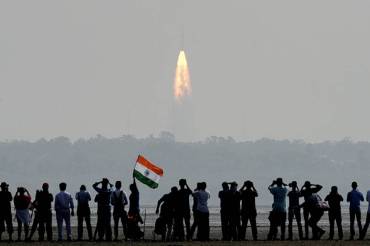
 

Spectators watched the launch of ISRO’s Polar Satellite Launch Vehicle (PSLV-C37) at Sriharikota on Feb. 15, 2017.

“India’s space program has come a long way,” she said.

Ms. Rajagopalan said the trend for sending more small satellites–instead of fewer large ones–will benefit ISRO due to the cost advantages it offers over its American and European competitors. The Space Foundation said nano satellites comprised 48% of launches in 2015

Wednesday’s feat eclipses the record set by Russia in 2014 when it launched 37 satellites in a single mission. A National Aeronautics and Space Administration rocket carried 29 satellites in 2013.

The PSLV rocket blasted off from the Satish Dhawan Space Center at Sriharikota in the southeastern state of Andhra Pradesh at 9.28 a.m. Wednesday local time (10.58 p.m. Tuesday ET).

The ISRO rocket hurtles through the sky after launch from Sriharikota, India, Feb. 15, 2017.

It first released its main cargo, ISRO’s 714 kilogram Cartosat-2 series satellite, which will be used for earth observation. It then released two smaller ISRO satellites, followed by the remaining 101 nano satellites, one each from Israel, Kazakhstan, Netherlands, Switzerland, United Arab Emirates, and 96 from the U.S. As many as 88 of the nano satellites belonged to U.S.-based company Planet Inc.

ISRO’s two smaller satellites are carrying equipment for conducting various experiments.

Indian Prime Minister Narendra Modi tweeted his congratulations. “This remarkable feat by @isro is yet another proud moment for our space scientific community and the nation. India salutes our scientists,” the message said.

Mission Director B. Jayakumar said it was a challenge to “find real estate (on the PSLV rocket) to accommodate all the satellites.” He said a “unique separation sequence” was designed due to the large number of satellites.

ISRO chairman Kiran Kumar Rao, right, held up models of the CARTOSAT-2 and Polar Satellite Launch Vehicle (PSLV-C37) after the launch in Sriharikota, India, Feb. 15, 2017.

ISRO said the satellites went into orbit 506 kilometers from earth, inclined at an angle of 97.46 degrees to the equator–very close to the intended orbit–after a flight of nearly 17 minutes. In the subsequent 12 minutes, all 104 satellites were successfully separated from the rocket in sequence, it said.

After separation, the two solar panels of ISRO’s Cartosat-2 series satellite were deployed and the space agency’s command center in Bangalore took control. In the coming days, the satellite will begin to provide start sending back black and white, and color pictures, ISRO said.

Source: India Breaks Record for Launching Most Satellites From Single Rocket – India Real Time – WSJ

Law of Unintended Consequences

continuously updated blog about China & India

ChiaHou's Book Reviews

continuously updated blog about China & India

What's wrong with the world; and its economy

continuously updated blog about China & India