Chindia Alert: You’ll be Living in their World Very Soon
aims to alert you to the threats and opportunities that China and India present. China and India require serious attention; case of ‘hidden dragon and crouching tiger’.
Without this attention, governments, businesses and, indeed, individuals may find themselves at a great disadvantage sooner rather than later.
The POSTs (front webpages) are mainly 'cuttings' from reliable sources, updated continuously.
The PAGEs (see Tabs, above) attempt to make the information more meaningful by putting some structure to the information we have researched and assembled since 2006.
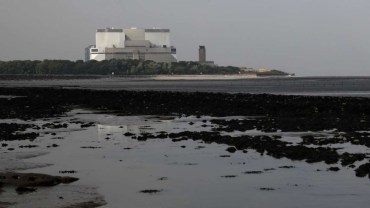
“Having thoroughly reviewed the proposals for Hinkley Point C, we will introduce a series of measures to enhance security and will ensure Hinkley cannot change hands without the government’s agreement,” Business SecretaryGreg Clark said in a statement.
Beijing calls for British nuclear project financially backed by China to proceed.
“Consequently, we have decided to proceed with the first new nuclear power station for a generation.”
The board of French state-owned power company EDF approved its participation in the project in southwest England on July 28, only for Britain’s new government under May to announce hours later that it wanted to review it.China has a one-third stake in Hinkley Point and analysts have warned that Britain would have risked its relations with the world’s second-largest economy if it cancelled the costly deal.
On Monday afternoon, a school bus was stopped in the Banashankari area in southern Bangalore. Three drunk men got into the bus and asked aloud: “Which child belongs to Karnataka and and which child belongs to Tamil Nadu?”
The 15-odd students, aged between 10 and 14, were stunned. Their school had asked them to leave early because the situation was tense, with violence and arson breaking out in many parts of the city.
“Luckily the driver handled it tactfully. He told the intruders that everyone was a native of Bangalore and that their families supported Karnataka on [water sharing with] Cauvery,” said a parent, not wanting to be identified.
Battle for access
By dusk, dark smoke had filled the Bangalore skies. Some 35 buses had been set on fire by protesters, just because the buses belonged to a travel agency whose owner is Tamil.
Is India facing its worst-ever water crisis?
India to ‘divert rivers’ to tackle droughtEarlier this month India’s Supreme Court ruled that Karnataka must release 12,000 cubic feet of water per second to Tamil Nadu from the Cauvery river until 20 September. Both states say they urgently need the water for irrigation and a battle about access to it has raged for decades.
Karnataka says water levels in Cauvery have declined because of insufficient rainfall
India’s water war
The Cauvery originates in Karnataka and flows through Tamil Nadu before joining the Bay of Bengal.
The dispute over its waters originated in the 19th Century during the British rule between the then Madras presidency (modern day Tamil Nadu) and the province of Mysore (now Karnataka).
Karnataka and Tamil Nadu have both argued that they need the water for millions of farmers in the region.
The Cauvery river water tribunal was set up in 1990 after the failure of several rounds of talks between the two states.
Dozens of meetings have been held to find a settlement to the century-old dispute.
In 2007, the tribunal ruled Tamil Nadu state would get 419bn cubic feet of water a year. Karnataka would get only 270bn.
Karnataka says water levels in the Cauvery have declined because of insufficient rainfall – 42% of the 3,598 irrigation tanks in the state are dry – and that it cannot therefore share water with Tamil Nadu. So Tamil Nadu went to the top court demanding 50,000 cubic feet of water per second.
When the Supreme Court on 2 September asked Karnataka to “live and let live”, the state softened and offered to release 10,000 cubic feet of water per second to Tamil Nadu every day for five days.
On 5 September however, the top court ordered Karnataka to release 15,000 cubic feet of water per second for 10 days. This ruling was later modified to 12,000 cubic feet of water per second until 20 September.
This would mean that nearly a quarter of the water now available in the Cauvery basin will flow into Tamil Nadu.
A truck from neighbouring Tamil Nadu set on fire in Bangalore
Tamil Nadu says it badly needs the river water for irrigation. Drought-hit Karnataka argues that most of the river water is now needed for drinking water supplies in Bangalore and some other cities, leaving no water for irrigation at all.
But even farmers in Tamil Nadu are unhappy with their share.P Ayyakannu, president of the local South Indian Rivers Interlinking Farmers Association, called it “akin to giving pigeon feed to an elephant”.
Rising violenceFeeling let down by the top court’s order, Karnataka is boiling.
The main city of Bangalore is the worst affected: the violence in the technology hub forced the closure of many offices and much of the public transport system. Police have imposed an emergency law that prohibits public gatherings, and more than 15,000 officers have been deployed across the city.
One person was killed when police opened fire on protesters on Monday evening. Buses and trucks bearing Tamil Nadu number plates have been attacked and set on fire. Schools and colleges are closing early and many businesses are shut.
A group of activists belonging to a fringe pro-Karnataka group assaulted an engineering student because he had ridiculed Kannada film stars for supporting the strike on Friday, by posting memes on Facebook. The student was hunted down and forced to apologise.
Across the border, in Tamil Nadu, petrol bombs were hurled at a popular restaurant owned by a resident of Karnataka in Chennai while the driver of a vehicle with Karnataka number plates was slapped and ordered to say “Cauvery belongs to Tamil Nadu”.
The latest violence brings back memories of the anti-Tamil riots in Bangalore in 1991 over the same issue.
Then, some 200,000 Tamils were reported to have left the city, after incidents of violence and arson targeting them.
There was a proposal in 2013 to set up a panel comprising representatives from the two warring states to resolve disputes over river water sharing.
But successive governments have dragged their feet on this, and the two leaders – Karnataka chief minister Siddaramaiah and his counterpart in Tamil Nadu, Jayaram Jayalalitha – have not reached out to each other to resolve the crisis. And with Delhi reduced to being a reluctant referee, the onus has fallen on the Supreme Court to crack the whip.
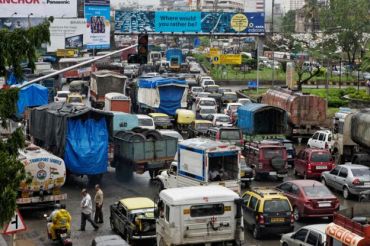
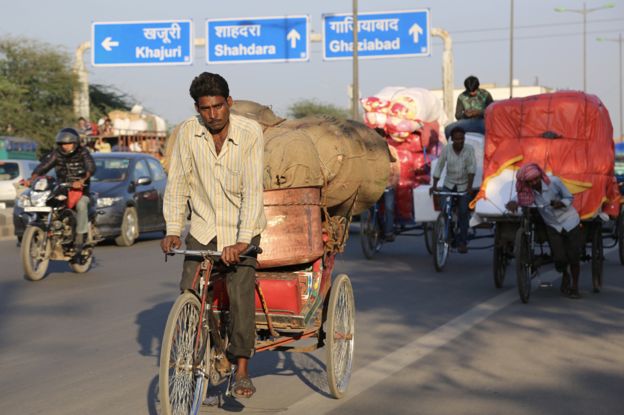
For a crash course in India’s car-crash culture, go to Mumbai. There are more accidents here than any other Indian city. You’ll witness a dangerous mix of pedestrians, scooters, cars, buses and lorries jostling through choked junctions. Many ignore both signals and the traffic police.Officers can do little about such rampant law-breaking.
“We can catch a maximum of two offenders at a time – maximum,” one shouts at me above the horns and revving engines at one particularly busy junction. “The rest,” he says flicking his wrist, “just go. There are no consequences.”
Mumbai: “A dangerous mix of pedestrians, scooters, cars, buses and lorries”
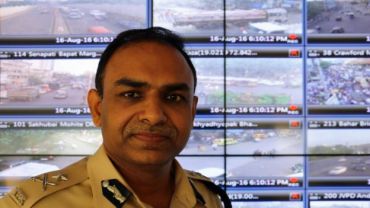
Mumbai’s commissioner of traffic police, Milind Bharambe, says this will soon end. From his cool office, flanked by monitors with live CCTV feeds of notorious accident spots, he explains how cameras will enforce the law electronically, targeting those who speed and run red lights. Combine that with the recent introduction of stiff new fines and within six months, he promises “a sea change” in driver behaviour.
Milind Bharambe, Mumbai’s commissioner of traffic police
But bad driving and weak enforcement are only part of the problem. Another aspect of it is the rapidly growing number of vehicles – a new one joins the chaos every 10 seconds. It adds up to almost 9,000 new vehicles a day, or more than three million a year.
This means that the streets are increasingly choked. It’s almost impossible to leave a safe distance between vehicles, and when space does open up, frustrated drivers often respond by putting their foot down.
Neal Razzall presents Fixing India’s Car Crash Capital on Crossing Continents, at 11:00 BST on Radio 4 – catch up on BBC iPlayer Radio
The problem is perhaps most acute in Mumbai, which is surrounded by water on three sides and has little room to grow. Officials here have in the past responded to the crush of cars by tearing out pavements to make room for more.”The government still thinks the major issue is ‘How do we move people in cars faster and quicker?'” says Binoy Mascarenhas from the pedestrian advocacy movement, Equal Streets. In reality, he says most journeys are local and, in theory, can be done on foot.
Pavements are often non-existent on Mumbai roads
In theory. He grew up in Mumbai, and used to walk to school. His daughter now goes to school in a car because it’s too dangerous to walk. Pavements, where they exist, are often in such a poor state people have to walk on the roads. No wonder then that pedestrians account for 60% of road deaths in Mumbai.
There are dangers outside the city, too.
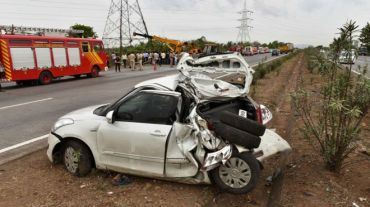
India’s first expressway, between the cities of Mumbai and Pune, opened in 2002. It has three wide lanes and room to move at high speed – a relief after the congestion of the city. But drive it with one of India’s few professional crash investigators, Ravi Shankar, and a quiet terror settles in. He’s studied thousands of crashes on this road and can point to dangers all around.
“There are small, man-made engineering problems that are actually killing people,” he says. Instead of rumble strips to warn drivers they’re at the road’s edge, there are black and yellow curb stones embedded into the concrete. Hit one of those, Shankar says, and your car can flip over. Then there are cliffs with no barriers, and guard-rails with tapered ends, which, he says, can send cars into the sky “like a rocket launcher”.
Things like this are happening all the time. The expressway is just 94km (58 miles) long but about 150 people die on it every year.
“That’s serious. That’s a very bad number,” Shankar says.
He and his colleagues at JD Research have identified more than 2,000 spots on the expressway where relatively simple engineering fixes, from better barriers to clearer signs, could save lives.Jump media playerMedia player helpOut of media player. Press enter to return or tab to continue.
“Road engineers are not serious about this problem,” Shankar says. “So we keep fighting with them on this point. How many deaths are you going to wait for, until you really understand that this is a serious concern?”
In this context, Prime Minister Narendra Modi‘s plan for the biggest expansion of roads in Indian history is unnerving. In the next few years he wants to pave a distance greater than the circumference of the earth and there’s a particular push to build highways and expressways.
Piyush Tewari, CEO of the safety charity Save Life India, says without putting the country on a “war footing”, including a complete overhaul of road safety legislation and a modern road-building code, Modi’s new roads will only add to the number of dead.
“Road crash deaths will increase at the rate of one death for every 2km of new road that is constructed. That’s the average death rate on Indian highways – one death every 2km, annually. So if we don’t fix any of this, if we’re constructing 100,000km of highways, 50,000 deaths is what the average maths tells us will be added to the total,” he says.
Image copyrightROLEX AWARDS/JESS HOFFMANImage captionPiyush Tewari believes the planned new roads could lead only to more fatalities
Modi’s government insists the new roads will be safer. “We are improving the road engineering; we are improving the traffic signal system; we are making crash barriers”, transportation minister, Nitin Gadkari, tells me.
There is progress in other areas too. When Mumbai’s commissioner of traffic police predicts a “sea change” in driver behaviour he is partly putting his faith in a new motor vehicle bill, now before parliament, which if passed would increase fines, toughen vehicle registration requirements and mandate road-worthiness tests for transport vehicles.
And earlier this year, a Good Samaritan Act came into effect which ended the crazy situation whereby people who helped crash victims could be held liable for the costs of treating them or even accused by police of causing the crash in the first place. That alone, campaigners say, will save thousands of lives.
More from the Magazine
When a road accident occurs, bystanders will usually try to help the injured, or at least call for help. In India it’s different. In a country with some of the world’s most dangerous roads, victims are all too often left to fend for themselves.
Save Life India estimates that half of all road deaths are the result of treatable injuries. That means 75,000 lives could be saved every year just with better medical care.
One man trying to save some of those lives is Mumbai neurosurgeon Dr Aadil Chagla, who is working with volunteers to build a series of clinics along Highway 66, south of Mumbai – many of them in rural areas – to prevent victims having to be driven for hours to the city.
The first is more than half-built. It looks out over rice paddies and lush hills, but Dr Chagla estimates it will be treating victims from “one or two crashes a day, every day”.
“If I can have an ambulance service and trauma centres every 50 to 100km run by the locals it would make huge difference to this entire highway – with or without government support,” he says.
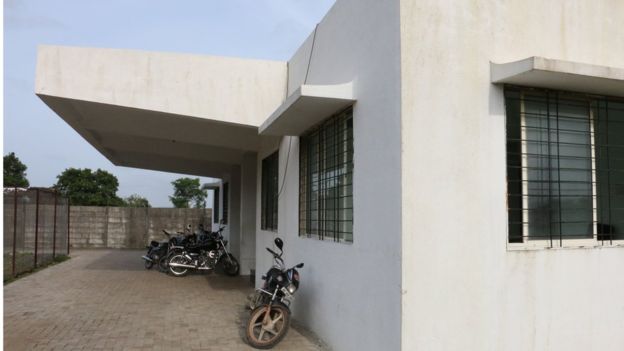
Image captionDr Chagla’s as-yet-unopened clinic to treat victims of road accidents
Since Dr Chagla started practising in the 1980s, the number killed on India’s roads has increased by 300%.
“I waited all this time and nothing has really come through so it’s important that I should do something about it,” he says.
So if transportation minister Nitin Gadkari is to make good on his promise to cut road deaths from 150,000 to 75,000 per year in two years, it will be thanks in part to the efforts of volunteers.
The state corporation that owns the Mumbai-Pune Expressway, meanwhile, says it will reduce deaths to zero – yes, zero – by 2020. It has accepted the list of essential improvements identified by crash investigator Ravi Shankar and authorised them to be made and then audited by Save Life India.
But there’s a snag, which suggests India is not yet on a “war footing” when it comes to safety.
The state government owns the road, but a private company runs it in exchange for collecting tolls. The two sides dispute who should make the safety upgrades. The official in charge of the expressway says the work will be done, even if it requires litigation to recover the costs.
While the dispute drags on, 100,000 vehicles use the expressway every day in its current, dangerous state. In the past week, it claimed six more lives.
China’s economy strengthened in August, with a slew of data, from factory production to retail sales, beating estimates Tuesday. The improved performance is a fresh sign that stepped-up government spending and strong property sales are helping to stabilize growth in the world’s second-largest economy.
As for the numbers themselves, as reported by the government, industrial output rose 6.3% last month from a year earlier. Investment in buildings and other fixed assets outside rural households climbed a better-than-expected 8.1% year over year in the first eight months of 2016, while retail sales grew 10.6% in August from a year ago.
Economists generally cheered the numbers, but wondered how long the better times would last. Following are excerpts from economists’ views on the latest data, edited for length and style:Better-than-expected data out of China today raise hopes that policymakers’ efforts to reverse the slide in investment growth are seeing some success. Stronger industrial activity last month appears to have been partly driven by a recovery in investment spending, especially in the state sector. The delayed impact of earlier policy easing means that a stronger second half of this year is likely. The latest evidence of a pick-up suggests that recent concerns that policy easing had failed to provide any noticeable boost to the economy were likely somewhat premature. Julian Evans-Pritchard, Capital EconomicsToday’s data suggest that the downside risk for third quarter GDP is significantly reduced. Investment in manufacturing industry increased only 3% in Jan-Aug, while investment in services picked up to 11.2%, showing economic rebalancing continues to take place. The uptick in industrial output is consistent with the rebound in the August official manufacturing PMI. However, the divergence of PMI performance between large corporates and small- and medium-size enterprises remains a concern.
Louis Lam and David Qu, ANZ ResearchWe expect investment to remain under pressure for the rest of the year because of slower real estate construction and spare capacity in key sectors. But with industrial profits recovering recently, and investment also up in August, the downward pressure should diminish. Meanwhile, export momentum should improve along with global trade, while we expect consumption to hold up. In all, while further stimulus is necessary to reach the government’s GDP growth target of at least 6.5% this year, the outlook has improved slightly after the August data. Louis Kuijs, Oxford EconomicsChina needs to nurture an initial economic stabilization with continued fiscal support. Today’s data show economic growth seems to have stabilized a little last month, but it is not on a solid footing yet. Measures such as tax cuts and increased government spending can not only help spur growth but also help restructure the economy by boosting consumption. Fiscal expenditures rose 10% in August from a year earlier, much faster than July’s 0.3% increase. Liu Xuezhi, Bank of Communication
Air fares in India are the lowest in the world, according to a global transportation study, underscoring the intense competition between carriers in the South Asian country.
In India, it costs an average of just $2.27 to fly 100 kilometers (62 miles) on domestic routes on a budget airline and $2.67 on a full-service carrier, according to a survey conducted by Kiwi.com, a Czech Republic-based online travel agency.
The most expensive place to fly domestically is the United Arab Emirates where flights are 80 times costlier than India. It costs $181.38 for 100 kilometers on a budget airline in the UAE and $220.36 on a full-service airline, according to website’s 2016 Aviation Price Index, which analyzed more than one million flights worldwide.
Domestic budget airline fares in India are similar to those in Malaysia—the second least expensive country–which cost $2.32 per 100 kilometers. Fares on full-service carriers in the Southeast Asian nation are however more expensive, at $5.81 for a similar distance.
Indian fares are cheaper thanks to strong competition and comparatively lower jet fuel prices. The country also has a number of budget airlines, including InterGlobe Aviation Ltd.’s IndiGo and SpiceJet Ltd.
A Boeing Co. 737 aircraft operated by SpiceJet Ltd. approaches to land at Chhatrapati Shivaji International Airport in Mumbai, India, Oct. 26, 2015. Spicejet is among a number of budget carriers in India.
Prices in India have fallen as competition increased with the arrival of new carriers. Malaysia’s AirAsia Bhd. started a budget airline venture with India’s Tata Sons Ltd. while Singapore Airlines Ltd. began a full-service carrier with Tata Sons.
Russia is ranked third least expensive for domestic air travel, with prices at $7.02 for budget airlines and $6.32 for full-service, the survey showed.
On the steep side, Finland — where it costs $39.61 and $130.80 to fly 100 kilometers on a low-cost and a full-service airline respectively — is the second most expensive. Qatar is the third-most expensive costing $64.36 for a budget airline ticket and $85.31 for a full-service airline ticket for the same distance.
The website said China offered the least expensive international flights on both budget and full-service airlines, at $1.22 and $2.84 respectively for 100 kilometers of travel. International flights from Canada are the most expensive at $43.70 and $94.66 on low-cost and full-service airlines respectively.
Germany’s Daimler AG plans to sell Mercedes-Benz branded all-electric battery cars in China, its China chief said on Wednesday, as the automaker capitalizes on government initiatives aimed at growing the market for new-energy vehicles (NEVs).
Hubertus Troska said the government’s push, which involves tax breaks and other policy support, helped the number of NEVs sold last year surpass 300,000, making China the world’s biggest market for electric, gasoline-electric and other such vehicles.
The majority of those vehicles were priced under 250,000 yuan ($37,515) and offered mainly by Chinese automakers, Troska said at an analyst and investor conference in Beijing.
Given factors including the government push – which falls under a broader drive to cut oil dependence and air pollution – Daimler is “very confident NEVs will be an important factor of the Chinese market,” Troska said.”Mercedes-Benz is also going to play a role in China in NEVs,” he said, referring to the planned cars.
He also said he sees demand over time shifting toward a “higher segment” of more expensive and capable all-electric battery cars and plug-in hybrids.Troska did not elaborate on the planned cars such as cost, pricing, models or launch dates. But investor relations head Björn Scheib said Daimler plans to show a concept electric car at the Paris Motor Show which opens to the public on Oct. 1.
Daimler currently sells one all-electric battery model in China under its smart brand, and one under the Denza brand it operates with local partner BYD Co Ltd.
Its China line-up also includes plug-in gasoline-electric hybrid versions of the Mercedes-Benz C-class and S-class sedans and GLE crossover sport utility vehicle.
After a summer lull, China’s economy is likely to have picked up, if only slightly, in August, according to economists.
The stirring in business activity, while lackluster, points to stabilization in the world’s second-largest economy, a survey of 15 economists by The Wall Street Journal showed. August data numbers to be released in coming days are expected to show that factory output improved marginally and new bank credit picked up, while investment and retail sales slowed, though not by much, the survey said.“We expect the upcoming August data release to show China’s economic activity finding a slightly firmer footing after July’s more-than-expected weakening,” said economists at UBS Securities Asia Ltd.
A surprising rise in a key gauge of manufacturing activity earlier this month buoyed the outlook for many economists.Industrial output, a rough proxy for economic growth, likely grew 6.2% in August from a year earlier, compared with a 6.0% increase in July, the survey showed. Fixed-asset investment outside rural households, a key gauge of construction activity, likely expanded 7.9% for the January-to-August period, slightly slower than an 8.1% increase over the first seven months.
Retail sales likely climbed 10.1% in August, a tick down from July’s 10.2% growth.
Among the other positive signs, the consumer-price index, a main gauge of inflation, moderated, likely rising 1.6% from a year earlier last month and slightly slower than the 1.8% growth in July, the survey found. Meanwhile, the producer-price index, a gauge of factory gate prices, likely dropped 0.9% from a year earlier last month, improving from a 1.7% decline in July and continuing a march out of deflationary territory where it has been for more than four years.
The better performance should give policymakers confidence to stay the course and refrain from interest-rate cuts or other aggressive easing measures, economists said.
At the same time, the faint improvements are largely the result of better performance of large firms that benefit more from policy support, economists said, while growing piles of debt and percolating bubbles in the property market are a looming concern for policymakers.
“At this moment, the key constraint faced by China’s monetary policy is not inflation, but the property market and the financial market,” said economists at Macquarie Capital Ltd.
Chinese banks probably gave out 792.5 billion yuan ($118.69billion) in new credit last month, well above July’s 463.6 billion yuan, the survey of economists showed. The economists mainly attributed the rebound to seasonal patterns, since banks tend to pick up the pace of lending at the end of each quarter.
In July almost all the new credit went to medium- and long-term household loans, predominantly mortgage lending. Lending to corporate borrowers, however, recorded a net drain of 2.6 billion yuan, the first negative growth in 11 years.
Household mortgage loans may have continued to surge in August. Recent data show a jump in housing transactions in many cities, and housing prices continue to rise. Credit demand from the corporate sector likely remained sluggish, though may have improved mildly, economists of Standard Chartered Bank.
Trade also remained anemic. Outbound shipments likely declined 4.0% from a year earlier in August, compared with July’s drop of 4.4%, while imports likely dropped by 5.0%, improving notably from July’s 12.5% dip, the same poll showed. Improvements in imports reflect last year’s low base, likely slightly better industrial production activity, and continued easing of import price deflation, UBS economists noted.
That would bring the country’s trade surplus to $59.40 billion last month, widening from July’s $52.31 billion. A large trade surplus should lend support to the country’s hoard of foreign currencies, which is expected to have dropped only slightly last month. The nation’s total reserves likely fell by about $2 billion last month to $3.199 trillion, the survey showed.
“The Indians said they wanted to look at how we could continue to have a strong trading relationship and there was agreement that as we prepare to leave the EU, we should be exploring what that looks like,” the official said.
“Prime Minister Modi said that we had always been an important partner for India and nothing about leaving the European Union would change that.”
The two leaders were meeting on the sidelines of the G20 summit in the Chinese city of Hangzhou.
Prime Minister Theresa May said on Sunday she wanted her security advisers to review a delayed nuclear power investment from China – a source of diplomatic tension – as she arrived in the country to attend a G20 summit.
May upset Chinese officials in July by delaying a $24 billion project that would see French firm EDF (EDF.PA) build Britain’s first new nuclear power plant in decades with the help of $8 billion from China.
Speaking during her first visit to China, May was asked whether she would ask the National Security Council, a team of ministers supported by intelligence officers, to look at the potential security implications of the Hinkley deal.
“I will be doing exactly as you’ve said,” May replied, saying it would be part of her decision-making process. The comment marked the first official acknowledgement that national security was a factor in her decision.
The initial delay caught investors by surprise and has cast doubt over whether May, who took office in July following Britain’s vote to leave the European Union, will continue to court China as a major source of infrastructure investment.
“This is the way I operate,” May earlier told reporters en route to the summit, which will include a one-to-one with Chinese PresidentXi Jinping.
“I look at the evidence, …take the advice and consider that and come to my decision.
“A final decision is expected later this month.
May, a former interior minister, is wary of the risks of allowing China to invest in nuclear projects, according to a former cabinet colleague. The EDF deal is viewed as a precursor to Chinese involvement in another two nuclear plants.
Asked whether she trusted China, May said: “Of course we have a relationship with them… What I want to do is build on that relationship.
“She also stressed a need to broaden the group of nations that Britain can trade with and tap for cash to help reinvigorate its power, transport and technology infrastructure.”This is the G20, this is about talking to a number of world leaders. I’m going to give the message that Britain is very much open for business… I want to be talking about the opportunities for free trade around the world.”
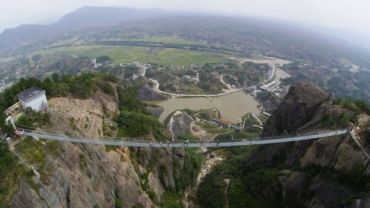
Tourism sites in the central Henan and Hunan provinces have been constructing vertigo-inducing skywalks in a bid to attract visitors.
And it seems to have worked, attracting thrill-seeking tourists and locals, all wanting a chance to experience a bird’s eye view of the Chinese countryside.
One of them is student Li Shu Zhen, 19, from Hangzhou city.
“You look down and feel a sense of fear, but you quickly recover from that and enjoy the scenery,” she said.
“It was beautiful, almost as if one was walking on air.”
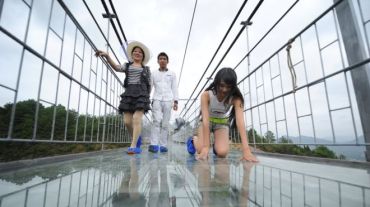
Yoga has been one of the stranger activities performed on the Brave Man’s Bridge
An eating challenge was held on this bridge in Yueyang country – although you might lose your appetite if you look downT
he fully transparent bridge, which measures 300m long (984ft) and 180m high, first opened to the public in September.
It is one of the more popular bridges, with events – like mass yoga displays – often being staged on it.
Local officials say that glass panels were designed to withstand high winds and earthquakes, as well as the “weight of 800 visitors”.
Glass bridge fever has also spread to neighbouring Taiwan, where a 179m-high bridge opened in Nantou county.
Construction has already begun on a second glass bridge above Zhangjiajie valley in Hunan province
‘Even if the glass breaks’
Construction on the latest bridge, touted as the world’s longest glass-bottomed walkway, is also nearing completion.
Standing at 300m high and stretching 375m, the bridge will hang above the Zhangjiajie grand canyon, also in Hunan province.
Gearing up for the bridge’s 2016 opening, officials have even enlisted the public’s help in naming it.
One of its engineers, Yang Guohong, from state-owned China Railway Major Bridge Reconnaissance and Design Institute, said contractors had taken extra safety precautions.
“No matter how the tourists jump on the bridge, it will still be fine,” he told the People’s Daily newspaper.
“The steel structures beneath it are incredibly dense, so even if the glass breaks, visitors won’t fall through.”
Would you dare to walk across?
But architects who spoke to the BBC said that such glass bridges were often “primarily a novelty, built as visitor attractions rather than commuter bridges”.
Architect Keith Brownlie, who was involved in a glass bridge for The London Science Museum, said that the appeal was “thrill”.
“It is the relationship between emotionally driven fear and the logical understanding of safety,” he said. “These structures tread the boundary between those two contrasting senses and people like to challenge their rational mind in relation to their irrational fear.
“Others felt that the bridges symbolised extravagance, especially in China.
“In architecture, glass has always been associated with luxury and often as a display of wealth,” said bridge designer Ezra Groskin.
“Glass floor panels, used in the creation of invisible architecture, are not a new phenomenon. However its use is often restricted due to cost and practicality.”
A terrifying incident last October sent visitors fleeing in fear after a section of a glass bridge in Yuntai mountain, Henan province, cracked
Shattered nerves
But how safe are China’s glass bridges?
An incident in October sent terrified visitors fleeing in fear after part of a glass skywalk in Henan province’s Yuntai Mountain Geological Park cracked, despite only being open for two weeks.
Park officials closed the walkway immediately, later saying there was “no reason for worry” and that the cracks had “no impact on safety”.
But experts questioned the use of glass in an exposed mountain environment.
“While a glass structure designed by a competent engineer and manufactured by a specialist contractor has no greater risk in terms of structural integrity than any other building material, glass can be prone to localised shocks,” noted architect Adam Holicska.
“The use of it in a mountain environment where there is a potential risk of rock impact can make it a questionable choice.
“Architect Keith Brownlie added that the cleaning of glass panels and lack of slip resistance should also be considered in such an environment.”One issue with glass decks is the problem of grip,” he said. “Glass is slippery and so anti-slip properties must be provided,”
The glass-bottomed Brave Man’s Bridge in Hunan province connects two mountains
“Please, no more such bridges,” commented a user on China’s popular micro-blogging site Weibo. “Judging from this incident, it is only a matter of time before more serious accidents and deaths occur.
“But glass bridge enthusiasts remain undeterred.
“I still would not hesitate to visit other glass bridges soon,” Ms Li admitted.
Other netizens on the site also expressed similar opinions.
“I am confident that officials will step up additional measures after that happened,” said one Weibo user.
“Thankfully deaths were avoided but one bad incident should not put one off from conquering such a spectacular bridge.”
Another compared it to other bridges of the world: “If Sydney’s Harbour Bridge experienced a crack, I doubt government officials would close it down. So we should not let such an episode affect our opinions about our unique Chinese structures.”













 CHINDIA ALERT: You'll be living in their world, very soon