Archive for ‘Economics’

22/06/2016

Cabinet approves auction of mobile phone airwaves – govt source | Reuters

The cabinet approved on Wednesday an auction of mobile phone airwaves, a government source told Reuters.

Earlier this year India’s telecoms ministry had proposed sale of airwaves in the 700 Mhz, 800 Mhz, 900 Mhz, 1800 Mhz, 2100 Mhz, 2300 Mhz and 2500 MHz bands.

India is the world’s second largest mobile phone market by users after China, and a rapid expansion of high-speed 4G services is expected to create demand for additional airwaves.The government is expected to announce details of the auction at a press conference later in the day, the official who did not want to be named, said.

Source: Cabinet approves auction of mobile phone airwaves – govt source | Reuters

22/06/2016

McDonald’s gets bids for China, HK stores sale in up to $3 billion deal – sources | Reuters

McDonald’s Corp (MCD.N) has received more than half a dozen bids for its China and Hong Kong stores, including offers from Beijing Tourism Group, Sanpower and ChemChina, in an auction that could fetch up to $3 billion, people familiar with the matter said.

Buyout firms including Bain Capital, TPG Capital [TPG.UL] and Carlyle Group (CG.O) too are participating in the auction with a view to teaming up with Chinese strategic bidders, they said.

The U.S. fast food company had announced in March it was reorganising its Asian operations by bringing in partners who would own the restaurants within a franchise business. Competitor Yum Brands (YUM.N) is also restructuring its China operations by spinning it off ahead of a likely IPO next year.

The planned sale of China units by McDonald’s and Yum indicates they are seeking local partners who could help ward off growing competition from domestic rivals and also better manage public perception in the wake of food-safety scares that hit the two fast-food giants in the last few years.

“Given the difficulties Western chains have had recently with public perception, local players have become a serious competitive threat,” said Elizabeth Friend, consumer foodservice analyst at Euromonitor International.

Oak Brook, Illinois-based McDonald’s has hired Morgan Stanley (MS.N) to run the sale of about 2,800 restaurants in China, Hong Kong and South Korea, Reuters previously reported. The sale in South Korea is being run separately and it was not known if the same parties have expressed interest in that sale, the people added.

As part of the deal, McDonald’s is offering a 20-year master franchise agreement to buyers, with an option to extend it by another 10 years.It has stipulated that private equity firms remain a minority partner in any bidding consortium, restrictions that discouraged some buyout funds from participating in the auction, the people added.

Among those who were preparing to place first-round bids ahead of the June 20 deadline were Beijing Capital Agribusiness Group, which is McDonald’s current China partner, and GreenTree Hospitality, the people added. It was not immediately clear if they made the bids.McDonald’s will now draw up a shortlist of bidders for the next round in the coming weeks.

Source: Exclusive: McDonald’s gets bids for China, HK stores sale in up to $3 billion deal – sources | Reuters

22/06/2016

India’s Space Agency Sends 20 Satellites Into Orbit – India Real Time – WSJ

India on Wednesday put 20 satellites into the Earth’s orbit, including 17 from foreign countries, a record number for its space agency as it seeks to become a low-cost and reliable choice for launches.

The successful mission by the Indian Space Research Organisation puts it right after Russia and the U.S. for the number of satellites launched from a single rocket so far, said an ISRO official. In 2014, a single Russian space launch vehicle deployed 33 satellites. A National Aeronautics and Space Administration rocket carried 29 satellites in 2013.

ISRO’s rocket, the Polar Satellite Launch Vehicle, carried its own Cartosat-2 series satellite for earth observation along with 13 satellites from the U.S., two from Canada, one each from Germany and Indonesia and two from Indian academic institutions.

“ISRO continues to break new barriers,” Indian Prime Minister Narendra Modi said on his Twitter account. He said the country’s space program “has time and again shown the transformative potential of science and technology in people’s lives.”

The launch comes as global space agencies face competition from private companies who are aiming to bring down the cost and time for manufacturing and launching satellites by automating their production and using unmanned reusable rockets.

U.S. businessman Greg Wyler has joined hands with Airbus Group SE to build an automated manufacturing facility in Florida that can churn out hundreds of satellites each year. Traditional satellites are built using touch labor. SpaceX, an aerospace startup founded by Elon Musk, successfully landed a rocket on an ocean platform in early May after launching a communications satellite.

India has been fast achieving recognition as a budget option for launching satellites. In 2014, ISRO put a satellite into the orbit of Mars, becoming the first Asian country to reach the red planet, and at fraction of the cost of a similar launch in U.S. and Europe.

In May ISRO launched the test model of its planned reusable space shuttle.  In April, it launched the seventh satellite needed to create its own navigation system, joining a small group of nations with their own versions of GPS.

The global space industry was estimated to be worth $330 billion in 2014, the latest year for which data are available, according to the Space Foundation, a U.S.-based research group. Commercial space activities comprised as much as 76% of the industry, it said.

There were 92 rocket launches in 2014, and Russia continues to hold its leadership in this area with 32 rocket launches, followed by U.S. with 32 and 11 by Europe, the Space Foundation said. It didn’t provide figures for India.Ajay Lele, a senior fellow at New Delhi-based Institute for Defense Studies and Analyses estimates the U.S. has about a 40% share of the global satellite-launching market, while Europe has 25% and Russia 20%. Countries such as China and India have a much smaller share of the market of about 3% percent or less, Mr. Lele said.

ISRO officials said after the launch they want to accelerate the pace of sending satellites into space by extending partnerships with private Indian companies. The space organization has launched more than 57 satellites from about 20 countries on board the PSLV over about two decades.

Source: India’s Space Agency Sends 20 Satellites Into Orbit – India Real Time – WSJ

21/06/2016

India’s suicide farmers’ widows face living death | Reuters

At the age of 24, Joshna Wandile and her two children were thrown out of the house she shared with her in-laws after her farmer husband hanged himself. He left a pile of debts after years of drought laid waste to his land.Wandile is not alone. More than 300,000 farmers have killed themselves in India over the last two decades, leaving their widows battling with the state, moneylenders, in-laws and their communities.

While widows in rural India are often ostracised and abused, farmer widows have it particularly tough, activists said ahead of International Widows’ Day on Thursday.”I had nothing when my husband died – he sold everything in the house, even the cooking vessels, to pay the creditors,” said Wandile who lives in Vidarbha in Maharashtra, among the worst affected by farmers’ suicides.

“I couldn’t even feel sad. I could only think: where will we live? How will I earn enough money? How will I keep us safe?” said Wandile, who was married at 17.

Maharashtra, which is struggling with its worst drought in four decades, accounted for more than half the 5,650 farmer suicides in India in 2014, according to official data. Some estimate last year’s toll exceeded 3,000.

“Bankruptcy or indebtedness” was the most common reason cited. Most were small farmers, with holdings of under two hectares.

There is little information on the families left behind who struggle to claim their right to the land they till and the house they live in, while battling archaic stigmas that dog their every step.

Source: India’s suicide farmers’ widows face living death | Reuters

18/06/2016

India looks to China’s technology for making clouds rain|Government|chinadaily.com.cn

China is in talks with India on the transfer of cloud-seeding technology.In the first such engagement between the Asian giants, a team of scientists and officials from Beijing, Shanghai and East China’s Anhui province, were recently in Maharashtra to discuss weather conditions with the government of the western Indian state, parts of which have experienced severe droughts over the past two years.

line art drawing of cloud seeding.

line art drawing of cloud seeding. (Photo credit: Wikipedia)

The Chinese team’s days-long tour concluded on June 2.If the discussions are successful, Chinese experts would provide training to officials of the Indian Meteorological Department on their latest cloud-seeding technology, according to two sources with knowledge of the matter.

One of the sources had earlier described it as an “exploratory visit by the Chinese side to discuss with relevant Indian authorities how to go about it”.

The training is expected to be given on procedures to seed clouds successfully, the source said.

The training is aimed at inducing rain over Maharashtra’s Marathwada region in the summer of 2017 if needed, the source said.

While summer rains have arrived this year in India, the region has been traditionally vulnerable to drought.

The sources spoke to China Daily on condition of anonymity.

An official in the China Meteorological Administration said that arrangements are still in progress.

The development follows a meeting between Han Zheng, Shanghai’s top official, and Maharashtra chief minister Devendra Fadnavis, in the Indian state’s capital of Mumbai in early May.

Han, who is also a Communist Party of China Politburo member, had asked Fadnavis if China could do anything for drought relief in Maharashtra, one of the sources said.

Monsoons and temperatures nearing 50 C have triggered many agrarian crises in India, with poor farmers being hit the hardest.

Indian media said in April that the Maharashtra government would begin cloud-seeding experiments in June and continue through August – the period of summer monsoons.

China started to use cloud-seeding technology in 1958, and today has one of the most advanced systems in the world.

Source: India looks to China’s technology for making clouds rain|Government|chinadaily.com.cn

18/06/2016

New App Promises to Tell Indian Farmers When to Sow Crops – India Real Time – WSJ

Monsoon season in India has just begun, but farmers in Andhra Pradesh, a southeastern coastal state of India, won’t need to look to the skies to know when to sow their crops.

A new mobile application launched earlier this month and developed by a local agriculture research institute, Microsoft India and the state government tells farmers in the state which week is perfect for sowing seeds, the health of their soil and other indicators.

The app uses rainfall data collected from farms in 13 districts in Andhra Pradesh over 45 years to give farmers a sense of when to start planting, Suhas P. Wani, director of Asia research at the International Crops Research Institute for Semi-Arid Tropics or ICRISAT, a research organization in Hyderabad said.Farmers are asked to register a mobile number with the state government, choose a language–currently limited to the regional Telugu and English–and enter details of the village, district or sub-district.

The advice received could vary from farmer to farmer and from village to village, Mr. Wani said. “The app has crop-specific information such as 10 years of groundnut sowing progress data” to guide farmers who grow specific crops, he added.

He said that constant data on crop yield was being collected on a monthly basis by field officers and sent for evaluation to provide regular forecasts to farmers.

A weather button shows the temperature and rainfall as well as fertilizer recommendations for the day and projection for the next seven days. Additionally, a farmer can get weather alerts for extreme conditions like hailstorms or unseasonal rains that impact crop yields.

Andhra Pradesh logged the highest number of farmer suicides in the country last year. At least 58 farmers took their own lives in the state, according to an agriculture ministry report.

But not every farmer can afford to invest in expensive smartphone technology.

So far, most of the farmers have requested to be sent the information via SMS message. Mr. Wani said once registered, farmers can get the predicted sowing date through SMS. “The main idea behind the application is to help farmers reduce losses by telling when to sow seeds or spray the plants,” he said.

The application will be rolled out in other Indian states next year, based on feedback from farmers in the state, he added.

Source: New App Promises to Tell Indian Farmers When to Sow Crops – India Real Time – WSJ

18/06/2016

The great crawl | The Economist

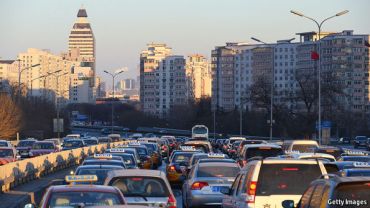
LATE last month a black-and-white photograph of a professor from Beijing Jiaotong University spread on social media. His image was edged by a black frame, like those displayed at funerals in China, and trimmed with white flowers of mourning. Though Mao Baohua is still very much alive, he had angered netizens enough to depict him as dead. His crime? To suggest that Beijing should follow the likes of London and Stockholm, by charging drivers 20-50 yuan ($3-7.50) to enter the capital’s busiest areas in the hope of easing traffic flow in the gridlocked city.

Most Chinese urbanites see buying a vehicle as a rite of passage: a symbol of wealth, status and autonomy, as it once was in America. Hence their outrage at any restraint on driving. Since car ownership is more concentrated among middle- and high-income earners in China than it is in richer countries, any attack on driving is, in effect, essentially aimed at the middle class, a group the Communist Party is keen to keep on side. That makes it hard to push through changes its members dislike.

Since 2009 officials in Beijing and the southern city of Guangzhou have repeatedly aired the idea of introducing congestion charges. Netizens have fought back, accusing their governments of being lazy, brutal and greedy. Many also gripe that the policy would be “unfair” because the fee would have less impact on the super-rich. Complaints about the inequality of congestion charging echo those made in London and other cities before they launched such schemes. But the party, nervous of being accused of straying from socialism, is particularly sensitive to accusations that it is favouring the wealthiest.

Because of such objections, city governments have not pushed their proposals very hard. But that is now changing in Beijing, where officials face a dilemma. Traffic jams in the city and appalling air pollution—30% of which comes from vehicle fumes, by official reckoning—may end up causing as much popular resentment as any surcharge. The local government is trying to work out how close it is to this tipping point. It is conducting surveys to “pressure test” how people would react to a congestion fee, says Yuan Yue of Horizon, China’s biggest polling company (the results will not be made public). It is likely that a concrete plan for a congestion charge will be announced soon. Beijing’s environmental and transport departments (not usual partners) are collaborating on a draft. State media have recently published a flurry of articles about this, not all in favour.

Public opinion is not the only challenge a congestion scheme faces. The urban planners who conceived Beijing’s layout, and that of other Chinese cities, never imagined that so many people would want to drive. The capital now has 3.6m privately owned cars: the number per 1,000 people in Beijing has increased an astonishing 21-fold since 2000, according to our sister company, the Economist Intelligence Unit (see chart).

On most days large tracts of the capital are now bumper to bumper amid a cacophony of car horns. Beijingers have the longest average commute of any city in China, according to data collected by Baidu, a Chinese search engine. The problem is not confined to Beijing. The capital has higher vehicle ownership than any other Chinese city, but car use is rising rapidly across the country. Many second- and third-tier cities are already clogged.

Beijing’s congestion scheme would be the first outside the rich world, where a handful of cities now charge drivers to enter a designated area. (Singapore has a different form of road pricing, with tolls on individual arterial roads.) Such measures have been credited with reductions in downtown car-use, improved traffic flow and greater use of public transport. They have also cut pollution, including emissions of the tiny PM2.5 particles that are particularly dangerous to health and abundant in Beijing’s air.

Transport planners reckon a congestion zone would have similar effects in Beijing, and complement existing attempts to restrict car use. In 2008, after Beijing staged the Olympic games, the city launched the current system whereby each car is banned from the urban core one workday per week, depending on the last digit of its licence plate. Beijing is now one of 11 Chinese cities with similar restrictions.

But some drivers choose to pay the 100 yuan fine, which is far higher than the congestion charge that Beijing is now mulling (around the sums suggested by Professor Mao). People also drive without plates, or buy second cars, to bypass the rules. In 2011 the capital introduced a lottery for obtaining new licence plates (six other cities do this). In Beijing the scheme has slowed the increase in car ownership, but not enough to cut congestion; some residents use vehicles registered elsewhere. Also in 2011 the capital raised parking fees, hoping to deter drivers. But people often park on pavements and traffic islands instead, usually with impunity.

Source: The great crawl | The Economist

18/06/2016

Study Finds China’s Ecosystems Have Become Healthier – China Real Time Report – WSJ

China’s skies may be toxic, and its rivers fetid and prone to sudden infestations of pig carcasses. But according to a new study, the country’s environmental battle has also been making quiet, measurable progress.

The paper, a collaboration between U.S. and Chinese researchers published in this week’s issue of Science, found that China’s ecosystems have become healthier and more resilient against such disasters as sandstorms and flooding. The authors partly credit what they describe as the world’s largest government-backed effort to restore natural habitats such as forests and grasslands, totaling some $150 billion in spending since 2000.

“In a more and more turbulent world, with climate change unfolding, it’s really crucial to measure these kinds of things,” says Gretchen Daily, a Stanford biology professor and a senior author on the paper.

The study didn’t examine air, water or soil quality, all deeply entrenched problems for the country.

Beijing’s investments in promoting better ecosystem protection were triggered after a spate of disasters in the 1990s. In particular, authors note, two decades after China started to liberalize its economy, rampant deforestation and soil erosion triggered devastating floods along the Yangtze River in 1998, killing thousands and causing some $36 billion in property damage.

The government subsequently embarked on an effort to try to forestall such environmental catastrophes. According to the study, in the decade following, carbon sequestration went up 23%, soil retention went up 13% and flood mitigation by 13%, with sandstorm prevention up by 6%.

The paper also involved authors from the Chinese Academy of Sciences and the University of Minnesota, among other institutions. Data was collected by remote sensing and a team of some 3,000 scientists across China, said Ms. Daily, who praised the “big-data” approach to tracking the quality of China’s ecosystems.

“The whole world is waking up to the need to invest in natural capital as the basis for green growth,” she said.

Reforestation was one particular bright spot, she said. Under the country’s founding father, Mao Zedong, China razed acres of forests to fuel steel-smelting furnaces. To reverse the trend–and combat creeping desertification in the country’s north — the country embarked on a project in 1978 to build a “Great Green Wall” of trees. Today, authorities say that 22% of the country is covered by forest, up 1.3 percentage points compared with 2008.

The authors note that the study has limits. While China has reported improving levels of air quality in the past year, urban residents still choke under regular “airpocalypses.” The majority of Chinese cities endure levels of smog that exceed both Chinese and World Health Organization health standards.

“You can plant trees till the end of time,” says Ms. Daily. “But they’ll never be enough to clean up the air.”

Source: Study Finds China’s Ecosystems Have Become Healthier – China Real Time Report – WSJ

16/06/2016

Reaping what they sow: Shaolin monks harvest wheat as a form of Zen practise | South China Morning Post

Monks at Shaolin Temple in Henan province have been harvesting wheat as a method to practice Buddhism, the China News Agency reported on Thursday.

The 1,400-year-old temple, famed as the birthplace of Chan (Zen) Buddhism and martial arts traditions, operates a farm of of about 70 hectares where they grow wheat, corn, vegetables and herbs.

During the wheat reaping season in June, groups of monks cut the crops, thrash the grain, bag it and carry it to the barn.

Farming is also a kind of self-cultivation,” said Shi Yanzi, the monk in charge of the farm. “We farm with the spirit of Zen, and plough and sow in our own mind too.

”Shaolin’s millennium-long tradition of farming was interrupted in the past decades, but was resumed by head abbot Shi Yongxin in recent years.

Shi believes producing food in the temple’s fields can also ensure food safety.

The Shaolin temple farm also opens to tourists to experience harvesting fresh vegetables or fruit.

Source: Reaping what they sow: Shaolin monks harvest wheat as a form of Zen practise | South China Morning Post

16/06/2016

Disney’s China fairytale begins with $5.5 billion park opening | Reuters

Walt Disney Co has opened the gates to its first theme park in China, prompting a rush from thousands of gathered Mickey Mouse enthusiasts to be the first to storm Treasure Cove, ride the Roaring Rapids or visit Disney’s tallest castle.

Disney’s largest overseas investment at $5.5 billion, the park is a bet on China’s middle class and booming domestic tourism. The U.S. firm hopes it will offset an otherwise lackluster international theme park business, better known for cash-burning sites such as Euro Disney.

“This is one of the proudest and most exciting moments in the history of the Walt Disney Company,” chief executive Bob Iger said at the official ribbon cutting ceremony on Thursday, where he was flanked by Chinese government officials.

Iger and Chinese Vice Premier Wang Yang read out letters of support from Barack Obama and President Xi Jinping.

Not everything has gone quite to plan though.The opening gala – meant to be a bonanza of fireworks, live music and dance – was rained off on Wednesday night, while at Disney’s park in Orlando, Florida, a young boy was grabbed by an alligator and killed.

Disney, though, sees China as its biggest opportunity since Walt Disney bought land in Florida in the 1960s for what is now Walt Disney World – the world’s most-visited theme park.

With that in mind, Main Street has been replaced by Mickey Avenue to reduce the feel of Americana while attractions include the Chinese-style Wandering Moon tea house, a Chinese Zodiac-themed garden and a Tarzan musical featuring Chinese acrobats.

Disney estimates 330 million people within a three-hour radius of Shanghai will be able to afford to come to the park: that includes Zhao Qiong, 36, who was one of the first visitors inside the park on Thursday with her 4-year-old daughter.”Since she was young, my little girl has always loved Disney princesses, so I wanted to bring her to the park to fulfill her dream,” she told Reuters.

Source: Disney’s China fairytale begins with $5.5 billion park opening | Reuters

Law of Unintended Consequences

continuously updated blog about China & India

ChiaHou's Book Reviews

continuously updated blog about China & India

What's wrong with the world; and its economy

continuously updated blog about China & India