Archive for ‘Services’

01/06/2020

‘Lemon’ or not, Trump is stuck with Phase 1 China trade deal

WASHINGTON (Reuters) – U.S. President Donald Trump has little choice but to stick with his Phase 1 China trade deal despite his anger at Beijing over the coronavirus pandemic, new Hong Kong security rules, and dwindling hopes China can meet U.S. goods purchase targets, people familiar with his administration’s deliberations say.

The U.S.-China trade negotiations took more than two years, heaped tariffs on $370 billion of Chinese products, whipsawed financial markets and dimmed global growth prospects well before the coronavirus outbreak crushed them.

In recent weeks, suggestions that Trump may cancel the deal have emanated from the White House almost daily, and businesses, investors, and China trade watchers are hanging on to every word and tweet.

But on Friday, when Trump said the United States would start dismantling trade and travel privileges for Hong Kong, he did not mention the deal. Stock markets heaved a sigh of relief, with the S&P 500 .SPX reversing losses.

Talking tough on China and criticizing the Obama administration’s more measured approach is a key part of Trump’s re-election strategy. Sticking with the pact may mean accepting that China is likely to fall short of purchase commitments for U.S. agricultural goods, manufactured products, energy and services – goals that many said were unrealistic here even before the pandemic.

Canceling the deal, though, would reignite the nearly two-year U.S.-China trade war at a time U.S. unemployment is at its worst since the 1930s Great Depression.

The next U.S. step would likely be reviving previously planned but canceled tariffs on some $165 billion worth of Chinese consumer goods, including Apple (AAPL.O) cellphones and computers, toys and clothing – all ultimately paid by U.S. companies and passed on to consumers. Beijing would retaliate with tariffs on U.S. goods, fueling more market turmoil and delaying recovery.

“He’s stuck with a lemon. He gets an empty agreement if he sticks with it, and he gets more actions that create an economic drag and more volatility if he abandons it,” said one person briefed on the administration’s trade deliberations.

U.S. goods exports here to China in the first quarter were down $4 billion from the trade war-damaged levels a year earlier, according to U.S. Census Bureau data.

The Peterson Institute of International Economics estimates here that during the first quarter, China made only about 40% of the purchases it needed to stay on target for a first-year increase of $77 billion over 2017 levels, implying an extremely steep climb in the second half.

Leaving the deal now would not buy a lasting political bounce for Trump in manufacturing-heavy swing states with five months to go before the presidential election, analysts say.

COMPLEX RELATIONSHIP

Trump blames China for failing to contain the coronavirus and has repeatedly said the deal, including its pledges to boost U.S. exports to China by $200 billion over two years, no longer means as much to him with U.S. coronavirus deaths now over 100,000 and job losses piling up.

Trump said on Friday that China was “absolutely smothering Hong Kong’s freedom,” but refrained from harsh sanctions that could put the trade deal in jeopardy, taking milder steps to revoke the territory’s separate travel and customs benefits from China.

Claire Reade, a former U.S. trade negotiator, said Trump’s “peripheral steps” would not deter Beijing from proceeding with the security law, as it regards Hong Kong as a core national security issue.

“Probably the most significant thing from the trade perspective is that the Phase 1 trade deal is – for now anyway – unaffected,” said Reade, senior counsel with Arnold and Porter law firm in Washington.

White House Economic Adviser Larry Kudlow criticized Beijing last week, but on trade told CNBC: “It’s a complex relationship. The China Phase 1 trade deal does continue to go on for the moment and we may be making progress there.”

U.S. Trade Representative Robert Lighthizer has recently cited here “continuing progress” in the deal, after China welcomed U.S. blueberries, barley, beef and dairy products. He has touted the deal’s dispute settlement mechanism, which provides for regular consultations on compliance with Beijing’s commitments on intellectual property protections, financial services, agriculture standards and purchases.

U.S.-China flashpoints on Hong Kong, Taiwan and other issues did not derail negotiations that resulted in new concessions from China, said Jamieson Greer, who served as Lighthizer’s chief of staff until April.

“Some of these security and human rights challenges have certainly complicated the atmosphere, but the trade agreement can still provide a set of rules governing important aspects of the trade relationship,” said Greer, now an international trade partner at the King and Spalding law firm.

Another person familiar with USTR thinking said the agency “needs to make Phase 1 look good. They want to show that progress is being made. The president looks at the China relationship much more broadly.”

Source: Reuters
29/04/2020

Cathay Pacific looks to increase passenger flights in late June if coronavirus travel restrictions are eased

  • Carrier targets return of daily services to major Asian cities and more frequent long-haul services
  • Airline to monitor global situation and adjustments may be made ‘as necessary’
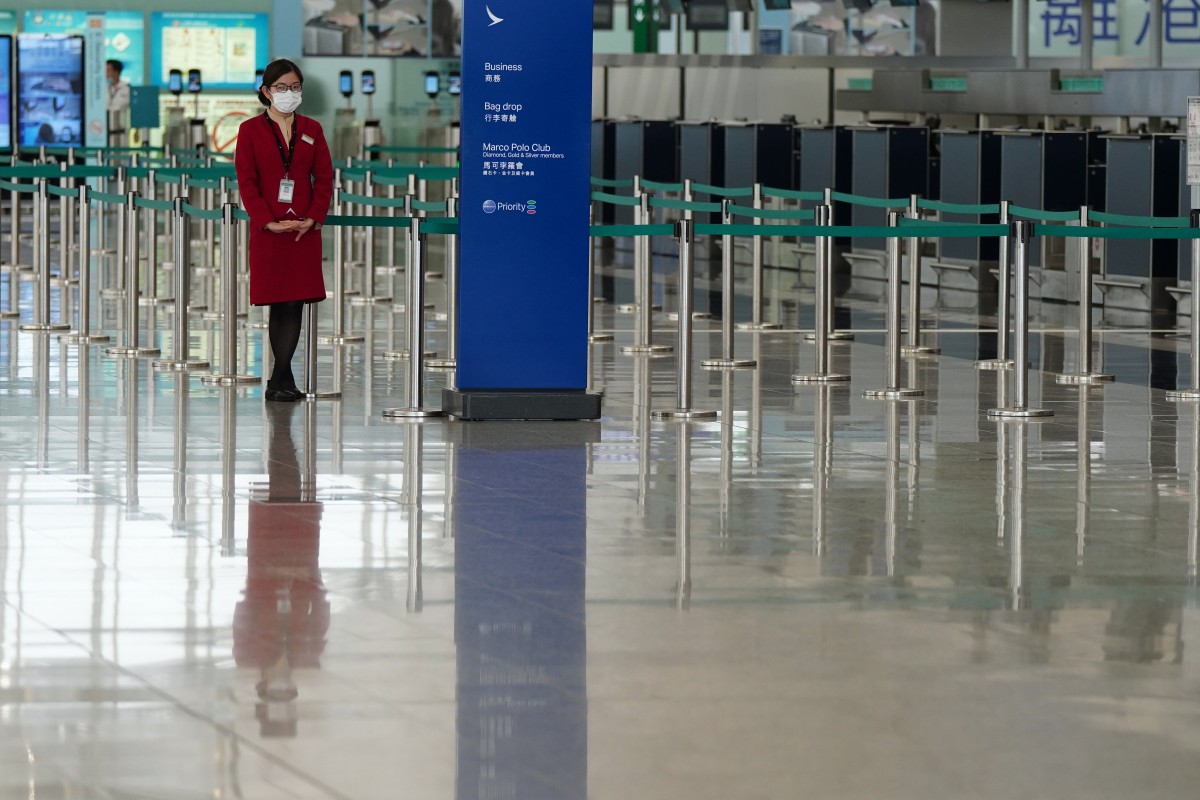
A Cathay Pacific employee stands near the check-in desks at a virtually deserted Hong Kong International Airport. Photo: Sam Tsang
Cathay Pacific Airways has signalled its intent to start reversing its near-total grounding of aircraft because of the coronavirus pandemic, and plans to start increasing its number of passenger flights in the last week of June.
The airline said it hoped to add more long-haul destinations, make flights more frequent, and reinstate some major Asian cities to its daily schedule for the first time in several months, “subject to government travel restrictions”.
Cathay scaled its operations back to a skeleton schedule of 3 per cent of services in early April, and that was extended until June 20. The newly announced increases would take that up to 5 per cent.
The global airline industry has been rocked by the pandemic, which triggered a collapse in air travel demand amid severe travel restrictions and tough quarantine measures.
Tracking the massive impact of the Covid-19 pandemic on the world’s airline industry in early 2020 Singapore Airlines, another of Asia’s major carriers, said last week it would maintain a 96 per cent reduction in flights until the end of June.
Cathay, which has 236 aircraft, currently operates long-haul flights to London Heathrow, Los Angeles, Vancouver and Sydney twice a week, but will increase that to five times a week.

On top of that, Amsterdam, Frankfurt, San Francisco and Melbourne are among the long-haul destinations set to return three times a week.

With regional routes currently operating three times a week, including Tokyo Narita, Taipei, Beijing and Singapore, Asian routes will increase to a daily service. Osaka and Seoul would also return to the network, too.

“We will continue to monitor the developing situation and further adjustments may be made as necessary,” the airline said.

Coronavirus: ban on non-residents leaves Hong Kong airport virtually deserted
Earlier this month, Cathay’s budget unit HK Express extended its total grounding until June 18, having been on hiatus since March 23.

Meanwhile, Boeing has added to warnings of a very slow recovery in air travel, with Dave Calhoun, its CEO, saying demand may not return to 2019 levels for two to three years.

Cathay Pacific’s daily passenger volume has collapsed from regular previous peaks of 100,000 to less than 1,000 in April. Over the past two months, the company has been running more than 250 extra pairs of cargo-only passenger flights to maintain air freight capacity, much of which is accounted for by passenger services.

In a bid to cut costs, most of the Cathay Pacific Group’s 34,200 staff have taken three weeks of unpaid leave. Also, 433 cabin crew in the US and Canada were told they would be laid off, while about 200 pilots in the UK, Australia have been furloughed.

The International Air Transport Association, which revised down pandemic-related revenue losses for the global sector to US$314 billion (HK$2.4 trillion) two weeks ago, said last week the Hong Kong aviation market would take a US$7.5 billion hit this year, a 27 per cent increase on the previous estimate. That equates to a 59 per cent decline in air travel demand, or a loss of almost 31 million passengers, in 2020.

BOCOM International, a financial services company, forecast in a report on Monday that the city’s aviation sector would lose HK$65.2 billion in revenue in 2020, yet Cathay Pacific could emerge as a winner if it survived largely unscathed, given the weakness of rivals at home and in the region plus its dominant position in Hong Kong.

“Hong Kong aviation is at the most critical juncture in its history. Though calamitous, Covid-19 is set to reshape Hong Kong’s aviation industry for the years, possibly decades, to come,” said transportation analyst Luya You.

“Covid-19’s sweeping blows now offer a blank slate for remaining players to regain lost leadership or gain new markets. If [Cathay Pacific] can survive intact from Covid, the carrier could enjoy winner-takes-all growth trajectory in the years following [2020].”

Source: SCMP

17/02/2020

The Kashmir journalist forced into manual labour

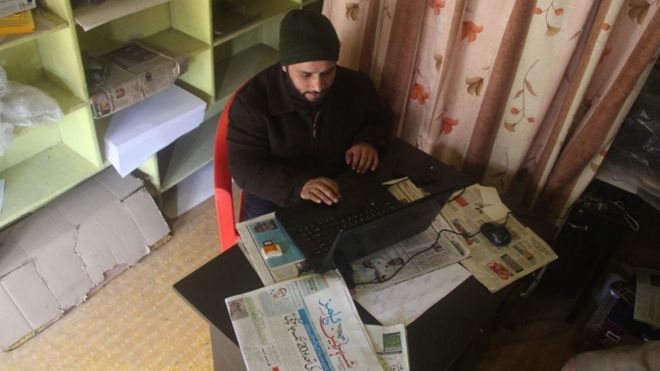
Muneeb Ul IslamImage copyright MUKHTAR ZAHOOR
Image caption Muneeb Ul Islam can no longer afford to work as a journalist in Kashmir

Journalists in Indian-administered Kashmir are struggling to make ends meet amid a months-long communications blockade that has only partially been lifted. The BBC’s Priyanka Dubey visited the region to find out more.

Muneeb Ul Islam, 29, had worked as a photo-journalist in Kashmir for five years, his pictures appearing in several publications in India and abroad.

But the young photographer’s dream job vanished almost overnight in August last year, when India’s federal government suspended landline, mobile and internet services in Kashmir.

The government’s move came a day before its announcement that it was revoking the region’s special status – a constitutionally-guaranteed provision, which gave Kashmir partial autonomy in matters related to property ownership, permanent residency and fundamental rights.

The controversial decision catapulted the Muslim-majority valley into global news – but local journalists like Mr Islam had no way to report on what was going on. And worse, they had to find other things to do because journalism could no longer pay the bills.

By January, the region had not had access to the internet for more than 150 days, India’s longest such shutdown.

Media caption The silenced YouTube stars of Indian-administered Kashmir

“I chose journalism because I wanted to do something for my people,” Mr Islam explains. “I covered this conflict-ridden region with dedication until the loss of Kashmir’s special status put a full stop on my journey.”

In January, the government eased restrictions and allowed limited broadband service in the Muslim-majority valley, while 2G mobile coverage resumed in parts of the neighbouring Jammu region. But mobile internet and social media are still largely blocked.

India says this is necessary to maintain law and order since the region saw protests in August, and there has also been a long-running insurgency against Indian rule. But opposition leaders and critics of the move say the government cannot leave these restrictions in place indefinitely.

Meanwhile, journalists like Mr Islam are struggling.

Kashmiri journalists protest against the continuous internet blockade for 100th day out Kashmir press club , Srinagar, Indian Administered Kashmir on 12 November 2019.Image copyright GETTY IMAGES
Image caption Kashmiri journalists protested after 100 days of no internet in the region

For months, Mr Islam says, he kept trying to report and file stories and photos.

In September, he even spent 6,000 rupees ($84; £65) of his own money to make two trips to the capital, Srinagar, for a story. But he soon ran out of funds and had to stop.

He then tried to file his stories on a landline phone: he would call and read them aloud to someone on the other side who could type it out. But, as he found out, his stories didn’t earn him enough money to cover the cost of travelling for hours in search of a working landline.

Presentational grey line

Read more on Kashmir

Presentational grey line

And Mr Islam was desperate for money because his wife was ill. So he eventually asked his brother for help, finding work carrying bricks on a construction site in his neighbourhood in Anantnag city. It pays him 500 rupees a day.

Mr Islam is not the only journalist in Kashmir who has been forced to abandon their career for another job.

Another journalist, who did not want to reveal his name, says he had been working as a reporter for several years, but quit the profession in August. He now plans to work in a dairy farm.

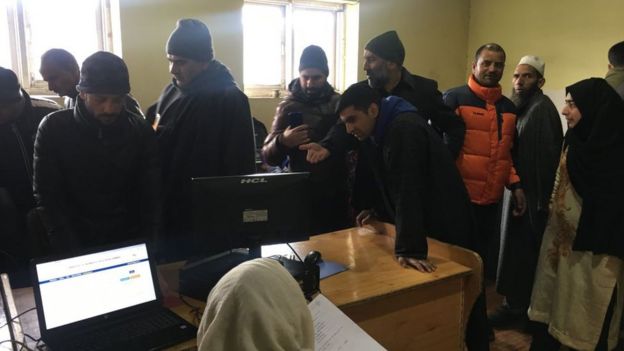
People at the Anantnag information officeImage copyright MUKHTAR ZAHOOR
Image caption Internet is available in some government offices

Yet another reporter, who also also wished to remain anonymous, says he used to earn enough to comfortably provide for his family. Now, he barely has money to buy petrol for his motorcycle.

“I have no money because I have not been able to file any story in the last six months,” a third reporter, who spoke to the BBC on the condition of anonymity, says. “My family keeps telling me to find another job. But what else can I do?”

In December, people were given limited access to the internet at a government office in Anantnag, but this hasn’t helped local journalists. The office, Mr Islam says, is always crowded and there are only four desktops for a scrum of officials, students and youngsters who want to log on to respond to emails, fill exam forms, submit job applications or even check their social media.

“We have access for only for a few minutes and the internet speed is slow,” he explains. “We are barely able to access email, forget reading the news.”

What’s more, Mr Islam says those who work at the office often ask customers to show them the contents of emails. “This makes us uncomfortable, but we don’t have a choice.”

Basheer Manzar, the editor of Kashmir ImagesImage copyright MUKHTAR ZAHOOR
Image caption Basheer Manzar runs Kashmir Images, a local newspaper

Many journalists say that they have been completely cut off from their contacts for months now, making it hard to to maintain their networks or sources.

They also speak of how humiliating it is to beg for wi-fi passwords and hotspots at the cramped media centre in Srinagar, which has less than two dozen computers for hundreds of journalists.

This has left publishers in the lurch too. “My reporters and writers are not able to file,” says Basheer Manzar, the editor of Kashmir Images.

He still publishes a print edition, he says, because if he doesn’t do so for a certain number of days in the month, he will lose the license.

But the website continues to struggle, he adds, because most of the readers in Indian-administered Kashmir have no access to the internet.

“I know what is happening in New York through news on the TV, but I don’t know what’s happening in my hometown.”

Source: The BBC

10/09/2019

Chinese police detain 100 over US$7 million ‘fortune-telling’ scam

  • Suspects rounded up after people complain of being duped into making donations to support non-existent temples
  • One woman says she handed over US$4,600 after being told that charitable gesture would help her live to be 400
One victim of the alleged scams said she was told she could live for 400 years if she handed over her money. Photo: Thepaper.cn

Police in southeast China have detained 100 people on suspicion of being part of a criminal network that cheated members of the public out of 50 million yuan (US$7 million) by preying on their superstitions and generosity.

Authorities in Ningguo, Anhui province launched an investigation in May after receiving a number of complaints about the activities of several groups posing as fortune-tellers on social media platforms like Weibo, financial news outlet Caijing reported on its website on Tuesday.

One of the groups, which operated on the Twitter-like service under the name “Kanxiang Zen Master”, was run by a local man surnamed Zhang and had 12 million followers, the report said.

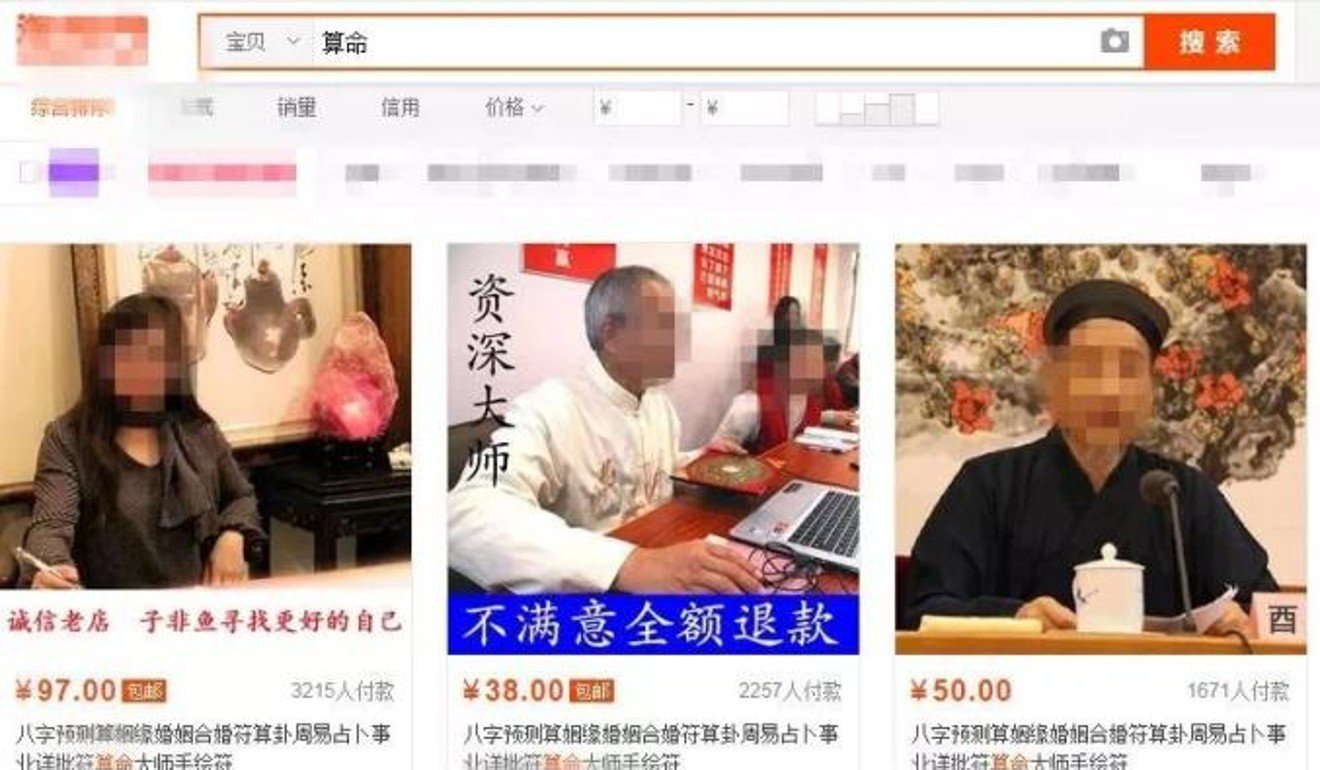
Adverts for online fortune-telling services are common in China. Photo: Thepaper.cn
In one alleged scam, members of the group were told they would receive good luck if they made a donation to support a “famous temple”. But when a man who gifted 10,000 yuan via WeChat Pay checked on the address of the recipient, he found it was a residential address in the city of Xuancheng and not a place of worship, the report said.
When police investigated, they found Zhang had links to seven criminal groups in Anhui and neighbouring Jiangsu province, which between them operated about 60 fortune-telling accounts on Weibo, several of which had more than 10 million followers. The Kanxiang Zen Master account has since been removed from the platform.
Six Chinese wanted for internet scam arrested in Vanuatu

A number of the gangs were registered as media companies and operated as semi-professional organisations with formal recruiting procedures and regular conferences to plan their fraudulent activities, the report said, adding that they had been operating for at least two years.

Police in July staged a series of raids to round up the suspects and confiscated associated equipment, including computers, vehicles and mobile phones, the report said.

Authorities in Ningguo have appealed for more victims to come forward.

A separate report by Shanghai-based news outlet Thepaper.cn said that some of the suspects also used e-commerce sites such as Taobao and the messaging service WeChat to promote their fortune-telling services.

Taobao is owned by Alibaba Group, which also owns the South China Morning Post.

In one case, a woman from the city of Changshu in Jiangsu said she made multiple payments – totalling about 33,000 yuan – to a fortune-teller she met on WeChat who said the money would be used to buy incense for use in offerings to the gods.

She said she reported the alleged fraud after starting to doubt the fortune-teller’s claims, including one that said if she made the donations she could live for up to 400 years.

Alibaba, Weibo and Tencent, which owns WeChat, have been contacted for comment.

Source: SCMP

11/04/2019

U.S., China agree to establish trade deal enforcement offices – Mnuchin

WASHINGTON (Reuters) – The United States and China have largely agreed on a mechanism to police any trade agreement they reach, including establishing new “enforcement offices,” U.S. Treasury Secretary Steven Mnuchin said on Wednesday.

Mnuchin, speaking on CNBC television, said that progress continues to be made in the talks, including a “productive” call with China’s Vice Premier Liu He on Tuesday night. The discussions would be resumed early on Thursday, Washington time, he added.

“We’ve pretty much agreed on an enforcement mechanism, we’ve agreed that both sides will establish enforcement offices that will deal with the ongoing matters,” Mnuchin said, adding that there were still important issues for the countries to address.

Mnuchin declined to comment on when or if U.S. tariffs on $250 billion worth of Chinese goods would be removed. Although President Donald Trump said recently that a deal could be ready around the end of April, Mnuchin declined to put a timeframe on the negotiations, adding that Trump was focused on getting the “right deal.”

“As soon as we’re ready and we have this done, he’s ready and willing to meet with President Xi (Jinping) and it’s important for the two leaders to meet and we’re hopeful we can do this quickly, but we’re not going to set an arbitrary deadline,” Mnuchin added.

The United States is demanding that China implement significant reforms to curb the theft of U.S. intellectual property and end forced transfers of technology from American companies to Chinese firms.

Washington also wants Beijing to curb industrial subsidies, open its markets more widely to U.S. firms and vastly increase purchases of American agricultural, energy and manufactured goods.

The Chinese commerce ministry on Thursday confirmed that senior trade negotiators from both countries discussed the remaining issues in a phone call following the last round of talks in Washington.

“In the next step, both trade teams will keep in close communication, and work at full speed via all sorts of effective channels to proceed with negotiations,” Gao Feng, the ministry’s spokesman told reporters in a regular briefing in Beijing.

Mnuchin did not address whether the enforcement structure would allow the United States a unilateral right to reimpose tariffs without retaliation if China fails to follow through on its commitments.

People familiar with the discussions have said that U.S. negotiators are seeking that right, but that China is reluctant to agree to such a concession. Alternatively, the United States may seek to keep tariffs in place, only removing them when China meets certain benchmarks in implementing its reforms.

Mnuchin said he and U.S. Trade Representative Robert Lighthizer, who is leading the negotiations, are focused on “execution” of drafting the documents in the trade agreement.
The two sides are working on broad agreements covering six areas: forced technology transfer and cyber theft, intellectual property rights, services, currency, agriculture and non-tariff barriers to trade, according to two sources familiar with the progress of the talks.
“Some of the chapters are close to finished, some of the chapters still have technical issues,” Mnuchin said.
Source: Reuters
18/03/2019

China’s crowded co-working industry turns to services amid funding crunch

HONG KONG/SHANGHAI (Reuters) – Co-working space operators in China are shifting their focus from ambitious expansion plans to services such as customising offices for clients, as rising vacancy rates and tighter financing slow their exponential growth of the past two years.

The strategy shift marks a turn of fortunes for the Chinese co-working industry, whose rapid expansion has helped operators such as Ucommune, MyDreamPlus and Kr Space raise hundreds of millions of dollars.

The combined area of co-working space in four first-tier cities in China surged by almost 60 percent between the end of 2017 and October last year, according to industry association China Real Estate Chamber of Commerce.

However, 40 percent of the co-working centres were more than half empty as of October and 40 co-working brands had shut in the first 10 months of 2018, it added.

“There’s a shake-out in the flexible office space,” said Paul Salnikow, global CEO of The Executive Centre, which entered China in 2001 and currently operates 45 premium flexible working centres in nine Chinese cities.

“Since November, we’ve seen operators in China walking away from centres, trying to give it back to the landlord. We’ve been offered furniture from some of these people, saying they’re trying to raise money.”

A common solution for firms appears to be diversification into services that require less capital investment, such as office design and management.

“Our focus this year is ‘management output’,” Mao Daqing, founder of Ucommune, one of the largest co-working space operators in China, told Reuters.

The company expected to partner with enterprise clients and open another 30 flexible working centres for them this year, providing design and management services, from 15 currently, he said. Ucommune’s own branded centres would add five to 10 more to the over 200 already in place.

U.S.-based WeWork started providing such services in China last year and also plans to grow the business.

One industry executive who declined to be identified told Reuters the asset-light model helped to shift rental costs to clients, boosting income.

LANDLORDS AT RISK

A survey of Chinese flexible working space operators by real estate consultancy CBRE in January found that around 68 percent planned to slow or halt expansion this year.

But the rise in vacancy rates and operators dropping out of the business could also spell trouble for Chinese office landlords, especially in major cities like Shanghai where co-working is more common than the rest of Asia-Pacific.“Co-working operators need to go further asset-light and slow one-off CAPEX investment to stay in operation,” said Virginia Huang, CBRE Greater China managing director of advisory and transaction services.

“What this means is landlords also share some risks of this industry, not only the operators.”

Terms of underwriting co-operating operators are also changing, with landlords bearing more costs and risks.

Stanley Ching, Citic Capital’s head of property, said operators were increasingly seeking fit-out subsidies and leasing on profit-sharing models with landlords, as they become more reluctant to pay high rents to secure space.

LaSalle Investment Management, which rents space to co-working operators in China, said picking the right operators and limiting exposure was crucial.

“They’re not recession-proof yet; they haven’t gone through a recession, we don’t know who’s going to survive or who’s not,” said Elysia Tse, LaSalle IM Asia Pacific head of research and strategy.

“So we’ll make sure our portfolio of co-working tenants is a small minority portion.”

One positive trend for co-working operators is the growth in demand from larger corporates amid China’s broader economic slowdown.

“As companies’ outlook on the economy turns conservative and they want to save office costs, they turn to co-working space which provides flexibility,” said Ucommune’s Mao.

“Our clients for office design service also increased for this reason.”

Source: Reuters

05/11/2014

India’s Services Activity Stagnates in October – India Real Time – WSJ

India’s services sector stagnated in October following five months of expansion, but industry executives remain optimistic that activity will strengthen in the coming year as the economy steadily recovers.

The seasonally-adjusted Service Sector Business Activity Index fell to 50.0 from 51.6 in September, according to a HSBC HSBA.LN -0.57% index released Wednesday. A figure above 50 indicates expansion while one below points to a contraction.

Underpinning the stagnation was weaker new business growth. Orders received by service sector firms increased at the weakest pace since May, HSBC saHSBA.LN +1.01%id.

Some sectors such as post and telecommunications showed strength, but their performance was offset by contraction in others such as the hospitality sector, HSBC added.

“On the positive side, business confidence rose to the strongest in three months, with the hospitality sector being most upbeat about the outlook,” HSBC joint head of Asian economic research Frederic Neumann said.

via India’s Services Activity Stagnates in October – India Real Time – WSJ.

Tags: , ,
03/07/2014

China services sector booms in June, suggest economy steadying | Reuters

Activity in China’s services sector expanded at its fastest pace in 15 months in June, a private survey showed on Thursday, reinforcing signs that the broader economy is stabilizing.

A worker wipes sweat on his forehead next a man taking a nap on a bench, in Beijing June 23, 2014.  REUTERS/Kim Kyung-Hoon

The services purchasing managers’ index (PMI) compiled by HSBC/Markit rebounded to 53.1 in June from 50.7 in May, well above the 50-point level that demarcates expansion in activity from contraction.

“The expansion in the service sector reinforces the recovery seen in the manufacturing sector, and signaled a broad-based improvement over the month,” said Qu Hongbin, chief economist for China at HSBC.

via China services sector booms in June, suggest economy steadying | Reuters.

06/06/2014

China’s services sector grows apace, mirroring rebound in manufacturing | South China Morning Post

China’s services sector grew at its fastest pace in six months last month as new orders rebounded, an official survey showed, reinforcing hopes that the economy may be steadying after a tumultuous few months.

3f1f9ff7c23faa0c8507e9cb507fc5a.jpg

The official non-manufacturing purchasing managers index (PMI) climbed to 55.5 from April’s 54.8, the National Bureau of Statistics said. That is well above the 50-point level that separates an expansion from a contraction in activity.

In a sign of buoyancy in the sector, new orders rebounded to an eight-month high of 52.7 from April’s 50.8. Business expectations also held their ground at a solid 60.7, compared with April’s 61.5.

The pick-up in the services PMI echoes a rebound in the factory sector, which turned in its best performance in four months last month as export orders improved, although activity still contracted, a private survey showed yesterday.

The final reading of the HSBC/Markit PMI for May rose to 49.4 from 48.1 in April, although lower than a preliminary “flash” reading of 49.7.

The final PMI was weaker than the flash reading because of an upward revision of the inventory of finished goods, HSBC said.

via China’s services sector grows apace, mirroring rebound in manufacturing | South China Morning Post.

Enhanced by Zemanta
11/09/2013

Reading Li Keqiang’s Tea Leaves at the World Economic Forum

In my opinion, this is another important article to read. It complements the Reuter’s piece: see – https://chindia-alert.org/2013/09/11/changing-china-set-to-shake-world-economy-again/


WSJ: “What’s the outlook for growth and the plans for reform of China’s economy? China Real Time planned an exclusive interview with Premier Li Keqiang to get the lowdown.

Unfortunately there wasn’t a time when both of us were free. So instead we read the transcript of Mr. Li’s question and answer session with executives at a closed door session at the World Economic Forum in Dalian, Tuesday.

Mr. Li’s remarks on everything from the role of government to the importance of financial reforms contained little in the way of new commitments. But coming ahead of a November meeting of senior Communist Party leaders – billed as the decisive moment for shifting China’s economic model – they raise expectations of concrete progress.

Here are the edited highlights of what Mr. Li said, and what we think it means.

“First, I think we need to get the relationship between government, the market and society right, that’s the key to economic reform, let the market do what the market should do, society do what society should do, and the government do what the government should do.”

A theme Mr. Li hit at his first press conference as Premier back at the National People’s Congress in March, and again here, is the need to get the roles of government and the market right. One of the main criticisms of Wen Jiabao – Mr. Li’s predecessor – was that he allowed the state to grow its role at the expense of a dynamic private sector. The hope among many economists is that Mr. Li will push back in the other direction.

“When there’s downward pressure on growth, one choice is to adjust economic policy, increase deficits, relax monetary policy. That might have a short-term benefit, but may not be beneficial for the future.”

Another criticism of Mr. Wen’s approach was that every hiccup in the economy was greeted with a credit- and investment-fueled stimulus. That helped keep growth buoyant and employment high, but also left a legacy of high debt and industrial overcapacity. Mr. Li is signaling he wants to focus on long-term reform rather than short-term stimulus.

“We will continue to liberalize interest rates… we eliminated the floor on lending interest rates. This is a step forward in the process of making interest rates market based, and we will keep moving forward.”

China’s artificially low government-set interest rates channel funds from household savers to business borrowers – contributing to lackluster consumption and overdone investment. Mr. Wen struck an early blow to liberalize interest rates toward the end of his administration by raising the ceiling on deposit rates and lowering the floor on loan rates. Mr. Li has continued in the same direction, with loan rates now set entirely by the market. The next step is further liberalization of deposit rates – good for savers but bad for banks, which would see profit margins fall.

“We will continue to open up the financial markets – to internal and external competition. For example… we are moving ahead with making the yuan convertible on the capital account.”

Mr. Li says he wants to allow a greater role for private firms in the financial system, and a more open capital account. Both would increase the efficiency of capital allocation. But some economists worry that with China’s state banks overextended from years of breakneck lending, rapid reforms could lay weakness bare and precipitate a crisis.

“We want to create a market environment of fair competition… Enterprises of different ownerships should all enjoy fair opportunities and conditions to compete in the market.”

Low productivity in state-dominated sectors of the economy is a key barrier to sustaining growth. Mr. Li stops short of any specific proposals, but the hope is that areas like telecoms, banking and logistics will be increasingly open to competition.

With an audience of foreign executives, Mr. Li also threw in a reference to protecting intellectual property, a key concern for multinationals that fear their technology and know-how will be pilfered by Chinese rivals.

“I can also tell you all, a few decades ago I was a farmer. That experience has helped me a lot as Premier. If the managers of this building have the experience of ‘cleaning the toilet,’ I believe they can better manage this complex.”

China’s domestic media have focused attention on this line, where Mr. Li nods to his experience as a farmer in the 1970s in inland Anhui province.The message is aimed partly at China’s students.  Anticipating close to 7 million university graduates nationwide this year, the government has been trying to encourage realistic expectation on employment prospects. High ambitions are good, but starting at the bottom is OK.

via Reading Li Keqiang’s Tea Leaves at the World Economic Forum – China Real Time Report – WSJ.

See also: https://chindia-alert.org/2013/08/01/china-treads-cautiously-to-rebalance-economy/

Law of Unintended Consequences

continuously updated blog about China & India

ChiaHou's Book Reviews

continuously updated blog about China & India

What's wrong with the world; and its economy

continuously updated blog about China & India