Chindia Alert: You’ll be Living in their World Very Soon
aims to alert you to the threats and opportunities that China and India present. China and India require serious attention; case of ‘hidden dragon and crouching tiger’.
Without this attention, governments, businesses and, indeed, individuals may find themselves at a great disadvantage sooner rather than later.
The POSTs (front webpages) are mainly 'cuttings' from reliable sources, updated continuously.
The PAGEs (see Tabs, above) attempt to make the information more meaningful by putting some structure to the information we have researched and assembled since 2006.
Chinese President Xi Jinping, also general secretary of the Communist Party of China Central Committee and chairman of the Central Military Commission, checks the ecological protection work of the Fenhe River in Taiyuan, capital city of north China’s Shanxi Province, May 12, 2020. (Xinhua/Li Xueren)
BEIJING, May 13 (Xinhua) — Chinese President Xi Jinping attaches great importance to ecological conservation and environmental protection. He has spoken of the issue on many occasions. The following are some highlights of his quotes.
— Lucid waters and lush mountains are invaluable assets.
— Ecological conservation and environmental protection are contemporary causes that will benefit many generations to come.
— A sound ecological environment is the basic foundation for the sustainable development of humanity and society.
— We should adhere to the integrated protection and restoration of mountains, rivers, forests, farmlands, lakes and grasslands, and coordinate efforts to strengthen ecological and environmental protection in river basins with efforts to promote an energy revolution, green production and lifestyle, and economic transformation and development.
— A good ecological environment is the fairest public product and the most accessible welfare for the people.
— The quality of the eco-environment is the key to building a moderately prosperous society in all respects.
— Economic development should not be achieved at the cost of the ecology. The ecological environment itself is the economy. Protecting the environment is developing productivity.
— We shall protect ecosystems as preciously as we protect our eyes, and cherish them as dearly as we cherish our lives.
— The history of civilizations shows that the rise or fall of a civilization is closely tied to the quality of the ecological environment.
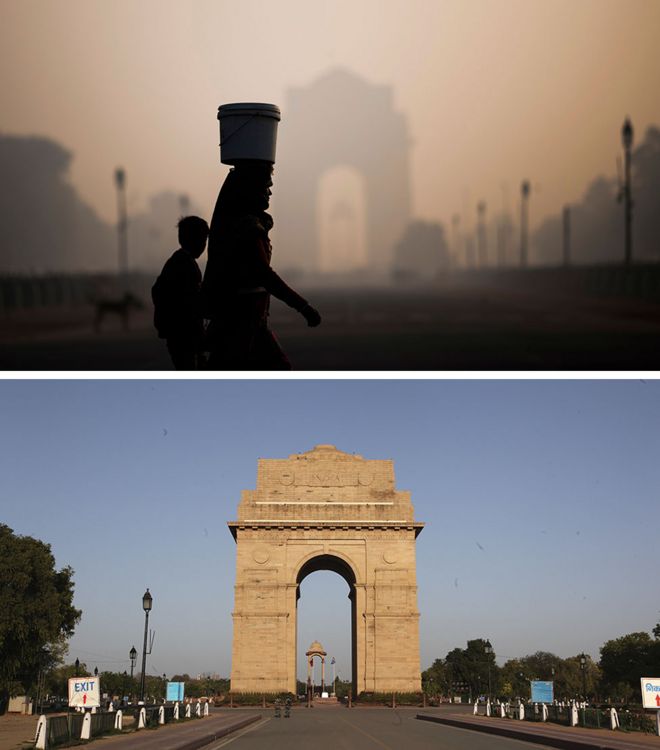
Image copyright GETTY IMAGESImage caption Delhi’sair quality has improved remarkably during the shutdown
When India shut down last month and suspended all transport to contain the spread of coronavirus, the skies over its polluted cities quickly turned an azure blue, and the air, unusually fresh.
As air pollution plummeted to levels unseen in living memory, people shared pictures of spotless skies and even Himalayan peaks from cities where the view had been obscured by fog for decades.
On one social messaging group, a resident of the capital, Delhi, which regularly records some of the foulest air in the world, celebrated the city’s “alpine weather“. Politician and author Shashi Tharoor wrote that the “blissful sight of blue skies and the joy of breathing clean air provides just the contrast to illustrate what we are doing to ourselves the rest of the time”.
Media caption India coronavirus lockdown cleans up Ganges river
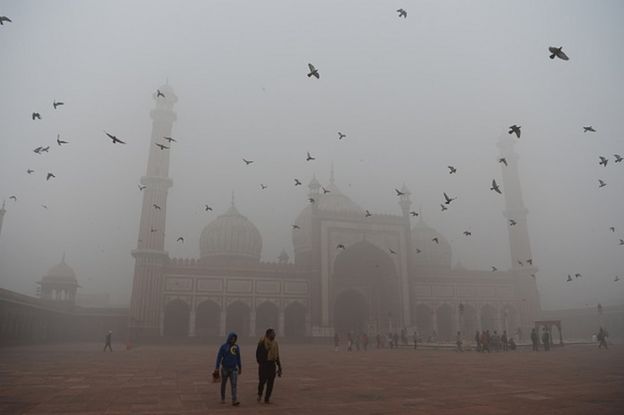
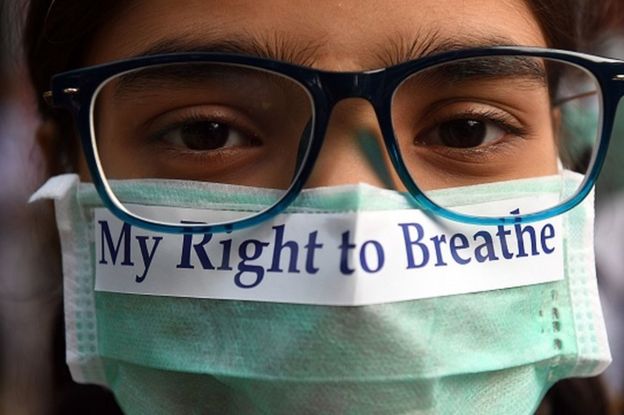
Less than six months ago, Delhi was gasping for breath. Authorities said air quality had reached “unbearable levels”. Schools were shut, flights were diverted, and people were asked to wear masks, avoid polluted areas and keep doors and windows closed.
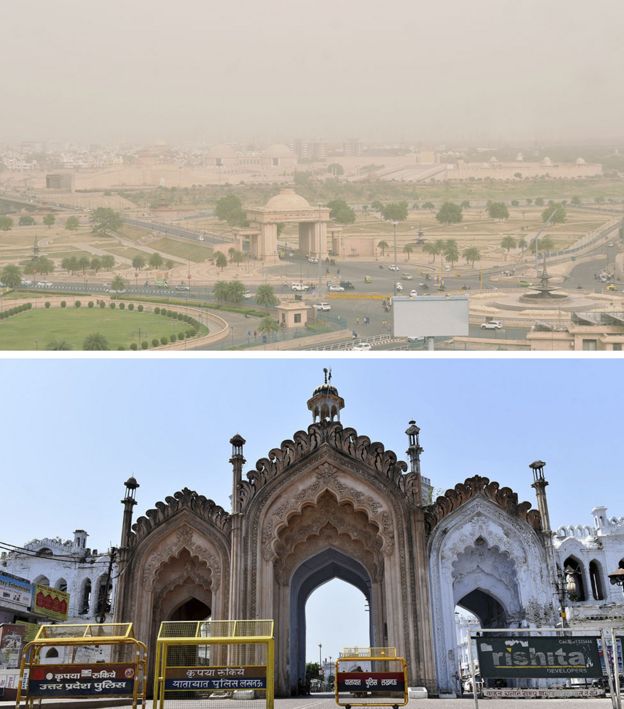
Delhi and 13 other Indian cities feature on a list of the world’s 20 most polluted. It is estimated that more than a million Indians die every year because of air pollution-related diseases. Industrial smoke, vehicular emissions, burning of trash and crop residue, and construction and road dust are the major contributors.
As urban Indians gazed at the skies and breathed clean air inside their homes, researchers hunkered down to track data on how the grinding lockdown – now extended to 3 May – was impacting air pollution across the country.
Image copyright GETTY IMAGESImage caption Lucknow is another city on the top 20 world’s most polluted list
“This was an unprecedented opportunity for us to take a close look at how air pollution levels have responded to an extraordinary development,” Sarath Guttikunda, who heads Urban Emissions, an independent research group that provides air quality forecasts, told me.
Dr Guttikunda and his team of researchers looked at the data spewed out by the 100-odd air quality monitoring stations all over India. They decided to concentrate on the capital Delhi and its suburbs – a massive sprawl called the National Capital region, where more than 20 million people live. Last winter, air pollution here had reached more than 20 times the World Health Organization’s safe limit.
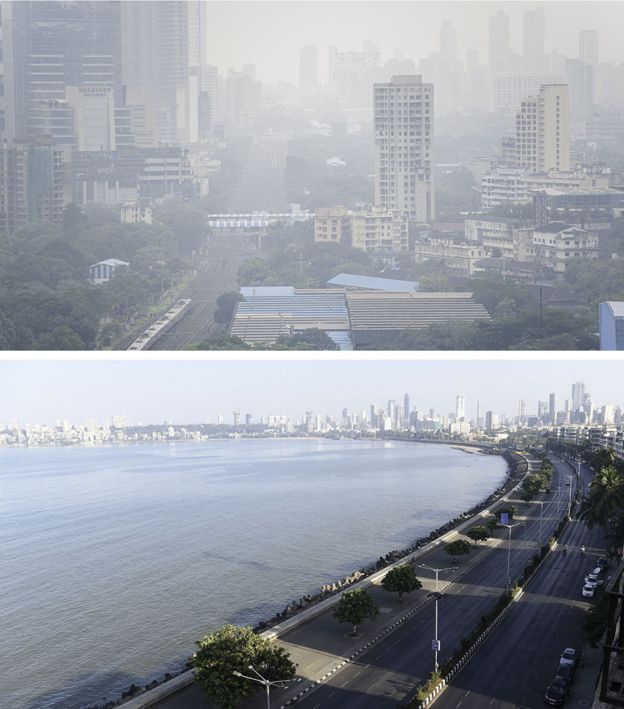
Image copyright HINDUSTAN TIMESImage caption The financial capital Mumbai also seems very different
The deadliest particle in Delhi’s foul air is the tiny but deadly PM 2.5, which increases the likelihood of respiratory and cardiovascular diseases. They primarily come from combustion – fires, automobiles and power plants.
Urban Emissions found the levels of PM 2.5 in Delhi during the lockdown plummeted to 20 micrograms per cubic metre with a 20-day average of 35.
To put this into context, between 2017 and 2019, the monthly average of PM 2.5 in the capital was up to four times higher. (The national standard is set at 40, and the WHO has an annual average guideline of just 10 micrograms per cubic metre.)
“If 35 is the average lowest available PM2.5 with limited local emissions, it means that at least 70% of the pollution is locally generated,” Mr Guttikunda told me.
Media caption India coronavirus lockdown cleans up Ganges river
His study also found a marked dip in PM 10, caused mainly by road and construction dust, and nitrogen dioxide, which comes mainly from vehicular emissions, and nearly 90% of vehicles are off the road.
“The current crisis has shown us that clear skies and breathable air can be achieved very fast if concrete action is taken to reduce burning of fossil fuels,” says Sunil Dahiya, of the Centre for Research on Energy and Clean Air, which has also been tracking air pollution levels during the lockdown.
But will this prompt change? After all, urban Indians’ and the media’s panic and outrage during the deadly winter pollution every year soon gets lost in the fog of summer heat and concerns over monsoon rains and droughts.
“We don’t yet have a democratic demand for clean air,” Arunabha Ghosh, Chief Executive Officer of the Council on Energy, Environment and Water, a leading climate think tank, told me. Orders to clean up the air have almost always come from the courts, responding to pleas by NGOs.
Image copyright GETTY IMAGESImage caption Pollution in Delhi peaks during winter
However, Dr Ghosh still hopes that “the experience of blue skies and fresh air could be a trigger to create a democratic demand for clean air in India”.
Crises often trigger life changing reforms. A fatal four-day “pea-souper” that engulfed London in 1952 and killed thousands provoked the passing of the Clean Air Act to reduce the use of smoky fuels.
China tried to clean up its air several times before hosting marquee international events – like the Beijing Olympics in 2008, the World Expo in Shanghai and the Guangzhou Asian Games in 2010 – before sliding back to grey, smoky skies.
But many believe the 2014 Apec meeting in Beijing, when China hosted 21 heads of Asia-Pacific economies, was a turning point. The rare blue skies over Beijing spawned the phrase ‘Apec blue‘. In a rush to clean its air, China introduced a set of far-reaching measures. Over the next four years, this resulted in a 32% drop in average pollution across major Chinese cities.
So could a lockdown to prevent the spread of a pandemic, which has imperilled the health and livelihoods of millions, trigger similar policy changes to clean up India’s air?
Image copyright GETTY IMAGESImage caption The movement for clean air has been sporadic and mainly pushed by NGOs
Could it move to a shift in reducing traffic on the road by asking people to work from home in shifts now that millions have experienced clean air for the first time in years? (Facing energy shortages after the loss of the Fukushima nuclear power plant, Japan unleashed a Cool Biz campaign to cut down air conditioning in workplaces and reduce carbon emissions by asking office workers to shed their suits.)
Or can India use some of the money from an inevitable stimulus to help kick-start the economy go towards helping green industries? Renewables, experts say, creates more jobs than coal: India has already created nearly 100,000 jobs in solar and wind energy firms.
Can the country use the windfall revenues accruing from the steep decline in oil prices – most of India’s oil is imported – to provide rebates to polluting factories to set up much-needed emission control equipment?
“We have to learn lessons to deploy the economic recovery from the pandemic. We need growth, jobs and sustainable development,” says Dr Ghosh. Cleaning up the air could be the key. For too long, India – and Indians – have ignored their right to breathe easy.
What’s more, if China can reduce air pollution by 32% in four-and-a-half years, why can’t India pledge to reduce pollution by 80% in 80 cities by 2027, which is our 80th anniversary of Independence? asks Dr Ghosh.
Both individuals and businesses need to play their part in lowering carbon emissions, and increasing the city’s proportion of clean energy seems inevitable
With two-thirds of Hong Kong’s carbon emissions coming from power generation, increasing the proportion of clean energy seems inevitable.
Switching off all air conditioning to achieve zero carbon emissions may sound a little extreme. But it underlines the challenges in fighting global warming, a common goal that involves behavioural and institutional changes from all stakeholders.
As the threats loom larger and the clock for action ticks faster, it is time we made tough choices. The options for Hong Kong have been mapped out in the public consultation on the long-term decarbonisation strategy, with the focus being drawn to importing more nuclear energy from across the border.
The idea strikes a raw nerve, not just because it touches on the issue of nuclear safety, but also resistance arising from the perceived higher reliance on the mainland. The lack of information about the actual impact on electricity tariffs also makes discussion difficult.
With two-thirds of the city’s carbon emissions coming from power generation, increasing the proportion of clean energy seems inevitable.
Currently, nuclear power from the mainland accounts for about a quarter of our energy supply. As long as safety is not an issue, there is no reason why we cannot develop on that basis, along with more use of solar and other renewable energies.
In addition to other institutional options such as phasing out polluting fuels for vehicles and introducing more incentives for green buildings, a great deal can be achieved at both individual and corporate levels.
For example, air conditioning will be just as comfortable when set at 24 degrees Celsius instead of 21. Cutting down on fashion and plastic consumption helps, as can replacing business trips by video conferencing.
How far are you willing to go to save planet from climate change?
These changes are simple and easy to do, but they go a long way in saving our planet.
To combat climate change, the Paris Agreement has set a carbon reduction target to keep the increase in the global average temperature to well below 2 degrees Celsius.
A small city like ours may seem too little to make an impact on climate change. But as a responsible global citizen and a heavily developed world city, we have a duty to help mitigate the impact.
The consultation has put the relevant issues into perspective in a timely manner. For the sake of sustainable development and the well-being of future generations, tough choices will have to be made.
BEIJING, April 26 (Xinhua) — The China-proposed Belt and Road Initiative (BRI) facilitates the compliance with the UN 2030 Agenda for Sustainable Development and the realization of the 17 Sustainable Development Goals in Latin America, said a senior official of a UN body based in Latin America.
Mario Cimoli, deputy executive secretary of the Economic Commission for Latin America and the caribbean (ECLAC), made the remarks in an interview with Xinhua.
Also as chief of the division of production, productivity and management of ECLAC, Cimoli has arrived in Beijing to participate in the second Belt and Road Forum for International Cooperation on April 25-27.
So far, 18 Latin American countries have signed the Memorandum of Understanding on jointly building the Belt and Road cooperation with China.
“The countries in Latin America view China as a fundamental actor,” he said. “The fact that 18 Latin American countries have joined the Belt and Road Initiative means that these countries think that China is necessary and China is also aware of the importance of dialogue. It’s a historical process.”
In his opinion, the BRI makes “greater integration, greater multilateralism and more dialogue” possible and “does good to Latin America.”
He said that both the 2030 Agenda and the BRI seek sustainable development and reduction of inequality and poverty, without contradicting with the proper model of each country.
“Given that the growth rates of Latin America will not be very high for the next few years, a rational process of cooperation such as the Belt and Road will surely help the region and allow each country to seek and improve their model of development and growth,” the ECLAC official said.
The BRI is a much more horizontal dialogue, a platform, in that sense that it is a process that helps and allows a much more positive coexistence despite current global tensions, he said.
In the dialogue with China, Latin America can demonstrate the importance of being an integrated area of trade, policies, and infrastructures in order to trade better with Asia, he said.
Cimoli also affirmed that the incorporation of new technologies in Latin America is a course under discussion, and dialogue with China can accelerate and improve the process.
Cimoli said his one observation of his ongoing China trip is the extensive use of electronic commerce among ordinary people.
He said when he went out to buy something, he found almost everyone use e-payments.
The way in which technologies immerge into the daily life of Chinese citizens is an example and would be a valuable contribution of China to the world and especially to Latin America, Cimoli said.
“The example of China shows the role that a state should play to trigger the technological development. In this dialogue with China, Latin America surely has to learn from the pragmatism of China,” he said.
The ECLAC official mentioned that China invests over 2 percent of its GDP in science and technology, while the average investment of Latin American countries in the field is between 0.4 and 0.5 percent of its GDP, plus, it appears to be swaying instead of stable state policies.
“There is a lot of cooperation to be done, much experience to be shared and much a platform for dialogue like the Belt and Road Initiative could do,” said Cimoli.
But Professor Qu Geping, who has overseen environmental policymaking since the early 1970s, said pollution had run wild as a result of unchecked economic growth under a “rule of men”, as opposed to the rule of law. Their rule imposed no checks on power and allowed governments to ignore environmental protection laws and regulations.
“I would not call the past 40 years’ efforts of environmental protection a total failure,” he said. “But I have to admit that governments have done far from enough to rein in the wild pursuit of economic growth … and failed to avoid some of the worst pollution scenarios we, as policymakers, had predicted.”
Qu, 83, was China’s first environmental protection administrator between 1987 and 1993. He then headed the National People’s Congress environment and resource committee for 10 years.
After three decades of worsening industrial pollution resulting from rapid urbanisation and industrialisation, China has accumulated huge environmental debts that will have to be paid back, Qu said.
He said recently he regretted that some of the very forward-looking strategies – emphasising a more balanced and co-ordinated approach to development and conservation, that were worked out as early as 1983 – were never put into serious practice when China was still at an early stage of industrialisation.
In 1970, premier Zhou Enlai had invited a Japanese journalist to give a lecture to senior government officials on the lessons Japan had learned from a series of heavy metal pollution scandals that killed several hundred people during a period of rapid industrialisation in the 1950s and 1960s, Qu said.
“But looking back, China fell into the same trap again,” he said. “In some cases, the problems are even worse now given the country’s huge population and the vast scale of its economy.”
We sincerely hope that the author is right and that the Chinese authorities both agree with him and decide to implement his suggestions – soon!
NY Times: “CHINA is experiencing its most severe economic downturn in decades, and revitalizing its economic model is critical to future prosperity — not only in China, but around the world.
Central to that effort is the transformation of China’s cities. By adopting a new approach to urbanization, its leaders can assure more balanced investment, address a major source of debt, achieve a consumption windfall and clean up the country’s environment. Otherwise, China’s economic and environmental problems will worsen, with vast implications for the rest of the world.
China’s success has been built on two pillars: investment and exports. But after decades of growth, this model is delivering diminishing returns. There is little doubt that China must change to a new model, one that relies on consumption to generate growth, while addressing debt and broadening the use of sustainable energy and environmental practices.
Cities, home to hundreds of millions of Chinese consumers, lie at the core of this problem — and offer a potential solution.
A flawed system of municipal finance is driving debt, corruption and dissent, while unsustainable urban planning has yielded polluted cities that are destroying China’s ecosystem. Yet China’s future requires continued urbanization, which, absent a new approach, will only make the problem worse.
Cities can, however, be part of the solution: better urban policies can put China on a healthier path forward, economically and environmentally.
For one thing, municipal financial reform is essential because debt is crushing Chinese cities, leaving mayors with no means of financing the central government’s policy mandates. Mayors have developed creative ways to raise revenues, including appropriating farmers’ land and seizing land on the outskirts of cities to sell to developers. But these practices contribute to urban sprawl and often feed corruption.
Among other changes, China’s cities need transparent budgets and the devolution of more tax authority to cities.
More innovative urban planning and design are also needed. To achieve the country’s goals of raising living standards for a broader share of the population, cities must be better designed to yield energy efficiency and environmental sustainability.
China’s potential is stifled by traffic and pollution. Gazing out my hotel window in Beijing on a recent trip, I saw air that was hazy and polluted — a stark contrast to the sparkling view of Lake Michigan I enjoy from my kitchen window at home in Chicago.
This isn’t just China’s problem. Experts found that dirty air from China contributed up to 20 percent of the ground-level pollution on the American West Coast in 2010. And that is when just one-tenth of Chinese own cars. Imagine what China’s air quality will become when this number triples, as some experts predict it will within the next several years.
Take another example: construction. Within city centers are countless “superblocks” — half-kilometer-square developments interspersed with huge boulevards that create monster traffic jams and skyrocketing pollution.
In response, an approach that featured smaller blocks and mixed-use neighborhoods and accessible public transportation would alleviate these unintended consequences. Such “livable cities” would balance economic development with energy efficiency, improve air quality and reduce congestion.
Getting China’s urbanization right will matter to us all. Fortunately, many in China understand this, and cooperation with the United States government, corporate world and nonprofit sector, including my own research and advocacy institute, is bringing them the tools they need to prioritize design issues in their cities and adapt infrastructure plans now. These tools include instruction in sustainable practices for government leaders, public education in environmental issues and specialized training for the country’s urban planners.
China must adopt this new approach quickly, before vast infrastructure investment makes the current model irreversible. By 2025, China is projected to have a staggering 200 cities with populations over one million. America has just nine.
Global prosperity depends on China’s continuing to be an engine of growth. We all need China to reinvent its economic model. Working together on urbanization creates progress toward joint solutions to the challenges the world faces from overwhelming pressure on natural ecosystems, resources and commodities.
We need Chinese cities to succeed, and we can help ensure that they do so.”
As Western organisations know, “what you don’t measure you cannot manage” and “incentives matter”. So China’s local authorities are beginning to realise, as evidenced at Linfen. Assuming this notion is being espoused across China, then it is very good news indeed for the environment.
China Daily: “Fan Lifen clearly recalls the days when her hometown was shrouded in darkness, with the sun barely visible through a thick curtain of smog.
“The situation would worsen in the winter, when households would burn coal for heating,” recalls Fan, a native of the city of Linfen in North China’s Shanxi province.
Rapid industrialization and urbanization in the past two decades have saddled cities like Linfen with heavy environmental burdens, damaging the health of local residents and fueling complaints.
However, Linfen is making efforts to turn its situation around.
“The air in Linfen has improved tremendously,” said Liu Dashan, spokesman for the Shanxi Provincial Environmental Protection Bureau.
The dramatic turnaround started when Linfen was listed as the “most polluted” among 113 major Chinese cities for three consecutive years from 2003 to 2005.
The local government has since launched a cleanup campaign, closing 1,056 factories and imposing stricter environmental standards on those that are still operating, according to Mayor Yue Puyu.
Substandard mines have been shut down and smaller ones have been merged into competitive mining conglomerates, Yue said.
Residents have been weaned off of coal burning, with natural gas heating introduced to more than 85 percent of the city’s households, said Yang Zhaofen, director of the city’s environmental protection bureau.
The changes were made possible by changing the way the performance of local officials is evaluated, with promotions and other rewards linked to their efforts to improve the city’s environment.
Officials have not only closed down heavily polluting factories, but also taken action to add “green” features to the city. A large park was opened on the banks of the Fenhe River last year, helping to absorb pollutants and purify the air.
Over the years, China’s economic growth has been fueled by over exploitation of natural resources, resulting in environment degradation. A worsening environment has prompted the government to exert greater efforts on environmental protection, replacing the practice of achieving growth at all costs.
President Hu Jintao said in a speech delivered to the 18th Communist Party of China (CPC) National Congress on Thursday that China should “give high priority to making ecological progress” and “work hard to build a beautiful country and achieve lasting and sustainable development.”
Linfen is a part of Shanxi’s efforts to repair its environment. The province, which provides over 70 percent of China’s coal, is slowly turning toward sustainable development.
More than 3,000 mines have been shut down since reforms were initiated in 2008, according to Wang Hongying, chief of the institute of macroeconomics under the provincial development and reform commission.
In addition to consolidating coal mines, the province has also made changes to the coal tax and fostered substitute industries, Wang said.
“We have set an example for other provinces. Although difficulties may emerge in the future, reforms will continue and we have high hopes for them,” Wang said.”
China knows it is a major emitter of green gases and polluter. But it is also at the forefront of trying to minimize the effects without slowing down economic development. One example is Dezhou, a city not very far from Beijing.
“Ask any six-year-old in a Chinese street, ‘What’s a solar water heater and what’s it for?’ Without hesitation they will tell you: ‘A solar water heater is on the roof of a building to make hot water for the shower’. This story is told by Hongzhi Cheng, vice secretary-general of the Beijing-based Chinese Solar Thermal Industry Federation (CSTIF) and head of The Sun’s Vision, a company based in the city of Dezhou in Shandong province.
Dezhou, one hour by car south of Beijing, has become one of China’s solar towns due to the presence of Himin Solar, one of the country’s largest solar water heater manufacturers. For a German visitor with an interest in solar thermal technology, driving in the city provides an exciting tour past scores of roof and facade installations.
From Retrofits to Central Systems
Dezhou is also a great city to see how the solar thermal industry is developing from retrofitted systems for individual households towards large-scale rooftop solar fields serving entire buildings.
…
Building-integrated Systems Take Off
The third generation of solar thermal technology in China consists of building-integrated systems. Himin Solar is blazing a trail with several demonstration projects in Dezhou’s ‘Solar Valley’.
…
Pressurised Balcony Systems
Each flat at these new developments also includes a vacuum tube collector installed in the facade and a 300-litre tank on the balcony to supply hot water. These solar systems represent a totally new generation of residential solar water usage in China. They are pressurised, indirect systems with u-pipe collectors, and a closed-loop solar circuit filled with glycol. If the facade collector fails to reach 60°C, the electric element in the tank compensates. Solar domestic hot water is therefore separate from the buildings’ central heating and cooling system.
…
Sales Double for Balcony Systems
Balcony systems are popular for multi-family buildings that lack roof space for a solar unit for each apartment. ‘We produced 60,000 tanks for balcony systems last year and we expect a doubling this year,’ says Jie Xu, Linuo Paradigma’s production manager.
…
China’s tall buildings seem to have no upper limit for solar thermal installations. The industry aims high and still has huge growth potential, says Hongzhi Cheng. ‘Only 30% of the market demand is fulfilled yet in the rural area. We expect the rural segment to grow [from around RMB100 billion ($15 billion) today] to RMB600 million.’ But he predicts even stronger growth of thousands of billions of renminbi for the large-scale solar thermal sector. European visitors will then be astonished by even more solar thermal installations on Chinese skylines.”
China Daily: “China has set a target of producing and selling 500,000 energy-efficient and alternative-energy vehicles a year by 2015, and five million vehicles by 2020.
The blueprint, announced by the State Council on Monday, has outlined generous subsidies to consumers and producers of the new generation of greener vehicles, as it aims to ease the country’s heavy dependence on imported oil, cut emissions, and speed up the restructuring of its automobile sector into a more environmentally sustainable model.
According to the details, there will be heavy government investment in the core technology needed to build a strong and globally competitive new-energy vehicle industry.
The world’s largest auto market has set an accumulated production and sales target of 500,000 units of pure electric and plug-in hybrid vehicles by 2015, and that will be increased tenfold to more than 5 million units by 2020.”
IT Decisions: “Professor Stéphane Garelli of IMD Business School and the University of Lausanne delivered one of the opening keynotes, describing the future of the world economy. One of the key points he made related to consumers in emerging economies creating ‘needs’ from what were previously ‘wants’.
“In China, everybody is buying a fridge. How many times have you bought a fridge? Once you have one then it lasts a long time before you replace it. You are living in a replacement economy where you are just upgrading what you already have. In China, you have no fridge, you want one. You have no TV set, you want one. You have no telephone, you want one…” he said.
The idea that enormous tranches of humanity are about to start consuming items they have never used before, such as cars, washing machines, fridges, and air conditioning, is a scary thought for environmental campaigners. Economic growth benefits those who are lifted from poverty, but how can the world really cope with billions of new drivers all expecting their own car?
Professor Garelli said: “The problem for the environment is that the infrastructure is not following [consumption]. For example in China, in 2020 they will buy 30m cars and only 15m will be sold in the USA. So everybody wants a car, but there are not enough roads for all of them. You need growth, you need traffic control, etc – the infrastructure has to grow in parallel.”
Professor Garelli went on to explain: “This means there is an enormous environmental impact and I think that this growth has to be checked. At a certain stage they will have to slow down some access. There are some countries where people can perhaps wait for a car – can you imagine if every single person in Mumbai has a car?” … “








 CHINDIA ALERT: You'll be living in their world, very soon