22/04/2020
SEOUL/BEIJING (Reuters) – China has allowed 200 employees from South Korea’s Samsung Electronics Co Ltd (005930.KS) to enter the country to work on an expansion of the firm’s NAND memory chip factory, the company said on Wednesday.
The move came after China said on Tuesday that it was in talks with some countries to establish fast-track procedures to allow travel by business and technical personnel to ensure the smooth operation of global supply chains.
China said it has reached a consensus on such an arrangement with South Korea, without elaborating on the terms, including whether individuals entering China will be subject to quarantine.
China, where the virus first emerged late last year, blocked entry last month for nearly all foreigners in an effort to curb risks of coronavirus infections posed by travellers from overseas. After bringing the local spread under control with tough containment measures, it is trying to restart its economic engines after weeks of near paralysis.
A chartered China Air Ltd (601111.SS) plane flew in the Samsung Electronics employees on Wednesday, a company spokeswoman said.
Samsung said its employees will follow the local government’s policy upon arrival, without elaborating.
Shaanxi province, where Samsung’s NAND memory chip plant is located, requires people travelling from overseas to undergo a 14-day quarantine, according to South Korea’s foreign ministry.
“Samsung employees will not be exempted from the 14-day quarantine rule imposed by the Shaanxi province. They will get coronavirus tests at the airport upon arrival and will be transported to a local hotel designated by Chinese authorities,” an official at the Consulate General of South Korea in Xi’an told Reuters.
Samsung Electronics in December increased investment at its chip factory in China by $8 billion to boost production of NAND flash memory chips.
Source: Reuters
Posted in $8 billion, 14-day quarantine, 200, according, after, Airport, allow, allowed, allows, Arrangement, arrival, Beijing, billion, blocked, boost, bringing, Business, came, chartered, China, China Air Ltd, chinese authorities, chip factory, Company, consensus, Consulate General, containment, control, coronavirus infections, coronavirus tests, countries, Country, curb, December, designated, economic engines, effort, elaborating, emerged, employees, ensure, enter, entering, entry, establish, exempted, expansion, Factory, fast-track, firms, flash memory chips, flew, Foreign Ministry, Foreigners, from, from overseas, global supply chains, including, increased, individuals, Investment, last month, late last year, local governments, local hotel, local spread, located, measures, memory chip, move, NAND, near, nearly, Official, operation, overseas, paralysis, People, personnel, plane, Plant, policy, posed, procedures, production, quarantine, reached, requires, restart, Reuters, Risks, rule, Samsung Elec, Seoul, shaanxi province, smooth, South Korea, South Korea’s, spokeswoman, staff, subject, talks, technical, terms, tough, transported, travel, travellers, travelling, trying, Tuesday, Uncategorized, undergo, upon, Virus, Wednesday, weeks, whether, without, work, Xi'an |
Leave a Comment »
27/09/2019
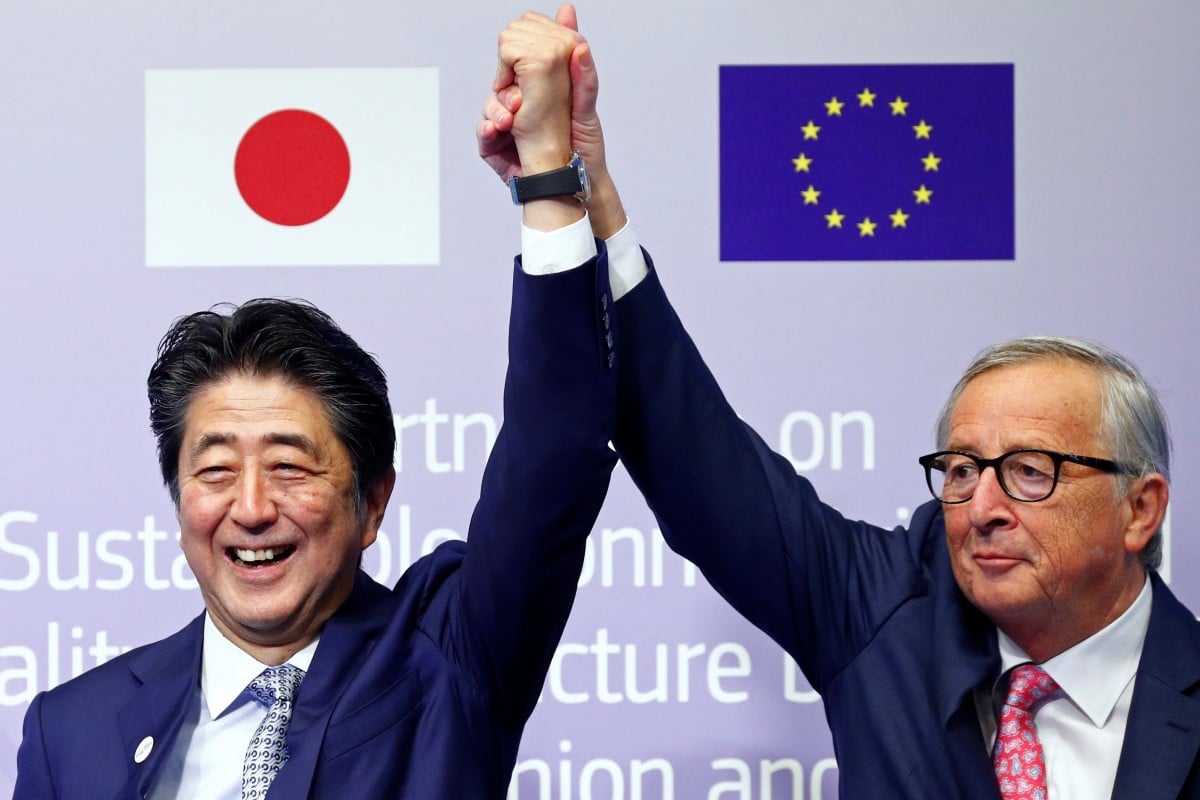
- Japan’s Prime Minister Shinzo Abe and EC President Jean-Claude Juncker mark first anniversary of EU-Asia Connectivity scheme with swipes at China
- Partners reach out to countries in Balkans and Africa and agree US$65.5 billion development plan
Japan’s Prime Minister Shinzo Abe (left) and European Commission President Jean-Claude Juncker mark the anniversary of the EU-Asia Connectivity scheme in Brussels, Belgium. Photo: Reuters
The
European Union and
Japan are stepping up their efforts to counter China’s
, with their leaders vowing to be “guardians of universal values” such as democracy, sustainability and good governance.
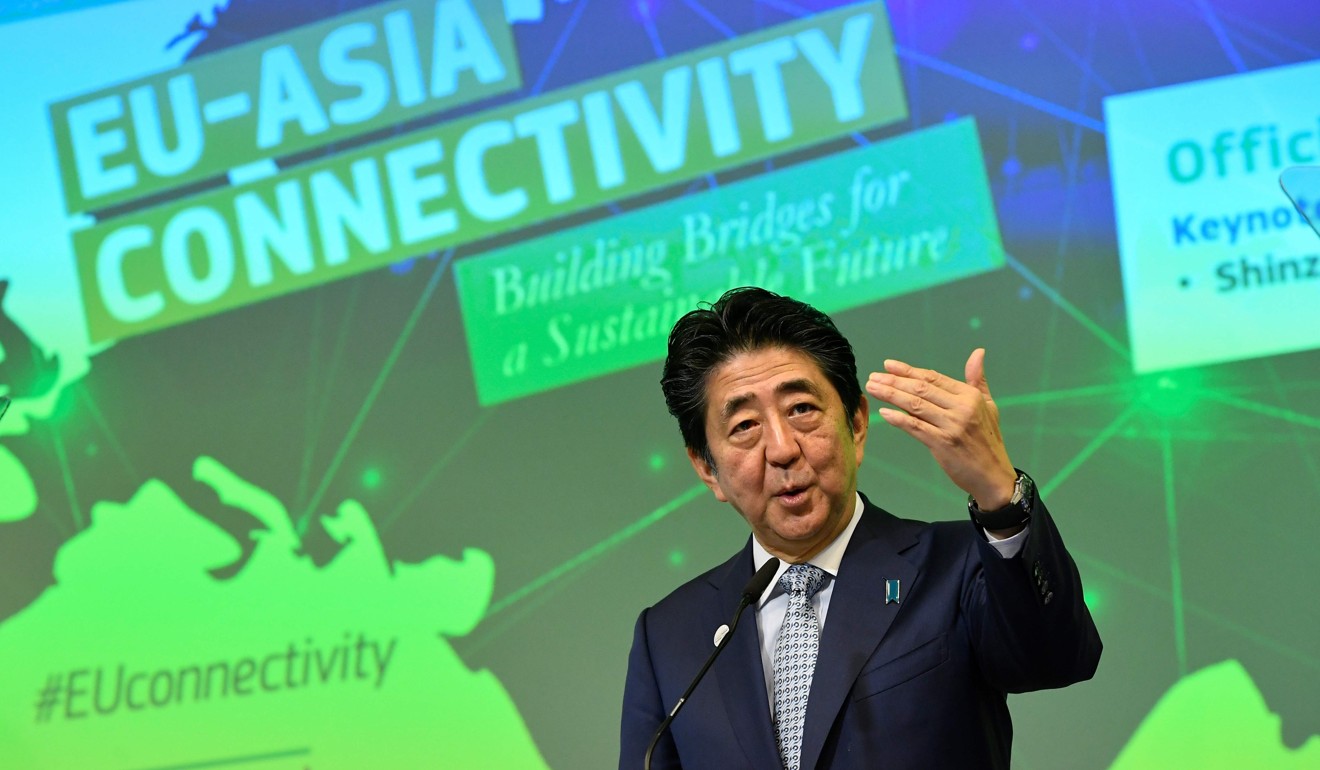
Speaking in Brussels on Friday, Japanese Prime Minister Shinzo Abe said the world’s third-biggest economy would work with the EU to strengthen their transport, energy and digital ties to Africa and the Balkans – key regions for China’s flagship trade and development project.
At a forum to mark the first anniversary of the EU-Asia Connectivity scheme, Abe and European Commission President Jean-Claude Juncker signed an agreement formalising Japan’s involvement in the Europe-Asia plan that will be backed by a €60 billion (US$65.54 billion) EU guarantee fund, development banks and private investors.
Abe said Japan would ensure that officials from 30 African countries would be trained in sovereign debt management over the next three years, a veiled attack on what Western diplomats claim is China’s debt trap for its belt and road partners.
“The EU and Japan are linked through and through,” Abe said. “The infrastructure we build from now on must be [high] quality infrastructure.
“Whether it be a single road or a single port, when the EU and Japan undertake something, we are able to build sustainable, comprehensive and rules-based connectivity, from the Indo-Pacific to the west Balkans and Africa.”
Japan wants to extend its business reach through its alliance with the EU as its economy slows and geopolitical competition from China takes its toll.
Japan indicates China is bigger threat than North Korea in latest defence review
China’s low-key delegation to the forum was led by Guo Xuejun, deputy director general of international affairs at the foreign ministry.
The US was represented by its deputy assistant secretary of state for cyber policy, Robert Strayer, who was in Europe to lobby against Chinese telecoms giant Huawei Technologies and its involvement in fifth-generation telecoms networks.
Abe and Juncker made cybersecurity the highlight of their addresses. Juncker, who will step down from the presidency by the end of October, repeated his attack on China’s trade policies without naming the country.
“Openness is reciprocal, based on high standards of transparency and good governance, especially for public procurement, and equal access to businesses while respecting intellectual property rights,” he said.
Prime Minister Shinzo Abe says Japan will train officials from 30 African countries in sovereign debt management in three years. Photo: AFP
European policymakers and businesses have for years complained about China’s refusal to allow foreign companies in without a Chinese joint venture partner, a practice that critics claimed involved forced transfer of intellectual property to the Chinese side.
“One of the keys to successful connectivity is to respect basic rules and common sense,” Juncker said, stressing that EU-Japanese cooperation focused on the “same commitment to democracy, rule of law, freedom and human dignity”.
European businesses urge EU to take ‘defensive’ measures against China’s state-owned enterprises
When the commission proposed improved transport, energy and digital infrastructure links with Asia last year, it denied it was seeking to stymie Chinese ambitions.
The EU plan, which would be backed by additional funds from the EU’s common budget from 2021, private sector loans and development banks, amounted to a response to China’s largesse in much of central Asia and south-eastern Europe, where Beijing has invested billions of dollars.
Source: SCMP
Posted in africa, African countries, Beijing, Belgium, Belt and Road Initiative, Belt and Road Initiative (BRI), belt and road partners, Brussels, Central Asia, challenge, China alert, commission, cybersecurity, debt management, debt trap, Democracy, digital infrastructure, ean-Claude Juncker, EC President, effort, energy, EU, EU-Asia Connectivity scheme, Europe-Asia plan, European Union, fifth-generation telecoms networks, geopolitical competition, good governance, guardians, huawei technologies, Indo-Pacific, Intellectual property, Japan, Japanese Prime Minister Shinzo Abe, play, south-eastern Europe, state-owned enterprises (SOEs), Sustainability, Transport, Uncategorized, universal values, Western diplomats |
Leave a Comment »



 CHINDIA ALERT: You'll be living in their world, very soon