26/04/2020
SHANGHAI (Reuters) – China’s smog-prone northern province of Hebei met its air quality targets by a big margin over the winter after concerted efforts to tackle emissions, a local official said on Sunday, without mentioning coronavirus-related factory shutdowns.
Average PM2.5 concentrations over the October-March period dropped 15% from a year earlier to 61 micrograms per cubic metre, while sulphur dioxide also fell by a third, said He Litao, vice-head of the provincial environmental bureau.
Most experts have attributed the significant decline in air pollution throughout China in the first quarter to the coronavirus outbreak and tough containment measures, which saw cities and entire provinces locked down and sharply reduced traffic and industrial activity throughout the country.
With millions staying at home, concentrations of lung-damaging PM2.5 particles fell by nearly 15% in more than 300 Chinese cities in the first three months of 2020.
Shanghai saw emissions fall by nearly 20% in the first quarter, while in Wuhan, where the pandemic originated, monthly averages dropped more than a third compared to last year.
However, He of the Hebei environmental bureau attributed the local decline in pollution to the “conscientious implementation” of government decisions even in the face of unfavourable weather conditions.
According to a winter action plan published last year, 10 cities in Hebei were expected to cut lung-damaging small particles known as PM2.5 by 1%-6% compared to the previous year.
Despite the decline, average PM2.5 was still much higher than China’s official standard of 35 micrograms, and the recommended World Health Organization level of 10 micrograms.
Source: Reuters
Posted in 10, 15, 15%, 20%, 2020, 300, 35, according, action plan, air pollution, air quality, also, at home, attributed, Average, averages, “conscientious implementation”, big, China, China's, China’s, cities, compared, concentrations, concerted, conditions, containment, coronavirus outbreak, coronavirus-related, Country, cubic metre, cut, decisions, decline, dropped, earlier, efforts, emissions, entire, environmental bureau, even, expected, experts, face-of, Factory, fall, Fell, first, first quarter, from, Government, Hebei, industrial activity, known as, last year, level, local, local official, locked down, lung-damaging, March, margin, measures, mentioning, micrograms, millions, monthly, months, more than, most, nearly, northern province, October, Official, originated, over, pandemic, particles, Period, PM2.5, Pollution, previous, provinces, provincial environmental bureau, published, recommended, reduced, said, saw, Shanghai, sharply, shutdowns, significant, small, standard, staying, sulphur dioxide, Sunday, tackle, targets, third, Three, throughout, tough, traffic, Uncategorized, unfavourable, weather, which, while, winter, without, World Health Organization, Wuhan, year |
Leave a Comment »
02/12/2019
- World’s largest coal consumer shows little sign of ending its dependency even though it is also the biggest market for renewable energy sources
- UN climate summit is meeting to discuss ways to limit future warming, but hopes are fading that China will commit to further curbs on emissions
China now accounts for around 30 per cent of the world’s carbon emissions. Photo: AP
As world leaders gather in Spain to discuss how to slow the warming of the planet, the spotlight has fallen on China – the top emitter of greenhouse gases.
China burns about half the coal used globally each year. Between 2000 and 2018, its annual carbon emissions nearly tripled, and it now accounts for about 30 per cent of the world’s total.
Yet it is also the leading market for solar panels, wind turbines and electric vehicles, and it manufactures about two-thirds of solar cells installed worldwide.
“We are witnessing many contradictions in China’s energy development,” said Kevin Tu, a Beijing-based fellow with the Centre on Global Energy Policy at Columbia University. “It’s the largest coal market and the largest clean energy market in the world.”
That apparent paradox is possible because of the sheer scale of China’s energy demands.
Pollution alarm as tourism businesses contaminate home of China’s hairy crab
But as China’s economy slows to the lowest level in a quarter century – around 6 per cent growth, according to government statistics – policymakers are doubling down on support for coal and other heavy industries, the traditional backbones of China’s energy system and economy. At the same time, the country is reducing subsidies for renewable energy.
At the annual United Nations climate summit, this year in Madrid, government representatives will put the finishing touches on implementing the 2015 Paris Agreement, which set a goal to limit future warming to 1.5 to 2 degrees Celsius above pre-industrial levels.
Nations may decide for themselves how to achieve it.
China had previously committed to shifting its energy mix to 20 per cent renewables, including nuclear and hydroelectric energy.
Climate experts generally agree that the initial targets pledged in Paris will not be enough to reach the goal, and next year nations are required to articulate more ambitious targets.
Hopes that China would offer to do much more are fading.
Recent media reports and satellite images suggest that China is building or planning to complete new coal power plants with total capacity of 148 gigawatts – nearly equal to the entire coal-power capacity of the European Union within the next few years, according to an analysis by Global Energy Monitor, a San Francisco-based non-profit.
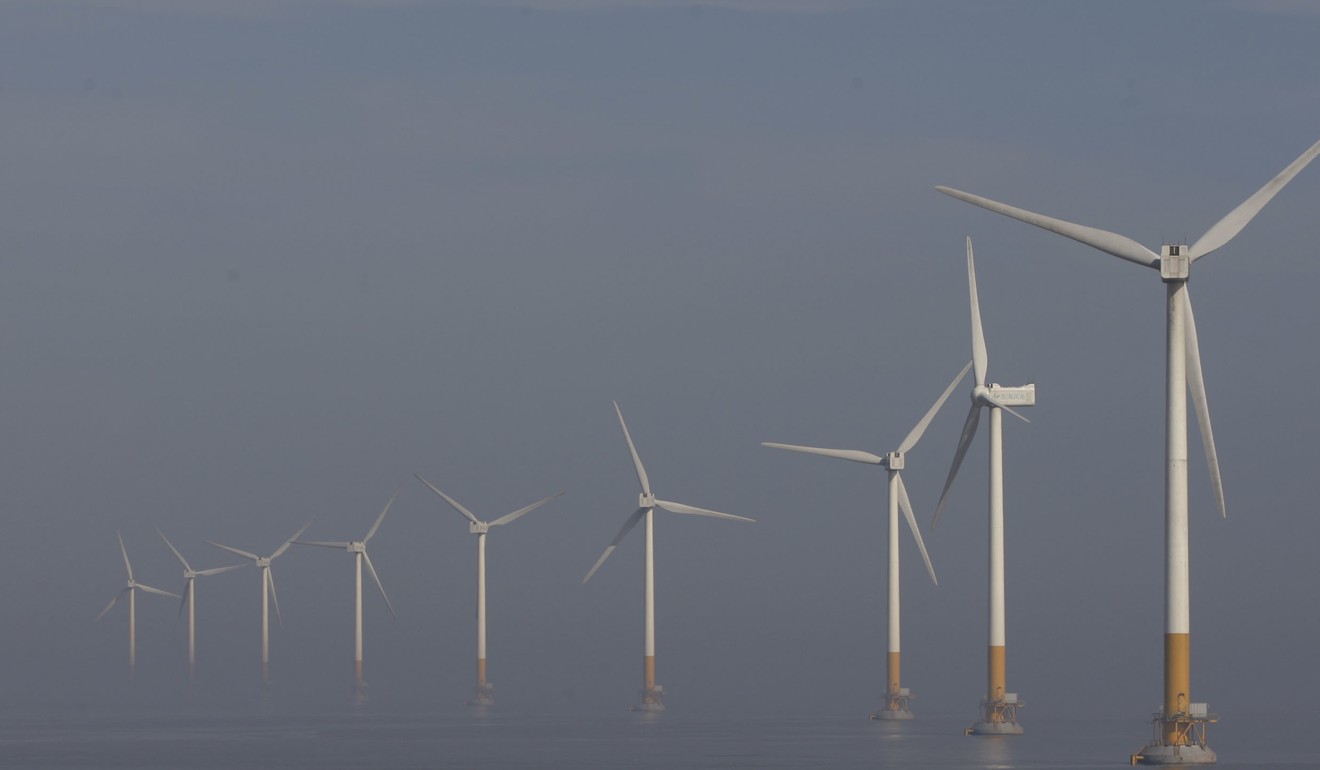
China is the world’s leading market for wind turbines and other renewables – but is still a major source of emissions. Photo: Chinatopix via AP
Meanwhile, investment in China’s renewable energy dropped almost 40 per cent in the first half of 2019 compared with the same period last year, according to Bloomberg New Energy Finance, a research organisation. The government slashed subsidies for solar energy.
Last week in Beijing, China’s vice-minister of ecology and environment told reporters that non-fossil-fuel sources already account for 14.3 per cent of the country’s energy mix. He did not indicate that China would embrace more stringent targets soon.
“We are still faced with challenges of developing our economy, improving people’s livelihood,” Zhao Yingmin said.
As a fast-growing economy, it was always inevitable that China’s energy demands would climb steeply. The only question was whether the country could power a sufficiently large portion of its economy with renewables to curb emissions growth.
Many observers took hope from a brief dip in China’s carbon emissions between 2014 and 2016. Today the country’s renewed focus on coal comes as a disappointment.
“Now there’s a sense that rather than being a leader, China is the one that is out of step,” said Lauri Myllyvirta, lead analyst at the Centre for Research on Energy and Clean Air in Helsinki.
He notes that several developed countries – including Germany, South Korea and the United States – are rapidly reducing their reliance on coal power.
After climbing sharply for two decades, China’s emissions stalled around 2013 and then declined slightly in 2015 and 2016, according to Global Carbon Budget, which tracks emissions worldwide.
This dip came as Chinese leaders declared a “war on pollution” and suspended the construction of dozens of planned coal power plants, including some in Shanxi.
Pollution scandal near China nature reserve at Tengger desert’s edge
At the same time, the government required many existing coal operators to install new equipment in chimneys to remove sulphur dioxide, nitrous oxide and other hazardous substances. About 80 per cent of coal plants now have scrubbers, said Alvin Lin, Beijing-based China climate and energy policy director for the Natural Resources Defence Council, a non-profit.
As a result, the air quality in many Chinese cities, including Beijing, improved significantly between 2013 and 2017. Residents long accustomed to wearing face masks and running home air-filter machines enjoyed a reprieve of more “blue sky days,” as low-pollution days are known in China.
In the past three years, China’s carbon emissions have begun to rise again, according to Global Carbon Budget.
The coming winter in Beijing may see a return of prolonged smog, as authorities loosen environmental controls on heavy industry – in part to compensate for other slowing sectors in the economy.
The UN Climate Change Conference is taking place in Madrid this month. Photo: AFP
Permits for new coal plants proliferated after regulatory authority was briefly devolved from Beijing to provincial governments, which see construction projects and coal operations as boosts to local economies and tax bases, said Ted Nace, executive director of Global Energy Monitor.
“It’s as though a boa constrictor swallowed a giraffe, and now we’re watching that bulge move through the system,” said Nace. In China, it takes about three years to build a coal plant.
The world has already warmed by 1 degree Celsius. All scenarios envisioned by the Intergovernmental Panel on Climate Change for holding planetary warming to around 1.5 degrees Celsius involve steep worldwide reductions in coal-power generation.
In that effort, other countries rely on Chinese manufacturing to hold down prices on solar panels. wind turbines and lithium-ion batteries.
“China has a really mixed record. On the one hand, it’s seen rapidly rising emissions over the past two decades,” said Jonas Nahm, an energy expert at Johns Hopkins University.
“On the other hand, it’s shown it’s able to innovate around manufacturing – and make new energy technologies available at scale, faster and cheaper.”
Source: SCMP
Posted in against, “blue sky days,, battle, Beijing, Bloomberg New Energy Finance, boa constrictor, boa constructor, Centre for Research on Energy and Clean Air, Centre on Global Energy Policy, China’s, coal, coal plants, Coal Power, Columbia University, Construction, demands, electric vehicles, emissions, energy, European Union, Germany, giraffe, global, Global Carbon Budget, Global Energy Monitor, global warming, greenhouse gases, heavy industry, Helsinki, Intergovernmental Panel on Climate Change, Johns Hopkins University, leading market, Madrid, Natural Resources Defence Council, new, paradox, plans, plants, Reliance, renewables, Risk, Shanxi, Solar Energy, solar panels, source, South Korea, suspended, swallowed, Tengger desert, top emitter, UN Climate Change Conference, UN climate summit, Uncategorized, undermining, United States, war on pollution, warming, wind turbines |
Leave a Comment »
21/09/2019
UNITED NATIONS, Sept. 20 (Xinhua) — United Nations Secretary-General Antonio Guterres Friday hailed China’s efforts in implementing the Paris Agreement commitments ahead of time.
“It’s good to note that because the majority (of the countries) are not on time,” he said while addressing reporters at a working luncheon on climate.
“They are ready to announce very meaningful developments in renewables and in other aspects,” he told reporters from world-renowned media outlets, including Xinhua.
“At the same time, they are already having a slowdown in increasing their coal-based electricity production,” said the secretary-general.
The secretary-general vowed that he will push as much as he can for “a very strong and committed climate action.”
However, he also said some top-rated companies are taking climate risks into account in the formulation of policies.
“If you look at the European elections one year ago, it would be essentially on migration. The last European parliament elections were much more centered on climate,” he noted while explaining the climate is becoming more of an electoral issue than in the past.
He expressed hope that “a meaningful number of countries will announce important decisions in relation to emissions and to other aspects” at the forthcoming Climate Action Summit to be held on Monday.
“The next few years are absolutely crucial to reverse the present trend. That is still a negative trend. Emissions are still growing. The situation is getting worse clearly on the ground,” said the secretary-general.
Heads of state and government, high-level representatives from member states and representatives from the private sector will attend the Climate Action Summit to tackle “the defining issue of our time.”
The Climate Action Summit will be preceded by a Youth Climate Summit on Saturday, where participants from across the globe will showcase their solutions on how to combat the crisis.
Source: Xinhua
Posted in Antonio Guterres, climate, Climate Action Summit, coal-based electricity production, combat, crisis, emissions, European elections, European parliament elections, migration, Paris Agreement, renewables, solutions, Uncategorized, United Nations Secretary-General, Youth Climate Summit |
Leave a Comment »
06/03/2019
BEIJING, March 5 (Xinhua) — Despite increasing downward pressure on its economy, China is assuring the world of its firm resolution in the pursuit of green development with concrete and self-motivated efforts.
For China, green development is a critical element of modernizing its economy. The country sticks to a new development vision that features innovative, coordinated, green and open development for the benefit of all.
It is not at the request of others, but on the country’s own initiative.
With a large population, China is facing increasing resource constraints, severe environmental pollution and a deteriorating ecosystem. People are becoming increasingly aware of environmental problems.
The country’s leadership has made it clear that China must win the battle to ensure blue skies and clean water and soil.
The battle will not be won easily.
Facing a complicated and challenging domestic and international environment of a kind rarely seen in many years, China has two options: lowering standards of environmental protection in launching new projects to stimulate growth; finding fundamental solutions to address pollution and build an ecological civilization that will benefit generations to come.
China’s choice and actions reassure those who may doubt its seriousness about green development.
When China says it “puts ecological protection first,” it is not just lip service.
This year, China will cut the energy consumption per unit of GDP by around 3 percent. Sulfur dioxide and nitrogen oxide emissions will be cut by 3 percent, and there will be a continuous decline in PM2.5 density in key areas.
The central government will allocate 25 billion yuan (3.73 billion U.S. dollars) to prevent and control air pollution, an increase of 25 percent year on year, an evidence of the advantage of China’s governance system which can “concentrate resources to accomplish major undertakings.”
China will also strengthen green and environmental protection industries, and press ahead to conserve and restore the ecosystems of mountains, rivers, lakes, forests, farmland, and grassland.
Simple, moderate, green, and low-carbon ways of life are increasingly popular in China. It has become common sense among the public that “lucid waters and lush mountains are invaluable assets themselves.”
As a matter of fact, the country’s yearning for green growth, instead of dragging down the economy, will be a boon to the economy, for China and the rest of the world.
Chinese and foreign investors are embracing a new wave of opportunities in the market for environment-related products and services, such as thermal power and steel industry upgrading, the development of sewer networks and treatment facilities and the construction of eco-friendly buildings.
China is one of the first countries to sign the Paris Agreement on climate change. China has pledged to halt the rise in carbon dioxide emissions by around 2030.
Among the essence of traditional Chinese thinking is the concept that man and nature form a community of life. Only by observing the laws of nature can mankind avoid costly blunders in its exploitation.
China has embarked on this bumpy but promising road. Marching toward an era of green development, there will be no turning back.
Source: Xinhua
Posted in Central government, China alert, eco-friendly buildings, ecosystems, emissions, energy consumption, environment-related products and services, environmental protection industries, farmland, forests, GDP, governance system, grassland, green development, green growth, lakes, man and nature form a community of life, mountains, nitrogen oxide, Paris Agreement on climate change, rivers, sewer networks and treatment facilities, Sulfur dioxide, thermal power, Uncategorized |
Leave a Comment »



 CHINDIA ALERT: You'll be living in their world, very soon