Chindia Alert: You’ll be Living in their World Very Soon
aims to alert you to the threats and opportunities that China and India present. China and India require serious attention; case of ‘hidden dragon and crouching tiger’.
Without this attention, governments, businesses and, indeed, individuals may find themselves at a great disadvantage sooner rather than later.
The POSTs (front webpages) are mainly 'cuttings' from reliable sources, updated continuously.
The PAGEs (see Tabs, above) attempt to make the information more meaningful by putting some structure to the information we have researched and assembled since 2006.
BEIJING (Reuters) – For Zhang Yu, who runs a cafe in one of Beijing’s top tourist spots, business has never been so bad.
To contain the spread of the coronavirus, bars and cafes in the Wudaoying hutong – a top Lonely Planet destination built around a narrow lane – are permitted to provide take-away services only. Non-residents must show proof they have an appointment to enter the area.
Added to which, tourism has plummeted.
“Don’t mention it! This is supposed to be the peak season,” said Zhang, who has run her cafe for five years. “But there are almost no customers as they (authorities) don’t want to have people hanging around here.”
While China’s manufacturing and retail sectors are starting to get back to work as the pace of new infections slows sharply, tourism sites in Beijing remain a shadow of their former and bustling self.
China’s capital city has maintained the highest level of emergency response to the outbreak, so tourist attractions like the Forbidden City remain closed. A 14-day quarantine for new arrivals has stifled travel.
As a result, small business owners running restaurants, souvenir shops and tourism agencies are struggling.
Only a little over 20% of tourism-related businesses in Beijing had resumed operation as of the three-day Qingming national holiday in early April, a survey by on-demand delivery service giant Meituan Dianping showed.
HANGING ON
The only people present in Wudaoying on a recent afternoon were a few elderly residents sitting outside to enjoy the spring sunshine. A cat made its way lazily through empty rooftop bars.
“We used to see more customers in one hour in pre-virus days than we see in a whole day right now,” said a worker at a sandwich restaurant in Wudaoying.
In another popular area, Khazzy, a 32-year-old doctoral student who opened a restaurant last October, has had only four customers all day.
“There are almost no tourists coming to Beijing and the remaining locals have concerns about eating out,” Khazzy said as sunset approached.
Khazzy said he has let five of his 13 staff go and has no idea how long he can stay afloat financially even though his landlord has agreed to waive one month’s rent on the property in Qianmen, near Beijing’s Tiananmen Square.
More than half of the shops in Qianmen remain closed. The manager of a state-backed noodle restaurant said most of the closed stores are privately owned small businesses that can’t secure enough business to support their daily operations.
She said revenues at the noodle restaurant have plunged more than 80%, but staff salaries have not been cut.
Zhang, the cafe owner in Wudaoying, reckoned small businesses could hold on for the next three months.
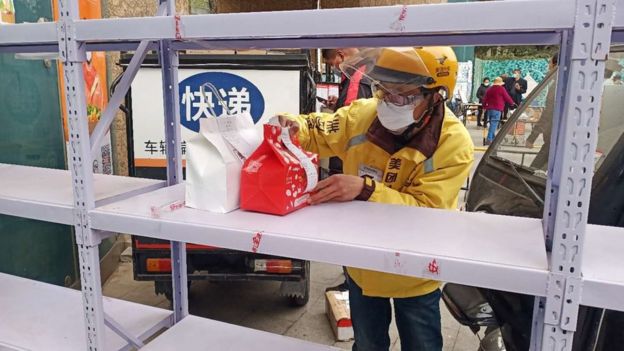
“Doctors and nurses are people who saved me from cancer and gave me strength in the darkest time. I need to return the favour,” says Li Yan, a food delivery rider based in Beijing.
Mr Li was diagnosed with lymph cancer in 2003, when he was just 17 years old. He recovered from the disease and has been full of gratitude ever since for the medical workers who nursed him back to health. With China in a national lockdown, food delivery firms found themselves in hot demand providing meals for residents stuck at home to prevent the spread of the coronavirus.
As a delivery rider for Meituan, one of China’s biggest food delivery firms, Mr Li saw an opportunity to repay the medical professionals he admires by providing them with food and drinks as they worked tirelessly on patients across the city. “Given my past experience, I felt I needed to do something for them in return during the virus outbreak,” he adds.
Beijing is a city of 21 million residents, and Mr Li covers its Tongzhou district, where there are a handful of hospitals with fever clinics, one of which is a designated hospital for Covid-19 treatment. “Many might have concerns delivering for the hospital, but I’ve chosen to deliver for them more often. I just think of the local residents and medical workers who need us. I can’t leave them being hungry. It’s not for money.”
Before the outbreak in China, he delivered more than 50 orders on an average day. But during the first ten days after the coronavirus outbreak in late January, the number of orders dropped to less than 20, as some restaurants were closed. The outbreak also coincided with the Chinese New Year period which is normally a low season.
“By mid-February when the situation was brought more under control, and people’s concerns and fears gradually began to ease, orders started to be restored. I can deliver over 40 orders a day now.”
Image copyright LI YAN
During this time, Meituan brought in a contactless delivery option which allowed food to be dropped off at designated points to avoid contact between customers and riders. “When I called customers to explain, some initially didn’t understand and wanted to cancel the order. But gradually people grew more understanding and began to welcome the contactless approach.”
Empty streets
China was in lockdown for more than two months, although restrictions are now beginning to be lifted. It will still take time before a sense of normalcy returns.
“I remember when the coronavirus first broke out, it was hazy for a few days in Beijing. Streets were empty and stores were closed. An ambulance or a delivery rider occasionally drove by. It felt like I was living in a different world.”
Mr Li says restaurants have started to re-open and people have begun coming back to work in the office since mid-February. Orders are still lower than normal but are improving.
“I miss the hustling Beijing which used to filled with traffic, the days when I could smell car exhaust when I stop at crossroads, the times when I had to walk all the way up to the 6th floor to deliver food, and even times when I was late for a delivery.”
Image copyright LI YAN
When the virus first broke out, face masks and alcohol disinfectant were the most ordered items along with supermarket groceries. “Grains, rice, cooking oil, vegetables, fruits, and solid, packaged food that lasts long. Orders often came in big sizes and transaction prices at around 200 yuan [£23; $28] to 300 yuan on one order.”
Being a food delivery rider, Mr Li feels he can not only give back to the medical community but to the city’s vulnerable too.
“I once received an order that came with a note saying the customer is a 82-year-old who lives alone and couldn’t get downstairs to pick up the food so the rider needs to enter the residential community and deliver food to the door. I had to spend some time communicating with security and finally was allowed in. The door was open when I arrived, and I put the bowl of wontons [a type of dumpling] on the table.”
Tips have increased from happy customers during the pandemic as a result. “Many more send me thank-you notes in the Meituan app and tell me to take care.”
Image copyright LI YAN
Keeping clean
Mr Li has a new routine now which involves lots of disinfecting and temperature checks. “I get my temperature checked dozens of times everyday now, before entering shopping malls, at restaurants, and returning home to the residential compound I live in. I also bring with me disinfectant sprays, a towel in my scooter and use disposable gloves when delivering to areas with reported confirmed cases.”
While he’s providing a vital service, is Mr Li worried about the risk of infection? “I did have worries when the virus spread and was at its worst time here but I feel like I’ve already been there, given what I went through in the fight against cancer.
“I’ve learnt to take things easy, look at the bright side of things and always seek strength in a dark time. As long as I take sufficient precautions, masks, gloves, disinfectants and everything, and follow advice from disease control experts, I think the possibility of getting the virus is pretty low.”
And with a seven-month pregnant wife at home, Mr Li is looking forward to happier times.
WUHAN, China (Reuters) – The growing number of imported coronavirus cases in China risked fanning a second wave of infections at a time when “domestic transmission has basically been stopped”, a spokesman for the National Health Commission said on Sunday.
“China already has an accumulated total of 693 cases entering from overseas, which means the possibility of a new round of infections remains relatively big,” Mi Feng, the spokesman, said.
In the last seven days, China has reported 313 imported cases of coronavirus but only 6 confirmed cases of domestic transmission, the commission’s data showed.
There were 45 new coronavirus cases reported in the mainland for Saturday, down from 54 on the previous day, with all but one involving travelers from overseas.
RELATED COVERAGE
China says imported virus cases raise risk of new infection wave
Most of those imported cases have involved Chinese returning home from abroad.
Airlines have been ordered to sharply cut international flights from Sunday. And restrictions on foreigners entering the country went into effect on Saturday.
Five more people died on Saturday, all of them in Wuhan, the industrial central city where the epidemic began in December. But Wuhan, the capital of Hubei province, has reported only one new case on the last 10 days.
A total of 3,300 people have now died in mainland China, with a reported 81,439 infections.
Saturday marked the fourth consecutive day that Hubei province recorded no new confirmed cases. The sole case of domestically transmitted coronavirus was recorded in Henan province, bordering Hubei.
With traffic restrictions in the province lifted, Wuhan is also gradually reopening borders and restarting some local transportation services.
“It’s much better now, there was so much panic back then. There weren’t any people on the street. Nothing. How scary the epidemic situation was,” a man, who gave his surname as Hu, told Reuters as he ventured out to buy groceries in Wuhan.
“Now, it is under control. Now, it’s great, right?”
All airports in Hubei resumed some domestic flights on Sunday, with the exception of Wuhan’s Tianhe airport, which will open to domestic flights on April 8. Flights from Hubei to Beijing remain suspended.
A train arrived in Wuhan on Saturday for the first time since the city was placed in lockdown two months ago. Greeting the train, Hubei Communist Party Secretary Ying Yong described Wuhan as “a city full of hope” and said the heroism and hard work of its people had “basically cut off transmission” of the virus.
More than 60,000 people entered Wuhan on Saturday after rail services were officially restarted, with more than 260 trains arriving or travelling through, the People’s Daily reported on Sunday.
On Sunday, streets and metro trains were still largely empty amid a cold rainy day. Flashing signs on the Wuhan Metro, which resumed operations on Saturday, said its cars would keep passenger capacity at less than 30%.
The Hubei government on Sunday said on its official WeChat account that a number of malls in Wuhan, as well as the Chu River and Han Street shopping belt, will be allowed to resume operations on March 30.
Concerns have been raised that a large number of undiagnosed asymptomatic patients could return to circulation once transport restrictions are eased.
China’s top medical adviser, Zhong Nanshan, played down that risk in comments to state broadcaster CCTV on Sunday. Zhong said asymptomatic patients were usually found by tracing the contacts of confirmed cases, which had so far shown no sign of rebounding.
With the world’s second-biggest economy expected to shrink for the first time in four decades this quarter, China is set to unleash hundreds of billions of dollars in stimulus.
The ruling Communist Party’s Politburo called on Friday for a bigger budget deficit, the issuance of more local and national bonds, and steps to guide interest rates lower, delay loan repayments, reduce supply-chain bottlenecks and boost consumption.





 CHINDIA ALERT: You'll be living in their world, very soon