Chindia Alert: You’ll be Living in their World Very Soon
aims to alert you to the threats and opportunities that China and India present. China and India require serious attention; case of ‘hidden dragon and crouching tiger’.
Without this attention, governments, businesses and, indeed, individuals may find themselves at a great disadvantage sooner rather than later.
The POSTs (front webpages) are mainly 'cuttings' from reliable sources, updated continuously.
The PAGEs (see Tabs, above) attempt to make the information more meaningful by putting some structure to the information we have researched and assembled since 2006.
Project will examine whether earthquake and changing wind speeds have affected peak’s snowcap
Survey team hoping the BeiDou satellite navigation system and other Chinese technology can help them find the answer
A Chinese team is preparing to determine the exact height of Mount Everest. Photo: AFP
China is sending a surveying and mapping team to the summit of Mount Everest this month in a bid to end the long-running debate over the precise height of the world’s tallest mountain.
The mission was announced on Wednesday at one of the mountain’s base camps in Tibet, where a team of 53 surveyors has been making technical preparations since March 2. The team will use China’s BeiDou navigation satellite system and Chinese surveying instruments for the project.
Mount Everest – known as Sagarmatha in Nepal and Qomolangma in Tibet – lies in the Himalayas on the border between China and Nepal. The two countries have long disputed whether measurements of the mountain should include its snowcap or be limited to the rock base.
Nepal suspends Everest permits over coronavirus
In 2005, a Chinese expedition assessed the peak and measured the height from both the rock base and from the top of the snowfall. The result, a rock height of 8,844.43 metres (29,017.2 feet), was declared by China to be the most accurate and precise measurement to date.
Nepal has long held that Everest’s snowcap should be included, putting the iconic peak at 8,848 metres, a height which is widely accepted. However, geologists believe the snowcap may have shrunk by several centimetres after the magnitude 8.1 earthquake in 2015. Changing wind speeds are also believed to have affected it.
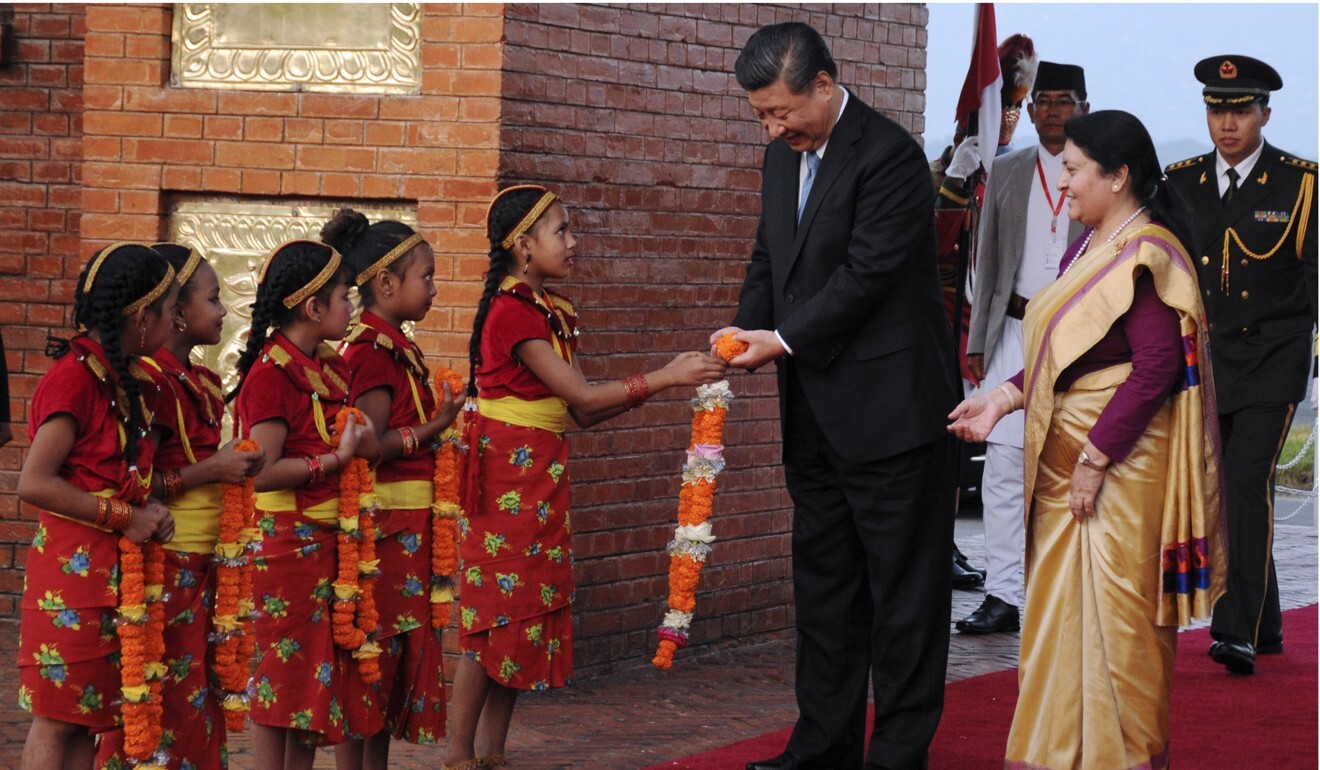
Chinese President Xi Jinping visited Nepal in October. Photo: EPA-EFE
Following a state visit to Nepal by Chinese President Xi Jinping in October, the two countries agreed to jointly launch a scientific research project to determine the exact height of Everest, recognising the peak as “an eternal symbol of the friendship between the two countries”.
China’s natural resources ministry said the project indicated a new step in the friendship and highlighted the historical significance of the mission, which coincides with the 60th anniversary of the first Chinese ascent of the mountain’s north side as well as the 45th anniversary of China’s first precise measurement of the peak.
The results of the survey will be used for geodynamics research and the precise depth of the summit’s snowcap, meteorological and wind speed data will offer first-hand materials for glacier monitoring and biological environment protection.
In a separate development, China Mobile said on Thursday that the entire peak now had 5G coverage.
In a joint project with Huawei, 5G antennas were installed at the mountain’s advance base camp, at a height of 6,500 metres. Antennas were installed earlier in April at the lower base camp, at 5,300 metres and at 5,800 metres.
City at centre of outbreak finally able to declare itself clear of disease after months in lockdown and thousands of deaths
Risk of infection remains, however, with some patients testing positive for coronavirus that causes disease without showing symptoms
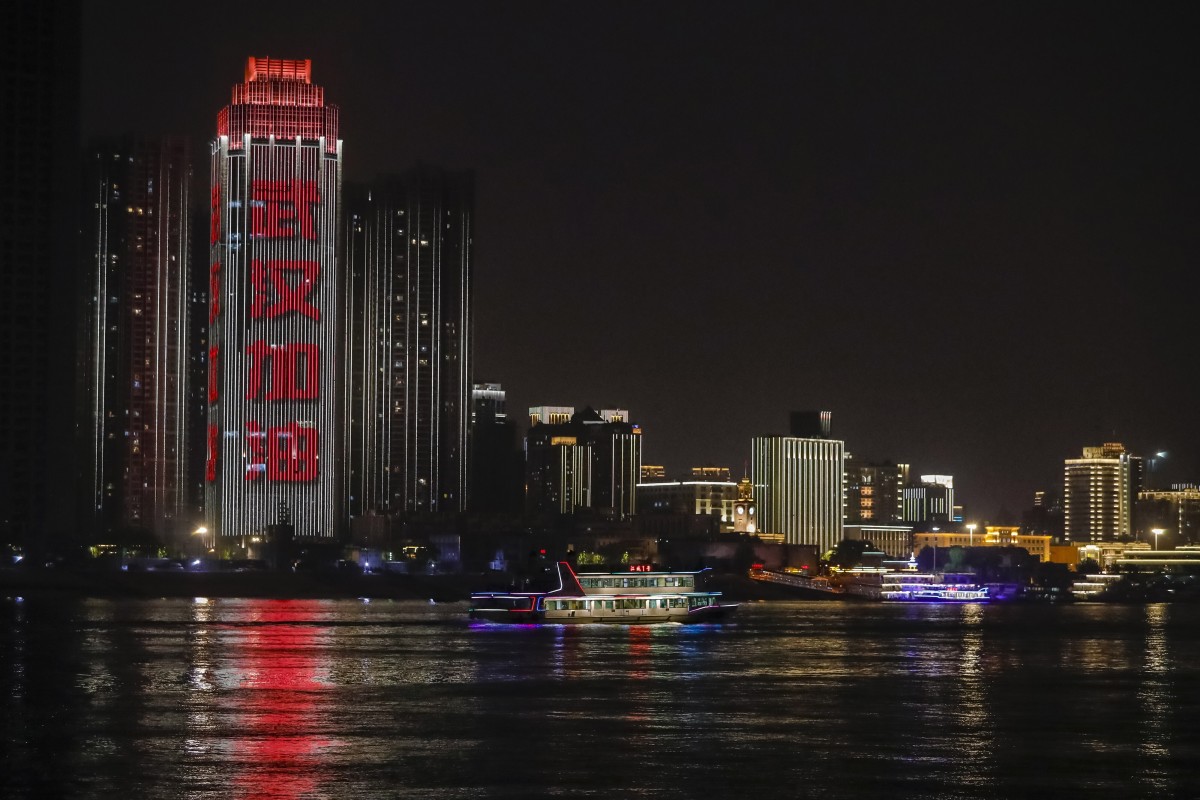
Ferries and other public transport services resumed in Wuhan last week. Photo: Xinhua
The city of Wuhan, the initial epicentre of the coronavirus pandemic, no longer has any Covid-19 patients in hospital after the last 12 were discharged on Sunday.
Their release ended a four-month nightmare for the city, where the disease was first detected in December. The number of patients being treated for Covid-19, the disease caused by a new coronavirus, peaked on February 18 at 38,020 – nearly 10,000 of whom were in severe or critical condition.
“With the joint efforts of Wuhan and the national medical aid given to Hubei province, all cases of Covid-19 in Wuhan were cleared as of April 26,” Mi Feng, a spokesman for the National Health Commission said on Sunday afternoon.
The announcement came only one day after the city discharged the last patient who had been in a severe condition. That patient also was the last severe case in Hubei province.
The last patient discharged from Wuhan Chest Hospital, a 77-year-old man surnamed Ding, twice tested negative for Sars-CoV-2, the virus that causes Covid-19, and was released at noon on Sunday.
“I missed my family so much!” Ding told Changjing Daily.
Another unidentified patient exclaimed as he left the hospital: “The air outside is so fresh! The weather is so good today!”
Wuhan faced a long journey to bring its patient count down to zero.
The city of 11 million, the capital of Hubei province and a transport hub for central China, was put under a strict lockdown on January 23 that barred anyone from entering or exiting the city without official approval for 76 days until it was officially lifted on April 8.
Coronavirus: Wuhan, Los Angeles officials discuss getting back to work after lockdown
22 Apr 2020
Residents were ordered to stay in their apartments as the city stopped public transport and banned private cars from city streets. As the epidemic worsened, more than 42,000 medical staff from across the country were sent to the city and to Hubei province to help ease the burden on the local health care system.
Wuhan was the hardest hit city in China, accounting for 50,333 of the 82,827 locally transmitted Covid-19 cases recorded in China. More than 4,600 died in the country from the disease.
On March 13, the city reported for the first time that there were no new suspected cases of the infection, and five days later there were no confirmed cases.
The number of discharged patients bottomed out at 39.1 per cent at the end of February, gradually climbing to 92.2 per cent by last Thursday.
“Having the patients in the hospital cleared on April 26 marks a major achievement for the city’s Covid-19 treatment,” the Wuhan Health Commission said in a statement.
However, having no severe cases in hospital does not mean all the discharged patients will require no further treatment as they may still need further care.
“Clearing all the severe cases marks a decisive victory for the battle to safeguard Wuhan,” health minister Ma Xiaowei told state broadcaster China Central Television on Saturday.
“Some patients who have other conditions are being treated in specialised hospitals. It has been properly arranged.”
Coronavirus: Chinese writer hit by nationalist backlash over diary about Wuhan lockdown
18 Apr 2020
Ten patients aged between 42 and 85 who have been declared coronavirus-free are still in intensive care at the city’s Tongji Hospital where they are being treated for kidney problems and other complications arising from Covid-19. Some still need ventilators to help them breathe.
These 10 patients are under 24-hour care, with 190 nurses on four-hour rotations. There are other patients in a similar condition in two other hospitals in Wuhan, according to the Hubei Broadcasting and Television Network.
However, the discharge of the last batch of Covid-19 patients does not mean that the risk of infection is gone.
The city reported 20 new cases of people testing positive for Sars-CoV-2, the official name for the coronavirus that causes the disease, but who do not yet show symptoms.
There are 535 such carriers under medical observation. Past data shows some of these asymptomatic carriers will develop symptoms, and so will be counted as Covid-19 patients under China’s diagnosis and treatment plan.
China’s coronavirus infection curve has flattened out with about 694 imported cases of Covid-19 on top of about 800 locally transmitted ones now under treatment.
The national health commission spokesman warned that people still need to be on high alert as the virus is continuing to spread around the globe, with no sign yet of a slowdown.
“[We] must not drop our guard and loosen up. [We] must discover cases in time and deal with them quickly,” Mi said, citing the continued pressure from cases imported by people returning from overseas.
“The next step will be to implement the requirements of the central government and continue to guard against imported cases and a rebound of domestic transmitted cases.”
The US invaded Afghanistan weeks after the September 2001 attacks in New York by the Afghanistan-based al-Qaeda group.
More than 2,400 US troops have been killed during the conflict. About 12,000 are still stationed in the country. President Trump has promised to put an end to the conflict.
What happened in Doha?
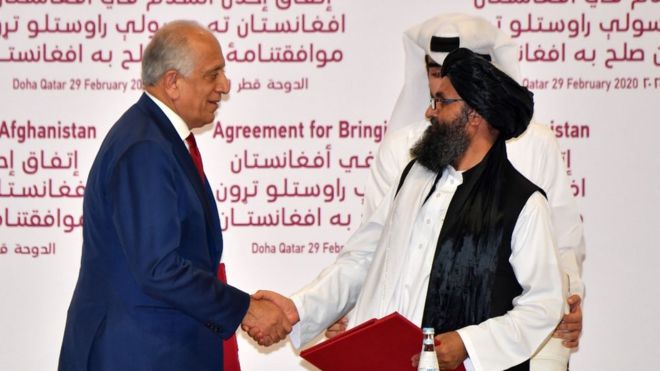
The deal was signed by US special envoy Zalmay Khalilzad and Taliban political chief Mullah Abdul Ghani Baradar with Mr Pompeo as a witness.
In a speech, Mr Pompeo urged the militant group to “keep your promises to cut ties with al-Qaeda”.
Meanwhile US Defence Secretary Mark Esper was in the Afghan capital Kabul alongside Afghanistan’s President Ashraf Ghani – whose government did not take part in the US-Taliban talks.
Mr Esper said: “This is a hopeful moment, but it is only the beginning. The road ahead will not be easy. Achieving lasting peace in Afghanistan will require patience and compromise among all parties.” He said the US would continue to support the Afghan government.
What’s in the agreement?
Within the first 135 days of the deal the US will reduce its forces in Afghanistan to 8,600, with allies also drawing down their forces proportionately.
The move would allow US President Donald Trump to show that he has brought troops home ahead of the US presidential election in November.
The deal also provides for a prisoner swap. Some 5,000 Taliban prisoners and 1,000 Afghan security force prisoners would be exchanged by 10 March, when talks between the Taliban and the Afghan government are due to start.
The US will also lift sanctions against the Taliban and work with the UN to lift its separate sanctions against the group.
Landmark deal rife with uncertainties
This historic deal has been years in the making, as all sides kept seeking advantage on the battlefield.
The agreement is born of America’s determination to bring troops home and a recognition, at least by some Taliban, that talks are the best route to return to Kabul.
It’s a significant step forward, despite deep uncertainty and scepticism over where it will lead. When the only alternative is unending war, many Afghans seem ready to take this risk for peace.
Taliban leaders say they’ve changed since their harsh rule of the 1990s still seared in the memory of many, and most of all Afghan women.
This process will test the Taliban, but also veteran Afghan leaders of the past, and a new generation which has come of age in the last two decades and is hoping against hope for a different future.
How did US-Taliban talks come about?
Since 2011, Qatar has hosted Taliban leaders who have moved there to discuss peace in Afghanistan. It has been a chequered process. A Taliban office was opened in 2013, and closed the same year amid rows over flags. Other attempts at talks stalled.
In December 2018, the militants announced they would meet US officials to try to find a “roadmap to peace”. But the hard-line Islamist group continued to refuse to hold official talks with the Afghan government, whom they dismissed as American “puppets”.
Media caption The view from Lashkar Gah province on whether peace with the Taliban is possible
Following nine rounds of US-Taliban talks in Qatar, the two sides seemed close to an agreement.
Washington’s top negotiator announced last September that the US would withdraw 5,400 troops from Afghanistan within 20 weeks as part of a deal agreed “in principle” with Taliban militants.
Days later, Mr Trump said the talks were “dead”, after the group killed a US soldier. But within weeks the two sides resumed discussions behind the scenes.
A week ago the Taliban agreed to a “reduction of violence” – although Afghan officials say at least 22 soldiers and 14 civilians have been killed in Taliban attacks over that period.
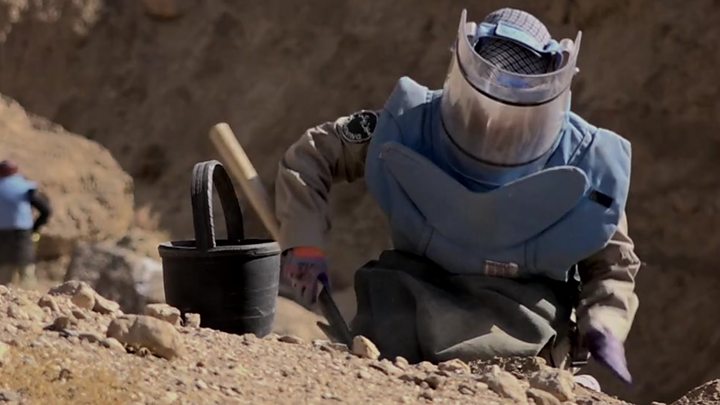
Media caption Meet Fatima and Fiza, some of the women removing landmines in Afghanistan
It began when the US launched air strikes one month following the 11 September 2001 attacks and after the Taliban had refused to hand over the man behind them, Osama bin Laden.
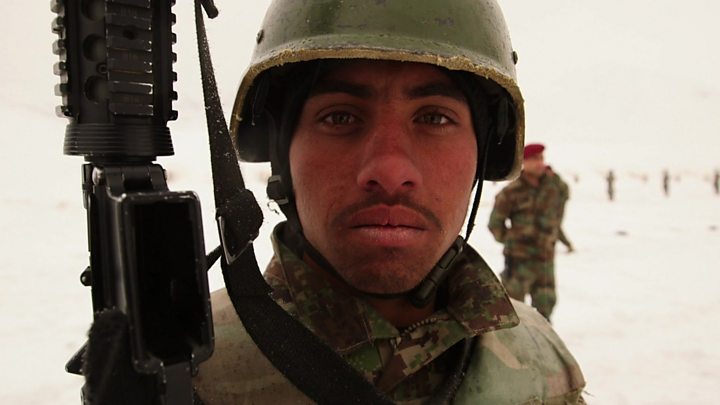
Media caption Tens of thousands of Afghan soldiers have been killed and injured. This is their story
The US was joined by an international coalition and the Taliban were quickly removed from power. However, they turned into an insurgent force and continued deadly attacks, destabilising subsequent Afghan governments.
The international coalition ended its combat mission in 2014, staying only to train Afghan forces. But the US continued its own, scaled-back combat operation, including air strikes.
The Taliban has however continued to gain momentum and last year the BBC found they were active across 70% of Afghanistan.
Media caption Zan TV presenter Ogai Wardak: “If the Taliban come, I will fight them”
Nearly 3,500 members of the international coalition forces have died in Afghanistan since the 2001 invasion.
The figures for Afghan civilians, militants and government forces are more difficult to quantify. In a February 2019 report, the UN said that more than 32,000 civilians had died. The Watson Institute at Brown University says 58,000 security personnel and 42,000 opposition combatants have been killed.
Why has the war lasted so long?
There are many reasons for this. But they include a combination of fierce Taliban resistance, the limitations of Afghan forces and governance, and other countries’ reluctance to keep their troops for longer in Afghanistan.
At times over the past 18 years, the Taliban have been on the back foot. In late 2009, US President Barack Obama announced a troop “surge” that saw the number of American soldiers in Afghanistan top 100,000.
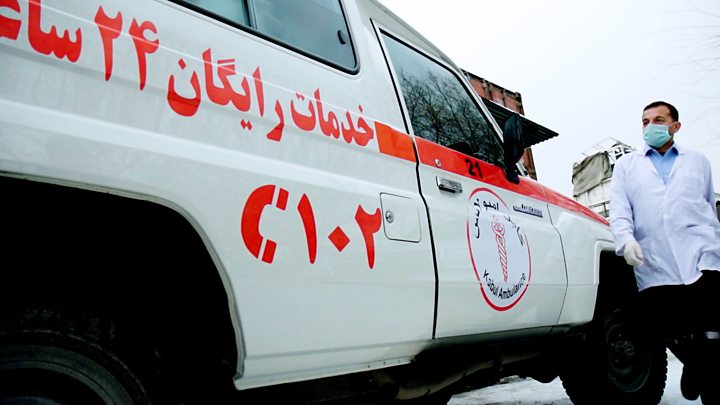
Media caption The BBC was given exclusive access to spend a week with ambulance workers in Afghanistan.
The surge helped drive the Taliban out of parts of southern Afghanistan, but it was never destined to last for years.
The BBC World Service’s Dawood Azami says there are five main reasons the war is still going on now. They include:
a lack of political clarity since the invasion began, and questions about the effectiveness of the US strategy over the past 18 years
the fact each side is trying to break what has become a stalemate – and that the Taliban have been trying maximise their leverage during peace negotiations
an increase in violence by Islamic State militants in Afghanistan – they’ve been behind some of the bloodiest attacks recently
There’s also the role played by Afghanistan’s neighbour, Pakistan.
BEIJING/SINGAPORE (Reuters) – China reported on Wednesday its smallest number of coronavirus cases since January, lending weight to a prediction by its top medical adviser for the outbreak to end by April, but a global infectious diseases expert warned of the spread elsewhere.
Financial markets took heart from the outlook of the Chinese official, epidemiologist Zhong Nanshan, who said on Tuesday the number of new cases was falling in some provinces, and forecast the epidemic would peak this month, even as the death toll in China rose to more than 1,100 people.
World stocks, which had seen rounds of sell-offs over the virus, surged to record highs on hopes of a peak in cases. The Dow industrials, S&P 500 and Nasdaq all hit new highs, and Asian shares nudged higher on Wednesday.
But the World Health Organization (WHO) has warned that the epidemic poses a global threat akin to terrorism and one expert coordinating its response said while the outbreak may be peaking at its epicentre in China, it was likely to spread elsewhere in the world, where it had just begun.
RELATED COVERAGE
Chess, squabbles aboard cruise ship cast away by coronavirus fears
Singapore’s DBS evacuates 300 staff after employee contracts coronavirus
See more stories
“It has spread to other places where it’s the beginning of the outbreak,” the official, Dale Fisher, head of the Global Outbreak Alert and Response Network coordinated by the WHO, said in an interview in Singapore.
“In Singapore, we are at the beginning of the outbreak.”
Singapore has reported 47 cases and worry about the spread is growing. Its biggest bank, DBS (DBSM.SI), evacuated 300 staff from its head office on Wednesday after a confirmed coronavirus case in the building.
Hundreds of cases have been reported in dozens of other countries and territories around the world, but only two people have died outside mainland China – one in Hong Kong and another in the Philippines.
WHO chief Tedros Adhanom Ghebreyesus said on Tuesday the world had to “wake up and consider this enemy virus as public enemy number one” and the first vaccine was 18 months away.
In China, total infections have hit 44,653, health officials said, including 2,015 new confirmed cases on Tuesday. That was the lowest daily rise in new cases since Jan. 30.
The number of deaths on the mainland rose by 97 to 1,113 by the end of Tuesday.
But doubts have been aired on social media about how reliable the figures are, after the government last week amended guidelines on the classification of cases.
‘STAY HOPEFUL’
The biggest cluster of cases outside China is aboard the Diamond Princess cruise ship quarantined off Japan’s port of Yokohama, with about 3,700 people on board. Japanese officials on Wednesday said 39 more people had tested positive for the virus, taking the total to 175.
One of the new cases was a quarantine officer.
Thailand said it was barring passengers from another cruise ship, MS Westerdam, from disembarking, the latest country to turn it away amid fears of the coronavirus, despite no confirmed infections on board.
“We try to stay hopeful,” American passenger Angela Jones told Reuters in a video recording. “But each day, that becomes a little bit more difficult, when country after country rejects us.”
Echoing the comparison with the fight against terrorism, China’s state news agency Xinhua said late on Tuesday the epidemic was a “battle that has no gunpowder smoke but must be won”.
The epidemic was a big test of China’s governance and capabilities and some officials were still “dropping the ball” in places where it was most severe, it said, adding: “This is a wake-up call.”
The government of Hubei, the central province at the outbreak’s epicentre, dismissed the provincial health commission’s Communist Party boss, state media said on Tuesday, amid mounting public anger over the crisis.
China’s censors had allowed criticism of local officials but have begun cracking down on reporting of the outbreak, issuing reprimands to tech firms that gave free rein to online speech, Chinese journalists said.
The pathogen has been named COVID-19 – CO for corona, VI for virus, D for disease and 19 for the year it emerged. It is suspected to have come from a market that illegally traded wildlife in Hubei’s capital of Wuhan in December.
The city of 11 million people remains under virtual lockdown as part of China’s unprecedented measures to seal infected regions and limit transmission routes.
Travel restrictions that have paralysed the world’s second-biggest economy have left Wuhan and other Chinese cities resembling ghost towns.
Even if the epidemic ends soon, it has taken a toll of China’s economy, with companies laying off workers and needing loans running into billions of dollars to stay afloat. Supply chains for makers of items from cars to smartphones have broken down.
ANZ Bank said China’s first-quarter growth would probably slow to 3.2% to 4.0%, down from a projection of 5.0%.
The likely slowdown in China could shave 0.1 to 0.2 percentage points off both euro zone and British growth this year, credit rating agency S&P Global estimated.
Priority carriages on underground trains have not solved the problem of sexual harassment for female passengers
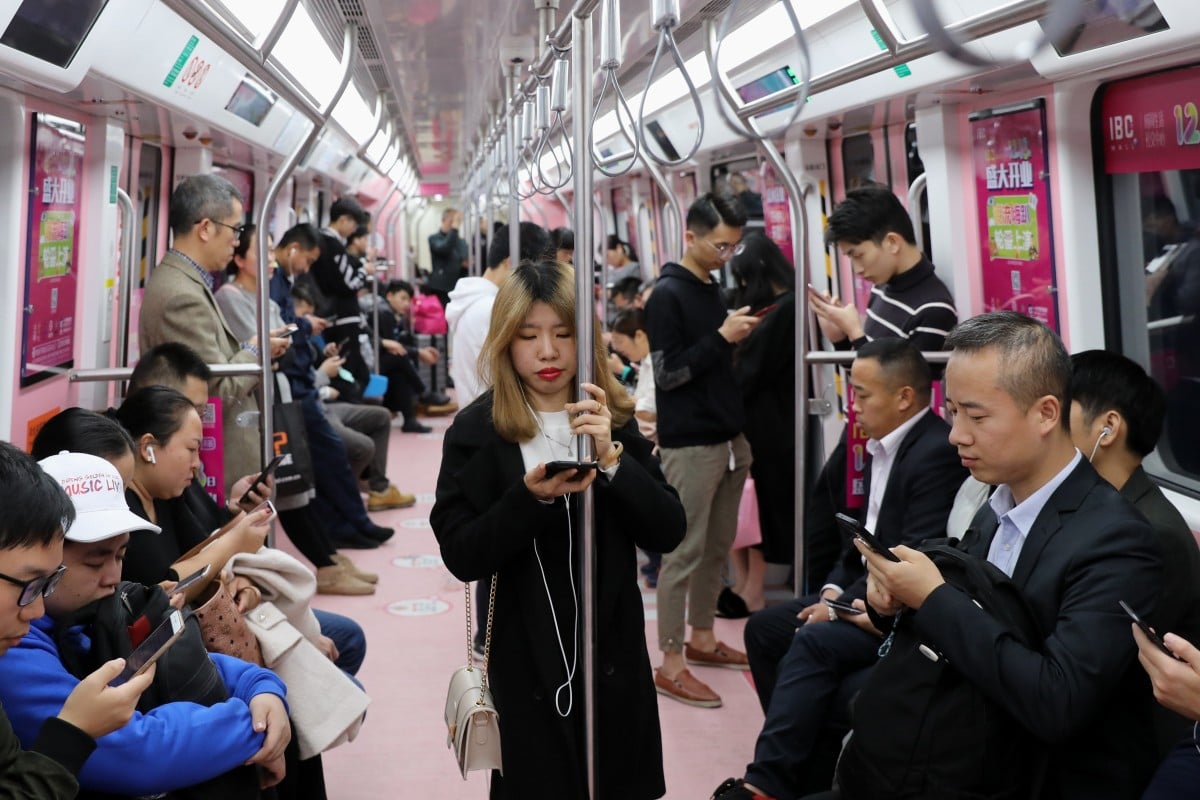
A woman is surrounded by men in a priority carriage on the Shenzhen metro. Photo: Sam Tsang
The first time Wanda was groped by a man on a Beijing bus she was a college student, travelling to school in her gym uniform on a summer’s day. Ten years – and numerous examples of sexual harassment on public transport – later, she is still haunted by the memory.
Now 31, Wanda – who asked to be identified only by her first name – remembers every detail of the incident. The bus was not crowded but the man, who appeared to be in his 40s, went straight over to stand uncomfortably close to her.
Then he pressed himself tightly against her and began making a thrusting motion with his lower body. Wanda said she froze, terrified by the encounter and unsure how to act. Just then, the bus took a sharp turn, the man was thrown aside and she quickly moved away.
“Afterwards, for a period, I looked at every adult man I saw as if he was aggressive,” she said.
Since then, Wanda said she had been flashed at in public and just last year was forced to block a man with her purse when he tried to touch her leg on a train.
118 Chinese men detained for groping women on subway trains
Wanda’s experience is not unusual but attempts to address the problem of sexual harassment on public transport in China have met with mixed results, as well as claims by feminists that they are restrictive to women.
Two major cities in southern China, for example, introduced priority carriages for women on their underground trains in 2017.
and Guangzhou, both in Guangdong province, established two designated carriages – one at each end of the train – during peak times.
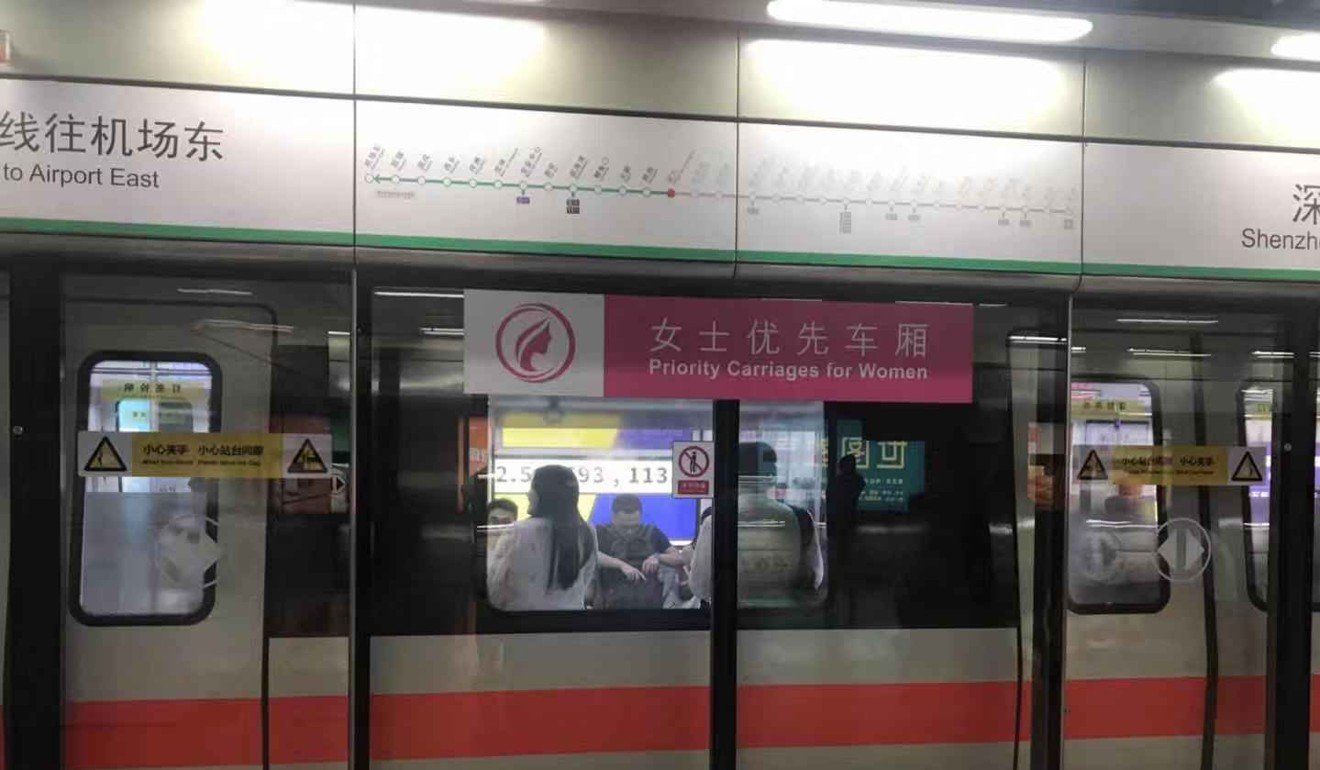
The carriages are decorated with pink stickers which say, in Chinese and English, “priority carriages for women” and while men are not barred from using them
they are encouraged to leave them to women passengers.
While the authorities did not specifically say they were intended to prevent sexual harassment – saying only that the scheme was meant to “give more care and respect to women” – the carriages followed a precedent set by Japan and Europe for that reason.
Shenzhen is currently considering an update to its priority carriages with an amended law designating them for people with disabilities and minors, as well as women, and only during rush hour. Other passengers who do not meet these criteria can be asked to leave by rail staff.
A priority carriage for women on the Shenzhen underground system. Photo: Phoebe Zhang
But in reality the restrictions on the priority carriages are seldom enforced and they have been used by men since their launch. Furthermore, feminists say the scheme is a form of segregation, rather than an attempt to solve the cause of the issue.
One reason the priority carriages have failed in their purpose could be the size of the crowds using public transport each day. According to government data, there are roughly 5 million passenger trips on the Shenzhen underground every day and 8 million in Guangzhou.
It is also hard for staff to enforce the regulation.
“When it first came out, subway staff vehemently advocated for women to use it, so many people did,” said Zhang Ying, a piano teacher in Guangzhou. Staff would hold loud speakers and gesture for women to get on the priority carriages. But now, everybody just treats it like an ordinary carriage, she said.
Zhang said she rarely uses the priority carriages because of the inconvenience of having to walk all the way to the end of the train.
Women call for convenience in all areas, but [the government] only wants to draw you a little corner to play in.Xiao Meili, Guangzhou-based feminist
Feminists have opposed the scheme from the start.
“The logic behind the scheme is wrong to begin with,” said Xiao Meili, a Guangzhou-based feminist. “When noticing the dangers women face in public spaces, women call for convenience in all areas, but [the government] only wants to draw you a little corner to play in, signalling they still will neglect you in most places.”
Although it may appear well-intentioned, Xiao said the scheme was restricting women’s space.
“Most of the sexual harassers and rapists are men, so wouldn’t it be more effective to put these offenders in a limited space?” she asked.
In a survey of 443 people conducted by a group of feminists in Shenzhen in 2017, 42 per cent of women said they had been harassed on public transport, compared with just 6 per cent of men.
Most of the interviewees said they were dissatisfied with the police response and 65 per cent said they thought police should be most responsible for handling sexual harassment in public.
Six ways Japanese women can deter gropers on trains
Xiao and others have repeatedly written to government representatives about sexual harassment on public transport. In 2016, Xiao’s feminist group received 40,000 yuan (US$5,650) in public donations – just enough to buy an advertisement slot.
For two years, the group tried to put up anti-harassment billboards in the Guangzhou and Shenzhen underground systems, but they were repeatedly blocked by the authorities who said the advertisements would cause panic.
But in 2018 Xiao’s group spotted advertisements in the subways in Beijing, Shanghai and Chengdu, some placed by news organisations and others by local governments. One advertisement in Chengdu, put up by rail officials, said: “There’s no groping hand here.”
Another, in Beijing, said: “Prevent sexual harassment, be vocal.”
Xiao said she was happy to see the changes, but described the current policy of updating the carriages in Shenzhen as an example of “lazy politics”.
There needed to be more than a pink bumper sticker on carriage windows, she said.
Instead, policymakers needed to think about the actual mechanisms of stopping harassment and how to handle culprits once they were caught.
“Women do not demand special care as if they are a soft and weak group,” Xiao said.
“They demand the safety they deserve and the right to travel conveniently.”








 CHINDIA ALERT: You'll be living in their world, very soon