Chindia Alert: You’ll be Living in their World Very Soon
aims to alert you to the threats and opportunities that China and India present. China and India require serious attention; case of ‘hidden dragon and crouching tiger’.
Without this attention, governments, businesses and, indeed, individuals may find themselves at a great disadvantage sooner rather than later.
The POSTs (front webpages) are mainly 'cuttings' from reliable sources, updated continuously.
The PAGEs (see Tabs, above) attempt to make the information more meaningful by putting some structure to the information we have researched and assembled since 2006.
BENGALURU (Reuters) – The Indian economy is likely to suffer its worst quarter since the mid-1990s, hit by the ongoing lockdown imposed to stem the spread of coronavirus, according to a Reuters poll, which predicted a mild and gradual recovery.
Over 2.6 million people tmsnrt.rs/3aIRuz7 have been infected by the coronavirus worldwide and more than 180,000 have died. Business and household lockdowns have disrupted supply chains globally, bringing growth to a halt.
The April 17-22 Reuters poll predicted the economy expanded at an annual pace of 3.0% last quarter but will shrink 5.2% in the three months ending in June, far weaker than expectations in a poll published last month for 4.0% and 2.0% growth, respectively.
The predicted contraction would be the first – under any gross domestic product calculation, which has changed a few times – since the mid-1990s, when official reporting for quarterly data began.
“The extended lockdown until early May adds further downside risk to our view of a 5% year-on-year GDP fall in the current quarter, the worst in the last few decades,” said Prakash Sakpal, Asia economist at ING.
“We don’t consider economic stimulus as strong enough to position the economy for a speedy recovery once the pandemic ends,” he said.
(Graphic: Reuters poll graphic on coronavirus impact on the Indian economy IMAGE link: here)
The Indian government announced a spending package of 1.7 trillion rupees in March to cushion the economy from the initial lockdown, which has been extended until May 3.
In an emergency meeting last week, the Reserve Bank of India cut its deposit rate again, after reducing it on March 27 and lowering the main policy rate by 75 basis points. It also announced another round of targeted long-term repo operations to ease liquidity.
But even with those measures, 40% of economists, or 13 of 32 – who provided quarterly figures – predicted an outright recession this year. Only one had expected a recession last month.
In the worst case, a smaller sample of respondents predicted, the economy would contract 9.3% in the current quarter. That compares with 0.5% growth in the previous poll’s worst-case forecast in late March, underscoring how rapidly the outlook has deteriorated.
The latest poll’s consensus view still shows the economy recovering again slowly in the July-September quarter, growing 0.8%, then 4.2% in October-December and 6.0% in the final quarter of the fiscal year, in early 2021.
But that compares with considerably more optimistic near-term forecasts of 3.3%, 5.0% and 5.6%, respectively, in the previous poll.
“A rebound in economic activity following the disruption is expected, but the low starting point of growth implies a gradual recovery,” said Upasana Chachra, chief India economist at Morgan Stanley.
“Indeed, before disruptions related to COVID-19, growth was slowing, with domestic issues of risk aversion in financial sector … (and) those concerns will likely stay after the COVID-19 disruptions have passed unless the policy response is much larger than expected,” she said.
The unemployment rate has tripled to 23.8% since the lockdown started on March 25, according to the Centre for Monitoring Indian Economy, a Mumbai-based research firm.
The Indian economy was now forecast to expand 1.5% in the fiscal year ending on March 31, 2021 – the weakest since 1991 and significantly lower than 3.6% predicted in late March. It probably grew 4.6% in the fiscal year that just ended.
Under a worst-case scenario, the median showed the economy shrinking 1.0% this fiscal year. That would be the first officially reported economic contraction for a 12-month period since GDP was reported to have contracted for calendar year 1979.
“Unless fiscal policy is also loosened aggressively alongside monetary policy, there is a big risk the drastic economic slowdown currently underway morphs into an annual contraction in output and that the recovery is hampered,” said Shilan Shah, senior India economist at Capital Economics.
All 37 economists who answered a separate question unanimously said the RBI would follow up with more easing, including lowering the repo and reverse repo rates and expanding the new long-term loans programme.
The RBI was expected to cut its repo rate by another 40 basis points to 4.00% by the end of this quarter. Already lowered twice over the past month by a cumulative 115 basis points, the reverse repo rate was forecast to be trimmed by another 25 points by end-June to 3.50%.
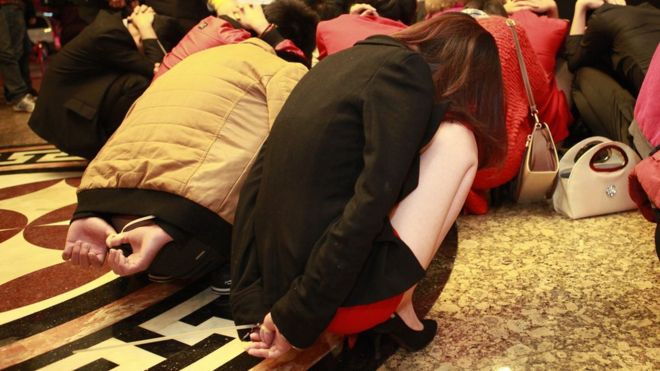
Image copyright AFPImage caption Past detainees claim they were forced to work making toys and household goods
China is to end a punishment system for prostitution that allowed police to hold sex workers and their clients in custody for up to two years at so-called education centres.
Detainees were forced to work, allegedly making toys and household goods.
The detention system will come to an end on 29 December. Those still in custody will be released, according to Xinhua, China’s state media.
Prostitution remains illegal in China.
It carries punishments of up to 15 days in detention and fines of up to 5,000 yuan (£546).
China’s state media claims the “custody and education” system has helped to maintain a “good social atmosphere and public order” since it was introduced more than 20 years ago.
It added that over time, the system has become less and less appropriate.
The report included interviews with 30 female sex workers from two cities.
It claimed detainees were unable to learn new skills during detention that could help them after their release. The report added that the detainees typically undertake manual labour.
It said: “All of the sex workers we interviewed returned to the sex trade immediately after release.”
A 2013 report by Human Rights Watch interviewed 140 sex workers, clients, police and specialists and found that many sex workers were beaten by police in an attempt to coerce confessions.
One worker claimed she had been deceived into signing a confession.
“The police told me it was fine, all I needed to do was sign my name and they would release me after four or five days,” she said.
“Instead, I was locked up in [a] Custody and Education centre for six months.”
Shen Tingting, director of Asia Catalyst, said the move to abolish forced labour detention centres is positive but only a small step towards safeguarding the rights of sex workers.
“Chinese law and policies focus on prohibition and cracking down on sex work, rather than providing a framework to ensure the health and safety of sex work as a profession,” she said.
In 2013, China announced it had abolished its system of “re-education through labour camps” for petty criminals.
That decision came after several high-profile miscarriages of justice, including a case where a mother was sent to a labour camp after demanding justice for her daughter who had been raped.
However, the abolition did not extend to the “custody and education” system affecting sex workers and their clients.
China isn’t totally abandoning the idea of re-education. Authorities in the country claim a number of camps in the north-west region of Xinjiang are voluntary education camps that help to combat extremism.
However rights groups claim many Chinese Uighur people have been rounded up into the camps and made to criticise or denounce their faith.



 CHINDIA ALERT: You'll be living in their world, very soon
