Chindia Alert: You’ll be Living in their World Very Soon
aims to alert you to the threats and opportunities that China and India present. China and India require serious attention; case of ‘hidden dragon and crouching tiger’.
Without this attention, governments, businesses and, indeed, individuals may find themselves at a great disadvantage sooner rather than later.
The POSTs (front webpages) are mainly 'cuttings' from reliable sources, updated continuously.
The PAGEs (see Tabs, above) attempt to make the information more meaningful by putting some structure to the information we have researched and assembled since 2006.
BEIJING, May 2 (Xinhua) — The number of China-Europe freight trains hit a record monthly high of 979 in April, up 46 percent year on year, the China State Railway Group said Saturday.
A total of 88,000 TEUs (20-foot equivalent units) of cargo were transported by the trains, up 50 percent from a year earlier.
From January to April, a total of 2,920 China-Europe freight trains transported cargo of 262,000 TEUs, up 24 percent and 27 percent from a year earlier, respectively.
The number of departing trains rose 36 percent year on year to 1,638 during the first four months, while the number of returning trains climbed 11 percent to 1,282.
China-Europe cargo train services have become an important logistics channel to ensure smooth trade as air, sea and road transportation have been severely affected by the novel coronavirus epidemic, the company said.
The freight trains have also been playing a crucial role in helping with the fight against the pandemic in Europe as massive quantities of medical supplies were sent by them.
From March 21 to the end of April, anti-epidemic supplies totaling 660,000 items and weighing 3,142 tonnes were sent by the freight trains to European countries such as Italy, Germany, Spain and the Czech Republic.
SEOUL/BEIJING (Reuters) – China has allowed 200 employees from South Korea’s Samsung Electronics Co Ltd (005930.KS) to enter the country to work on an expansion of the firm’s NAND memory chip factory, the company said on Wednesday.
The move came after China said on Tuesday that it was in talks with some countries to establish fast-track procedures to allow travel by business and technical personnel to ensure the smooth operation of global supply chains.
China said it has reached a consensus on such an arrangement with South Korea, without elaborating on the terms, including whether individuals entering China will be subject to quarantine.
China, where the virus first emerged late last year, blocked entry last month for nearly all foreigners in an effort to curb risks of coronavirus infections posed by travellers from overseas. After bringing the local spread under control with tough containment measures, it is trying to restart its economic engines after weeks of near paralysis.
A chartered China Air Ltd (601111.SS) plane flew in the Samsung Electronics employees on Wednesday, a company spokeswoman said.
Samsung said its employees will follow the local government’s policy upon arrival, without elaborating.
Shaanxi province, where Samsung’s NAND memory chip plant is located, requires people travelling from overseas to undergo a 14-day quarantine, according to South Korea’s foreign ministry.
“Samsung employees will not be exempted from the 14-day quarantine rule imposed by the Shaanxi province. They will get coronavirus tests at the airport upon arrival and will be transported to a local hotel designated by Chinese authorities,” an official at the Consulate General of South Korea in Xi’an told Reuters.
Samsung Electronics in December increased investment at its chip factory in China by $8 billion to boost production of NAND flash memory chips.
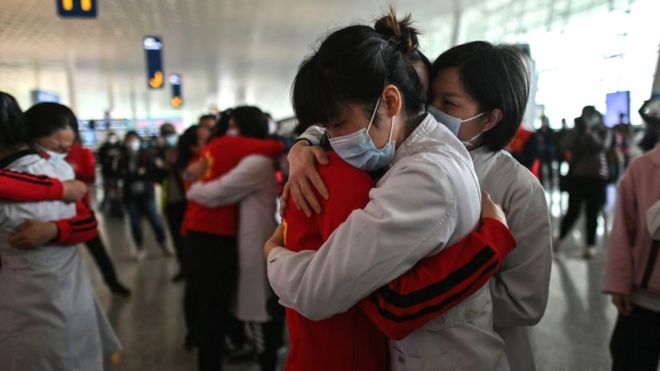
Image copyright GETTY IMAGESImage caption The Chinese city of Wuhan recently lifted its strict quarantine measures
The Chinese city of Wuhan, where the coronavirus originated last year, has raised its official Covid-19 death toll by 50%, adding 1,290 fatalities.
Wuhan officials attributed the new figure to updated reporting and deaths outside hospitals. China has insisted there was no cover-up.
It has been accused of downplaying the severity of its virus outbreak.
Wuhan’s 11 million residents spent months in strict lockdown conditions, which have only recently been eased.
The latest official figures bring the death toll in the city in China’s central Hubei province to 3,869, increasing the national total to more than 4,600.
China has confirmed nearly 84,000 coronavirus infections, the seventh-highest globally, according to Johns Hopkins University data.
What’s China’s explanation for the rise in deaths?
In a statement released on Friday, officials in Wuhan said the revised figures were the result of new data received from multiple sources, including records kept by funeral homes and prisons.
Deaths linked to the virus outside hospitals, such as people who died at home, had not previously been recorded.
Media caption Learn how Wuhan dealt with the lockdown
The “statistical verification” followed efforts by authorities to “ensure that information on the city’s Covid-19 epidemic is open, transparent and the data [is] accurate”, the statement said.
It added that health systems were initially overwhelmed and cases were “mistakenly reported” – in some instances counted more than once and in others missed entirely.
A shortage of testing capacity in the early stages meant that many infected patients were not accounted for, it said.
A spokesman for China’s National Health Commission, Mi Feng, said the new death count came from a “comprehensive review” of epidemic data.
In its daily news conference, the foreign ministry said accusations of a cover-up, which have been made most stridently on the world stage by US President Donald Trump, were unsubstantiated. “We’ll never allow any concealment,” a spokesman said.
Why are there concerns over China’s figures?
Friday’s revised figures come amid growing international concern that deaths in China have been under-reported. Questions have also been raised about Beijing’s handling of the epidemic, particularly in its early stages.
In December 2019, Chinese authorities launched an investigation into a mysterious viral pneumonia after cases began circulating in Wuhan.
China reported the cases to the World Health Organization (WHO), the UN’s global health agency, on 31 December.
But WHO experts were only allowed to visit China and investigate the outbreak on 10 February, by which time the country had more than 40,000 cases.
The mayor of Wuhan has previously admitted there was a lack of action between the start of January – when about 100 cases had been confirmed – and 23 January, when city-wide restrictions were enacted.
Around that time, a doctor who tried to warn his colleagues about an outbreak of a Sars-like virus was silenced by the authorities. Dr Li Wenliang later died from Covid-19.
Wuhan’s death toll increase of almost exactly 50% has left some analysts wondering if this is all a bit too neat.
For months questions have been asked about the veracity of China’s official coronavirus statistics.
The inference has been that some Chinese officials may have deliberately under-reported deaths and infections to give the impression that cities and towns were successfully managing the emergency.
If that was the case, Chinese officials were not to know just how bad this crisis would get in other countries, making its own figures now seem implausibly small.
The authorities in Wuhan, where the first cluster of this disease was reported, said there had been no deliberate misrepresentation of data, rather that a stabilisation in the emergency had allowed them time to revisit the reported cases and to add any previously missed.
That the new death toll was released at the same time as a press conference announcing a total collapse in China’s economic growth figures has led some to wonder whether this was a deliberate attempt to bury one or other of these stories.
Then again, it could also be a complete coincidence.
China has been pushing back against US suggestions that the coronavirus came from a laboratory studying infectious diseases in Wuhan, the BBC’s Barbara Plett Usher in Washington DC reports.
US President Donald Trump and some of his officials have been flirting with the outlier theory in the midst of a propaganda war with China over the origin and handling of the pandemic, our correspondent says.
Mr Trump this week halted funding for the World Health Organization (WHO), accusing it of making deadly mistakes and overly trusting China.
“Do you really believe those numbers in this vast country called China, and that they have a certain number of cases and a certain number of deaths; does anybody really believe that?” Mr Trump said at the White House on Wednesday.
On Thursday, UK Foreign Secretary Dominic Raab said: “We’ll have to ask the hard questions about how [coronavirus] came about and how it couldn’t have been stopped earlier.”
But China has also been praised for its handling of the crisis and the unprecedented restrictions that it instituted to slow the spread of the virus.
Photo taken on April 4, 2020 shows a press conference of the joint prevention and control mechanism of the State Council in Beijing, capital of China. Chinese officials said Saturday that the country can hold firm its “rice bowl” despite the novel coronavirus impact, with ample grain reserves and measures to boost production. (Xinhua/Pan Xu)
BEIJING, April 4 (Xinhua) — Chinese officials said Saturday that the country can hold firm its “rice bowl” despite the novel coronavirus impact, with ample grain reserves and measures to boost production.
The country has recorded a long streak of bumper years, with grain output reaching a record of 663.85 million tonnes last year. With measures to boost grain production “we have the confidence and determination to hold firm our ‘rice bowl,'” Pan Wenbo, an official at the Ministry of Agriculture and Rural Affairs, told a press conference.
The bumper harvests supported the country’s efforts to boost social and economic development as well as fight the novel coronavirus outbreak, Pan said in response to questions that whether some countries’ grain export ban would strain China’s grain supply.
Pan said China has unveiled a series of “unconventional measures” to stabilize grain production, including setting region-specific grain plantation targets, offering subsidies for farmers and raising minimum prices for state procurement of rice, which secured a good start this year and would ensure stable grain production for the whole year.
The country’s grain reserves have run at a high level, with those of rice and wheat being sufficient to meet the country’s consumer market demand for one year, said Qin Yuyun, an official with the National Food and Strategic Reserves Administration.
Qin said the administration will continue efforts to ensure abundant supply and stable prices.
CHANGSHA, March 26 (Xinhua) — Du Xu, a postgraduate from Central South University of Forestry and Technology (CSUFT), turned on his laptop and prepared for his dissertation pre-defense online.
While at home in eastern China’s Shandong Province, Du presented his dissertation to five professors for the first time through the remote video connection.
“Half a month ago, the university informed us to prepare an online pre-defense, find out the tutors’ opinions on the first draft and then revise it,” the 26-year-old said. Although he had experience with an opening thesis defense and other face-to-face forms, he was not familiar with the process of online defense, which made him feel nervous.
According to the CSUFT, all the postgraduate dissertations must be pre-defended before being submitted for examination to ensure the quality. The graduate school of the university adjusted the arrangement amid the epidemic. Online defense started on Feb. 10 to ensure that the graduate students could graduate on time.
“Since our defense is open and anyone can click the link to join, there were 55 students online when I spoke,” Du said. The open online defense can help us check missing key points and learn from each other. Some students also recorded the defense process to follow up on the comments of the tutor to further modify their dissertation, according to Du.
The university said the pre-defense would be submitted via the Internet, and the degree management office has set up an online platform for it.
Feng Jiajin, a graduate of the Hunan Railway Professional Technology College (HRPTC), who works as an intern at the Nanchang Railway Bureau in eastern China’s Jiangxi Province, also needs to demonstrate his graduation project through an online defense.
On March 18, Feng launched a video conference for his final project defense in the office via software on his mobile phone during his lunch break. More than 10 teachers from his college attended the meeting.
In front of the camera, Feng talked about his graduation project “Ultrasonic Ranging and Reversing System” and displayed the slides on the screen with explanations.
When displaying his final product, he showed the results of the graduation project in different situations.
“Vocational schools focus on students’ practical ability. Before the formal defense, the instructor first reviewed the students’ graduation projects and the statements. Only when the work is qualified are the students are allowed to participate in the defense and display,” said Xiong Yi with HRPTC.
According to the college, members of the dissertation defense committee ask questions about the relevant theoretical knowledge and the design methods, which the students should answer one by one. Finally, the members of the defense committee discuss the defense process and results. The results will be announced after a secret ballot. The entire process of the dissertation defense will be recorded, screenshot and saved as the defense record.
“The outbreak of coronavirus won’t affect the students’ graduation and seeking employment. Before the start of the new semester, the university will use online defense to ensure their graduation on time,” said Zhang Ying, vice president of HRPTC, adding that in March, the school will have more than 600 graduates participate in online defense.








 CHINDIA ALERT: You'll be living in their world, very soon